1
College Of Agriculture
Kotwa Azamgarh
NAME : SAURABH TRIPATHI ,SANTOSH
KUMAR, RAVI PARAKASH, SANJAY KUMAR,
SACHIN, ROHIT ,SACHIN verma
CLASS: BSc Ag 2nd year session:
TOPIC:
SUBMITTED TO: DR. SANDEEP PANDEY
2020-2021
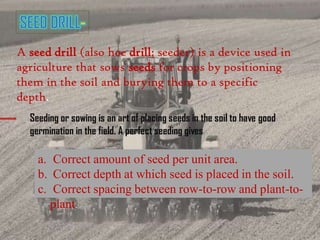
A seed drill (also hoe drill; seeder) is a device used in
agriculture that sows seeds for crops by positioning
them in the soil and burying them to a specific
depth.
Seeding or sowing is an art of placing seeds in the soil to have good
germination in the field. A perfect seeding gives
a. Correct amount of seed per unit area.
b. Correct depth at which seed is placed in the soil.
c. Correct spacing between row-to-row and plant-to-
plant.
COMPONENTS OF SEED DRILL
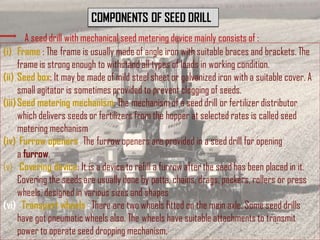
A seed drill with mechanical seed metering device mainly consists of :
(i) Frame : The frame is usually made of angle iron with suitable braces and brackets. The
frame is strong enough to withstand all types of loads in working condition.
(ii) Seed box: It may be made of mild steel sheet or galvanized iron with a suitable cover. A
small agitator is sometimes provided to prevent clogging of seeds.
(iii)Seed metering mechanism: The mechanism of a seed drill or fertilizer distributor
which delivers seeds or fertilizers from the hopper at selected rates is called seed
metering mechanism
(iv) Furrow openers: The furrow openers are provided in a seed drill for opening
a furrow.
(v) Covering device: It is a device to refill a furrow after the seed has been placed in it.
Covering the seeds are usually done by patta, chains, drags, packers, rollers or press
wheels, designed in various sizes and shapes
(vi) Transport wheels.: There are two wheels fitted on the main axle. Some seed drills
have got pneumatic wheels also. The wheels have suitable attachments to transmit
power to operate seed dropping mechanism.
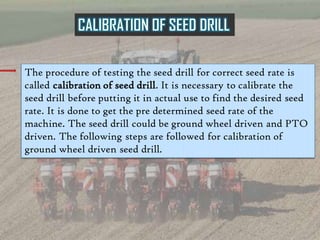
The procedure of testing the seed drill for correct seed rate is
called calibration of seed drill. It is necessary to calibrate the
seed drill before putting it in actual use to find the desired seed
rate. It is done to get the pre determined seed rate of the
machine. The seed drill could be ground wheel driven and PTO
driven. The following steps are followed for calibration of
ground wheel driven seed drill.
i. Determine the nominal width (W) of seed drill
W = M x S,
Where,
M = Number of furrow openers, and
S = Spacing between the openers, m
ii Find the length of the strip (L) having nominal
width (W).
Suppose we have 1 ha of area
We know 1 ha = 10000 m2
L*W= 10000
L = 10000/W, meter
iii. Determine the number of revolutions (N) of the
ground wheel of the seed drill required to cover the
length of the strip (L)
L = P x D x N = 10000/W
N = 10000/P x D x W revolutions per minute
IV. Jack the seed drill so that the ground wheels
turn freely. Make a mark on the drive wheel and a
corresponding mark at a convenient place on the
body of the drill to help in counting the revolutions of
the ground wheel
V. Fill the selected seed in the seed hopper.
Place a container under each boot for collecting
the seeds dropped from the hopper
VI. Set the seed rate control adjustment for maximum position and
mark this position on the control for reference.
VII. Engage the clutch and rotate the ground wheel for N = 10000/P x
D x W, revolutions per minute.
VIII. Weigh the quantity of seed collected in the container and record
the observation.
IX. Calculate the seed rate in kg/ha.
X. If the calculated seed rate is higher or lower than the desired rate
of selected crop, repeat the process by adjusting the seed rate control
adjustment till the desired seed rate is obtained.
(a) Measure the ground wheel dia. ‘cm’
(b) Measure the number of furrow openers
(c) Measure distance between two openers ‘cm’
(d) Perimeter of ground wheel P = π D
(e) Width of implement W = 2 m
Diameter D = 40 cm
Give one revolution to the ground wheel
Area covered/revolution of ground wheel
= πDW
= 3.14 x 2 x 0.40
= 2.5 m2
Recommended seed of wheat = 40 Kg/acre or 100 Kg/ha.
4000 m2 - 40 Kg
2.5 m2 = 40 X 2.5 X 1000
4000
= 25 gm.
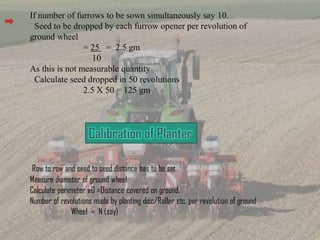
If number of furrows to be sown simultaneously say 10.
Seed to be dropped by each furrow opener per revolution of
ground wheel
= 25 = 2.5 gm
10
As this is not measurable quantity
Calculate seed dropped in 50 revolutions
2.5 X 50 = 125 gm.
Row to row and seed to seed distance has to be set
Measure diameter of ground wheel
Calculate perimeter πD =Distance covered on ground.
Number of revolutions made by planting disc/Roller etc. per revolution of ground
Wheel = N (say)
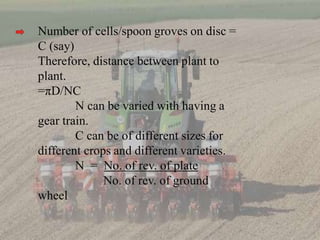
Number of cells/spoon groves on disc =
C (say)
Therefore, distance between plant to
plant.
=πD/NC
N can be varied with having a
gear train.
C can be of different sizes for
different crops and different varieties.
N = No. of rev. of plate
No. of rev. of ground
wheel
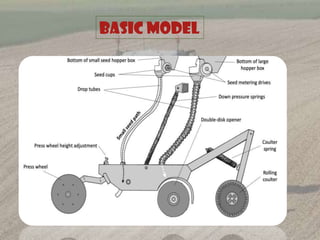
BASIC MODEL
Seed drill caliberation

Seed drill caliberation

  • 1.
  • 2.
    NAME : SAURABHTRIPATHI ,SANTOSH KUMAR, RAVI PARAKASH, SANJAY KUMAR, SACHIN, ROHIT ,SACHIN verma CLASS: BSc Ag 2nd year session: TOPIC: SUBMITTED TO: DR. SANDEEP PANDEY 2020-2021
  • 3.
    A seed drill(also hoe drill; seeder) is a device used in agriculture that sows seeds for crops by positioning them in the soil and burying them to a specific depth. Seeding or sowing is an art of placing seeds in the soil to have good germination in the field. A perfect seeding gives a. Correct amount of seed per unit area. b. Correct depth at which seed is placed in the soil. c. Correct spacing between row-to-row and plant-to- plant.
  • 4.
    COMPONENTS OF SEEDDRILL A seed drill with mechanical seed metering device mainly consists of : (i) Frame : The frame is usually made of angle iron with suitable braces and brackets. The frame is strong enough to withstand all types of loads in working condition. (ii) Seed box: It may be made of mild steel sheet or galvanized iron with a suitable cover. A small agitator is sometimes provided to prevent clogging of seeds. (iii)Seed metering mechanism: The mechanism of a seed drill or fertilizer distributor which delivers seeds or fertilizers from the hopper at selected rates is called seed metering mechanism (iv) Furrow openers: The furrow openers are provided in a seed drill for opening a furrow. (v) Covering device: It is a device to refill a furrow after the seed has been placed in it. Covering the seeds are usually done by patta, chains, drags, packers, rollers or press wheels, designed in various sizes and shapes (vi) Transport wheels.: There are two wheels fitted on the main axle. Some seed drills have got pneumatic wheels also. The wheels have suitable attachments to transmit power to operate seed dropping mechanism.
  • 5.
    The procedure oftesting the seed drill for correct seed rate is called calibration of seed drill. It is necessary to calibrate the seed drill before putting it in actual use to find the desired seed rate. It is done to get the pre determined seed rate of the machine. The seed drill could be ground wheel driven and PTO driven. The following steps are followed for calibration of ground wheel driven seed drill.
  • 6.
    i. Determine thenominal width (W) of seed drill W = M x S, Where, M = Number of furrow openers, and S = Spacing between the openers, m ii Find the length of the strip (L) having nominal width (W). Suppose we have 1 ha of area We know 1 ha = 10000 m2 L*W= 10000 L = 10000/W, meter
  • 7.
    iii. Determine thenumber of revolutions (N) of the ground wheel of the seed drill required to cover the length of the strip (L) L = P x D x N = 10000/W N = 10000/P x D x W revolutions per minute IV. Jack the seed drill so that the ground wheels turn freely. Make a mark on the drive wheel and a corresponding mark at a convenient place on the body of the drill to help in counting the revolutions of the ground wheel V. Fill the selected seed in the seed hopper. Place a container under each boot for collecting the seeds dropped from the hopper
  • 8.
    VI. Set theseed rate control adjustment for maximum position and mark this position on the control for reference. VII. Engage the clutch and rotate the ground wheel for N = 10000/P x D x W, revolutions per minute. VIII. Weigh the quantity of seed collected in the container and record the observation. IX. Calculate the seed rate in kg/ha. X. If the calculated seed rate is higher or lower than the desired rate of selected crop, repeat the process by adjusting the seed rate control adjustment till the desired seed rate is obtained.
  • 9.
    (a) Measure theground wheel dia. ‘cm’ (b) Measure the number of furrow openers (c) Measure distance between two openers ‘cm’ (d) Perimeter of ground wheel P = π D (e) Width of implement W = 2 m Diameter D = 40 cm Give one revolution to the ground wheel Area covered/revolution of ground wheel = πDW = 3.14 x 2 x 0.40 = 2.5 m2 Recommended seed of wheat = 40 Kg/acre or 100 Kg/ha. 4000 m2 - 40 Kg 2.5 m2 = 40 X 2.5 X 1000 4000 = 25 gm.
  • 10.
    If number offurrows to be sown simultaneously say 10. Seed to be dropped by each furrow opener per revolution of ground wheel = 25 = 2.5 gm 10 As this is not measurable quantity Calculate seed dropped in 50 revolutions 2.5 X 50 = 125 gm. Row to row and seed to seed distance has to be set Measure diameter of ground wheel Calculate perimeter πD =Distance covered on ground. Number of revolutions made by planting disc/Roller etc. per revolution of ground Wheel = N (say)
  • 11.
    Number of cells/spoongroves on disc = C (say) Therefore, distance between plant to plant. =πD/NC N can be varied with having a gear train. C can be of different sizes for different crops and different varieties. N = No. of rev. of plate No. of rev. of ground wheel
  • 12.