UNIT 1. HIGHWAY PLANNING AND
             ALIGNMENT 8
•   History of road development in India.

•   Classification of highways.

•   Institutions for Highway planning, design and implementation at
    different levels

•   Factors influencing highway alignment

•   Engineering surveys for alignment, objectives, conventional
    and modern methods.
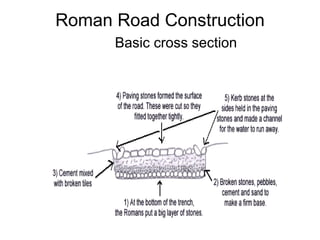
Roman Road Construction
      Basic cross section
History of Road Development in
               India
• Ancient Period (3500 BC)

• Mughul Period (15th Century)

• British Period (17th & 18th Century)

• Free India (1950 onwards)
Types of Ancient Indian Roads
• Indus Valley Civilization :
      Roads with brick drains on both sides.
• Mauryan rule in the 4th century constructed
      Rajpath (high roads)
      Banikpaths (merchant roads).
• Ashoka Regime:
     Road networks with horticulture and rest houses at 4.8 – 6.4km along the roads.

• Mughul Period
     Trunk roads between Northwest to Eastern part and also linking coastal and
     central part of India
• British Period
      Trunk roads, bridges, PWD was formed, construction of Grand Trunk Road
Indian Roads
• India has a large road network of over 3.314
  million kilometers of roadways (2.1 million
  miles), making it 3rd largest road network in the
  world.

• At 0.66 km of highway per square kilometer of
  land the density of India’s highway network is
  higher than that of the United States (0.65) and
  far higher than that of China's (0.16) or Brazil's
  (0.20).
Impact of Transportation
• Economic Development

• Social Development

• Spatial Development

• Cultural Development

• Political Development
Institution for Highway Planning, Design and Implementation at Different Levels


   •   Jayakar Committee (1927)
   •   Central Road Fund (1929)
   •   Indian Roads Congress (IRC), 1934
   •   Central Road Research Institute (CRRI), 1950
   •   National Highway Act, 1956
   •   National Highway Authority of India (NHAI),1995
   •   National highway act ( 1956 )
   •   Second twenty year road plan ( 1961 )
   •   Highway Research board ( 1973 )
   •   National Transport Policy committee ( 1978 )
   •   Third twenty year road plan ( 1981 )
Jayakar Committee,1927
• Road development should be made a national interest
  since the provincial and local govt do not have financial
  and technical capacity for road development.
• Levy extra tax on petrol from road users to create the
  road development fund.
• To establish a semi-official ,technical institution to pool
  technical knowledge, sharing of ideas and to act as an
  advisory body.
• To create a national level institution to carry research ,
  development works and consultation.
Central Road Fund , 1929
              CRF Act , 2000

Distribution of 100% cess on petrol as follows:
57.5% for NH
                      MORTH
30% for SH
12.5% for safety works on rail-Road crossing.

50% cess on diesel for Rural Road development
Indian Roads Congress, 1934
• To provide national forum for regular pooling of
  experience and ideas on matters related to
  construction and maintenance of highways.

• To recommend standard specifications.

• To provide a platform for expression of professional
  opinion on matters relating to roads and road
  transport.
CRRI
A constituent of Council of Scientific and Industrial Research (CSIR)

    engaged in carrying out research and development projects.

    design, construction and maintenance of roads and runways,
     traffic and transportation planning of mega and medium cities,
     management of roads in different terrains,

      Improvement of marginal materials,
      Utilization of industrial waste in road construction,
      Landslide control,
      Ground improvements environmental pollution,

    Road traffic safety,

    Service life assessment and rehabilitation of highway & railway
     bridges.
Ministry of Road Transport & Highways

• Planning, development and maintenance of
  National Highways in the country.
• Extends technical and financial support to State
  Governments for the development of state roads
  and the roads of inter-state connectivity and
  economic importance.
• Evolves standard specifications for roads and
  bridges in the country.
• Serves as a repository of technical knowledge on
  roads and bridges.
Classification of Highways
Depending on weather

All weather roads
 Fair weather roads
          National highway act ( 1956 )
Depending the type of Carriage way
 Paved roads
 Unpaved roads

 Depending upon the pavement surface
 Surfaced roads
 Un surfaced roads
Classification of Highways
Based on the Traffic Volume
 Heavy
 Medium
 Light

Based on Load or Tonnage
 Class 1 or Class 2 etc or Class A , B etc Tonnes per day

Based on location and function ( Nagpur road plan )
 NH
 SH
MDR
 ODR
 VR
Based on modified system of
       Highways classification
• Primary
    Expressways
    National Highways

• Secondary
    SH
    MDR

• Tertiary
    ODR
    VR
Urban Road Classification
•   ARTERIAL ROADS
•   SUB ARTERIAL
•   COLECTOR
•   LOCAL STREET
•   CUL-DE-SAC
•   PATHWAY
•   DRIVEWAY
Road Patterns
•   Rectangular or Block patterns
•   Radial or Star block pattern
•   Radial or Star Circular pattern
•   Radial or Star grid pattern
•   Hexagonal Pattern
•   Minimum travel Pattern
Classification of Roadways
• Expressways                 200 Km

• National Highways           70,548 Km

• State Highways              1,31,899 Km

• Major District Roads    4,67,763 Km

• Rural and Other Roads       26,50,000 Km
Expressways
•   Heavy traffic at high speed (120km/hr)
•   Land Width (90m)
•   Full access control
•   Connects major points of traffic generation
•   No slow moving traffic allowed
•   No loading, unloading, parking.
National Highways
• India has a huge network of national highways.
• The national highways have a total length of 70,548 kms.
  Indian highways cover 2% of the total road network of
  India and carry 40% of the total traffic.
• The entire highway network of India is managed by the
  National Highway Authority of India which is responsible
  for development and maintenance of highways.

  The longest highway in India is NH7 which stretches
  from Varansi in Uttar Pradesh to Kanyakumari in the
  southern most point of Indian mainland.

• The shortest highway is NH47A which stretches from
  Ernakulam to Kochi and covers total length of 4 Kms.
State Highways

• They are the arterial roads of a state,
  connecting up with the national highways
  of adjacent states, district head quarters
  and important cities within the state.

• Total length of all SH in the country is
  1,37,119 Kms.
Major District Roads

• Important roads with in a district serving
  areas of production and markets ,
  connecting those with each other or with
  the major highways.

• India has a total of 4,70,000 kms of MDR.
Other district roads

• Roads serving rural areas of production
  and providing them with outlet to market
  centers or other important roads like MDR
  or SH.
Village roads
• They are roads connecting villages or
  group of villages with each other or to the
  nearest road of a higher category like
  ODR or MDR.

• India has 26,50,000 kms of ODR+VR out
  of the total 33,15,231 kms of all type of
  roads.
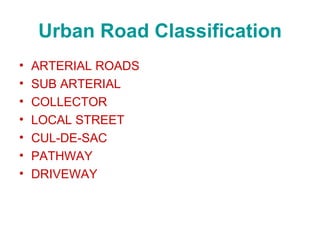
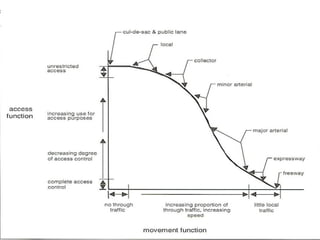
Urban Road Classification
•   ARTERIAL ROADS
•   SUB ARTERIAL
•   COLLECTOR
•   LOCAL STREET
•   CUL-DE-SAC
•   PATHWAY
•   DRIVEWAY
ARTERIAL
• No frontage access, no standing vehicle,
  very little cross traffic.
• Design Speed : 80km/hr
• Land width       : 50 – 60m
• Spacing 1.5km in CBD & 8km or more in
  sparsely developed areas.
• Divided roads with full or partial parking
• Pedestrian allowed to walk only at
  intersection
SUB ARTERIAL

•   Bus stops but no standing vehicle.
•   Less mobility than arterial.
•   Spacing for CBD : 0.5km
•   Sub-urban fringes : 3.5km
•   Design speed           : 60 km/hr
•   Land width         : 30 – 40 m
Collector Street
• Collects and distributes traffic from local
  streets
• Provides access to arterial roads
• Located in residential, business and
  industrial areas.
• Full access allowed.
• Parking permitted.
• Design speed : 50km/hr
• Land Width : 20-30m
Local Street
• Design Speed : 30km/hr.
• Land Width      : 10 – 20m.
• Primary access to residence, business or
  other abutting property
• Less volume of traffic at slow speed
• Origin and termination of trips.
• Unrestricted parking, pedestrian
  movements. (with frontage access,
  parked vehicle, bus stops and no waiting
  restrictions)
CUL–DE- SAC
• Dead End Street with only one entry
  access for entry and exit.
• Recommended in Residential areas
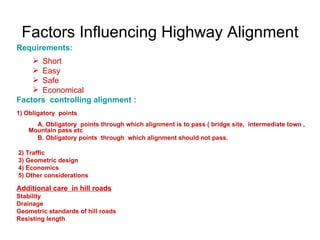
Factors Influencing Highway Alignment
Requirements:
     Short
     Easy
     Safe
     Economical
Factors controlling alignment :
1) Obligatory points
     A. Obligatory points through which alignment is to pass ( bridge site, intermediate town ,
   Mountain pass etc
     B. Obligatory points through which alignment should not pass.

2) Traffic
3) Geometric design
4) Economics
5) Other considerations

Additional care in hill roads
Stability
Drainage
Geometric standards of hill roads
Resisting length
Factors governing alignment
• Obligatory points
   – The location should avoid obstructions such as places of
     cemeteries, archeological, historical monument, public facilities
     like schools and hospitals, utility services.

• Geometric design features
   – Facilitate easy grade and curvature
   – Enable ruling gradient in most sections
   – Void sudden changes in sight distance, especially near
     crossings
   – Avoid sharp horizontal curves
   – Avoid road intersections near bend or at the top or bottom of a
     hill
Factors governing alignment
• Precautions at river and railway crossings
  – Bridges should be preferably be located at
    right angles to the river flow, not located on a
    horizontal curve
  – Crossing railway lines should avoid
    intersections at gradient, frequent crossing
    and recrossing
Factors governing alignment
• Topographical control points
   – The alignment, where possible should avoid passing through
        •   Marshy and low lying land with poor drainage
        •   Flood prone areas
        •   Unstable hilly features
        •   Avalanche prone areas
   –   Flat terrain-below 3%
   –   Rolling terrain -3 to 25%
   –   Mountainous terrain – above 25%
   –   A location on high ground should be preferred rather than valley
       to avoid cross drainage works
Factors governing alignment
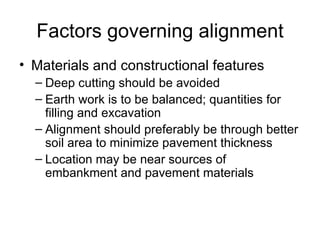
• Materials and constructional features
  – Deep cutting should be avoided
  – Earth work is to be balanced; quantities for
    filling and excavation
  – Alignment should preferably be through better
    soil area to minimize pavement thickness
  – Location may be near sources of
    embankment and pavement materials
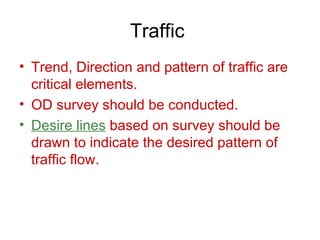
Traffic
• Trend, Direction and pattern of traffic are
  critical elements.
• OD survey should be conducted.
• Desire lines based on survey should be
  drawn to indicate the desired pattern of
  traffic flow.
ECONOMIC FACTORS
•   Capital cost
•   Maintenance Cost
•   Operational cost
•   Road User Cost
•   Embankment and deep cuttings cost.
Other Considerations
• Engineering feasibility

• Environmental consideration

• Social consideration

• Political Acceptability

• Monotony.
Engineering Surveys for Highway locations

 Provisional alignment Identification
  ( Map study)

 Reconnaissance survey

 Preliminary survey

 Final location to determine center line
  and detailed survey
Drawing and Report

1) Key map
2) Index map
3) Preliminary survey plans
4) Detailed plan and longitudinal section
5) Detailed cross section
6) Land acquisition plans
7) Drawings of cross drainage and other retaining
   structures
8) Drawings of road intersections
9) Land plans showing quarries etc
SURVEY DATA COLLECTION
•   Natural and man made features.
•   Proposed Geometric Design elements.
•   Number of cross drainage structures.
•   Soil characteristics
•   Source of construction materials.
•   Geological formation, type of rocks.
•   Drainage
MAP STUDY
• Base Map preparation
   Topographical map (SoI)
     Scale -1: 2,50,000
              1: 50,000
            1: 25,000
• Shows man made and natural features and
  contour lines at 15 or 30m interval.
• Shows possible alignments with obligatory
  points and minimum number of cross
  drainage structures.
RECONNAISSANCE SURVEY
•   Map updating – to confirm features indicated on map.

•   Checking for:
      Number of cross drainage structures.
      High Flood Level (HFL)
      Confirming Length and value of gradient to IRC standards.
      Soil Characteristics.
      Geological features.
      Proximity to source of construction materials- quarries, water
       sources.

•   Prepare a report on merits and demerits and profile map of scale
    1:50,000.
PRELIMINARY SURVEY
•   Base Plan                              Hz        Vr
        Built up area/hilly terrain      1:1000    1:100
        Plain and rolling terrain        1:2500    1:250

•   Establish center line
•   Incorporation of natural and man made features
•   Longitudinal and cross sectional profile (Levelling).
         Plain Terrain` : 100 – 200m
         Rolling Terrain : 50m
         Hilly Terrain     : 30m

•   Other studies
        Drainage, Hydrological, soil, Traffic and Materials.

•   Finalisation of the best alignment
         Comparative analysis.
         Choose best alignment among alternatives.
         Design geometric elements.
DETAILED SURVEY FOR FINAL
             LOCATION
•   Transferring the alignment on to ground.

•   Detail Survey – levelling work for longitudinal and transverse
    direction.

•   Intervals for cross sectional levelling
          Plain          50 – 100m
          Rolling        50 – 75m
          Built up       50m
          Hilly          20m
•   Soil Profile
Alignment for hill roads
• Minimum hair pin bends.
• Bends should be located on stable and flat
  slopes.
• Cross section for hair pin bends should be
  at intervals of 20-25m.
• Avoid bends in valleys.
• Survey for a width of ;
     15 m on either side of centre line in straight
      alignment
     30m on sharp curves.
MODERN SURVEY METHODS
 Provisional alignment Identification ( Map
  study)

 Reconnaissance survey
 Hand held GPS giving 3D positions to an
  accuracy of 10-20m .
 Preliminary Survey
      Mapping of topography and relief
      Use of aerial Photos
      Airborne Laser Terain Mapping

6) Final location and detailed survey.
Modern Equipments for
            Surveying
•   EDM – Electronic Distance Measurement
•   Auto level.
•   Digital level.
•   Total station.
•   GPS – global positioning system.
DATA FROM AERIAL SURVEY
• Mosaic for longitudinal and lateral
  overlaps.
• Control points
• Examination of photos for spot levels
  and contour lines
• Topo details
• Photo interpretation for geological
  features, soil and drainage for the study
  area
GEOMETRIC DESIGN
• Elements of design:
  – Sight distance
     • The length of road ahead visible to drivers
         – Stopping sight distance
         – Passing sight distance
  – Horizontal alignment
     • Super elevation rates (0.1 for rural areas, 0.06 for urban)
     • Minimum radius
  – Vertical alignment
  – Pavement design
  – Intersection and crossing design
Guidance for Route Selection
• Straight line alignment preferred.

• Avoid obstructions and frequent railway and
  river crossings.

• Avoid landslide, erosion prone and water
  logged and marshy area.

• Avoid alignment on clayey soil.

• Alignment should aim at maintaining uniform
  design speed, easy grades and curvature.
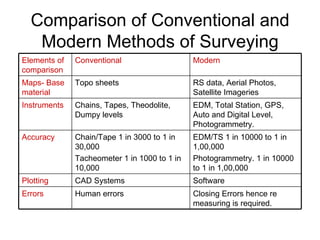
Comparison of Conventional and
   Modern Methods of Surveying
Elements of   Conventional                    Modern
comparison
Maps- Base    Topo sheets                     RS data, Aerial Photos,
material                                      Satellite Imageries
Instruments   Chains, Tapes, Theodolite,      EDM, Total Station, GPS,
              Dumpy levels                    Auto and Digital Level,
                                              Photogrammetry.
Accuracy      Chain/Tape 1 in 3000 to 1 in    EDM/TS 1 in 10000 to 1 in
              30,000                          1,00,000
              Tacheometer 1 in 1000 to 1 in   Photogrammetry. 1 in 10000
              10,000                          to 1 in 1,00,000
Plotting      CAD Systems                     Software
Errors        Human errors                    Closing Errors hence re
                                              measuring is required.

Highway unit-1-hand-outs

  • 1.
    UNIT 1. HIGHWAYPLANNING AND ALIGNMENT 8 • History of road development in India. • Classification of highways. • Institutions for Highway planning, design and implementation at different levels • Factors influencing highway alignment • Engineering surveys for alignment, objectives, conventional and modern methods.
  • 2.
    Roman Road Construction Basic cross section
  • 3.
    History of RoadDevelopment in India • Ancient Period (3500 BC) • Mughul Period (15th Century) • British Period (17th & 18th Century) • Free India (1950 onwards)
  • 4.
    Types of AncientIndian Roads • Indus Valley Civilization :  Roads with brick drains on both sides. • Mauryan rule in the 4th century constructed  Rajpath (high roads)  Banikpaths (merchant roads). • Ashoka Regime: Road networks with horticulture and rest houses at 4.8 – 6.4km along the roads. • Mughul Period Trunk roads between Northwest to Eastern part and also linking coastal and central part of India • British Period  Trunk roads, bridges, PWD was formed, construction of Grand Trunk Road
  • 5.
    Indian Roads • Indiahas a large road network of over 3.314 million kilometers of roadways (2.1 million miles), making it 3rd largest road network in the world. • At 0.66 km of highway per square kilometer of land the density of India’s highway network is higher than that of the United States (0.65) and far higher than that of China's (0.16) or Brazil's (0.20).
  • 6.
    Impact of Transportation •Economic Development • Social Development • Spatial Development • Cultural Development • Political Development
  • 7.
    Institution for HighwayPlanning, Design and Implementation at Different Levels • Jayakar Committee (1927) • Central Road Fund (1929) • Indian Roads Congress (IRC), 1934 • Central Road Research Institute (CRRI), 1950 • National Highway Act, 1956 • National Highway Authority of India (NHAI),1995 • National highway act ( 1956 ) • Second twenty year road plan ( 1961 ) • Highway Research board ( 1973 ) • National Transport Policy committee ( 1978 ) • Third twenty year road plan ( 1981 )
  • 8.
    Jayakar Committee,1927 • Roaddevelopment should be made a national interest since the provincial and local govt do not have financial and technical capacity for road development. • Levy extra tax on petrol from road users to create the road development fund. • To establish a semi-official ,technical institution to pool technical knowledge, sharing of ideas and to act as an advisory body. • To create a national level institution to carry research , development works and consultation.
  • 9.
    Central Road Fund, 1929 CRF Act , 2000 Distribution of 100% cess on petrol as follows: 57.5% for NH MORTH 30% for SH 12.5% for safety works on rail-Road crossing. 50% cess on diesel for Rural Road development
  • 10.
    Indian Roads Congress,1934 • To provide national forum for regular pooling of experience and ideas on matters related to construction and maintenance of highways. • To recommend standard specifications. • To provide a platform for expression of professional opinion on matters relating to roads and road transport.
  • 12.
    CRRI A constituent ofCouncil of Scientific and Industrial Research (CSIR)  engaged in carrying out research and development projects.  design, construction and maintenance of roads and runways, traffic and transportation planning of mega and medium cities, management of roads in different terrains,  Improvement of marginal materials,  Utilization of industrial waste in road construction,  Landslide control,  Ground improvements environmental pollution,  Road traffic safety,  Service life assessment and rehabilitation of highway & railway bridges.
  • 13.
    Ministry of RoadTransport & Highways • Planning, development and maintenance of National Highways in the country. • Extends technical and financial support to State Governments for the development of state roads and the roads of inter-state connectivity and economic importance. • Evolves standard specifications for roads and bridges in the country. • Serves as a repository of technical knowledge on roads and bridges.
  • 14.
    Classification of Highways Dependingon weather All weather roads Fair weather roads National highway act ( 1956 ) Depending the type of Carriage way Paved roads Unpaved roads Depending upon the pavement surface Surfaced roads Un surfaced roads
  • 15.
    Classification of Highways Basedon the Traffic Volume Heavy Medium Light Based on Load or Tonnage Class 1 or Class 2 etc or Class A , B etc Tonnes per day Based on location and function ( Nagpur road plan ) NH SH MDR ODR VR
  • 16.
    Based on modifiedsystem of Highways classification • Primary  Expressways  National Highways • Secondary  SH  MDR • Tertiary  ODR  VR
  • 17.
    Urban Road Classification • ARTERIAL ROADS • SUB ARTERIAL • COLECTOR • LOCAL STREET • CUL-DE-SAC • PATHWAY • DRIVEWAY
  • 18.
    Road Patterns • Rectangular or Block patterns • Radial or Star block pattern • Radial or Star Circular pattern • Radial or Star grid pattern • Hexagonal Pattern • Minimum travel Pattern
  • 19.
    Classification of Roadways •Expressways 200 Km • National Highways 70,548 Km • State Highways 1,31,899 Km • Major District Roads 4,67,763 Km • Rural and Other Roads 26,50,000 Km
  • 20.
    Expressways • Heavy traffic at high speed (120km/hr) • Land Width (90m) • Full access control • Connects major points of traffic generation • No slow moving traffic allowed • No loading, unloading, parking.
  • 21.
    National Highways • Indiahas a huge network of national highways. • The national highways have a total length of 70,548 kms. Indian highways cover 2% of the total road network of India and carry 40% of the total traffic. • The entire highway network of India is managed by the National Highway Authority of India which is responsible for development and maintenance of highways. The longest highway in India is NH7 which stretches from Varansi in Uttar Pradesh to Kanyakumari in the southern most point of Indian mainland. • The shortest highway is NH47A which stretches from Ernakulam to Kochi and covers total length of 4 Kms.
  • 22.
    State Highways • Theyare the arterial roads of a state, connecting up with the national highways of adjacent states, district head quarters and important cities within the state. • Total length of all SH in the country is 1,37,119 Kms.
  • 23.
    Major District Roads •Important roads with in a district serving areas of production and markets , connecting those with each other or with the major highways. • India has a total of 4,70,000 kms of MDR.
  • 24.
    Other district roads •Roads serving rural areas of production and providing them with outlet to market centers or other important roads like MDR or SH.
  • 25.
    Village roads • Theyare roads connecting villages or group of villages with each other or to the nearest road of a higher category like ODR or MDR. • India has 26,50,000 kms of ODR+VR out of the total 33,15,231 kms of all type of roads.
  • 26.
    Urban Road Classification • ARTERIAL ROADS • SUB ARTERIAL • COLLECTOR • LOCAL STREET • CUL-DE-SAC • PATHWAY • DRIVEWAY
  • 28.
    ARTERIAL • No frontageaccess, no standing vehicle, very little cross traffic. • Design Speed : 80km/hr • Land width : 50 – 60m • Spacing 1.5km in CBD & 8km or more in sparsely developed areas. • Divided roads with full or partial parking • Pedestrian allowed to walk only at intersection
  • 29.
    SUB ARTERIAL • Bus stops but no standing vehicle. • Less mobility than arterial. • Spacing for CBD : 0.5km • Sub-urban fringes : 3.5km • Design speed : 60 km/hr • Land width : 30 – 40 m
  • 30.
    Collector Street • Collectsand distributes traffic from local streets • Provides access to arterial roads • Located in residential, business and industrial areas. • Full access allowed. • Parking permitted. • Design speed : 50km/hr • Land Width : 20-30m
  • 31.
    Local Street • DesignSpeed : 30km/hr. • Land Width : 10 – 20m. • Primary access to residence, business or other abutting property • Less volume of traffic at slow speed • Origin and termination of trips. • Unrestricted parking, pedestrian movements. (with frontage access, parked vehicle, bus stops and no waiting restrictions)
  • 32.
    CUL–DE- SAC • DeadEnd Street with only one entry access for entry and exit. • Recommended in Residential areas
  • 33.
    Factors Influencing HighwayAlignment Requirements:  Short  Easy  Safe  Economical Factors controlling alignment : 1) Obligatory points A. Obligatory points through which alignment is to pass ( bridge site, intermediate town , Mountain pass etc B. Obligatory points through which alignment should not pass. 2) Traffic 3) Geometric design 4) Economics 5) Other considerations Additional care in hill roads Stability Drainage Geometric standards of hill roads Resisting length
  • 34.
    Factors governing alignment •Obligatory points – The location should avoid obstructions such as places of cemeteries, archeological, historical monument, public facilities like schools and hospitals, utility services. • Geometric design features – Facilitate easy grade and curvature – Enable ruling gradient in most sections – Void sudden changes in sight distance, especially near crossings – Avoid sharp horizontal curves – Avoid road intersections near bend or at the top or bottom of a hill
  • 35.
    Factors governing alignment •Precautions at river and railway crossings – Bridges should be preferably be located at right angles to the river flow, not located on a horizontal curve – Crossing railway lines should avoid intersections at gradient, frequent crossing and recrossing
  • 36.
    Factors governing alignment •Topographical control points – The alignment, where possible should avoid passing through • Marshy and low lying land with poor drainage • Flood prone areas • Unstable hilly features • Avalanche prone areas – Flat terrain-below 3% – Rolling terrain -3 to 25% – Mountainous terrain – above 25% – A location on high ground should be preferred rather than valley to avoid cross drainage works
  • 37.
    Factors governing alignment •Materials and constructional features – Deep cutting should be avoided – Earth work is to be balanced; quantities for filling and excavation – Alignment should preferably be through better soil area to minimize pavement thickness – Location may be near sources of embankment and pavement materials
  • 38.
    Traffic • Trend, Directionand pattern of traffic are critical elements. • OD survey should be conducted. • Desire lines based on survey should be drawn to indicate the desired pattern of traffic flow.
  • 39.
    ECONOMIC FACTORS • Capital cost • Maintenance Cost • Operational cost • Road User Cost • Embankment and deep cuttings cost.
  • 40.
    Other Considerations • Engineeringfeasibility • Environmental consideration • Social consideration • Political Acceptability • Monotony.
  • 41.
    Engineering Surveys forHighway locations  Provisional alignment Identification ( Map study)  Reconnaissance survey  Preliminary survey  Final location to determine center line and detailed survey
  • 42.
    Drawing and Report 1)Key map 2) Index map 3) Preliminary survey plans 4) Detailed plan and longitudinal section 5) Detailed cross section 6) Land acquisition plans 7) Drawings of cross drainage and other retaining structures 8) Drawings of road intersections 9) Land plans showing quarries etc
  • 43.
    SURVEY DATA COLLECTION • Natural and man made features. • Proposed Geometric Design elements. • Number of cross drainage structures. • Soil characteristics • Source of construction materials. • Geological formation, type of rocks. • Drainage
  • 44.
    MAP STUDY • BaseMap preparation Topographical map (SoI) Scale -1: 2,50,000 1: 50,000 1: 25,000 • Shows man made and natural features and contour lines at 15 or 30m interval. • Shows possible alignments with obligatory points and minimum number of cross drainage structures.
  • 45.
    RECONNAISSANCE SURVEY • Map updating – to confirm features indicated on map. • Checking for:  Number of cross drainage structures.  High Flood Level (HFL)  Confirming Length and value of gradient to IRC standards.  Soil Characteristics.  Geological features.  Proximity to source of construction materials- quarries, water sources. • Prepare a report on merits and demerits and profile map of scale 1:50,000.
  • 46.
    PRELIMINARY SURVEY • Base Plan Hz Vr  Built up area/hilly terrain 1:1000 1:100  Plain and rolling terrain 1:2500 1:250 • Establish center line • Incorporation of natural and man made features • Longitudinal and cross sectional profile (Levelling).  Plain Terrain` : 100 – 200m  Rolling Terrain : 50m  Hilly Terrain : 30m • Other studies  Drainage, Hydrological, soil, Traffic and Materials. • Finalisation of the best alignment  Comparative analysis.  Choose best alignment among alternatives.  Design geometric elements.
  • 47.
    DETAILED SURVEY FORFINAL LOCATION • Transferring the alignment on to ground. • Detail Survey – levelling work for longitudinal and transverse direction. • Intervals for cross sectional levelling  Plain 50 – 100m  Rolling 50 – 75m  Built up 50m  Hilly 20m • Soil Profile
  • 48.
    Alignment for hillroads • Minimum hair pin bends. • Bends should be located on stable and flat slopes. • Cross section for hair pin bends should be at intervals of 20-25m. • Avoid bends in valleys. • Survey for a width of ; 15 m on either side of centre line in straight alignment 30m on sharp curves.
  • 49.
    MODERN SURVEY METHODS Provisional alignment Identification ( Map study)  Reconnaissance survey  Hand held GPS giving 3D positions to an accuracy of 10-20m .  Preliminary Survey  Mapping of topography and relief  Use of aerial Photos  Airborne Laser Terain Mapping 6) Final location and detailed survey.
  • 50.
    Modern Equipments for Surveying • EDM – Electronic Distance Measurement • Auto level. • Digital level. • Total station. • GPS – global positioning system.
  • 51.
    DATA FROM AERIALSURVEY • Mosaic for longitudinal and lateral overlaps. • Control points • Examination of photos for spot levels and contour lines • Topo details • Photo interpretation for geological features, soil and drainage for the study area
  • 52.
    GEOMETRIC DESIGN • Elementsof design: – Sight distance • The length of road ahead visible to drivers – Stopping sight distance – Passing sight distance – Horizontal alignment • Super elevation rates (0.1 for rural areas, 0.06 for urban) • Minimum radius – Vertical alignment – Pavement design – Intersection and crossing design
  • 53.
    Guidance for RouteSelection • Straight line alignment preferred. • Avoid obstructions and frequent railway and river crossings. • Avoid landslide, erosion prone and water logged and marshy area. • Avoid alignment on clayey soil. • Alignment should aim at maintaining uniform design speed, easy grades and curvature.
  • 54.
    Comparison of Conventionaland Modern Methods of Surveying Elements of Conventional Modern comparison Maps- Base Topo sheets RS data, Aerial Photos, material Satellite Imageries Instruments Chains, Tapes, Theodolite, EDM, Total Station, GPS, Dumpy levels Auto and Digital Level, Photogrammetry. Accuracy Chain/Tape 1 in 3000 to 1 in EDM/TS 1 in 10000 to 1 in 30,000 1,00,000 Tacheometer 1 in 1000 to 1 in Photogrammetry. 1 in 10000 10,000 to 1 in 1,00,000 Plotting CAD Systems Software Errors Human errors Closing Errors hence re measuring is required.

Editor's Notes

  • #3 The road building techniques used by the Romans is a good model for present techniques. The basic idea is to provide a structure that has successively stronger layers as we proceed from the sub grade to the surface. The major difference is in materials that were used. Present day surface materials like asphalt and concrete are superior in ease of construction compared to the rock slabs used by the Romans. In fact the major difference between then and now is in the amount of human labor where slave labor is used instead of Caterpillar excavators. The typical Roman road was a layered system as shown below and is described by (1,2)