Light- Reflection and Refraction
Key learnings :

1. When light falls on a body, it may be absorbed, may be
transmitted or light may come back to the same medium.

2. Reflection of a light means light waves are neither
transmitted nor absorbed but are deflected from the surface
of the medium back into the same medium.

3. Laws of Reflection:
First law of reflection: The incident ray, the normal to the
surface at the point of incidence and the reflected ray, all lie
in the same plane.
Second law of reflection: The angle of incidence is equal
to the angle of reflection.

4. Real image is obtained when the rays of light after
reflection, actually converge at a point. It can be obtained
on the screen and can be seen with the eye.

5. Virtual image forms when rays of light do not actually
meet, but appear to meet when produced backwards. It
cannot be obtained on the screen.

6. Characteristics of the image formed by the plane mirror:
i. The image formed by a plane mirror is always virtual and
erect.
ii. Size of image = Size of object and the image is laterally
inverted.
iii. The image formed by the plane mirror is as far behind
the mirror as the object is in front.

7. Lateral Inversion: The phenomenon due to which the
right side of the object appears as left and the left side of


For More School Notes & Projects Visit www.toppersarena.com
the object appears as right. That is the image is inverted
sideways.

8. A spherical mirror whose reflecting surface is curved
outwards and polished on the inner spherical surface is
convex mirror.

9. A spherical mirror whose reflecting surface is curved
inwards and polished on the outer spherical surface is
concave mirror.

10. Concave mirror mostly forms real images, which can be
received on the screen.

11. Convex mirror forms virtual images, which cannot be
received on the screen.

12. Differentiating between a plane mirror, a concave mirror
and a convex mirror, without touching them:
i) If the image formed is erect and is of same size as in
reality then it is a plane mirror.
ii) If the image formed is still erect but smaller in size then it
is a convex mirror.
iii) If the image is erect but magnified when mirror is close
to the object then it is a concave mirror.

13. Solar concentrators use huge concave mirrors to focus
large amounts of solar energy thereby producing high
temperature conditions in a solar power plant.

14. Concave mirrors are used as shaving and make up
mirrors.

15. The centre of the reflecting surface of a spherical mirror
is a point called the pole of the mirror and usually
represented by P.


For More School Notes & Projects Visit www.toppersarena.com
16. The horizontal line passing through the centre of
curvature and pole of the spherical mirror is known as
Principal axis.

17. The centre of curvature of a spherical mirror is the
centre of the hollow sphere of glass, of which the spherical
mirror is a part and usually represented by C.

18. The radius of curvature of a spherical mirror is the
radius of the hollow
sphere of glass, of which the spherical mirror is a part and
usually represented by R.

19. The diameter of the reflecting surface that is twice the
radius is called its aperture.

20. Radius of curvature (R) = 2 
                                  focal length (f)

21. Rules for ray diagram-
i. The path of the reflected light ray depends upon how the
incident ray is oriented with respect to the principal axis.
ii. A ray of light parallel to the principal axis, after reflection
pass through the principal focus.
iii. A ray of light passing through the principal focus of a
mirror becomes parallel to the principal axis of the mirror,
on reflection
iv. A ray of light incident obliquely towards the pole of mirror
is reflected obliquely as per the laws of reflection
v. A ray of light passing through centre of curvature of a
mirror is reflected back along the same path


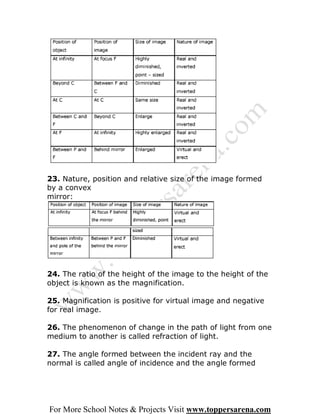
22. Image formation by a concave mirror for different
positions of the object


For More School Notes & Projects Visit www.toppersarena.com
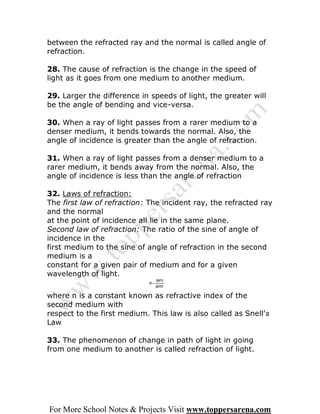
23. Nature, position and relative size of the image formed
by a convex
mirror:


24. The ratio of the height of the image to the height of the
object is known as the magnification.

25. Magnification is positive for virtual image and negative
for real image.

26. The phenomenon of change in the path of light from one
medium to another is called refraction of light.

27. The angle formed between the incident ray and the
normal is called angle of incidence and the angle formed


For More School Notes & Projects Visit www.toppersarena.com
between the refracted ray and the normal is called angle of
refraction.

28. The cause of refraction is the change in the speed of
light as it goes from one medium to another medium.

29. Larger the difference in speeds of light, the greater will
be the angle of bending and vice-versa.

30. When a ray of light passes from a rarer medium to a
denser medium, it bends towards the normal. Also, the
angle of incidence is greater than the angle of refraction.

31. When a ray of light passes from a denser medium to a
rarer medium, it bends away from the normal. Also, the
angle of incidence is less than the angle of refraction

32. Laws of refraction:
The first law of refraction: The incident ray, the refracted ray
and the normal
at the point of incidence all lie in the same plane.
Second law of refraction: The ratio of the sine of angle of
incidence in the
first medium to the sine of angle of refraction in the second
medium is a
constant for a given pair of medium and for a given
wavelength of light.


where n is a constant known as refractive index of the
second medium with
respect to the first medium. This law is also called as Snell’s
Law

33. The phenomenon of change in path of light in going
from one medium to another is called refraction of light.


For More School Notes & Projects Visit www.toppersarena.com
34. The ratio of speed of light in vacuum to the speed of
light in a medium is called the refractive index of the
medium. It has no unit.

35. When a ray of light traveling from a rarer to a denser
medium slows down and bends towards the normal.

36. When it travels from a denser medium to a rarer
medium, it speeds up and bends away from the normal.

37. The shifting of emergent ray sideways from the direction
of original incident ray is called lateral displacement or
lateral shift

38. The extend of the lateral shift depends on
- the angle of incidence,
- the thickness of slab, and
- Refractive index of the glass slab

39. Lateral displacement is produced during refraction
through a glass slab and not through a glass prism.

40. The angle through which a ray of light deviates on
passing through a prism is called the angle of deviation.

41. Convex lens is thicker at the middle than at the edges.

42. Concave lens is thicker at the edges than at the middle.

43. Convex lens converge the rays of light while concave
lens diverges.

44. As the object moves towards the optical centre of
convex lens, the image moves away from the optical centre
except when the object is placed between focus and optical
centre of the lens.


For More School Notes & Projects Visit www.toppersarena.com
45. As the object moves towards the optical centre of the
convex lens, the size of image increases and it’s highly
enlarged when object is at focus.

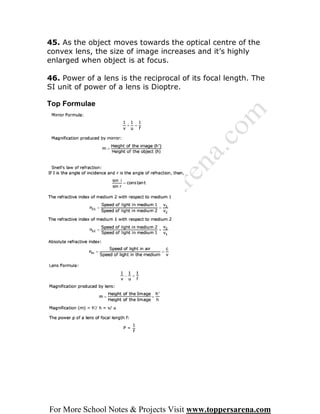
46. Power of a lens is the reciprocal of its focal length. The
SI unit of power of a lens is Dioptre.

Top Formulae


For More School Notes & Projects Visit www.toppersarena.com

X physics full notes chapter 5

  • 1.
    Light- Reflection andRefraction Key learnings : 1. When light falls on a body, it may be absorbed, may be transmitted or light may come back to the same medium. 2. Reflection of a light means light waves are neither transmitted nor absorbed but are deflected from the surface of the medium back into the same medium. 3. Laws of Reflection: First law of reflection: The incident ray, the normal to the surface at the point of incidence and the reflected ray, all lie in the same plane. Second law of reflection: The angle of incidence is equal to the angle of reflection. 4. Real image is obtained when the rays of light after reflection, actually converge at a point. It can be obtained on the screen and can be seen with the eye. 5. Virtual image forms when rays of light do not actually meet, but appear to meet when produced backwards. It cannot be obtained on the screen. 6. Characteristics of the image formed by the plane mirror: i. The image formed by a plane mirror is always virtual and erect. ii. Size of image = Size of object and the image is laterally inverted. iii. The image formed by the plane mirror is as far behind the mirror as the object is in front. 7. Lateral Inversion: The phenomenon due to which the right side of the object appears as left and the left side of For More School Notes & Projects Visit www.toppersarena.com
  • 2.
    the object appearsas right. That is the image is inverted sideways. 8. A spherical mirror whose reflecting surface is curved outwards and polished on the inner spherical surface is convex mirror. 9. A spherical mirror whose reflecting surface is curved inwards and polished on the outer spherical surface is concave mirror. 10. Concave mirror mostly forms real images, which can be received on the screen. 11. Convex mirror forms virtual images, which cannot be received on the screen. 12. Differentiating between a plane mirror, a concave mirror and a convex mirror, without touching them: i) If the image formed is erect and is of same size as in reality then it is a plane mirror. ii) If the image formed is still erect but smaller in size then it is a convex mirror. iii) If the image is erect but magnified when mirror is close to the object then it is a concave mirror. 13. Solar concentrators use huge concave mirrors to focus large amounts of solar energy thereby producing high temperature conditions in a solar power plant. 14. Concave mirrors are used as shaving and make up mirrors. 15. The centre of the reflecting surface of a spherical mirror is a point called the pole of the mirror and usually represented by P. For More School Notes & Projects Visit www.toppersarena.com
  • 3.
    16. The horizontalline passing through the centre of curvature and pole of the spherical mirror is known as Principal axis. 17. The centre of curvature of a spherical mirror is the centre of the hollow sphere of glass, of which the spherical mirror is a part and usually represented by C. 18. The radius of curvature of a spherical mirror is the radius of the hollow sphere of glass, of which the spherical mirror is a part and usually represented by R. 19. The diameter of the reflecting surface that is twice the radius is called its aperture. 20. Radius of curvature (R) = 2  focal length (f) 21. Rules for ray diagram- i. The path of the reflected light ray depends upon how the incident ray is oriented with respect to the principal axis. ii. A ray of light parallel to the principal axis, after reflection pass through the principal focus. iii. A ray of light passing through the principal focus of a mirror becomes parallel to the principal axis of the mirror, on reflection iv. A ray of light incident obliquely towards the pole of mirror is reflected obliquely as per the laws of reflection v. A ray of light passing through centre of curvature of a mirror is reflected back along the same path 22. Image formation by a concave mirror for different positions of the object For More School Notes & Projects Visit www.toppersarena.com
  • 4.
    23. Nature, positionand relative size of the image formed by a convex mirror: 24. The ratio of the height of the image to the height of the object is known as the magnification. 25. Magnification is positive for virtual image and negative for real image. 26. The phenomenon of change in the path of light from one medium to another is called refraction of light. 27. The angle formed between the incident ray and the normal is called angle of incidence and the angle formed For More School Notes & Projects Visit www.toppersarena.com
  • 5.
    between the refractedray and the normal is called angle of refraction. 28. The cause of refraction is the change in the speed of light as it goes from one medium to another medium. 29. Larger the difference in speeds of light, the greater will be the angle of bending and vice-versa. 30. When a ray of light passes from a rarer medium to a denser medium, it bends towards the normal. Also, the angle of incidence is greater than the angle of refraction. 31. When a ray of light passes from a denser medium to a rarer medium, it bends away from the normal. Also, the angle of incidence is less than the angle of refraction 32. Laws of refraction: The first law of refraction: The incident ray, the refracted ray and the normal at the point of incidence all lie in the same plane. Second law of refraction: The ratio of the sine of angle of incidence in the first medium to the sine of angle of refraction in the second medium is a constant for a given pair of medium and for a given wavelength of light. where n is a constant known as refractive index of the second medium with respect to the first medium. This law is also called as Snell’s Law 33. The phenomenon of change in path of light in going from one medium to another is called refraction of light. For More School Notes & Projects Visit www.toppersarena.com
  • 6.
    34. The ratioof speed of light in vacuum to the speed of light in a medium is called the refractive index of the medium. It has no unit. 35. When a ray of light traveling from a rarer to a denser medium slows down and bends towards the normal. 36. When it travels from a denser medium to a rarer medium, it speeds up and bends away from the normal. 37. The shifting of emergent ray sideways from the direction of original incident ray is called lateral displacement or lateral shift 38. The extend of the lateral shift depends on - the angle of incidence, - the thickness of slab, and - Refractive index of the glass slab 39. Lateral displacement is produced during refraction through a glass slab and not through a glass prism. 40. The angle through which a ray of light deviates on passing through a prism is called the angle of deviation. 41. Convex lens is thicker at the middle than at the edges. 42. Concave lens is thicker at the edges than at the middle. 43. Convex lens converge the rays of light while concave lens diverges. 44. As the object moves towards the optical centre of convex lens, the image moves away from the optical centre except when the object is placed between focus and optical centre of the lens. For More School Notes & Projects Visit www.toppersarena.com
  • 7.
    45. As theobject moves towards the optical centre of the convex lens, the size of image increases and it’s highly enlarged when object is at focus. 46. Power of a lens is the reciprocal of its focal length. The SI unit of power of a lens is Dioptre. Top Formulae For More School Notes & Projects Visit www.toppersarena.com