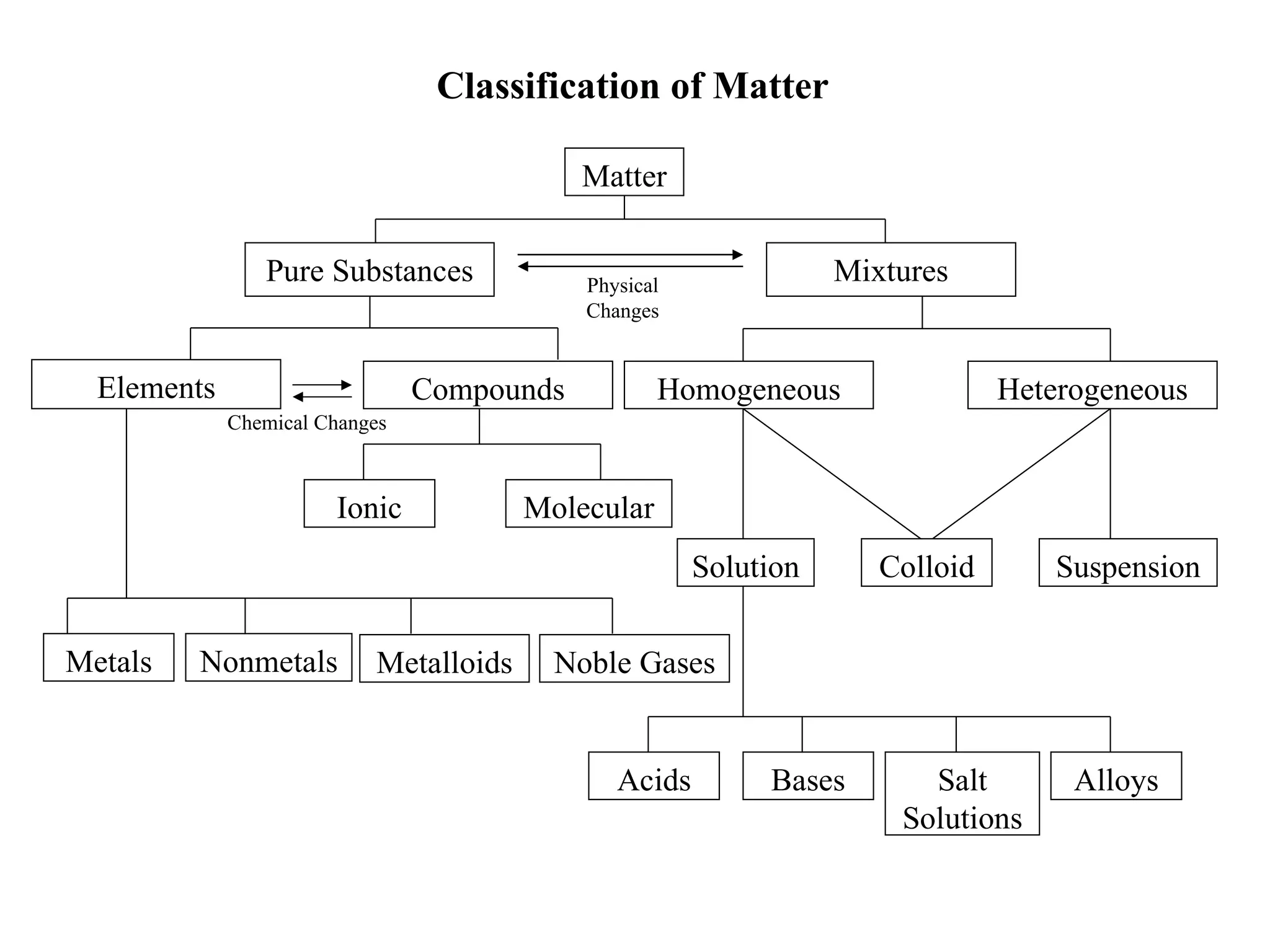
Classification of Matter   Matter Pure Substances Mixtures Elements Compounds Metals Nonmetals Metalloids Noble Gases Ionic Molecular Homogeneous Heterogeneous Solution Acids Bases Salt Solutions Alloys Suspension Colloid Physical Changes Chemical Changes
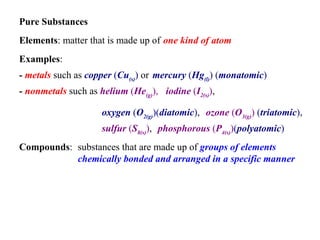
Elements : matter that is made up of one kind of atom   Examples :  -  metals  such as  copper  ( Cu (s) )  or mercury  ( Hg (l) ) ( monatomic )   -  nonmetals  such as  helium  ( He (g) ),  oxygen  ( O 2(g) )( diatomic ) ,  ozone  ( O 3(g) )  ( triatomic ) ,  iodine  ( I 2(s) ) ,   sulfur  ( S 8(s) ) ,   phosphorous  ( P 4(s) ) ( polyatomic )   Compounds : substances that are made up of  groups of elements chemically bonded and arranged in a specific manner   Pure Substances
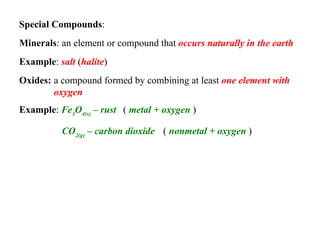
Special Compounds :   Minerals :  Oxides:  an element or compound that  occurs naturally in the earth   Example :  salt  ( halite )   a compound formed by combining at least  one element with oxygen   Example :  Fe 3 O 4(s)  – rust (  metal + oxygen  ) CO 2(g)  – carbon dioxide (  nonmetal + oxygen  )
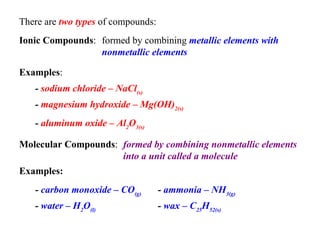
There are  two types  of compounds:   Ionic Compounds :  Molecular Compounds :  formed by combining  metallic elements with nonmetallic elements   Examples :   -  sodium chloride – NaCl (s)   -  magnesium hydroxide – Mg(OH) 2(s)   -  aluminum oxide – Al 2 O 3(s)   formed by combining nonmetallic elements into a unit called a molecule   Examples:   -  carbon monoxide – CO (g)   -  water – H 2 O (l)   -  ammonia – NH 3(g)   -  wax – C 25 H 52(s)
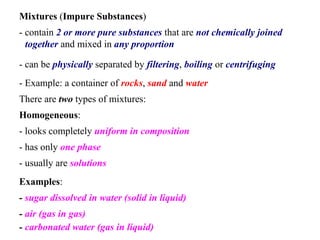
Mixtures  ( Impure Substances )   - contain  2 or more pure substances  that are  not chemically joined together  and mixed in  any proportion   - can be  physically  separated by  filtering ,  boiling  or  centrifuging   - Example: a container of  rocks ,  sand  and  water   There are  two  types of mixtures:   Homogeneous :  - looks completely  uniform in composition   - has only  one phase   - usually are  solutions   Examples :  -  sugar dissolved in water (solid in liquid)   -  air (gas in gas)   -  carbonated water (gas in liquid)
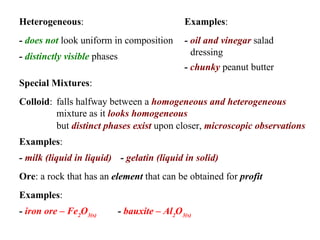
Heterogeneous :   -  does not  look uniform in composition   -  distinctly visible  phases   Examples :   -  oil and vinegar  salad dressing   -  chunky  peanut butter   Special Mixtures :   Colloid :  falls halfway between a  homogeneous and heterogeneous  mixture as it  looks homogeneous but  distinct phases exist  upon closer,  microscopic observations   Examples :   -  milk (liquid in liquid)   -  gelatin (liquid in solid)   Ore :  a rock that has an  element  that can be obtained for  profit   Examples :   -  iron ore – Fe 2 O 3(s)   -  bauxite – Al 2 O 3(s)
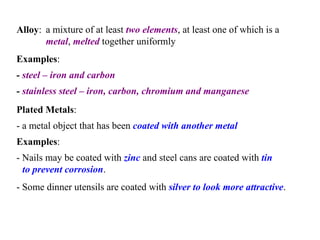
Alloy :  a mixture of at least  two elements , at least one of which is a  metal ,  melted  together uniformly   Examples :   -  steel – iron and carbon   -  stainless steel – iron, carbon, chromium and manganese   Plated Metals :  - a metal object that has been  coated with another metal   Examples :   - Nails may be coated with  zinc  and steel cans are coated with  tin to prevent corrosion .   - Some dinner utensils are coated with  silver to look more attractive .

C20 Unit 1 2 Classification Of Matter

  • 1.
    Classification of Matter Matter Pure Substances Mixtures Elements Compounds Metals Nonmetals Metalloids Noble Gases Ionic Molecular Homogeneous Heterogeneous Solution Acids Bases Salt Solutions Alloys Suspension Colloid Physical Changes Chemical Changes
  • 2.
    Elements : matterthat is made up of one kind of atom Examples : - metals such as copper ( Cu (s) ) or mercury  ( Hg (l) ) ( monatomic ) - nonmetals such as helium ( He (g) ), oxygen ( O 2(g) )( diatomic ) , ozone ( O 3(g) ) ( triatomic ) , iodine  ( I 2(s) ) , sulfur ( S 8(s) ) , phosphorous  ( P 4(s) ) ( polyatomic ) Compounds : substances that are made up of groups of elements chemically bonded and arranged in a specific manner Pure Substances
  • 3.
    Special Compounds : Minerals : Oxides: an element or compound that occurs naturally in the earth Example : salt ( halite ) a compound formed by combining at least one element with oxygen Example : Fe 3 O 4(s) – rust ( metal + oxygen ) CO 2(g) – carbon dioxide ( nonmetal + oxygen )
  • 4.
    There are two types of compounds: Ionic Compounds : Molecular Compounds : formed by combining metallic elements with nonmetallic elements Examples : - sodium chloride – NaCl (s) - magnesium hydroxide – Mg(OH) 2(s) - aluminum oxide – Al 2 O 3(s) formed by combining nonmetallic elements into a unit called a molecule Examples: - carbon monoxide – CO (g) - water – H 2 O (l) - ammonia – NH 3(g) - wax – C 25 H 52(s)
  • 5.
    Mixtures (Impure Substances ) - contain 2 or more pure substances that are not chemically joined together and mixed in any proportion - can be physically separated by filtering , boiling or centrifuging - Example: a container of rocks , sand and water There are two types of mixtures: Homogeneous : - looks completely uniform in composition - has only one phase - usually are solutions Examples : - sugar dissolved in water (solid in liquid) - air (gas in gas) - carbonated water (gas in liquid)
  • 6.
    Heterogeneous : - does not look uniform in composition - distinctly visible phases Examples : - oil and vinegar salad dressing - chunky peanut butter Special Mixtures : Colloid : falls halfway between a homogeneous and heterogeneous mixture as it looks homogeneous but distinct phases exist upon closer, microscopic observations Examples : - milk (liquid in liquid) - gelatin (liquid in solid) Ore : a rock that has an element that can be obtained for profit Examples : - iron ore – Fe 2 O 3(s) - bauxite – Al 2 O 3(s)
  • 7.
    Alloy : a mixture of at least two elements , at least one of which is a metal , melted together uniformly Examples : - steel – iron and carbon - stainless steel – iron, carbon, chromium and manganese Plated Metals : - a metal object that has been coated with another metal Examples : - Nails may be coated with zinc and steel cans are coated with tin to prevent corrosion . - Some dinner utensils are coated with silver to look more attractive .