Structure of atom
Top concepts:

1. Ionisation of gases in the discharge tube proved that
atoms have subatomic particles

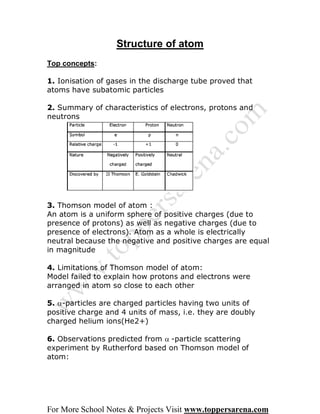
2. Summary of characteristics of electrons, protons and
neutrons


3. Thomson model of atom :
An atom is a uniform sphere of positive charges (due to
presence of protons) as well as negative charges (due to
presence of electrons). Atom as a whole is electrically
neutral because the negative and positive charges are equal
in magnitude

4. Limitations of Thomson model of atom:
Model failed to explain how protons and electrons were
arranged in atom so close to each other

5. -particles are charged particles having two units of
positive charge and 4 units of mass, i.e. they are doubly
charged helium ions(He2+)

6. Observations predicted from -particle scattering
experiment by Rutherford based on Thomson model of
atom:


For More School Notes & Projects Visit www.toppersarena.com
Rutherford expected that if the model proposed earlier by J.J
Thomson, according to which there is uniform distribution of
positive and negative charge, was correct then -particle
particles striking the gold atoms would be uniformly
deflected which was not the case. Since the -particles were
much heavier than the protons, he did not expect to see
large deflections

7. Selection of gold metal for Rutherford's -particle
scattering experiment:
Since -particles are easily absorbed by objects; he wanted
to ensure that alpha particles pass through foil without
getting absorbed. If  -particles were absorbed in matter
then they would not be able to give any useful information
about insight of atom. Only if -particles were deflected
then only it can give useful information about insight of
atom. Gold is easily malleable and can be beaten into very
thin sheets.

8. Observations made by Rutherford from -particle
scattering experiment:
1. Most of the -particles passed straight through gold foil
without suffering any deflection from their original path
2. Some of the -particles were deflected by the foil by
small angles
3. One out of every 12000 particles appeared to rebound

9. Conclusions from Rutherford’s model of an atom
1. Most of the space between inside atoms is empty; hence
it allows the particles to pass straight through it without
any deflection
2. Very few particles were deflected from their path which
suggests that the positive charge of the atom occupies very
little space
3. The total volume occupied by a nucleus is very small
compared to the total volume of the atom, as very few
  particles are reflected by 180o and all the positive charge


For More School Notes & Projects Visit www.toppersarena.com
and mass of the gold atom were concentrated in a very
small volume within atom.

10. Rutherford’s model of an atom
1. There is positively charged centre in an atom called the
nucleus and the entire mass of atom resides in the nucleus
2. Electrons revolve around the nucleus in well defined orbits
3. Size of nucleus is very small as compared to size of atom

11. Defects in Rutherford model of atom:
1. Rutherford had proposed that electrons move around a
positively charged nucleus at very high speed in circular
orbits. To remain in a circular orbit electron would have to
be accelerated centripetally (tending to move toward a
center). But according to electromagnetic theory if charged
body (electron) is accelerated around another charged body
(nucleus) then there would be continuous radiation of the
moving body (i.e. electron). This loss of energy would slow
down speed of electron and eventually electron would fall
into nucleus. But Rutherford’s model could not explain such
a collapse
2. Rutherford had proposed that electrons revolve around
the nucleus in fixed orbits. He did not specify the number of
electrons in each orbit

12. Postulates put forward by Bohr regarding model of
atom:
1. Electrons revolve around the nucleus in a limited number
of orbits called discrete orbits of electrons or also called as
permissible orbits
2. While revolving in discrete orbits the electrons does not
radiate energy i.e. energy of an electron remains constant
so long as it stays in a given orbit. Electrons present in
different orbits have different energies
3. When an electron jumps from lower energy level to higher
energy level some energy is absorbed, while energy is
released when electron jumps from higher energy to lower


For More School Notes & Projects Visit www.toppersarena.com
one Orbits or shells are represented by the letters K, L, M,
N… or the numbers, n=1, 2, 3, 4…

13. Bohr-Bury scheme for distribution of electrons in
different orbits
1. Maximum number of electrons that can be accommodated
in a shell is given by 2n2 ,where n is the shell number i.e.
first shell can accommodate 2 electrons, second shell can
accommodate 8 electrons, third shell can accommodate 18
electrons and so on
2. Outermost orbit of an atom can accommodate a
maximum number of 8 electrons
3. Electrons are not accommodated in a given shell, unless
the inner shells are filled i.e. the shells are filled in a step-
wise manner

14. Combining capacity of an atom is called its valency

15. Outermost shell of an atom is called valence shell

16. Electrons present in valence shell is called valence
electrons

17. If the outermost shell of an atom is completely, its
valency is 0

18. Valency of elements having 1-4 electrons in outermost
shell are generally determined by the rule: Valency =
Number of electrons in outermost shell

19. Valency of elements having number of electrons in
outermost shell close to 8 is determined by the formula:
Valency=8- Number of electrons in outermost shell

20.Significance of valence electrons:
1. Valence electrons are responsible for chemical changes
2. Elements having same number of valence electrons in
their atoms possess similar chemical properties because


For More School Notes & Projects Visit www.toppersarena.com
chemical properties of an element are determined by the
number of valence electrons in an atom
3. Elements having different number of valence electrons in
their atoms possess different chemical properties

21. Atomic number(Z) is defined as the total number of
protons present in nucleus of an atom

22.Protons and neutrons together are called nucleons

23.Mass number (A) is defined as the sum of the total
number of protons and neutrons present in the nucleus of an
atom.

24. Isotopes:
   Isotopes are the atoms of same element having same
     atomic number but different mass number
   Isotopes have similar chemical properties because
     they have same number of valence electrons
   Isotopes have different physical properties like boiling
     point, melting point etc because they have different
     mass number
   Fractional atomic mass of elements are due fact that
     all elements have isotope
   Applications of isotopes:
  1. Uranium isotope( U ) is used in nuclear reaction
  2. Cobalt isotope ( U) is used to remove brain tumours
  and in their treatment
  3. Isotope of sodium ( Na) has been used to diagnose
  restricted circulation of blood

25. Isobars are the atoms of different element with different
atomic number but same mass number


For More School Notes & Projects Visit www.toppersarena.com

Ix chemistry full notes chapter 4

  • 1.
    Structure of atom Topconcepts: 1. Ionisation of gases in the discharge tube proved that atoms have subatomic particles 2. Summary of characteristics of electrons, protons and neutrons 3. Thomson model of atom : An atom is a uniform sphere of positive charges (due to presence of protons) as well as negative charges (due to presence of electrons). Atom as a whole is electrically neutral because the negative and positive charges are equal in magnitude 4. Limitations of Thomson model of atom: Model failed to explain how protons and electrons were arranged in atom so close to each other 5. -particles are charged particles having two units of positive charge and 4 units of mass, i.e. they are doubly charged helium ions(He2+) 6. Observations predicted from -particle scattering experiment by Rutherford based on Thomson model of atom: For More School Notes & Projects Visit www.toppersarena.com
  • 2.
    Rutherford expected thatif the model proposed earlier by J.J Thomson, according to which there is uniform distribution of positive and negative charge, was correct then -particle particles striking the gold atoms would be uniformly deflected which was not the case. Since the -particles were much heavier than the protons, he did not expect to see large deflections 7. Selection of gold metal for Rutherford's -particle scattering experiment: Since -particles are easily absorbed by objects; he wanted to ensure that alpha particles pass through foil without getting absorbed. If  -particles were absorbed in matter then they would not be able to give any useful information about insight of atom. Only if -particles were deflected then only it can give useful information about insight of atom. Gold is easily malleable and can be beaten into very thin sheets. 8. Observations made by Rutherford from -particle scattering experiment: 1. Most of the -particles passed straight through gold foil without suffering any deflection from their original path 2. Some of the -particles were deflected by the foil by small angles 3. One out of every 12000 particles appeared to rebound 9. Conclusions from Rutherford’s model of an atom 1. Most of the space between inside atoms is empty; hence it allows the particles to pass straight through it without any deflection 2. Very few particles were deflected from their path which suggests that the positive charge of the atom occupies very little space 3. The total volume occupied by a nucleus is very small compared to the total volume of the atom, as very few  particles are reflected by 180o and all the positive charge For More School Notes & Projects Visit www.toppersarena.com
  • 3.
    and mass ofthe gold atom were concentrated in a very small volume within atom. 10. Rutherford’s model of an atom 1. There is positively charged centre in an atom called the nucleus and the entire mass of atom resides in the nucleus 2. Electrons revolve around the nucleus in well defined orbits 3. Size of nucleus is very small as compared to size of atom 11. Defects in Rutherford model of atom: 1. Rutherford had proposed that electrons move around a positively charged nucleus at very high speed in circular orbits. To remain in a circular orbit electron would have to be accelerated centripetally (tending to move toward a center). But according to electromagnetic theory if charged body (electron) is accelerated around another charged body (nucleus) then there would be continuous radiation of the moving body (i.e. electron). This loss of energy would slow down speed of electron and eventually electron would fall into nucleus. But Rutherford’s model could not explain such a collapse 2. Rutherford had proposed that electrons revolve around the nucleus in fixed orbits. He did not specify the number of electrons in each orbit 12. Postulates put forward by Bohr regarding model of atom: 1. Electrons revolve around the nucleus in a limited number of orbits called discrete orbits of electrons or also called as permissible orbits 2. While revolving in discrete orbits the electrons does not radiate energy i.e. energy of an electron remains constant so long as it stays in a given orbit. Electrons present in different orbits have different energies 3. When an electron jumps from lower energy level to higher energy level some energy is absorbed, while energy is released when electron jumps from higher energy to lower For More School Notes & Projects Visit www.toppersarena.com
  • 4.
    one Orbits orshells are represented by the letters K, L, M, N… or the numbers, n=1, 2, 3, 4… 13. Bohr-Bury scheme for distribution of electrons in different orbits 1. Maximum number of electrons that can be accommodated in a shell is given by 2n2 ,where n is the shell number i.e. first shell can accommodate 2 electrons, second shell can accommodate 8 electrons, third shell can accommodate 18 electrons and so on 2. Outermost orbit of an atom can accommodate a maximum number of 8 electrons 3. Electrons are not accommodated in a given shell, unless the inner shells are filled i.e. the shells are filled in a step- wise manner 14. Combining capacity of an atom is called its valency 15. Outermost shell of an atom is called valence shell 16. Electrons present in valence shell is called valence electrons 17. If the outermost shell of an atom is completely, its valency is 0 18. Valency of elements having 1-4 electrons in outermost shell are generally determined by the rule: Valency = Number of electrons in outermost shell 19. Valency of elements having number of electrons in outermost shell close to 8 is determined by the formula: Valency=8- Number of electrons in outermost shell 20.Significance of valence electrons: 1. Valence electrons are responsible for chemical changes 2. Elements having same number of valence electrons in their atoms possess similar chemical properties because For More School Notes & Projects Visit www.toppersarena.com
  • 5.
    chemical properties ofan element are determined by the number of valence electrons in an atom 3. Elements having different number of valence electrons in their atoms possess different chemical properties 21. Atomic number(Z) is defined as the total number of protons present in nucleus of an atom 22.Protons and neutrons together are called nucleons 23.Mass number (A) is defined as the sum of the total number of protons and neutrons present in the nucleus of an atom. 24. Isotopes:  Isotopes are the atoms of same element having same atomic number but different mass number  Isotopes have similar chemical properties because they have same number of valence electrons  Isotopes have different physical properties like boiling point, melting point etc because they have different mass number  Fractional atomic mass of elements are due fact that all elements have isotope  Applications of isotopes: 1. Uranium isotope( U ) is used in nuclear reaction 2. Cobalt isotope ( U) is used to remove brain tumours and in their treatment 3. Isotope of sodium ( Na) has been used to diagnose restricted circulation of blood 25. Isobars are the atoms of different element with different atomic number but same mass number For More School Notes & Projects Visit www.toppersarena.com