INTRODUCTION TO
  AGRICULTURE

   AP HUMAN GEOGRAPHY
   Agriculture and Land Use
           Keller ‘11
So what is agriculture?
   The textbooks define it as…
    • The deliberate modification of Earth’s
      surface through cultivation of plants and
      rearing of animals to obtain sustenance
      or economic gain.

    • Intentional planting of crops and raising
      of domesticated animals
ECONOMIC ACTIVITY LEVELS
   PRIMARY
    • Involves products closest to the ground; farming,
      ranching, fishing, forestry, mining
   SECONDARY
    • Manufacturing of a primary product; processed foods,
      cars, chemicals
   TERTIARY
    • The service industry; bankers, lawyers, teachers
   QUATERNARY
    • Services involved with the exchange of money or goods
   QUINARY
    • Services involved with research and higher education


   Agriculture is classified as a primary activity
WHY study agriculture?
             Use Chapter 10 to help
   Impact on people?
   Impact on other
    businesses/industry?
   Importance of survival to agrarian
    societies
    • AGRARIAN: Relating to or concerning
      the land and its cultivation
What is agriculture dependent upon?

              Climate?

    Culture and Traditions?

             Demand?
AGRICULTURE TODAY…
   Agriculture has been transformed into a globally
    integrated system.
   The introduction of new technologies, political
    concerns about food security and self-sufficiency,
    and changing opportunities for investment and
    employment are among the many forces that
    have dramatically shaped agriculture as we know
    it today.
   The industrialized agricultural system of today’s
    world has developed from – and largely displaced
    – older agricultural practices, including
    subsistence agriculture and pastoralism.
   Transformations in agriculture have had dramatic
    impacts on the environment, including soil
    erosion, desertification, deforestation, and soil
    and water pollution, as well as the elimination of
    some plant and animal species.
AGRICULTURE TOMORROW…
   World population will grow from around 6.7 billion people
    today to 8.3 billion people in 2030.
   The world population will be increasingly well-fed by 2030.
   The number of hungry people in developing countries is
    expected to decline, but Sub-Saharan Africa is cause for
    serious concern.
   Much of future food production growth will come from
    higher productivity.
   The expansion of farmland for food production will be
    slower than in the past.
   Globally, deforestation will probably continue to slow down.
   At a global level there is enough water available, but some
    regions will face serious water shortages.
   Modern biotechnology offers promises as a means to
    improving food security.
   Climate change could increase the dependency of some
    developing countries on food imports.
FOOD PRODUCTION
   Providing food in the United
    States and Canada is a vast
    industry.
   The mechanized, highly
    productive American or
    Canadian farm contrasts with
    the subsistence farm found in
    much of the world.
   This sharp contrast in
    agricultural practices
    constitutes one of the most
    fundamental differences
    between the more developed
    and less developed countries of
    the world.
KEY ISSUES
   1. Where did agriculture originate?
    • Major Agricultural Revolutions
   2. Where are agricultural regions in
    less developed countries?
   3. Where are agricultural regions in
    more developed countries?
   4. Why do farmers face economic
    difficulties?
The Economics of Farming
   The reason why farming varies around the world relates to
    distribution across space of cultural and environmental
    factors.
   Elements of the physical environment, such as climate, soil,
    and topography, set broad limits on agricultural practices,
    and farmers make choices to modify the environment in a
    variety of ways.
   Broad climate patterns influence the crops planted in a
    region, and local soil conditions influence the crops planted
    on an individual farm.
   Farmers choose from a variety of agricultural practices,
    based on their perception of the value of each alternative.
   These values are partly economic and partly cultural.
   How farmers deal with their physical environment varies
    according to dietary preferences, availability of technology,
    and other cultural traditions.
   At a global scale, farmers increasingly pursue the most
    profitable agriculture
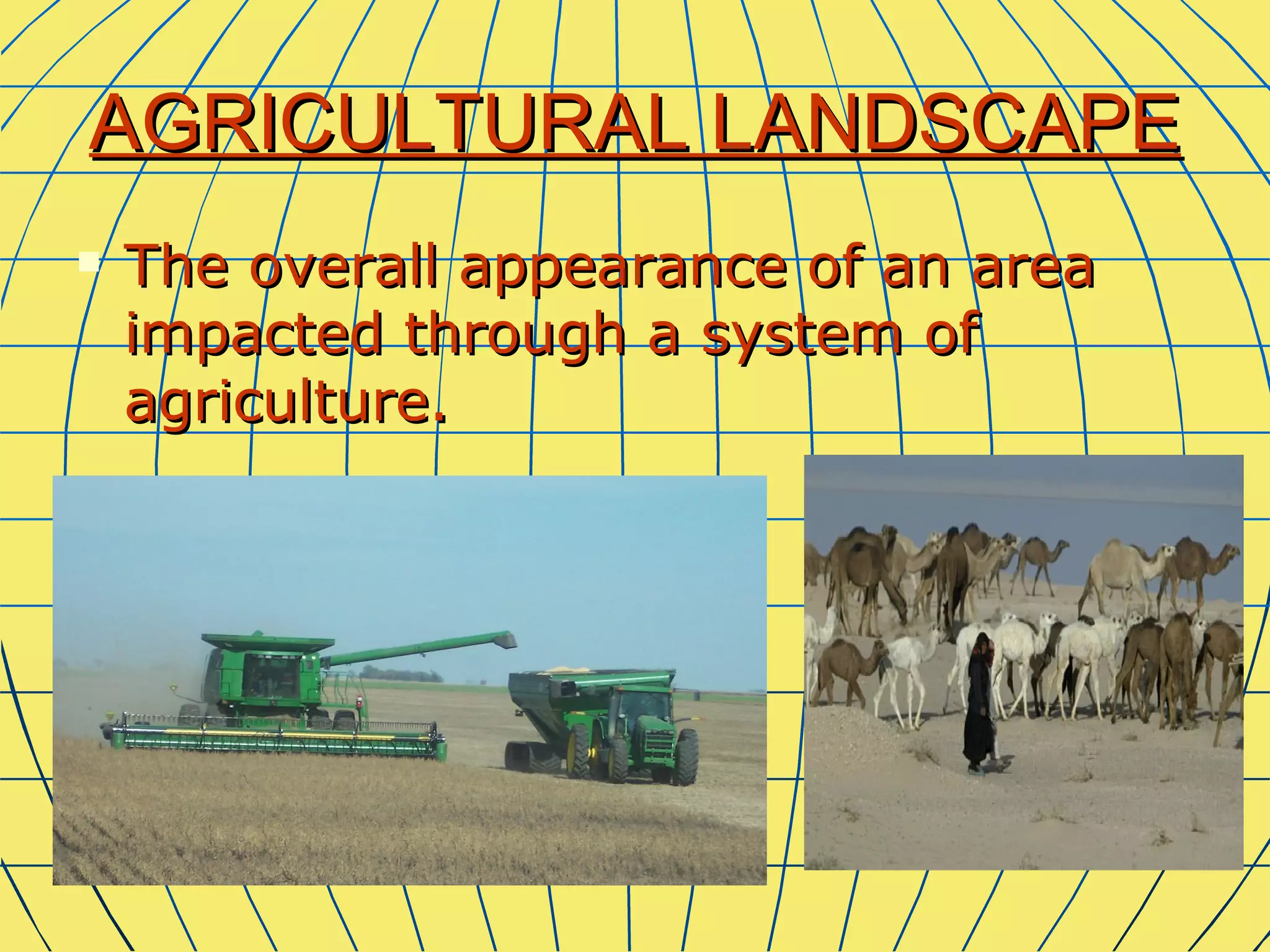
AGRICULTURAL LANDSCAPE
   The overall appearance of an area
    impacted through a system of
    agriculture.
WHAT IS THIS?
(WHERE MIGHT THIS BE?)
WHAT IS THIS?
(WHERE MIGHT THIS BE?)
WHAT IS THIS?
(WHERE MIGHT THIS BE?)
WHAT IS THIS?
(WHERE MIGHT THIS BE?)
WHAT IS THIS?
(WHERE MIGHT THIS BE?)
WHAT IS THIS?
(WHERE MIGHT THIS BE?)
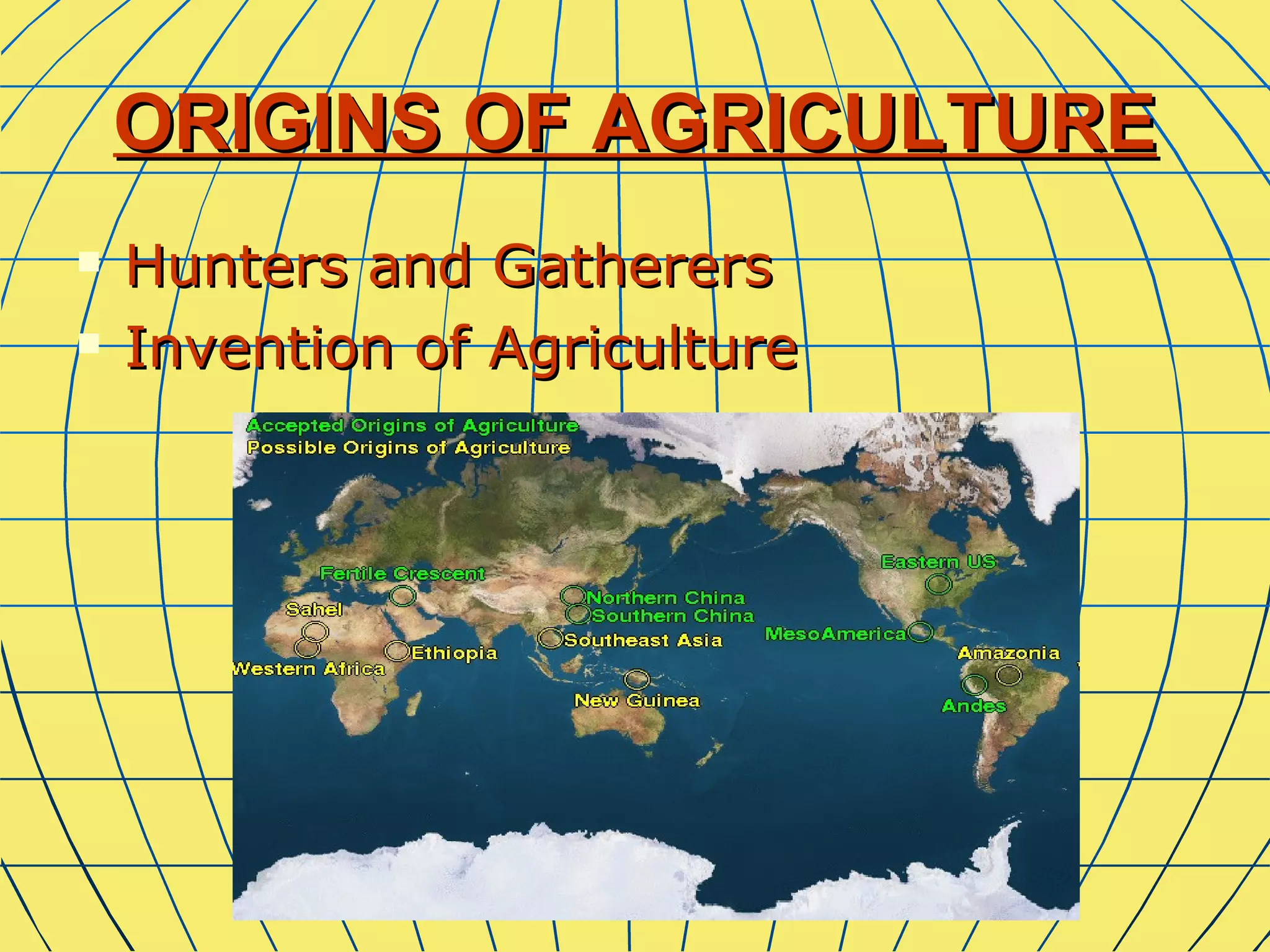
ORIGINS OF AGRICULTURE
   Hunters and Gatherers
   Invention of Agriculture
HUNTERS AND GATHERERS
   Before the invention of agriculture, all humans probably obtained
    the food they needed for survival through hunting for animals,
    fishing, or gathering.
   Hunters and gatherers lived in small groups.
   The men hunted game or fished, and the women collected berries,
    nuts, and roots.
   This division of labor sounds like a stereotype but is based on
    evidence from archaeology and anthropology.
   The group traveled frequently, establishing new home bases or
    camps.
   The direction and frequency of migration depended on the
    movement of game and the seasonal growth of plants at various
    locations.
CONTEMPORARY HUNTING AND GATHERING

   Today perhaps a quarter-
    million people, or less
    than 0.005 percent of the
    world’s population, still
    survive by hunting and
    gathering.
   Contemporary hunting
    and gathering societies
    are isolated groups living
    on the periphery of world
    settlement, but they
    provide insight into
    human customs that
    prevailed in prehistoric
    times, before the
    invention of agriculture.
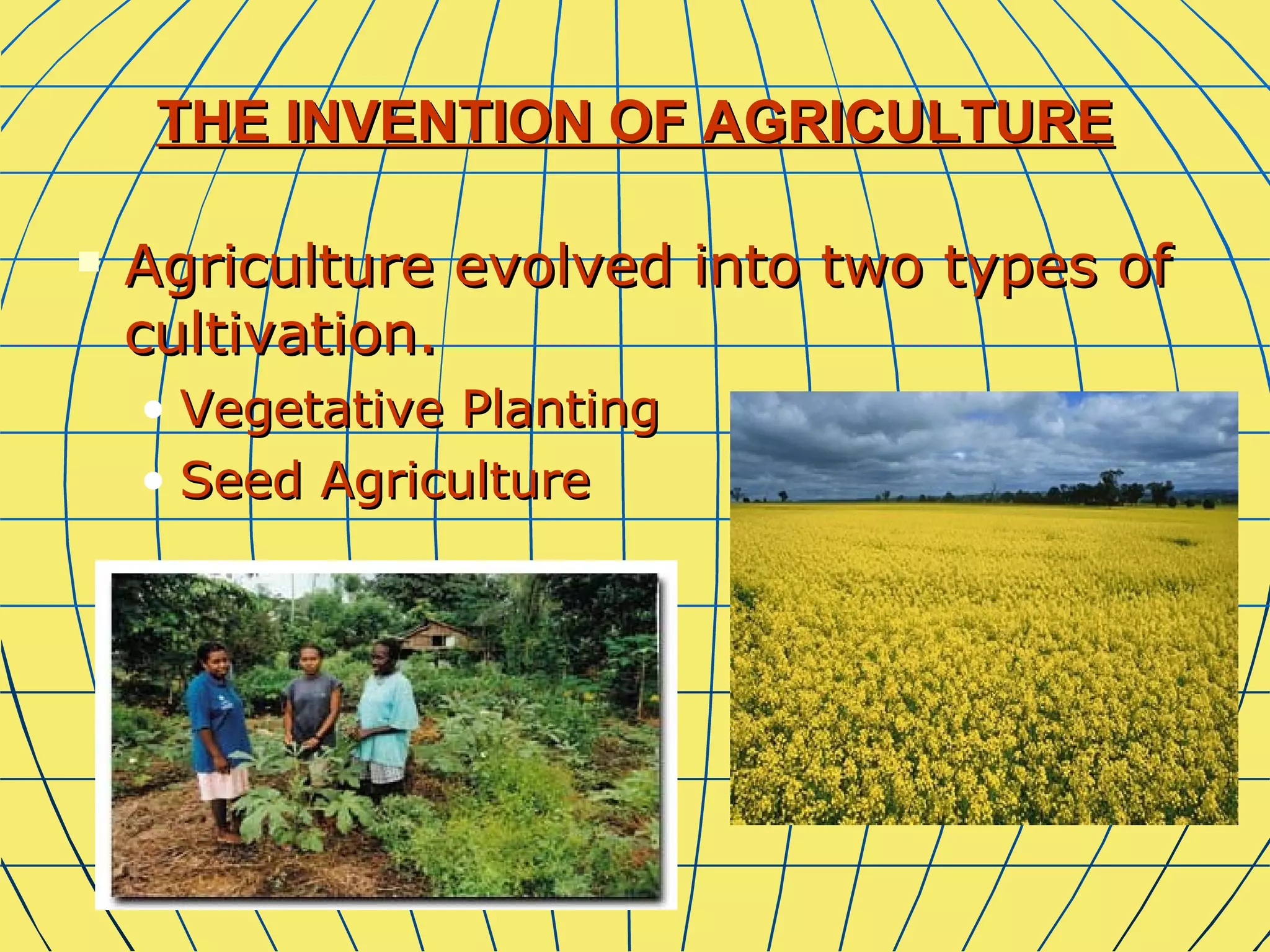
THE INVENTION OF AGRICULTURE

   Agriculture evolved into two types of
    cultivation.
    • Vegetative Planting
    • Seed Agriculture
TWO TYPES OF CULTIVATION
   Over thousands of years, plant
    cultivation apparently evolved from a
    combination of accidental and deliberate
    experiment.
   The earliest form of plant cultivation,
    according to Carl Sauer, was vegetative
    planting, direct cloning from existing
    plants, such as cutting stems and
    dividing roots.
   Coming later, according to Sauer, was
    seed agriculture. Seed agriculture is
    practiced by most farmers today.
VEGETATIVE PLANTING HEARTHS


   There were several main hearths, or centers of origin, for
    vegetative crops (roots and tubers, etc.), from which the
    crops diffused to other areas.
LOCATION OF FIRST
        VEGETATIVE PLANTING
   Dr. Sauer believes that vegetative planting
    probably originated in Southeast Asia.
   The region’s diversity of climate and topography
    encouraged plants suitable for dividing.
   The first plants domesticated in Southeast Asia.. .
    probably included roots such as the taro and
    yam, and tree crops such as the banana and
    palm.
   The dog, pig, and chicken probably were
    domesticated first in Southeast Asia.
   Other early hearths of vegetative planting also
    may have emerged independently in West Africa
    and northwestern South America.
SEED AGRICULTURAL HEARTHS


   Seed agriculture also originated in several
    hearths and diffused from those elsewhere.
DIFFUSION OF SEED
                     AGRICULTURE
   Seed agriculture diffused from
    Southwest Asia across Europe and
    through North Africa.
   Seed agriculture also diffused eastward
    from Southwest Asia to northwestern
    India and the Indus River plain.
   Again, various domesticated plants and
    animals were brought from Southwest
    Asia, although other plants, such as
    cotton and rice, arrived in India from
    different hearths.
   Rice has an unknown hearth.
   Sauer identified a third independent
    hearth in Ethiopia, where millet and
    sorghum were domesticated early.
   However, he argued that agricultural
    advances in Ethiopia did not diffuse
    widely to other locations
DIFFUSION OF SEED
         AGRICULTURE IN THE
        WESTERN HEMISPHERE
   Two independent seed agriculture hearths
    originated in the Western Hemisphere:
    southern Mexico and northern Peru.
   Agricultural practices diffused to other parts
    of the Western Hemisphere.
   This diversity derives from a unique legacy of
    wild plants, climatic conditions, and cultural
    preferences in each region.
   Improved communications in recent
    centuries have encouraged the diffusion of
    some plants to varied locations around the
    world.
DIFFERENCES BETWEEN
         COMMERCIAL AND
    SUBSISTENCE AGRICULTURE
   The most fundamental differences in agricultural practices
    are between those in less developed countries and those in
    more developed countries.
   Subsistence agriculture is the production of food primarily
    for consumption by the farmer’s family.
   Commercial agriculture is the production of food primarily
    for sale off the farm.
     • Five principal features distinguish commercial from
        subsistence agriculture:
          purpose of farming;

          percentage of farmers in the labor force;

          use of machinery;

          arm size;

          (and) relationship of farming to other businesses.
LABOR FORCE IN AGRICULTURE


   A large proportion of workers in most LDCs are in agriculture,
    while only a small percentage of workers in MDCs are engaged in
    agriculture.
FARM SIZE
   The average farm size is relatively
    large in commercial agriculture,
    especially in the United States and
    Canada.
   Commercial agriculture is
    increasingly dominated by a handful
    of large farms.
   In the United States the largest 4
    percent of farms account for more
    than one half of the country’s total
    output.
   One half of U.S. farms generate
    less than $10,000 a year in sales.
   Large size is partly a consequence
    of mechanization.
   As a result of the large size and the
    high level of mechanization,
    commercial agriculture is an
    expensive business.
RELATIONSHIP OF FARMING TO
    OTHER BUSINESSES
   Commercial farming is closely tied to other
    businesses.
   Commercial farming has been called
    agribusiness, integrated into a large food
    production industry.
   Although farmers are less than 2 percent
    of the U.S. labor force, more than 20
    percent of U.S. labor works in food
    production related to agribusiness: food
    processing, packaging, storing,
    distributing, and retailing.
AGRICULTURAL REVOLUTIONS
   First Agricultural Revolution
    • Dating back 10,000 years, this achieved plant
      domestication and animal domestication.
   Second Agricultural Revolution
    • Witnessed improved methods of cultivation,
      harvesting, and storage of farm produce.
   Third Agricultural Revolution
    • Currently in progress, its principal orientation
      is the development of Genetically Modified
      Organisms
FIRST AGRICULTURAL REVOLUTION


   Studied by geographer, Dr. Carl Sauer
    • Believed that agriculture would only flourish
      in a land of plenty

   Key area: Tigris and the Euphrates Rivers
    (Fertile Crescent)
SECOND AGRICULTURAL REVOLUTION

   Coincided with the Industrial Revolution
   Surpluses of food needed to feed those
    working in factories
   New technologies developed to improve
    crop yields
   Supported by governments of Europe
    • Enclosure Act of Great Britain – enforced the
      increase in the size of farms; created large
      scale farms
THIRD AGRICULTURAL REVOLUTION

   Also known as the Green Revolution
   Dates back to the 1930s
   Manipulation of seed varieties to
    increase crop yields
   1960s – focus of the Green
    Revolution turned to India
   Crops impacted: corn, wheat, rice
   Decreased famine in numerous areas
   “Hunger Areas” greatly impacted
Intro to agriculture

Intro to agriculture

  • 1.
    INTRODUCTION TO AGRICULTURE AP HUMAN GEOGRAPHY Agriculture and Land Use Keller ‘11
  • 2.
    So what isagriculture?  The textbooks define it as… • The deliberate modification of Earth’s surface through cultivation of plants and rearing of animals to obtain sustenance or economic gain. • Intentional planting of crops and raising of domesticated animals
  • 3.
    ECONOMIC ACTIVITY LEVELS  PRIMARY • Involves products closest to the ground; farming, ranching, fishing, forestry, mining  SECONDARY • Manufacturing of a primary product; processed foods, cars, chemicals  TERTIARY • The service industry; bankers, lawyers, teachers  QUATERNARY • Services involved with the exchange of money or goods  QUINARY • Services involved with research and higher education  Agriculture is classified as a primary activity
  • 4.
    WHY study agriculture? Use Chapter 10 to help  Impact on people?  Impact on other businesses/industry?  Importance of survival to agrarian societies • AGRARIAN: Relating to or concerning the land and its cultivation
  • 5.
    What is agriculturedependent upon?  Climate?  Culture and Traditions?  Demand?
  • 6.
    AGRICULTURE TODAY…  Agriculture has been transformed into a globally integrated system.  The introduction of new technologies, political concerns about food security and self-sufficiency, and changing opportunities for investment and employment are among the many forces that have dramatically shaped agriculture as we know it today.  The industrialized agricultural system of today’s world has developed from – and largely displaced – older agricultural practices, including subsistence agriculture and pastoralism.  Transformations in agriculture have had dramatic impacts on the environment, including soil erosion, desertification, deforestation, and soil and water pollution, as well as the elimination of some plant and animal species.
  • 7.
    AGRICULTURE TOMORROW…  World population will grow from around 6.7 billion people today to 8.3 billion people in 2030.  The world population will be increasingly well-fed by 2030.  The number of hungry people in developing countries is expected to decline, but Sub-Saharan Africa is cause for serious concern.  Much of future food production growth will come from higher productivity.  The expansion of farmland for food production will be slower than in the past.  Globally, deforestation will probably continue to slow down.  At a global level there is enough water available, but some regions will face serious water shortages.  Modern biotechnology offers promises as a means to improving food security.  Climate change could increase the dependency of some developing countries on food imports.
  • 8.
    FOOD PRODUCTION  Providing food in the United States and Canada is a vast industry.  The mechanized, highly productive American or Canadian farm contrasts with the subsistence farm found in much of the world.  This sharp contrast in agricultural practices constitutes one of the most fundamental differences between the more developed and less developed countries of the world.
  • 9.
    KEY ISSUES  1. Where did agriculture originate? • Major Agricultural Revolutions  2. Where are agricultural regions in less developed countries?  3. Where are agricultural regions in more developed countries?  4. Why do farmers face economic difficulties?
  • 10.
    The Economics ofFarming  The reason why farming varies around the world relates to distribution across space of cultural and environmental factors.  Elements of the physical environment, such as climate, soil, and topography, set broad limits on agricultural practices, and farmers make choices to modify the environment in a variety of ways.  Broad climate patterns influence the crops planted in a region, and local soil conditions influence the crops planted on an individual farm.  Farmers choose from a variety of agricultural practices, based on their perception of the value of each alternative.  These values are partly economic and partly cultural.  How farmers deal with their physical environment varies according to dietary preferences, availability of technology, and other cultural traditions.  At a global scale, farmers increasingly pursue the most profitable agriculture
  • 11.
    AGRICULTURAL LANDSCAPE  The overall appearance of an area impacted through a system of agriculture.
  • 12.
    WHAT IS THIS? (WHEREMIGHT THIS BE?)
  • 13.
    WHAT IS THIS? (WHEREMIGHT THIS BE?)
  • 14.
    WHAT IS THIS? (WHEREMIGHT THIS BE?)
  • 15.
    WHAT IS THIS? (WHEREMIGHT THIS BE?)
  • 16.
    WHAT IS THIS? (WHEREMIGHT THIS BE?)
  • 17.
    WHAT IS THIS? (WHEREMIGHT THIS BE?)
  • 18.
    ORIGINS OF AGRICULTURE  Hunters and Gatherers  Invention of Agriculture
  • 19.
    HUNTERS AND GATHERERS  Before the invention of agriculture, all humans probably obtained the food they needed for survival through hunting for animals, fishing, or gathering.  Hunters and gatherers lived in small groups.  The men hunted game or fished, and the women collected berries, nuts, and roots.  This division of labor sounds like a stereotype but is based on evidence from archaeology and anthropology.  The group traveled frequently, establishing new home bases or camps.  The direction and frequency of migration depended on the movement of game and the seasonal growth of plants at various locations.
  • 20.
    CONTEMPORARY HUNTING ANDGATHERING  Today perhaps a quarter- million people, or less than 0.005 percent of the world’s population, still survive by hunting and gathering.  Contemporary hunting and gathering societies are isolated groups living on the periphery of world settlement, but they provide insight into human customs that prevailed in prehistoric times, before the invention of agriculture.
  • 21.
    THE INVENTION OFAGRICULTURE  Agriculture evolved into two types of cultivation. • Vegetative Planting • Seed Agriculture
  • 22.
    TWO TYPES OFCULTIVATION  Over thousands of years, plant cultivation apparently evolved from a combination of accidental and deliberate experiment.  The earliest form of plant cultivation, according to Carl Sauer, was vegetative planting, direct cloning from existing plants, such as cutting stems and dividing roots.  Coming later, according to Sauer, was seed agriculture. Seed agriculture is practiced by most farmers today.
  • 23.
    VEGETATIVE PLANTING HEARTHS  There were several main hearths, or centers of origin, for vegetative crops (roots and tubers, etc.), from which the crops diffused to other areas.
  • 24.
    LOCATION OF FIRST VEGETATIVE PLANTING  Dr. Sauer believes that vegetative planting probably originated in Southeast Asia.  The region’s diversity of climate and topography encouraged plants suitable for dividing.  The first plants domesticated in Southeast Asia.. . probably included roots such as the taro and yam, and tree crops such as the banana and palm.  The dog, pig, and chicken probably were domesticated first in Southeast Asia.  Other early hearths of vegetative planting also may have emerged independently in West Africa and northwestern South America.
  • 25.
    SEED AGRICULTURAL HEARTHS  Seed agriculture also originated in several hearths and diffused from those elsewhere.
  • 26.
    DIFFUSION OF SEED AGRICULTURE  Seed agriculture diffused from Southwest Asia across Europe and through North Africa.  Seed agriculture also diffused eastward from Southwest Asia to northwestern India and the Indus River plain.  Again, various domesticated plants and animals were brought from Southwest Asia, although other plants, such as cotton and rice, arrived in India from different hearths.  Rice has an unknown hearth.  Sauer identified a third independent hearth in Ethiopia, where millet and sorghum were domesticated early.  However, he argued that agricultural advances in Ethiopia did not diffuse widely to other locations
  • 27.
    DIFFUSION OF SEED AGRICULTURE IN THE WESTERN HEMISPHERE  Two independent seed agriculture hearths originated in the Western Hemisphere: southern Mexico and northern Peru.  Agricultural practices diffused to other parts of the Western Hemisphere.  This diversity derives from a unique legacy of wild plants, climatic conditions, and cultural preferences in each region.  Improved communications in recent centuries have encouraged the diffusion of some plants to varied locations around the world.
  • 28.
    DIFFERENCES BETWEEN COMMERCIAL AND SUBSISTENCE AGRICULTURE  The most fundamental differences in agricultural practices are between those in less developed countries and those in more developed countries.  Subsistence agriculture is the production of food primarily for consumption by the farmer’s family.  Commercial agriculture is the production of food primarily for sale off the farm. • Five principal features distinguish commercial from subsistence agriculture:  purpose of farming;  percentage of farmers in the labor force;  use of machinery;  arm size;  (and) relationship of farming to other businesses.
  • 29.
    LABOR FORCE INAGRICULTURE  A large proportion of workers in most LDCs are in agriculture, while only a small percentage of workers in MDCs are engaged in agriculture.
  • 30.
    FARM SIZE  The average farm size is relatively large in commercial agriculture, especially in the United States and Canada.  Commercial agriculture is increasingly dominated by a handful of large farms.  In the United States the largest 4 percent of farms account for more than one half of the country’s total output.  One half of U.S. farms generate less than $10,000 a year in sales.  Large size is partly a consequence of mechanization.  As a result of the large size and the high level of mechanization, commercial agriculture is an expensive business.
  • 31.
    RELATIONSHIP OF FARMINGTO OTHER BUSINESSES  Commercial farming is closely tied to other businesses.  Commercial farming has been called agribusiness, integrated into a large food production industry.  Although farmers are less than 2 percent of the U.S. labor force, more than 20 percent of U.S. labor works in food production related to agribusiness: food processing, packaging, storing, distributing, and retailing.
  • 32.
    AGRICULTURAL REVOLUTIONS  First Agricultural Revolution • Dating back 10,000 years, this achieved plant domestication and animal domestication.  Second Agricultural Revolution • Witnessed improved methods of cultivation, harvesting, and storage of farm produce.  Third Agricultural Revolution • Currently in progress, its principal orientation is the development of Genetically Modified Organisms
  • 33.
    FIRST AGRICULTURAL REVOLUTION  Studied by geographer, Dr. Carl Sauer • Believed that agriculture would only flourish in a land of plenty  Key area: Tigris and the Euphrates Rivers (Fertile Crescent)
  • 34.
    SECOND AGRICULTURAL REVOLUTION  Coincided with the Industrial Revolution  Surpluses of food needed to feed those working in factories  New technologies developed to improve crop yields  Supported by governments of Europe • Enclosure Act of Great Britain – enforced the increase in the size of farms; created large scale farms
  • 35.
    THIRD AGRICULTURAL REVOLUTION  Also known as the Green Revolution  Dates back to the 1930s  Manipulation of seed varieties to increase crop yields  1960s – focus of the Green Revolution turned to India  Crops impacted: corn, wheat, rice  Decreased famine in numerous areas  “Hunger Areas” greatly impacted