Unit I Introduction to Agriculture
Dr. S. Marimuthu., Ph.D.
Asst. Professor (AGR)
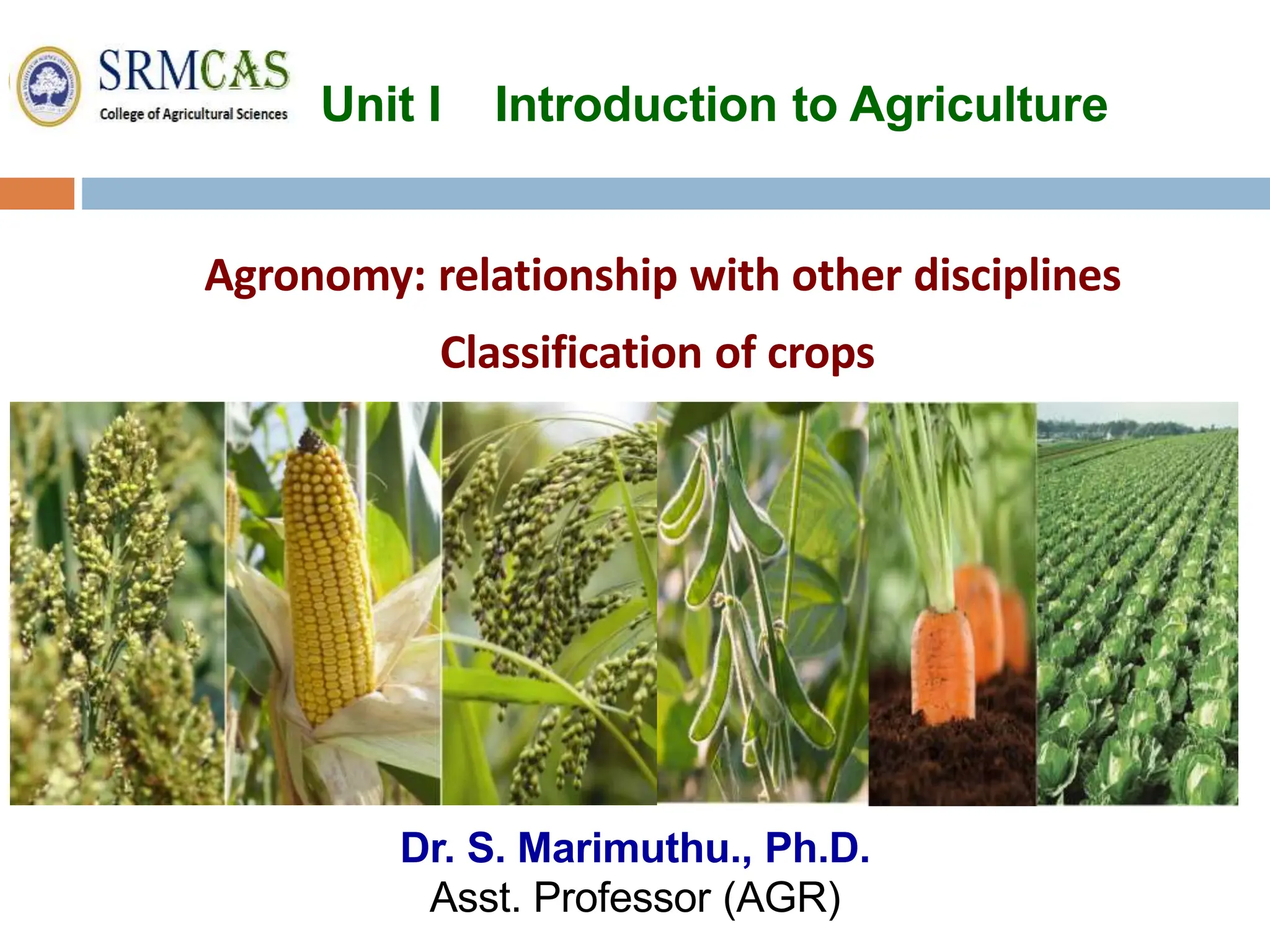
Agronomy: relationship with other disciplines
Classification of crops
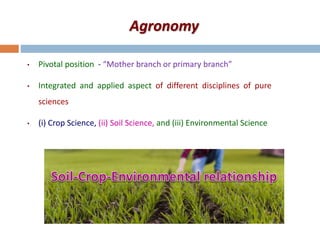
Agronomy
• Pivotal position - “Mother branch or primary branch”
• Integrated and applied aspect of different disciplines of pure
sciences
• (i) Crop Science, (ii) Soil Science, and (iii) Environmental Science
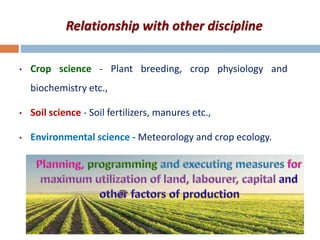
Relationship with other discipline
• Crop science - Plant breeding, crop physiology and
biochemistry etc.,
• Soil science - Soil fertilizers, manures etc.,
• Environmental science - Meteorology and crop ecology.
Crops
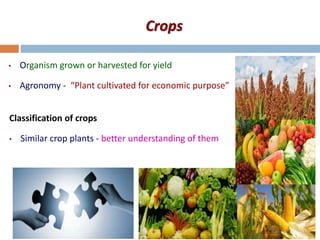
• Organism grown or harvested for yield
• Agronomy - “Plant cultivated for economic purpose”
Classification of crops
• Similar crop plants - better understanding of them
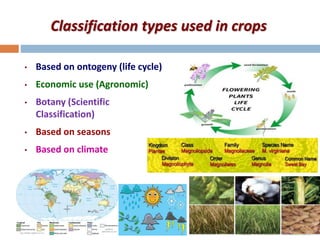
Classification types used in crops
• Based on ontogeny (life cycle)
• Economic use (Agronomic)
• Botany (Scientific
Classification)
• Based on seasons
• Based on climate
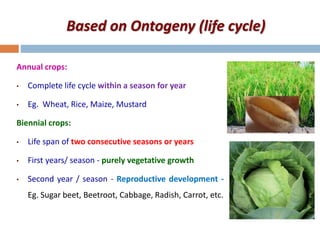
Based on Ontogeny (life cycle)
Annual crops:
• Complete life cycle within a season for year
• Eg. Wheat, Rice, Maize, Mustard
Biennial crops:
• Life span of two consecutive seasons or years
• First years/ season - purely vegetative growth
• Second year / season - Reproductive development -
Eg. Sugar beet, Beetroot, Cabbage, Radish, Carrot, etc.
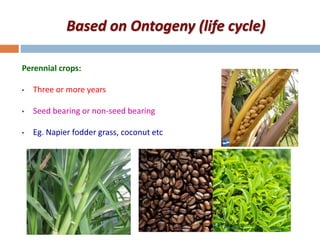
Based on Ontogeny (life cycle)
Perennial crops:
• Three or more years
• Seed bearing or non-seed bearing
• Eg. Napier fodder grass, coconut etc
Based on economic use (Agronomic)
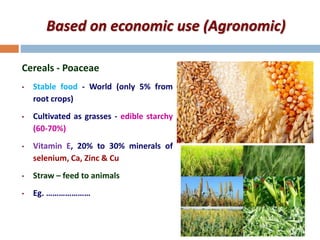
Cereals - Poaceae
• Stable food - World (only 5% from
root crops)
• Cultivated as grasses - edible starchy
(60-70%)
• Vitamin E, 20% to 30% minerals of
selenium, Ca, Zinc & Cu
• Straw – feed to animals
• Eg. …………………
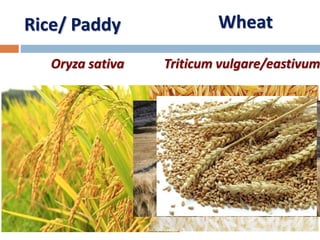
Rice/ Paddy
Oryza sativa
Wheat
Triticum vulgare/eastivum
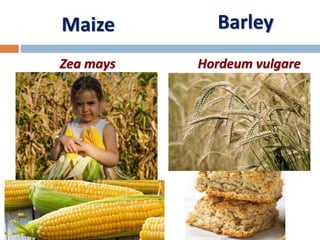
Maize
Zea mays
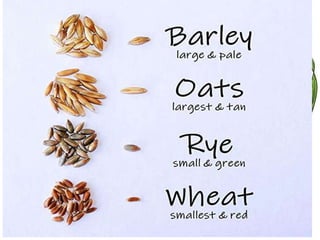
Barley
Hordeum vulgare
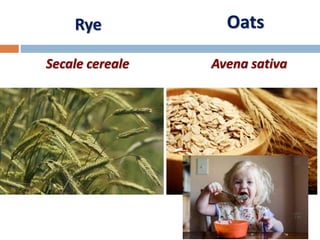
Rye
Secale cereale
Oats
Avena sativa
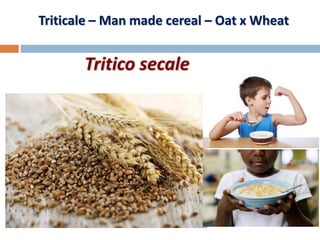
Triticale – Man made cereal – Oat x Wheat
Tritico secale
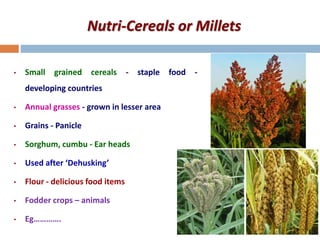
Nutri-Cereals or Millets
• Small grained cereals - staple food -
developing countries
• Annual grasses - grown in lesser area
• Grains - Panicle
• Sorghum, cumbu - Ear heads
• Used after ‘Dehusking’
• Flour - delicious food items
• Fodder crops – animals
• Eg………….
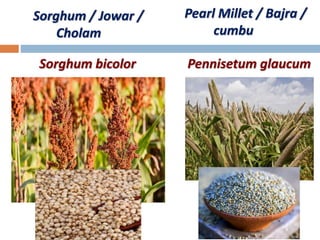
Sorghum / Jowar /
Cholam
Sorghum bicolor
Pearl Millet / Bajra /
cumbu
Pennisetum glaucum
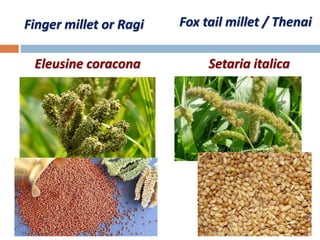
Finger millet or Ragi
Eleusine coracona
Fox tail millet / Thenai
Setaria italica
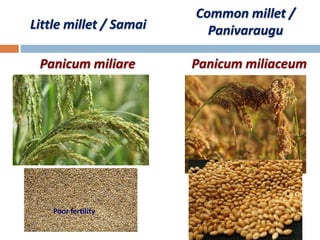
Little millet / Samai
Panicum miliare
Common millet /
Panivaraugu
Panicum miliaceum
Poor fertility
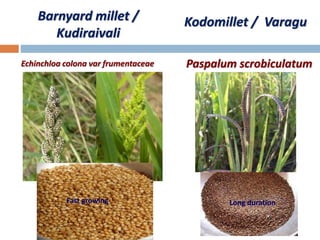
Barnyard millet /
Kudiraivali
Echinchloa colona var frumentaceae
Kodomillet / Varagu
Paspalum scrobiculatum
Fast growing Long duration
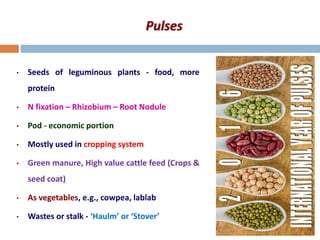
Pulses
• Seeds of leguminous plants - food, more
protein
• N fixation – Rhizobium – Root Nodule
• Pod - economic portion
• Mostly used in cropping system
• Green manure, High value cattle feed (Crops &
seed coat)
• As vegetables, e.g., cowpea, lablab
• Wastes or stalk - ‘Haulm’ or ‘Stover’
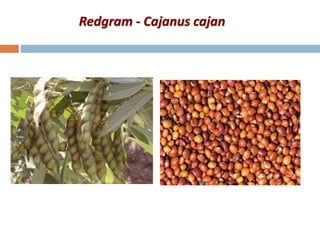
Redgram - Cajanus cajan
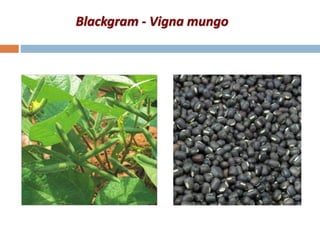
Blackgram - Vigna mungo
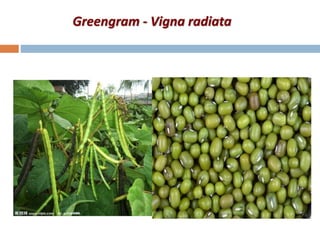
Greengram - Vigna radiata
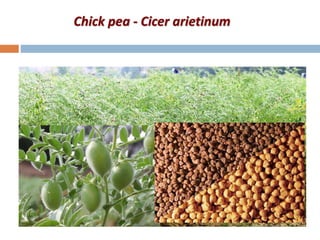
Chick pea - Cicer arietinum
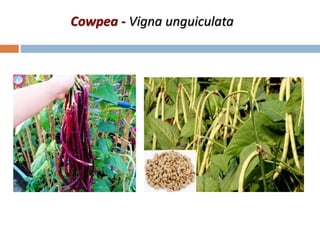
Cowpea - Vigna unguiculata
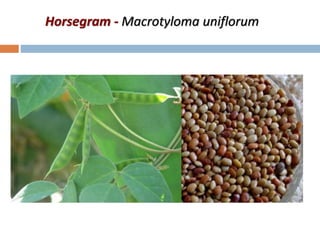
Horsegram - Macrotyloma uniflorum
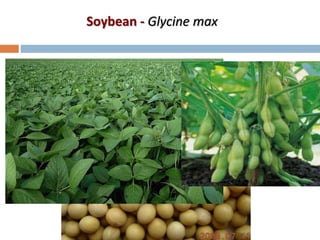
Soybean - Glycine max
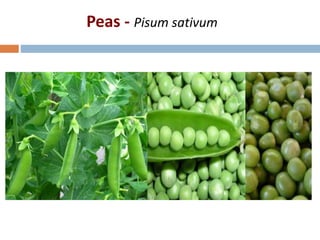
Peas - Pisum sativum
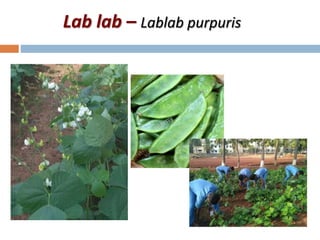
Lab lab – Lablab purpuris
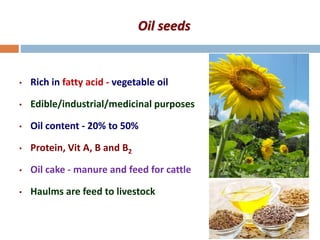
Oil seeds
• Rich in fatty acid - vegetable oil
• Edible/industrial/medicinal purposes
• Oil content - 20% to 50%
• Protein, Vit A, B and B2
• Oil cake - manure and feed for cattle
• Haulms are feed to livestock
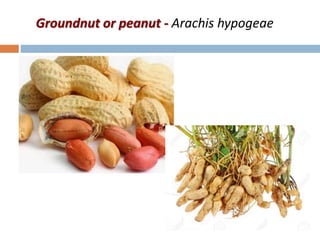
Groundnut or peanut - Arachis hypogeae
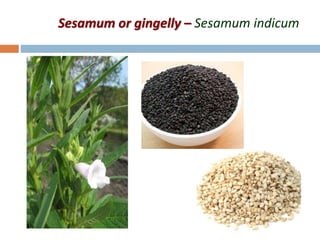
Sesamum or gingelly – Sesamum indicum
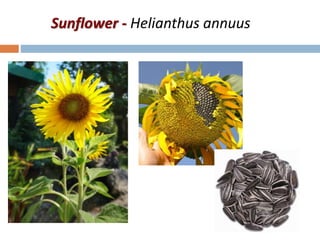
Sunflower - Helianthus annuus
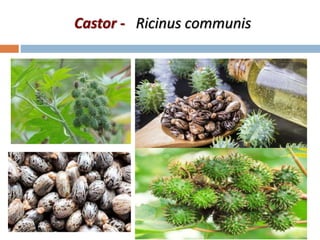
Castor - Ricinus communis
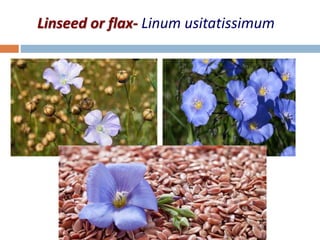
Linseed or flax- Linum usitatissimum
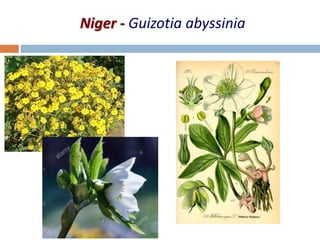
Niger - Guizotia abyssinia
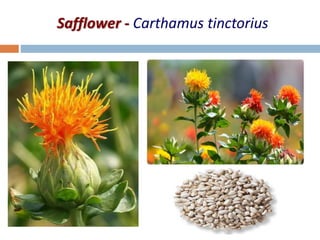
Safflower - Carthamus tinctorius
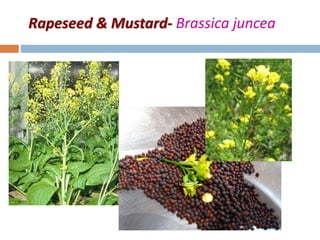
Rapeseed & Mustard- Brassica juncea
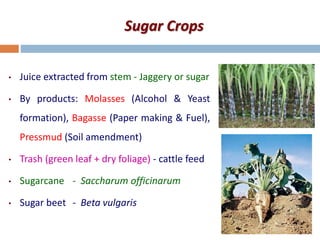
Sugar Crops
• Juice extracted from stem - Jaggery or sugar
• By products: Molasses (Alcohol & Yeast
formation), Bagasse (Paper making & Fuel),
Pressmud (Soil amendment)
• Trash (green leaf + dry foliage) - cattle feed
• Sugarcane - Saccharum officinarum
• Sugar beet - Beta vulgaris
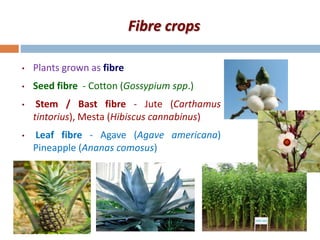
Fibre crops
• Plants grown as fibre
• Seed fibre - Cotton (Gossypium spp.)
• Stem / Bast fibre - Jute (Carthamus
tintorius), Mesta (Hibiscus cannabinus)
• Leaf fibre - Agave (Agave americana)
Pineapple (Ananas comosus)
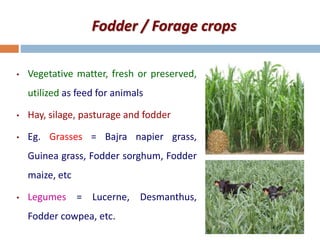
Fodder / Forage crops
• Vegetative matter, fresh or preserved,
utilized as feed for animals
• Hay, silage, pasturage and fodder
• Eg. Grasses = Bajra napier grass,
Guinea grass, Fodder sorghum, Fodder
maize, etc
• Legumes = Lucerne, Desmanthus,
Fodder cowpea, etc.
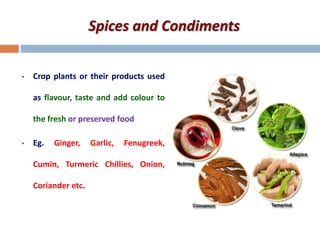
Spices and Condiments
• Crop plants or their products used
as flavour, taste and add colour to
the fresh or preserved food
• Eg. Ginger, Garlic, Fenugreek,
Cumin, Turmeric Chillies, Onion,
Coriander etc.
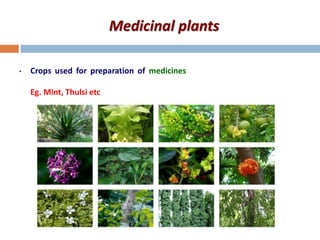
Medicinal plants
• Crops used for preparation of medicines
Eg. Mint, Thulsi etc
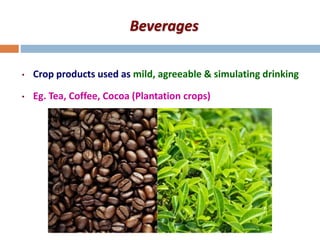
Beverages
• Crop products used as mild, agreeable & simulating drinking
• Eg. Tea, Coffee, Cocoa (Plantation crops)
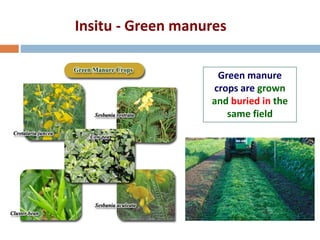
Green manure
crops are grown
and buried in the
same field
Insitu - Green manures
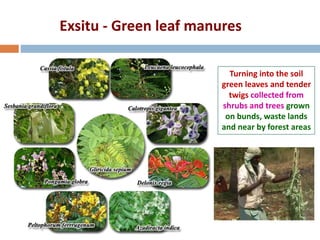
Exsitu - Green leaf manures
Turning into the soil
green leaves and tender
twigs collected from
shrubs and trees grown
on bunds, waste lands
and near by forest areas
GM Vs GLM
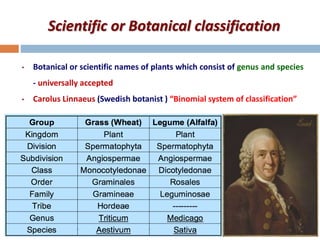
Scientific or Botanical classification
• Botanical or scientific names of plants which consist of genus and species
- universally accepted
• Carolus Linnaeus (Swedish botanist ) “Binomial system of classification”
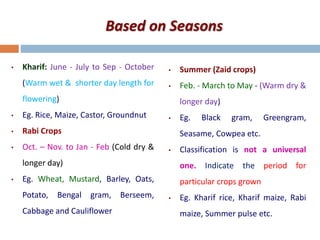
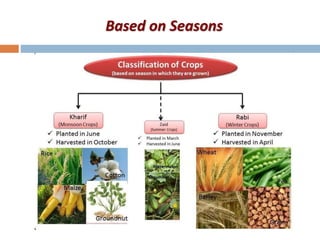
Based on Seasons
• Kharif: June - July to Sep - October
(Warm wet & shorter day length for
flowering)
• Eg. Rice, Maize, Castor, Groundnut
• Rabi Crops
• Oct. – Nov. to Jan - Feb (Cold dry &
longer day)
• Eg. Wheat, Mustard, Barley, Oats,
Potato, Bengal gram, Berseem,
Cabbage and Cauliflower
• Summer (Zaid crops)
• Feb. - March to May - (Warm dry &
longer day)
• Eg. Black gram, Greengram,
Seasame, Cowpea etc.
• Classification is not a universal
one. Indicate the period for
particular crops grown
• Eg. Kharif rice, Kharif maize, Rabi
maize, Summer pulse etc.
Based on Seasons
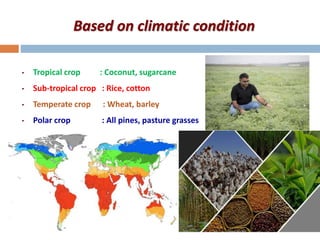
Based on climatic condition
• Tropical crop : Coconut, sugarcane
• Sub-tropical crop : Rice, cotton
• Temperate crop : Wheat, barley
• Polar crop : All pines, pasture grasses
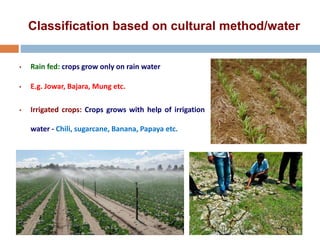
Classification based on cultural method/water
• Rain fed: crops grow only on rain water
• E.g. Jowar, Bajara, Mung etc.
• Irrigated crops: Crops grows with help of irrigation
water - Chili, sugarcane, Banana, Papaya etc.
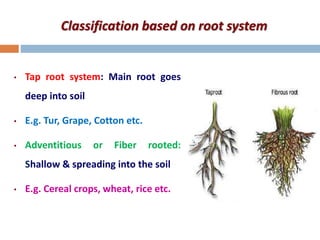
Classification based on root system
• Tap root system: Main root goes
deep into soil
• E.g. Tur, Grape, Cotton etc.
• Adventitious or Fiber rooted:
Shallow & spreading into the soil
• E.g. Cereal crops, wheat, rice etc.
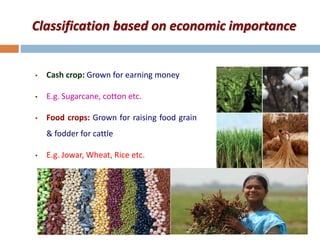
Classification based on economic importance
• Cash crop: Grown for earning money
• E.g. Sugarcane, cotton etc.
• Food crops: Grown for raising food grain
& fodder for cattle
• E.g. Jowar, Wheat, Rice etc.
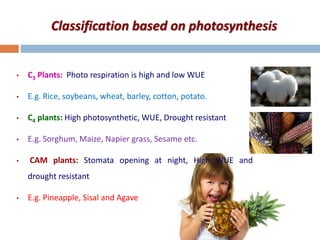
Classification based on photosynthesis
• C3 Plants: Photo respiration is high and low WUE
• E.g. Rice, soybeans, wheat, barley, cotton, potato.
• C4 plants: High photosynthetic, WUE, Drought resistant
• E.g. Sorghum, Maize, Napier grass, Sesame etc.
• CAM plants: Stomata opening at night, High WUE and
drought resistant
• E.g. Pineapple, Sisal and Agave
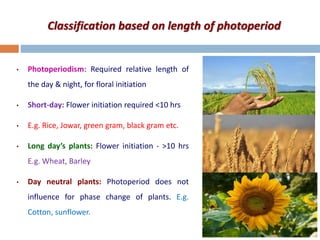
Classification based on length of photoperiod
• Photoperiodism: Required relative length of
the day & night, for floral initiation
• Short-day: Flower initiation required <10 hrs
• E.g. Rice, Jowar, green gram, black gram etc.
• Long day’s plants: Flower initiation - >10 hrs
E.g. Wheat, Barley
• Day neutral plants: Photoperiod does not
influence for phase change of plants. E.g.
Cotton, sunflower.
Thanks a lot

Agronomic Crops Classification - Agriculture

  • 1.
    Unit I Introductionto Agriculture Dr. S. Marimuthu., Ph.D. Asst. Professor (AGR) Agronomy: relationship with other disciplines Classification of crops
  • 2.
    Agronomy • Pivotal position- “Mother branch or primary branch” • Integrated and applied aspect of different disciplines of pure sciences • (i) Crop Science, (ii) Soil Science, and (iii) Environmental Science
  • 3.
    Relationship with otherdiscipline • Crop science - Plant breeding, crop physiology and biochemistry etc., • Soil science - Soil fertilizers, manures etc., • Environmental science - Meteorology and crop ecology.
  • 4.
    Crops • Organism grownor harvested for yield • Agronomy - “Plant cultivated for economic purpose” Classification of crops • Similar crop plants - better understanding of them
  • 5.
    Classification types usedin crops • Based on ontogeny (life cycle) • Economic use (Agronomic) • Botany (Scientific Classification) • Based on seasons • Based on climate
  • 6.
    Based on Ontogeny(life cycle) Annual crops: • Complete life cycle within a season for year • Eg. Wheat, Rice, Maize, Mustard Biennial crops: • Life span of two consecutive seasons or years • First years/ season - purely vegetative growth • Second year / season - Reproductive development - Eg. Sugar beet, Beetroot, Cabbage, Radish, Carrot, etc.
  • 7.
    Based on Ontogeny(life cycle) Perennial crops: • Three or more years • Seed bearing or non-seed bearing • Eg. Napier fodder grass, coconut etc
  • 8.
    Based on economicuse (Agronomic) Cereals - Poaceae • Stable food - World (only 5% from root crops) • Cultivated as grasses - edible starchy (60-70%) • Vitamin E, 20% to 30% minerals of selenium, Ca, Zinc & Cu • Straw – feed to animals • Eg. …………………
  • 9.
  • 10.
  • 11.
  • 12.
    Triticale – Manmade cereal – Oat x Wheat Tritico secale
  • 14.
    Nutri-Cereals or Millets •Small grained cereals - staple food - developing countries • Annual grasses - grown in lesser area • Grains - Panicle • Sorghum, cumbu - Ear heads • Used after ‘Dehusking’ • Flour - delicious food items • Fodder crops – animals • Eg………….
  • 15.
    Sorghum / Jowar/ Cholam Sorghum bicolor Pearl Millet / Bajra / cumbu Pennisetum glaucum
  • 16.
    Finger millet orRagi Eleusine coracona Fox tail millet / Thenai Setaria italica
  • 17.
    Little millet /Samai Panicum miliare Common millet / Panivaraugu Panicum miliaceum Poor fertility
  • 18.
    Barnyard millet / Kudiraivali Echinchloacolona var frumentaceae Kodomillet / Varagu Paspalum scrobiculatum Fast growing Long duration
  • 19.
    Pulses • Seeds ofleguminous plants - food, more protein • N fixation – Rhizobium – Root Nodule • Pod - economic portion • Mostly used in cropping system • Green manure, High value cattle feed (Crops & seed coat) • As vegetables, e.g., cowpea, lablab • Wastes or stalk - ‘Haulm’ or ‘Stover’
  • 20.
  • 21.
  • 22.
  • 23.
    Chick pea -Cicer arietinum
  • 24.
    Cowpea - Vignaunguiculata
  • 25.
  • 26.
  • 27.
    Peas - Pisumsativum
  • 28.
    Lab lab –Lablab purpuris
  • 29.
    Oil seeds • Richin fatty acid - vegetable oil • Edible/industrial/medicinal purposes • Oil content - 20% to 50% • Protein, Vit A, B and B2 • Oil cake - manure and feed for cattle • Haulms are feed to livestock
  • 30.
    Groundnut or peanut- Arachis hypogeae
  • 31.
    Sesamum or gingelly– Sesamum indicum
  • 32.
  • 33.
  • 34.
    Linseed or flax-Linum usitatissimum
  • 35.
  • 36.
  • 37.
    Rapeseed & Mustard-Brassica juncea
  • 38.
    Sugar Crops • Juiceextracted from stem - Jaggery or sugar • By products: Molasses (Alcohol & Yeast formation), Bagasse (Paper making & Fuel), Pressmud (Soil amendment) • Trash (green leaf + dry foliage) - cattle feed • Sugarcane - Saccharum officinarum • Sugar beet - Beta vulgaris
  • 39.
    Fibre crops • Plantsgrown as fibre • Seed fibre - Cotton (Gossypium spp.) • Stem / Bast fibre - Jute (Carthamus tintorius), Mesta (Hibiscus cannabinus) • Leaf fibre - Agave (Agave americana) Pineapple (Ananas comosus)
  • 40.
    Fodder / Foragecrops • Vegetative matter, fresh or preserved, utilized as feed for animals • Hay, silage, pasturage and fodder • Eg. Grasses = Bajra napier grass, Guinea grass, Fodder sorghum, Fodder maize, etc • Legumes = Lucerne, Desmanthus, Fodder cowpea, etc.
  • 41.
    Spices and Condiments •Crop plants or their products used as flavour, taste and add colour to the fresh or preserved food • Eg. Ginger, Garlic, Fenugreek, Cumin, Turmeric Chillies, Onion, Coriander etc.
  • 42.
    Medicinal plants • Cropsused for preparation of medicines Eg. Mint, Thulsi etc
  • 43.
    Beverages • Crop productsused as mild, agreeable & simulating drinking • Eg. Tea, Coffee, Cocoa (Plantation crops)
  • 44.
    Green manure crops aregrown and buried in the same field Insitu - Green manures
  • 45.
    Exsitu - Greenleaf manures Turning into the soil green leaves and tender twigs collected from shrubs and trees grown on bunds, waste lands and near by forest areas
  • 46.
  • 47.
    Scientific or Botanicalclassification • Botanical or scientific names of plants which consist of genus and species - universally accepted • Carolus Linnaeus (Swedish botanist ) “Binomial system of classification”
  • 48.
    Based on Seasons •Kharif: June - July to Sep - October (Warm wet & shorter day length for flowering) • Eg. Rice, Maize, Castor, Groundnut • Rabi Crops • Oct. – Nov. to Jan - Feb (Cold dry & longer day) • Eg. Wheat, Mustard, Barley, Oats, Potato, Bengal gram, Berseem, Cabbage and Cauliflower • Summer (Zaid crops) • Feb. - March to May - (Warm dry & longer day) • Eg. Black gram, Greengram, Seasame, Cowpea etc. • Classification is not a universal one. Indicate the period for particular crops grown • Eg. Kharif rice, Kharif maize, Rabi maize, Summer pulse etc.
  • 49.
  • 50.
    Based on climaticcondition • Tropical crop : Coconut, sugarcane • Sub-tropical crop : Rice, cotton • Temperate crop : Wheat, barley • Polar crop : All pines, pasture grasses
  • 51.
    Classification based oncultural method/water • Rain fed: crops grow only on rain water • E.g. Jowar, Bajara, Mung etc. • Irrigated crops: Crops grows with help of irrigation water - Chili, sugarcane, Banana, Papaya etc.
  • 52.
    Classification based onroot system • Tap root system: Main root goes deep into soil • E.g. Tur, Grape, Cotton etc. • Adventitious or Fiber rooted: Shallow & spreading into the soil • E.g. Cereal crops, wheat, rice etc.
  • 53.
    Classification based oneconomic importance • Cash crop: Grown for earning money • E.g. Sugarcane, cotton etc. • Food crops: Grown for raising food grain & fodder for cattle • E.g. Jowar, Wheat, Rice etc.
  • 54.
    Classification based onphotosynthesis • C3 Plants: Photo respiration is high and low WUE • E.g. Rice, soybeans, wheat, barley, cotton, potato. • C4 plants: High photosynthetic, WUE, Drought resistant • E.g. Sorghum, Maize, Napier grass, Sesame etc. • CAM plants: Stomata opening at night, High WUE and drought resistant • E.g. Pineapple, Sisal and Agave
  • 55.
    Classification based onlength of photoperiod • Photoperiodism: Required relative length of the day & night, for floral initiation • Short-day: Flower initiation required <10 hrs • E.g. Rice, Jowar, green gram, black gram etc. • Long day’s plants: Flower initiation - >10 hrs E.g. Wheat, Barley • Day neutral plants: Photoperiod does not influence for phase change of plants. E.g. Cotton, sunflower.
  • 56.