Operating, Calibrating, and
Maintaining Agricultural
Planting Systems
akkoradia51@gmail.com
Bell Work / Objectives
Describe the operating principles of planting
equipment.
Identify the types of planting equipment.
Identify the components of row-crop planting
equipment.
Identify the components of solid planting equipment.
Explain the calibration of planting equipment
Identify maintenance procedures for planting
equipment.
Terms
Broadcasting
Checkrow
planting
Field calibration
Germination
Hill drop planting
Population
Row-crop planting
Solid planting
Starter fertilizer
The Beginning
Interest Approach
Show students a kernel of corn, and a
small, average, and large ear of corn.
( or three kernel, or three different types
of seed) Lead a discussion on where
the kernel and the ears came from. Ask
students what causes the different sizes
of ears of corn and why is the size of an
ear of corn important?
Objective #1
What are the operating
principles of planting
equipment?
Basic Functions of the planter
Open a furrow in the soil
– seed must be in contact with moist soil to
germinate
– germinate
change from a dormant condition to one of activity &
growth
– places each seed in equal depth regardless of soil
conditions
– furrow opener accomplishes this
Meter the seed to the soil
– specific seed rates are needed
– accomplished by metering devices on the planter
Basic Functions of the planter
Place seed in soil
– yields depends on moisture seed depth & spacing
Covers the seed
– seed must have protection in order to survive
– accomplished by press wheels on planters and
chains or drags on drills
Firm the seedbed
– provides adequate seed to soil contact
– press wheels and drag chains accomplish this
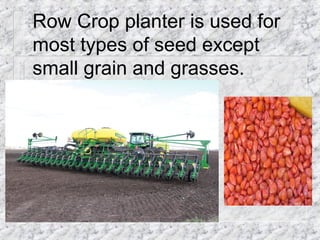
Row Crop planter is used for
most types of seed except
small grain and grasses.
Objective #2
What are the types of planting
equipment?
Types of planting equipment
Row crop planting
– require precise row spacing and even spacing of
plants within the row
– planted in rows far enough apart to permit
operation of machinery such as cultivators and
harvesters
– generally corn, soybeans, sorghum, vegetables &
cotton
Grain drills and air seeders
– used to sow crops such as alfalfa, oats, barley,
and other small grains and soybeans
Grain Drill!
Wheat is planted with a grain
drill!
Some crops such as rice
require specialized planters!
Types of planting equipment
Broadcast seeders
– used to broadcast small grains, grasses &
legumes
– broadcasting
– seeds are scattered on a random, non-row basis
on top of the seedbed
Specialized planters
– designed for special planting operations
– examples include: potato planter, vegetable
planter, and transplanters
Broadcast planter!
Types of Row crop planters
Drill planting method
– seeds are dropped individually in the row at given
distances
– spacing depends on population
– population
– number of seeds or plants desired per acre
Hill drop planting
– seeds are located in hills of 2 to 5 seeds per hill
Checkrow planting
– 3 to 5 seeds dropped in hills same distance in all
directions
Objective #3
What are the components of row-
crop planting equipment?
Frames used on planters
Drawn or trailing planter
– has its own wheels in contact with the soil
– units are mounted on the main frame
– attached to tractor by a tongue
– raised and lowered by hydraulic cylinders
Integral planter frame
– attached by a 3 point hitch on tractor
Tool-bar planter
– has its own frame and drives
– attached to a tool bar either on tractor or
implement
Planter drives
Deliver the correct spacing of seeds in
the row at varying travel speeds under
varying soil and topographical
conditions
Either ground driven or hydraulic driven.
Ground driven drives
Carrying-wheel drives
– used on most trailing type planters
– power comes from transport wheels through a
series of chains, sprockets, gears and shafts
– populations changed by changing sprocket sizes
Gauge-wheel drives
– used on the tool bar planters
– power comes from the transport wheels
– populations changed by changing sprocket sizes
Ground driven drives
Press-wheel drives
– Power is transmitted through a drive chain
and sprocket between the seed bin and
packing wheel.
– Slippage is greater because press wheel
running in loose soil and pressure on
wheels might not be enough to prevent
slippage.
– Plant populations changed by changing
sprockets in the planter.
– A single planter is used for multiple crops
by changing plates and sprockets.
Hydraulic drives
Operated by tractor’s hydraulic system.
Hydraulic motor mounted on planter drives
metering system through chains & sprockets.
Seeding population controlled using variable
rate technology (VRT).
Radar gun or Global Positioning System
(GPS) used to automatically adjust population
depending on ground speed.
Furrow openers
Major function is to
open a well defined
groove in the soil
where the seed is
placed at proper
depth and in contact
with soil
Furrow openers
V-trench
– 2 sharply angled disks and close hugging gauge
wheels are used to make a V-shaped trench
Disk openers
– 2 sharply angled disks are used to make a V-
shaped trench
Runner openers
– runner opener widens from the front to rear which
has formed a furrow
Furrow openers
Combination runner and double disk
openers
– advantages from both types
Shovel openers
– used to prepare a seed slot in sticky soil
conditions
Seed metering device
Function of seed
metering device is to
deliver seeds from
the hopper to the
seed placing
mechanism at a
selected rate
Seed Plate Metering System
Seed plate metering system
Has a seed plate with openings that rotates.
Seed plate turns, seeds fall into openings.
One kernel/seed at a time if proper size is
selected.
Spring loaded pawl keeps other seeds out.
When plate passes over the discharge hole a
knockout pawl ejects the seed.
Seed plates have to be changed to match
seed size.
Finger-pickup metering system
Eliminates changing of plates.
Fingers pickup individual kernels.
Has 12 spring loaded fingers that open &
close by a cam as they rotate.
Fingers select one individual kernel/seed.
Delivers it to the discharge tube.
Goes to the seed placement mechanism.
Three types of air metering systems
Pressurized
metering drum
Pressurized
metering disk
Vacuum metering
disk
Pressurized metering drum
Uses PTO or hydraulic motor fan to
pressurize the seed hopper and drum.
Drum has holes around its circumference for
each row to be planted.
Pressure inside drum is higher than outside.
Seeds are held due to this pressure.
Discharge manifold, a release wheel releases
seed into seed delivery tube
Air pushes seed to row planting unit.
Pressurized metering disk
Vacuum System
Vacuum System
Seeds are held in openings by atmospheric
air pressure.
Seed cut off wiper removes excess seeds.
Vacuum metering system use hydraulic
powered pump to create consistent vacuum
to each unit.
Volume Metered Systems
Metered on basis of spacing, weight or
volume per acre
common types
– feed cup
– picker wheel
– adjustable hole
– adjustable cutoff plate
Volume metering systems
Feed cup
– has scallops on inside feed cup, fed into from
hopper, carried upward, discharged into seed
tubes
Picker wheel
– used on cotton
Adjustable hole
– agitator moves seeds over hole to delivery tube
Adjustable cutoff plate
– seeds flow through a stationary cutoff plate onto a
rotating dome type seed plate to the discharge
tube
Seed Placement Mechanism
Function is to accept
seed from metering
device, drop it into
the seed tube, and
deliver it to the
furrow properly
spaced
Seed Placement Mechanism
Gravity drop
– simplest and least expensive
– disadvantage is not placing seed uniformly
because planter is moving
seed conveyor belt
– used with finger pickup
– seed is placed on a belt to be delivered to the soil
– seed placement is very accurate
Seed Placement Mechanism
Rotary valve
– used with plate-type metering system
– valve holds seed until a lobe ejects the seed
Chain drop
– picks up seed at metering devices carries it to soil
then ejected to soil
Air seed drop
– uses air velocity to transport seed to soil
Seeds planted at proper depth
Depth control devices required
gauge wheels are found in different
places of planters
best place is beside furrow openers
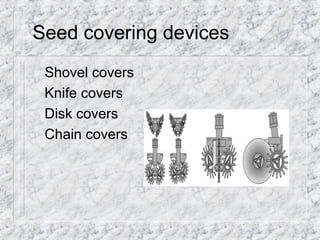
Seed covering devices
Shovel covers
Knife covers
Disk covers
Chain covers
Seed Monitors
Function is to alert the operator of a planter
malfunctions.
Contains a photo-electric eye at seed tube
that senses the seed as it falls.
Sends information to the monitor.
Monitor displays information to operator.
Other attachments
Starter fertilizer
– fertilizer applied at planting time
Fertilizers and pesticides can be applied
through the planter either in dry, granular, or
liquid.
Tillage attachments can be added to reduce
other passes over the field.
Objective #4
What are the components of solid
planting equipment?
Solid planting devices
Solid planting
– row spacing is too
close to permit
cultivating between
the rows
grain drills, air
seeders, broadcast
seeders, airplanes,
& helicopters
Types of drills
End-wheel drill
– has wheels that support and drive drill
Press-wheel drill
– has press wheel gangs mounted at rear of drill
that firms the soil, drives the metering system, and
supports the drill
Tiling drill
– same as end-wheel with a power driven cutter that
prepares the seedbed
Calibrating the planter
Proper field adjustment and operation of
planting equipment can lead to better yields
operator’s manual is used as a guide for
initial planter settings
Field calibration
– the process of actually checking and making final
adjustments to the planter
Calibrating the planter
Fill seed hoppers 1/2 full
tie up covering wheels
mark row distance equal to 1/1000 acre
plant measured distance at normal speed
count seeds in the row
multiply number of seeds X 1000
equals your population rate
Proper Maintenance
Proper servicing can
mean difference
between profitable
crop and high
losses.
Planters are
precision
instruments they
require large
amounts of care.
Servicing planter before season
Clean planter thoroughly.
Check for obstructions to keep the
mechanisms operating properly.
Inspect metering systems for worn or broken
parts.
Repair or replace any damaged parts.
Check all bolts and hoses for tightness.
Servicing during season
Store planter away from moisture when
not in use.
Use correct type of lubricant.
Lubricate at appropriate times.
Avoid getting dirt into bearings.
Wipe of fittings before lubricating.
Review
What are the operating principles of planting
equipment?
What are the types of planting equipment?
What are the components of row-crop
planting equipment?
What are the components of solid planting
equipment?
What are the maintenance procedures for
planting equipment?
The End

Planting Systems

  • 1.
    Operating, Calibrating, and MaintainingAgricultural Planting Systems akkoradia51@gmail.com
  • 2.
    Bell Work /Objectives Describe the operating principles of planting equipment. Identify the types of planting equipment. Identify the components of row-crop planting equipment. Identify the components of solid planting equipment. Explain the calibration of planting equipment Identify maintenance procedures for planting equipment.
  • 3.
    Terms Broadcasting Checkrow planting Field calibration Germination Hill dropplanting Population Row-crop planting Solid planting Starter fertilizer
  • 4.
  • 5.
    Interest Approach Show studentsa kernel of corn, and a small, average, and large ear of corn. ( or three kernel, or three different types of seed) Lead a discussion on where the kernel and the ears came from. Ask students what causes the different sizes of ears of corn and why is the size of an ear of corn important?
  • 6.
    Objective #1 What arethe operating principles of planting equipment?
  • 7.
    Basic Functions ofthe planter Open a furrow in the soil – seed must be in contact with moist soil to germinate – germinate change from a dormant condition to one of activity & growth – places each seed in equal depth regardless of soil conditions – furrow opener accomplishes this Meter the seed to the soil – specific seed rates are needed – accomplished by metering devices on the planter
  • 8.
    Basic Functions ofthe planter Place seed in soil – yields depends on moisture seed depth & spacing Covers the seed – seed must have protection in order to survive – accomplished by press wheels on planters and chains or drags on drills Firm the seedbed – provides adequate seed to soil contact – press wheels and drag chains accomplish this
  • 9.
    Row Crop planteris used for most types of seed except small grain and grasses.
  • 10.
    Objective #2 What arethe types of planting equipment?
  • 11.
    Types of plantingequipment Row crop planting – require precise row spacing and even spacing of plants within the row – planted in rows far enough apart to permit operation of machinery such as cultivators and harvesters – generally corn, soybeans, sorghum, vegetables & cotton Grain drills and air seeders – used to sow crops such as alfalfa, oats, barley, and other small grains and soybeans
  • 12.
  • 13.
    Wheat is plantedwith a grain drill!
  • 14.
    Some crops suchas rice require specialized planters!
  • 15.
    Types of plantingequipment Broadcast seeders – used to broadcast small grains, grasses & legumes – broadcasting – seeds are scattered on a random, non-row basis on top of the seedbed Specialized planters – designed for special planting operations – examples include: potato planter, vegetable planter, and transplanters
  • 16.
  • 17.
    Types of Rowcrop planters Drill planting method – seeds are dropped individually in the row at given distances – spacing depends on population – population – number of seeds or plants desired per acre Hill drop planting – seeds are located in hills of 2 to 5 seeds per hill Checkrow planting – 3 to 5 seeds dropped in hills same distance in all directions
  • 18.
    Objective #3 What arethe components of row- crop planting equipment?
  • 19.
    Frames used onplanters Drawn or trailing planter – has its own wheels in contact with the soil – units are mounted on the main frame – attached to tractor by a tongue – raised and lowered by hydraulic cylinders Integral planter frame – attached by a 3 point hitch on tractor Tool-bar planter – has its own frame and drives – attached to a tool bar either on tractor or implement
  • 20.
    Planter drives Deliver thecorrect spacing of seeds in the row at varying travel speeds under varying soil and topographical conditions Either ground driven or hydraulic driven.
  • 21.
    Ground driven drives Carrying-wheeldrives – used on most trailing type planters – power comes from transport wheels through a series of chains, sprockets, gears and shafts – populations changed by changing sprocket sizes Gauge-wheel drives – used on the tool bar planters – power comes from the transport wheels – populations changed by changing sprocket sizes
  • 22.
    Ground driven drives Press-wheeldrives – Power is transmitted through a drive chain and sprocket between the seed bin and packing wheel. – Slippage is greater because press wheel running in loose soil and pressure on wheels might not be enough to prevent slippage. – Plant populations changed by changing sprockets in the planter. – A single planter is used for multiple crops by changing plates and sprockets.
  • 23.
    Hydraulic drives Operated bytractor’s hydraulic system. Hydraulic motor mounted on planter drives metering system through chains & sprockets. Seeding population controlled using variable rate technology (VRT). Radar gun or Global Positioning System (GPS) used to automatically adjust population depending on ground speed.
  • 24.
    Furrow openers Major functionis to open a well defined groove in the soil where the seed is placed at proper depth and in contact with soil
  • 25.
    Furrow openers V-trench – 2sharply angled disks and close hugging gauge wheels are used to make a V-shaped trench Disk openers – 2 sharply angled disks are used to make a V- shaped trench Runner openers – runner opener widens from the front to rear which has formed a furrow
  • 26.
    Furrow openers Combination runnerand double disk openers – advantages from both types Shovel openers – used to prepare a seed slot in sticky soil conditions
  • 27.
    Seed metering device Functionof seed metering device is to deliver seeds from the hopper to the seed placing mechanism at a selected rate
  • 28.
  • 29.
    Seed plate meteringsystem Has a seed plate with openings that rotates. Seed plate turns, seeds fall into openings. One kernel/seed at a time if proper size is selected. Spring loaded pawl keeps other seeds out. When plate passes over the discharge hole a knockout pawl ejects the seed. Seed plates have to be changed to match seed size.
  • 30.
  • 31.
    Finger-pickup metering system Eliminateschanging of plates. Fingers pickup individual kernels. Has 12 spring loaded fingers that open & close by a cam as they rotate. Fingers select one individual kernel/seed. Delivers it to the discharge tube. Goes to the seed placement mechanism.
  • 32.
    Three types ofair metering systems Pressurized metering drum Pressurized metering disk Vacuum metering disk
  • 33.
  • 35.
    Pressurized metering drum UsesPTO or hydraulic motor fan to pressurize the seed hopper and drum. Drum has holes around its circumference for each row to be planted. Pressure inside drum is higher than outside. Seeds are held due to this pressure. Discharge manifold, a release wheel releases seed into seed delivery tube Air pushes seed to row planting unit.
  • 36.
  • 37.
  • 38.
    Vacuum System Seeds areheld in openings by atmospheric air pressure. Seed cut off wiper removes excess seeds. Vacuum metering system use hydraulic powered pump to create consistent vacuum to each unit.
  • 39.
    Volume Metered Systems Meteredon basis of spacing, weight or volume per acre common types – feed cup – picker wheel – adjustable hole – adjustable cutoff plate
  • 40.
    Volume metering systems Feedcup – has scallops on inside feed cup, fed into from hopper, carried upward, discharged into seed tubes Picker wheel – used on cotton Adjustable hole – agitator moves seeds over hole to delivery tube Adjustable cutoff plate – seeds flow through a stationary cutoff plate onto a rotating dome type seed plate to the discharge tube
  • 41.
    Seed Placement Mechanism Functionis to accept seed from metering device, drop it into the seed tube, and deliver it to the furrow properly spaced
  • 42.
    Seed Placement Mechanism Gravitydrop – simplest and least expensive – disadvantage is not placing seed uniformly because planter is moving seed conveyor belt – used with finger pickup – seed is placed on a belt to be delivered to the soil – seed placement is very accurate
  • 43.
    Seed Placement Mechanism Rotaryvalve – used with plate-type metering system – valve holds seed until a lobe ejects the seed Chain drop – picks up seed at metering devices carries it to soil then ejected to soil Air seed drop – uses air velocity to transport seed to soil
  • 44.
    Seeds planted atproper depth Depth control devices required gauge wheels are found in different places of planters best place is beside furrow openers
  • 45.
    Seed covering devices Shovelcovers Knife covers Disk covers Chain covers
  • 46.
    Seed Monitors Function isto alert the operator of a planter malfunctions. Contains a photo-electric eye at seed tube that senses the seed as it falls. Sends information to the monitor. Monitor displays information to operator.
  • 47.
    Other attachments Starter fertilizer –fertilizer applied at planting time Fertilizers and pesticides can be applied through the planter either in dry, granular, or liquid. Tillage attachments can be added to reduce other passes over the field.
  • 48.
    Objective #4 What arethe components of solid planting equipment?
  • 49.
    Solid planting devices Solidplanting – row spacing is too close to permit cultivating between the rows grain drills, air seeders, broadcast seeders, airplanes, & helicopters
  • 50.
    Types of drills End-wheeldrill – has wheels that support and drive drill Press-wheel drill – has press wheel gangs mounted at rear of drill that firms the soil, drives the metering system, and supports the drill Tiling drill – same as end-wheel with a power driven cutter that prepares the seedbed
  • 51.
    Calibrating the planter Properfield adjustment and operation of planting equipment can lead to better yields operator’s manual is used as a guide for initial planter settings Field calibration – the process of actually checking and making final adjustments to the planter
  • 52.
    Calibrating the planter Fillseed hoppers 1/2 full tie up covering wheels mark row distance equal to 1/1000 acre plant measured distance at normal speed count seeds in the row multiply number of seeds X 1000 equals your population rate
  • 53.
    Proper Maintenance Proper servicingcan mean difference between profitable crop and high losses. Planters are precision instruments they require large amounts of care.
  • 54.
    Servicing planter beforeseason Clean planter thoroughly. Check for obstructions to keep the mechanisms operating properly. Inspect metering systems for worn or broken parts. Repair or replace any damaged parts. Check all bolts and hoses for tightness.
  • 55.
    Servicing during season Storeplanter away from moisture when not in use. Use correct type of lubricant. Lubricate at appropriate times. Avoid getting dirt into bearings. Wipe of fittings before lubricating.
  • 56.
    Review What are theoperating principles of planting equipment? What are the types of planting equipment? What are the components of row-crop planting equipment? What are the components of solid planting equipment? What are the maintenance procedures for planting equipment?
  • 57.