CLASSIFICATION OF CROPS
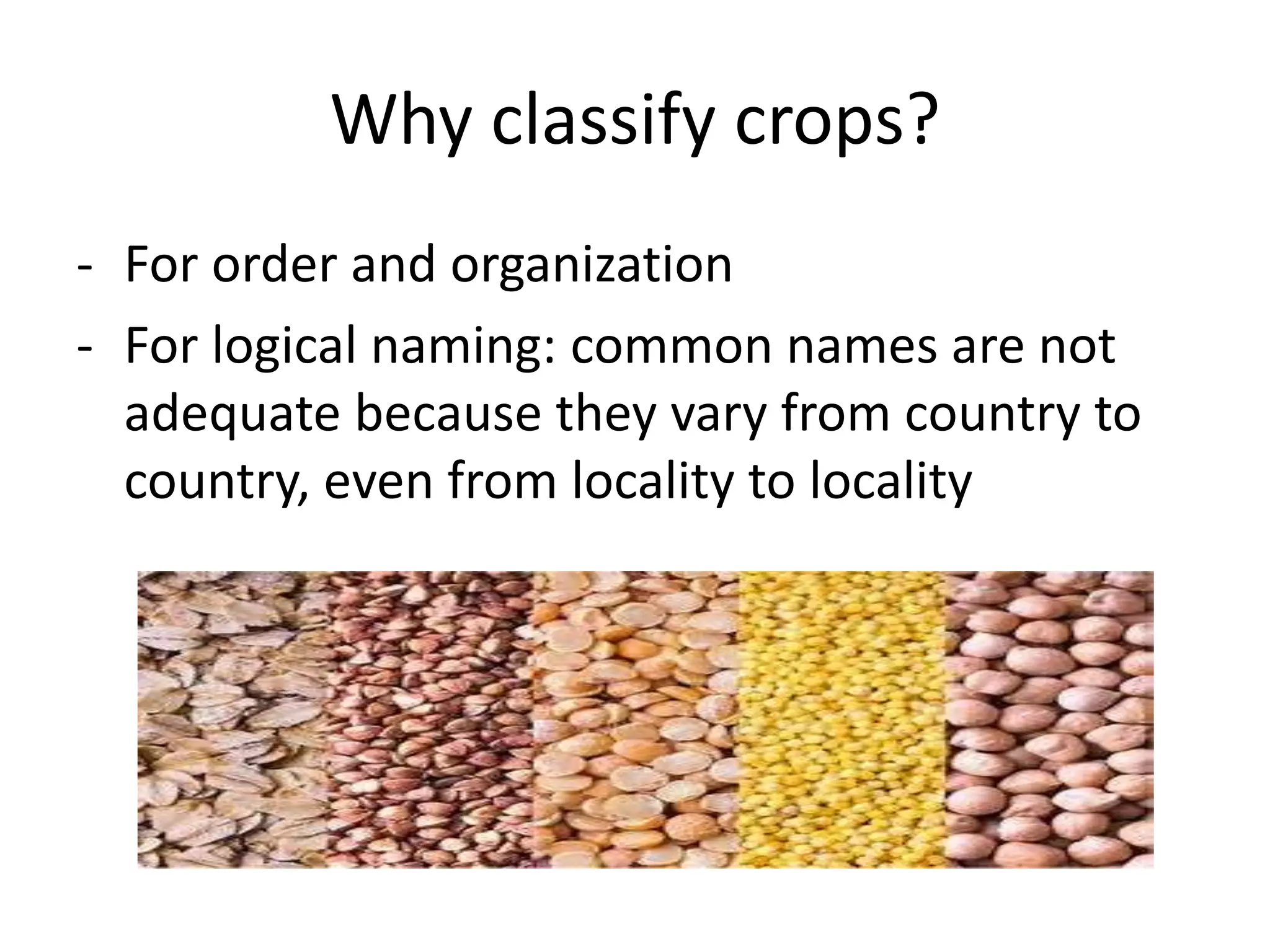
Why classify crops?
- For order and organization
- For logical naming: common names are not
adequate because they vary from country to
country, even from locality to locality
Bases for classification
• Aristotle classified plants based on structure
and size (e.g. herb, shrub, tree)
• Carolus Linnaeus classified plants based on
structure only, i.e., different species with
similar structural features
• Modern classification is based on phylogeny
(evolution of plants)
Botanical system of classification
• Classifies plants into seven categories
-Kingdom, Division, Class, Order, Family, Genus
and Species
• Additional category may be included: Variety
or Cultivar
• Example: Rice hybrid “Mestizo” can be
classified as follows:
Kingdom: Plantae
Division: Magnoliophyta
Class: Liliopsida
Order: Cyperales
Family: Graminae or Poaceae
Genus: Oryza
Species: sativa
Variety: Mestizo
Agronomic classification
• Based on the purpose for which the crop is
grown
• Categories or groups:
- cereals, legumes, root crops, fiber crop,
industrial crop (sugar and drug), forage and
pasture crop, oil crop
Horticultural classification
• Also based on the purpose for which the crop is grown
• Categories or groups:
a. Vegetable – leafy, cole or crucifers, root and
bulb, legume, solanaceous, cucurbits, tree)
b. Fruit – tree, nut, small fruit
c. Plantation – oil, fiber, beverage, spices,
condiments and essences, latex and resin, medicinal,
pesticidal
d. Ornamental – cutflower, flowering pot plants,
foliage, landscape, turf
Special purpose classificat
• Green manure
• Silage
• Catch crop
• Cover crop
• Companion crop
Other methods of classification
• Based on growth habit (vine, herb, shrub or
tree)
• Based on habitat (terrestial, aquatic, epiphtye)
• Based on lifespan (annual, biennial, perrenial)
• Based on the mode of reproduction (sexual,
asexual)

CLASSIFICATION OF CROPS.pptx

  • 1.
  • 2.
    Why classify crops? -For order and organization - For logical naming: common names are not adequate because they vary from country to country, even from locality to locality
  • 3.
    Bases for classification •Aristotle classified plants based on structure and size (e.g. herb, shrub, tree) • Carolus Linnaeus classified plants based on structure only, i.e., different species with similar structural features • Modern classification is based on phylogeny (evolution of plants)
  • 4.
    Botanical system ofclassification • Classifies plants into seven categories -Kingdom, Division, Class, Order, Family, Genus and Species • Additional category may be included: Variety or Cultivar • Example: Rice hybrid “Mestizo” can be classified as follows:
  • 5.
    Kingdom: Plantae Division: Magnoliophyta Class:Liliopsida Order: Cyperales Family: Graminae or Poaceae Genus: Oryza Species: sativa Variety: Mestizo
  • 6.
    Agronomic classification • Basedon the purpose for which the crop is grown • Categories or groups: - cereals, legumes, root crops, fiber crop, industrial crop (sugar and drug), forage and pasture crop, oil crop
  • 7.
    Horticultural classification • Alsobased on the purpose for which the crop is grown • Categories or groups: a. Vegetable – leafy, cole or crucifers, root and bulb, legume, solanaceous, cucurbits, tree) b. Fruit – tree, nut, small fruit c. Plantation – oil, fiber, beverage, spices, condiments and essences, latex and resin, medicinal, pesticidal d. Ornamental – cutflower, flowering pot plants, foliage, landscape, turf
  • 8.
    Special purpose classificat •Green manure • Silage • Catch crop • Cover crop • Companion crop
  • 9.
    Other methods ofclassification • Based on growth habit (vine, herb, shrub or tree) • Based on habitat (terrestial, aquatic, epiphtye) • Based on lifespan (annual, biennial, perrenial) • Based on the mode of reproduction (sexual, asexual)