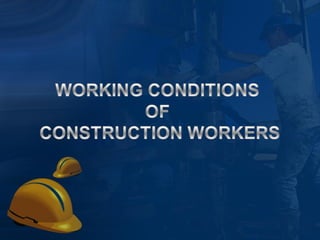
CONSTRUCTION LABOR
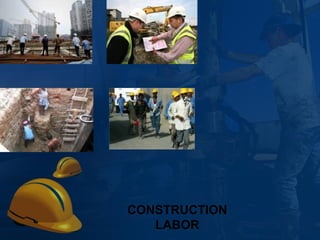
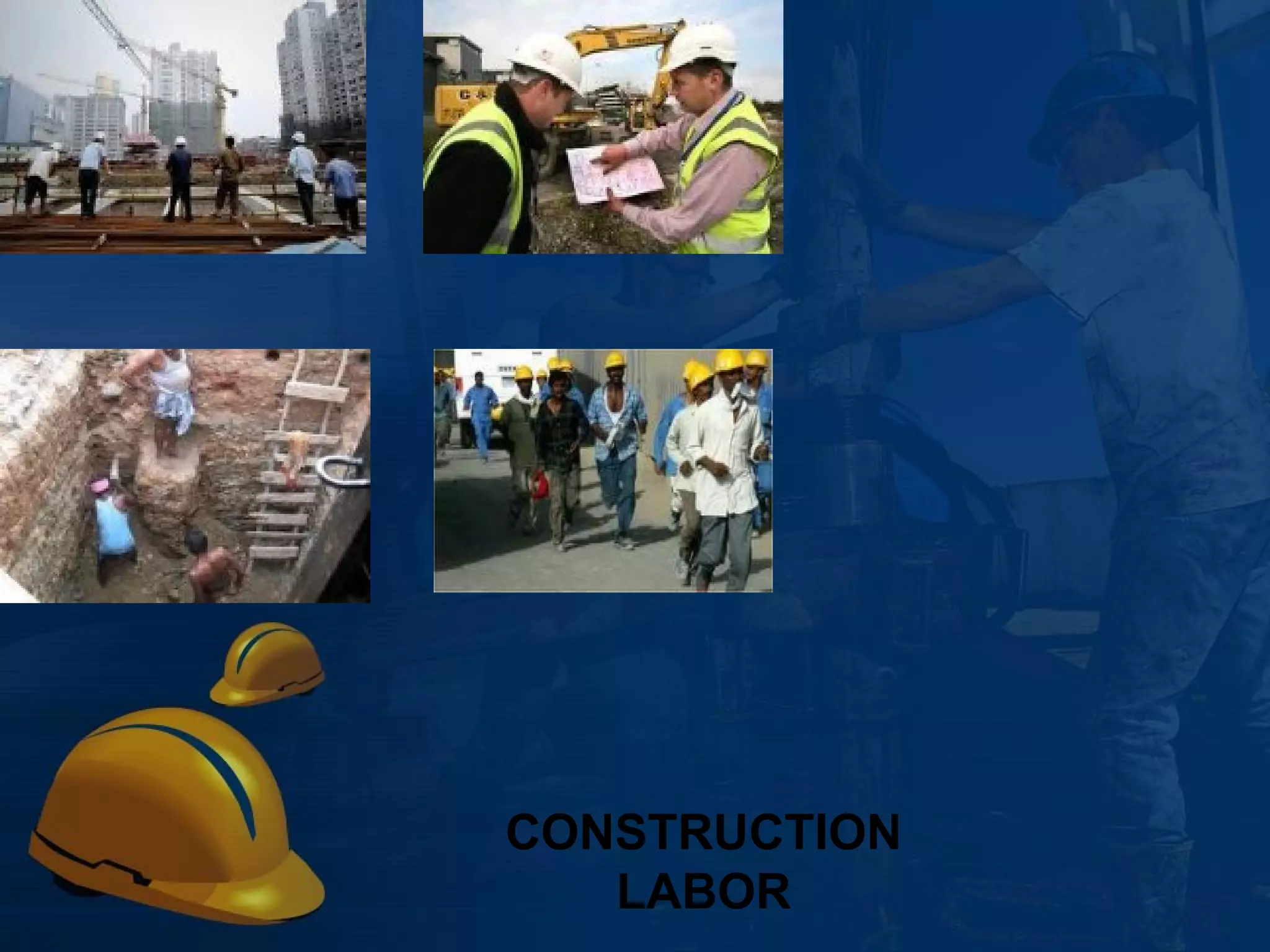
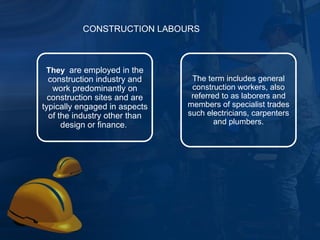
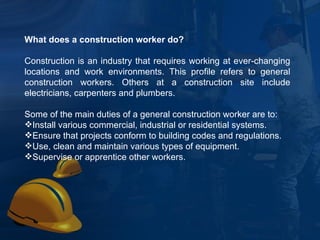
They  are employed in the construction industry and work predominantly on construction sites and are typically engaged in aspects of the industry other than design or finance.  The term includes general construction workers, also referred to as laborers and members of specialist trades such electricians, carpenters and plumbers. CONSTRUCTION LABOURS
What does a construction worker do? Construction is an industry that requires working at ever-changing locations and work environments. This profile refers to general construction workers. Others at a construction site include electricians, carpenters and plumbers. Some of the main duties of a general construction worker are to: Install various commercial, industrial or residential systems. Ensure that projects conform to building codes and regulations. Use, clean and maintain various types of equipment. Supervise or apprentice other workers.
 
The construction industry is divided into three major segments.   Construction of buildings contractors, or general contractors, build residential, industrial, commercial, and other buildings.  Heavy and civil engineering construction contractors build sewers, roads, highways, bridges, tunnels, and other projects.  Specialty trade contractors are engaged in specialized activities such as carpentry, painting, plumbing, and electrical work
 
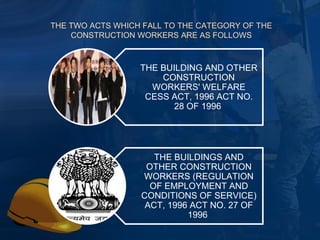
THE TWO ACTS WHICH FALL TO THE CATEGORY OF THE CONSTRUCTION WORKERS ARE AS FOLLOWS THE BUILDING AND OTHER CONSTRUCTION WORKERS' WELFARE CESS ACT, 1996 ACT NO. 28 OF 1996  THE BUILDINGS AND OTHER CONSTRUCTION WORKERS (REGULATION OF EMPLOYMENT AND CONDITIONS OF SERVICE) ACT, 1996 ACT NO. 27 OF 1996
THE BUILDING AND OTHER CONSTRUCTION WORKERS' WELFARE CESS ACT, 1996 ACT NO. 28 OF 1996 [19th August, 1996] BE it enacted by Parliament in the Forty-seventh Year of the Republic of India as follows:-  An act to provide for the levy.  And collection of a cess on the cost of construction incurred by employers with a view to augmenting the resources of the Building and Other Construction Workers' Welfare Boards constituted under the Building and Other Construction Workers (Regulation of Employment and Conditions of Service) Act, 1996.
Short title, extent and commencement.  This Act may be called the Building and Other Construction Workers' Welfare Cess Act, 1996.  (2) It extends to the whole of India.  (3) It shall be deemed to have come into force on the 3rd day of November, 1995.
BUILDING AND OTHER CONSTRUCTION WORKERS(REGULATION OF EMPLOYMENT AND WORKING CONDITIONS)ACT, 1996
There are about 8.5 million building and other construction workers in India as per the estimates of National Sample Survey (1987-88).  These workers are one of the most numerous and vulnerable segments of the unorganized sector in India.  The building and other construction works are characterized by their inherent risk to the life and limb of the workers.  The work is also characterized by its casual nature, temporary relationship between employer and employee, uncertain working hours, lack of basic amenities and inadequacy of welfare facilities.  Although the provisions of various Labor Laws i.e., Minimum Wages Act 1948, Contract Labor (Regulation & Abolition) Act1970 and Inter-State Migrant Workmen (Regulation of Employment & Conditions of Services) Act 1979 etc., are applicable to the building and other construction workers, a need was felt for a comprehensive Central Legislation for this category of workers.
The above law aims to provide for regulation of employment & conditions of service of the building and other construction workers as also their safety, health and welfare measures in every establishment which employs or employed during the preceding year ten or more workers.  The exception made is only in respect of residential houses for own purpose constructed with a cost not exceeding Rs. 10 lakh and such other activities to which the provisions of Factories Act, 1948 and Mines Act, 1952 apply. AIM:
 
TYPES OF CONSTRUCTION WORKERS Pipe fitter layers Sheet metal worker  Steam fitters  Painters paperhangers  Drywall installers  Tile Installers  Tapers  Cement Masons  Concrete finishers  Segmental pavers Brick masons Stonemasons  Insulation workers  Duct workers
 
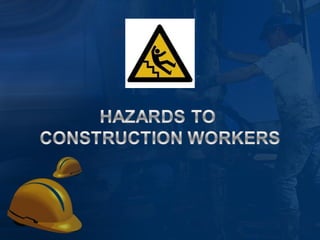
CONSTRUCTION SITES ARE RIFE THE FOLLOWING SOURCES OF DANGER: Slip and trip hazards Overhead electrical wires and other exposed wiring Sharp edges Falls from elevation Massive machinery and objects incorporated in construction Actively used chemicals Commonly sustained injuries caused by the above include: Electrical and chemical burns Poisoning Amputation Severe lacerations Traumatic brain injuries Repetitive strain injuries Crush injuries
 
Most employees in this industry work full time, and many work over 40 hours a week.  In 2002, about 1 in 5 construction workers worked 45 hours or more a week.  Construction workers may sometimes work evenings, weekends, and holidays to finish a job or take care of an emergency.  Workers in this industry need physical stamina because the work frequently requires prolonged standing, bending, stooping, and working in cramped quarters.  They also may be required to lift and carry heavy objects.  Exposure to weather is common because much of the work is done outside or in partially enclosed structures.  Construction workers often work with potentially dangerous tools and equipment amidst a clutter of building materials some work on temporary scaffolding or at great heights and in bad weather. Consequently, they are more prone to injuries than are workers in other jobs.
 
Pain or injury from physical overexertion, repetitive manual tasks, or working in awkward positions. Exposure to moulds, fungi and bird or rodent droppings. Exposure to lead, wood dust, asbestos, paints, solvents, and other toxic chemicals or materials. Working in extreme temperatures and UV radiation. Working with hand tools, powered tools and heavy powered equipment. Excess vibration in the hands, arms or body from powered tools or equipment. Confined spaces. Noise. Working at heights. Electrical hazards. Working with cranes, hoists, and other material handling equipment. Slips, trips and falls. Respiratory and fire hazards from wood dust. Stress Shift work or extended work days
 
Keep tools and equipment in good working order. Use correct personal protective equipment and apparel, including safety footwear.  Keep all work areas clear of clutter and equipment. Avoid awkward body positions or take frequent breaks. Learn safe lifting techniques. Follow a recommended shift work pattern, and be aware of the associated hazards. PREVENTIVE MEASURES
 
Follow safety procedures for: Confined space entry  Working at heights Electrical safety  Lockout/tagout of machinery  Machinery  Ladders Material handling Working with tools and equipment Practice safe lifting techniques. Follow company safety rules. Stay informed about chemical hazards, WHMIS and MSDS. Know how to report a hazard. Follow good housekeeping procedures.
 

Construction labor

  • 1.
  • 2.
    They areemployed in the construction industry and work predominantly on construction sites and are typically engaged in aspects of the industry other than design or finance. The term includes general construction workers, also referred to as laborers and members of specialist trades such electricians, carpenters and plumbers. CONSTRUCTION LABOURS
  • 3.
    What does aconstruction worker do? Construction is an industry that requires working at ever-changing locations and work environments. This profile refers to general construction workers. Others at a construction site include electricians, carpenters and plumbers. Some of the main duties of a general construction worker are to: Install various commercial, industrial or residential systems. Ensure that projects conform to building codes and regulations. Use, clean and maintain various types of equipment. Supervise or apprentice other workers.
  • 4.
  • 5.
    The construction industryis divided into three major segments. Construction of buildings contractors, or general contractors, build residential, industrial, commercial, and other buildings. Heavy and civil engineering construction contractors build sewers, roads, highways, bridges, tunnels, and other projects. Specialty trade contractors are engaged in specialized activities such as carpentry, painting, plumbing, and electrical work
  • 6.
  • 7.
    THE TWO ACTSWHICH FALL TO THE CATEGORY OF THE CONSTRUCTION WORKERS ARE AS FOLLOWS THE BUILDING AND OTHER CONSTRUCTION WORKERS' WELFARE CESS ACT, 1996 ACT NO. 28 OF 1996 THE BUILDINGS AND OTHER CONSTRUCTION WORKERS (REGULATION OF EMPLOYMENT AND CONDITIONS OF SERVICE) ACT, 1996 ACT NO. 27 OF 1996
  • 8.
    THE BUILDING ANDOTHER CONSTRUCTION WORKERS' WELFARE CESS ACT, 1996 ACT NO. 28 OF 1996 [19th August, 1996] BE it enacted by Parliament in the Forty-seventh Year of the Republic of India as follows:- An act to provide for the levy. And collection of a cess on the cost of construction incurred by employers with a view to augmenting the resources of the Building and Other Construction Workers' Welfare Boards constituted under the Building and Other Construction Workers (Regulation of Employment and Conditions of Service) Act, 1996.
  • 9.
    Short title, extentand commencement. This Act may be called the Building and Other Construction Workers' Welfare Cess Act, 1996. (2) It extends to the whole of India. (3) It shall be deemed to have come into force on the 3rd day of November, 1995.
  • 10.
    BUILDING AND OTHERCONSTRUCTION WORKERS(REGULATION OF EMPLOYMENT AND WORKING CONDITIONS)ACT, 1996
  • 11.
    There are about8.5 million building and other construction workers in India as per the estimates of National Sample Survey (1987-88). These workers are one of the most numerous and vulnerable segments of the unorganized sector in India. The building and other construction works are characterized by their inherent risk to the life and limb of the workers. The work is also characterized by its casual nature, temporary relationship between employer and employee, uncertain working hours, lack of basic amenities and inadequacy of welfare facilities. Although the provisions of various Labor Laws i.e., Minimum Wages Act 1948, Contract Labor (Regulation & Abolition) Act1970 and Inter-State Migrant Workmen (Regulation of Employment & Conditions of Services) Act 1979 etc., are applicable to the building and other construction workers, a need was felt for a comprehensive Central Legislation for this category of workers.
  • 12.
    The above lawaims to provide for regulation of employment & conditions of service of the building and other construction workers as also their safety, health and welfare measures in every establishment which employs or employed during the preceding year ten or more workers. The exception made is only in respect of residential houses for own purpose constructed with a cost not exceeding Rs. 10 lakh and such other activities to which the provisions of Factories Act, 1948 and Mines Act, 1952 apply. AIM:
  • 13.
  • 14.
    TYPES OF CONSTRUCTIONWORKERS Pipe fitter layers Sheet metal worker Steam fitters Painters paperhangers Drywall installers Tile Installers Tapers Cement Masons Concrete finishers Segmental pavers Brick masons Stonemasons Insulation workers Duct workers
  • 15.
  • 16.
    CONSTRUCTION SITES ARERIFE THE FOLLOWING SOURCES OF DANGER: Slip and trip hazards Overhead electrical wires and other exposed wiring Sharp edges Falls from elevation Massive machinery and objects incorporated in construction Actively used chemicals Commonly sustained injuries caused by the above include: Electrical and chemical burns Poisoning Amputation Severe lacerations Traumatic brain injuries Repetitive strain injuries Crush injuries
  • 17.
  • 18.
    Most employees inthis industry work full time, and many work over 40 hours a week. In 2002, about 1 in 5 construction workers worked 45 hours or more a week. Construction workers may sometimes work evenings, weekends, and holidays to finish a job or take care of an emergency. Workers in this industry need physical stamina because the work frequently requires prolonged standing, bending, stooping, and working in cramped quarters. They also may be required to lift and carry heavy objects. Exposure to weather is common because much of the work is done outside or in partially enclosed structures. Construction workers often work with potentially dangerous tools and equipment amidst a clutter of building materials some work on temporary scaffolding or at great heights and in bad weather. Consequently, they are more prone to injuries than are workers in other jobs.
  • 19.
  • 20.
    Pain or injuryfrom physical overexertion, repetitive manual tasks, or working in awkward positions. Exposure to moulds, fungi and bird or rodent droppings. Exposure to lead, wood dust, asbestos, paints, solvents, and other toxic chemicals or materials. Working in extreme temperatures and UV radiation. Working with hand tools, powered tools and heavy powered equipment. Excess vibration in the hands, arms or body from powered tools or equipment. Confined spaces. Noise. Working at heights. Electrical hazards. Working with cranes, hoists, and other material handling equipment. Slips, trips and falls. Respiratory and fire hazards from wood dust. Stress Shift work or extended work days
  • 21.
  • 22.
    Keep tools andequipment in good working order. Use correct personal protective equipment and apparel, including safety footwear. Keep all work areas clear of clutter and equipment. Avoid awkward body positions or take frequent breaks. Learn safe lifting techniques. Follow a recommended shift work pattern, and be aware of the associated hazards. PREVENTIVE MEASURES
  • 23.
  • 24.
    Follow safety proceduresfor: Confined space entry Working at heights Electrical safety Lockout/tagout of machinery Machinery Ladders Material handling Working with tools and equipment Practice safe lifting techniques. Follow company safety rules. Stay informed about chemical hazards, WHMIS and MSDS. Know how to report a hazard. Follow good housekeeping procedures.
  • 25.