1THE 9 VECTOR VIEW OF  HUMAN PERFORMANCEbyArun Kumar . GM.B.A
Introduction
Nine primary disciplines
Performance management process
Great performance management cycle
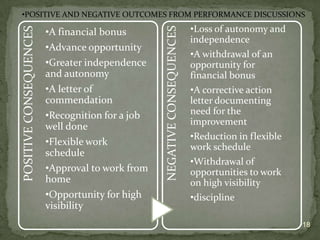
Positive and negative outcomes
Conclusion
Reference2
3multi dimensional challenges require multidimensional solutions –
a holistic approach to change management built on the foundation of nine primary disciplines .In Harvard, Professor John Kotter’sbook , a sense of urgency , he contends that a “winning strategy comes analytically sounds, ambitious but logical goals with methods that help people experience new , often very ambitious goals , as exciting meaningful , and uplifting –creating a deeply felt determination to move , make it happen , and win now”As the government  seeks to ,maximize resources  and mounting deficits ,
organizational change is a top priority. In private sector slow economic recovery is forcing companiesto reevaluate their current business practices and
explore new approaches for enhancing productivity and increasing profitability 4In other words not all change strategies are created equal, and
a good change strategy is not good enough if it is not supported by those whom it affects.At the same time , change managers who may be competent in a single discipline , such as human performance improvement of project management , may not understand the Interplay between other areas that are directly relevant to transformational effort, because change is multidimensional in nature . a holistic approach to managing change requires  a foundational understanding of nine primary disciplines and
 how they are intertwined..
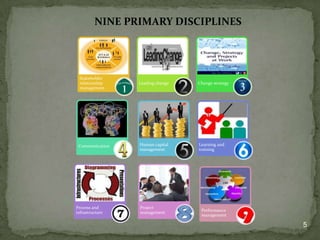
5NINE PRIMARY DISCIPLINESStakeholder relationship managementLeading changeChange strategyCommunicationHuman capital managementLearning and trainingProcess and infrastructureProject managementPerformance management
61.STAKE HOLDER RELATIONSHIP MANAGEMENT.Having understanding of the many individuals or groups affected by a change is a critical first step that is often given shrift and perception as important realties here. Managers need the skills to map out the multiple layers of stake holders associated with the propose change.2. LEADING CHANGEA question often left ambiguous is “who is going to lead the change ?”, more likely , it is a group of people who enable the change through a combination of inspiration, influence , facilitation and resource allocation ..3. CHANGE STRATEGYHaving a clear plan for how the change will be executed is a critical as having a blueprint for building a house , a plan that consists of merely developing a technology solution and then throwing to the wall of end users is a failure strategy.
74. COMMUNICATIONIts crucial to engage stake holders at all levels of the organization , from c level executives to frontline staff. Using well planned and timely communication , the change manager's goal is to ensure  that every person who is affected by the change has a thorough understanding of the change and why it is occurring .5.HUMAN CAPITAL MANAGEMENT Understanding how a change will affect the roles, responsibilities , and job descriptions and no of staff is only one of the ways human capital is critical to change effort “ implementing strategies to help individuals  maximize their full potential in the new organizational while simultaneously managing the risk of reduce productivity and effectiveness that often occurs as a result of changes,  “6.LEARNING AND TRAININGWhile it is tempting to see “training” as the bulk of implementation , it is in a fact that a tool to be used through out the change . From the time the idea for change is hatched , learning opportunities can be designed to involve affected groups and make them aware of what possibly lies ahead .
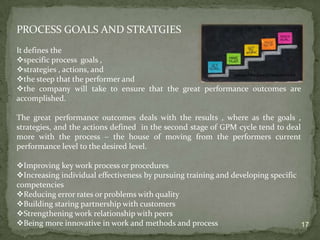
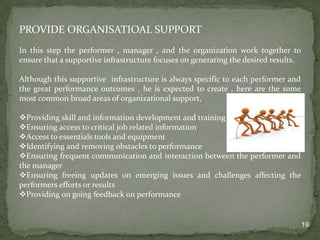
87.PROCESS AND INFRASTRUCTUREWhy is the organization shifting ? It could be driven by organization policy, new technology , market forces, or departure or arrival of a leader ,change practitioners have to understand the context of the organization before they are institutionally change  making it part of the fabric of day today business process ad operations .8.PROJECT MANAGEMENTThe methods ,skills and techniques are central to executing change . A change management must draw up on project management to facilitate successful relationships between the key groups who are driving change   and deliver transparency around decision rights.9.PERFORMANCE MANAGEMENTSenior executives are constantly balancing priorities and trying to find consensus as they manage multiple , often conflicting , goals. This is happening right now , as leaders is numerous federal agencies are working to perform performance management to make it credible access across the federal government.
9PERFORMANCE MANAGEMENT IS A PROCESS
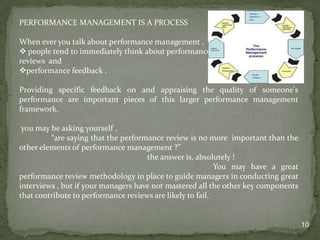
10PERFORMANCE MANAGEMENT IS A PROCESS When ever you talk about performance management , people tend to immediately think about performance                                        reviews  and
performance feedback . Providing specific feedback on and appraising the quality of someone's performance are important pieces of this larger performance management framework.  you may be asking yourself , 	“are saying that the performance review is no more  important than the other elements of performance management ?” 				the answer is, absolutely !						 You may have a great performance review methodology in place to guide managers in conducting great interviews , but if your managers have not mastered all the other key components that contribute to performance reviews are likely to fail.
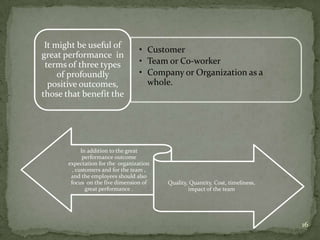
11GREAT PERFORMANCEOUTCOMES
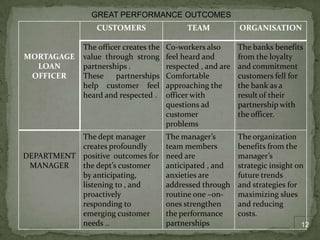
12GREAT PERFORMANCE OUTCOMES
13PERFORMANCE MANAGEMENT CYCLE
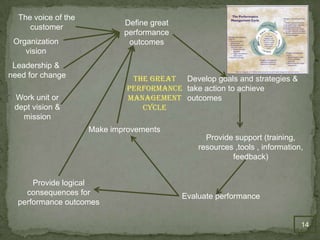
14The voice of the customer Define great  performance outcomes Organization vision Leadership & need for change Develop goals and strategies & take action to achieve outcomes the great performance management cycle Work unit or dept vision & mission Make improvements Provide support (training, resources ,tools , information, feedback)Provide logical consequences for performance outcomes Evaluate performance

The 9 vector view of human performance

  • 1.
    1THE 9 VECTORVIEW OF HUMAN PERFORMANCEbyArun Kumar . GM.B.A
  • 2.
  • 3.
  • 4.
  • 5.
  • 6.
  • 7.
  • 8.
  • 9.
    3multi dimensional challengesrequire multidimensional solutions –
  • 10.
    a holistic approachto change management built on the foundation of nine primary disciplines .In Harvard, Professor John Kotter’sbook , a sense of urgency , he contends that a “winning strategy comes analytically sounds, ambitious but logical goals with methods that help people experience new , often very ambitious goals , as exciting meaningful , and uplifting –creating a deeply felt determination to move , make it happen , and win now”As the government seeks to ,maximize resources and mounting deficits ,
  • 11.
    organizational change isa top priority. In private sector slow economic recovery is forcing companiesto reevaluate their current business practices and
  • 12.
    explore new approachesfor enhancing productivity and increasing profitability 4In other words not all change strategies are created equal, and
  • 13.
    a good changestrategy is not good enough if it is not supported by those whom it affects.At the same time , change managers who may be competent in a single discipline , such as human performance improvement of project management , may not understand the Interplay between other areas that are directly relevant to transformational effort, because change is multidimensional in nature . a holistic approach to managing change requires a foundational understanding of nine primary disciplines and
  • 14.
    how theyare intertwined..
  • 15.
    5NINE PRIMARY DISCIPLINESStakeholderrelationship managementLeading changeChange strategyCommunicationHuman capital managementLearning and trainingProcess and infrastructureProject managementPerformance management
  • 16.
    61.STAKE HOLDER RELATIONSHIPMANAGEMENT.Having understanding of the many individuals or groups affected by a change is a critical first step that is often given shrift and perception as important realties here. Managers need the skills to map out the multiple layers of stake holders associated with the propose change.2. LEADING CHANGEA question often left ambiguous is “who is going to lead the change ?”, more likely , it is a group of people who enable the change through a combination of inspiration, influence , facilitation and resource allocation ..3. CHANGE STRATEGYHaving a clear plan for how the change will be executed is a critical as having a blueprint for building a house , a plan that consists of merely developing a technology solution and then throwing to the wall of end users is a failure strategy.
  • 17.
    74. COMMUNICATIONIts crucialto engage stake holders at all levels of the organization , from c level executives to frontline staff. Using well planned and timely communication , the change manager's goal is to ensure that every person who is affected by the change has a thorough understanding of the change and why it is occurring .5.HUMAN CAPITAL MANAGEMENT Understanding how a change will affect the roles, responsibilities , and job descriptions and no of staff is only one of the ways human capital is critical to change effort “ implementing strategies to help individuals maximize their full potential in the new organizational while simultaneously managing the risk of reduce productivity and effectiveness that often occurs as a result of changes, “6.LEARNING AND TRAININGWhile it is tempting to see “training” as the bulk of implementation , it is in a fact that a tool to be used through out the change . From the time the idea for change is hatched , learning opportunities can be designed to involve affected groups and make them aware of what possibly lies ahead .
  • 18.
    87.PROCESS AND INFRASTRUCTUREWhyis the organization shifting ? It could be driven by organization policy, new technology , market forces, or departure or arrival of a leader ,change practitioners have to understand the context of the organization before they are institutionally change making it part of the fabric of day today business process ad operations .8.PROJECT MANAGEMENTThe methods ,skills and techniques are central to executing change . A change management must draw up on project management to facilitate successful relationships between the key groups who are driving change and deliver transparency around decision rights.9.PERFORMANCE MANAGEMENTSenior executives are constantly balancing priorities and trying to find consensus as they manage multiple , often conflicting , goals. This is happening right now , as leaders is numerous federal agencies are working to perform performance management to make it credible access across the federal government.
  • 19.
  • 20.
    10PERFORMANCE MANAGEMENT ISA PROCESS When ever you talk about performance management , people tend to immediately think about performance reviews and
  • 21.
    performance feedback .Providing specific feedback on and appraising the quality of someone's performance are important pieces of this larger performance management framework. you may be asking yourself , “are saying that the performance review is no more important than the other elements of performance management ?” the answer is, absolutely ! You may have a great performance review methodology in place to guide managers in conducting great interviews , but if your managers have not mastered all the other key components that contribute to performance reviews are likely to fail.
  • 22.
  • 23.
  • 24.
  • 25.
    14The voice ofthe customer Define great performance outcomes Organization vision Leadership & need for change Develop goals and strategies & take action to achieve outcomes the great performance management cycle Work unit or dept vision & mission Make improvements Provide support (training, resources ,tools , information, feedback)Provide logical consequences for performance outcomes Evaluate performance