Software Quality Management : Managing the quality of the  software process and products ILAYARAJA.S Faculty – Management Studies RMD ENGINEERING COLLEGE . [email_address] December 04 th  2009
INDEX Introduction to software quality software product, software development process, product quality, product quality attributes, product quality factors, quality of service, process quality, quality-related activities Quality assurance and standards Quality planning and control Software testing Software inspections and reviews Software measurement and metrics The role of formal methods Conclusions
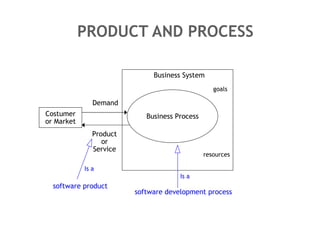
PRODUCT AND PROCESS Business Process Demand Business System Costumer or Market Product or Service software product software development process Is a Is a goals resources
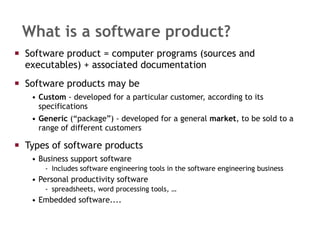
What is a software product? Software product = computer programs (sources and executables) + associated documentation Software products may be  Custom  - developed for a particular customer, according to its specifications Generic  (“package”) - developed for a general  market , to be sold to a range of different customers Types of software products Business support software  Includes software engineering tools in the software engineering business Personal productivity software spreadsheets, word processing tools, … Embedded software....
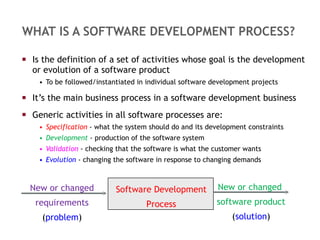
WHAT IS A SOFTWARE DEVELOPMENT PROCESS? Is the definition of a set of activities whose goal is the development or evolution of a software product  To be followed/instantiated in individual software development projects It’s the main business process in a software development business Generic activities in all software processes are: Specification  - what the system should do and its development constraints Development  - production of the software system Validation  - checking that the software is what the customer wants Evolution   - changing the software in response to changing demands New or changed requirements ( problem ) New or changed  software product ( solution ) Software Development Process
THE IMPORTANCE OF SOFTWARE The economies of ALL developed nations are dependent on software More and more systems are software controlled Including an increasing number of safety- critical  and mission-critical systems, with high demands on dependability More and more businesses depend on software for their success Software and Information Systems are  critical  success factors in an increasing number of businesses and organizations Software engineering expenditure (in the development and maintenance of software products) represents a significant fraction of GNP (Gross National Product) in all developed countries
What is product quality? Quality, simplistically, means that  a product should   meet its specification The software product should deliver the required functionality ( functional requirements ) with the required  quality attributes  ( non–functional requirements ) This is problematical for software systems Tension  between customer quality requirements (efficiency, reliability, ...) and developer quality requirements (maintainability, reusability, ...) Some quality requirements are difficult to specify in an  unambiguous  way Software specifications are usually  incomplete  and often  inconsistent The quality compromise: we cannot wait for specifications to improve before paying attention to quality, and procedures must be put into place to improve quality in spite of imperfect specification  Quality attributes are frequently conflicting and increase development costs, so there is a need for weighting and balancing Software engineering is concerned with the cost-effective development of good software
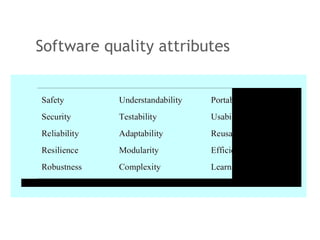
Product quality attributes (1) Attributes of good software  (beyond delivering the required functionality): Efficiency Software should not make wasteful use of system resources (disk and memory space, CPU time, etc.) and should present appropriate response times Usability (ease of use) Software must be usable by the users for which it was designed Dependability (reliability, availability, security, safety,…) Software must be trustworthy Maintainability (ease of maintenance) Software must evolve to meet changing needs Software costs more to maintain than it does to develop. For systems with a long life, maintenance costs may be several times development costs …
Product quality attributes (2) Other quality attributes: Resilience (Flexibility) Robustness Understandability Testability Adaptability Modularity Simplicity Portability Reusability Learnability
Main dimensions of dependability Reliability   - The probability of failure-free system operation over a specified time in a given environment for a given purpose Availability  -  The probability that a system, at a point in time, will be operational and able to deliver the requested services It’s possibly to have high availability with low reliability if failures are repaired quickly Safety   - The system’s ability to operate, normally or abnormally, without danger of causing human injury or death and without damage to the system’s environment Security  – The system’s ability to protect itself from accidental or deliberate external attack
Dependability and critical systems For critical systems, it is usually the case that the most important system property is the dependability of the system Types of critical systems: Safety–critical system  – a system whose failure may result in injury, loss of life or major environment damage e.g. an insulin delivery system Mission-critical system  – a system whose failure may result in the failure of some goal-directed activity e.g. a navigational system for a space aircraft Business-critical system  – a system whose failure may result in the failure of the business using the system e.g. a customer account system in a bank
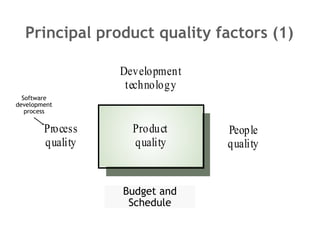
Principal product quality factors (1) Software development process Budget and Schedule
Principal product quality factors (2) Process quality A good process is usually required to produce a good product For manufactured goods, process is the principal quality determinant  For design-based activity (like software development), other factors are also involved especially the capabilities of the designers  For  large projects  with ‘average’ capabilities, the development process determines product quality People quality For  small projects , the capabilities of the developers is the main determinant Corollary: you need lower quality people (and higher quality process) in larger projects?  Project Size  x  People Quality = Constant ?  Development technology  Is particularly significant for  small projects Budget and schedule In  all projects , if an unrealistic schedule is imposed then product quality will suffer
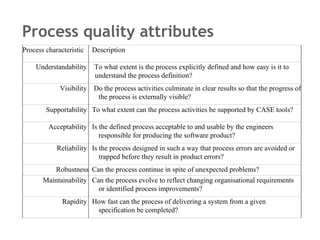
Process quality attributes Process characteristic Description Understandability  To what extent is the process explicitly defined and how easy is it to understand the process definition? Visibility  Do the process activities culminate in clear results so that the progress of the process is externally visible? Supportability  To what extent can the process activities be supported by CASE tools? Acceptability  Is the defined process acceptable to and usable by the engineers responsible for producing the software product? Reliability  Is the process designed in such a way that process errors are avoided or trapped before they result in product errors? Robustness Can the process continue in spite of unexpected problems? Maintainability  Can the process evolve to reflect changing organisational requirements or identified process improvements? Rapidity  How fast can the process of delivering a system from a given specification be completed?
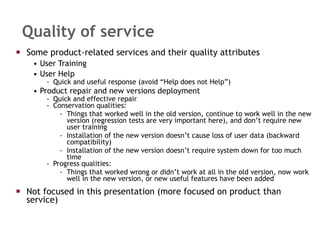
Quality of service Some product-related services and their quality attributes User Training User Help Quick and useful response (avoid “Help does not Help”) Product repair and new versions deployment Quick and effective repair Conservation qualities: Things that worked well in the old version, continue to work well in the new version (regression tests are very important here), and don’t require new user training Installation of the new version doesn’t cause loss of user data (backward compatibility) Installation of the new version doesn’t require system down for too much time Progress qualities: Things that worked wrong or didn’t work at all in the old version, now work well in the new version, or new useful features have been added Not focused in this presentation (more focused on product than service)
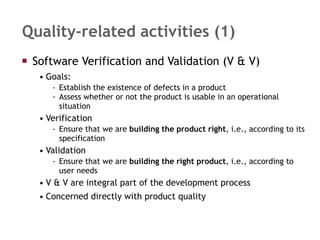
Quality-related activities (1) Software Verification and Validation (V & V) Goals: Establish the existence of defects in a product Assess whether or not the product is usable in an operational situation Verification  Ensure that we are  building the product right , i.e., according to its specification Validation  Ensure that we are  building the right product , i.e., according to user needs V & V are integral part of the development process Concerned directly with product quality
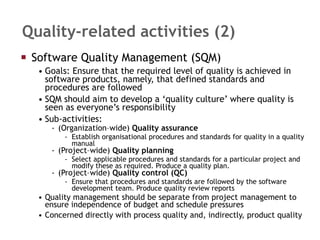
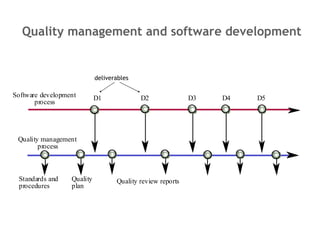
Quality-related activities (2) Software Quality Management (SQM) Goals: Ensure that the required level of quality is achieved in software products, namely, that defined standards and procedures are followed SQM should aim to develop a ‘quality culture’ where quality is seen as everyone’s responsibility Sub-activities: (Organization–wide)  Quality assurance Establish organisational procedures and standards for quality in a quality manual (Project–wide)  Quality planning Select applicable procedures and standards for a particular project and modify these as required. Produce a quality plan. (Project–wide)  Quality control (QC) Ensure that procedures and standards are followed by the software development team. Produce quality review reports Quality management should be separate from project management to ensure independence of budget and schedule pressures Concerned directly with process quality and, indirectly, product quality
Quality management and software development deliverables
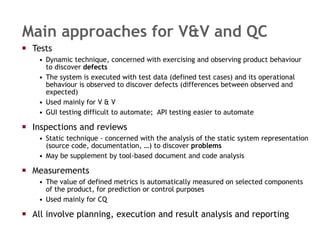
Main approaches for V&V and QC Tests Dynamic technique, concerned with exercising and observing product behaviour to discover  defects The system is executed with test data (defined test cases) and its operational behaviour is observed to discover defects (differences between observed and expected)  Used mainly for V & V GUI testing difficult to automate;  API testing easier to automate Inspections and reviews Static technique - concerned with the analysis of the static system representation (source code, documentation, …) to discover  problems May be supplement by tool-based document and code analysis Measurements The value of defined metrics is automatically measured on selected components of the product, for prediction or control purposes Used mainly for CQ All involve planning, execution and result analysis and reporting
Standards are the key to effective quality management They may be international, national, organizational or project standards Product standards  define characteristics that all components should exhibit e.g. a common programming style Process standards  define how the software process should be enacted Quality assurance and standards
Encapsulation of best practice - avoids repetition of past mistakes Framework for quality assurance process – it involves checking standard compliance Provide continuity - new staff can understand  the organisation by understand the standards  applied Importance of standards
Problems with standards Not seen as relevant and up-to-date by software engineers Practitioners should be involved in development. Engineers should understand the rationale  underlying a standard Standards and their usage should be  reviewed regularly . Standards can quickly become outdated and this reduces their credibility amongst practitioners Involve too much bureaucratic form filling Unsupported by software tools so tedious manual work is involved to maintain standards Detailed standards should have associated tool support. Excessive clerical work is the most significant complaint against standards
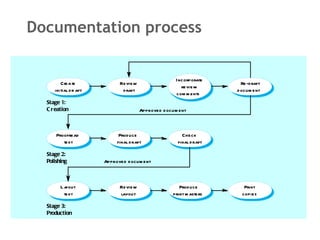
Documentation standards Particularly important - documents are the tangible manifestation of the software Documentation process standards How documents should be developed, validated and maintained Document standards Concerned with document identification, structure, presentation, changes highlighting, etc. Document interchange standards How documents are stored and interchanged between different documentation systems XML is an emerging standard for document interchange which will be widely supported in future
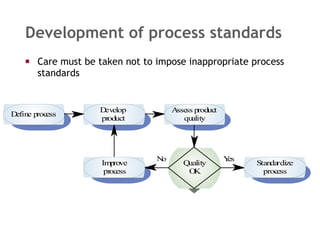
Development of process standards Care must be taken not to impose inappropriate process standards
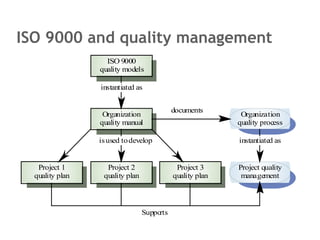
ISO 9000 International set of standards for quality management (ISO 9000:2000, ISO 9001:2000, ISO 9004:2000, etc.) Applicable to a range of organisations from manufacturing to service industries ISO 9001:2000 specifies requirements for a quality management system for any organization that needs to demonstrate its ability to consistently provide  product  that meets customer and applicable regulatory requirements and aims to enhance customer satisfaction, in all business sectors Integrates previous standards ISO 9001, ISO 9002 and ISO 9003  ISO 9001 is a generic model that must be instantiated for each organisation ISO 9004:2000 provides guidance for continual improvement of a quality management system to benefit all parties (employees, owners, suppliers, society in general,…) through sustained customer satisfaction. It should be used to extend the benefits obtained from ISO 9001:2000 to all parties that are interested in or affected by the business operations.
ISO 9000 certification Quality standards and procedures should be documented in an organisational  quality manual External body may certify that an organisation’s quality manual conforms to ISO 9000 standards (namely ISO 9001) Customers are, increasingly, demanding that suppliers are ISO 9000 certified
ISO 9000 and quality management
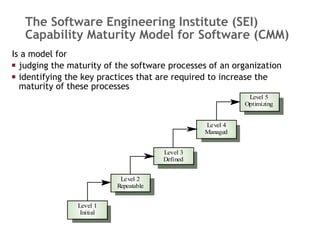
The Software Engineering Institute (SEI) Capability Maturity Model for Software (CMM) Is a model for  judging the maturity of the software processes of an organization identifying the key practices that are required to increase the maturity of these processes
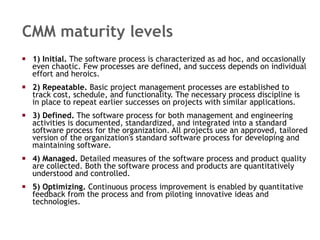
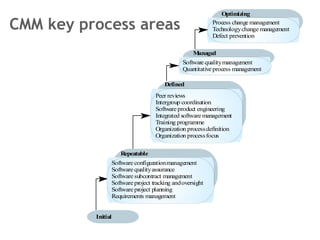
CMM maturity levels 1) Initial.  The software process is characterized as ad hoc, and occasionally even chaotic. Few processes are defined, and success depends on individual effort and heroics.  2) Repeatable.  Basic project management processes are established to track cost, schedule, and functionality. The necessary process discipline is in place to repeat earlier successes on projects with similar applications.  3) Defined.  The software process for both management and engineering activities is documented, standardized, and integrated into a standard software process for the organization. All projects use an approved, tailored version of the organization's standard software process for developing and maintaining software.  4) Managed.  Detailed measures of the software process and product quality are collected. Both the software process and products are quantitatively understood and controlled.  5) Optimizing.  Continuous process improvement is enabled by quantitative feedback from the process and from piloting innovative ideas and technologies.
CMM key process areas
The CMM and ISO 9000 There is a clear correlation between the key processes in the CMM and the quality management processes in ISO 9000 The CMM is more detailed and prescriptive and includes a more detailed framework for improvement Organisations rated as level 2 in the CMM are likely to be ISO 9000 compliant
Index Introduction  Quality assurance and standards Quality planning and control Software testing Software inspections and reviews Software measurement and metrics The role of formal methods Conclusions
Quality planning A quality plan sets out (within a particular project) the desired product qualities and how these are assessed and define the most significant quality attributes It should define the quality assessment process It should set out which organisational standards should be applied and, if necessary, define new standards Quality plans should be short, succinct documents If they are too long, no-one will read them
Quality control Checking the software development process (within a particular project) to ensure that procedures and standards, as defined in the quality plan, are being followed Two approaches to quality control (Manual) Quality reviews – main approach (Automated) Quality measurement
Index Introduction  Quality assurance and standards Quality planning and control Software testing Software inspections and reviews Software measurement and metrics The role of formal methods Conclusions
Black-box and white-box tests Black-box testing  An approach to testing where the program is considered as a ‘black-box’ The program test cases are based on the system specification  Test planning can begin early in the software process White-box testing Sometime called structural testing Derivation of test cases according to program structure. Knowledge of the program is used to identify additional test cases Objective is to exercise all program statements (not all path combinations) Test coverage measures ensure that all statements have been executed at least once
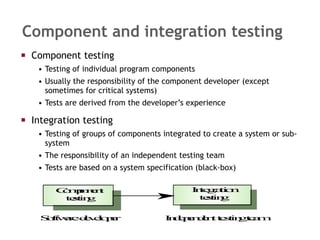
Component and integration testing Component testing  Testing of individual program components Usually the responsibility of the component developer (except sometimes for critical systems) Tests are derived from the developer’s experience Integration testing Testing of groups of components integrated to create a system or sub-system The responsibility of an independent testing team Tests are based on a system specification (black-box)
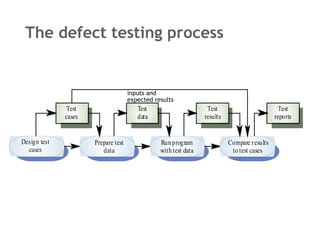
The defect testing process inputs and expected results
Index Introduction  Quality assurance and standards Quality planning and control Software testing Software inspections and reviews Software measurement and metrics The role of formal methods Conclusions
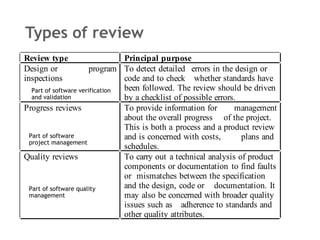
Types of review Part of software project management Part of software verification and validation Part of software quality management
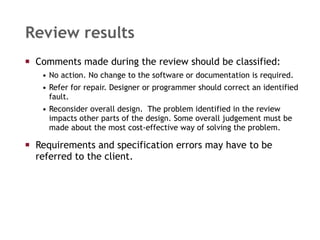
Comments made during the review should be classified: No action. No change to the software or documentation is required. Refer for repair. Designer or programmer should correct an identified fault. Reconsider overall design.  The problem identified in the review impacts other parts of the design. Some overall judgement must be made about the most cost-effective way of solving the problem. Requirements and specification errors may have to be referred to the client. Review results
Index Introduction  Quality assurance and standards Quality planning and control Software testing Software inspections and reviews Software measurement and metrics The role of formal methods Conclusions
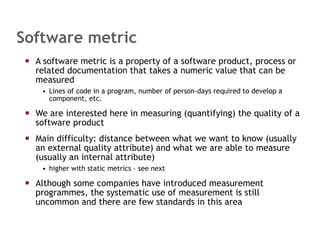
A software metric is a property of a software product, process or related documentation that takes a numeric value that can be measured Lines of code in a program, number of person-days required to develop a component, etc. We are interested here in measuring (quantifying) the quality of a software product Main difficulty: distance between what we want to know (usually an external quality attribute) and what we are able to measure (usually an internal attribute) higher with static metrics – see next Although some companies have introduced measurement programmes, the systematic use of measurement is still uncommon and there are few standards in this area Software metric
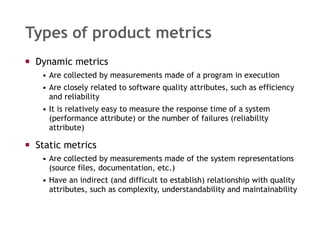
Dynamic metrics  Are collected by measurements made of a program in execution Are closely related to software quality attributes, such as efficiency and reliability It is relatively easy to measure the response time of a system (performance attribute) or the number of failures (reliability attribute) Static metrics  Are collected by measurements made of the system representations (source files, documentation, etc.) Have an indirect (and difficult to establish) relationship with quality attributes, such as complexity, understandability and maintainability Types of product metrics
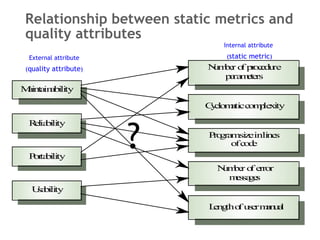
Relationship between static metrics and quality attributes External attribute ( quality attribute ) Internal attribute  ( static metric ) ?
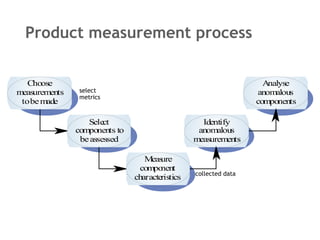
Product measurement process select metrics collected data
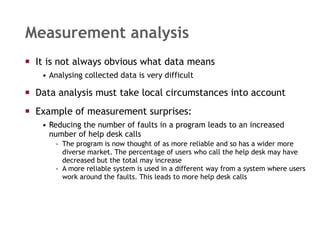
Measurement analysis It is not always obvious what data means  Analysing collected data is very difficult Data analysis must take local circumstances into account Example of measurement surprises: Reducing the number of faults in a program leads to an increased number of help desk calls The program is now thought of as more reliable and so has a wider more diverse market. The percentage of users who call the help desk may have decreased but the total may increase A more reliable system is used in a different way from a system where users work around the faults. This leads to more help desk calls
Index Introduction  Quality assurance and standards Quality planning and control Software testing Software inspections and reviews Software measurement and metrics The role of formal methods Conclusions
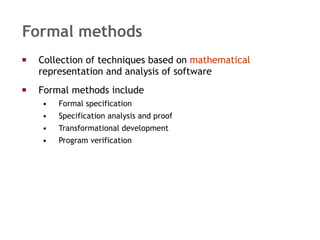
Formal methods Collection of techniques based on  mathematical  representation and analysis of software Formal methods include Formal specification Specification analysis and proof Transformational development Program verification
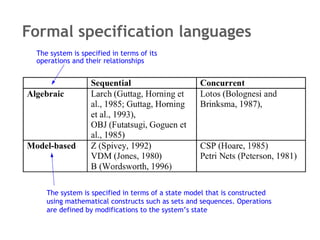
Formal specification languages The system is specified in terms of a state model that is constructed using mathematical constructs such as sets and sequences. Operations are defined by modifications to the system’s state The system is specified in terms of its operations and their relationships
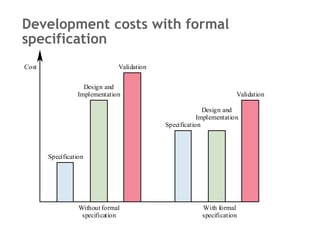
Development costs with formal specification
Index Introduction  Quality assurance and standards Quality planning and control Software testing Software inspections and reviews Software measurement and metrics The role of formal methods Conclusions
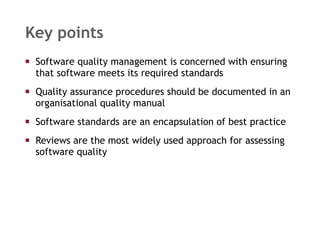
Key points Software quality management is concerned with ensuring that software meets its required standards Quality assurance procedures should be documented in an organisational quality manual Software standards are an encapsulation of best practice Reviews are the most widely used approach for assessing software quality
Documentation process
Software quality attributes

Quality software management

  • 1.
    Software Quality Management: Managing the quality of the software process and products ILAYARAJA.S Faculty – Management Studies RMD ENGINEERING COLLEGE . [email_address] December 04 th 2009
  • 2.
    INDEX Introduction tosoftware quality software product, software development process, product quality, product quality attributes, product quality factors, quality of service, process quality, quality-related activities Quality assurance and standards Quality planning and control Software testing Software inspections and reviews Software measurement and metrics The role of formal methods Conclusions
  • 3.
    PRODUCT AND PROCESSBusiness Process Demand Business System Costumer or Market Product or Service software product software development process Is a Is a goals resources
  • 4.
    What is asoftware product? Software product = computer programs (sources and executables) + associated documentation Software products may be Custom - developed for a particular customer, according to its specifications Generic (“package”) - developed for a general market , to be sold to a range of different customers Types of software products Business support software Includes software engineering tools in the software engineering business Personal productivity software spreadsheets, word processing tools, … Embedded software....
  • 5.
    WHAT IS ASOFTWARE DEVELOPMENT PROCESS? Is the definition of a set of activities whose goal is the development or evolution of a software product To be followed/instantiated in individual software development projects It’s the main business process in a software development business Generic activities in all software processes are: Specification - what the system should do and its development constraints Development - production of the software system Validation - checking that the software is what the customer wants Evolution - changing the software in response to changing demands New or changed requirements ( problem ) New or changed software product ( solution ) Software Development Process
  • 6.
    THE IMPORTANCE OFSOFTWARE The economies of ALL developed nations are dependent on software More and more systems are software controlled Including an increasing number of safety- critical and mission-critical systems, with high demands on dependability More and more businesses depend on software for their success Software and Information Systems are critical success factors in an increasing number of businesses and organizations Software engineering expenditure (in the development and maintenance of software products) represents a significant fraction of GNP (Gross National Product) in all developed countries
  • 7.
    What is productquality? Quality, simplistically, means that a product should meet its specification The software product should deliver the required functionality ( functional requirements ) with the required quality attributes ( non–functional requirements ) This is problematical for software systems Tension between customer quality requirements (efficiency, reliability, ...) and developer quality requirements (maintainability, reusability, ...) Some quality requirements are difficult to specify in an unambiguous way Software specifications are usually incomplete and often inconsistent The quality compromise: we cannot wait for specifications to improve before paying attention to quality, and procedures must be put into place to improve quality in spite of imperfect specification Quality attributes are frequently conflicting and increase development costs, so there is a need for weighting and balancing Software engineering is concerned with the cost-effective development of good software
  • 8.
    Product quality attributes(1) Attributes of good software (beyond delivering the required functionality): Efficiency Software should not make wasteful use of system resources (disk and memory space, CPU time, etc.) and should present appropriate response times Usability (ease of use) Software must be usable by the users for which it was designed Dependability (reliability, availability, security, safety,…) Software must be trustworthy Maintainability (ease of maintenance) Software must evolve to meet changing needs Software costs more to maintain than it does to develop. For systems with a long life, maintenance costs may be several times development costs …
  • 9.
    Product quality attributes(2) Other quality attributes: Resilience (Flexibility) Robustness Understandability Testability Adaptability Modularity Simplicity Portability Reusability Learnability
  • 10.
    Main dimensions ofdependability Reliability - The probability of failure-free system operation over a specified time in a given environment for a given purpose Availability - The probability that a system, at a point in time, will be operational and able to deliver the requested services It’s possibly to have high availability with low reliability if failures are repaired quickly Safety - The system’s ability to operate, normally or abnormally, without danger of causing human injury or death and without damage to the system’s environment Security – The system’s ability to protect itself from accidental or deliberate external attack
  • 11.
    Dependability and criticalsystems For critical systems, it is usually the case that the most important system property is the dependability of the system Types of critical systems: Safety–critical system – a system whose failure may result in injury, loss of life or major environment damage e.g. an insulin delivery system Mission-critical system – a system whose failure may result in the failure of some goal-directed activity e.g. a navigational system for a space aircraft Business-critical system – a system whose failure may result in the failure of the business using the system e.g. a customer account system in a bank
  • 12.
    Principal product qualityfactors (1) Software development process Budget and Schedule
  • 13.
    Principal product qualityfactors (2) Process quality A good process is usually required to produce a good product For manufactured goods, process is the principal quality determinant For design-based activity (like software development), other factors are also involved especially the capabilities of the designers For large projects with ‘average’ capabilities, the development process determines product quality People quality For small projects , the capabilities of the developers is the main determinant Corollary: you need lower quality people (and higher quality process) in larger projects? Project Size x People Quality = Constant ? Development technology Is particularly significant for small projects Budget and schedule In all projects , if an unrealistic schedule is imposed then product quality will suffer
  • 14.
    Process quality attributesProcess characteristic Description Understandability To what extent is the process explicitly defined and how easy is it to understand the process definition? Visibility Do the process activities culminate in clear results so that the progress of the process is externally visible? Supportability To what extent can the process activities be supported by CASE tools? Acceptability Is the defined process acceptable to and usable by the engineers responsible for producing the software product? Reliability Is the process designed in such a way that process errors are avoided or trapped before they result in product errors? Robustness Can the process continue in spite of unexpected problems? Maintainability Can the process evolve to reflect changing organisational requirements or identified process improvements? Rapidity How fast can the process of delivering a system from a given specification be completed?
  • 15.
    Quality of serviceSome product-related services and their quality attributes User Training User Help Quick and useful response (avoid “Help does not Help”) Product repair and new versions deployment Quick and effective repair Conservation qualities: Things that worked well in the old version, continue to work well in the new version (regression tests are very important here), and don’t require new user training Installation of the new version doesn’t cause loss of user data (backward compatibility) Installation of the new version doesn’t require system down for too much time Progress qualities: Things that worked wrong or didn’t work at all in the old version, now work well in the new version, or new useful features have been added Not focused in this presentation (more focused on product than service)
  • 16.
    Quality-related activities (1)Software Verification and Validation (V & V) Goals: Establish the existence of defects in a product Assess whether or not the product is usable in an operational situation Verification Ensure that we are building the product right , i.e., according to its specification Validation Ensure that we are building the right product , i.e., according to user needs V & V are integral part of the development process Concerned directly with product quality
  • 17.
    Quality-related activities (2)Software Quality Management (SQM) Goals: Ensure that the required level of quality is achieved in software products, namely, that defined standards and procedures are followed SQM should aim to develop a ‘quality culture’ where quality is seen as everyone’s responsibility Sub-activities: (Organization–wide) Quality assurance Establish organisational procedures and standards for quality in a quality manual (Project–wide) Quality planning Select applicable procedures and standards for a particular project and modify these as required. Produce a quality plan. (Project–wide) Quality control (QC) Ensure that procedures and standards are followed by the software development team. Produce quality review reports Quality management should be separate from project management to ensure independence of budget and schedule pressures Concerned directly with process quality and, indirectly, product quality
  • 18.
    Quality management andsoftware development deliverables
  • 19.
    Main approaches forV&V and QC Tests Dynamic technique, concerned with exercising and observing product behaviour to discover defects The system is executed with test data (defined test cases) and its operational behaviour is observed to discover defects (differences between observed and expected) Used mainly for V & V GUI testing difficult to automate; API testing easier to automate Inspections and reviews Static technique - concerned with the analysis of the static system representation (source code, documentation, …) to discover problems May be supplement by tool-based document and code analysis Measurements The value of defined metrics is automatically measured on selected components of the product, for prediction or control purposes Used mainly for CQ All involve planning, execution and result analysis and reporting
  • 20.
    Standards are thekey to effective quality management They may be international, national, organizational or project standards Product standards define characteristics that all components should exhibit e.g. a common programming style Process standards define how the software process should be enacted Quality assurance and standards
  • 21.
    Encapsulation of bestpractice - avoids repetition of past mistakes Framework for quality assurance process – it involves checking standard compliance Provide continuity - new staff can understand the organisation by understand the standards applied Importance of standards
  • 22.
    Problems with standardsNot seen as relevant and up-to-date by software engineers Practitioners should be involved in development. Engineers should understand the rationale underlying a standard Standards and their usage should be reviewed regularly . Standards can quickly become outdated and this reduces their credibility amongst practitioners Involve too much bureaucratic form filling Unsupported by software tools so tedious manual work is involved to maintain standards Detailed standards should have associated tool support. Excessive clerical work is the most significant complaint against standards
  • 23.
    Documentation standards Particularlyimportant - documents are the tangible manifestation of the software Documentation process standards How documents should be developed, validated and maintained Document standards Concerned with document identification, structure, presentation, changes highlighting, etc. Document interchange standards How documents are stored and interchanged between different documentation systems XML is an emerging standard for document interchange which will be widely supported in future
  • 24.
    Development of processstandards Care must be taken not to impose inappropriate process standards
  • 25.
    ISO 9000 Internationalset of standards for quality management (ISO 9000:2000, ISO 9001:2000, ISO 9004:2000, etc.) Applicable to a range of organisations from manufacturing to service industries ISO 9001:2000 specifies requirements for a quality management system for any organization that needs to demonstrate its ability to consistently provide product that meets customer and applicable regulatory requirements and aims to enhance customer satisfaction, in all business sectors Integrates previous standards ISO 9001, ISO 9002 and ISO 9003 ISO 9001 is a generic model that must be instantiated for each organisation ISO 9004:2000 provides guidance for continual improvement of a quality management system to benefit all parties (employees, owners, suppliers, society in general,…) through sustained customer satisfaction. It should be used to extend the benefits obtained from ISO 9001:2000 to all parties that are interested in or affected by the business operations.
  • 26.
    ISO 9000 certificationQuality standards and procedures should be documented in an organisational quality manual External body may certify that an organisation’s quality manual conforms to ISO 9000 standards (namely ISO 9001) Customers are, increasingly, demanding that suppliers are ISO 9000 certified
  • 27.
    ISO 9000 andquality management
  • 28.
    The Software EngineeringInstitute (SEI) Capability Maturity Model for Software (CMM) Is a model for judging the maturity of the software processes of an organization identifying the key practices that are required to increase the maturity of these processes
  • 29.
    CMM maturity levels1) Initial. The software process is characterized as ad hoc, and occasionally even chaotic. Few processes are defined, and success depends on individual effort and heroics. 2) Repeatable. Basic project management processes are established to track cost, schedule, and functionality. The necessary process discipline is in place to repeat earlier successes on projects with similar applications. 3) Defined. The software process for both management and engineering activities is documented, standardized, and integrated into a standard software process for the organization. All projects use an approved, tailored version of the organization's standard software process for developing and maintaining software. 4) Managed. Detailed measures of the software process and product quality are collected. Both the software process and products are quantitatively understood and controlled. 5) Optimizing. Continuous process improvement is enabled by quantitative feedback from the process and from piloting innovative ideas and technologies.
  • 30.
  • 31.
    The CMM andISO 9000 There is a clear correlation between the key processes in the CMM and the quality management processes in ISO 9000 The CMM is more detailed and prescriptive and includes a more detailed framework for improvement Organisations rated as level 2 in the CMM are likely to be ISO 9000 compliant
  • 32.
    Index Introduction Quality assurance and standards Quality planning and control Software testing Software inspections and reviews Software measurement and metrics The role of formal methods Conclusions
  • 33.
    Quality planning Aquality plan sets out (within a particular project) the desired product qualities and how these are assessed and define the most significant quality attributes It should define the quality assessment process It should set out which organisational standards should be applied and, if necessary, define new standards Quality plans should be short, succinct documents If they are too long, no-one will read them
  • 34.
    Quality control Checkingthe software development process (within a particular project) to ensure that procedures and standards, as defined in the quality plan, are being followed Two approaches to quality control (Manual) Quality reviews – main approach (Automated) Quality measurement
  • 35.
    Index Introduction Quality assurance and standards Quality planning and control Software testing Software inspections and reviews Software measurement and metrics The role of formal methods Conclusions
  • 36.
    Black-box and white-boxtests Black-box testing An approach to testing where the program is considered as a ‘black-box’ The program test cases are based on the system specification Test planning can begin early in the software process White-box testing Sometime called structural testing Derivation of test cases according to program structure. Knowledge of the program is used to identify additional test cases Objective is to exercise all program statements (not all path combinations) Test coverage measures ensure that all statements have been executed at least once
  • 37.
    Component and integrationtesting Component testing Testing of individual program components Usually the responsibility of the component developer (except sometimes for critical systems) Tests are derived from the developer’s experience Integration testing Testing of groups of components integrated to create a system or sub-system The responsibility of an independent testing team Tests are based on a system specification (black-box)
  • 38.
    The defect testingprocess inputs and expected results
  • 39.
    Index Introduction Quality assurance and standards Quality planning and control Software testing Software inspections and reviews Software measurement and metrics The role of formal methods Conclusions
  • 40.
    Types of reviewPart of software project management Part of software verification and validation Part of software quality management
  • 41.
    Comments made duringthe review should be classified: No action. No change to the software or documentation is required. Refer for repair. Designer or programmer should correct an identified fault. Reconsider overall design. The problem identified in the review impacts other parts of the design. Some overall judgement must be made about the most cost-effective way of solving the problem. Requirements and specification errors may have to be referred to the client. Review results
  • 42.
    Index Introduction Quality assurance and standards Quality planning and control Software testing Software inspections and reviews Software measurement and metrics The role of formal methods Conclusions
  • 43.
    A software metricis a property of a software product, process or related documentation that takes a numeric value that can be measured Lines of code in a program, number of person-days required to develop a component, etc. We are interested here in measuring (quantifying) the quality of a software product Main difficulty: distance between what we want to know (usually an external quality attribute) and what we are able to measure (usually an internal attribute) higher with static metrics – see next Although some companies have introduced measurement programmes, the systematic use of measurement is still uncommon and there are few standards in this area Software metric
  • 44.
    Dynamic metrics Are collected by measurements made of a program in execution Are closely related to software quality attributes, such as efficiency and reliability It is relatively easy to measure the response time of a system (performance attribute) or the number of failures (reliability attribute) Static metrics Are collected by measurements made of the system representations (source files, documentation, etc.) Have an indirect (and difficult to establish) relationship with quality attributes, such as complexity, understandability and maintainability Types of product metrics
  • 45.
    Relationship between staticmetrics and quality attributes External attribute ( quality attribute ) Internal attribute ( static metric ) ?
  • 46.
    Product measurement processselect metrics collected data
  • 47.
    Measurement analysis Itis not always obvious what data means Analysing collected data is very difficult Data analysis must take local circumstances into account Example of measurement surprises: Reducing the number of faults in a program leads to an increased number of help desk calls The program is now thought of as more reliable and so has a wider more diverse market. The percentage of users who call the help desk may have decreased but the total may increase A more reliable system is used in a different way from a system where users work around the faults. This leads to more help desk calls
  • 48.
    Index Introduction Quality assurance and standards Quality planning and control Software testing Software inspections and reviews Software measurement and metrics The role of formal methods Conclusions
  • 49.
    Formal methods Collectionof techniques based on mathematical representation and analysis of software Formal methods include Formal specification Specification analysis and proof Transformational development Program verification
  • 50.
    Formal specification languagesThe system is specified in terms of a state model that is constructed using mathematical constructs such as sets and sequences. Operations are defined by modifications to the system’s state The system is specified in terms of its operations and their relationships
  • 51.
    Development costs withformal specification
  • 52.
    Index Introduction Quality assurance and standards Quality planning and control Software testing Software inspections and reviews Software measurement and metrics The role of formal methods Conclusions
  • 53.
    Key points Softwarequality management is concerned with ensuring that software meets its required standards Quality assurance procedures should be documented in an organisational quality manual Software standards are an encapsulation of best practice Reviews are the most widely used approach for assessing software quality
  • 54.
  • 55.