Forecasting in Management- Methods,features,advantages,importance and process
Forecasting involves analyzing past and present events to predict future outcomes. It plays a pivotal role in organizations by providing the basis for planning. Accurate forecasting is necessary for efficient management. Some common forecasting methods include analyzing similarity of past events, surveying executive opinions, and time series analysis. Forecasting considers factors that may impact organizational functions and provides a guideline for proper planning, but predictions may differ from actual results.
Objectives
• At theend of the chapter you will be
able to understand
– The meaning, definition and features of
forecasting
– Know about the importance of forecasting
– The areas of forecasting and its
advantages
– Difference between the forecasting and
planning
3.
Introduction
• Forecasting isthe technique of
estimating the relevant future events
and problems on the basis of past and
present behavior or happenings
• Forecasting depends upon an
analysis of past events and current
conditions
4.
Meaning and
Definition
• Meaningof Forecasting
– Forecasting the systematic guessing of
future course of events with the help of
analysis of present and past events
• Definition of Forecasting
– According to Webster’s new Collegiate
Dictionary, ‘A forecast is a prediction and
its purpose is to calculate some future
events or conditions
5.
Features of Forecasting
•Forecasting is concerned with the
future events
• Impact of future events has to be
considered in the planning process
• Forecasting considers all the factors
which affect the organizational
functions
6.
Forecasting Process
• Forecastingperiod may be short-term
or long- term. In either of the cases
certain stages or steps have to be
passed as below
• Thorough preparation of foundation
– Detailed investigation and complete
analysis of the company are necessary
for forecasting
– Forecasting is based on the foundation
7.
Forecasting Process
• Estimationof future
– The prosperity of the future can be
estimated with the help of past
experience and performance
• Collection of results
– All the information can be collected
– Nothing can be omitted and irrelevant
information can be avoided while
collecting results
8.
Forecasting Process
• Comparisonof results
– The actual results are compared with
estimated results to know derivations
• Refining the forecast
– The forecast can be refined in the
light of derivations which seem to
be more realistic
9.
Importance of
Forecasting
• Forecastinghelps the
management in the following
ways:
• Pivotal role in an Organization
– Planning is the backbone of effective
functioning of an organization
– Planning is based on forecasting
10.
Importance of
Forecasting
• Developmentof a business
– Business is established in order to
achieve specified objective
• Implementation of project
– Forecasting is an important factor which
enable the entrepreneur to get success
• Primacy to planning
– Planning can not be done without the
forecasting
11.
Importance of
Forecasting
• Co-ordination
–Forecasting helps management
executives in effective co-
ordination indirectly
• Effective control
– Forecasting can provide adequate
information for exercising effective
control
• Key to success
12.
Areas of Forecasting
•Accurate forecasting is necessary for
efficient management. So making
accurate forecasting is of utmost
necessity in the following areas
• Competition
– It is necessary to predict the strategies
followed by the competitors
– Forecasting helps the management to
enhance the market share of the
13.
Areas of Forecasting
•Supply of labor
– The supply of labor is changing in its
structure
– The three categories of labors are 1)
skilled labor, 2) semi-skilled workers, 3)
unskilled workers
– No industry can be expanded or
modernized without adequate labor
force
14.
Areas of Forecasting
•Economic condition
– The strength of any business unit
depends on its economic condition
– Good economic condition assists in the
growth of the company
• Growth trend
– A forecast in growth trend helps the
management to decide the opening level
15.
Areas of Forecasting
•Social change
– Forecasting can predict the convenience
and comforts that would be enjoyed by
the consumers in future
• Political change
– Frequent changes I politics bring about
changes in the policy of government
towards business
16.
Areas of Forecasting
•Technology
– The invention of new technology may
change the operations on an
organization
• New laws and regulations
– A meticulous adoption of new laws and
regulations is necessary for effective
functioning of an organization
17.
Forecasting methods
• Varioustechniques of forecasting are
used in the field of business because
the future of any business can never
be predicted with certainty. Some
techniques are as below:
• Similarity events methods
– It is also called as Historical analogy
method
– The similarity of events of past and
18.
Forecasting methods
• Juryof executives options
– The opinion of experts is sought under
this method and the meritorious one is
accepted
– The reasons for favoring a particular
opinion by an expert in known to the
management
• Survey method
– Field survey can be conducted to
19.
Forecasting methods
• Salesperson’s opinion
– A reasonable sales trend can be
predicted based on the opinions of sales
persons
• Business barometers
– Index numbers are used to measure the
state of condition of business between
two or more periods
– However, index numbers do not give an
assurance for success.
20.
Forecasting methods
• Expectationof consumer
– Under this method, a survey is
conducted in order to know the future
needs of consumes
• Time series analysis
– In this method, the future is
forecast on the assumption that
the past activities are good
indicators of future activities
– Time series analysis can be applied
21.
Forecasting methods
• Delphimethod
– This method was developed by Rand
corporation in 1969 to forecast the
military events
– this method is useful when past data is
not available
• Extrapolation
– Means estimation of future behavior
from the known data
22.
Forecasting methods
• Regressionanalysis
– Used to find out the effect of changes of
the relative movements of two or more
inter-related variables
– Regression analysis helps in isolating the
effects of the factors that are responsible
for the changes made in variables to a
great extent
23.
Forecasting methods
• Inputand output analysis
– Under this method, a forecast can be
made if the relationship between the
input and output is known
– The prevailing inter relationship among
the various sectors of the company can
be well established
24.
Forecasting methods
• Econometricmodel
– Also called as casual model
– The complex relationship of various
variable is responsible for the future
behavior of one variable
• These techniques can be divided
in to two broad categories
– Qualitative techniques: based on human
judgment
– Quantitative techniques: based on the
25.
Advantages of
Forecasting
Forecasting helpsa businessman in a
number of ways. Some of the
advantages of the forecasting are:
• Facilitates planning
– Forecasting facilitates the planning
function of management.
– Provides basis for preparing a possible
planning
26.
Advantages of
Forecasting
• Ensures– coordination
– Forecasting of an organization can not be
done by an individual, which involves
group efforts
• Easy controlling
– Control is not possible in absence of
forecasting.
– Forecasting helps the management
to exercise control
27.
Limitations of
Forecasting
• Forecastingis based on certain
assumptions and can give wrong
results if the assumptions are faulty
• Too much expectations from
forecasting will cause
disappointment
• It is not possible to forecast correctly
since it is very difficult to collect
reliable information
28.
Difference between
Forecasting and
Planning
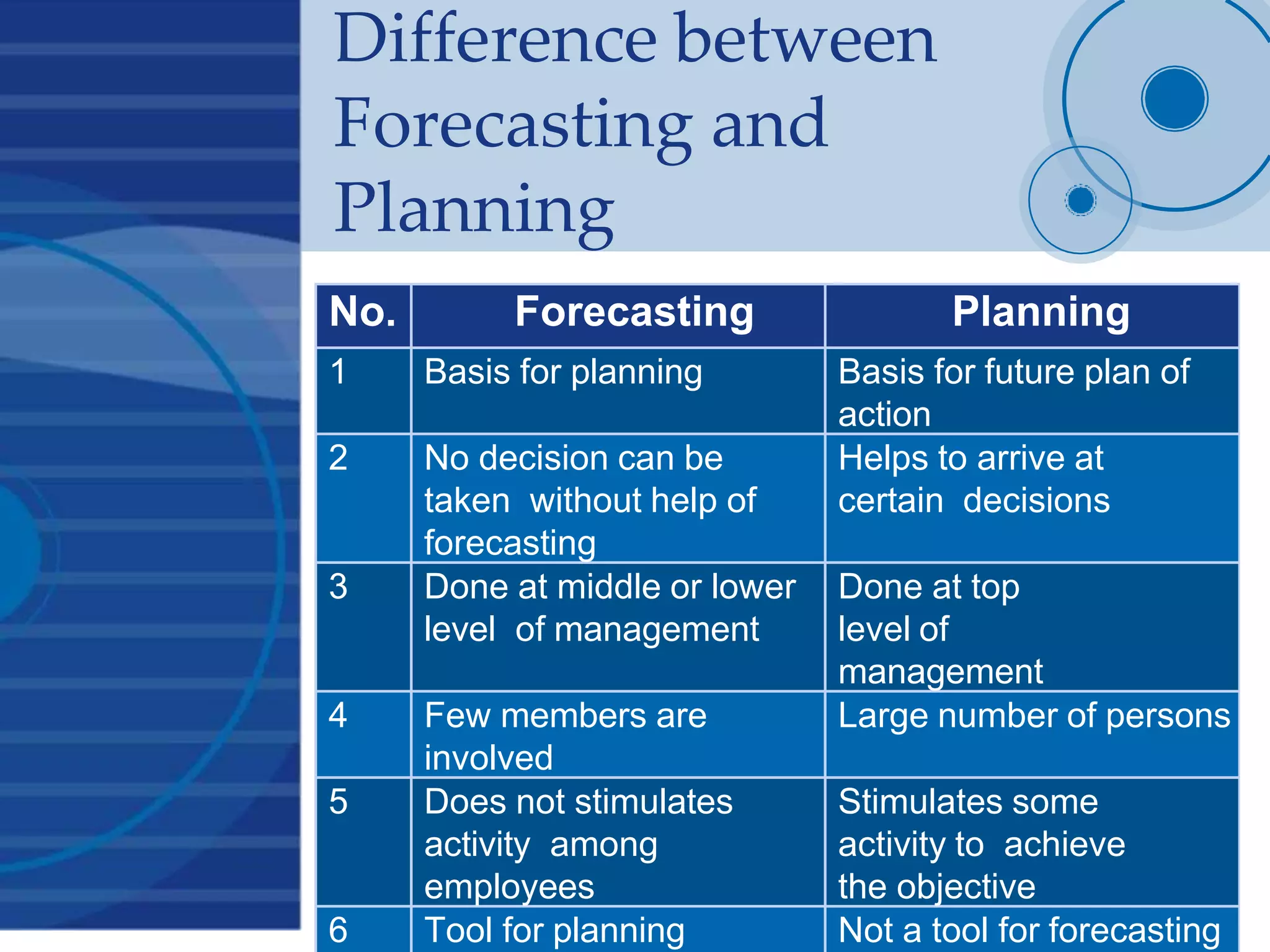
No.Forecasting Planning
1 Basis for planning Basis for future plan of
action
2 No decision can be
taken without help of
forecasting
Helps to arrive at
certain decisions
3 Done at middle or lower
level of management
Done at top
level of
management
4 Few members are
involved
Large number of persons
5 Does not stimulates
activity among
employees
Stimulates some
activity to achieve
the objective
6 Tool for planning Not a tool for forecasting
29.
Difference between
Forecasting and
Planning
•Forecasting is an integral part of
planning process
• Forecasting provides scope for
guessing of future happenings
• Forecast serves as a guideline to
executives for proper planning
30.
Summary
• Forecasting involvesdetailed analysis
of the past and present events to get
a clear idea about probable events in
future
• It is very important as it plays a
pivotal role in an organization
• Accurate forecasting is necessary
for efficient management
31.
Summary
• It usessome methods like
similarity events method,
executive method etc.
• It requires high degree of skill
• Basis for planning
• Forecast is important as it considers
the factors which effect proper