DIABETES MELLITUS:
 Metabolic disorder characterised by
hyperglycemia, glycosuria, hyperlipemia,
Negative nitrogen balance and some
time ketonemia
 Sign and Symptoms
 Increase in frequency of urination
(Polyuria)
 Excessive thirst (polydipsia)
 Excessive eating (Polyphagia)
 Fatigue
 Unexplained weight loss etc
Why diabetes should be controlled?
Uncontrolled leads to complications:
ACUTE
 Diabetic Ketoacidosis (DKA)
 Hyperglycemic hyperosmolar state
(HHS)
CHRONIC
 Retinopathy, Neuropathy,
Nephropathy- (microvascular)
 Coronary & peripheral vascular
disease and cerebrovascular
disease- (macrovascular)
 other
TYPES OF DIABETES MELLITUS:
Type 1 / Insulin Dependent
Diabetes Mellitus (IDDM)
Characterized by β-cell (pancreatic
islets) destruction leading to absolute
insulin deficiency
Type 2 / Non Insulin Dependent
Diabetes Mellitus (NIDDM)
Characterized by insulin resistance
and relative insulin deficiency
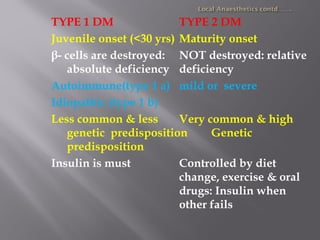
TYPE 1 DM TYPE 2 DM
Juvenile onset (<30 yrs) Maturity onset
β- cells are destroyed: NOT destroyed: relative
absolute deficiency deficiency
Autoimmune(type 1 a) mild or severe
Idiopathic (type 1 b)
Less common & less Very common & high
genetic predisposition Genetic
predisposition
Insulin is must Controlled by diet
change, exercise & oral
drugs: Insulin when
other fails
INSULIN:
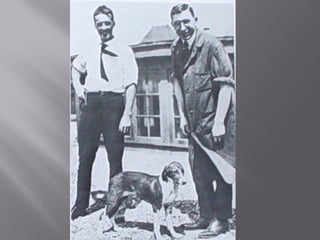
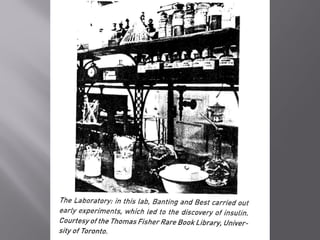
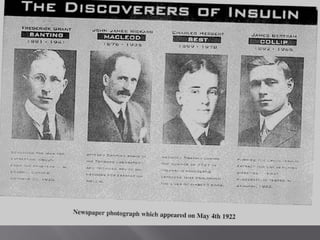
 Discovered in 1921 by Banting
and best
 Banting and Macleod got nobel
prize in 1923
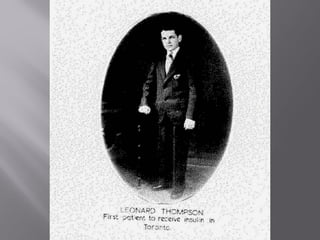
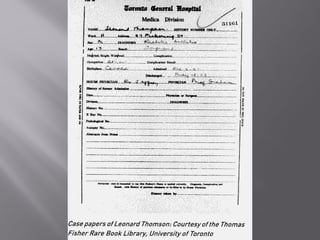
 Leonard Thompson: First
patient to receive insulin
Diabetes mellitus contd…….
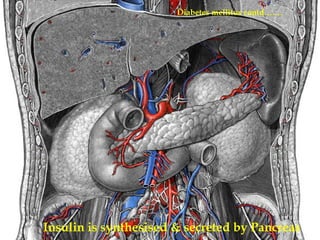
Insulin is synthesised & secreted by Pancreas
PANCREAS
a) Exocrine Gland
b) Endocrine Gland
Exocrine Gland:
 secretes enzymes
ENDOCRINE
Islets of Langerhans contains:
 α cells : secrete glucagon.
 β cells : secrete insulin.
 δ cells : secrete gastrin &
somatostatin
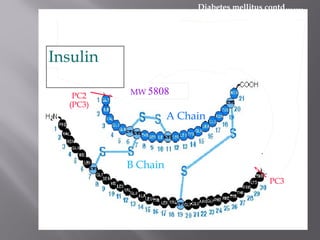
 Insulin is polypeptide 51
aminoacid (MW 6000). Contains
two chains; chain-A 21 aa &
Chain-B 30
 These chains are held together
by two inter-disulfide bonds &
one intra disulfide bond
 Pork insulin differ by one aa
where as Beef by two aa differ
SYNTHESIS
 Synthesized as preproinsulin
(110 aa) in rough ER (single
chain)
 Preproinsulin → proinsulin (86 aa;
molecule fold )
 Transported to Golgi apparatus
 Converted to insulin & C-peptide
 Stored in the granules of β cells
C peptide
Proinsulin
A Chain
B Chain
PC2
(PC3)
PC3
Diabetes mellitus contd…….
Insulin contd…….
 Insulin is measured in IU
FACTORS CONTROLLING THE
SECRETION OF INSULIN
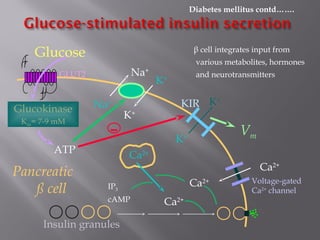
 Blood glucose concentration
 Hormonal control
 Neural control
Ca2+
Insulin granules
Na+
Na+
K+
K+
K+
K+
ATP
Na+
K+
-
K+
Glucose
GLUT2
Ca2+
Ca2+
Ca2+
Voltage-gated
Ca2+
channel
KIR
Vm
Pancreatic
ß cell IP3
cAMP
Glucokinase
Km= 7-9 mM
β cell integrates input from
various metabolites, hormones
and neurotransmitters
Diabetes mellitus contd…….
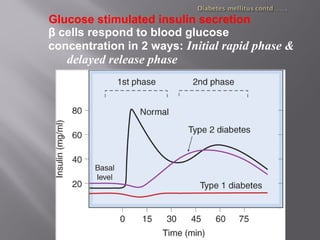
Glucose stimulated insulin secretion
β cells respond to blood glucose
concentration in 2 ways: Initial rapid phase &
delayed release phase
Neuronal control of insulin secretion
Parasympathetic nervous system:
~stimulates insulin secretion
Sympathetic nervous system:
~inhibits insulin secretion
EFFECTS OF INSULIN
ADIPOSE TISSUE
Increased glucose entry
Inhibits lipolysis & release of ffa
Increased triglyceride deposition
Increased K+
uptake
MUSCLE
Increased glucose entry
Increased glycogen synthesis
↑ed aa uptake & protein synthesis
Increased K+
uptake
LIVER
↑ed glucose uptake & glycogen
synthesis
Inhibits glycogenolysis &
glucose output
Inhibits gluconeogenesis
GENERAL
Increased cell growth
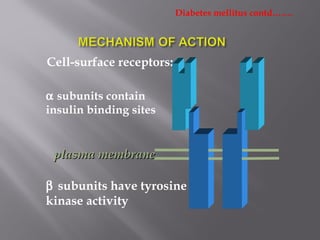
Cell-surface receptors:
α subunits contain
insulin binding sites
β subunits have tyrosine
kinase activity
plasma membraneplasma membrane
Diabetes mellitus contd…….
 MOA contd…
 Insulin binds to alpha subunit of receptor
tyrosine kinase (RTK) present in cell
membrane & activates tyrosine kinase
activity of beta subunit.
 There, it is phosphorylated by glucokinase,
which acts as a glucose sensor. The rise in
ATP levels causes a block of K+ channels,
leading to membrane depolarization and an
influx of Ca2+. The increase in intracellular
Ca2+ causes insulin release.
PHARMACOKINETICS
 NOT given orally, given s.c.
 Metabolised in liver, kidney & muscle
 Enzymatic degradation follows
receptor-mediated endocytosis
 t1/2 3-5 min
TYPES OF INSULIN
ACCORDING TO SOURCE
Conventional Insulin:
a)Bovine (More antigenic)
b)Porcine (Less antigenic)
Highly Purified Insulin Preparation
Human insulin:
Produced by rDNA technology
More water soluble & hydrophobic than
conventional insulin
More rapid s.c. absorption & shorter acting than
conventional insulin
Valuable in case of allergy to conventional,
insulin resistance, lipodystrophy, pregnancy
ACCORDING TO ONSET & DURATION
OF ACTION:
Rapid acting:
Insulin lispro, Insulin aspart, Insulin
glulisine
Short acting:
Regular (soluble) Insulin
Intermediate acting:
Insulin Zinc suspension (Lente)
Neutral protamine hagedorn (NPH) or
isophane insulin
Long acting:
Protamine zinc insulin (PZI)
Insulin glargine
Rapid acting: insulin lispro
lysine [B28], proline [B29]
Given immediately before or after meal
LYS
PROLYS
PRO
InsulinlisproInsulin
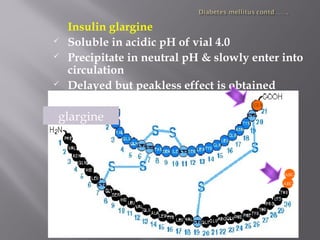
Insulin glargine
 Soluble in acidic pH of vial 4.0
 Precipitate in neutral pH & slowly enter into
circulation
 Delayed but peakless effect is obtained
ARG
ARG
ASNGLY
Insulinglargine
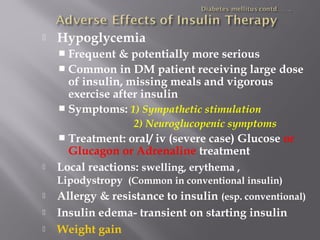
 Hypoglycemia
 Frequent & potentially more serious
 Common in DM patient receiving large dose
of insulin, missing meals and vigorous
exercise after insulin
 Symptoms: 1) Sympathetic stimulation
2) Neuroglucopenic symptoms
 Treatment: oral/ iv (severe case) Glucose or
Glucagon or Adrenaline treatment
 Local reactions: swelling, erythema ,
Lipodystropy (Common in conventional insulin)
 Allergy & resistance to insulin (esp. conventional)
 Insulin edema- transient on starting insulin
 Weight gain
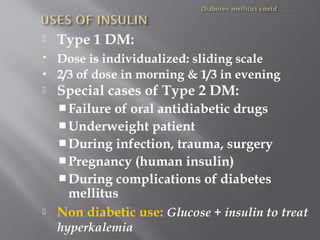
 Type 1 DM:
 Dose is individualized: sliding scale
 2/3 of dose in morning & 1/3 in evening
 Special cases of Type 2 DM:
Failure of oral antidiabetic drugs
Underweight patient
During infection, trauma, surgery
Pregnancy (human insulin)
During complications of diabetes
mellitus
 Non diabetic use: Glucose + insulin to treat
hyperkalemia
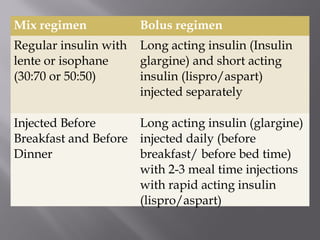
Mix regimen Bolus regimen
Regular insulin with
lente or isophane
(30:70 or 50:50)
Long acting insulin (Insulin
glargine) and short acting
insulin (lispro/aspart)
injected separately
Injected Before
Breakfast and Before
Dinner
Long acting insulin (glargine)
injected daily (before
breakfast/ before bed time)
with 2-3 meal time injections
with rapid acting insulin
(lispro/aspart)
1. β blocker (nonspecific) are contracted in
Diabetic patient receiving insulin?
 Because β blockers mask the symptoms of
hypoglycemia and also
 Delays recovery-prolong hypoglycemic attack
2. Thiazide, furosemide, corticosteroids,
Oral contraceptives, Salbutamol – reduce
effectiveness
3. Acute ingestion of alcohol-
hypoglycemia
Insulin

Insulin

  • 2.
    DIABETES MELLITUS:  Metabolicdisorder characterised by hyperglycemia, glycosuria, hyperlipemia, Negative nitrogen balance and some time ketonemia  Sign and Symptoms  Increase in frequency of urination (Polyuria)  Excessive thirst (polydipsia)  Excessive eating (Polyphagia)  Fatigue  Unexplained weight loss etc
  • 3.
    Why diabetes shouldbe controlled? Uncontrolled leads to complications: ACUTE  Diabetic Ketoacidosis (DKA)  Hyperglycemic hyperosmolar state (HHS) CHRONIC  Retinopathy, Neuropathy, Nephropathy- (microvascular)  Coronary & peripheral vascular disease and cerebrovascular disease- (macrovascular)  other
  • 4.
    TYPES OF DIABETESMELLITUS: Type 1 / Insulin Dependent Diabetes Mellitus (IDDM) Characterized by β-cell (pancreatic islets) destruction leading to absolute insulin deficiency Type 2 / Non Insulin Dependent Diabetes Mellitus (NIDDM) Characterized by insulin resistance and relative insulin deficiency
  • 5.
    TYPE 1 DMTYPE 2 DM Juvenile onset (<30 yrs) Maturity onset β- cells are destroyed: NOT destroyed: relative absolute deficiency deficiency Autoimmune(type 1 a) mild or severe Idiopathic (type 1 b) Less common & less Very common & high genetic predisposition Genetic predisposition Insulin is must Controlled by diet change, exercise & oral drugs: Insulin when other fails
  • 6.
    INSULIN:  Discovered in1921 by Banting and best  Banting and Macleod got nobel prize in 1923  Leonard Thompson: First patient to receive insulin
  • 12.
    Diabetes mellitus contd……. Insulinis synthesised & secreted by Pancreas
  • 13.
    PANCREAS a) Exocrine Gland b)Endocrine Gland Exocrine Gland:  secretes enzymes
  • 14.
    ENDOCRINE Islets of Langerhanscontains:  α cells : secrete glucagon.  β cells : secrete insulin.  δ cells : secrete gastrin & somatostatin
  • 15.
     Insulin ispolypeptide 51 aminoacid (MW 6000). Contains two chains; chain-A 21 aa & Chain-B 30  These chains are held together by two inter-disulfide bonds & one intra disulfide bond  Pork insulin differ by one aa where as Beef by two aa differ
  • 16.
    SYNTHESIS  Synthesized aspreproinsulin (110 aa) in rough ER (single chain)  Preproinsulin → proinsulin (86 aa; molecule fold )  Transported to Golgi apparatus  Converted to insulin & C-peptide  Stored in the granules of β cells
  • 17.
    C peptide Proinsulin A Chain BChain PC2 (PC3) PC3 Diabetes mellitus contd…….
  • 18.
    Insulin contd…….  Insulinis measured in IU FACTORS CONTROLLING THE SECRETION OF INSULIN  Blood glucose concentration  Hormonal control  Neural control
  • 19.
    Ca2+ Insulin granules Na+ Na+ K+ K+ K+ K+ ATP Na+ K+ - K+ Glucose GLUT2 Ca2+ Ca2+ Ca2+ Voltage-gated Ca2+ channel KIR Vm Pancreatic ß cellIP3 cAMP Glucokinase Km= 7-9 mM β cell integrates input from various metabolites, hormones and neurotransmitters Diabetes mellitus contd…….
  • 20.
    Glucose stimulated insulinsecretion β cells respond to blood glucose concentration in 2 ways: Initial rapid phase & delayed release phase
  • 21.
    Neuronal control ofinsulin secretion Parasympathetic nervous system: ~stimulates insulin secretion Sympathetic nervous system: ~inhibits insulin secretion
  • 22.
    EFFECTS OF INSULIN ADIPOSETISSUE Increased glucose entry Inhibits lipolysis & release of ffa Increased triglyceride deposition Increased K+ uptake MUSCLE Increased glucose entry Increased glycogen synthesis ↑ed aa uptake & protein synthesis Increased K+ uptake
  • 23.
    LIVER ↑ed glucose uptake& glycogen synthesis Inhibits glycogenolysis & glucose output Inhibits gluconeogenesis GENERAL Increased cell growth
  • 24.
    Cell-surface receptors: α subunitscontain insulin binding sites β subunits have tyrosine kinase activity plasma membraneplasma membrane Diabetes mellitus contd…….
  • 25.
     MOA contd… Insulin binds to alpha subunit of receptor tyrosine kinase (RTK) present in cell membrane & activates tyrosine kinase activity of beta subunit.  There, it is phosphorylated by glucokinase, which acts as a glucose sensor. The rise in ATP levels causes a block of K+ channels, leading to membrane depolarization and an influx of Ca2+. The increase in intracellular Ca2+ causes insulin release.
  • 26.
    PHARMACOKINETICS  NOT givenorally, given s.c.  Metabolised in liver, kidney & muscle  Enzymatic degradation follows receptor-mediated endocytosis  t1/2 3-5 min
  • 27.
    TYPES OF INSULIN ACCORDINGTO SOURCE Conventional Insulin: a)Bovine (More antigenic) b)Porcine (Less antigenic) Highly Purified Insulin Preparation Human insulin: Produced by rDNA technology More water soluble & hydrophobic than conventional insulin More rapid s.c. absorption & shorter acting than conventional insulin Valuable in case of allergy to conventional, insulin resistance, lipodystrophy, pregnancy
  • 28.
    ACCORDING TO ONSET& DURATION OF ACTION: Rapid acting: Insulin lispro, Insulin aspart, Insulin glulisine Short acting: Regular (soluble) Insulin Intermediate acting: Insulin Zinc suspension (Lente) Neutral protamine hagedorn (NPH) or isophane insulin Long acting: Protamine zinc insulin (PZI) Insulin glargine
  • 29.
    Rapid acting: insulinlispro lysine [B28], proline [B29] Given immediately before or after meal LYS PROLYS PRO InsulinlisproInsulin
  • 30.
    Insulin glargine  Solublein acidic pH of vial 4.0  Precipitate in neutral pH & slowly enter into circulation  Delayed but peakless effect is obtained ARG ARG ASNGLY Insulinglargine
  • 31.
     Hypoglycemia  Frequent& potentially more serious  Common in DM patient receiving large dose of insulin, missing meals and vigorous exercise after insulin  Symptoms: 1) Sympathetic stimulation 2) Neuroglucopenic symptoms  Treatment: oral/ iv (severe case) Glucose or Glucagon or Adrenaline treatment  Local reactions: swelling, erythema , Lipodystropy (Common in conventional insulin)  Allergy & resistance to insulin (esp. conventional)  Insulin edema- transient on starting insulin  Weight gain
  • 32.
     Type 1DM:  Dose is individualized: sliding scale  2/3 of dose in morning & 1/3 in evening  Special cases of Type 2 DM: Failure of oral antidiabetic drugs Underweight patient During infection, trauma, surgery Pregnancy (human insulin) During complications of diabetes mellitus  Non diabetic use: Glucose + insulin to treat hyperkalemia
  • 33.
    Mix regimen Bolusregimen Regular insulin with lente or isophane (30:70 or 50:50) Long acting insulin (Insulin glargine) and short acting insulin (lispro/aspart) injected separately Injected Before Breakfast and Before Dinner Long acting insulin (glargine) injected daily (before breakfast/ before bed time) with 2-3 meal time injections with rapid acting insulin (lispro/aspart)
  • 34.
    1. β blocker(nonspecific) are contracted in Diabetic patient receiving insulin?  Because β blockers mask the symptoms of hypoglycemia and also  Delays recovery-prolong hypoglycemic attack 2. Thiazide, furosemide, corticosteroids, Oral contraceptives, Salbutamol – reduce effectiveness 3. Acute ingestion of alcohol- hypoglycemia

Editor's Notes

  • #18 Nobel Prizes Fredrick Banting, John Macleod1923 Fredrick Sanger1958 Rosalyn Yalow and Solomon Berson DOROTHY CROWFOOT HODGKIN 1964 Nobel Laureate in Chemistry1978: Human insulin cloned into E. coli by Genentech scientists. Genentech licenses , the human insulin technology to Eli Lilly. In 1982, human insulin, Humulin, becomes the first recombinant DNA drug approved by FDA. [