Immunomodulators
Dr. Kaushik Mukhopadhyay
Assistant Professor, Dept. Of Pharmacology
ESI-PGIMSR
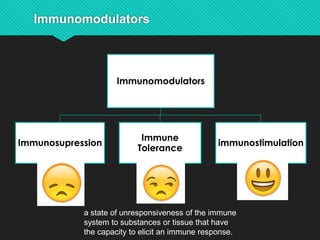
Immunomodulators
Immunosupression
Immune
Tolerance
immunostimulation
a state of unresponsiveness of the immune
system to substances or tissue that have
the capacity to elicit an immune response.
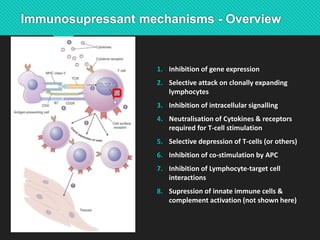
1. Inhibition of gene expression
2. Selective attack on clonally expanding
lymphocytes
3. Inhibition of intracellular signalling
4. Neutralisation of Cytokines & receptors
required for T-cell stimulation
5. Selective depression of T-cells (or others)
6. Inhibition of co-stimulation by APC
7. Inhibition of Lymphocyte-target cell
interactions
8. Supression of innate immune cells &
complement activation (not shown here)
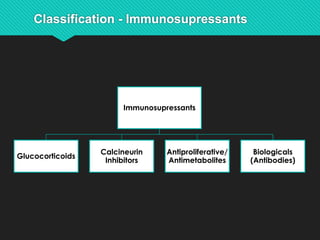
Immunosupressants
Glucocorticoids
Calcineurin
Inhibitors
Antiproliferative/
Antimetabolites
Biologicals
(Antibodies)
Glucocorticoids have broad anti-inflammatory effects on multiple components of cellular
immunity.
 MOA –
To effect longer-term responses, steroids bind to receptors inside cells; either these
receptors, glucocorticoid-induced proteins, or interacting proteins regulate the
transcription of numerous other genes
 Glucocorticoids lyse and induce the redistribution of lymphocytes,
 Curtail activation of NF-КB, which increases apoptosis of activated cells, key pro-
inflammatory cytokines such as IL-1 and IL-6 are downregulated.
 T cells are inhibited from making IL-2 and proliferating.
 The activation of cytotoxic T lymphocytes is inhibited.
 Neutrophils and monocytes display poor chemotaxis and decreased lysosomal enzyme
release.
 combined with other immunosuppressive agents to prevent and treat
transplant rejection.
 graft-versus-host disease in bone-marrow transplantation.
 Glucocorticoids are routinely used to treat auto-immune disorders such
as
 RA
 SLE, psoriasis
 Asthma and other allergic disorders,
 inflammatory bowel disease
 acute exacerbations of MS (see "Multiple Sclerosis").
 to block first-dose cytokine storm caused by treatment with
muromonab-CD3 and to a lesser extent ATG
 Growth retardation in children,
 Avascular necrosis of bone, osteopenia
 Increased risk of infection
 Poor wound healing
 Cataracts
 Hyperglycemia
 Hypertension
The advent of combined glucocorticoid + calcineurin inhibitor regimens
has allowed reduced doses or rapid withdrawal of steroids, resulting in
lower steroid-induced morbidities.
 Perhaps the most effective immunosuppressive drugs
in routine use
 They target intracellular signalling pathways induced as
a consequence of T cell–receptor activation
Tacrolimus Cyclosporine
 PK-
• Variable
• Trough level correlates better with clinical events
(100-200 ng/mL )
• The t 1/2 of tacrolimus is 12 hours
• CYP3A4
 USE –
• prophylaxis of solid-organ allograft rejection
• GVHD
 Tacrolimus (FK506) is a macrolide antibiotic produced by
Streptomyces tsukubaensis
 Nephrotoxicity,
 Neurotoxicity (e.g., tremor, headache, motor
disturbances, seizures),
 GI complaints,
 hypertension,
 hyperkalemia,
 Hyperglycemia and diabetes
 PK-
• 20-50% bioavailability
• CYP3A4
 USE –
• Clinical indications for cyclosporine are kidney, liver, heart,
and other organ transplantation
• Rheumatoid arthritis and psoriasis.
 Cyclosporine, a cyclic polypeptide of 11 amino acids, is produced by
the fungus Beauveria nivea
 Nephrotoxicity,
 GI complaints,
 hypertension,
 tremor,
 hirsutism,
 hyperlipidemia,
 and gum hyperplasia
 DDI - Sirolimus aggravates cyclosporine-induced renal dysfunction
 PK-
• Systemic availability is 15%
• A loading dose of three times the
maintenance dose will provide
nearly steady-state
• CYP3A4
 USE –
• Prophylaxis of organ transplant
rejection usually in combination
• At risk of calcineurin inhibitor–
associated nephrotoxicity
 Sirolimus is a macrocyclic lactone produced by Streptomyces
hygroscopicus
MOA
 dose-dependent increase in serum cholesterol
 Lymphocele, a known surgical complication associated with renal
transplantation
 cyclosporine and sirolimus interact, and their administration
should be separated by time
Everolimus
chemically and clinically related to sirolimus but has distinct
pharmacokinetics.
The main difference is a shorter t1/2 and thus a shorter time to
achieve steady-state concentrations of the drug.
 It is an imidazolyl derivative of 6-mercaptopurine
 MOA –
cleaved to 6-mercaptopurine (via Glutathione),
A fraudulent nucleotide, 6-thio-IMP, is converted to 6-
thio-GMP and finally to 6-thio-GTP, which is
incorporated into DNA.
converted to additional metabolites that inhibit de
novo purine synthesis
Cell proliferation thereby is inhibited, impairing a
variety of lymphocyte functions.
 PK –
 Well absorbed orally
 T1/2 = 10 mins (active metabolites)
 USE-
 adjunct for prevention of organ transplant rejection
 Severe RA
 ADR –
 The major side effect of azathioprine is bone marrow suppression
 increased susceptibility to infections (HSV),
 hepatotoxicity, alopecia, GI toxicity, pancreatitis,
 It is an ester of mycophenolic acid (MPA).
 MOA –
 MMF is a prodrug that is rapidly
hydrolyzed to the active drug, MPA
 MPA - a selective, noncompetitive,
reversible inhibitor of inosine
monophosphate dehydrogenase (IMPDH),
 IMPDH is an enzyme @ de novo pathway
of guanine nucleotide synthesis
 B and T lymphocytes are highly
dependent on this pathway for cell
proliferation (others- salvage pathway)
 PK –
 The parent drug - within a few minutes. The t1/2 of MPA is 16 hours.
 T1/2 = 10 mins (active metabolites)
 USE-
 MMF is indicated for prophylaxis of transplant rejection, and it
typically is used in combination (Glucocorticoid/Calcineurin)
 off label - SLE
 ADR –
 Gut -
 Hematologic – PRCA, leucopenia
 Congenital anomaly
 Methotrexate
 Cyclophosphamide
 Chlorumbucil
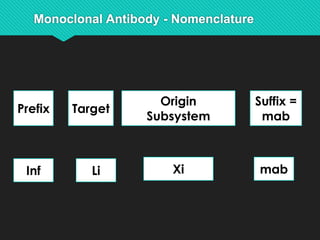
Inf Li Xi mab
Prefix Target
Origin
Subsystem
Suffix =
mab
Oma Li Zu mab
Ab ci xi mab
Ri tu xi mab
Ada Lim u mab
Omalizumab
Abciximab
Rituximab
Adalimumab
 Levamisole – colorectal CA
 BCG – intravesical therapy of superficial bladder cancer
 Cytokines – Interferrons,
 Filgramostim – chemotherapy induced
myelosupression
 Thalidomide – ENL, Multiple myeloma
 Imiquimod
Thank You

Immunomodulators

  • 1.
    Immunomodulators Dr. Kaushik Mukhopadhyay AssistantProfessor, Dept. Of Pharmacology ESI-PGIMSR
  • 2.
    Immunomodulators Immunosupression Immune Tolerance immunostimulation a state ofunresponsiveness of the immune system to substances or tissue that have the capacity to elicit an immune response.
  • 5.
    1. Inhibition ofgene expression 2. Selective attack on clonally expanding lymphocytes 3. Inhibition of intracellular signalling 4. Neutralisation of Cytokines & receptors required for T-cell stimulation 5. Selective depression of T-cells (or others) 6. Inhibition of co-stimulation by APC 7. Inhibition of Lymphocyte-target cell interactions 8. Supression of innate immune cells & complement activation (not shown here)
  • 6.
  • 7.
    Glucocorticoids have broadanti-inflammatory effects on multiple components of cellular immunity.  MOA – To effect longer-term responses, steroids bind to receptors inside cells; either these receptors, glucocorticoid-induced proteins, or interacting proteins regulate the transcription of numerous other genes  Glucocorticoids lyse and induce the redistribution of lymphocytes,  Curtail activation of NF-КB, which increases apoptosis of activated cells, key pro- inflammatory cytokines such as IL-1 and IL-6 are downregulated.  T cells are inhibited from making IL-2 and proliferating.  The activation of cytotoxic T lymphocytes is inhibited.  Neutrophils and monocytes display poor chemotaxis and decreased lysosomal enzyme release.
  • 8.
     combined withother immunosuppressive agents to prevent and treat transplant rejection.  graft-versus-host disease in bone-marrow transplantation.  Glucocorticoids are routinely used to treat auto-immune disorders such as  RA  SLE, psoriasis  Asthma and other allergic disorders,  inflammatory bowel disease  acute exacerbations of MS (see "Multiple Sclerosis").  to block first-dose cytokine storm caused by treatment with muromonab-CD3 and to a lesser extent ATG
  • 9.
     Growth retardationin children,  Avascular necrosis of bone, osteopenia  Increased risk of infection  Poor wound healing  Cataracts  Hyperglycemia  Hypertension The advent of combined glucocorticoid + calcineurin inhibitor regimens has allowed reduced doses or rapid withdrawal of steroids, resulting in lower steroid-induced morbidities.
  • 10.
     Perhaps themost effective immunosuppressive drugs in routine use  They target intracellular signalling pathways induced as a consequence of T cell–receptor activation Tacrolimus Cyclosporine
  • 12.
     PK- • Variable •Trough level correlates better with clinical events (100-200 ng/mL ) • The t 1/2 of tacrolimus is 12 hours • CYP3A4  USE – • prophylaxis of solid-organ allograft rejection • GVHD  Tacrolimus (FK506) is a macrolide antibiotic produced by Streptomyces tsukubaensis
  • 13.
     Nephrotoxicity,  Neurotoxicity(e.g., tremor, headache, motor disturbances, seizures),  GI complaints,  hypertension,  hyperkalemia,  Hyperglycemia and diabetes
  • 14.
     PK- • 20-50%bioavailability • CYP3A4  USE – • Clinical indications for cyclosporine are kidney, liver, heart, and other organ transplantation • Rheumatoid arthritis and psoriasis.  Cyclosporine, a cyclic polypeptide of 11 amino acids, is produced by the fungus Beauveria nivea
  • 15.
     Nephrotoxicity,  GIcomplaints,  hypertension,  tremor,  hirsutism,  hyperlipidemia,  and gum hyperplasia  DDI - Sirolimus aggravates cyclosporine-induced renal dysfunction
  • 16.
     PK- • Systemicavailability is 15% • A loading dose of three times the maintenance dose will provide nearly steady-state • CYP3A4  USE – • Prophylaxis of organ transplant rejection usually in combination • At risk of calcineurin inhibitor– associated nephrotoxicity  Sirolimus is a macrocyclic lactone produced by Streptomyces hygroscopicus MOA
  • 17.
     dose-dependent increasein serum cholesterol  Lymphocele, a known surgical complication associated with renal transplantation  cyclosporine and sirolimus interact, and their administration should be separated by time Everolimus chemically and clinically related to sirolimus but has distinct pharmacokinetics. The main difference is a shorter t1/2 and thus a shorter time to achieve steady-state concentrations of the drug.
  • 18.
     It isan imidazolyl derivative of 6-mercaptopurine  MOA – cleaved to 6-mercaptopurine (via Glutathione), A fraudulent nucleotide, 6-thio-IMP, is converted to 6- thio-GMP and finally to 6-thio-GTP, which is incorporated into DNA. converted to additional metabolites that inhibit de novo purine synthesis Cell proliferation thereby is inhibited, impairing a variety of lymphocyte functions.
  • 19.
     PK – Well absorbed orally  T1/2 = 10 mins (active metabolites)  USE-  adjunct for prevention of organ transplant rejection  Severe RA  ADR –  The major side effect of azathioprine is bone marrow suppression  increased susceptibility to infections (HSV),  hepatotoxicity, alopecia, GI toxicity, pancreatitis,
  • 20.
     It isan ester of mycophenolic acid (MPA).  MOA –  MMF is a prodrug that is rapidly hydrolyzed to the active drug, MPA  MPA - a selective, noncompetitive, reversible inhibitor of inosine monophosphate dehydrogenase (IMPDH),  IMPDH is an enzyme @ de novo pathway of guanine nucleotide synthesis  B and T lymphocytes are highly dependent on this pathway for cell proliferation (others- salvage pathway)
  • 21.
     PK – The parent drug - within a few minutes. The t1/2 of MPA is 16 hours.  T1/2 = 10 mins (active metabolites)  USE-  MMF is indicated for prophylaxis of transplant rejection, and it typically is used in combination (Glucocorticoid/Calcineurin)  off label - SLE  ADR –  Gut -  Hematologic – PRCA, leucopenia  Congenital anomaly
  • 22.
  • 26.
    Inf Li Ximab Prefix Target Origin Subsystem Suffix = mab
  • 27.
    Oma Li Zumab Ab ci xi mab Ri tu xi mab Ada Lim u mab Omalizumab Abciximab Rituximab Adalimumab
  • 30.
     Levamisole –colorectal CA  BCG – intravesical therapy of superficial bladder cancer  Cytokines – Interferrons,  Filgramostim – chemotherapy induced myelosupression  Thalidomide – ENL, Multiple myeloma  Imiquimod
  • 31.