WEST BENGAL UNIVERSITY OF
ANIMAL AND FISHERY SCIENCES
FACULTY OF FISHERY SCIENCES
A SEMINAR ON: BILE ACID
SEQUESTRANTS
SUBMITTED TO:
Dr. Supratim Choudhury
Dept. of FPT
SUBMITTED BY:
Shirsak Mondal
B.F.Sc 1st Year 2nd semester
INTRODUCTION
• The bile acid sequestrants are a group of
resins used to bind certain components of bile
in the gastrointestinal tract.
• They disrupt the enterohepatic circulation of
bile acids by combining with bile constituents
• In general, they are classified as
hypolipidemic agents,
• They are used in the treatment of chronic
diarrhea due to bile acid malabsorption.
MECHANISM
• Bile acid sequestrants are polymeric compounds that serve
as ion-exchange resins
• Bile acid sequestrants exchange anions such as chloride
ions for bile acids. By doing so, they bind bile acids and
sequester them from the enterohepatic circulation. then more
bile acids are produced to replace those that have been lost.
Because the body uses cholesterol to make bile acids, this
reduces the amount of LDL cholesterol circulating in the
blood.
• Bile acid sequestrants are large polymeric structures, and
they are not significantly absorbed from the gut into the
bloodstream.
Medical uses
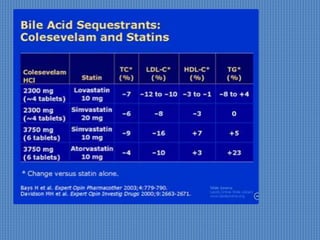
• Hyperlipidemia
As bile acids are biosynthesized from cholesterol, disruption of bile
acid reabsorption will decrease cholesterol levels, in particular, low-
density lipoprotein (commonly known as "bad cholesterol") in blood.
Consequently, these drugs have been used for the treatment of
hypercholesterolemia and dyslipidemia.
• In chronic liver diseases such as cirrhosis, bile acids may deposit in
the skin, causing pruritus (itching). Hence, bile acid sequestrants
may be used for the prevention of pruritus in patients with chronic
liver disease.
• Cholestyramine has been used in the treatment of Clostridium
difficile infections, in order to absorb toxins A and B.
Side-effects
As bile acid sequestrants are systemic side-effects.
However, they may cause problems in the
gastrointestinal tract (GI tract), such as constipation,
diarrhea, bloating and flatulence. Some patients
complain of the bad taste.
designed to stay in the gut, in general, they do not
have
Drug interactions
• In addition to bile acids, bile acid sequestrants
may also bind drugs in the GI tract, preventing
their absorption into the bloodstream. For this
reason, it is generally advised that bile acid
sequestrants be spaced several hours apart from
other drugs.
• . They can also bind fat-soluble vitamins, such as
vitamin A, vitamin D, vitamin E, and vitamin K.
This effect could result in a vitamin deficiency,
and so checking blood levels and possible
supplementation has been suggested.
Examples
Three drugs are members of this class; all are
synthetic polymeric resins:
* Cholestyramine (Questran and other
propriety names)
* Colestipol (Colestid, Colestipid)
* Colesevelam (Cholestagel in Europe,
Welchol in the USA)
bile acid sequestrants

bile acid sequestrants

  • 1.
    WEST BENGAL UNIVERSITYOF ANIMAL AND FISHERY SCIENCES FACULTY OF FISHERY SCIENCES A SEMINAR ON: BILE ACID SEQUESTRANTS SUBMITTED TO: Dr. Supratim Choudhury Dept. of FPT SUBMITTED BY: Shirsak Mondal B.F.Sc 1st Year 2nd semester
  • 2.
    INTRODUCTION • The bileacid sequestrants are a group of resins used to bind certain components of bile in the gastrointestinal tract. • They disrupt the enterohepatic circulation of bile acids by combining with bile constituents • In general, they are classified as hypolipidemic agents, • They are used in the treatment of chronic diarrhea due to bile acid malabsorption.
  • 3.
    MECHANISM • Bile acidsequestrants are polymeric compounds that serve as ion-exchange resins • Bile acid sequestrants exchange anions such as chloride ions for bile acids. By doing so, they bind bile acids and sequester them from the enterohepatic circulation. then more bile acids are produced to replace those that have been lost. Because the body uses cholesterol to make bile acids, this reduces the amount of LDL cholesterol circulating in the blood. • Bile acid sequestrants are large polymeric structures, and they are not significantly absorbed from the gut into the bloodstream.
  • 4.
    Medical uses • Hyperlipidemia Asbile acids are biosynthesized from cholesterol, disruption of bile acid reabsorption will decrease cholesterol levels, in particular, low- density lipoprotein (commonly known as "bad cholesterol") in blood. Consequently, these drugs have been used for the treatment of hypercholesterolemia and dyslipidemia. • In chronic liver diseases such as cirrhosis, bile acids may deposit in the skin, causing pruritus (itching). Hence, bile acid sequestrants may be used for the prevention of pruritus in patients with chronic liver disease. • Cholestyramine has been used in the treatment of Clostridium difficile infections, in order to absorb toxins A and B.
  • 5.
    Side-effects As bile acidsequestrants are systemic side-effects. However, they may cause problems in the gastrointestinal tract (GI tract), such as constipation, diarrhea, bloating and flatulence. Some patients complain of the bad taste. designed to stay in the gut, in general, they do not have
  • 7.
    Drug interactions • Inaddition to bile acids, bile acid sequestrants may also bind drugs in the GI tract, preventing their absorption into the bloodstream. For this reason, it is generally advised that bile acid sequestrants be spaced several hours apart from other drugs. • . They can also bind fat-soluble vitamins, such as vitamin A, vitamin D, vitamin E, and vitamin K. This effect could result in a vitamin deficiency, and so checking blood levels and possible supplementation has been suggested.
  • 8.
    Examples Three drugs aremembers of this class; all are synthetic polymeric resins: * Cholestyramine (Questran and other propriety names) * Colestipol (Colestid, Colestipid) * Colesevelam (Cholestagel in Europe, Welchol in the USA)