LEARNING OBJECTIVES -- VIDEO 4
• GOLGI APPARATUS
• LYSOSOMES
• MITOCHONDIA
• PLASTIDS
• VACOULES
• CELL DIVISION
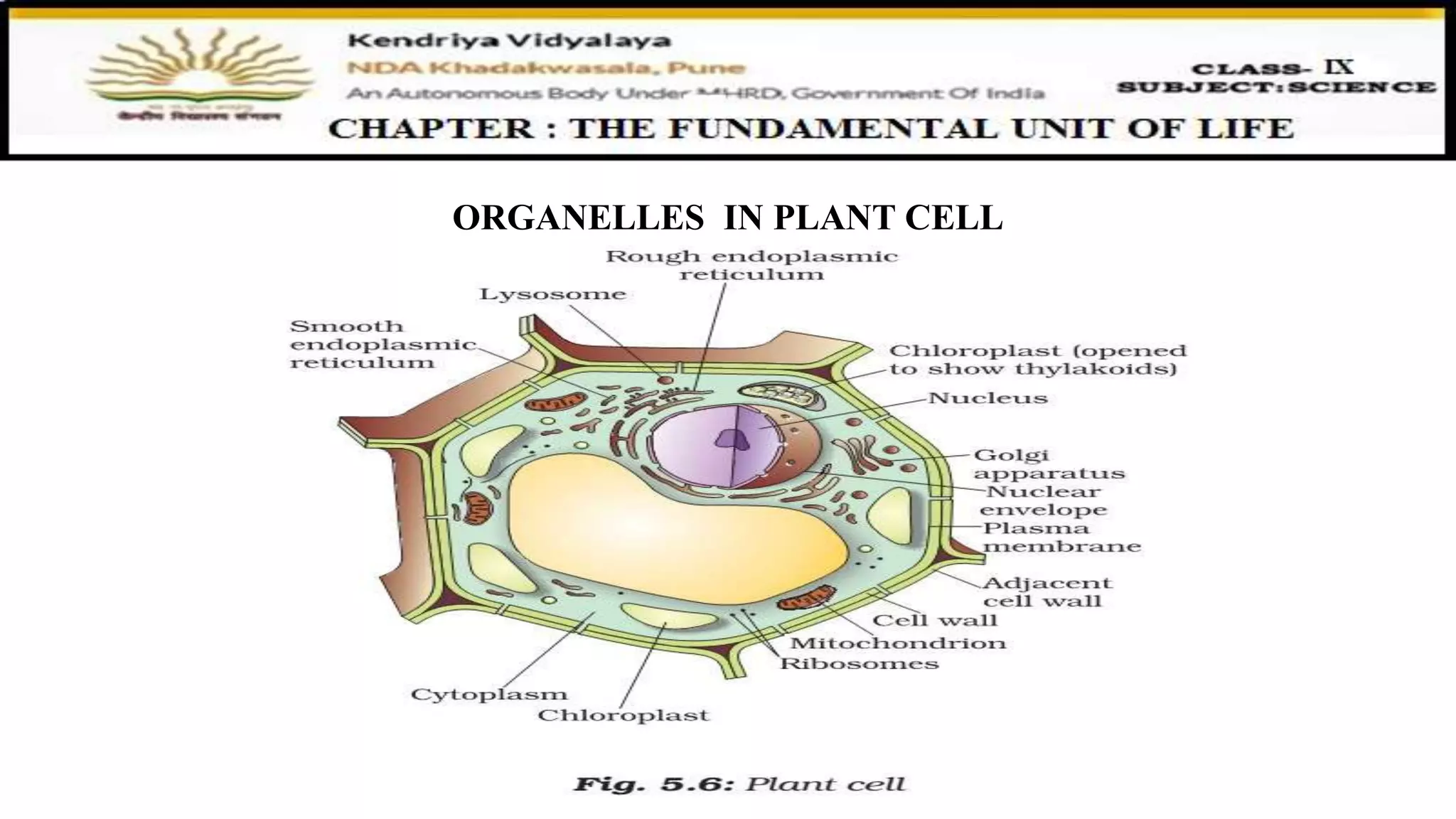
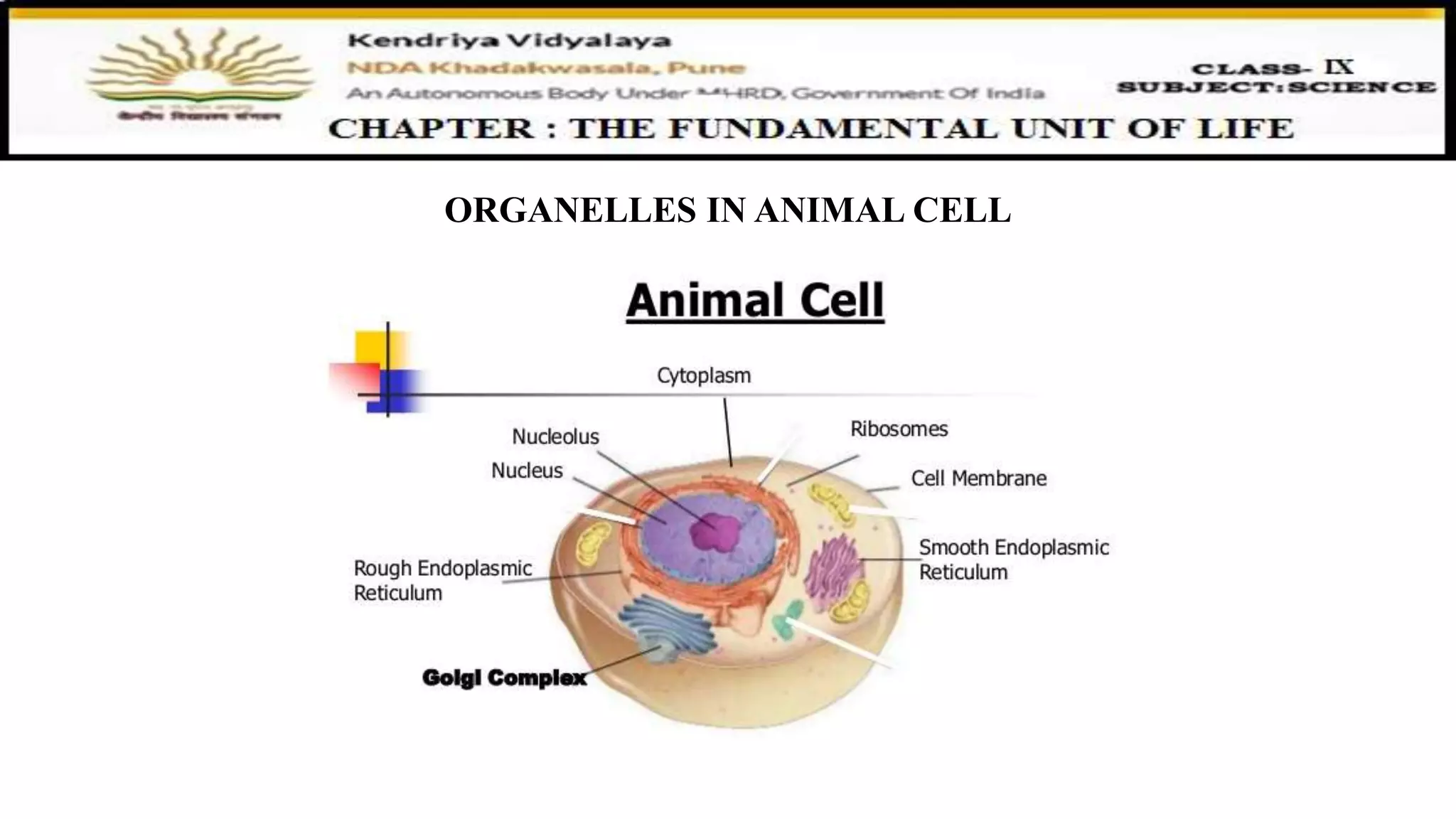
• ORGANELLES IN PLANT AND ANIMAL
CELL
GOLGI APPARATUS
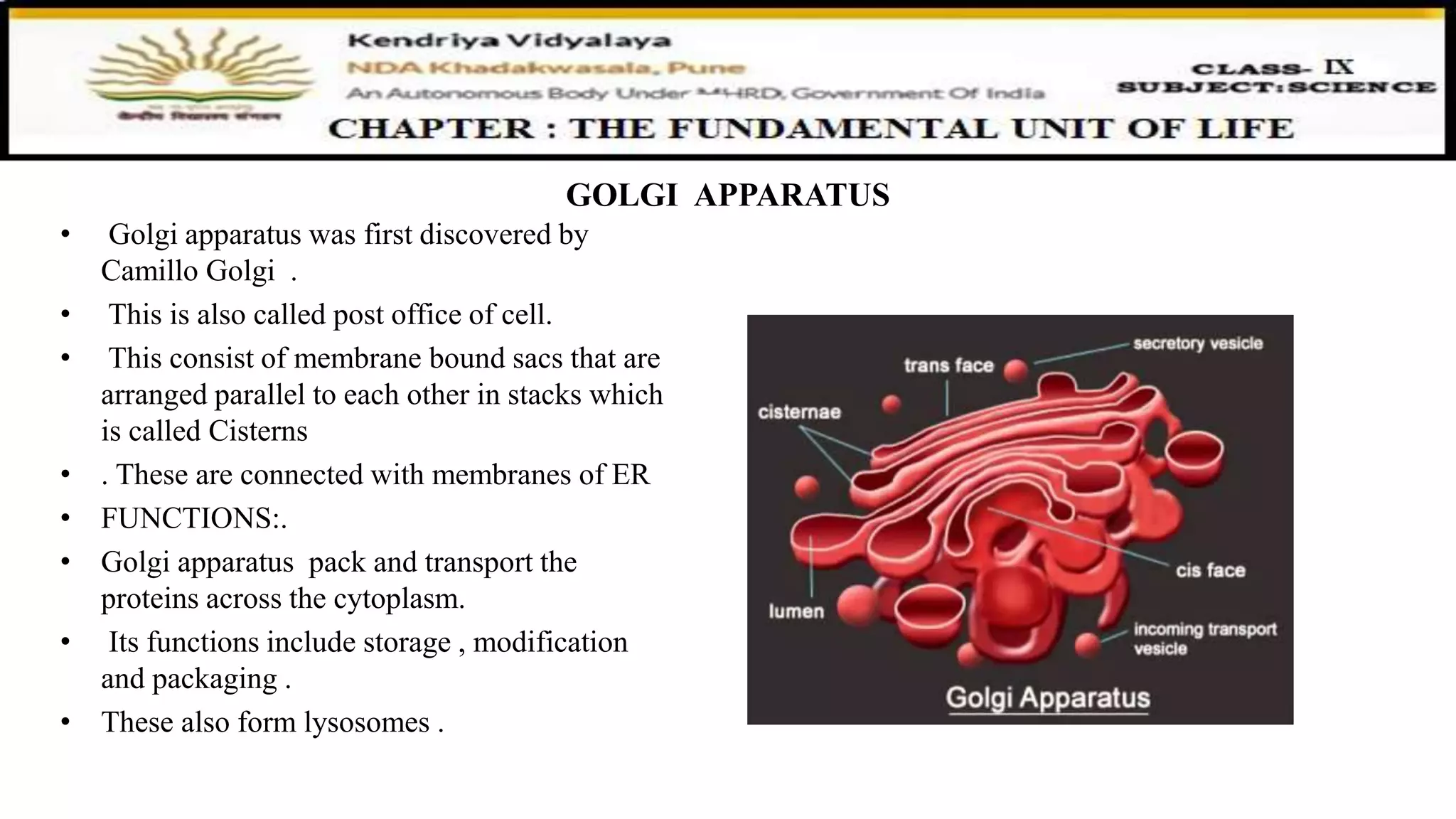
• Golgi apparatus was first discovered by
Camillo Golgi .
• This is also called post office of cell.
• This consist of membrane bound sacs that are
arranged parallel to each other in stacks which
is called Cisterns
• . These are connected with membranes of ER
• FUNCTIONS:.
• Golgi apparatus pack and transport the
proteins across the cytoplasm.
• Its functions include storage , modification
and packaging .
• These also form lysosomes .
LYSOSOMES
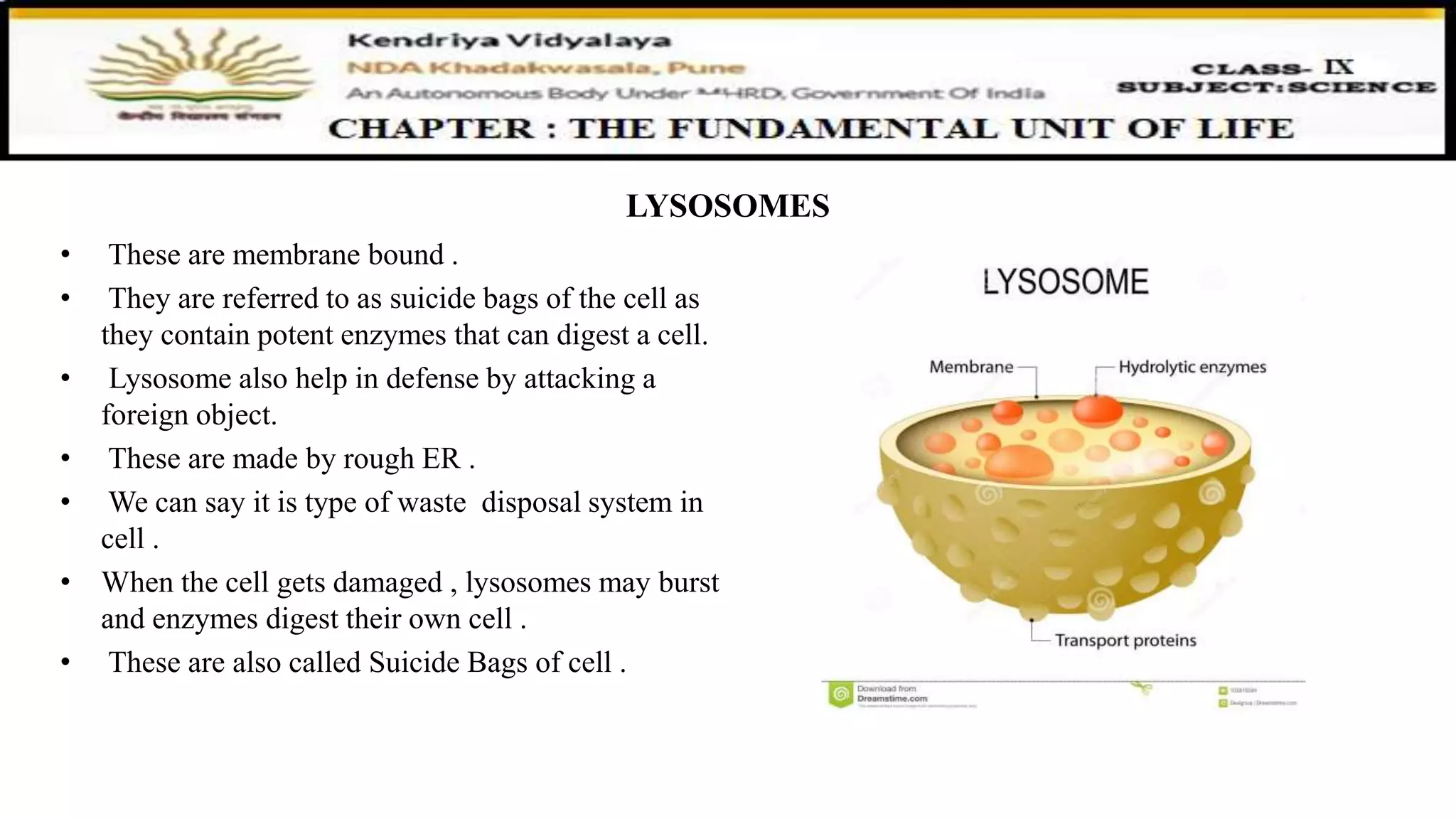
• These are membrane bound .
• They are referred to as suicide bags of the cell as
they contain potent enzymes that can digest a cell.
• Lysosome also help in defense by attacking a
foreign object.
• These are made by rough ER .
• We can say it is type of waste disposal system in
cell .
• When the cell gets damaged , lysosomes may burst
and enzymes digest their own cell .
• These are also called Suicide Bags of cell .
MITOCHONDRIA
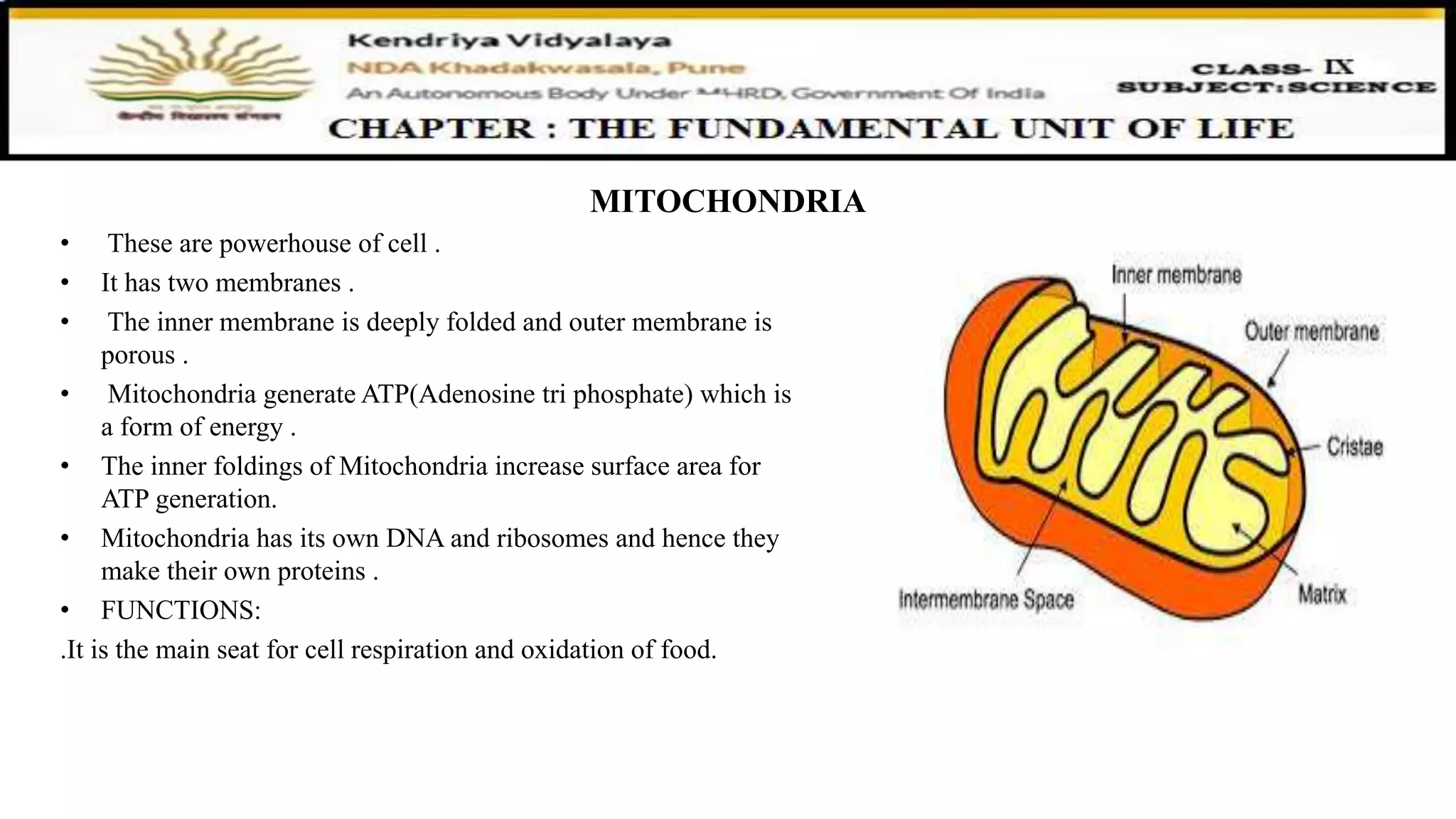
• These are powerhouse of cell .
• It has two membranes .
• The inner membrane is deeply folded and outer membrane is
porous .
• Mitochondria generate ATP(Adenosine tri phosphate) which is
a form of energy .
• The inner foldings of Mitochondria increase surface area for
ATP generation.
• Mitochondria has its own DNA and ribosomes and hence they
make their own proteins .
• FUNCTIONS:
.It is the main seat for cell respiration and oxidation of food.
PLASTIDS
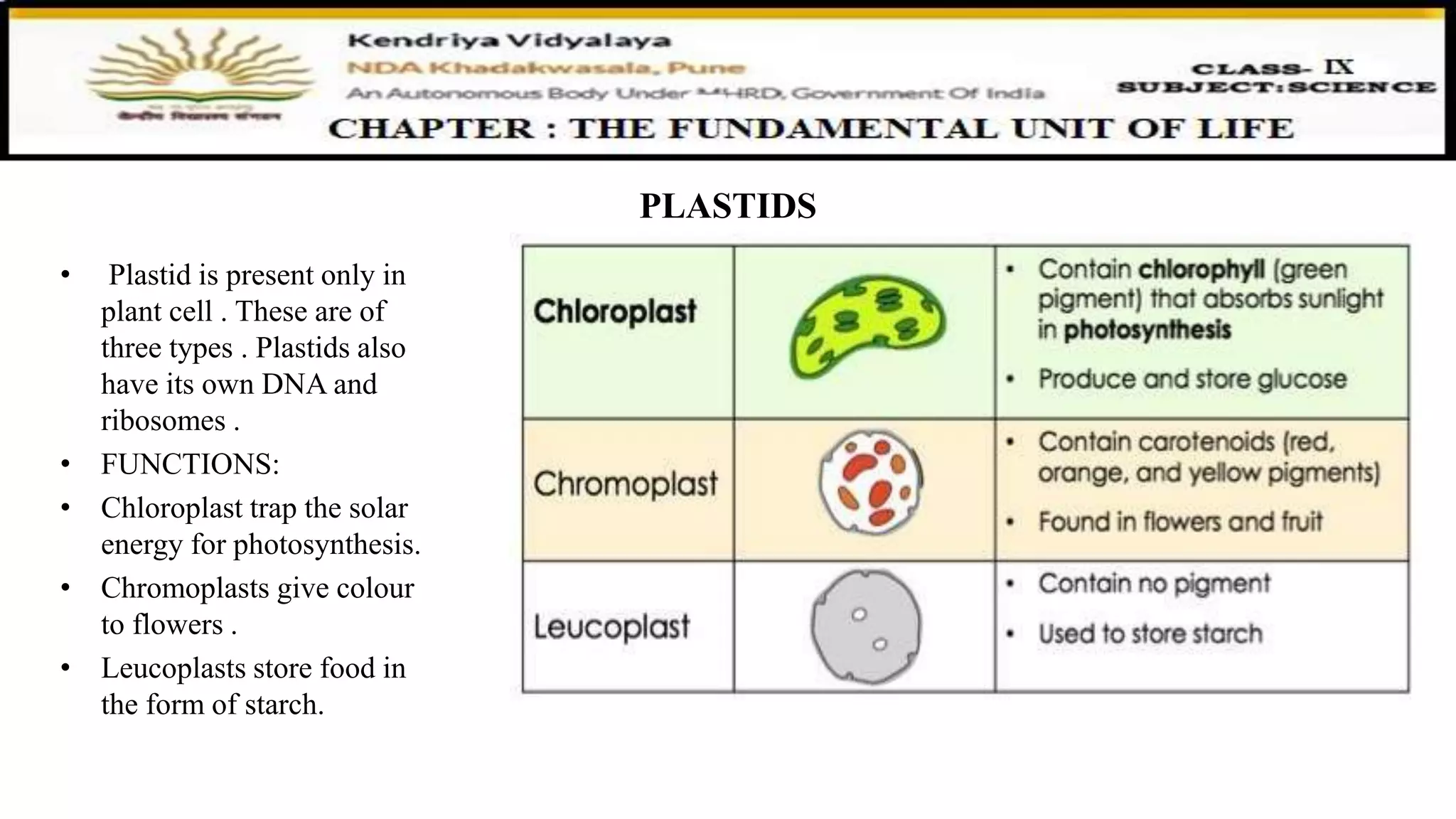
• Plastid is present only in
plant cell . These are of
three types . Plastids also
have its own DNA and
ribosomes .
• FUNCTIONS:
• Chloroplast trap the solar
energy for photosynthesis.
• Chromoplasts give colour
to flowers .
• Leucoplasts store food in
the form of starch.
VACUOLES
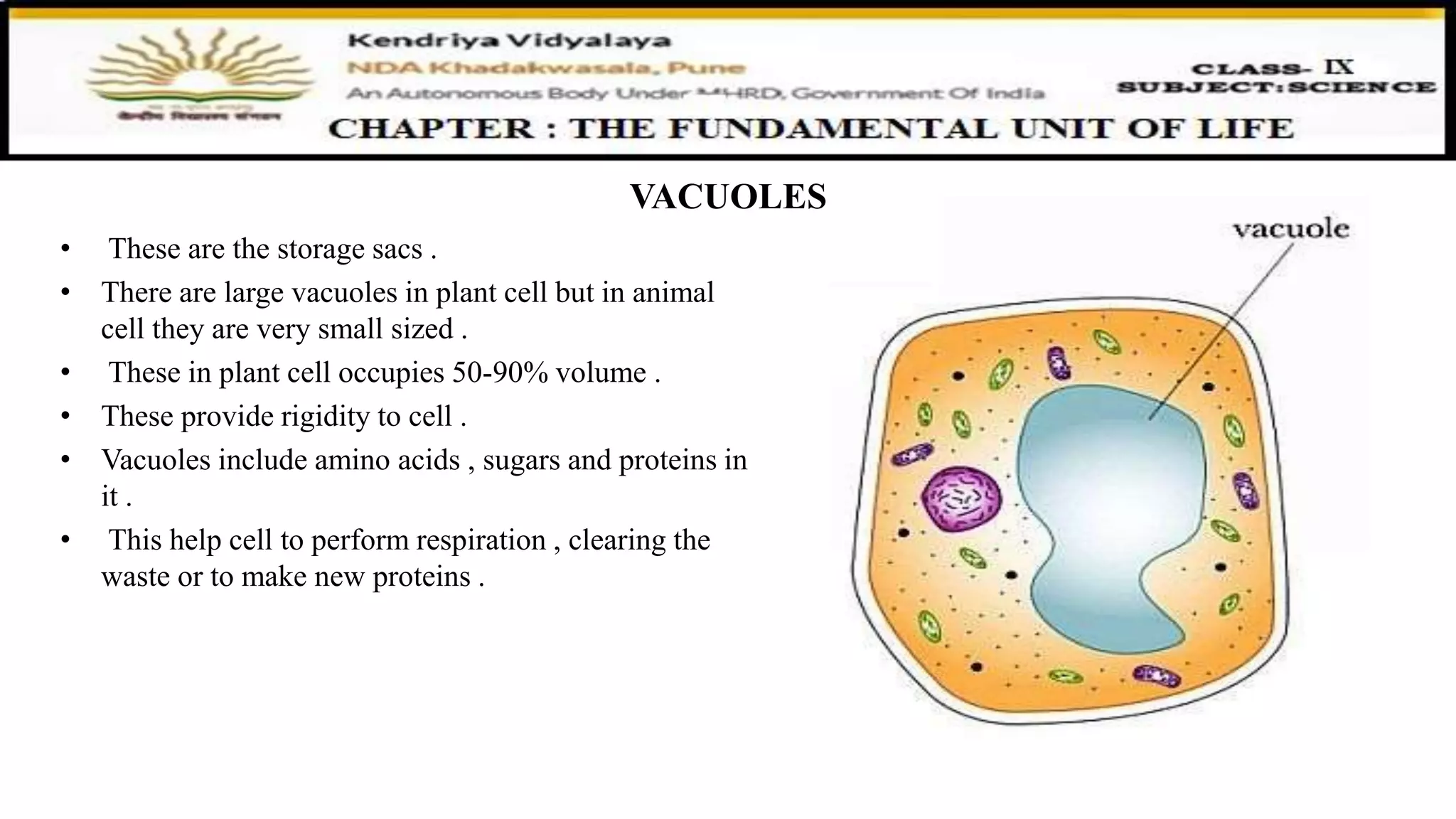
• These are the storage sacs .
• There are large vacuoles in plant cell but in animal
cell they are very small sized .
• These in plant cell occupies 50-90% volume .
• These provide rigidity to cell .
• Vacuoles include amino acids , sugars and proteins in
it .
• This help cell to perform respiration , clearing the
waste or to make new proteins .
CELL INCLUSIONS
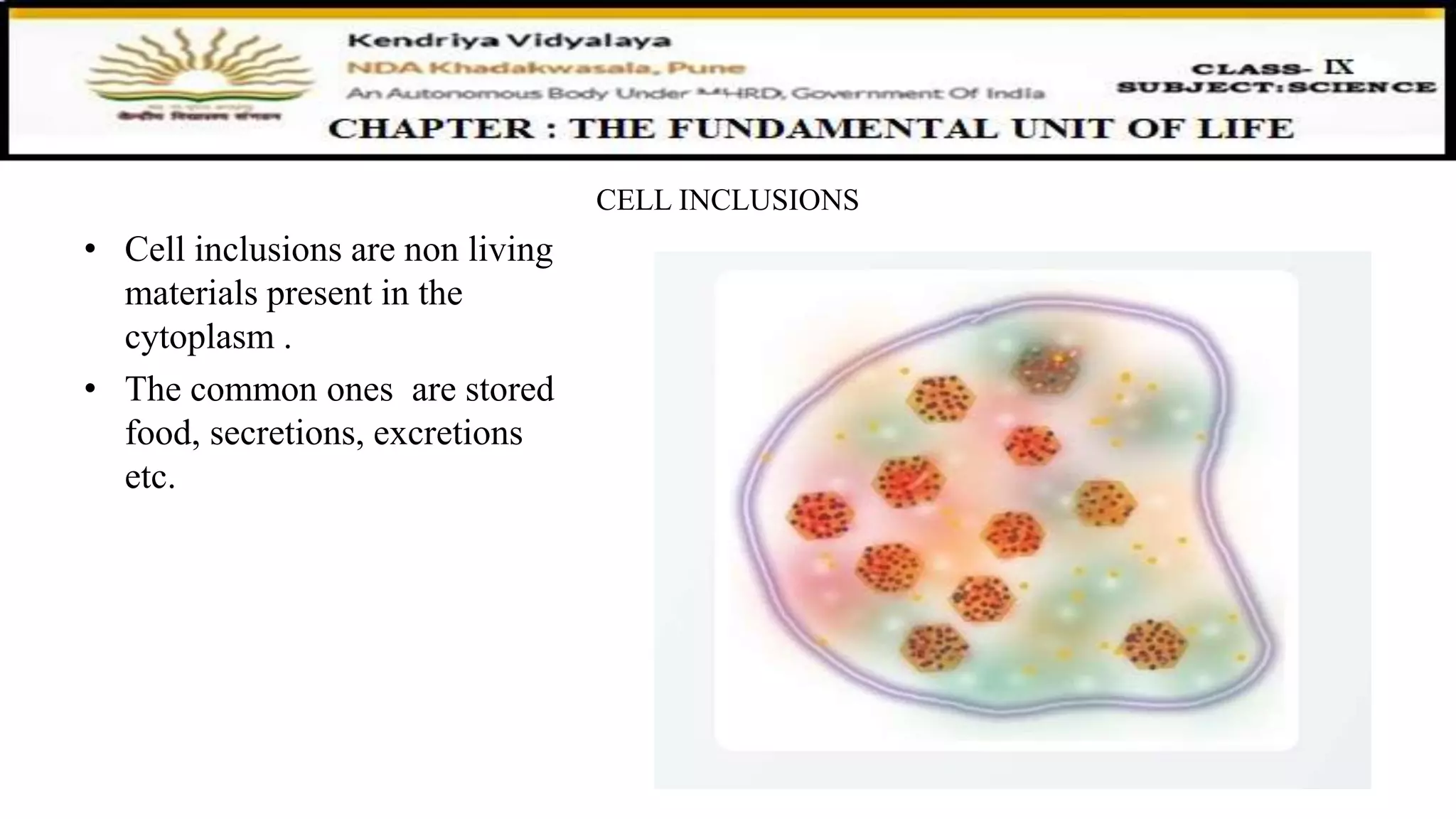
• Cell inclusions are non living
materials present in the
cytoplasm .
• The common ones are stored
food, secretions, excretions
etc.
CELL DIVISION
• Cells are formed to grow and replace old and dead
cells .
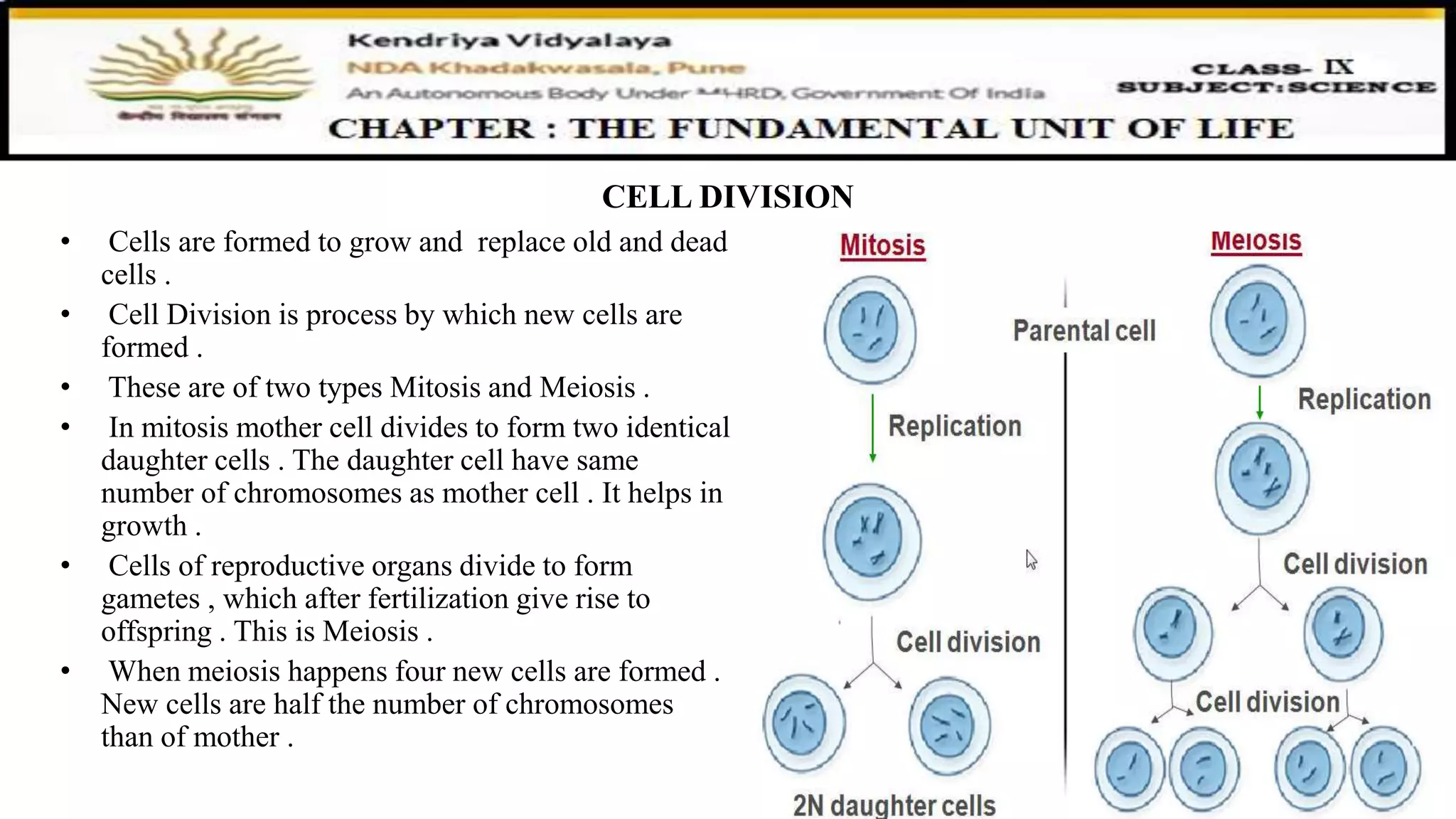
• Cell Division is process by which new cells are
formed .
• These are of two types Mitosis and Meiosis .
• In mitosis mother cell divides to form two identical
daughter cells . The daughter cell have same
number of chromosomes as mother cell . It helps in
growth .
• Cells of reproductive organs divide to form
gametes , which after fertilization give rise to
offspring . This is Meiosis .
• When meiosis happens four new cells are formed .
New cells are half the number of chromosomes
than of mother .
ORGANELLES IN PLANT CELL
ORGANELLES IN ANIMAL CELL
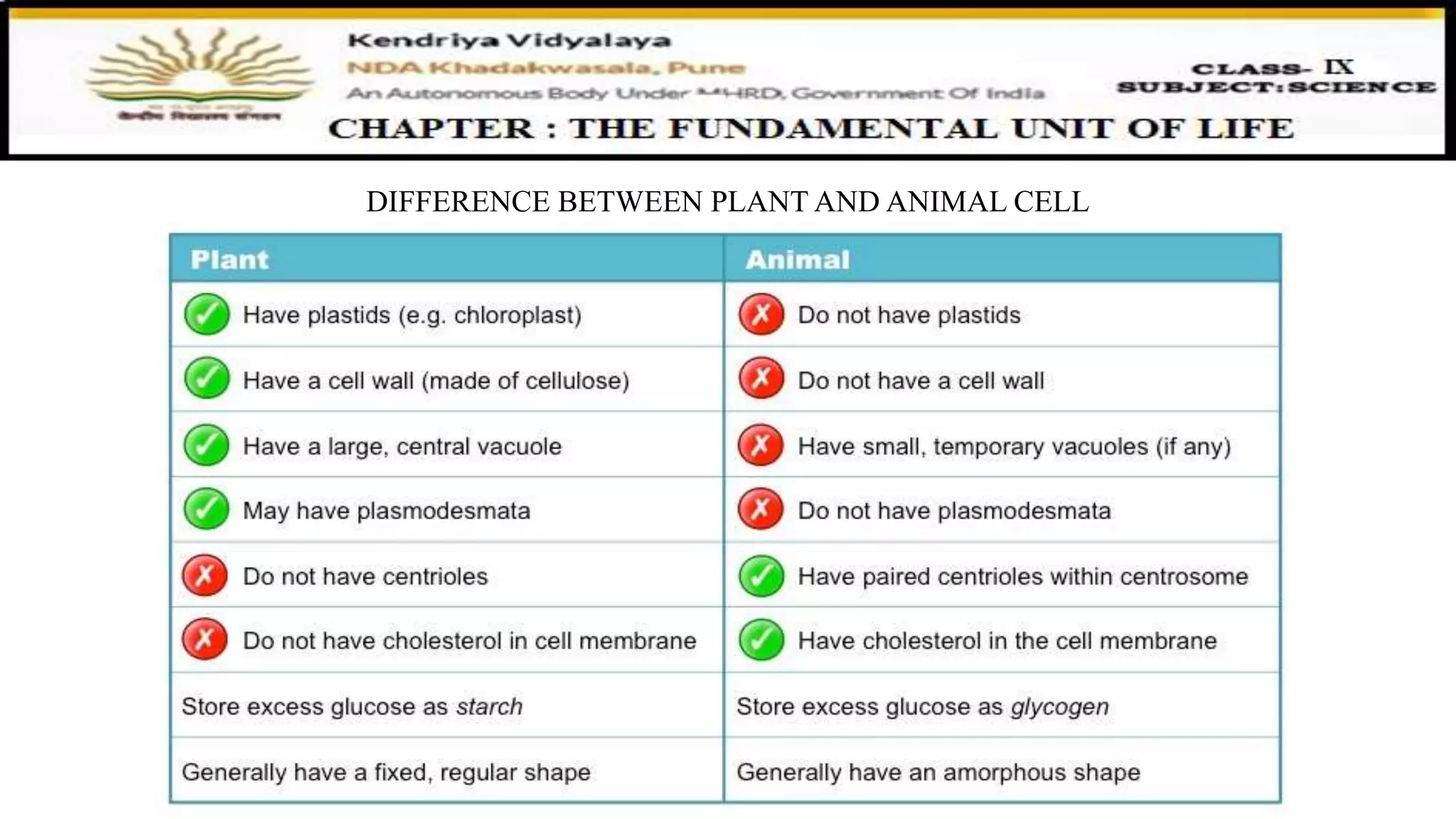
DIFFERENCE BETWEEN PLANT AND ANIMAL CELL
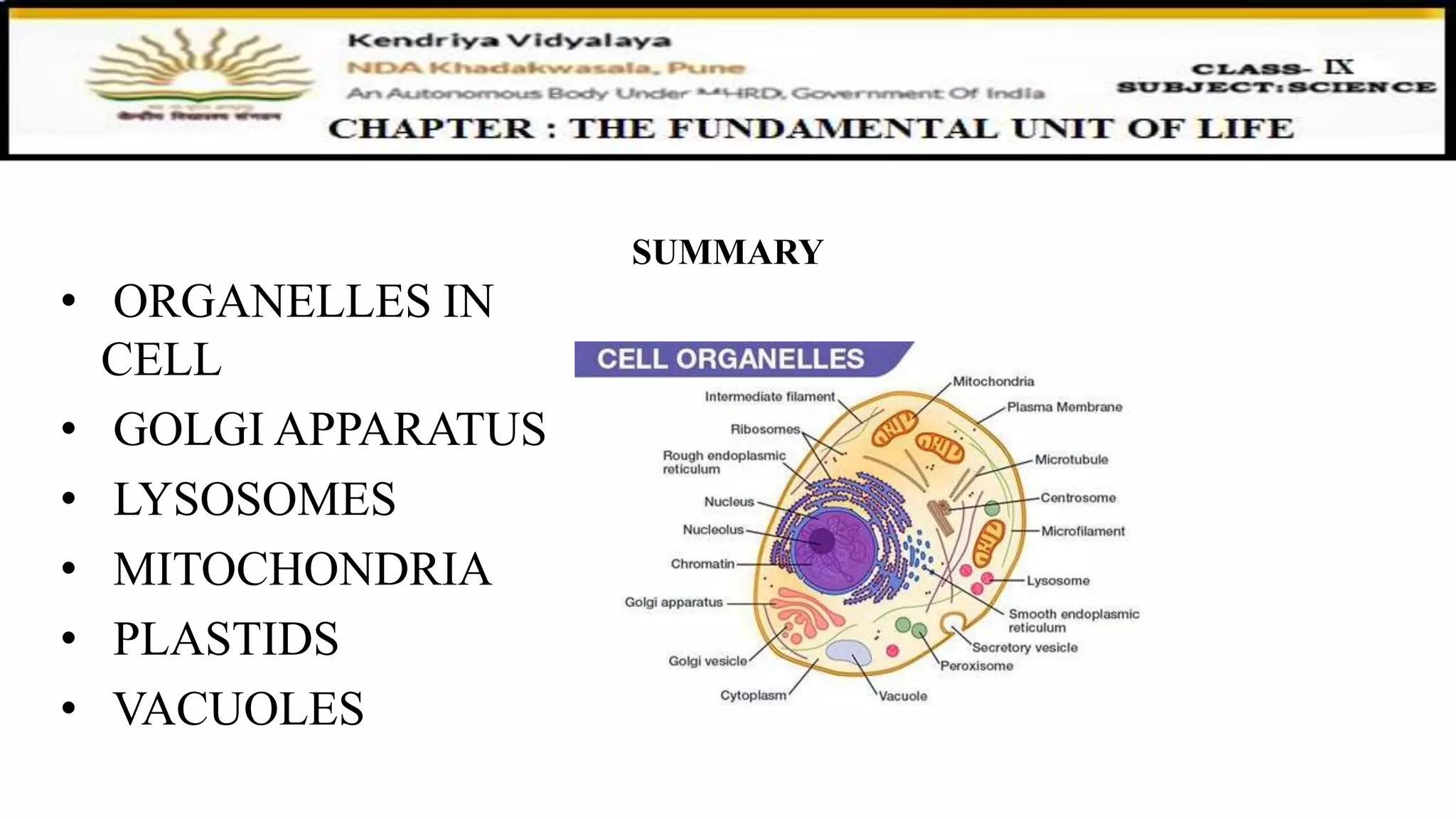
SUMMARY
• ORGANELLES IN
CELL
• GOLGI APPARATUS
• LYSOSOMES
• MITOCHONDRIA
• PLASTIDS
• VACUOLES

Class 9 cell ppt 4

  • 1.
    LEARNING OBJECTIVES --VIDEO 4 • GOLGI APPARATUS • LYSOSOMES • MITOCHONDIA • PLASTIDS • VACOULES • CELL DIVISION • ORGANELLES IN PLANT AND ANIMAL CELL
  • 2.
    GOLGI APPARATUS • Golgiapparatus was first discovered by Camillo Golgi . • This is also called post office of cell. • This consist of membrane bound sacs that are arranged parallel to each other in stacks which is called Cisterns • . These are connected with membranes of ER • FUNCTIONS:. • Golgi apparatus pack and transport the proteins across the cytoplasm. • Its functions include storage , modification and packaging . • These also form lysosomes .
  • 3.
    LYSOSOMES • These aremembrane bound . • They are referred to as suicide bags of the cell as they contain potent enzymes that can digest a cell. • Lysosome also help in defense by attacking a foreign object. • These are made by rough ER . • We can say it is type of waste disposal system in cell . • When the cell gets damaged , lysosomes may burst and enzymes digest their own cell . • These are also called Suicide Bags of cell .
  • 4.
    MITOCHONDRIA • These arepowerhouse of cell . • It has two membranes . • The inner membrane is deeply folded and outer membrane is porous . • Mitochondria generate ATP(Adenosine tri phosphate) which is a form of energy . • The inner foldings of Mitochondria increase surface area for ATP generation. • Mitochondria has its own DNA and ribosomes and hence they make their own proteins . • FUNCTIONS: .It is the main seat for cell respiration and oxidation of food.
  • 5.
    PLASTIDS • Plastid ispresent only in plant cell . These are of three types . Plastids also have its own DNA and ribosomes . • FUNCTIONS: • Chloroplast trap the solar energy for photosynthesis. • Chromoplasts give colour to flowers . • Leucoplasts store food in the form of starch.
  • 6.
    VACUOLES • These arethe storage sacs . • There are large vacuoles in plant cell but in animal cell they are very small sized . • These in plant cell occupies 50-90% volume . • These provide rigidity to cell . • Vacuoles include amino acids , sugars and proteins in it . • This help cell to perform respiration , clearing the waste or to make new proteins .
  • 7.
    CELL INCLUSIONS • Cellinclusions are non living materials present in the cytoplasm . • The common ones are stored food, secretions, excretions etc.
  • 8.
    CELL DIVISION • Cellsare formed to grow and replace old and dead cells . • Cell Division is process by which new cells are formed . • These are of two types Mitosis and Meiosis . • In mitosis mother cell divides to form two identical daughter cells . The daughter cell have same number of chromosomes as mother cell . It helps in growth . • Cells of reproductive organs divide to form gametes , which after fertilization give rise to offspring . This is Meiosis . • When meiosis happens four new cells are formed . New cells are half the number of chromosomes than of mother .
  • 9.
  • 10.
  • 11.
    DIFFERENCE BETWEEN PLANTAND ANIMAL CELL
  • 12.
    SUMMARY • ORGANELLES IN CELL •GOLGI APPARATUS • LYSOSOMES • MITOCHONDRIA • PLASTIDS • VACUOLES