Atoms and
Molecules
P R E S E N T E D B Y
R A X I T G U P T A
C L A S S I X C
History of Atom
∙ Ancient Indian and Greek philosopher have wondered about unknown and
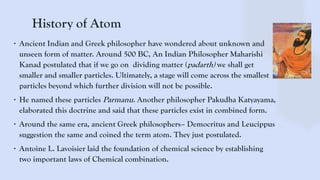
unseen form of matter. Around 500 BC, An Indian Philosopher Maharishi
Kanad postulated that if we go on dividing matter (padarth) we shall get
smaller and smaller particles. Ultimately, a stage will come across the smallest
particles beyond which further division will not be possible.
∙ He named these particles Parmanu. Another philosopher Pakudha Katyayama,
elaborated this doctrine and said that these particles exist in combined form.
∙ Around the same era, ancient Greek philosophers– Democritus and Leucippus
suggestion the same and coined the term atom. They just postulated.
∙ Antoine L. Lavoisier laid the foundation of chemical science by establishing
two important laws of Chemical combination.
Laws of Chemical combination.
∙ There are two laws of chemical combinations given after
much experimentations by ANTOINE L. LAVOISER and
JOSEPH L. PROUST.
∙ Two laws are:
1.Law of conservation of masses
2.Law of constant proportion.
Law of Conservation of Masses
∙ Law of conservation of masses states that masses can niether be created nor
destroyed in a chemical reaction.
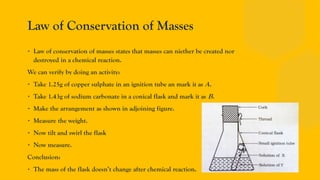
We can verify by doing an activity:
∙ Take 1.25g of copper sulphate in an ignition tube an mark it as A.
∙ Take 1.43g of sodium carbonate in a conical flask and mark it as B.
∙ Make the arrangement as shown in adjoining figure.
∙ Measure the weight.
∙ Now tilt and swirl the flask
∙ Now measure.
Conclusion:
∙ The mass of the flask doesn’t change after chemical reaction.
Law of constant proportion.
∙ Lavoisier, along other scientist noted that many compounds were composed of two
or more elements and each each such compound had the same element in the
same proportions, irrespective of where the compound is comes from.
∙ Like in compound water (H2O), the ratio of the masses of hydrogen and oxygen is
always 1:8, whatever the source of water. Means if 9g of H2O decomposed, 1g of
Hydrogen and 8g of oxygen are always obtained.
∙ Similarly, In Ammonia NH4 , Nitrogen and Hydrogen are always lresent in the
ratio of 14:3 by mass.
∙ So, this law stated by Proust as “In a chemical substance the elements are always
present in a definite proportion by mass”.
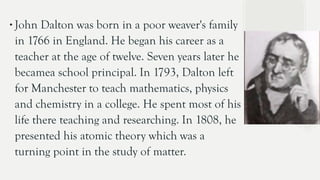
∙John Dalton was born in a poor weaver's family
in 1766 in England. He began his career as a
teacher at the age of twelve. Seven years later he
becamea school principal. In 1793, Dalton left
for Manchester to teach mathematics, physics
and chemistry in a college. He spent most of his
life there teaching and researching. In 1808, he
presented his atomic theory which was a
turning point in the study of matter.
Dalton’s Atomic Theory
∙ According to Dalton’s atomic theory, all matter, whether an element, a compound
or a mixture is composed of small particles called atoms. The postulates of this
theory may be stated as follows:
1. All matter is made of very tiny particles called atoms, which participate in
chemical reactions.
2. Atoms are indivisible particles, which cannot be created or destroyed in
chemical reaction.
3. Atoms of a given element are identical in mass and chemical properties.
4. Atoms of different elements have different masses and chemical properties.
5. Atoms combine in a ratio of small whole numbers to form compounds.
6. The relative number and kinds of atoms are constant in a given compound.
How Big are atoms?
∙ The atom is about 10-10 meters (or 10-8 centimeters) in size. This means a row of
108 (or 100,000,000) atoms would stretch a centimeter, about the size of your
fingernail. Atoms of different elements are different sizes, but 10-10 m can be
thought of as a rough value for any atom.
∙ The electron is by far the least massive of these particles at 9.11×10⁻³¹ kg, with a
negative electrical charge and a size that is too small to be measured using
available technique
∙ Atomic radius are measured in nanometers.
1/10⁹m= 1nm
1m=10⁹nm
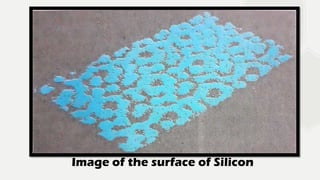
Image of the surface of Silicon
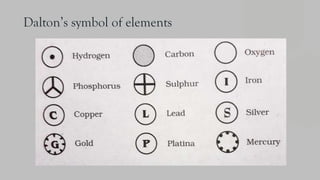
Dalton’s symbol of elements
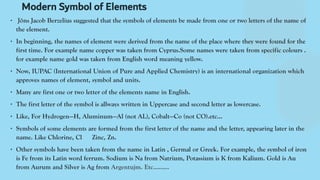
Modern Symbol of Elements
∙ Jöns Jacob Berzelius suggested that the symbols of elements be made from one or two letters of the name of
the element.
∙ In beginning, the names of element were derived from the name of the place where they were found for the
first time. For example name copper was taken from Cyprus.Some names were taken from specific colours .
for example name gold was taken from English word meaning yellow.
∙ Now, IUPAC (International Union of Pure and Applied Chemistry) is an international organization which
approves names of element, symbol and units.
∙ Many are first one or two letter of the elements name in English.
∙ The first letter of the symbol is allways written in Uppercase and second letter as lowercase.
∙ Like, For Hydrogen—H, Aluminum—Al (not AL), Cobalt—Co (not CO).etc…
∙ Symbols of some elements are formed from the first letter of the name and the letter, appearing later in the
name. Like Chlorine, Cl Zinc, Zn.
∙ Other symbols have been taken from the name in Latin , Germal or Greek. For example, the symbol of iron
is Fe from its Latin word ferrum. Sodium is Na from Natrium, Potassium is K from Kalium. Gold is Au
from Aurum and Silver is Ag from Argentujm. Etc………
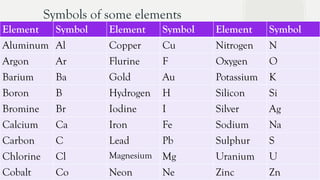
Symbols of some elements
Element Symbol Element Symbol Element Symbol
Aluminum Al Copper Cu Nitrogen N
Argon Ar Flurine F Oxygen O
Barium Ba Gold Au Potassium K
Boron B Hydrogen H Silicon Si
Bromine Br Iodine I Silver Ag
Calcium Ca Iron Fe Sodium Na
Carbon C Lead Pb Sulphur S
Chlorine Cl Magnesium Mg Uranium U
Cobalt Co Neon Ne Zinc Zn
How do Atoms Exist?
∙Atoms of most elements are not able to
exist independently. Atoms form
molecules and ions. These molecules or
ions aggregate in large number to form
the matter that we can see, feel or touch.
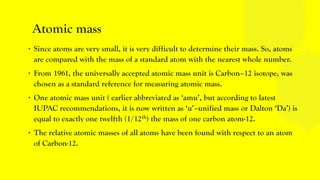
Atomic mass
∙ Since atoms are very small, it is very difficult to determine their mass. So, atoms
are compared with the mass of a standard atom with the nearest whole number.
∙ From 1961, the universally accepted atomic mass unit is Carbon–12 isotope, was
chosen as a standard reference for measuring atomic mass.
∙ One atomic mass unit ( earlier abbreviated as ‘amu’, but according to latest
IUPAC recommendations, it is now written as ‘u’–unified mass or Dalton ‘Da’) is
equal to exactly one twelfth (1/12th) the mass of one carbon atom-12.
∙ The relative atomic masses of all atoms have been found with respect to an atom
of Carbon-12.
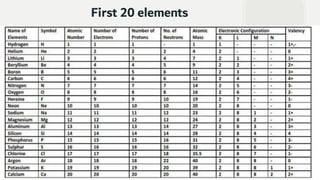
First 20 elements
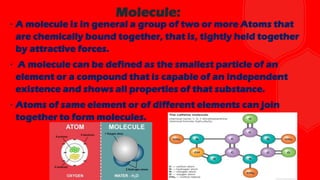
∙ A molecule is in general a group of two or more Atoms that
are chemically bound together, that is, tightly held together
by attractive forces.
∙ A molecule can be defined as the smallest particle of an
element or a compound that is capable of an independent
existence and shows all properties of that substance.
∙ Atoms of same element or of different elements can join
together to form molecules.
Molecule:
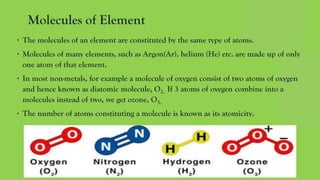
Molecules of Element
∙ The molecules of an element are constituted by the same type of atoms.
∙ Molecules of many elements, such as Argon(Ar), helium (He) etc. are made up of only
one atom of that element.
∙ In most non-metals, for example a molecule of oxygen consist of two atoms of oxygen
and hence known as diatomic molecule, O2. If 3 atoms of oxygen combine into a
molecules instead of two, we get ozone, O3.
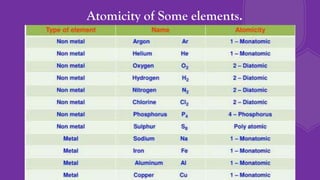
∙ The number of atoms constituting a molecule is known as its atomicity.
Atomicity of Some elements.
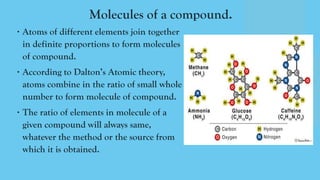
Molecules of a compound.
∙ Atoms of different elements join together
in definite proportions to form molecules
of compound.
∙ According to Dalton’s Atomic theory,
atoms combine in the ratio of small whole
number to form molecule of compound.
∙ The ratio of elements in molecule of a
given compound will always same,
whatever the method or the source from
which it is obtained.
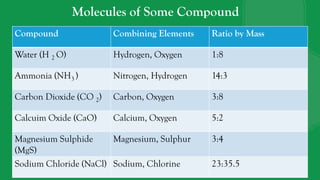
Molecules of Some Compound
Compound Combining Elements Ratio by Mass
Water (H 2 O) Hydrogen, Oxygen 1:8
Ammonia (NH3 ) Nitrogen, Hydrogen 14:3
Carbon Dioxide (CO 2) Carbon, Oxygen 3:8
Calcuim Oxide (CaO) Calcium, Oxygen 5:2
Magnesium Sulphide
(MgS)
Magnesium, Sulphur 3:4
Sodium Chloride (NaCl) Sodium, Chlorine 23:35.5
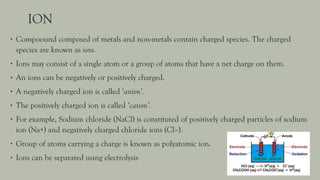
ION
∙ Compoound composed of metals and non-metals contain charged species. The charged
species are known as ions.
∙ Ions may consist of a single atom or a group of atoms that have a net charge on them.
∙ An ions can be negatively or positively charged.
∙ A negatively charged ion is called ‘anion’.
∙ The positively charged ion is called ‘cation’.
∙ For example, Sodium chloride (NaCl) is constituted of positively charged particles of sodium
ion (Na+) and negatively charged chloride ions (Cl–).
∙ Group of atoms carrying a charge is known as polyatomic ion.
∙ Ions can be separated using electrolysis
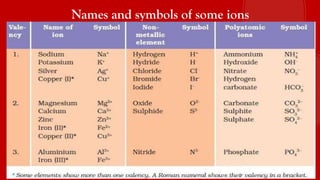
Names and symbols of some ions
Valency
∙Valency is the
combining power of an
element.
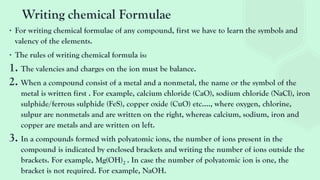
Writing chemical Formulae
∙ For writing chemical formulae of any compound, first we have to learn the symbols and
valency of the elements.
∙ The rules of writing chemical formula is:
1. The valencies and charges on the ion must be balance.
2. When a compound consist of a metal and a nonmetal, the name or the symbol of the
metal is written first . For example, calcium chloride (CaO), sodium chloride (NaCl), iron
sulphide/ferrous sulphide (FeS), copper oxide (CuO) etc…., where oxygen, chlorine,
sulpur are nonmetals and are written on the right, whereas calcium, sodium, iron and
copper are metals and are written on left.
3. In a compounds formed with polyatomic ions, the number of ions present in the
compound is indicated by enclosed brackets and writing the number of ions outside the
brackets. For example, Mg(OH)2 . In case the number of polyatomic ion is one, the
bracket is not required. For example, NaOH.
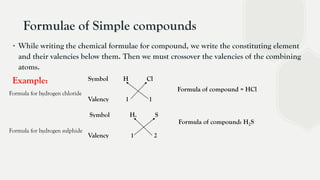
Formulae of Simple compounds
∙ While writing the chemical formulae for compound, we write the constituting element
and their valencies below them. Then we must crossover the valencies of the combining
atoms.
Example: Symbol H Cl
Valency 1 1
Formula of compound = HCl
Symbol H. S
Formula for hydrogen chloride
Formula for hydrogen sulphide
Valency 1 2
Formula of compound: H2S
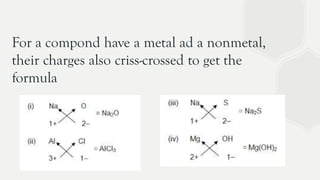
For a compond have a metal ad a nonmetal,
their charges also criss-crossed to get the
formula
We will use brackets when two or mose
more of the same ions in the formula
Like, in the formula of ammonium
sulphate:
Symbol/Formula NH4 SO4
Charge 1+. 2–
Formula : [NH4]2SO4
Molecular Mass
∙ This concept can be extended to calculate molecular mass.
∙ The molecular mass of a substance is the sum of the atomic masses of all the atoms in a
molecule of the substance.
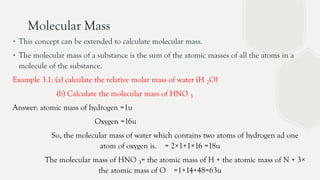
Example 3.1: (a) calculate the relative molar mass of water (H 2O)
(b) Calculate the molecular mass of HNO 3
Answer: atomic mass of hydrogen =1u
Oxygen =16u
So, the molecular mass of water which contains two atoms of hydrogen ad one
atom of oxygen is. = 2×1+1×16 =18u
The molecular mass of HNO 3= the atomic mass of H + the atomic mass of N + 3×
the atomic mass of O =1+14+48=63u
Formula Unit Mass
∙ The formula unit mass of a substance is a sum of the atomic
masses of all atoms in a formula unit of a compound
∙ It is calculated same manner as we calculate the molecular
mass. The only difference is that the word formula unit for
those substance whose constituent particles are ions.
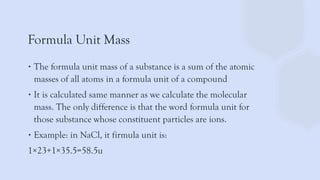
∙ Example: in NaCl, it firmula unit is:
1×23+1×35.5=58.5u
Mole concept.
∙ The mole is an amount unit similar to familiar units like pair, dozen, gross,
etc. It provides a specific measure of the number of atoms or molecules in a
bulk sample of matter. A mole is defined as the amount of substance
containing the same number of discrete entities (atoms, molecules, ions, etc.)
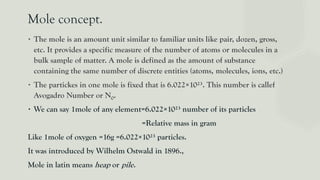
∙ The partickes in one mole is fixed that is 6.022×10²³. This number is callef
Avogadro Number or N0.
∙ We can say 1mole of any element=6.022×10²³ number of its particles
=Relative mass in gram
Like 1mole of oxygen =16g =6.022×10²³ particles.
It was introduced by Wilhelm Ostwald in 1896.,
Mole in latin means heap or pile.
Thank you
NCERT Exercise
∙ For NCERT Exercise and solutions go to:
https://drive.google.com/file/d/1kpJFFkW2YL6dalqE-
FajSLxCE04acwmv/view?usp=drivesdk
Or directly click:Atom and Molecule NCERT solution

Atoms and molecules class 9

  • 1.
    Atoms and Molecules P RE S E N T E D B Y R A X I T G U P T A C L A S S I X C
  • 2.
    History of Atom ∙Ancient Indian and Greek philosopher have wondered about unknown and unseen form of matter. Around 500 BC, An Indian Philosopher Maharishi Kanad postulated that if we go on dividing matter (padarth) we shall get smaller and smaller particles. Ultimately, a stage will come across the smallest particles beyond which further division will not be possible. ∙ He named these particles Parmanu. Another philosopher Pakudha Katyayama, elaborated this doctrine and said that these particles exist in combined form. ∙ Around the same era, ancient Greek philosophers– Democritus and Leucippus suggestion the same and coined the term atom. They just postulated. ∙ Antoine L. Lavoisier laid the foundation of chemical science by establishing two important laws of Chemical combination.
  • 3.
    Laws of Chemicalcombination. ∙ There are two laws of chemical combinations given after much experimentations by ANTOINE L. LAVOISER and JOSEPH L. PROUST. ∙ Two laws are: 1.Law of conservation of masses 2.Law of constant proportion.
  • 4.
    Law of Conservationof Masses ∙ Law of conservation of masses states that masses can niether be created nor destroyed in a chemical reaction. We can verify by doing an activity: ∙ Take 1.25g of copper sulphate in an ignition tube an mark it as A. ∙ Take 1.43g of sodium carbonate in a conical flask and mark it as B. ∙ Make the arrangement as shown in adjoining figure. ∙ Measure the weight. ∙ Now tilt and swirl the flask ∙ Now measure. Conclusion: ∙ The mass of the flask doesn’t change after chemical reaction.
  • 5.
    Law of constantproportion. ∙ Lavoisier, along other scientist noted that many compounds were composed of two or more elements and each each such compound had the same element in the same proportions, irrespective of where the compound is comes from. ∙ Like in compound water (H2O), the ratio of the masses of hydrogen and oxygen is always 1:8, whatever the source of water. Means if 9g of H2O decomposed, 1g of Hydrogen and 8g of oxygen are always obtained. ∙ Similarly, In Ammonia NH4 , Nitrogen and Hydrogen are always lresent in the ratio of 14:3 by mass. ∙ So, this law stated by Proust as “In a chemical substance the elements are always present in a definite proportion by mass”.
  • 6.
    ∙John Dalton wasborn in a poor weaver's family in 1766 in England. He began his career as a teacher at the age of twelve. Seven years later he becamea school principal. In 1793, Dalton left for Manchester to teach mathematics, physics and chemistry in a college. He spent most of his life there teaching and researching. In 1808, he presented his atomic theory which was a turning point in the study of matter.
  • 7.
    Dalton’s Atomic Theory ∙According to Dalton’s atomic theory, all matter, whether an element, a compound or a mixture is composed of small particles called atoms. The postulates of this theory may be stated as follows: 1. All matter is made of very tiny particles called atoms, which participate in chemical reactions. 2. Atoms are indivisible particles, which cannot be created or destroyed in chemical reaction. 3. Atoms of a given element are identical in mass and chemical properties. 4. Atoms of different elements have different masses and chemical properties. 5. Atoms combine in a ratio of small whole numbers to form compounds. 6. The relative number and kinds of atoms are constant in a given compound.
  • 8.
    How Big areatoms? ∙ The atom is about 10-10 meters (or 10-8 centimeters) in size. This means a row of 108 (or 100,000,000) atoms would stretch a centimeter, about the size of your fingernail. Atoms of different elements are different sizes, but 10-10 m can be thought of as a rough value for any atom. ∙ The electron is by far the least massive of these particles at 9.11×10⁻³¹ kg, with a negative electrical charge and a size that is too small to be measured using available technique ∙ Atomic radius are measured in nanometers. 1/10⁹m= 1nm 1m=10⁹nm
  • 9.
    Image of thesurface of Silicon
  • 10.
  • 11.
    Modern Symbol ofElements ∙ Jöns Jacob Berzelius suggested that the symbols of elements be made from one or two letters of the name of the element. ∙ In beginning, the names of element were derived from the name of the place where they were found for the first time. For example name copper was taken from Cyprus.Some names were taken from specific colours . for example name gold was taken from English word meaning yellow. ∙ Now, IUPAC (International Union of Pure and Applied Chemistry) is an international organization which approves names of element, symbol and units. ∙ Many are first one or two letter of the elements name in English. ∙ The first letter of the symbol is allways written in Uppercase and second letter as lowercase. ∙ Like, For Hydrogen—H, Aluminum—Al (not AL), Cobalt—Co (not CO).etc… ∙ Symbols of some elements are formed from the first letter of the name and the letter, appearing later in the name. Like Chlorine, Cl Zinc, Zn. ∙ Other symbols have been taken from the name in Latin , Germal or Greek. For example, the symbol of iron is Fe from its Latin word ferrum. Sodium is Na from Natrium, Potassium is K from Kalium. Gold is Au from Aurum and Silver is Ag from Argentujm. Etc………
  • 12.
    Symbols of someelements Element Symbol Element Symbol Element Symbol Aluminum Al Copper Cu Nitrogen N Argon Ar Flurine F Oxygen O Barium Ba Gold Au Potassium K Boron B Hydrogen H Silicon Si Bromine Br Iodine I Silver Ag Calcium Ca Iron Fe Sodium Na Carbon C Lead Pb Sulphur S Chlorine Cl Magnesium Mg Uranium U Cobalt Co Neon Ne Zinc Zn
  • 13.
    How do AtomsExist? ∙Atoms of most elements are not able to exist independently. Atoms form molecules and ions. These molecules or ions aggregate in large number to form the matter that we can see, feel or touch.
  • 14.
    Atomic mass ∙ Sinceatoms are very small, it is very difficult to determine their mass. So, atoms are compared with the mass of a standard atom with the nearest whole number. ∙ From 1961, the universally accepted atomic mass unit is Carbon–12 isotope, was chosen as a standard reference for measuring atomic mass. ∙ One atomic mass unit ( earlier abbreviated as ‘amu’, but according to latest IUPAC recommendations, it is now written as ‘u’–unified mass or Dalton ‘Da’) is equal to exactly one twelfth (1/12th) the mass of one carbon atom-12. ∙ The relative atomic masses of all atoms have been found with respect to an atom of Carbon-12.
  • 15.
  • 16.
    ∙ A moleculeis in general a group of two or more Atoms that are chemically bound together, that is, tightly held together by attractive forces. ∙ A molecule can be defined as the smallest particle of an element or a compound that is capable of an independent existence and shows all properties of that substance. ∙ Atoms of same element or of different elements can join together to form molecules. Molecule:
  • 17.
    Molecules of Element ∙The molecules of an element are constituted by the same type of atoms. ∙ Molecules of many elements, such as Argon(Ar), helium (He) etc. are made up of only one atom of that element. ∙ In most non-metals, for example a molecule of oxygen consist of two atoms of oxygen and hence known as diatomic molecule, O2. If 3 atoms of oxygen combine into a molecules instead of two, we get ozone, O3. ∙ The number of atoms constituting a molecule is known as its atomicity.
  • 18.
  • 19.
    Molecules of acompound. ∙ Atoms of different elements join together in definite proportions to form molecules of compound. ∙ According to Dalton’s Atomic theory, atoms combine in the ratio of small whole number to form molecule of compound. ∙ The ratio of elements in molecule of a given compound will always same, whatever the method or the source from which it is obtained.
  • 20.
    Molecules of SomeCompound Compound Combining Elements Ratio by Mass Water (H 2 O) Hydrogen, Oxygen 1:8 Ammonia (NH3 ) Nitrogen, Hydrogen 14:3 Carbon Dioxide (CO 2) Carbon, Oxygen 3:8 Calcuim Oxide (CaO) Calcium, Oxygen 5:2 Magnesium Sulphide (MgS) Magnesium, Sulphur 3:4 Sodium Chloride (NaCl) Sodium, Chlorine 23:35.5
  • 21.
    ION ∙ Compoound composedof metals and non-metals contain charged species. The charged species are known as ions. ∙ Ions may consist of a single atom or a group of atoms that have a net charge on them. ∙ An ions can be negatively or positively charged. ∙ A negatively charged ion is called ‘anion’. ∙ The positively charged ion is called ‘cation’. ∙ For example, Sodium chloride (NaCl) is constituted of positively charged particles of sodium ion (Na+) and negatively charged chloride ions (Cl–). ∙ Group of atoms carrying a charge is known as polyatomic ion. ∙ Ions can be separated using electrolysis
  • 22.
    Names and symbolsof some ions
  • 23.
  • 24.
    Writing chemical Formulae ∙For writing chemical formulae of any compound, first we have to learn the symbols and valency of the elements. ∙ The rules of writing chemical formula is: 1. The valencies and charges on the ion must be balance. 2. When a compound consist of a metal and a nonmetal, the name or the symbol of the metal is written first . For example, calcium chloride (CaO), sodium chloride (NaCl), iron sulphide/ferrous sulphide (FeS), copper oxide (CuO) etc…., where oxygen, chlorine, sulpur are nonmetals and are written on the right, whereas calcium, sodium, iron and copper are metals and are written on left. 3. In a compounds formed with polyatomic ions, the number of ions present in the compound is indicated by enclosed brackets and writing the number of ions outside the brackets. For example, Mg(OH)2 . In case the number of polyatomic ion is one, the bracket is not required. For example, NaOH.
  • 25.
    Formulae of Simplecompounds ∙ While writing the chemical formulae for compound, we write the constituting element and their valencies below them. Then we must crossover the valencies of the combining atoms. Example: Symbol H Cl Valency 1 1 Formula of compound = HCl Symbol H. S Formula for hydrogen chloride Formula for hydrogen sulphide Valency 1 2 Formula of compound: H2S
  • 26.
    For a compondhave a metal ad a nonmetal, their charges also criss-crossed to get the formula
  • 27.
    We will usebrackets when two or mose more of the same ions in the formula Like, in the formula of ammonium sulphate: Symbol/Formula NH4 SO4 Charge 1+. 2– Formula : [NH4]2SO4
  • 28.
    Molecular Mass ∙ Thisconcept can be extended to calculate molecular mass. ∙ The molecular mass of a substance is the sum of the atomic masses of all the atoms in a molecule of the substance. Example 3.1: (a) calculate the relative molar mass of water (H 2O) (b) Calculate the molecular mass of HNO 3 Answer: atomic mass of hydrogen =1u Oxygen =16u So, the molecular mass of water which contains two atoms of hydrogen ad one atom of oxygen is. = 2×1+1×16 =18u The molecular mass of HNO 3= the atomic mass of H + the atomic mass of N + 3× the atomic mass of O =1+14+48=63u
  • 29.
    Formula Unit Mass ∙The formula unit mass of a substance is a sum of the atomic masses of all atoms in a formula unit of a compound ∙ It is calculated same manner as we calculate the molecular mass. The only difference is that the word formula unit for those substance whose constituent particles are ions. ∙ Example: in NaCl, it firmula unit is: 1×23+1×35.5=58.5u
  • 30.
    Mole concept. ∙ Themole is an amount unit similar to familiar units like pair, dozen, gross, etc. It provides a specific measure of the number of atoms or molecules in a bulk sample of matter. A mole is defined as the amount of substance containing the same number of discrete entities (atoms, molecules, ions, etc.) ∙ The partickes in one mole is fixed that is 6.022×10²³. This number is callef Avogadro Number or N0. ∙ We can say 1mole of any element=6.022×10²³ number of its particles =Relative mass in gram Like 1mole of oxygen =16g =6.022×10²³ particles. It was introduced by Wilhelm Ostwald in 1896., Mole in latin means heap or pile.
  • 31.
  • 32.
    NCERT Exercise ∙ ForNCERT Exercise and solutions go to: https://drive.google.com/file/d/1kpJFFkW2YL6dalqE- FajSLxCE04acwmv/view?usp=drivesdk Or directly click:Atom and Molecule NCERT solution