Chapter - 2, Is matter around us pure?, Science, Class 9
The document explains the concepts of pure substances, mixtures, solutions, and various types of mixtures, including homogeneous and heterogeneous mixtures. It details the properties of solutions, suspensions, and colloids, along with methods for separating mixture components. Additionally, it distinguishes between physical and chemical changes with relevant examples.
Chapter - 2, Is matter around us pure?, Science, Class 9
1.
CHAPTER - 2
ISMATTER AROUND
US PURE?
BY SHIVAM PARMAR
(ENTREPRENEUR)
2.
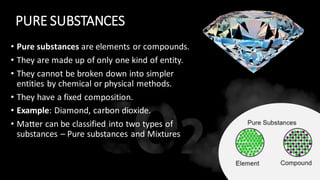
PURE SUBSTANCES
• Puresubstances are elements or compounds.
• They are made up of only one kind of entity.
• They cannot be broken down into simpler
entities by chemical or physical methods.
• They have a fixed composition.
• Example: Diamond, carbon dioxide.
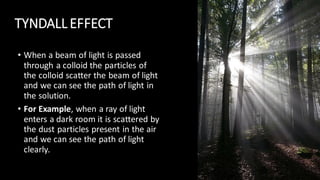
• Matter can be classified into two types of
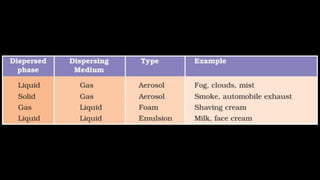
substances – Pure substances and Mixtures
3.
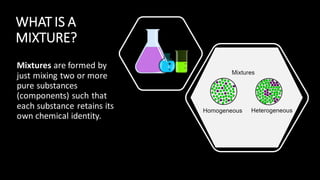
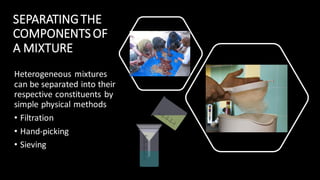
Mixtures are formedby
just mixing two or more
pure substances
(components) such that
each substance retains its
own chemical identity.
WHAT IS A
MIXTURE?
4.
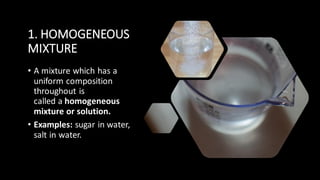
1. HOMOGENEOUS
MIXTURE
• Amixture which has a
uniform composition
throughout is
called a homogeneous
mixture or solution.
• Examples: sugar in water,
salt in water.
5.
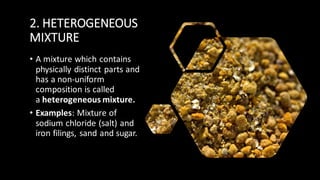
2. HETEROGENEOUS
MIXTURE
• Amixture which contains
physically distinct parts and
has a non-uniform
composition is called
a heterogeneous mixture.
• Examples: Mixture of
sodium chloride (salt) and
iron filings, sand and sugar.
SOLUTION
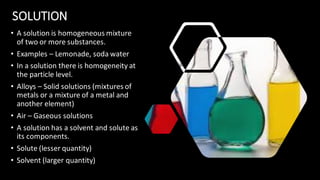
• A solutionis homogeneous mixture
of two or more substances.
• Examples – Lemonade, soda water
• In a solution there is homogeneity at
the particle level.
• Alloys – Solid solutions (mixtures of
metals or a mixture of a metal and
another element)
• Air – Gaseous solutions
• A solution has a solvent and solute as
its components.
• Solute (lesser quantity)
• Solvent (larger quantity)
8.
PROPERTIES OF SOLUTION
•Homogeneous mixture.
• Particles of a solution are
smaller than 1nm (nano-meter).
• Particles do not scatter a beam
of light(path of light is not
visible).
• Solute particles cannot be
separated by the process of
filtration.
9.
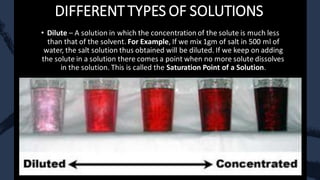
DIFFERENT TYPES OFSOLUTIONS
• Dilute – A solution in which the concentration of the solute is much less
than that of the solvent. For Example, If we mix 1gm of salt in 500 ml of
water, the salt solution thus obtained will be diluted. If we keep on adding
the solute in a solution there comes a point when no more solute dissolves
in the solution. This is called the Saturation Point of a Solution.
10.
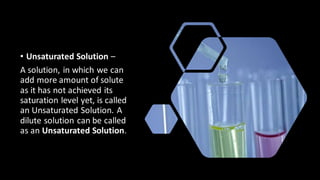
• Unsaturated Solution–
A solution, in which we can
add more amount of solute
as it has not achieved its
saturation level yet, is called
an Unsaturated Solution. A
dilute solution can be called
as an Unsaturated Solution.
11.
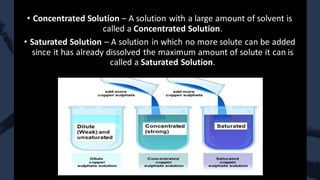
• Concentrated Solution– A solution with a large amount of solvent is
called a Concentrated Solution.
• Saturated Solution – A solution in which no more solute can be added
since it has already dissolved the maximum amount of solute it can is
called a Saturated Solution.
12.
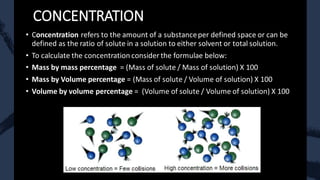
CONCENTRATION
• Concentration refersto the amount of a substanceper defined space or can be
defined as the ratio of solute in a solution to either solvent or total solution.
• To calculate the concentration consider the formulae below:
• Mass by mass percentage = (Mass of solute / Mass of solution) X 100
• Mass by Volume percentage = (Mass of solute / Volume of solution) X 100
• Volume by volume percentage = (Volume of solute / Volume of solution) X 100
13.
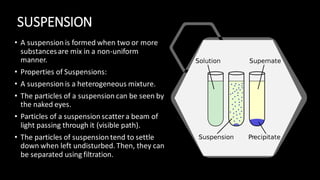
SUSPENSION
• A suspensionis formed when two or more
substancesare mix in a non-uniform
manner.
• Properties of Suspensions:
• A suspension is a heterogeneous mixture.
• The particles of a suspension can be seen by
the naked eyes.
• Particles of a suspension scatter a beam of
light passing through it (visible path).
• The particles of suspension tend to settle
down when left undisturbed. Then, they can
be separated using filtration.
14.
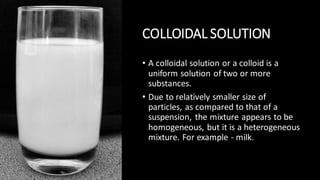
COLLOIDAL SOLUTION
• Acolloidal solution or a colloid is a
uniform solution of two or more
substances.
• Due to relatively smaller size of
particles, as compared to that of a
suspension, the mixture appears to be
homogeneous, but it is a heterogeneous
mixture. For example - milk.
15.
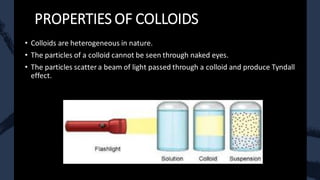
PROPERTIES OF COLLOIDS
•Colloids are heterogeneous in nature.
• The particles of a colloid cannot be seen through naked eyes.
• The particles scatter a beam of light passed through a colloid and produce Tyndall
effect.
16.
Colloids are stablein nature.
The particles of colloids do
not settle down if left
undisturbed.
We cannot separate the
particles of a colloid through
filtration. We use a method
called Centrifugation to
separate the particles of
a colloid.
17.
• When abeam of light is passed
through a colloid the particles of
the colloid scatter the beam of light
and we can see the path of light in
the solution.
• For Example, when a ray of light
enters a dark room it is scattered by
the dust particles present in the air
and we can see the path of light
clearly.
TYNDALL EFFECT
18.
COMPONENTS OF COLLOID
DispersedPhase – The
dispersed particles or
the solute-like
components in a
colloid.
Dispersing Medium –
The substance in
which these solute-
like particles are
added.
20.
Heterogeneous mixtures
can beseparated into their
respective constituents by
simple physical methods
• Filtration
• Hand-picking
• Sieving
SEPARATINGTHE
COMPONENTS OF
A MIXTURE
21.
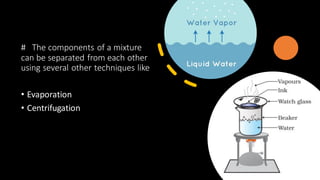
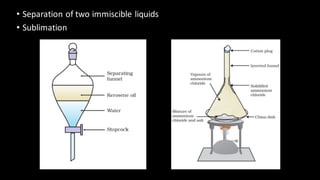
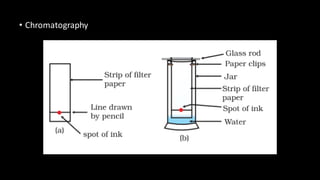
# The componentsof a mixture
can be separated from each other
using several other techniques like
• Evaporation
• Centrifugation
PHYSICAL CHANGE
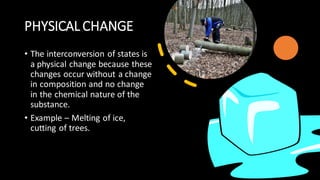
• Theinterconversion of states is
a physical change because these
changes occur without a change
in composition and no change
in the chemical nature of the
substance.
• Example – Melting of ice,
cutting of trees.
26.
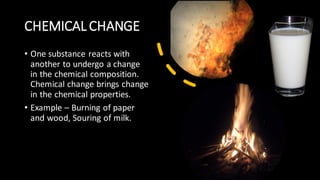
CHEMICAL CHANGE
• Onesubstance reacts with
another to undergo a change
in the chemical composition.
Chemical change brings change
in the chemical properties.
• Example – Burning of paper
and wood, Souring of milk.