Atoms and
Molecules
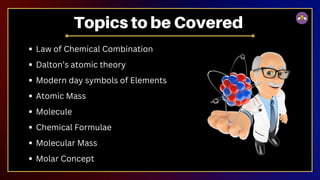
Law of Chemical Combination
Dalton’s atomic theory
Modern day symbols of Elements
Atomic Mass
Molecule
Chemical Formulae
Molecular Mass
Molar Concept
Topics to be Covered
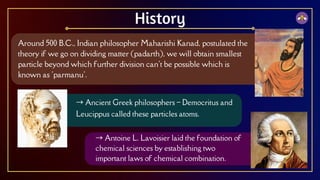
Around 500 B.C., Indian philosopher Maharishi Kanad, postulated the
theory if we go on dividing matter (padarth), we will obtain smallest
particle beyond which further division can't be possible which is
known as 'parmanu'.
History
→ Ancient Greek philosophers – Democritus and
Leucippus called these particles atoms.
→ Antoine L. Lavoisier laid the foundation of
chemical sciences by establishing two
important laws of chemical combination.
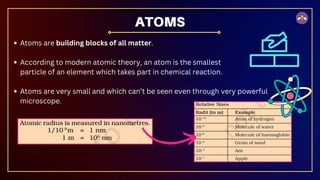
Atoms are building blocks of all matter.
According to modern atomic theory, an atom is the smallest
particle of an element which takes part in chemical reaction.
Atoms are very small and which can’t be seen even through very powerful
microscope.
ATOMS
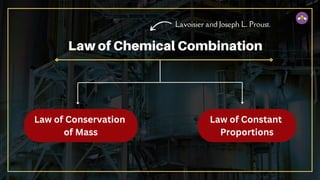
Law of Conservation
of Mass
Law of Constant
Proportions
Law of Chemical Combination
Lavoisier and Joseph L. Proust.
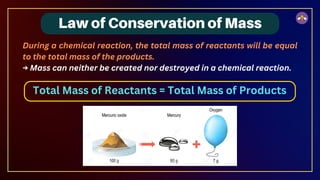
Law of Conservation of Mass
During a chemical reaction, the total mass of reactants will be equal
to the total mass of the products.
→ Mass can neither be created nor destroyed in a chemical reaction.
Total Mass of Reactants = Total Mass of Products
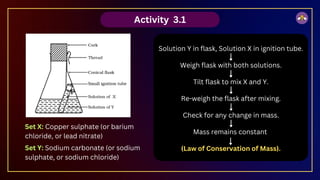
Solution Y in flask, Solution X in ignition tube.
Weigh flask with both solutions.
Tilt flask to mix X and Y.
Re-weigh the flask after mixing.
Check for any change in mass.
Mass remains constant
(Law of Conservation of Mass).
Activity 3.1
Set X: Copper sulphate (or barium
chloride, or lead nitrate)
Set Y: Sodium carbonate (or sodium
sulphate, or sodium chloride)
Q. Give an example of this law of conservation of mass when it
applies to physical change.
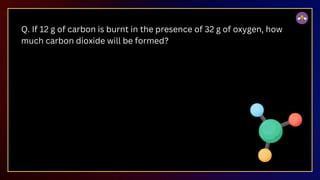
Q. If 12 g of carbon is burnt in the presence of 32 g of oxygen, how
much carbon dioxide will be formed?
Q. In a reaction 4.6 g of barium chloride reacted with 3.4 g of
sodium sulphate. The products obtained were 2.8 g of sodium
chloride and 5.2 g of barium sulphate.
The reaction takes place as follows:
Barium chloride + Sodium sulphate → Sodium chloride + Barium
sulphate."
Show that the above observation is in agreement with the law of
conservation of mass.​
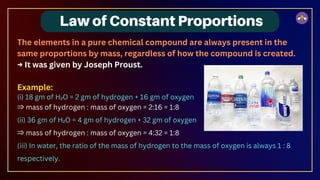
The elements in a pure chemical compound are always present in the
same proportions by mass, regardless of how the compound is created.
→ It was given by Joseph Proust.
Example:
(i) 18 gm of H₂O = 2 gm of hydrogen + 16 gm of oxygen
⇒ mass of hydrogen : mass of oxygen = 2:16 = 1:8
(ii) 36 gm of H₂O = 4 gm of hydrogen + 32 gm of oxygen
⇒ mass of hydrogen : mass of oxygen = 4:32 = 1:8
(iii) In water, the ratio of the mass of hydrogen to the mass of oxygen is always 1 : 8
respectively.
Law of Constant Proportions
Q. Hydrogen and oxygen combine in the ratio of 1:8 by mass to form
water. What mass of oxygen gas would be required to react
completely with 5 g of hydrogen gas?
Q. Calculate the percentage of elements in 1.5 g of calcium
carbonate if Ca = 40%, C = 12%, O = 48%.
If the law of constant proportion is true, what weight of these
elements will be present in another sample?
(Atomic masses: Ca = 40 u, C = 12 u, O = 16 u)
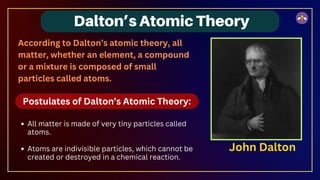
Dalton’s Atomic Theory
According to Dalton’s atomic theory, all
matter, whether an element, a compound
or a mixture is composed of small
particles called atoms.
John Dalton
All matter is made of very tiny particles called
atoms.
Atoms are indivisible particles, which cannot be
created or destroyed in a chemical reaction.
Postulates of Dalton’s Atomic Theory:
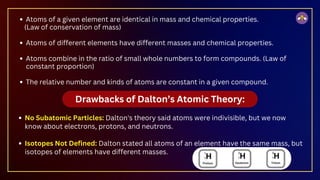
Atoms of a given element are identical in mass and chemical properties.
(Law of conservation of mass)
Atoms of different elements have different masses and chemical properties.
Atoms combine in the ratio of small whole numbers to form compounds. (Law of
constant proportion)
The relative number and kinds of atoms are constant in a given compound.
No Subatomic Particles: Dalton's theory said atoms were indivisible, but we now
know about electrons, protons, and neutrons.
Isotopes Not Defined: Dalton stated all atoms of an element have the same mass, but
isotopes of elements have different masses.
Drawbacks of Dalton’s Atomic Theory:
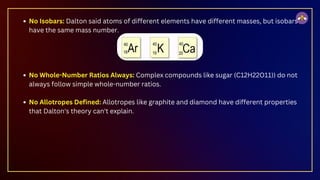
No Isobars: Dalton said atoms of different elements have different masses, but isobars
have the same mass number.
No Whole-Number Ratios Always: Complex compounds like sugar (C12​
H22​
O11​
)) do not
always follow simple whole-number ratios.
No Allotropes Defined: Allotropes like graphite and diamond have different properties
that Dalton's theory can't explain.
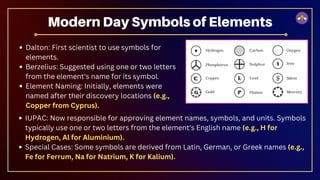
Dalton: First scientist to use symbols for
elements.
Berzelius: Suggested using one or two letters
from the element's name for its symbol.
Element Naming: Initially, elements were
named after their discovery locations (e.g.,
Copper from Cyprus).
Modern Day Symbols of Elements
IUPAC: Now responsible for approving element names, symbols, and units. Symbols
typically use one or two letters from the element's English name (e.g., H for
Hydrogen, Al for Aluminium).
Special Cases: Some symbols are derived from Latin, German, or Greek names (e.g.,
Fe for Ferrum, Na for Natrium, K for Kalium).
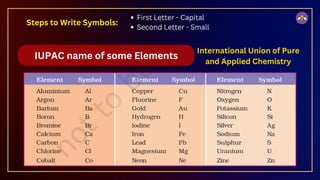
IUPAC name of some Elements
International Union of Pure
and Applied Chemistry
Steps to Write Symbols:
First Letter - Capital
Second Letter - Small
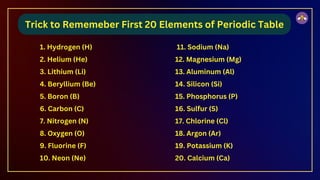
Trick to Rememeber First 20 Elements of Periodic Table
1. Hydrogen (H)
2. Helium (He)
3. Lithium (Li)
4. Beryllium (Be)
5. Boron (B)
6. Carbon (C)
7. Nitrogen (N)
8. Oxygen (O)
9. Fluorine (F)
10. Neon (Ne)
11. Sodium (Na)
12. Magnesium (Mg)
13. Aluminum (Al)
14. Silicon (Si)
15. Phosphorus (P)
16. Sulfur (S)
17. Chlorine (Cl)
18. Argon (Ar)
19. Potassium (K)
20. Calcium (Ca)
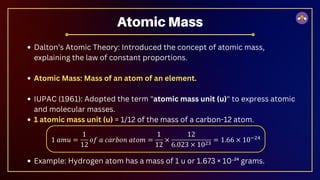
Dalton’s Atomic Theory: Introduced the concept of atomic mass,
explaining the law of constant proportions.
Atomic Mass: Mass of an atom of an element.
IUPAC (1961): Adopted the term "atomic mass unit (u)" to express atomic
and molecular masses.
1 atomic mass unit (u) = 1/12 of the mass of a carbon-12 atom.
Example: Hydrogen atom has a mass of 1 u or 1.673 × 10⁻²⁴ grams.
Atomic Mass
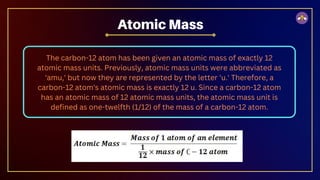
The carbon-12 atom has been given an atomic mass of exactly 12
atomic mass units. Previously, atomic mass units were abbreviated as
'amu,' but now they are represented by the letter 'u.' Therefore, a
carbon-12 atom's atomic mass is exactly 12 u. Since a carbon-12 atom
has an atomic mass of 12 atomic mass units, the atomic mass unit is
defined as one-twelfth (1/12) of the mass of a carbon-12 atom.
Atomic Mass
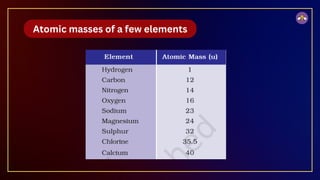
Atomic masses of a few elements
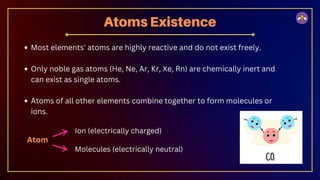
Most elements' atoms are highly reactive and do not exist freely.
Only noble gas atoms (He, Ne, Ar, Kr, Xe, Rn) are chemically inert and
can exist as single atoms.
Atoms of all other elements combine together to form molecules or
ions.
Atoms Existence
Atom
Ion (electrically charged)
Molecules (electrically neutral)
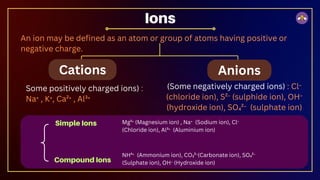
An ion may be defined as an atom or group of atoms having positive or
negative charge.
Cations Anions
Ions
Some positively charged ions) :
Na⁺ , K⁺, Ca²⁺ , Al³⁺
(Some negatively charged ions) : Cl⁻
(chloride ion), S²⁻ (sulphide ion), OH⁻
(hydroxide ion), SO₄²⁻ (sulphate ion)
Mg²⁺ (Magnesium ion) , Na⁺ (Sodium ion), Cl⁻
(Chloride ion), Al³⁺ (Aluminium ion)
Simple Ions
NH⁴⁺ (Ammonium ion), CO₃²⁻(Carbonate ion), SO₄²
⁻
(Sulphate ion), OH
⁻ (Hydroxide ion)
Compound Ions
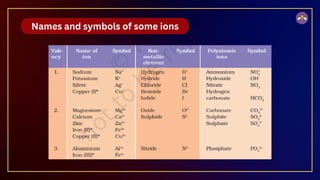
Names and symbols of some ions
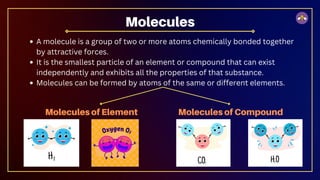
A molecule is a group of two or more atoms chemically bonded together
by attractive forces.
It is the smallest particle of an element or compound that can exist
independently and exhibits all the properties of that substance.
Molecules can be formed by atoms of the same or different elements.
Molecules
Molecules of Element Molecules of Compound
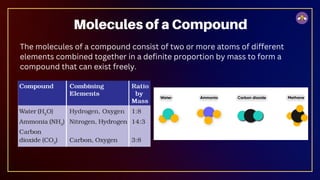
The molecules of a compound consist of two or more atoms of different
elements combined together in a definite proportion by mass to form a
compound that can exist freely.
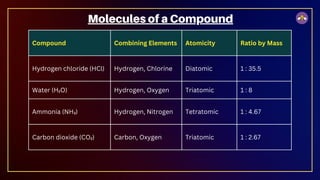
Molecules of a Compound
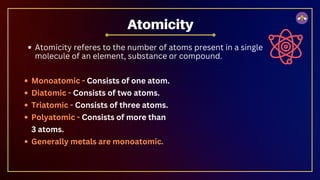
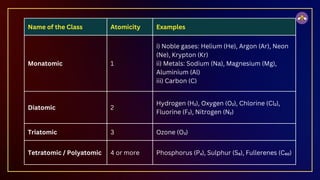
Atomicity referes to the number of atoms present in a single
molecule of an element, substance or compound.
Atomicity
Monoatomic - Consists of one atom.
Diatomic - Consists of two atoms.
Triatomic - Consists of three atoms.
Polyatomic - Consists of more than
3 atoms.
Generally metals are monoatomic.
Name of the Class Atomicity Examples
Monatomic 1
i) Noble gases: Helium (He), Argon (Ar), Neon
(Ne), Krypton (Kr)
ii) Metals: Sodium (Na), Magnesium (Mg),
Aluminium (Al)
iii) Carbon (C)
Diatomic 2
Hydrogen (H₂), Oxygen (O₂), Chlorine (Cl₂),
Fluorine (F₂), Nitrogen (N₂)
Triatomic 3 Ozone (O₃)
Tetratomic / Polyatomic 4 or more Phosphorus (P₄), Sulphur (S₈), Fullerenes (C₆₀)
Compound Combining Elements Atomicity Ratio by Mass
Hydrogen chloride (HCl) Hydrogen, Chlorine Diatomic 1 : 35.5
Water (H₂O) Hydrogen, Oxygen Triatomic 1 : 8
Ammonia (NH₃) Hydrogen, Nitrogen Tetratomic 1 : 4.67
Carbon dioxide (CO₂) Carbon, Oxygen Triatomic 1 : 2.67
Molecules of a Compound
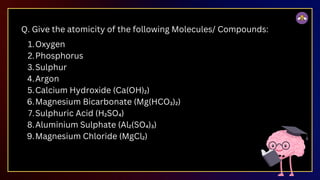
Q. Give the atomicity of the following Molecules/ Compounds:
Oxygen
1.
Phosphorus
2.
Sulphur
3.
Argon
4.
Calcium Hydroxide (Ca(OH)₂)
5.
Magnesium Bicarbonate (Mg(HCO₃)₂)
6.
Sulphuric Acid (H₂SO₄)
7.
Aluminium Sulphate (Al₂(SO₄)₃)
8.
Magnesium Chloride (MgCl₂)
9.
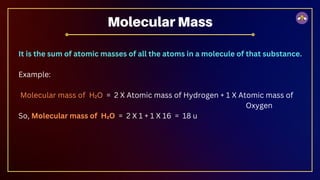
It is the sum of atomic masses of all the atoms in a molecule of that substance.
Example:
Molecular mass of H₂O = 2 X Atomic mass of Hydrogen + 1 X Atomic mass of
Oxygen
So, Molecular mass of H₂O = 2 X 1 + 1 X 16 = 18 u
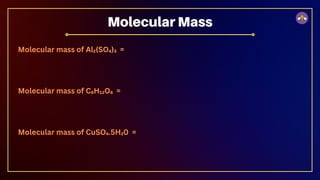
Molecular Mass
Molecular mass of Al₂(SO₄)₃ =
Molecular mass of C₆H₁₂O₆ =
Molecular mass of CuSO₄.5H₂0 =
Molecular Mass
Q. Calculate the molecular mass of the following:
(a) Ammonia (NH₃)
(b) Nitric acid (HNO₃)
(c) Sodium chloride (NaCl)
(d) Calcium chloride (CaCl₂)
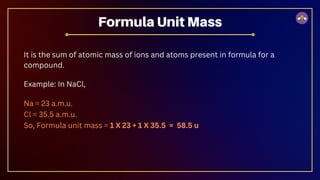
It is the sum of atomic mass of ions and atoms present in formula for a
compound.
Example: In NaCl,
Na = 23 a.m.u.
Cl = 35.5 a.m.u.
So, Formula unit mass = 1 X 23 + 1 X 35.5 = 58.5 u
Formula Unit Mass
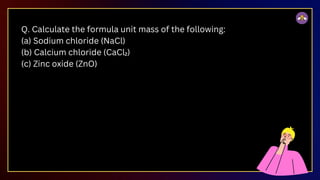
Q. Calculate the formula unit mass of the following:
(a) Sodium chloride (NaCl)
(b) Calcium chloride (CaCl₂)
(c) Zinc oxide (ZnO)
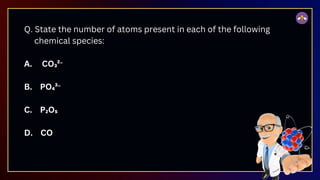
Q. State the number of atoms present in each of the following
chemical species:
A. CO₃²⁻
B. PO₄³⁻
C. P₂O₅
D. CO
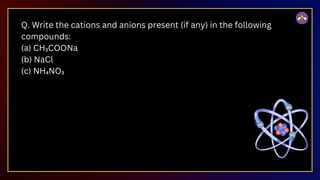
Q. Write the cations and anions present (if any) in the following
compounds:
(a) CH₃COONa
(b) NaCl
(c) NH₄NO₃
Why do Atoms Combine?
The atoms combine to attain a noble or inert gas electronic configuration,
in order to complete their octet by formation of a chemical bond either
by sharing, losing or gaining electrons.
The combining capacity of an element is called its valency.
It shows how many atoms of other elements one atom of an element
can combine with.
Valency equals the number of electrons gained, lost, or shared to
achieve a noble gas configuration.
Examples: Sodium (Na): Valency = 1, Magnesium (Mg): Valency = 2,
Chlorine (Cl): Valency = 1
Valency
It is the symbolic representation of the composition of a compound.
Characteristics of chemical formulae:
The valencies or charges on ion must balance.
When a compound is formed of metal and non-metal, symbol of metal
comes first. E.g., CaO, NaCl, CuO.
When polyatomic ions are used, the ions are enclosed in brackets before
writing the number to show the ratio. E.g., Ca(OH)₂ , (NH₄)₂SO₄
Chemical Formulae
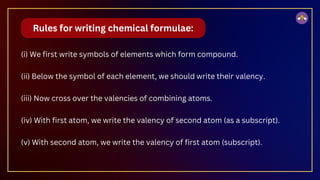
(i) We first write symbols of elements which form compound.
(ii) Below the symbol of each element, we should write their valency.
(iii) Now cross over the valencies of combining atoms.
(iv) With first atom, we write the valency of second atom (as a subscript).
(v) With second atom, we write the valency of first atom (subscript).
Rules for writing chemical formulae:
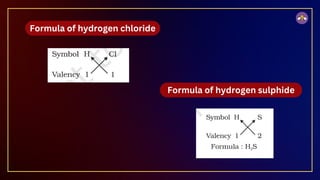
Formula of hydrogen chloride
Formula of hydrogen sulphide
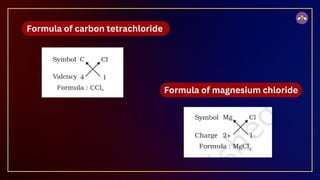
Formula of carbon tetrachloride
Formula of magnesium chloride
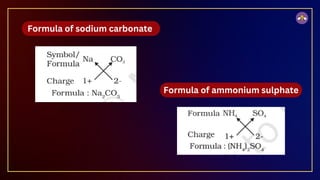
Formula of sodium carbonate
Formula of ammonium sulphate
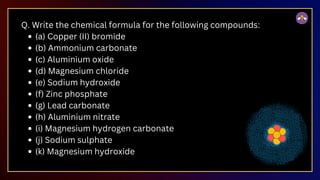
Q. Write the chemical formula for the following compounds:
(a) Copper (II) bromide
(b) Ammonium carbonate
(c) Aluminium oxide
(d) Magnesium chloride
(e) Sodium hydroxide
(f) Zinc phosphate
(g) Lead carbonate
(h) Aluminium nitrate
(i) Magnesium hydrogen carbonate
(j) Sodium sulphate
(k) Magnesium hydroxide
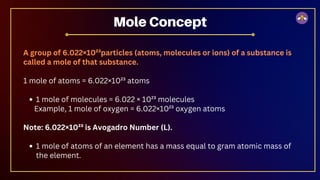
A group of 6.022×10²³particles (atoms, molecules or ions) of a substance is
called a mole of that substance.
1 mole of atoms = 6.022×10²³ atoms
1 mole of molecules = 6.022 × 10²³ molecules
Example, 1 mole of oxygen = 6.022×10²³ oxygen atoms
Note: 6.022×10²³ is Avogadro Number (L).
1 mole of atoms of an element has a mass equal to gram atomic mass of
the element.
Mole Concept
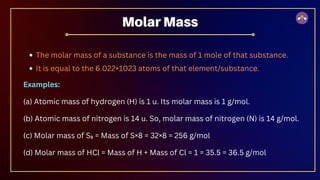
The molar mass of a substance is the mass of 1 mole of that substance.
It is equal to the 6.022×10²³ atoms of that element/substance.
Examples:
(a) Atomic mass of hydrogen (H) is 1 u. Its molar mass is 1 g/mol.
(b) Atomic mass of nitrogen is 14 u. So, molar mass of nitrogen (N) is 14 g/mol.
(c) Molar mass of S₈ = Mass of S×8 = 32×8 = 256 g/mol
(d) Molar mass of HCl = Mass of H + Mass of Cl = 1 = 35.5 = 36.5 g/mol
Molar Mass
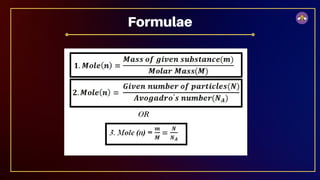
Formulae
Question
Question
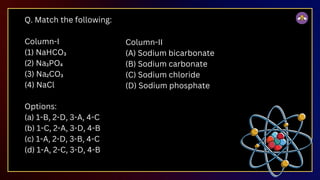
Q. Match the following:
Column-I
(1) NaHCO₃
(2) Na₃PO₄
(3) Na₂CO₃
(4) NaCl
Options:
(a) 1-B, 2-D, 3-A, 4-C
(b) 1-C, 2-A, 3-D, 4-B
(c) 1-A, 2-D, 3-B, 4-C
(d) 1-A, 2-C, 3-D, 4-B
Column-II
(A) Sodium bicarbonate
(B) Sodium carbonate
(C) Sodium chloride
(D) Sodium phosphate
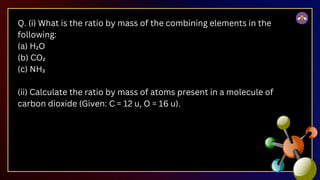
Q. (i) What is the ratio by mass of the combining elements in the
following:
(a) H₂O
(b) CO₂
(c) NH₃
(ii) Calculate the ratio by mass of atoms present in a molecule of
carbon dioxide (Given: C = 12 u, O = 16 u).
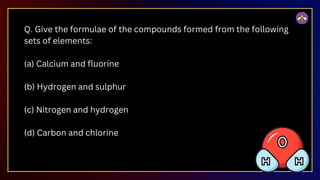
Q. Give the formulae of the compounds formed from the following
sets of elements:
(a) Calcium and fluorine
(b) Hydrogen and sulphur
(c) Nitrogen and hydrogen
(d) Carbon and chlorine
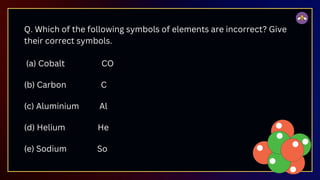
Q. Which of the following symbols of elements are incorrect? Give
their correct symbols.
(a) Cobalt CO
(b) Carbon C
(c) Aluminium Al
(d) Helium He
(e) Sodium So
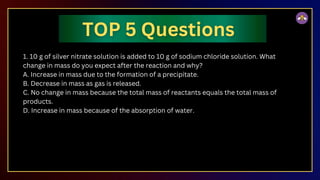
1. 10 g of silver nitrate solution is added to 10 g of sodium chloride solution. What
change in mass do you expect after the reaction and why?
A. Increase in mass due to the formation of a precipitate.
B. Decrease in mass as gas is released.
C. No change in mass because the total mass of reactants equals the total mass of
products.
D. Increase in mass because of the absorption of water.
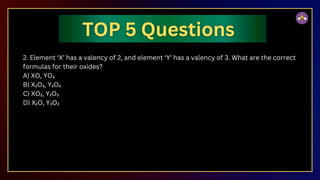
2. Element ‘X’ has a valency of 2, and element ‘Y’ has a valency of 3. What are the correct
formulas for their oxides?
A) XO, YO₃
B) X₂O₃, Y₂O₃
C) XO₂, Y₂O₃
D) X₂O, Y₃O₂
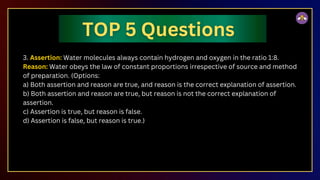
3. Assertion: Water molecules always contain hydrogen and oxygen in the ratio 1:8.
Reason: Water obeys the law of constant proportions irrespective of source and method
of preparation. (Options:
a) Both assertion and reason are true, and reason is the correct explanation of assertion.
b) Both assertion and reason are true, but reason is not the correct explanation of
assertion.
c) Assertion is true, but reason is false.
d) Assertion is false, but reason is true.)
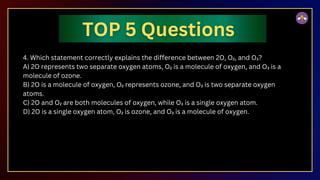
4. Which statement correctly explains the difference between 2O, O₂, and O₃?
A) 2O represents two separate oxygen atoms, O₂ is a molecule of oxygen, and O₃ is a
molecule of ozone.
B) 2O is a molecule of oxygen, O₂ represents ozone, and O₃ is two separate oxygen
atoms.
C) 2O and O₂ are both molecules of oxygen, while O₃ is a single oxygen atom.
D) 2O is a single oxygen atom, O₂ is ozone, and O₃ is a molecule of oxygen.
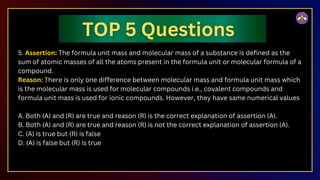
5. Assertion: The formula unit mass and molecular mass of a substance is defined as the
sum of atomic masses of all the atoms present in the formula unit or molecular formula of a
compound.
Reason: There is only one difference between molecular mass and formula unit mass which
is the molecular mass is used for molecular compounds i.e., covalent compounds and
formula unit mass is used for ionic compounds. However, they have same numerical values
A. Both (A) and (R) are true and reason (R) is the correct explanation of assertion (A).
B. Both (A) and (R) are true and reason (R) is not the correct explanation of assertion (A).
C. (A) is true but (R) is false
D. (A) is false but (R) is true
- Law of Constant Proportions

Class 9th- Atoms and Molecules ( Prashant Kirad ).pdf

  • 1.
  • 2.
    Law of ChemicalCombination Dalton’s atomic theory Modern day symbols of Elements Atomic Mass Molecule Chemical Formulae Molecular Mass Molar Concept Topics to be Covered
  • 3.
    Around 500 B.C.,Indian philosopher Maharishi Kanad, postulated the theory if we go on dividing matter (padarth), we will obtain smallest particle beyond which further division can't be possible which is known as 'parmanu'. History → Ancient Greek philosophers – Democritus and Leucippus called these particles atoms. → Antoine L. Lavoisier laid the foundation of chemical sciences by establishing two important laws of chemical combination.
  • 4.
    Atoms are buildingblocks of all matter. According to modern atomic theory, an atom is the smallest particle of an element which takes part in chemical reaction. Atoms are very small and which can’t be seen even through very powerful microscope. ATOMS
  • 5.
    Law of Conservation ofMass Law of Constant Proportions Law of Chemical Combination Lavoisier and Joseph L. Proust.
  • 6.
    Law of Conservationof Mass During a chemical reaction, the total mass of reactants will be equal to the total mass of the products. → Mass can neither be created nor destroyed in a chemical reaction. Total Mass of Reactants = Total Mass of Products
  • 7.
    Solution Y inflask, Solution X in ignition tube. Weigh flask with both solutions. Tilt flask to mix X and Y. Re-weigh the flask after mixing. Check for any change in mass. Mass remains constant (Law of Conservation of Mass). Activity 3.1 Set X: Copper sulphate (or barium chloride, or lead nitrate) Set Y: Sodium carbonate (or sodium sulphate, or sodium chloride)
  • 8.
    Q. Give anexample of this law of conservation of mass when it applies to physical change.
  • 9.
    Q. If 12g of carbon is burnt in the presence of 32 g of oxygen, how much carbon dioxide will be formed?
  • 10.
    Q. In areaction 4.6 g of barium chloride reacted with 3.4 g of sodium sulphate. The products obtained were 2.8 g of sodium chloride and 5.2 g of barium sulphate. The reaction takes place as follows: Barium chloride + Sodium sulphate → Sodium chloride + Barium sulphate." Show that the above observation is in agreement with the law of conservation of mass.​
  • 11.
    The elements ina pure chemical compound are always present in the same proportions by mass, regardless of how the compound is created. → It was given by Joseph Proust. Example: (i) 18 gm of H₂O = 2 gm of hydrogen + 16 gm of oxygen ⇒ mass of hydrogen : mass of oxygen = 2:16 = 1:8 (ii) 36 gm of H₂O = 4 gm of hydrogen + 32 gm of oxygen ⇒ mass of hydrogen : mass of oxygen = 4:32 = 1:8 (iii) In water, the ratio of the mass of hydrogen to the mass of oxygen is always 1 : 8 respectively. Law of Constant Proportions
  • 12.
    Q. Hydrogen andoxygen combine in the ratio of 1:8 by mass to form water. What mass of oxygen gas would be required to react completely with 5 g of hydrogen gas?
  • 13.
    Q. Calculate thepercentage of elements in 1.5 g of calcium carbonate if Ca = 40%, C = 12%, O = 48%. If the law of constant proportion is true, what weight of these elements will be present in another sample? (Atomic masses: Ca = 40 u, C = 12 u, O = 16 u)
  • 14.
    Dalton’s Atomic Theory Accordingto Dalton’s atomic theory, all matter, whether an element, a compound or a mixture is composed of small particles called atoms. John Dalton All matter is made of very tiny particles called atoms. Atoms are indivisible particles, which cannot be created or destroyed in a chemical reaction. Postulates of Dalton’s Atomic Theory:
  • 15.
    Atoms of agiven element are identical in mass and chemical properties. (Law of conservation of mass) Atoms of different elements have different masses and chemical properties. Atoms combine in the ratio of small whole numbers to form compounds. (Law of constant proportion) The relative number and kinds of atoms are constant in a given compound. No Subatomic Particles: Dalton's theory said atoms were indivisible, but we now know about electrons, protons, and neutrons. Isotopes Not Defined: Dalton stated all atoms of an element have the same mass, but isotopes of elements have different masses. Drawbacks of Dalton’s Atomic Theory:
  • 16.
    No Isobars: Daltonsaid atoms of different elements have different masses, but isobars have the same mass number. No Whole-Number Ratios Always: Complex compounds like sugar (C12​ H22​ O11​ )) do not always follow simple whole-number ratios. No Allotropes Defined: Allotropes like graphite and diamond have different properties that Dalton's theory can't explain.
  • 17.
    Dalton: First scientistto use symbols for elements. Berzelius: Suggested using one or two letters from the element's name for its symbol. Element Naming: Initially, elements were named after their discovery locations (e.g., Copper from Cyprus). Modern Day Symbols of Elements IUPAC: Now responsible for approving element names, symbols, and units. Symbols typically use one or two letters from the element's English name (e.g., H for Hydrogen, Al for Aluminium). Special Cases: Some symbols are derived from Latin, German, or Greek names (e.g., Fe for Ferrum, Na for Natrium, K for Kalium).
  • 18.
    IUPAC name ofsome Elements International Union of Pure and Applied Chemistry Steps to Write Symbols: First Letter - Capital Second Letter - Small
  • 19.
    Trick to RememeberFirst 20 Elements of Periodic Table 1. Hydrogen (H) 2. Helium (He) 3. Lithium (Li) 4. Beryllium (Be) 5. Boron (B) 6. Carbon (C) 7. Nitrogen (N) 8. Oxygen (O) 9. Fluorine (F) 10. Neon (Ne) 11. Sodium (Na) 12. Magnesium (Mg) 13. Aluminum (Al) 14. Silicon (Si) 15. Phosphorus (P) 16. Sulfur (S) 17. Chlorine (Cl) 18. Argon (Ar) 19. Potassium (K) 20. Calcium (Ca)
  • 20.
    Dalton’s Atomic Theory:Introduced the concept of atomic mass, explaining the law of constant proportions. Atomic Mass: Mass of an atom of an element. IUPAC (1961): Adopted the term "atomic mass unit (u)" to express atomic and molecular masses. 1 atomic mass unit (u) = 1/12 of the mass of a carbon-12 atom. Example: Hydrogen atom has a mass of 1 u or 1.673 × 10⁻²⁴ grams. Atomic Mass
  • 21.
    The carbon-12 atomhas been given an atomic mass of exactly 12 atomic mass units. Previously, atomic mass units were abbreviated as 'amu,' but now they are represented by the letter 'u.' Therefore, a carbon-12 atom's atomic mass is exactly 12 u. Since a carbon-12 atom has an atomic mass of 12 atomic mass units, the atomic mass unit is defined as one-twelfth (1/12) of the mass of a carbon-12 atom. Atomic Mass
  • 22.
    Atomic masses ofa few elements
  • 23.
    Most elements' atomsare highly reactive and do not exist freely. Only noble gas atoms (He, Ne, Ar, Kr, Xe, Rn) are chemically inert and can exist as single atoms. Atoms of all other elements combine together to form molecules or ions. Atoms Existence Atom Ion (electrically charged) Molecules (electrically neutral)
  • 24.
    An ion maybe defined as an atom or group of atoms having positive or negative charge. Cations Anions Ions Some positively charged ions) : Na⁺ , K⁺, Ca²⁺ , Al³⁺ (Some negatively charged ions) : Cl⁻ (chloride ion), S²⁻ (sulphide ion), OH⁻ (hydroxide ion), SO₄²⁻ (sulphate ion) Mg²⁺ (Magnesium ion) , Na⁺ (Sodium ion), Cl⁻ (Chloride ion), Al³⁺ (Aluminium ion) Simple Ions NH⁴⁺ (Ammonium ion), CO₃²⁻(Carbonate ion), SO₄² ⁻ (Sulphate ion), OH ⁻ (Hydroxide ion) Compound Ions
  • 25.
    Names and symbolsof some ions
  • 26.
    A molecule isa group of two or more atoms chemically bonded together by attractive forces. It is the smallest particle of an element or compound that can exist independently and exhibits all the properties of that substance. Molecules can be formed by atoms of the same or different elements. Molecules Molecules of Element Molecules of Compound
  • 27.
    The molecules ofa compound consist of two or more atoms of different elements combined together in a definite proportion by mass to form a compound that can exist freely. Molecules of a Compound
  • 28.
    Atomicity referes tothe number of atoms present in a single molecule of an element, substance or compound. Atomicity Monoatomic - Consists of one atom. Diatomic - Consists of two atoms. Triatomic - Consists of three atoms. Polyatomic - Consists of more than 3 atoms. Generally metals are monoatomic.
  • 29.
    Name of theClass Atomicity Examples Monatomic 1 i) Noble gases: Helium (He), Argon (Ar), Neon (Ne), Krypton (Kr) ii) Metals: Sodium (Na), Magnesium (Mg), Aluminium (Al) iii) Carbon (C) Diatomic 2 Hydrogen (H₂), Oxygen (O₂), Chlorine (Cl₂), Fluorine (F₂), Nitrogen (N₂) Triatomic 3 Ozone (O₃) Tetratomic / Polyatomic 4 or more Phosphorus (P₄), Sulphur (S₈), Fullerenes (C₆₀)
  • 30.
    Compound Combining ElementsAtomicity Ratio by Mass Hydrogen chloride (HCl) Hydrogen, Chlorine Diatomic 1 : 35.5 Water (H₂O) Hydrogen, Oxygen Triatomic 1 : 8 Ammonia (NH₃) Hydrogen, Nitrogen Tetratomic 1 : 4.67 Carbon dioxide (CO₂) Carbon, Oxygen Triatomic 1 : 2.67 Molecules of a Compound
  • 31.
    Q. Give theatomicity of the following Molecules/ Compounds: Oxygen 1. Phosphorus 2. Sulphur 3. Argon 4. Calcium Hydroxide (Ca(OH)₂) 5. Magnesium Bicarbonate (Mg(HCO₃)₂) 6. Sulphuric Acid (H₂SO₄) 7. Aluminium Sulphate (Al₂(SO₄)₃) 8. Magnesium Chloride (MgCl₂) 9.
  • 32.
    It is thesum of atomic masses of all the atoms in a molecule of that substance. Example: Molecular mass of H₂O = 2 X Atomic mass of Hydrogen + 1 X Atomic mass of Oxygen So, Molecular mass of H₂O = 2 X 1 + 1 X 16 = 18 u Molecular Mass
  • 33.
    Molecular mass ofAl₂(SO₄)₃ = Molecular mass of C₆H₁₂O₆ = Molecular mass of CuSO₄.5H₂0 = Molecular Mass
  • 34.
    Q. Calculate themolecular mass of the following: (a) Ammonia (NH₃) (b) Nitric acid (HNO₃) (c) Sodium chloride (NaCl) (d) Calcium chloride (CaCl₂)
  • 35.
    It is thesum of atomic mass of ions and atoms present in formula for a compound. Example: In NaCl, Na = 23 a.m.u. Cl = 35.5 a.m.u. So, Formula unit mass = 1 X 23 + 1 X 35.5 = 58.5 u Formula Unit Mass
  • 36.
    Q. Calculate theformula unit mass of the following: (a) Sodium chloride (NaCl) (b) Calcium chloride (CaCl₂) (c) Zinc oxide (ZnO)
  • 37.
    Q. State thenumber of atoms present in each of the following chemical species: A. CO₃²⁻ B. PO₄³⁻ C. P₂O₅ D. CO
  • 38.
    Q. Write thecations and anions present (if any) in the following compounds: (a) CH₃COONa (b) NaCl (c) NH₄NO₃
  • 39.
    Why do AtomsCombine? The atoms combine to attain a noble or inert gas electronic configuration, in order to complete their octet by formation of a chemical bond either by sharing, losing or gaining electrons. The combining capacity of an element is called its valency. It shows how many atoms of other elements one atom of an element can combine with. Valency equals the number of electrons gained, lost, or shared to achieve a noble gas configuration. Examples: Sodium (Na): Valency = 1, Magnesium (Mg): Valency = 2, Chlorine (Cl): Valency = 1 Valency
  • 40.
    It is thesymbolic representation of the composition of a compound. Characteristics of chemical formulae: The valencies or charges on ion must balance. When a compound is formed of metal and non-metal, symbol of metal comes first. E.g., CaO, NaCl, CuO. When polyatomic ions are used, the ions are enclosed in brackets before writing the number to show the ratio. E.g., Ca(OH)₂ , (NH₄)₂SO₄ Chemical Formulae
  • 41.
    (i) We firstwrite symbols of elements which form compound. (ii) Below the symbol of each element, we should write their valency. (iii) Now cross over the valencies of combining atoms. (iv) With first atom, we write the valency of second atom (as a subscript). (v) With second atom, we write the valency of first atom (subscript). Rules for writing chemical formulae:
  • 42.
    Formula of hydrogenchloride Formula of hydrogen sulphide
  • 43.
    Formula of carbontetrachloride Formula of magnesium chloride
  • 44.
    Formula of sodiumcarbonate Formula of ammonium sulphate
  • 45.
    Q. Write thechemical formula for the following compounds: (a) Copper (II) bromide (b) Ammonium carbonate (c) Aluminium oxide (d) Magnesium chloride (e) Sodium hydroxide (f) Zinc phosphate (g) Lead carbonate (h) Aluminium nitrate (i) Magnesium hydrogen carbonate (j) Sodium sulphate (k) Magnesium hydroxide
  • 46.
    A group of6.022×10²³particles (atoms, molecules or ions) of a substance is called a mole of that substance. 1 mole of atoms = 6.022×10²³ atoms 1 mole of molecules = 6.022 × 10²³ molecules Example, 1 mole of oxygen = 6.022×10²³ oxygen atoms Note: 6.022×10²³ is Avogadro Number (L). 1 mole of atoms of an element has a mass equal to gram atomic mass of the element. Mole Concept
  • 47.
    The molar massof a substance is the mass of 1 mole of that substance. It is equal to the 6.022×10²³ atoms of that element/substance. Examples: (a) Atomic mass of hydrogen (H) is 1 u. Its molar mass is 1 g/mol. (b) Atomic mass of nitrogen is 14 u. So, molar mass of nitrogen (N) is 14 g/mol. (c) Molar mass of S₈ = Mass of S×8 = 32×8 = 256 g/mol (d) Molar mass of HCl = Mass of H + Mass of Cl = 1 = 35.5 = 36.5 g/mol Molar Mass
  • 48.
  • 49.
  • 50.
    Q. Match thefollowing: Column-I (1) NaHCO₃ (2) Na₃PO₄ (3) Na₂CO₃ (4) NaCl Options: (a) 1-B, 2-D, 3-A, 4-C (b) 1-C, 2-A, 3-D, 4-B (c) 1-A, 2-D, 3-B, 4-C (d) 1-A, 2-C, 3-D, 4-B Column-II (A) Sodium bicarbonate (B) Sodium carbonate (C) Sodium chloride (D) Sodium phosphate
  • 51.
    Q. (i) Whatis the ratio by mass of the combining elements in the following: (a) H₂O (b) CO₂ (c) NH₃ (ii) Calculate the ratio by mass of atoms present in a molecule of carbon dioxide (Given: C = 12 u, O = 16 u).
  • 52.
    Q. Give theformulae of the compounds formed from the following sets of elements: (a) Calcium and fluorine (b) Hydrogen and sulphur (c) Nitrogen and hydrogen (d) Carbon and chlorine
  • 53.
    Q. Which ofthe following symbols of elements are incorrect? Give their correct symbols. (a) Cobalt CO (b) Carbon C (c) Aluminium Al (d) Helium He (e) Sodium So
  • 54.
    1. 10 gof silver nitrate solution is added to 10 g of sodium chloride solution. What change in mass do you expect after the reaction and why? A. Increase in mass due to the formation of a precipitate. B. Decrease in mass as gas is released. C. No change in mass because the total mass of reactants equals the total mass of products. D. Increase in mass because of the absorption of water.
  • 55.
    2. Element ‘X’has a valency of 2, and element ‘Y’ has a valency of 3. What are the correct formulas for their oxides? A) XO, YO₃ B) X₂O₃, Y₂O₃ C) XO₂, Y₂O₃ D) X₂O, Y₃O₂
  • 56.
    3. Assertion: Watermolecules always contain hydrogen and oxygen in the ratio 1:8. Reason: Water obeys the law of constant proportions irrespective of source and method of preparation. (Options: a) Both assertion and reason are true, and reason is the correct explanation of assertion. b) Both assertion and reason are true, but reason is not the correct explanation of assertion. c) Assertion is true, but reason is false. d) Assertion is false, but reason is true.)
  • 57.
    4. Which statementcorrectly explains the difference between 2O, O₂, and O₃? A) 2O represents two separate oxygen atoms, O₂ is a molecule of oxygen, and O₃ is a molecule of ozone. B) 2O is a molecule of oxygen, O₂ represents ozone, and O₃ is two separate oxygen atoms. C) 2O and O₂ are both molecules of oxygen, while O₃ is a single oxygen atom. D) 2O is a single oxygen atom, O₂ is ozone, and O₃ is a molecule of oxygen.
  • 58.
    5. Assertion: Theformula unit mass and molecular mass of a substance is defined as the sum of atomic masses of all the atoms present in the formula unit or molecular formula of a compound. Reason: There is only one difference between molecular mass and formula unit mass which is the molecular mass is used for molecular compounds i.e., covalent compounds and formula unit mass is used for ionic compounds. However, they have same numerical values A. Both (A) and (R) are true and reason (R) is the correct explanation of assertion (A). B. Both (A) and (R) are true and reason (R) is not the correct explanation of assertion (A). C. (A) is true but (R) is false D. (A) is false but (R) is true
  • 59.
    - Law ofConstant Proportions