Ancient Indian and
Greekphilosophers
have always
wondered about
the unknown and
unseen form of
matter.
Maharishi Xanad,
postulated that on
dividing matter, the
smallest particles
will be obtained,
he named these
particles Parmanu.
Indian philosopher,
Pakudha
Katyayama,
elaborated this
doctrine and said
that these
particles normally
exist in a combined
form.
Greek philosophers
— Democritus and
Leucippus told
that on dividing
maRer, a stage will
come when
particles obtained
cannot be divided
further. He called
these indivisible
particles ‘Atom’.
Antoine L. Lavoisier
laid the foundation
of chemical
sciences by
establishing two
important laws of
chemical
combination.
3.
Joseph Proust AntoineLavoisier
« The. źo.I.I.owing..two laws .of ch.emi«aI
cambinatio.n
. . .
were estabIi.s.hed. afte.r
much..ex.perime.n.tations
by Lavoisier..and.J.ose;¿h L.. I*rou»ż:
5.
o Lavoisier notedthat many compounds were
composed of two or more elements and each
compound had the same elements in the
same proportions.
o For e.g., in Water the ratio of the mass of
hydrogen
to the mass of oxygen is always 1:8.
o This led to the law of constant proportions which
is
also known as the Law Of Definite Proportions.
o This law was stated by Proust as “In a
chemical substance, the elements are
7.
o Dalton's AtomicTheory provided an explanation for the Law Of Conservation Of Mass.
o Acc. to him, an element, compound or a mixture is composed of small particles called
Atoms. The
postulates of this theory are as follows:
wAII matter is made of very tiny particles called Atoms, which participate in chemical reactions.
->Atoms are indivisible particles, which cannot be created or destroyed in a chemical reaction.
->Atoms of a given element are identical in mass and chemical properties.
wAtoms of diPerent elements have different masses and chemical properties.
->Atoms combine in the ratio of small whole numbers to form compounds.
->The relative number and kinds of atoms are constant in a given compound.
8.
Atomic radius ismeasured in nanometers.
1/ 10’ = 1 nm
l m = 10’ion
o The building blocks of all matter are Atoms.
o Atomz are very small, they are
smaller than anything that we can imagine
or compare with.
o More than millions of atoms when
stacked would make a layer barely as
thick as this sheet of paper.
Radii (in
meters)
10—10
10*"
10*'
10*4
10—"
1 1
Examples
Atom of Hydrogen
Molecule of Water
Molecule of Hemoglobin
Grain Of Sand
Ant
Apple
9.
o John Daltonwas the 1s*scientist to use the
symbols
for elements in a very specific
sense.
o When he used a symbol for an element he
also meant a definite quantity of that element, one
atom of that element.
» Berzelius suggested that the symbols of elementsbe
made from one or two letters of the name of the
element.
o In the beginning, the names of elements were
derived from the name of the place where they
were found for the first time.
Hydrogen Carbon Oxygen
Phosphorus Sulphur Iron
(
g) coppe
r
Lea
d
isi1ve
r
Gold Platna Mercury
10.
o UPAC )lnternationaIUnion of Pure and Applied Chemistry) is an international scientific
organization which approves names of elements, symbols and units.
o The 1st letter of a symbol is always written in Uppercase and the 2°^ letter in
Lowercase.
o For e.g. Hydrogen — H, Cobalt — Co, Aluminum — Al, etc.
o Other symbols have been taken from the names of elements in Latin, German or
Greek.
o For e.g. the symbol of Iron is Fe from its Latin name Ferrum, Sodium is Na from
Natrium.
11.
Ato m ieNo. Sy m bo I E ie m e
nt
1 Hydrogen H
2 Helium He
3 Lithium Li
4 Ber yllium Be
5 Boron B
6 Carbon C
7 Nitrogen N
8 Oxygen O
9 Flu or in e F
10 Neon Ne
1 1 Sodium Na
12 Magnesium Mg
13 Aluminium Al
14 Silicon Si
15 Phosphorus P
16 Sulphur S
17 Chlorine Cl
18 Argon Ar
19 Potassium K
20 Calcium Ca
12.
The most remarkableconcept that Dalton's Atomic Theory proposed was that of the Atomic
Mass. Acc. to him, each element had a characteristic atomic mass.
o It was earlier defined as ‘amu’ (Atomic Mass Unit) but now, acc. to IUPAC, itis reffered to
as ‘u’ (Unified Mass).
o While searching for various atomic mass units, scientists initially took 1/ 16 of the mass of an
atom, of naturally occurring oxygen as the unit.
o This was considered relevant due to two reasons:
• Oxygen reacted with a large number of elements and formed compounds.
• This amu gave masses of most of the elements as whole numbers.
13.
However, in 1961for a universally accepted
amu, Carbon-12 Isotope was chosen as the
standard reference for measuring atomic
masses.
o One amu is a mass unit equal to exactly one-
twelfth, (1/12*h) the mass of one atom of carbon-
12.
o The relative atomic masses of all elements have
been found with respect to an atom of carbon-
12.
o The relative atomic mass of the atom of an element is
defined as the average mass of the atom, as
compared to 1/12th the mass of one carbon-12 atom.
Hydrogen
Nñnigc
n
H
N 1
4
N
a
S
23
32
14.
o Atoms ofmost elements are not able to
exist independently.
o Atoms form Molecules and
Ions.
o Molecule is a group of two or more atoms that
are chemically bonded together by attractive
forces.
o A molecule can be defined as the smallest
particle of an element or a compound that is
capable of an, independent existence and
shows all the properties of that substance.
o Atoms of the same element or of different
elements can join together to form
molecules.
NiéiménQ
”
ules
Compounds
15.
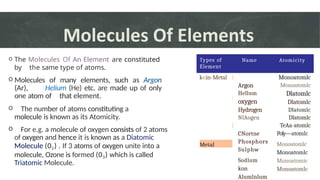
Name
Types of
Element
Atomicity
o TheMolecules Of An Element are constituted
by the same type of atoms.
o Molecules of many elements, such as Argon
(Ar), Helium (He) etc. are made up of only
one atom of that element.
o The number of atoms constituting a
molecule is known as its Atomicity.
o For e.g. a molecule of oxygen consists of 2 atoms
of oxygen and hence it is known as a Diatomic
Molecule (02) . If 3 atoms of oxygen unite into a
molecule, Ozone is formed (03) which is called
Triatomic Molecule.
k‹:in-Metal 1
Argon
Hellum
oxygen
Hydrogen
NlAogen
I
CNortne
Phosphors
Sulphw
Sodlum
kon
Alumlnlum
Monoatomlc
Monoatomlc
Dlatomlc
Dlatomlc
Dlatomlc
Dlatomlc
TeAa-atomlc
Poly—atomlc
Monoatomlc
Monoatomlc
Monoatomic
Monoatomlc
16.
Hat io
by
Mass
.
« Atomsof diPerent elements join
together in definite proportions to form
Molecules Of Compounds.
o This means molecules of compounds
have atoms of two or more diPerent
chemical elements.
o For e.g. Methane, Water, Carbon
Dioxide, Ammonia etc.
17.
Compounds composed ofMetals and Non -
Metals contain charged species which are
known as Ions.
o A negatively charged ion •is called an ‘Anion’
and the positively charged ion, a ‘Cation’.
o For e.g. Sodium Chloride (NaCI). Its constituent
particles are positively charged sodium ions
(Na+ ) and negatively charged chloride ions (Cl— ).
o A group of atoms carrying a charge is known as a
Polyatomic Ion.
a:
18.
Writing Chemical Formula
«The Chemical Formula of a compound is
a
symbolic representation of its composition.
o The combining power (or capacity) of
an element is known as its Valency.
o Valency can be used to find out how
the atoms of an element will combine
with the atom(s) of another element
to form achemical compound.
o ‘The valency of the atom of an element
can be thought of as hands or arms of that
atom’.
1.
S*xñum
Na
-
,. . .
’ . ,
. ..
e” i Az›m›••a
Et- I-lydroztde OH-
carbonate HCOJ
W Carbonate
Sulphlte
isulphate
CO^
£O^
SO ^
19.
The rules thatyou have to follow while writing a chemical formula are as
follows:
x The Valencies or Charges on the ion must balance.
< When a compound consists of a metal and a non-metal, the name or symbol of the metal is
written first. For e.g.: Calcium Oxide (CaO), Sodium Chloride (NaCI), Iron Sulphide (FeS) etc.,
where Oxygen, Chlorine, Sulphur are Non metals and Calcium, Sodium, Iron and Copper are the
Metals.
< In compounds formed with Polyatomic Ions, the no. of ions present in the compound is indicated
by,encIosing the formula of ion in a bracket and writing the number of ions outside the bracket.
For
e.g. Mg(OH)y .
20.
The simplest compoundswhich are made up of 2 different elements are called Binary
Compounds.
1.
Na
1
CI
"
1
NaCl
4. Fe
SO‹
2 ‘”' 2
FeSO4
7 Al
OH
AI(OH),
2
M
g
O
3.
Pb
2
2
MgO
.’i
.
Ca C
O
C
’
m
.
2
”
2
CaCO:
8. NHt
OH
1
1
NH4OH
NO
:
Pb(NO
6 A|
POS
3
AIPO
4
9 Ag
I
Ag
l
3
10. Zn S
2 2
ZnS
13. Fe SOA
Fe,(SO),
11. Mn SOA
2
’2
MnSOs
12 Al
NO:
1 3
Al(NO3
)
3
14 NH4 HCO: 1?• H S
1 I
NH,HCO,
2 1
H 2
S
21.
Molecular Mass
o TheMolecular Mass of a substance is the sum of the atomic masses of all the atoms in a
molecule
of the substance.
o t is therefore the relative mass of a molecule expressed in atomic mass units (u).
Molar mass O:
Molar mass H:
13.9994 gfmol
1.00794 g/mol
1.00794g/mol
Molar mass H2O:
18.0153 g/mol
22.
o The FormulaUnit Mass of a substance is a sum of the atomic masses of all atoms in a formula
unit of a compound.
o Formula Unit Mass is calculated for those substances whose constituent particles are ions.
Atomic
weight
Atom
1.00
8
H
1
35.4527
Cl1
Number
of Atome
1.008 x 1 =
1.008
35.4527 x 1 =
35.4527
H CI
Molecui
ar
Weight




![Atoms and molecules [autosaved]](https://cdn.slidesharecdn.com/ss_thumbnails/atomsandmoleculesautosaved-160615024046-thumbnail.jpg?width=640&height=640&fit=bounds)


