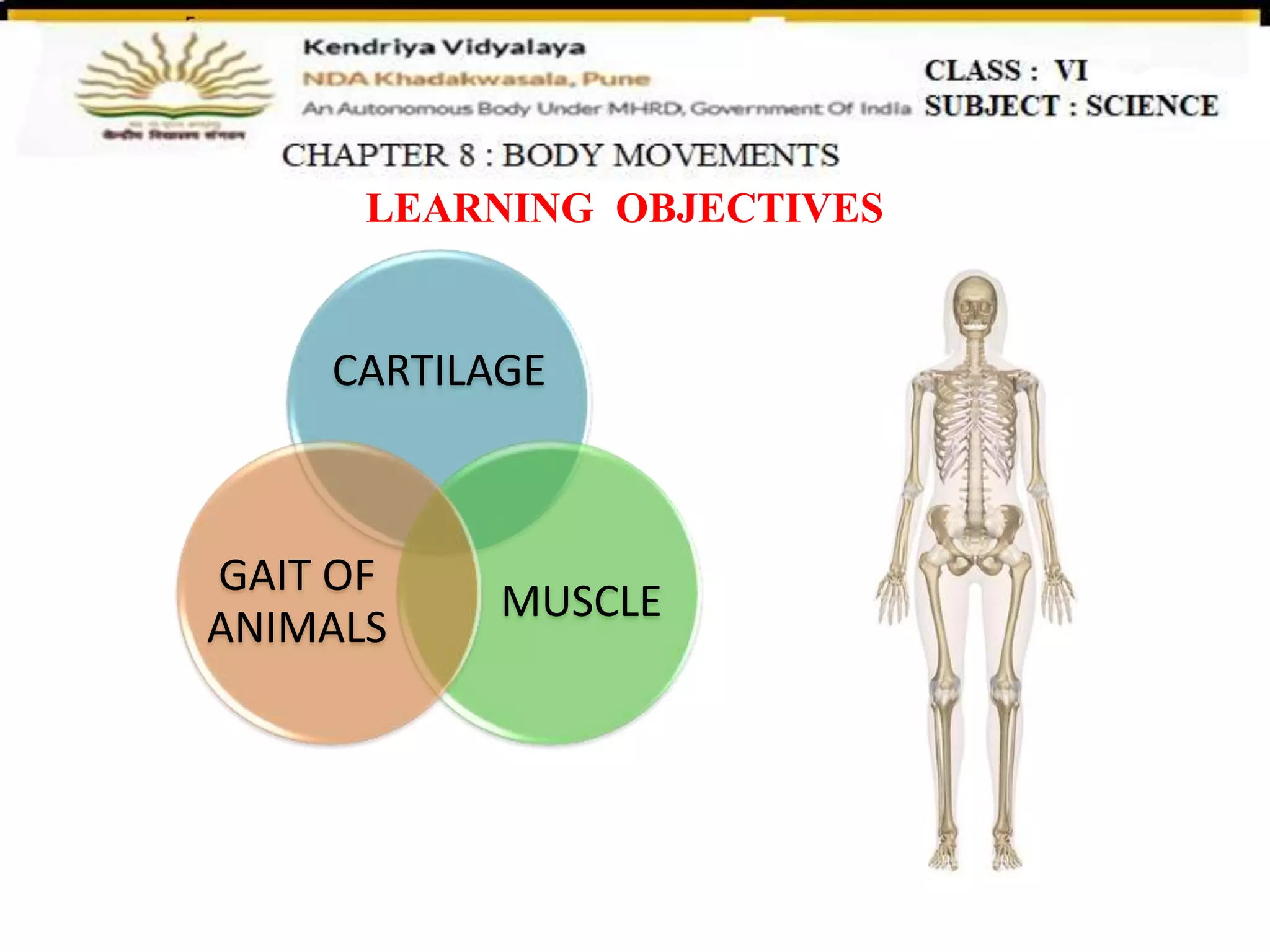
LEARNING OBJECTIVES
CARTILAGE
MUSCLE
GAIT OF
ANIMALS
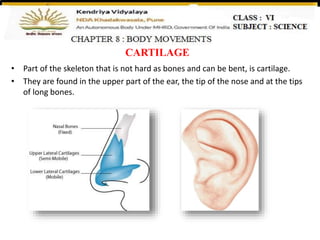
CARTILAGE
• Part of the skeleton that is not hard as bones and can be bent, is cartilage.
• They are found in the upper part of the ear, the tip of the nose and at the tips
of long bones.
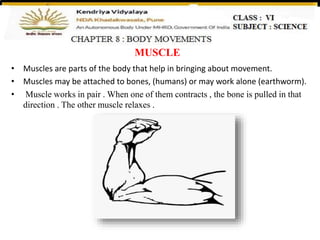
MUSCLE
• Muscles are parts of the body that help in bringing about movement.
• Muscles may be attached to bones, (humans) or may work alone (earthworm).
• Muscle works in pair . When one of them contracts , the bone is pulled in that
direction . The other muscle relaxes .
GAIT OF ANIMALS
• The different patterns of movement of animals
due to the differences in their skeletal
structure are called gaits of animals.
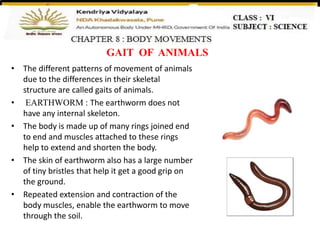
• EARTHWORM : The earthworm does not
have any internal skeleton.
• The body is made up of many rings joined end
to end and muscles attached to these rings
help to extend and shorten the body.
• The skin of earthworm also has a large number
of tiny bristles that help it get a good grip on
the ground.
• Repeated extension and contraction of the
body muscles, enable the earthworm to move
through the soil.
GAIT OF ANIMALS
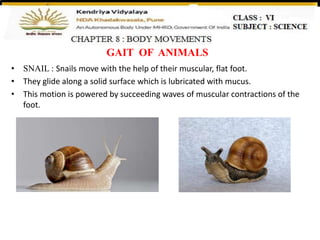
• SNAIL : Snails move with the help of their muscular, flat foot.
• They glide along a solid surface which is lubricated with mucus.
• This motion is powered by succeeding waves of muscular contractions of the
foot.
GAIT OF ANIMALS
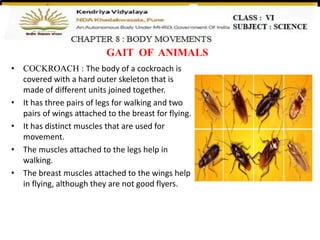
• COCKROACH : The body of a cockroach is
covered with a hard outer skeleton that is
made of different units joined together.
• It has three pairs of legs for walking and two
pairs of wings attached to the breast for flying.
• It has distinct muscles that are used for
movement.
• The muscles attached to the legs help in
walking.
• The breast muscles attached to the wings help
in flying, although they are not good flyers.
GAIT OF ANIMALS
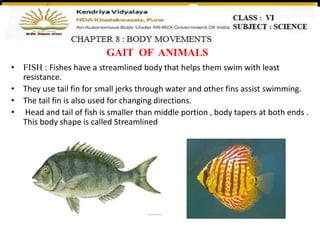
• FISH : Fishes have a streamlined body that helps them swim with least
resistance.
• They use tail fin for small jerks through water and other fins assist swimming.
• The tail fin is also used for changing directions.
• Head and tail of fish is smaller than middle portion , body tapers at both ends .
This body shape is called Streamlined
GAIT OF ANIMALS
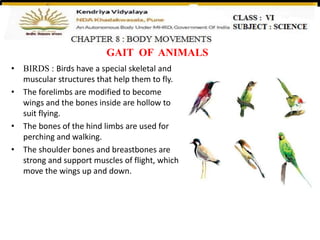
• BIRDS : Birds have a special skeletal and
muscular structures that help them to fly.
• The forelimbs are modified to become
wings and the bones inside are hollow to
suit flying.
• The bones of the hind limbs are used for
perching and walking.
• The shoulder bones and breastbones are
strong and support muscles of flight, which
move the wings up and down.
GAIT OF ANIMALS
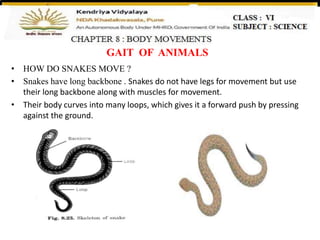
• HOW DO SNAKES MOVE ?
• Snakes have long backbone . Snakes do not have legs for movement but use
their long backbone along with muscles for movement.
• Their body curves into many loops, which gives it a forward push by pressing
against the ground.
SUMMARY
CARTILAGE MUSCLES
GAITS OF
ANIMALS

Class 6 chapter 8 ppt 3

  • 1.
  • 2.
    CARTILAGE • Part ofthe skeleton that is not hard as bones and can be bent, is cartilage. • They are found in the upper part of the ear, the tip of the nose and at the tips of long bones.
  • 3.
    MUSCLE • Muscles areparts of the body that help in bringing about movement. • Muscles may be attached to bones, (humans) or may work alone (earthworm). • Muscle works in pair . When one of them contracts , the bone is pulled in that direction . The other muscle relaxes .
  • 4.
    GAIT OF ANIMALS •The different patterns of movement of animals due to the differences in their skeletal structure are called gaits of animals. • EARTHWORM : The earthworm does not have any internal skeleton. • The body is made up of many rings joined end to end and muscles attached to these rings help to extend and shorten the body. • The skin of earthworm also has a large number of tiny bristles that help it get a good grip on the ground. • Repeated extension and contraction of the body muscles, enable the earthworm to move through the soil.
  • 5.
    GAIT OF ANIMALS •SNAIL : Snails move with the help of their muscular, flat foot. • They glide along a solid surface which is lubricated with mucus. • This motion is powered by succeeding waves of muscular contractions of the foot.
  • 6.
    GAIT OF ANIMALS •COCKROACH : The body of a cockroach is covered with a hard outer skeleton that is made of different units joined together. • It has three pairs of legs for walking and two pairs of wings attached to the breast for flying. • It has distinct muscles that are used for movement. • The muscles attached to the legs help in walking. • The breast muscles attached to the wings help in flying, although they are not good flyers.
  • 7.
    GAIT OF ANIMALS •FISH : Fishes have a streamlined body that helps them swim with least resistance. • They use tail fin for small jerks through water and other fins assist swimming. • The tail fin is also used for changing directions. • Head and tail of fish is smaller than middle portion , body tapers at both ends . This body shape is called Streamlined
  • 8.
    GAIT OF ANIMALS •BIRDS : Birds have a special skeletal and muscular structures that help them to fly. • The forelimbs are modified to become wings and the bones inside are hollow to suit flying. • The bones of the hind limbs are used for perching and walking. • The shoulder bones and breastbones are strong and support muscles of flight, which move the wings up and down.
  • 9.
    GAIT OF ANIMALS •HOW DO SNAKES MOVE ? • Snakes have long backbone . Snakes do not have legs for movement but use their long backbone along with muscles for movement. • Their body curves into many loops, which gives it a forward push by pressing against the ground.
  • 10.