

Memory Types
Session 3
SURYAPRAKASH S
suryaprakash.vsm@gmail.com
The resource for the PPT is made from variety of Books and online
PPT that were available in Internet. The Purpose of the PPT is made
for the Classroom Teaching.
Agenda
• Memory Types
• Memory Maps and Address
suryaprakash.vsm@gmail.com 2
Memory in
the System
suryaprakash.vsm@gmail.com 3
ROM, its uses and its
variants
• Non volatility
• Useful for embedded codes and data in
the system
• Mostly termed as Masked ROM, PROM,
OTP ROM, EPROM, and EEPROM
1. Masked ROM
2. EPROM, EEPROM, and OTP ROM
3. Used of ROM or EEPROM or Flash
4
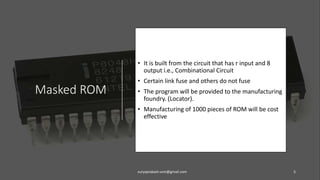
Masked ROM
• It is built from the circuit that has r input and 8
output i.e., Combinational Circuit
• Certain link fuse and others do not fuse
• The program will be provided to the manufacturing
foundry. (Locator).
• Manufacturing of 1000 pieces of ROM will be cost
effective
suryaprakash.vsm@gmail.com 5
EPROM, EEPROM and OTPROM
• EPROM-It is an ultraviolet ray erasable and device programmer PROM.
Erasing the device means restoring 1 at each bit in the cell array at each
ROM address.
• EEPROM erasing during an application –program run is done by sending all
eight data bus bits as 1s for the write in the presence if input of Vpp,
programming voltage for short write pulse.
• Flash Memory: is a form of EEPROM in which a sector of bytes can be
erased in a flash (very short duration of single clock cycle). The advantage
over EEPROM is that the erasing of many bytes simultaneously saves time
in each erase cycle that precedes the write cycle. Disadvantages is that
once erased takes more time in writing it.
• PROM: (an OTP ROM is an another form). Once written is not erasable.
suryaprakash.vsm@gmail.com 6
Uses if ROM or EEPROM or Flash
• EEPROM is usable by erasing over one million times. It can be erased
during runtime itself.
• Flash memory is usable about 10,000 times for repeated erasing
followed by programming during runtime.
• PROM is writer once by a device programmer or the first system run.
• Three examples of EEPROM memory
• Storing current date and time in a machine
• Storing port statuses.
• Storing driving , malfunctions and failure history in an automobile for use by
mechanics later on.
suryaprakash.vsm@gmail.com 7
RAM
• Various forms are SRAM, DRAM, NVRAM, ERORAM, SDRAM, RDRAM,
Parameterized Distributed RAM and Parameterized Block RAM.
• SRAM is used most commonly for designing caches and in embedded
system and microcontrollers.
• DRAM is used mostly in high performance computers or high memory
density system.
• EDO RAM is used in systems with buses to the device when operating with
clock rate up to 100 MHz.
• SDRAM synchronizes the read operation and keep the next word ready
while the precious one is being fetched.
• RDRAM accesses in burst the four successive words in a single fetch and
thus gives above 1GHz performance of the system.
suryaprakash.vsm@gmail.com 8
• Parameterized distributed RAM is the RAM distributes in various
system subunits. IO buffers and transceiver subunits can have a slice
of RAM each and the system stack can be at another slice.
Distribution provides buffering of memory at the subunits before they
are fetched and processed by the processor. It facilitates faster inputs
from the IO devices than the processor system buses access the IOs
using system memory.
• Parameterized block RAM is used when a specific block of the RAM is
dedicated for use by a subunits only, for example, MAC unit. A
parameterized block RAM is used when an access by the system or IO
or internal bus is slow compared to the processing speed of a subunit.
suryaprakash.vsm@gmail.com 9
suryaprakash.vsm@gmail.com 10
This Photo by Unknown Author is licensed under CC BY-NC-ND
Learn by Doing
Excel Thru Experimentation
Lead by Example
Acquire skills and get employed
Update skills and stay employed

Class 3 Memory types

  • 1.
    Memory Types Session 3 SURYAPRAKASHS suryaprakash.vsm@gmail.com The resource for the PPT is made from variety of Books and online PPT that were available in Internet. The Purpose of the PPT is made for the Classroom Teaching.
  • 2.
    Agenda • Memory Types •Memory Maps and Address suryaprakash.vsm@gmail.com 2
  • 3.
  • 4.
    ROM, its usesand its variants • Non volatility • Useful for embedded codes and data in the system • Mostly termed as Masked ROM, PROM, OTP ROM, EPROM, and EEPROM 1. Masked ROM 2. EPROM, EEPROM, and OTP ROM 3. Used of ROM or EEPROM or Flash 4
  • 5.
    Masked ROM • Itis built from the circuit that has r input and 8 output i.e., Combinational Circuit • Certain link fuse and others do not fuse • The program will be provided to the manufacturing foundry. (Locator). • Manufacturing of 1000 pieces of ROM will be cost effective suryaprakash.vsm@gmail.com 5
  • 6.
    EPROM, EEPROM andOTPROM • EPROM-It is an ultraviolet ray erasable and device programmer PROM. Erasing the device means restoring 1 at each bit in the cell array at each ROM address. • EEPROM erasing during an application –program run is done by sending all eight data bus bits as 1s for the write in the presence if input of Vpp, programming voltage for short write pulse. • Flash Memory: is a form of EEPROM in which a sector of bytes can be erased in a flash (very short duration of single clock cycle). The advantage over EEPROM is that the erasing of many bytes simultaneously saves time in each erase cycle that precedes the write cycle. Disadvantages is that once erased takes more time in writing it. • PROM: (an OTP ROM is an another form). Once written is not erasable. suryaprakash.vsm@gmail.com 6
  • 7.
    Uses if ROMor EEPROM or Flash • EEPROM is usable by erasing over one million times. It can be erased during runtime itself. • Flash memory is usable about 10,000 times for repeated erasing followed by programming during runtime. • PROM is writer once by a device programmer or the first system run. • Three examples of EEPROM memory • Storing current date and time in a machine • Storing port statuses. • Storing driving , malfunctions and failure history in an automobile for use by mechanics later on. suryaprakash.vsm@gmail.com 7
  • 8.
    RAM • Various formsare SRAM, DRAM, NVRAM, ERORAM, SDRAM, RDRAM, Parameterized Distributed RAM and Parameterized Block RAM. • SRAM is used most commonly for designing caches and in embedded system and microcontrollers. • DRAM is used mostly in high performance computers or high memory density system. • EDO RAM is used in systems with buses to the device when operating with clock rate up to 100 MHz. • SDRAM synchronizes the read operation and keep the next word ready while the precious one is being fetched. • RDRAM accesses in burst the four successive words in a single fetch and thus gives above 1GHz performance of the system. suryaprakash.vsm@gmail.com 8
  • 9.
    • Parameterized distributedRAM is the RAM distributes in various system subunits. IO buffers and transceiver subunits can have a slice of RAM each and the system stack can be at another slice. Distribution provides buffering of memory at the subunits before they are fetched and processed by the processor. It facilitates faster inputs from the IO devices than the processor system buses access the IOs using system memory. • Parameterized block RAM is used when a specific block of the RAM is dedicated for use by a subunits only, for example, MAC unit. A parameterized block RAM is used when an access by the system or IO or internal bus is slow compared to the processing speed of a subunit. suryaprakash.vsm@gmail.com 9
  • 10.
    suryaprakash.vsm@gmail.com 10 This Photoby Unknown Author is licensed under CC BY-NC-ND Learn by Doing Excel Thru Experimentation Lead by Example Acquire skills and get employed Update skills and stay employed

Editor's Notes

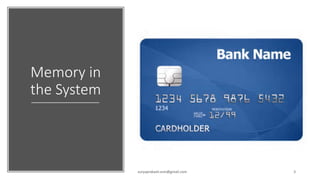
  • #4 Simple credit debit card transaction around 2kb of memory While on a smart card may require around 32kb of memory so a complex embedded system mat require huge memory
  • #5 Non Volatility-even can retrieve when the power is turned off