MEMORY TECHNOLOGY
By,
Israt Jahan
CSE 9th Batch
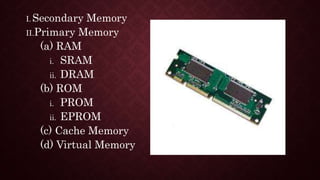
I. Secondary Memory
II.Primary Memory
(a) RAM
i. SRAM
ii. DRAM
(b) ROM
i. PROM
ii. EPROM
(c) Cache Memory
(d) Virtual Memory
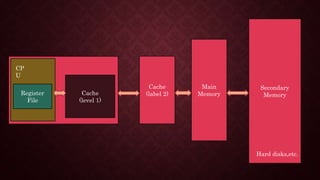
Register
File
Cache
(level 1)
Main
Memory
Secondary
Memory
Cache
(label 2)
CP
U
Hard disks,etc.
SECONDARY MEMORY
 Secondary storage does not lose the data when the
device is powered down—it is non-volatile. Per unit, it
is typically also an order of magnitude less expensive
than primary storage.Hard disk are usually used as
secondary storage.
PRIMARY MEMORY
 The CPU continuously reads instructions stored
there and executes them as required.Main memory
is directly or indirectly connected to the CPU via a
memory bus.an address bus and a data bus. The
CPU firstly sends a number through an address
bus.It is divided into RAM and ROM.
RAM
The RAM family includes two important memory devices:
static RAM (SRAM) and dynamic RAM (DRAM). The primary
difference between them is the lifetime of the data they store.
1) SRAM: retains its contents as long as electrical power is
applied to the chip. If the power is turned off or lost
temporarily, its contents will be lost forever.
2) DRAM: on the other hand, has an extremely short data
lifetime-typically about four milliseconds. This is true even
when power is applied constantly. DRAM controller is used to
refresh the data before it expires, the contents of memory can
be kept alive for as long as they are needed. So DRAM is as
useful as SRAM after all.
ROM:
Memories in the ROM family are distinguished by the
methods used to write new data to them (usually called
programming), and the number of times they can be
rewritten.
PROM
One step up from the masked ROM is the PROM
(programmable ROM), which is purchased in an
unprogrammed state. If we were to look at the contents
of an unprogrammed PROM, the data is made up
entirely of 1's.
EPROM
An EPROM (erasable-and-programmable ROM) is
programmed in exactly the same manner as a PROM.
However, EPROMs can be erased and reprogrammed
repeatedly.
combines the best features of the memory devices
described thus far. Flash memory devices are high
density, low cost, nonvolatile, fast (to read, but not to
write), and electrically reprogrammable.
Cache Memory
Each location in each memory has a datum (a cache
line), which in different designs ranges in size from 8
to 512 bytes. The size of the cache line is usually
larger than the size of the usual access requested by a
CPU instruction,
which ranges from 1 to 16 bytes.
Flash memory

Memory Technology

  • 1.
  • 2.
    I. Secondary Memory II.PrimaryMemory (a) RAM i. SRAM ii. DRAM (b) ROM i. PROM ii. EPROM (c) Cache Memory (d) Virtual Memory
  • 3.
  • 4.
    SECONDARY MEMORY  Secondarystorage does not lose the data when the device is powered down—it is non-volatile. Per unit, it is typically also an order of magnitude less expensive than primary storage.Hard disk are usually used as secondary storage. PRIMARY MEMORY  The CPU continuously reads instructions stored there and executes them as required.Main memory is directly or indirectly connected to the CPU via a memory bus.an address bus and a data bus. The CPU firstly sends a number through an address bus.It is divided into RAM and ROM.
  • 5.
    RAM The RAM familyincludes two important memory devices: static RAM (SRAM) and dynamic RAM (DRAM). The primary difference between them is the lifetime of the data they store. 1) SRAM: retains its contents as long as electrical power is applied to the chip. If the power is turned off or lost temporarily, its contents will be lost forever. 2) DRAM: on the other hand, has an extremely short data lifetime-typically about four milliseconds. This is true even when power is applied constantly. DRAM controller is used to refresh the data before it expires, the contents of memory can be kept alive for as long as they are needed. So DRAM is as useful as SRAM after all.
  • 6.
    ROM: Memories in theROM family are distinguished by the methods used to write new data to them (usually called programming), and the number of times they can be rewritten. PROM One step up from the masked ROM is the PROM (programmable ROM), which is purchased in an unprogrammed state. If we were to look at the contents of an unprogrammed PROM, the data is made up entirely of 1's. EPROM An EPROM (erasable-and-programmable ROM) is programmed in exactly the same manner as a PROM. However, EPROMs can be erased and reprogrammed repeatedly.
  • 7.
    combines the bestfeatures of the memory devices described thus far. Flash memory devices are high density, low cost, nonvolatile, fast (to read, but not to write), and electrically reprogrammable. Cache Memory Each location in each memory has a datum (a cache line), which in different designs ranges in size from 8 to 512 bytes. The size of the cache line is usually larger than the size of the usual access requested by a CPU instruction, which ranges from 1 to 16 bytes. Flash memory