CAN
           (Controller Area Network)

21 February 2013      D.V.C            1
Contents
 Overview
 Data Information
     Frame Format
       
    Protocol
    Error Detection
 Implementations
    Basic CAN
    Full CAN
    FIFO
    Enhanced Full CAN
 Manufacturers
 Diagrams
21 February 2013         D.V.C   2
Overview
 CAN (Controller Area Network) is a serial bus
  system used to communicate between
  several embedded 8-bit and 16-bit
  microcontrollers.
 It was originally designed for use in the
  automotive industry but is used today in many
  other systems (e.g. home appliances and
  industrial machines).


21 February 2013      D.V.C                       3
Overview (con’t)
 Highest Baud Rate is 1Mbit.
 CAN uses a message oriented transmission
  protocol.
 There are no defined addresses, just defined
  messages.


21 February 2013      D.V.C                      4
Data Information – Frame Format


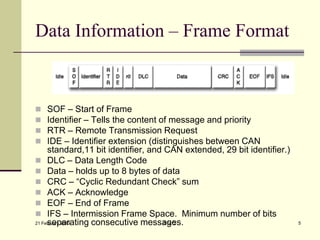
    SOF – Start of Frame
    Identifier – Tells the content of message and priority
    RTR – Remote Transmission Request
    IDE – Identifier extension (distinguishes between CAN
     standard,11 bit identifier, and CAN extended, 29 bit identifier.)
 DLC – Data Length Code
 Data – holds up to 8 bytes of data
 CRC – “Cyclic Redundant Check” sum
 ACK – Acknowledge
 EOF – End of Frame
 IFS – Intermission Frame Space. Minimum number of bits
     separating consecutive messages.
21 February 2013                     D.V.C                               5
Data Information - Protocol
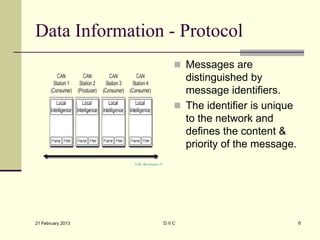
                        Messages are
                         distinguished by
                         message identifiers.
                        The identifier is unique
                         to the network and
                         defines the content &
                         priority of the message.


21 February 2013   D.V.C                            6
Data Information – Protocol (con’t)
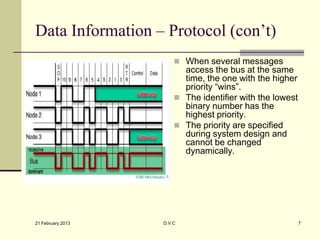
                        When several messages
                         access the bus at the same
                         time, the one with the higher
                         priority “wins”.
                        The identifier with the lowest
                         binary number has the
                         highest priority.
                        The priority are specified
                         during system design and
                         cannot be changed
                         dynamically.


21 February 2013   D.V.C                                  7
Data Information – Protocol (con’t)

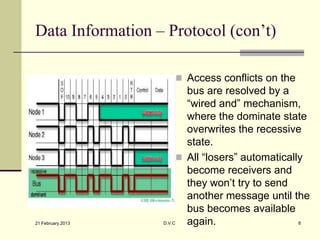
                      Access conflicts on the
                          bus are resolved by a
                          “wired and” mechanism,
                          where the dominate state
                          overwrites the recessive
                          state.
                         All “losers” automatically
                          become receivers and
                          they won’t try to send
                          another message until the
                          bus becomes available
21 February 2013   D.V.C  again.                   8
Data Information – Error detection
 If one or more errors are detected, the transmission
  is aborted. This prevents all other stations or nodes
  from accepting the message.
 Re-transmission is automatic. If errors continue, then
  the station or node may switch itself off to prevent the
  bus from being tied up.
 Error detection is done on two levels:
          Message level
          Bit level


21 February 2013            D.V.C                        9
Data Information – Error detection
(con’t)
 Message Level
         CRC = Cyclic Redundant Check sum
         Frame Check = compares message to fixed format and
          frame size
         ACK errors = if transmitter does not receive an ACK
          signal from the receivers
 Bit level
         Monitoring = The transmitter monitors the bus signal as
          it sends the message and compares the bit sent to the
          bit received.
         Bit Stuffing = After five consecutive equal bits, the
          transmitter inserts a stuff bit with a compliment value
          into the bit stream. The receivers remove this stuff bit.


21 February 2013                  D.V.C                           10
Implementations
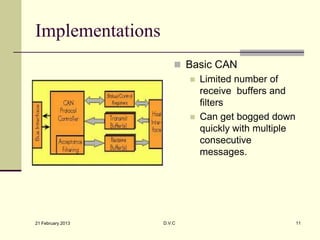
                        Basic CAN
                           Limited number of
                            receive buffers and
                            filters
                           Can get bogged down
                            quickly with multiple
                            consecutive
                            messages.


21 February 2013   D.V.C                            11
Implementation (con’t)
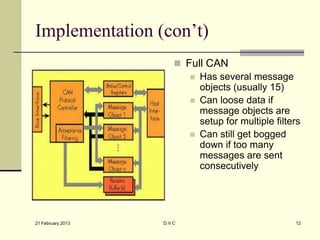
                        Full CAN
                           Has several message
                            objects (usually 15)
                           Can loose data if
                            message objects are
                            setup for multiple filters
                           Can still get bogged
                            down if too many
                            messages are sent
                            consecutively


21 February 2013   D.V.C                            12
Implementation (con’t)
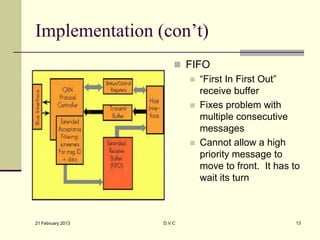
                        FIFO
                           “First In First Out”
                            receive buffer
                           Fixes problem with
                            multiple consecutive
                            messages
                           Cannot allow a high
                            priority message to
                            move to front. It has to
                            wait its turn


21 February 2013   D.V.C                           13
Implementation (con’t)
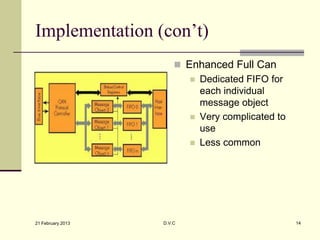
                        Enhanced Full Can
                           Dedicated FIFO for
                            each individual
                            message object
                           Very complicated to
                            use
                           Less common


21 February 2013   D.V.C                          14
Manufacturers
 Over 20 different chip manufacturers produce
  microcontrollers with on-chip CAN interfaces.
 Some more notable ones are:
          Cygnal
          Intel
          Motorola
          NEC
          Phillips
          Toshiba


21 February 2013          D.V.C                   15
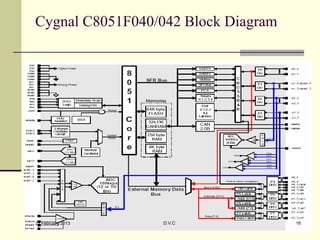
Cygnal C8051F040/042 Block Diagram


21 February 2013   D.V.C             16
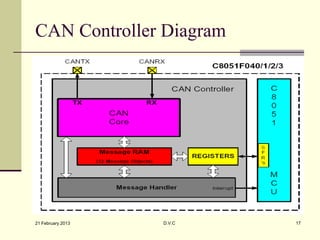
CAN Controller Diagram


21 February 2013   D.V.C   17
Summary
 CAN (Controller Area Network) is a serial bus system used to
  communicate between several embedded 8-bit and 16-bit
  microcontrollers
 Data Information
    Frame Format
    Protocol – message oriented
    Error Detection
              Message level (CRC, frame check, ACK errors)
              Bit level (monitoring, bit stuffing)
 Implementations
    Basic CAN
    Full CAN
    FIFO
    Enhanced Full CAN
 Over 20 different chip manufacturers produce microcontrollers with
  on-chip CAN interfaces including Cygnal, Intel, and Motorala.
  21 February 2013                      D.V.C                      18

Canbus

  • 1.
    CAN (Controller Area Network) 21 February 2013 D.V.C 1
  • 2.
    Contents  Overview  DataInformation Frame Format   Protocol  Error Detection  Implementations  Basic CAN  Full CAN  FIFO  Enhanced Full CAN  Manufacturers  Diagrams 21 February 2013 D.V.C 2
  • 3.
    Overview  CAN (ControllerArea Network) is a serial bus system used to communicate between several embedded 8-bit and 16-bit microcontrollers.  It was originally designed for use in the automotive industry but is used today in many other systems (e.g. home appliances and industrial machines). 21 February 2013 D.V.C 3
  • 4.
    Overview (con’t)  HighestBaud Rate is 1Mbit.  CAN uses a message oriented transmission protocol.  There are no defined addresses, just defined messages. 21 February 2013 D.V.C 4
  • 5.
    Data Information –Frame Format  SOF – Start of Frame  Identifier – Tells the content of message and priority  RTR – Remote Transmission Request  IDE – Identifier extension (distinguishes between CAN standard,11 bit identifier, and CAN extended, 29 bit identifier.)  DLC – Data Length Code  Data – holds up to 8 bytes of data  CRC – “Cyclic Redundant Check” sum  ACK – Acknowledge  EOF – End of Frame  IFS – Intermission Frame Space. Minimum number of bits separating consecutive messages. 21 February 2013 D.V.C 5
  • 6.
    Data Information -Protocol  Messages are distinguished by message identifiers.  The identifier is unique to the network and defines the content & priority of the message. 21 February 2013 D.V.C 6
  • 7.
    Data Information –Protocol (con’t)  When several messages access the bus at the same time, the one with the higher priority “wins”.  The identifier with the lowest binary number has the highest priority.  The priority are specified during system design and cannot be changed dynamically. 21 February 2013 D.V.C 7
  • 8.
    Data Information –Protocol (con’t)  Access conflicts on the bus are resolved by a “wired and” mechanism, where the dominate state overwrites the recessive state.  All “losers” automatically become receivers and they won’t try to send another message until the bus becomes available 21 February 2013 D.V.C again. 8
  • 9.
    Data Information –Error detection  If one or more errors are detected, the transmission is aborted. This prevents all other stations or nodes from accepting the message.  Re-transmission is automatic. If errors continue, then the station or node may switch itself off to prevent the bus from being tied up.  Error detection is done on two levels:  Message level  Bit level 21 February 2013 D.V.C 9
  • 10.
    Data Information –Error detection (con’t)  Message Level  CRC = Cyclic Redundant Check sum  Frame Check = compares message to fixed format and frame size  ACK errors = if transmitter does not receive an ACK signal from the receivers  Bit level  Monitoring = The transmitter monitors the bus signal as it sends the message and compares the bit sent to the bit received.  Bit Stuffing = After five consecutive equal bits, the transmitter inserts a stuff bit with a compliment value into the bit stream. The receivers remove this stuff bit. 21 February 2013 D.V.C 10
  • 11.
    Implementations  Basic CAN  Limited number of receive buffers and filters  Can get bogged down quickly with multiple consecutive messages. 21 February 2013 D.V.C 11
  • 12.
    Implementation (con’t)  Full CAN  Has several message objects (usually 15)  Can loose data if message objects are setup for multiple filters  Can still get bogged down if too many messages are sent consecutively 21 February 2013 D.V.C 12
  • 13.
    Implementation (con’t)  FIFO  “First In First Out” receive buffer  Fixes problem with multiple consecutive messages  Cannot allow a high priority message to move to front. It has to wait its turn 21 February 2013 D.V.C 13
  • 14.
    Implementation (con’t)  Enhanced Full Can  Dedicated FIFO for each individual message object  Very complicated to use  Less common 21 February 2013 D.V.C 14
  • 15.
    Manufacturers  Over 20different chip manufacturers produce microcontrollers with on-chip CAN interfaces.  Some more notable ones are:  Cygnal  Intel  Motorola  NEC  Phillips  Toshiba 21 February 2013 D.V.C 15
  • 16.
    Cygnal C8051F040/042 BlockDiagram 21 February 2013 D.V.C 16
  • 17.
    CAN Controller Diagram 21February 2013 D.V.C 17
  • 18.
    Summary  CAN (ControllerArea Network) is a serial bus system used to communicate between several embedded 8-bit and 16-bit microcontrollers  Data Information  Frame Format  Protocol – message oriented  Error Detection  Message level (CRC, frame check, ACK errors)  Bit level (monitoring, bit stuffing)  Implementations Basic CAN  Full CAN  FIFO  Enhanced Full CAN  Over 20 different chip manufacturers produce microcontrollers with on-chip CAN interfaces including Cygnal, Intel, and Motorala. 21 February 2013 D.V.C 18