
Categories of
Processor
Session 2
SURYAPRAKASH S
suryaprakash.vsm@gmail.com
Agenda
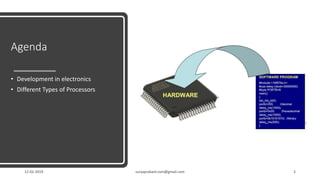
• Development in electronics
• Different Types of Processors
12-02-2019 suryaprakash.vsm@gmail.com 2
Development in Electronics
12-02-2019 suryaprakash.vsm@gmail.com 3
PROCESSOR
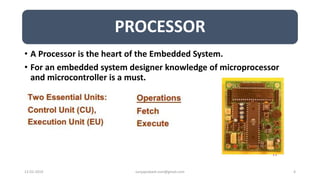
• A Processor is the heart of the Embedded System.
• For an embedded system designer knowledge of microprocessor
and microcontroller is a must.
12-02-2019 suryaprakash.vsm@gmail.com 4
VARIOUS PROCESSOR
1. General Purpose processor (GPP)
• Microprocessor
• Microcontroller
• Embedded Processor
• Digital signal Processor
2. Application Specific System Processor (ASSP)
3. Multi Processor System using GPPs
12-02-2019 suryaprakash.vsm@gmail.com 5
MICROPROCESSOR
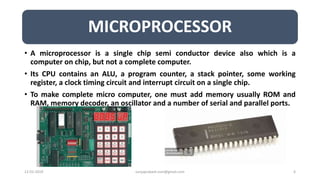
• A microprocessor is a single chip semi conductor device also which is a
computer on chip, but not a complete computer.
• Its CPU contains an ALU, a program counter, a stack pointer, some working
register, a clock timing circuit and interrupt circuit on a single chip.
• To make complete micro computer, one must add memory usually ROM and
RAM, memory decoder, an oscillator and a number of serial and parallel ports.
12-02-2019 suryaprakash.vsm@gmail.com 6
Processor technology
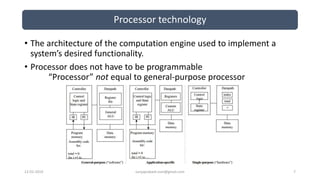
• The architecture of the computation engine used to implement a
system’s desired functionality.
• Processor does not have to be programmable
“Processor” not equal to general-purpose processor
12-02-2019 suryaprakash.vsm@gmail.com 7
Processor technology
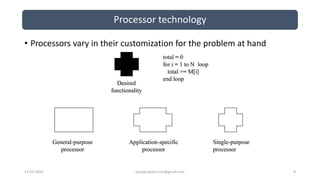
• Processors vary in their customization for the problem at hand
12-02-2019 suryaprakash.vsm@gmail.com 8
General-purpose processors
12-02-2019 suryaprakash.vsm@gmail.com 9
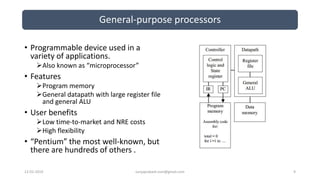
• Programmable device used in a
variety of applications.
Also known as “microprocessor”
• Features
Program memory
General datapath with large register file
and general ALU
• User benefits
Low time-to-market and NRE costs
High flexibility
• “Pentium” the most well-known, but
there are hundreds of others .
Single-purpose processors
12-02-2019 suryaprakash.vsm@gmail.com 10
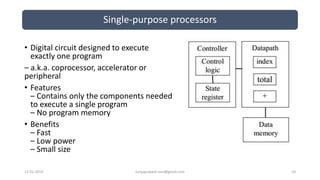
• Digital circuit designed to execute
exactly one program
– a.k.a. coprocessor, accelerator or
peripheral
• Features
– Contains only the components needed
to execute a single program
– No program memory
• Benefits
– Fast
– Low power
– Small size
Application-specific processors
12-02-2019 suryaprakash.vsm@gmail.com 11
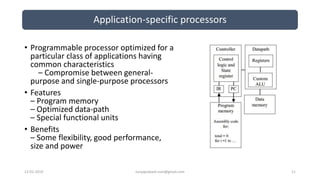
• Programmable processor optimized for a
particular class of applications having
common characteristics
– Compromise between general-
purpose and single-purpose processors
• Features
– Program memory
– Optimized data-path
– Special functional units
• Benefits
– Some flexibility, good performance,
size and power
IC technology
12-02-2019 suryaprakash.vsm@gmail.com 12
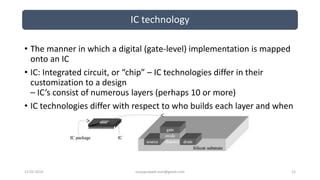
• The manner in which a digital (gate-level) implementation is mapped
onto an IC
• IC: Integrated circuit, or “chip” – IC technologies differ in their
customization to a design
– IC’s consist of numerous layers (perhaps 10 or more)
• IC technologies differ with respect to who builds each layer and when
IC technology
12-02-2019 suryaprakash.vsm@gmail.com 13
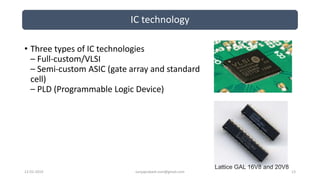
• Three types of IC technologies
– Full-custom/VLSI
– Semi-custom ASIC (gate array and standard
cell)
– PLD (Programmable Logic Device)
Lattice GAL 16V8 and 20V8
Full-custom/VLSI
12-02-2019 suryaprakash.vsm@gmail.com 14
• All layers are optimized for an embedded system’s particular digital
implementation
– Placing transistors
– Sizing transistors
– Routing wires
• Benefits
– Excellent performance, small size, low power
• Drawbacks
– High NRE cost (e.g., $300k), long time-to market
Semi-custom
12-02-2019 suryaprakash.vsm@gmail.com 15
• Lower layers are fully or partially built
– Designers are left with routing of wires and maybe placing some
blocks
• Benefits
– Good performance, good size, less NRE cost than a full-custom
implementation (perhaps $10k to $100k)
• Drawbacks
– Still require weeks to months to develop
PLD (Programmable Logic Device)
12-02-2019 suryaprakash.vsm@gmail.com 16
• All layers already exist
– Designers can purchase an IC
– Connections on the IC are either created or destroyed to implement
desired functionality
– Field-Programmable Gate Array (FPGA) very popular
• Benefits
– Low NRE costs, almost instant IC availability
• Drawbacks
– Bigger, expensive (perhaps $30 per unit), power
hungry, slower
MICROCONTROLLER
12-02-2019 suryaprakash.vsm@gmail.com 17
• A microcontroller is a functional computer system-on-a-chip. It
contains a processor, memory, and programmable input/output
peripherals.
• Microcontrollers include an integrated CPU, memory (a small amount
of RAM, program memory, or both) and peripherals capable of input
and output.
VARIOUS MICROCONTROLLERS
12-02-2019 suryaprakash.vsm@gmail.com 18
• INTEL
• 8031,8032,8051,8052,8751,8752
• PIC
• 8-bit PIC16, PIC18, 16-bit DSPIC33 / PIC24, PIC16C7x
• Motorola
• MC68HC11
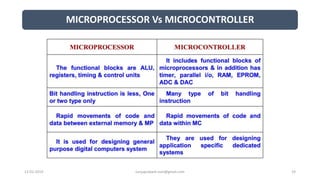
MICROPROCESSOR Vs MICROCONTROLLER
12-02-2019 suryaprakash.vsm@gmail.com 19
EMBEDDED PROCESSOR
12-02-2019 suryaprakash.vsm@gmail.com 20
• Special microprocessors & microcontrollers often called, Embedded
processors.
• An embedded processor is used when fast processing fast context-
switching & atomic ALU operations are needed.
• Examples : ARM 7, INTEL i960, AMD 29050.
DIGITAL SIGNAL PROCESSOR
12-02-2019 suryaprakash.vsm@gmail.com 21
• DSP as a GPP is a single chip VLSI unit.
• It includes the computational capabilities of microprocessor and
multiply & accumulate units (MAC).
• DSP has large number of applications such as image processing,
audio, video & telecommunication processing systems.
• It is used when signal processing functions are to be
processed fast.
• Examples : TMS320Cxx, SHARC, Motorola 5600xx
APPLICATION SPECIFIC SYSTEM PROCESSOR (ASSP)
12-02-2019 suryaprakash.vsm@gmail.com 22
• ASSP is dedicated to specific tasks and provides a faster solution.
• An ASSP is used as an additional processing unit for running the
application in place of using embedded software.
• Examples : IIM7100, W3100A
MULTI PROCESSOR SYSTEM USING GPPs
12-02-2019 suryaprakash.vsm@gmail.com 23
• Multiple processors are used when a single processor does not meet
the needs of different task.
• The operations of all the processors are synchronized to obtain an
optimum performance.
Moore’s Law
12-02-2019 suryaprakash.vsm@gmail.com 24
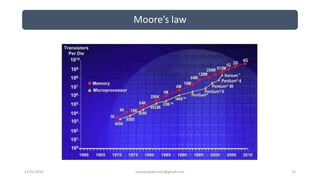
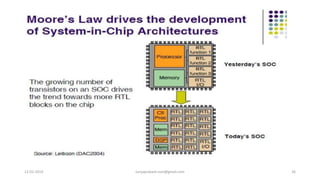
• Moore's law describes a long-term trend in the history of computing
hardware.
• Since the invention of the integrated circuit in 1958, the number of
transistors that can be placed inexpensively on an integrated circuit has
increased exponentially, doubling approximately every two years.
• The trend was first observed by Intel co-founder Gordon E.Moore in
1965.
• Almost every measure of the capabilities of digital electronic devices is
linked to Moore's law: processing speed, memory capacity, etc.
Moore’s law
12-02-2019 suryaprakash.vsm@gmail.com 25
12-02-2019 suryaprakash.vsm@gmail.com 26
OTHER HARDWARE
• Power Source
• Clock Oscillator
• Real Time Clock (RTC)
• Reset Circuit, Power-up Reset and watchdog timer Reset
• Memory
• I/O Ports, I/O Buses
• Interrupt Handler
• DAC and ADC
• LCD and LED Display
12-02-2019 suryaprakash.vsm@gmail.com 27
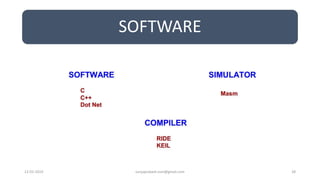
SOFTWARE
12-02-2019 suryaprakash.vsm@gmail.com 28
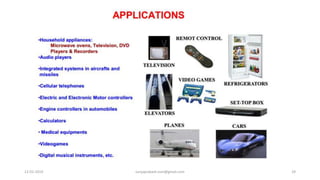
12-02-2019 suryaprakash.vsm@gmail.com 29
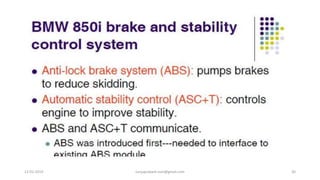
12-02-2019 suryaprakash.vsm@gmail.com 30
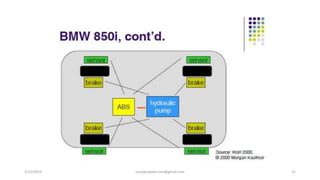
2/12/2019 suryaprakash.vsm@gmail.com 31
Automotive
embedded systems
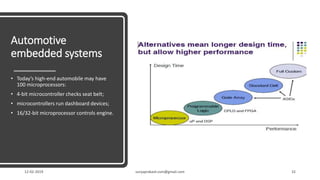
• Today’s high-end automobile may have
100 microprocessors:
• 4-bit microcontroller checks seat belt;
• microcontrollers run dashboard devices;
• 16/32-bit microprocessor controls engine.
12-02-2019 suryaprakash.vsm@gmail.com 32
• Thus ...
• Microprocessors are used
• As key components in an embedded design
• Programmable Logic and ASICs are used for critical parts in a design
• An objective for an embedded system designer is to find the cheapest
solution that meets the requirements
• Do not use a Pentium, when you only want to control a freezer...
12-02-2019 suryaprakash.vsm@gmail.com 33
2/12/2019 suryaprakash.vsm@gmail.com 34
This Photo by Unknown Author is licensed under CC BY-NC-ND
Learn by Doing
Excel Thru Experimentation
Lead by Example
Acquire skills and get employed
Update skills and stay employed

Class 2 categories of processor

  • 1.
  • 2.
    Agenda • Development inelectronics • Different Types of Processors 12-02-2019 suryaprakash.vsm@gmail.com 2
  • 3.
    Development in Electronics 12-02-2019suryaprakash.vsm@gmail.com 3
  • 4.
    PROCESSOR • A Processoris the heart of the Embedded System. • For an embedded system designer knowledge of microprocessor and microcontroller is a must. 12-02-2019 suryaprakash.vsm@gmail.com 4
  • 5.
    VARIOUS PROCESSOR 1. GeneralPurpose processor (GPP) • Microprocessor • Microcontroller • Embedded Processor • Digital signal Processor 2. Application Specific System Processor (ASSP) 3. Multi Processor System using GPPs 12-02-2019 suryaprakash.vsm@gmail.com 5
  • 6.
    MICROPROCESSOR • A microprocessoris a single chip semi conductor device also which is a computer on chip, but not a complete computer. • Its CPU contains an ALU, a program counter, a stack pointer, some working register, a clock timing circuit and interrupt circuit on a single chip. • To make complete micro computer, one must add memory usually ROM and RAM, memory decoder, an oscillator and a number of serial and parallel ports. 12-02-2019 suryaprakash.vsm@gmail.com 6
  • 7.
    Processor technology • Thearchitecture of the computation engine used to implement a system’s desired functionality. • Processor does not have to be programmable “Processor” not equal to general-purpose processor 12-02-2019 suryaprakash.vsm@gmail.com 7
  • 8.
    Processor technology • Processorsvary in their customization for the problem at hand 12-02-2019 suryaprakash.vsm@gmail.com 8
  • 9.
    General-purpose processors 12-02-2019 suryaprakash.vsm@gmail.com9 • Programmable device used in a variety of applications. Also known as “microprocessor” • Features Program memory General datapath with large register file and general ALU • User benefits Low time-to-market and NRE costs High flexibility • “Pentium” the most well-known, but there are hundreds of others .
  • 10.
    Single-purpose processors 12-02-2019 suryaprakash.vsm@gmail.com10 • Digital circuit designed to execute exactly one program – a.k.a. coprocessor, accelerator or peripheral • Features – Contains only the components needed to execute a single program – No program memory • Benefits – Fast – Low power – Small size
  • 11.
    Application-specific processors 12-02-2019 suryaprakash.vsm@gmail.com11 • Programmable processor optimized for a particular class of applications having common characteristics – Compromise between general- purpose and single-purpose processors • Features – Program memory – Optimized data-path – Special functional units • Benefits – Some flexibility, good performance, size and power
  • 12.
    IC technology 12-02-2019 suryaprakash.vsm@gmail.com12 • The manner in which a digital (gate-level) implementation is mapped onto an IC • IC: Integrated circuit, or “chip” – IC technologies differ in their customization to a design – IC’s consist of numerous layers (perhaps 10 or more) • IC technologies differ with respect to who builds each layer and when
  • 13.
    IC technology 12-02-2019 suryaprakash.vsm@gmail.com13 • Three types of IC technologies – Full-custom/VLSI – Semi-custom ASIC (gate array and standard cell) – PLD (Programmable Logic Device) Lattice GAL 16V8 and 20V8
  • 14.
    Full-custom/VLSI 12-02-2019 suryaprakash.vsm@gmail.com 14 •All layers are optimized for an embedded system’s particular digital implementation – Placing transistors – Sizing transistors – Routing wires • Benefits – Excellent performance, small size, low power • Drawbacks – High NRE cost (e.g., $300k), long time-to market
  • 15.
    Semi-custom 12-02-2019 suryaprakash.vsm@gmail.com 15 •Lower layers are fully or partially built – Designers are left with routing of wires and maybe placing some blocks • Benefits – Good performance, good size, less NRE cost than a full-custom implementation (perhaps $10k to $100k) • Drawbacks – Still require weeks to months to develop
  • 16.
    PLD (Programmable LogicDevice) 12-02-2019 suryaprakash.vsm@gmail.com 16 • All layers already exist – Designers can purchase an IC – Connections on the IC are either created or destroyed to implement desired functionality – Field-Programmable Gate Array (FPGA) very popular • Benefits – Low NRE costs, almost instant IC availability • Drawbacks – Bigger, expensive (perhaps $30 per unit), power hungry, slower
  • 17.
    MICROCONTROLLER 12-02-2019 suryaprakash.vsm@gmail.com 17 •A microcontroller is a functional computer system-on-a-chip. It contains a processor, memory, and programmable input/output peripherals. • Microcontrollers include an integrated CPU, memory (a small amount of RAM, program memory, or both) and peripherals capable of input and output.
  • 18.
    VARIOUS MICROCONTROLLERS 12-02-2019 suryaprakash.vsm@gmail.com18 • INTEL • 8031,8032,8051,8052,8751,8752 • PIC • 8-bit PIC16, PIC18, 16-bit DSPIC33 / PIC24, PIC16C7x • Motorola • MC68HC11
  • 19.
    MICROPROCESSOR Vs MICROCONTROLLER 12-02-2019suryaprakash.vsm@gmail.com 19
  • 20.
    EMBEDDED PROCESSOR 12-02-2019 suryaprakash.vsm@gmail.com20 • Special microprocessors & microcontrollers often called, Embedded processors. • An embedded processor is used when fast processing fast context- switching & atomic ALU operations are needed. • Examples : ARM 7, INTEL i960, AMD 29050.
  • 21.
    DIGITAL SIGNAL PROCESSOR 12-02-2019suryaprakash.vsm@gmail.com 21 • DSP as a GPP is a single chip VLSI unit. • It includes the computational capabilities of microprocessor and multiply & accumulate units (MAC). • DSP has large number of applications such as image processing, audio, video & telecommunication processing systems. • It is used when signal processing functions are to be processed fast. • Examples : TMS320Cxx, SHARC, Motorola 5600xx
  • 22.
    APPLICATION SPECIFIC SYSTEMPROCESSOR (ASSP) 12-02-2019 suryaprakash.vsm@gmail.com 22 • ASSP is dedicated to specific tasks and provides a faster solution. • An ASSP is used as an additional processing unit for running the application in place of using embedded software. • Examples : IIM7100, W3100A
  • 23.
    MULTI PROCESSOR SYSTEMUSING GPPs 12-02-2019 suryaprakash.vsm@gmail.com 23 • Multiple processors are used when a single processor does not meet the needs of different task. • The operations of all the processors are synchronized to obtain an optimum performance.
  • 24.
    Moore’s Law 12-02-2019 suryaprakash.vsm@gmail.com24 • Moore's law describes a long-term trend in the history of computing hardware. • Since the invention of the integrated circuit in 1958, the number of transistors that can be placed inexpensively on an integrated circuit has increased exponentially, doubling approximately every two years. • The trend was first observed by Intel co-founder Gordon E.Moore in 1965. • Almost every measure of the capabilities of digital electronic devices is linked to Moore's law: processing speed, memory capacity, etc.
  • 25.
  • 26.
  • 27.
    OTHER HARDWARE • PowerSource • Clock Oscillator • Real Time Clock (RTC) • Reset Circuit, Power-up Reset and watchdog timer Reset • Memory • I/O Ports, I/O Buses • Interrupt Handler • DAC and ADC • LCD and LED Display 12-02-2019 suryaprakash.vsm@gmail.com 27
  • 28.
  • 29.
  • 30.
  • 31.
  • 32.
    Automotive embedded systems • Today’shigh-end automobile may have 100 microprocessors: • 4-bit microcontroller checks seat belt; • microcontrollers run dashboard devices; • 16/32-bit microprocessor controls engine. 12-02-2019 suryaprakash.vsm@gmail.com 32
  • 33.
    • Thus ... •Microprocessors are used • As key components in an embedded design • Programmable Logic and ASICs are used for critical parts in a design • An objective for an embedded system designer is to find the cheapest solution that meets the requirements • Do not use a Pentium, when you only want to control a freezer... 12-02-2019 suryaprakash.vsm@gmail.com 33
  • 34.
    2/12/2019 suryaprakash.vsm@gmail.com 34 ThisPhoto by Unknown Author is licensed under CC BY-NC-ND Learn by Doing Excel Thru Experimentation Lead by Example Acquire skills and get employed Update skills and stay employed