I.F.D.C. LENGUAS VIVAS
TALLER DE PRÁCTICA DOCENTE
ALUMNO RESIDENTE: CHIHADE CECILIA
Período de Práctica: Nivel Primario
Institución Educativa: CEM N° 126
Dirección: San Martin 229- Valcheta
Sala / Grado / Año - sección: 1°-2°
Cantidad de alumnos: 14
Nivel lingüístico del curso: Principiantes
Tipo de Planificación: Clase
Unidad Temática: Parts of the house
Clase Nº: 1
Fecha: 14 de Noviembre de 2017
Hora: 19:00 – 20:10
Duración de la clase: 80 minutos
Fecha de entrega: 11 de Noviembre de 2017
 Aims or goals: 
During this lesson, learners will be able to…
 Identify and name different parts of the house.
 Incorporate and practise their previous knowledge of prepositions of
place and furniture.
 Develop their writing skills by completing different activities.
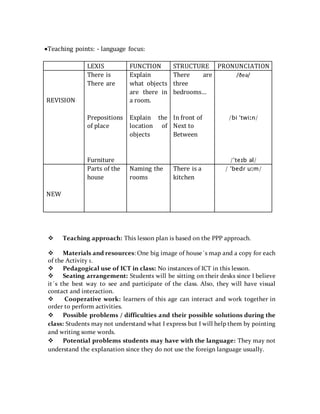
Teaching points: - language focus:
 Teaching approach: This lesson plan is based on the PPP approach.
 Materials and resources: One big image of house´s map and a copy for each
of the Activity 1.
 Pedagogical use of ICT in class: No instances of ICT in this lesson.
 Seating arrangement: Students will be sitting on their desks since I believe
it´s the best way to see and participate of the class. Also, they will have visual
contact and interaction.
 Cooperative work: learners of this age can interact and work together in
order to perform activities.
 Possible problems / difficulties and their possible solutions during the
class: Students may not understand what I express but I will help them by pointing
and writing some words.
 Potential problems students may have with the language: They may not
understand the explanation since they do not use the foreign language usually.
LEXIS FUNCTION STRUCTURE PRONUNCIATION
REVISION
There is
There are
Prepositions
of place
Furniture
Explain
what objects
are there in
a room.
Explain the
location of
objects
There are
three
bedrooms…
In front of
Next to
Between
/ðeə/
/bi ˈtwiːn/
/ˈteɪb əl/
NEW
Parts of the
house
Naming the
rooms
There is a
kitchen
/ ˈbedr uːm/
WARM UP (10 minutes)
Purpose: to introduce the topic and evaluate students´ understanding.
Hello! How are you? Let´s start! Today is November 14th
. Look here, what is this?
Yes, a house. And what are there inside it? Rooms. We will work with the parts of
the house today. (I will write the title on the board)
PRESENTATION (10 minutes)
Purpose: to further expose the learners to the target language, to foster
comprehension
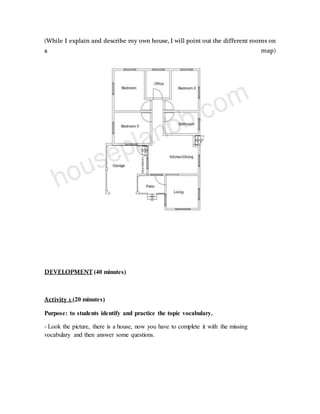
This is a house, I will describe it: There is a kitchen and a dinning room with a TV,
a table and six chairs, a living room with a computer and a sofa, a bathroom and
three bedrooms.
Next to bedroom 3 there is a garage which is connected to the house. Between
bedroom 1 and bedroom 2 there is an office.
In front of the house there is a garden.
(While I explain and describe my own house, I will point out the different rooms on
a map)
DEVELOPMENT (40 minutes)
Activity 1 (20 minutes)
Purpose: to students identify and practice the topic vocabulary.
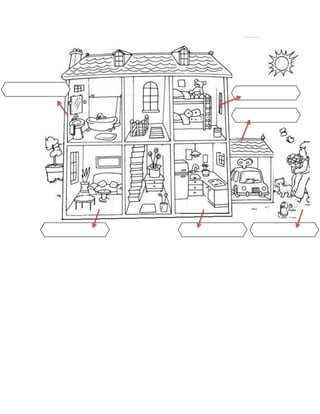
- Look the picture, there is a house, now you have to complete it with the missing
vocabulary and then answer some questions.
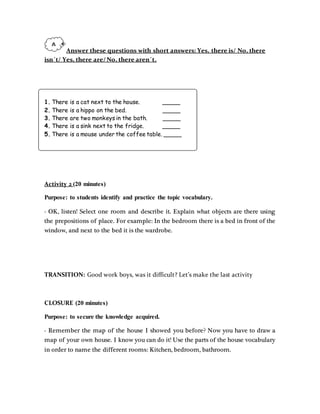
Answer these questions with short answers: Yes, there is/ No, there
isn´t/ Yes, there are/ No, there aren´t.
1. There is a cat next to the house. _____
2. There is a hippo on the bed. _____
3. There are two monkeys in the bath. _____
4. There is a sink next to the fridge. _____
5. There is a mouse under the coffee table. _____
Activity 2 (20 minutes)
Purpose: to students identify and practice the topic vocabulary.
- OK, listen! Select one room and describe it. Explain what objects are there using
the prepositions of place. For example: In the bedroom there is a bed in front of the
window, and next to the bed it is the wardrobe.
TRANSITION: Good work boys, was it difficult? Let’s make the last activity
CLOSURE (20 minutes)
Purpose: to secure the knowledge acquired.
- Remember the map of the house I showed you before? Now you have to draw a
map of your own house. I know you can do it! Use the parts of the house vocabulary
in order to name the different rooms: Kitchen, bedroom, bathroom.
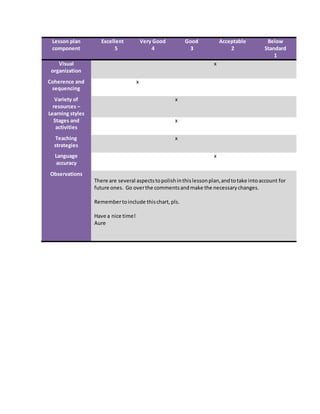
Lesson plan
component
Excellent
5
Very Good
4
Good
3
Acceptable
2
Below
Standard
1
Visual
organization
x
Coherence and
sequencing
x
Variety of
resources –
Learning styles
x
Stages and
activities
x
Teaching
strategies
x
Language
accuracy
x
Observations
There are several aspectstopolishinthislessonplan,andtotake intoaccount for
future ones. Go overthe commentsandmake the necessarychanges.
Remembertoinclude thischart,pls.
Have a nice time!
Aure

Class 01 chihade- secondary - just passed

  • 1.
    I.F.D.C. LENGUAS VIVAS TALLERDE PRÁCTICA DOCENTE ALUMNO RESIDENTE: CHIHADE CECILIA Período de Práctica: Nivel Primario Institución Educativa: CEM N° 126 Dirección: San Martin 229- Valcheta Sala / Grado / Año - sección: 1°-2° Cantidad de alumnos: 14 Nivel lingüístico del curso: Principiantes Tipo de Planificación: Clase Unidad Temática: Parts of the house Clase Nº: 1 Fecha: 14 de Noviembre de 2017 Hora: 19:00 – 20:10 Duración de la clase: 80 minutos Fecha de entrega: 11 de Noviembre de 2017  Aims or goals:  During this lesson, learners will be able to…  Identify and name different parts of the house.  Incorporate and practise their previous knowledge of prepositions of place and furniture.  Develop their writing skills by completing different activities.
  • 2.
    Teaching points: -language focus:  Teaching approach: This lesson plan is based on the PPP approach.  Materials and resources: One big image of house´s map and a copy for each of the Activity 1.  Pedagogical use of ICT in class: No instances of ICT in this lesson.  Seating arrangement: Students will be sitting on their desks since I believe it´s the best way to see and participate of the class. Also, they will have visual contact and interaction.  Cooperative work: learners of this age can interact and work together in order to perform activities.  Possible problems / difficulties and their possible solutions during the class: Students may not understand what I express but I will help them by pointing and writing some words.  Potential problems students may have with the language: They may not understand the explanation since they do not use the foreign language usually. LEXIS FUNCTION STRUCTURE PRONUNCIATION REVISION There is There are Prepositions of place Furniture Explain what objects are there in a room. Explain the location of objects There are three bedrooms… In front of Next to Between /ðeə/ /bi ˈtwiːn/ /ˈteɪb əl/ NEW Parts of the house Naming the rooms There is a kitchen / ˈbedr uːm/
  • 3.
    WARM UP (10minutes) Purpose: to introduce the topic and evaluate students´ understanding. Hello! How are you? Let´s start! Today is November 14th . Look here, what is this? Yes, a house. And what are there inside it? Rooms. We will work with the parts of the house today. (I will write the title on the board) PRESENTATION (10 minutes) Purpose: to further expose the learners to the target language, to foster comprehension This is a house, I will describe it: There is a kitchen and a dinning room with a TV, a table and six chairs, a living room with a computer and a sofa, a bathroom and three bedrooms. Next to bedroom 3 there is a garage which is connected to the house. Between bedroom 1 and bedroom 2 there is an office. In front of the house there is a garden.
  • 4.
    (While I explainand describe my own house, I will point out the different rooms on a map) DEVELOPMENT (40 minutes) Activity 1 (20 minutes) Purpose: to students identify and practice the topic vocabulary. - Look the picture, there is a house, now you have to complete it with the missing vocabulary and then answer some questions.
  • 6.
    Answer these questionswith short answers: Yes, there is/ No, there isn´t/ Yes, there are/ No, there aren´t. 1. There is a cat next to the house. _____ 2. There is a hippo on the bed. _____ 3. There are two monkeys in the bath. _____ 4. There is a sink next to the fridge. _____ 5. There is a mouse under the coffee table. _____ Activity 2 (20 minutes) Purpose: to students identify and practice the topic vocabulary. - OK, listen! Select one room and describe it. Explain what objects are there using the prepositions of place. For example: In the bedroom there is a bed in front of the window, and next to the bed it is the wardrobe. TRANSITION: Good work boys, was it difficult? Let’s make the last activity CLOSURE (20 minutes) Purpose: to secure the knowledge acquired. - Remember the map of the house I showed you before? Now you have to draw a map of your own house. I know you can do it! Use the parts of the house vocabulary in order to name the different rooms: Kitchen, bedroom, bathroom.
  • 7.
    Lesson plan component Excellent 5 Very Good 4 Good 3 Acceptable 2 Below Standard 1 Visual organization x Coherenceand sequencing x Variety of resources – Learning styles x Stages and activities x Teaching strategies x Language accuracy x Observations There are several aspectstopolishinthislessonplan,andtotake intoaccount for future ones. Go overthe commentsandmake the necessarychanges. Remembertoinclude thischart,pls. Have a nice time! Aure