Soil
Soil – An Introduction
• Along with water, light and air, it is the basic
necessity of the living world
• It is the upper layer of the earth’s crust
• It occurs everywhere on the earth except over
rocky land and the land under snow
• Soil mainly contains Oxygen (47.3%) and
Silicon (27.7%)
• Aluminium, iron, calcium, sodium, potassium
and magnesium are also present
Soil – An Introduction
• Soil is a mixture of mineral and organic
constituents that are in solid, gaseous and
aqueous states.
• Most soils have a density between 1 and
2 g/cm³
• Soil is also known as earth: it is the substance
from which our planet takes its name.
Types of Soil
• According to the kinds of particles and their
proportions in the soil, three kinds of soils
are possible:
– Sandy soil
– Clay soil
– Loam soil
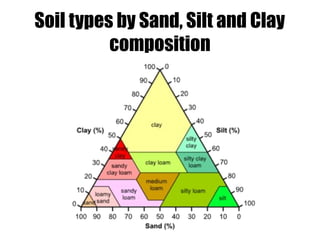
Soil types by Sand, Silt and Clay
composition
Types of Soil
• The proportion of sand and gravel is higher
• The soil is loose and porous
• Water holding capacity is low
• More air occurs in these pores
• The amount of nutrients is negligible
• These reasons render sandy soil as unfertile
Sandy Soil
Types of Soil
• The proportion of clay and silt particles is
higher
• Clay soil has higher porosity
• This type of soil is poorly aerated
• The spaces among the small colloidal particles
are very narrow, hence it hold a large amount
of water
Clay Soil
Types of Soil
• There is a proper mixture of the various-sized
particles
• Sand, silt, and clay are present in relatively even
concentration (about 40-40-20% concentration
respectively)
• Loam soil is considered ideal for gardening and
agricultural uses.
• Loams are gritty, moist, and retain water easily.
• Loam soil feels mellow and is easy to work over
a wide range of moisture conditions.
Loam Soil
Types of Soil
• Loam soils generally contain more nutrients
and humus than sandy soils, have better
infiltration and drainage than silty soils, and are
easier to till than clay soils.
• Loam is ideal for growing crops because it
retains nutrients well and retains water while
still allowing the water to flow freely.
• This soil is found in a majority of successful
farms in regions around the world known for
their fertile land.
Loam Soil
Soil Formation
Soil Formation
• Soil formation is the combined effect of
physical, chemical, and biological processes on
soil parent material.
• Soil genesis involves processes that develop
layers or horizons in the soil profile.
• These processes involve additions, losses,
transformations and translocations of material
that compose the soil.
• The weathering of bedrock produces the
parent material that soils form from.
Soil Formation
• Weather is the first stage in the transforming of
parent material into soil material.
• In soils forming from bedrock, a thick layer of
weathered material is formed.
• This is the result of weathering processes that
include:
– Hydrolysis, hydration & solution of minerals by
water
– physical processes that include freezing and
thawing or wetting and drying.
Weather
Soil Formation
• The mineralogical and chemical composition
of the primary bedrock material, plus physical
features, including grain size and degree of
consolidation, plus the rate and type of
weathering, transforms it into different soil
materials.
Weather
Soil Formation
• Soil formation greatly depends on the climate,
and soils from different climate zones show
distinctive characteristics.
• Temperature and moisture affect weathering and
leaching.
• Wind moves sand and other particles, especially
in arid regions where there is little plant cover.
• Temperature and precipitation rates affect
biological activity, rates of chemical reactions,
and types of vegetation cover.
Climate
Soil Formation
• The type and amount of precipitation influence
soil formation by affecting the movement of
ions and particles through the soil, aiding in
the development of different soil profiles.
• Seasonal and daily temperature fluctuations
affect the effectiveness of water in weathering
parent rock material and affect soil dynamics,
freezing and thawing is an affective mechanism
to break up rocks and other consolidated
materials.
Climate
Soil Formation
• Plants, animals, fungi, bacteria and humans
affect soil formation.
• Animals and micro-organisms mix soils and
form burrows and pores allowing moisture and
gases to seep into deeper layers.
• In the same way, plant roots open channels in
the soils, especially plants with deep taproots
which can penetrate many meters through the
different soil layers bringing up nutrients from
deeper in the soil.
Biological Factors
Soil Formation
• Plants with fibrous roots that spread out near
the soil surface, have roots that are easily
decomposed, adding organic matter.
• Micro-organisms, including fungi and bacteria
affect chemical exchanges between roots and
soil and act as a reserve of nutrients.
• Humans can impact soil formation by
removing vegetation cover, which promotes
erosion, or by mixing different soil layers which
restarts the soil formation process
Biological Factors
Soil Formation
• Vegetation impacts soils in numerous ways.
• It can prevent erosion from rain or surface
runoff.
• It shades soils, keeping them cooler and
slowing evaporation of soil moisture.
• Or it can cause soils to dry out by transpiration.
• Plants can form new chemicals that break
down or build up soil particles.
Biological Factors
Soil Formation
• Dead plants and dropped leaves and stems of
plants fall to the surface of the soil and
decompose.
• There, organisms feed on them and mix the
organic material with the upper soil layers;
these organic compounds become part of the
soil formation process, ultimately shaping the
type of soil formed
Biological Factors
Soil Formation
• Time is a factor in the interactions of all the
above factors as they develop soil.
• Over time, soils evolve features dependent on
the other forming factors, and soil formation is
a time-responsive process dependent on how
the other factors interplay with each other.
• Soil-forming factors continue to affect soils
during their existence
Time
Soil Formation
• Materials are deposited on top and materials
are blown or washed away from the surface.
• With additions, removals, and alterations, soils
are always subject to new conditions.
• Whether these are slow or rapid changes,
depends on climate, landscape position, and
biological activity.
Time
Soil Profile
Soil Profile
• In a vertical section of soil dug out at any place
on earth, we find many horizontal layers from
the upper surface to the deeper regions
• Such a multi-layered structuring of the soil is
called Soil Profile
• Each observed layer is called a horizon
Soil Horizon
• A soil horizon is a specific layer in the soil
which measures parallel to the soil surface and
possesses physical characteristics which differ
from the layers above and beneath.
• Horizon formation is a function of a range of
geological, chemical, and biological processes
and occurs over long time periods.
• Soils vary in the degree to which horizons are
expressed.
Soil Horizon
• Each soil type has at least one, usually three or
four different horizons
• Horizons are defined in most cases by obvious
physical features, colour and texture being
chief among them.
• These may be described both in absolute terms
(particle size distribution for texture) and in
terms relative to the surrounding material, i.e.,
‘coarser’ or ‘sandier’ than the horizons above
and below
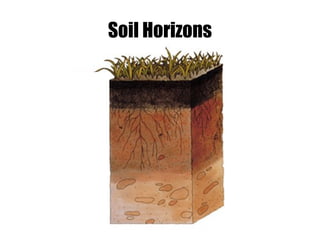
Soil Horizons
Soil Horizon
• There are 4 main horizons – A, B, C and D –
from the outside towards inside respectively
• Layer A has 5 sub-layers A00, A0, A1, A2 and A3
• A00 sub-layer is well developed in forest areas
and is rich in fallen leaves, flowers, petals and
excretory matter. It is called the litter layer and
is not a part of the soil itself.
• A0 sub-layer is called the duff layer and
comprises partially decomposed debris. It is
not observed in grassland soils
Soil Horizon
• A1 sub-layer is rich in organic matter and called
the humus layer
• A2 sub-layer is constantly leached by rainwater
It is a sub-layer of mineral soil with most
organic matter accumulation and soil life.
• This layer is depleted of iron, clay, aluminum,
organic compounds, and other soluble
constituents. This is called the surface soil
• A3 is a transition layer between layers A and B
Soil Horizon
• B layer is called the Established layer and is a
store-house of material being leached from the
upper regions
• C layer contains a store of degraded inorganic
material
• Water is stored here and also hard material like
calcium carbonate and calcium sulphate are
observed
• D is the innermost layer made of sand, rock or
clay
Soil Constituents
Soil Constituents
• Any soil consists of the following:
– Parental material or inorganic constituents
– Organic matter
– Soil solution
– Soil gases
– Soil organisms
Soil Constituents
• Composed of mineral substances
• Formed from the parental rock lying in the soil
• Only quartz (among parental rocks) remains in
its original form
• Other rocks are degraded into stones, sand, silt
and clay
• 90% of soil is composed of parental material
and their characteristics influences the nature
of plant life
Parental material
Soil Constituents
• These are dead bodies of organisms and
animal excreta
• Makes soil suitable for plant inhabitation
• Improves water-holding capacity and aeration
of the soil
• Starch, glucose, proteins and other organic
substances are supplemented through them
• Provide a source of nutrient substances
Organic Matter
Soil Constituents
• The dilute solution of water occurring around
the soil particles and in the pore spaces in the
soil
• Contains dissolved solids, liquids and gases
• Plants absorb their essential nutrients from this
soil solution
Soil Solution
Soil Constituents
• Helps plants in respiration by making available
oxygen and arranging for the removal of
carbon dioxide
• Amount of oxygen decreases with depth
• The presence of water and air in the soil is
inversely proportional
Soil Gases
Soil Constituents
• Numerous organisms can be found living in
soil.
• Among plants, we can find bacteria, fungi,
algae and the underground organs of plants
• Among animals, we can find protozoa and
other animals like ants, snakes, mites,
earthworms as well as burrowing animals like
rats and moles
Soil Organisms
Soil Constituents
• Organisms bring about useful or harmful
changes to the soil they live in
• Decomposer animals like ants and worms
degrade the dead bodies of organisms
• Several fungi and bacteria produce growth-
stimulating chemicals
• Some produce toxic substances through their
metabolic activities
• Earthworms bring soil from deeper regions to
the surface, improving soil constitution and
fertility
Soil Organisms
Soil – A Resource
• Soil is used in agriculture, where it serves as
the primary nutrient base for the plants.
• The types of soil used in agriculture vary
with respect to the species of plants that are
cultivated.
Soil – A Resource
• Soil material is a critical component in the
mining and construction industries.
• Soil serves as a foundation for most
construction projects.
• Massive volumes of soil can be involved in
surface mining, road building, and dam
construction.
• Earth sheltering is the architectural practice of
using soil for external thermal mass against
building walls.
Soil – A Resource
• Soil resources are critical to the
environment, as well as to food and fiber
production.
• Soil provides minerals and water to plants.
• Soil absorbs rainwater and releases it later
thus preventing floods and drought.
• Soil is the habitat for many organisms: the
major part of known and unknown
biodiversity is in the soil
Soil – A Resource
• Waste management often has a soil
component.
• Septic drain fields treat septic tank effluent
using aerobic soil processes.
• Landfills use soil for daily cover.
• Organic soils, especially peat, serve as a
significant fuel resource.
Soil – A Resource
• Both animals and humans in many cultures,
occasionally consume soil.
• It has been shown that some monkeys
consume soil, together with their preferred
food (tree foliage and fruits) in order to
alleviate tannin toxicity.
Soil – A Resource
• Soil cleans the water as it percolates.
• Soils filter and purify water and effect its
chemistry.
• Rain water and pooled water from ponds,
lakes and rivers percolate through the soil
horizons and the upper rock strata, and thus
become groundwater.
Soil – A Resource
• Pests (viruses) and pollutants such as oils,
heavy metals and excess nutrients are filtered
out by the soil and soil organisms metabolize
them or immobilize them in their biomass and
necromass, thereby incorporating them into
stable humus.
• The physical integrity of soil is also a
prerequisite for avoiding landslides in rugged
landscapes
Soil Pollution
Soil Pollution - Causes
• The main causes of soil pollution are:
• Increasing population, urbanization and
industrialization
• Dead bodies of animals and waste disposal of
various materials utilized by human beings
• The use of chemical fertilizers and various
insecticides and pesticides in agriculture
• Excessive irrigation increases soil salinity and a
decreasing nitrogen fixing capacity of bacteria
Soil Pollution - Causes
• Littering in the form of plastics and polythene
carry-bags is another source of soil pollution
• Random deforestation is another cause of soil
pollution, as it leads to erosion and top soil
being washed away
• Urban land fills is another source of soil
pollution
Soil Pollution - Control
• Proper disposal and collection of garbage
• Use of bio-degradable material like jute, paper
instead of plastic and polythene
• Planting more trees
• Proper agricultural practice of decreasing use
of pesticides and insecticides and more use of
organic farming and biological control methods
• Recycling of waste
• Modern irrigation techniques to minimize
wastage of water
Soil Erosion – An Introduction
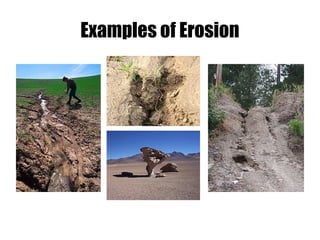
• Erosion is the removal of solids (sediment,
soil, rock and other particles) in the natural
environment.
• It usually occurs due to transport by wind,
water, or ice; by down-slope creep of soil
and other material under the force of
gravity; or by living organisms, such as
burrowing animals, in the case of bio-
erosion
Soil Erosion – An Introduction
• Erosion is a noticeable intrinsic natural process
but in many places it is increased by human
land use.
• Poor land use practices include deforestation,
overgrazing, unmanaged construction activity
and road-building.
• Land that is used for the production of
agricultural crops generally experiences a
significant greater rate of erosion than that of
land under natural vegetation.
Soil Erosion – An Introduction
• This is particularly true if tillage is used, which
reduces vegetation cover on the surface of the
soil and disturbs both soil structure and plant
roots that would otherwise hold the soil in
place.
• However, improved land use practices can limit
erosion, using techniques such as terrace-
building, conservation tillage practices, and
tree planting.
Soil Erosion – An Introduction
• A certain amount of erosion is natural and, in
fact, healthy for the ecosystem.
• For example, gravels continuously move
downstream in watercourses.
• Excessive erosion, however, does cause
problems, such as receiving water
sedimentation, ecosystem damage and outright
loss of soil.
Examples of Erosion
Soil Erosion - Causes
• The rate of erosion depends on many factors.
• Climatic factors include the amount and
intensity of precipitation, the average
temperature, as well as the typical temperature
range, and seasonality, the wind speed, storm
frequency.
• Geologic factors include the sediment or rock
type, its porosity and permeability, the slope
(gradient) of the land, and whether the rocks
are tilted, faulted, folded, or weathered.
Soil Erosion - Causes
• Biological factors include ground cover from
vegetation or lack thereof, the type of
organisms inhabiting the area, and the land
use.
• Activities like logging, building of roads and
embankments, and heavy grazing of animals
increase the chances of soil erosion
Erosion Processes
• Mass wasting is the down-slope movement of
rock and sediments, mainly due to the force of
gravity.
• Mass-movement processes are always
occurring continuously on all slopes; some
mass-movement processes act very slowly;
others occur very suddenly, often with
disastrous results.
• Any down-slope movement of rocks is often
referred to in general terms as a landslide.
Gravity Erosion
Erosion Processes
• Different types of erosion caused by water are:
• Splash erosion is the detachment and airborne
movement of small soil particles caused by the
impact of raindrops on soil.
• Sheet erosion is the detachment of soil
particles by raindrop impact and their removal
down slope by water flowing overland as a
sheet.
• Rill erosion refers to the development of small,
concentrated flow paths, which function as
both sediment source and sediment delivery
systems for erosion on hill-slopes.
Water Erosion
Erosion Processes
• Gully erosion results where water flows along a
linear depression eroding a trench or gully.
• Valley or stream erosion occurs with continued
water flow along a linear feature.
• At extremely high flows, kolks, or vortices are
formed by large volumes of rapidly rushing
water. Kolks cause extreme local erosion,
plucking bedrock and creating pothole-type
geographical features called Rock-cut basins.
Water Erosion
Erosion Processes
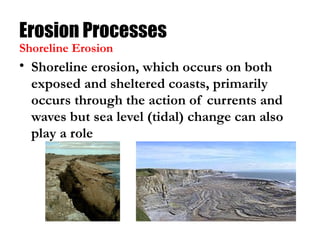
• Shoreline erosion, which occurs on both
exposed and sheltered coasts, primarily
occurs through the action of currents and
waves but sea level (tidal) change can also
play a role
Shoreline Erosion
Erosion Processes
• Ice erosion is caused by movement of ice,
typically as glaciers
• Sometimes, cold weather causes water
trapped in tiny rock cracks to freeze and
expand, breaking the rock into several
pieces. This can lead to gravity erosion on
steep slopes
Ice Erosion
Erosion Processes
• Wind erosion is the result of material
movement by the wind.
• There are two main effects.
• First, wind causes small particles to be lifted
and therefore moved to another region. This is
called deflation.
• Second, these suspended particles may impact
on solid objects causing erosion by abrasion
Wind Erosion
Erosion Processes
• Wind erosion generally occurs in areas with
little or no vegetation, often in areas where
there is insufficient rainfall to support
vegetation.
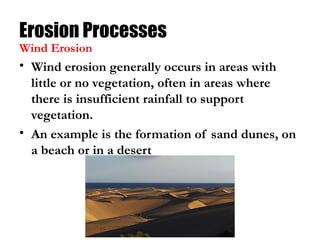
• An example is the formation of sand dunes, on
a beach or in a desert
Wind Erosion
Erosion - Control
• Covering of open land through cultivation
• Crops like groundnut, pulses, lucerne provide a
protective covering to the soil
• Creation of horizontal contours at right angles
to the gradient of the slope increase water
absorption and slows down the process of
erosion
• Planting of trees in ravines, and that of sand-
binding vegetation in deserts can help stop
erosion

Soil | Class 8 | Science

  • 1.
  • 2.
    Soil – AnIntroduction • Along with water, light and air, it is the basic necessity of the living world • It is the upper layer of the earth’s crust • It occurs everywhere on the earth except over rocky land and the land under snow • Soil mainly contains Oxygen (47.3%) and Silicon (27.7%) • Aluminium, iron, calcium, sodium, potassium and magnesium are also present
  • 3.
    Soil – AnIntroduction • Soil is a mixture of mineral and organic constituents that are in solid, gaseous and aqueous states. • Most soils have a density between 1 and 2 g/cm³ • Soil is also known as earth: it is the substance from which our planet takes its name.
  • 4.
    Types of Soil •According to the kinds of particles and their proportions in the soil, three kinds of soils are possible: – Sandy soil – Clay soil – Loam soil
  • 5.
    Soil types bySand, Silt and Clay composition
  • 6.
    Types of Soil •The proportion of sand and gravel is higher • The soil is loose and porous • Water holding capacity is low • More air occurs in these pores • The amount of nutrients is negligible • These reasons render sandy soil as unfertile Sandy Soil
  • 7.
    Types of Soil •The proportion of clay and silt particles is higher • Clay soil has higher porosity • This type of soil is poorly aerated • The spaces among the small colloidal particles are very narrow, hence it hold a large amount of water Clay Soil
  • 8.
    Types of Soil •There is a proper mixture of the various-sized particles • Sand, silt, and clay are present in relatively even concentration (about 40-40-20% concentration respectively) • Loam soil is considered ideal for gardening and agricultural uses. • Loams are gritty, moist, and retain water easily. • Loam soil feels mellow and is easy to work over a wide range of moisture conditions. Loam Soil
  • 9.
    Types of Soil •Loam soils generally contain more nutrients and humus than sandy soils, have better infiltration and drainage than silty soils, and are easier to till than clay soils. • Loam is ideal for growing crops because it retains nutrients well and retains water while still allowing the water to flow freely. • This soil is found in a majority of successful farms in regions around the world known for their fertile land. Loam Soil
  • 10.
  • 11.
    Soil Formation • Soilformation is the combined effect of physical, chemical, and biological processes on soil parent material. • Soil genesis involves processes that develop layers or horizons in the soil profile. • These processes involve additions, losses, transformations and translocations of material that compose the soil. • The weathering of bedrock produces the parent material that soils form from.
  • 12.
    Soil Formation • Weatheris the first stage in the transforming of parent material into soil material. • In soils forming from bedrock, a thick layer of weathered material is formed. • This is the result of weathering processes that include: – Hydrolysis, hydration & solution of minerals by water – physical processes that include freezing and thawing or wetting and drying. Weather
  • 13.
    Soil Formation • Themineralogical and chemical composition of the primary bedrock material, plus physical features, including grain size and degree of consolidation, plus the rate and type of weathering, transforms it into different soil materials. Weather
  • 14.
    Soil Formation • Soilformation greatly depends on the climate, and soils from different climate zones show distinctive characteristics. • Temperature and moisture affect weathering and leaching. • Wind moves sand and other particles, especially in arid regions where there is little plant cover. • Temperature and precipitation rates affect biological activity, rates of chemical reactions, and types of vegetation cover. Climate
  • 15.
    Soil Formation • Thetype and amount of precipitation influence soil formation by affecting the movement of ions and particles through the soil, aiding in the development of different soil profiles. • Seasonal and daily temperature fluctuations affect the effectiveness of water in weathering parent rock material and affect soil dynamics, freezing and thawing is an affective mechanism to break up rocks and other consolidated materials. Climate
  • 16.
    Soil Formation • Plants,animals, fungi, bacteria and humans affect soil formation. • Animals and micro-organisms mix soils and form burrows and pores allowing moisture and gases to seep into deeper layers. • In the same way, plant roots open channels in the soils, especially plants with deep taproots which can penetrate many meters through the different soil layers bringing up nutrients from deeper in the soil. Biological Factors
  • 17.
    Soil Formation • Plantswith fibrous roots that spread out near the soil surface, have roots that are easily decomposed, adding organic matter. • Micro-organisms, including fungi and bacteria affect chemical exchanges between roots and soil and act as a reserve of nutrients. • Humans can impact soil formation by removing vegetation cover, which promotes erosion, or by mixing different soil layers which restarts the soil formation process Biological Factors
  • 18.
    Soil Formation • Vegetationimpacts soils in numerous ways. • It can prevent erosion from rain or surface runoff. • It shades soils, keeping them cooler and slowing evaporation of soil moisture. • Or it can cause soils to dry out by transpiration. • Plants can form new chemicals that break down or build up soil particles. Biological Factors
  • 19.
    Soil Formation • Deadplants and dropped leaves and stems of plants fall to the surface of the soil and decompose. • There, organisms feed on them and mix the organic material with the upper soil layers; these organic compounds become part of the soil formation process, ultimately shaping the type of soil formed Biological Factors
  • 20.
    Soil Formation • Timeis a factor in the interactions of all the above factors as they develop soil. • Over time, soils evolve features dependent on the other forming factors, and soil formation is a time-responsive process dependent on how the other factors interplay with each other. • Soil-forming factors continue to affect soils during their existence Time
  • 21.
    Soil Formation • Materialsare deposited on top and materials are blown or washed away from the surface. • With additions, removals, and alterations, soils are always subject to new conditions. • Whether these are slow or rapid changes, depends on climate, landscape position, and biological activity. Time
  • 22.
  • 23.
    Soil Profile • Ina vertical section of soil dug out at any place on earth, we find many horizontal layers from the upper surface to the deeper regions • Such a multi-layered structuring of the soil is called Soil Profile • Each observed layer is called a horizon
  • 24.
    Soil Horizon • Asoil horizon is a specific layer in the soil which measures parallel to the soil surface and possesses physical characteristics which differ from the layers above and beneath. • Horizon formation is a function of a range of geological, chemical, and biological processes and occurs over long time periods. • Soils vary in the degree to which horizons are expressed.
  • 25.
    Soil Horizon • Eachsoil type has at least one, usually three or four different horizons • Horizons are defined in most cases by obvious physical features, colour and texture being chief among them. • These may be described both in absolute terms (particle size distribution for texture) and in terms relative to the surrounding material, i.e., ‘coarser’ or ‘sandier’ than the horizons above and below
  • 26.
  • 27.
    Soil Horizon • Thereare 4 main horizons – A, B, C and D – from the outside towards inside respectively • Layer A has 5 sub-layers A00, A0, A1, A2 and A3 • A00 sub-layer is well developed in forest areas and is rich in fallen leaves, flowers, petals and excretory matter. It is called the litter layer and is not a part of the soil itself. • A0 sub-layer is called the duff layer and comprises partially decomposed debris. It is not observed in grassland soils
  • 28.
    Soil Horizon • A1sub-layer is rich in organic matter and called the humus layer • A2 sub-layer is constantly leached by rainwater It is a sub-layer of mineral soil with most organic matter accumulation and soil life. • This layer is depleted of iron, clay, aluminum, organic compounds, and other soluble constituents. This is called the surface soil • A3 is a transition layer between layers A and B
  • 29.
    Soil Horizon • Blayer is called the Established layer and is a store-house of material being leached from the upper regions • C layer contains a store of degraded inorganic material • Water is stored here and also hard material like calcium carbonate and calcium sulphate are observed • D is the innermost layer made of sand, rock or clay
  • 30.
  • 31.
    Soil Constituents • Anysoil consists of the following: – Parental material or inorganic constituents – Organic matter – Soil solution – Soil gases – Soil organisms
  • 32.
    Soil Constituents • Composedof mineral substances • Formed from the parental rock lying in the soil • Only quartz (among parental rocks) remains in its original form • Other rocks are degraded into stones, sand, silt and clay • 90% of soil is composed of parental material and their characteristics influences the nature of plant life Parental material
  • 33.
    Soil Constituents • Theseare dead bodies of organisms and animal excreta • Makes soil suitable for plant inhabitation • Improves water-holding capacity and aeration of the soil • Starch, glucose, proteins and other organic substances are supplemented through them • Provide a source of nutrient substances Organic Matter
  • 34.
    Soil Constituents • Thedilute solution of water occurring around the soil particles and in the pore spaces in the soil • Contains dissolved solids, liquids and gases • Plants absorb their essential nutrients from this soil solution Soil Solution
  • 35.
    Soil Constituents • Helpsplants in respiration by making available oxygen and arranging for the removal of carbon dioxide • Amount of oxygen decreases with depth • The presence of water and air in the soil is inversely proportional Soil Gases
  • 36.
    Soil Constituents • Numerousorganisms can be found living in soil. • Among plants, we can find bacteria, fungi, algae and the underground organs of plants • Among animals, we can find protozoa and other animals like ants, snakes, mites, earthworms as well as burrowing animals like rats and moles Soil Organisms
  • 37.
    Soil Constituents • Organismsbring about useful or harmful changes to the soil they live in • Decomposer animals like ants and worms degrade the dead bodies of organisms • Several fungi and bacteria produce growth- stimulating chemicals • Some produce toxic substances through their metabolic activities • Earthworms bring soil from deeper regions to the surface, improving soil constitution and fertility Soil Organisms
  • 38.
    Soil – AResource • Soil is used in agriculture, where it serves as the primary nutrient base for the plants. • The types of soil used in agriculture vary with respect to the species of plants that are cultivated.
  • 39.
    Soil – AResource • Soil material is a critical component in the mining and construction industries. • Soil serves as a foundation for most construction projects. • Massive volumes of soil can be involved in surface mining, road building, and dam construction. • Earth sheltering is the architectural practice of using soil for external thermal mass against building walls.
  • 40.
    Soil – AResource • Soil resources are critical to the environment, as well as to food and fiber production. • Soil provides minerals and water to plants. • Soil absorbs rainwater and releases it later thus preventing floods and drought. • Soil is the habitat for many organisms: the major part of known and unknown biodiversity is in the soil
  • 41.
    Soil – AResource • Waste management often has a soil component. • Septic drain fields treat septic tank effluent using aerobic soil processes. • Landfills use soil for daily cover. • Organic soils, especially peat, serve as a significant fuel resource.
  • 42.
    Soil – AResource • Both animals and humans in many cultures, occasionally consume soil. • It has been shown that some monkeys consume soil, together with their preferred food (tree foliage and fruits) in order to alleviate tannin toxicity.
  • 43.
    Soil – AResource • Soil cleans the water as it percolates. • Soils filter and purify water and effect its chemistry. • Rain water and pooled water from ponds, lakes and rivers percolate through the soil horizons and the upper rock strata, and thus become groundwater.
  • 44.
    Soil – AResource • Pests (viruses) and pollutants such as oils, heavy metals and excess nutrients are filtered out by the soil and soil organisms metabolize them or immobilize them in their biomass and necromass, thereby incorporating them into stable humus. • The physical integrity of soil is also a prerequisite for avoiding landslides in rugged landscapes
  • 45.
  • 46.
    Soil Pollution -Causes • The main causes of soil pollution are: • Increasing population, urbanization and industrialization • Dead bodies of animals and waste disposal of various materials utilized by human beings • The use of chemical fertilizers and various insecticides and pesticides in agriculture • Excessive irrigation increases soil salinity and a decreasing nitrogen fixing capacity of bacteria
  • 47.
    Soil Pollution -Causes • Littering in the form of plastics and polythene carry-bags is another source of soil pollution • Random deforestation is another cause of soil pollution, as it leads to erosion and top soil being washed away • Urban land fills is another source of soil pollution
  • 48.
    Soil Pollution -Control • Proper disposal and collection of garbage • Use of bio-degradable material like jute, paper instead of plastic and polythene • Planting more trees • Proper agricultural practice of decreasing use of pesticides and insecticides and more use of organic farming and biological control methods • Recycling of waste • Modern irrigation techniques to minimize wastage of water
  • 49.
    Soil Erosion –An Introduction • Erosion is the removal of solids (sediment, soil, rock and other particles) in the natural environment. • It usually occurs due to transport by wind, water, or ice; by down-slope creep of soil and other material under the force of gravity; or by living organisms, such as burrowing animals, in the case of bio- erosion
  • 50.
    Soil Erosion –An Introduction • Erosion is a noticeable intrinsic natural process but in many places it is increased by human land use. • Poor land use practices include deforestation, overgrazing, unmanaged construction activity and road-building. • Land that is used for the production of agricultural crops generally experiences a significant greater rate of erosion than that of land under natural vegetation.
  • 51.
    Soil Erosion –An Introduction • This is particularly true if tillage is used, which reduces vegetation cover on the surface of the soil and disturbs both soil structure and plant roots that would otherwise hold the soil in place. • However, improved land use practices can limit erosion, using techniques such as terrace- building, conservation tillage practices, and tree planting.
  • 52.
    Soil Erosion –An Introduction • A certain amount of erosion is natural and, in fact, healthy for the ecosystem. • For example, gravels continuously move downstream in watercourses. • Excessive erosion, however, does cause problems, such as receiving water sedimentation, ecosystem damage and outright loss of soil.
  • 53.
  • 54.
    Soil Erosion -Causes • The rate of erosion depends on many factors. • Climatic factors include the amount and intensity of precipitation, the average temperature, as well as the typical temperature range, and seasonality, the wind speed, storm frequency. • Geologic factors include the sediment or rock type, its porosity and permeability, the slope (gradient) of the land, and whether the rocks are tilted, faulted, folded, or weathered.
  • 55.
    Soil Erosion -Causes • Biological factors include ground cover from vegetation or lack thereof, the type of organisms inhabiting the area, and the land use. • Activities like logging, building of roads and embankments, and heavy grazing of animals increase the chances of soil erosion
  • 56.
    Erosion Processes • Masswasting is the down-slope movement of rock and sediments, mainly due to the force of gravity. • Mass-movement processes are always occurring continuously on all slopes; some mass-movement processes act very slowly; others occur very suddenly, often with disastrous results. • Any down-slope movement of rocks is often referred to in general terms as a landslide. Gravity Erosion
  • 57.
    Erosion Processes • Differenttypes of erosion caused by water are: • Splash erosion is the detachment and airborne movement of small soil particles caused by the impact of raindrops on soil. • Sheet erosion is the detachment of soil particles by raindrop impact and their removal down slope by water flowing overland as a sheet. • Rill erosion refers to the development of small, concentrated flow paths, which function as both sediment source and sediment delivery systems for erosion on hill-slopes. Water Erosion
  • 58.
    Erosion Processes • Gullyerosion results where water flows along a linear depression eroding a trench or gully. • Valley or stream erosion occurs with continued water flow along a linear feature. • At extremely high flows, kolks, or vortices are formed by large volumes of rapidly rushing water. Kolks cause extreme local erosion, plucking bedrock and creating pothole-type geographical features called Rock-cut basins. Water Erosion
  • 59.
    Erosion Processes • Shorelineerosion, which occurs on both exposed and sheltered coasts, primarily occurs through the action of currents and waves but sea level (tidal) change can also play a role Shoreline Erosion
  • 60.
    Erosion Processes • Iceerosion is caused by movement of ice, typically as glaciers • Sometimes, cold weather causes water trapped in tiny rock cracks to freeze and expand, breaking the rock into several pieces. This can lead to gravity erosion on steep slopes Ice Erosion
  • 61.
    Erosion Processes • Winderosion is the result of material movement by the wind. • There are two main effects. • First, wind causes small particles to be lifted and therefore moved to another region. This is called deflation. • Second, these suspended particles may impact on solid objects causing erosion by abrasion Wind Erosion
  • 62.
    Erosion Processes • Winderosion generally occurs in areas with little or no vegetation, often in areas where there is insufficient rainfall to support vegetation. • An example is the formation of sand dunes, on a beach or in a desert Wind Erosion
  • 63.
    Erosion - Control •Covering of open land through cultivation • Crops like groundnut, pulses, lucerne provide a protective covering to the soil • Creation of horizontal contours at right angles to the gradient of the slope increase water absorption and slows down the process of erosion • Planting of trees in ravines, and that of sand- binding vegetation in deserts can help stop erosion