EKISTICS
-TAIYABA RASHID

F/O ARCHITECTURE & EKISTICS

JAMIA MILLIA ISLAMIA
1
EKISTICS


The term Ekistics was coined by Greek
architect & urban planner Konstantinos
Apostolos Doxiadis in 1942.



Applies to the
settlements.



Includes regional, city, community planning
and dwelling design.

science

of

human

2
BASIC PRINCIPLES OF EKISTICS
Human happiness
 Unity of Purpose
 Hierarchy of Functions
 Four dimensions
 Many scales for many masters


3
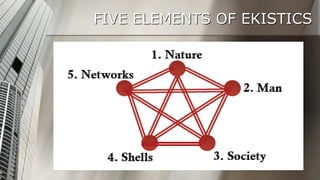
FIVE ELEMENTS OF EKISTICS

4
BASIC PARTS OF COMPOSITE
HUMAN SETTLEMENTS


Homogeneous parts- fields;



Central parts- built-up villages;



Circulatory parts- roads & paths within the
fields; and



Special parts- i.e., a monastery contained
5
within the homogeneous part.
CLASSIFICATION OF HUMAN
SETTLEMENTS







Based on sizes- size of five elements &
their combinations
Hamlet to Metropolitan cities
Small & sparsely spaced (rural settlements
or villages specializing in agriculture & other
primary activities)
Large & closely spaced (urban settlements
specializing
in
secondary
&
tertiary
activities)
6
CLASSIFICATION OF HUMAN
SETTLEMENTS
Based on Location of Settlements- plains,
mountains, coastal, etc.
 Based
on
Relationships
between
Settlements within Space (hierarchical or
non-hierarchical)
 Based on Physical Forms- form as the
expression of content, function, & structure
 Based on Five Elements of Human
Settlements


7
CLASSIFICATION OF HUMAN
SETTLEMENTS


Based on Functions- which are important
to an understanding of the meaning & role
of settlements:



Reveal nature, specialisation, & raison
d’etre of settlements
Based on activity (economic, social), their
performance,
or
special
role
(as
dormitories, retirement villages, etc.)



8
CLASSIFICATION OF HUMAN
SETTLEMENTS

Based on Time Dimension- age of
settlements, their place in continuum (past,
present, future), their relative static or
dynamic character, the whole process of
their growth
 Based on degree of society’s conscious
involvement in settlements creationnatural & planned settlements
 Based on institutions, legislations &
administration- which society has created
9
for settlements

CLASSIFICATION OF HUMAN
SETTLEMENTS
By
 By
 By
 By
 By


Ekistics Units
Ekistics Elements
Ekistics Functions
Evolutionary Phases
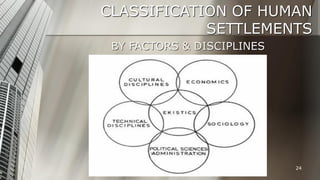
Factors & Disciplines

10
CLASSIFICATION OF HUMAN
SETTLEMENTS
BY EKISTICS UNITS: FOUR BASIC GROUPS
Minor shells or elementary units- man
(anthropos), room, house;
 Micro-settlements- units smaller than, or
as small as, the traditional town where
people used , do & still do achieve
interconnection by walking (housegroup,
small neighbourhood);


11
CLASSIFICATION OF HUMAN
SETTLEMENTS
BY EKISTICS UNITS: FOUR BASIC GROUPS
Meso-settlements- between traditional
town & conurbation within which one can
commute daily (small polis, polis, small
metropolis, small megalopolis, small
eperopolis, eperopolis); and
 Macro-settlementswhose
largest
possible expression is the Ecumenopolis.


12
CLASSIFICATION OF HUMAN
SETTLEMENTS
BY EKISTICS UNITS
Physical & Social Units
 Man (as individual)- smallest unit
 Space- second unit either personally owned
or shared with others
 Family Home- third unit
Social Unit
 Group of Homes
13
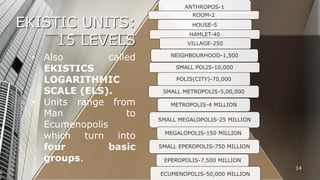
ANTHROPOS-1

EKISTIC UNITS:
15 LEVELS
• Also
called
EKISTICS
LOGARITHMIC
SCALE (ELS).
• Units range from
Man
to
Ecumenopolis
which turn into
four
basic
groups.

ROOM-2
HOUSE-5
HAMLET-40
VILLAGE-250

NEIGHBOURHOOD-1,500
SMALL POLIS-10,000
POLIS(CITY)-75,000
SMALL METROPOLIS-5,00,000
METROPOLIS-4 MILLION
SMALL MEGALOPOLIS-25 MILLION

MEGALOPOLIS-150 MILLION
SMALL EPEROPOLIS-750 MILLION
EPEROPOLIS-7,500 MILLION
ECUMENOPOLIS-50,000 MILLION

14
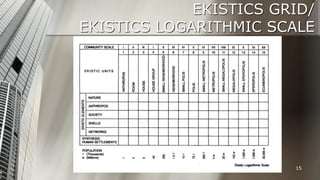
EKISTICS GRID/
EKISTICS LOGARITHMIC SCALE

15
EKISTICS UNITS

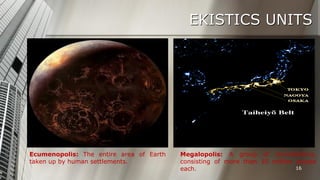
Ecumenopolis: The entire area of Earth
taken up by human settlements.

Megalopolis: A group of conurbations,
consisting of more than 10 million people
16
each.
EKISTICS UNITS

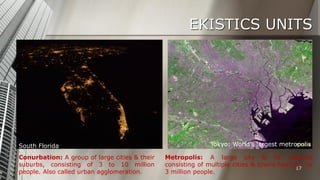
South Florida
Conurbation: A group of large cities & their
suburbs, consisting of 3 to 10 million
people. Also called urban agglomeration.

Tokyo: World’s largest metropolis
Metropolis: A large city & its suburbs
consisting of multiple cities & towns having 1 to
17
3 million people.
EKISTICS UNITS
Large City: A city with large population &
many services having less than 1 million but
over 3 lakhs people.
 City: A city with abundant but not with as
many services as in a large city, having over
1 lakh upto 3 lakhs people.
 Large Town: Population of 20,000 to 1
lakh.
 Town: Population of 1,000 to 20,000.


18
EKISTICS UNITS
Village: Generally does not have many
services, possibly having only a small
corner shop or post office. Population of 100
to 1,000.
 Hamlet: A tiny population (<100) & very
few (if any) services, & few buildings.
 Isolated dwellings: 1 or 2 buildings or
families with negligible services, if any.


19
CLASSIFICATION OF HUMAN
SETTLEMENTS
BY EKISTICS ELEMENTS
 Nature: Represents ecosystems including
water cycle, biosystems, climatic zones, etc.


Anthropos:
Constantly
adapting
&
changing certain physical & psychological
diseases
directly
associated
with
urbanisation.
These
include
obesity,
respiratory elements & alienation.
20
CLASSIFICATION OF HUMAN
SETTLEMENTS
BY EKISTICS ELEMENTS
 Society: Realm of society comprises all
those aspects of the urban or rural scene
that
are
commonly
dealt
with
by
sociologists, economists & administrators:
population trends, social customs, income &
occupations, & the system of urban
government.
21
CLASSIFICATION OF HUMAN
SETTLEMENTS
BY EKISTICS ELEMENTS
 Shells:
The built environment is the
traditional domain of architectural &
engineering professions.
 Networks: Provide glue for all systems of
urbanisation. Changes profoundly affect
urban scale like advent of the rail-road, or
of piped water supplies, or of the telephone
which affect the extent, texture & densities
22
of human settlements.
CLASSIFICATION OF HUMAN
SETTLEMENTS
BY EVOLUTIONARY PHASES
 Macro scale- nomadic, agricultural, urban,
urban-industrial;


Micro scale- specific area at a limited
period of time.

23
CLASSIFICATION OF HUMAN
SETTLEMENTS
BY FACTORS & DISCIPLINES

24
THE UNIVERSITY OF THE PUNJAB









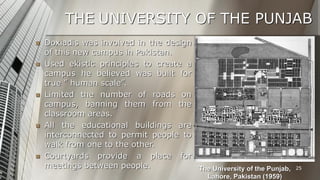
Doxiadis was involved in the design
of this new campus in Pakistan.
Used ekistic principles to create a
campus he believed was built for
true ” human scale”.
Limited the number of roads on
campus, banning them from the
classroom areas.
All the educational buildings are
interconnected to permit people to
walk from one to the other.
Courtyards provide a place for
meetings between people.
The University of the Punjab,
Lahore, Pakistan (1959)

25
DOXIADIS’ BAGHDAD





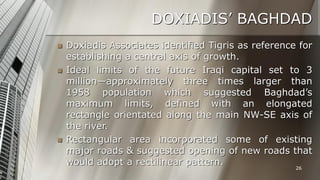
Doxiadis Associates identified Tigris as reference for
establishing a central axis of growth.
Ideal limits of the future Iraqi capital set to 3
million—approximately three times larger than
1958 population which suggested Baghdad’s
maximum limits, defined with an elongated
rectangle orientated along the main NW-SE axis of
the river.
Rectangular area incorporated some of existing
major roads & suggested opening of new roads that
would adopt a rectilinear pattern.
26
DOXIADIS’ BAGHDAD






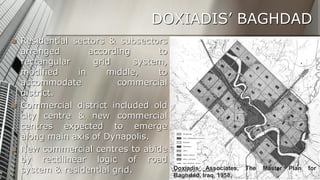
Residential sectors & subsectors
arranged
according
to
rectangular
grid
system,
modified
in
middle,
to
accommodate
commercial
district.
Commercial district included old
city centre & new commercial
centres expected to emerge
along main axis of Dynapolis.
New commercial centres to abide
by rectilinear logic of road
system & residential grid.

Doxiadis Associates,
Baghdad, Iraq, 1958.

The

Master

27
Plan

for
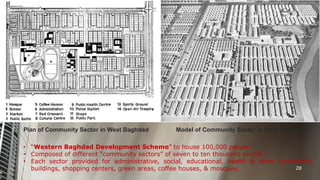
Plan of Community Sector in West Baghdad

Model of Community Sector in West Baghdad

• “Western Baghdad Development Scheme” to house 100,000 people.
• Composed of different “community sectors” of seven to ten thousand people.
• Each sector provided for administrative, social, educational, health & other community
28
buildings, shopping centers, green areas, coffee houses, & mosques.
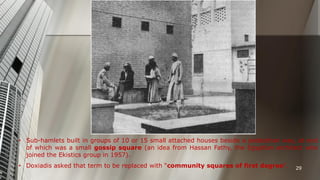
• Sub-hamlets built in groups of 10 or 15 small attached houses beside a pedestrian way, at end
of which was a small gossip square (an idea from Hassan Fathy, the Egyptian architect who
joined the Ekistics group in 1957).
• Doxiadis asked that term to be replaced with “community squares of first degree”.

29
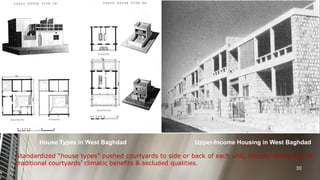
House Types in West Baghdad

Upper-Income Housing in West Baghdad

Standardized “house types” pushed courtyards to side or back of each unit, thereby losing any of
traditional courtyards’ climatic benefits & secluded qualities.
30
ISLAMABAD




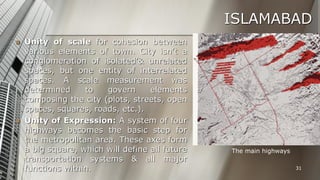
Unity of scale for cohesion between
various elements of town. City isn’t a
conglomeration of isolated’& unrelated
spaces, but one entity of interrelated
spaces. A scale measurement was
determined
to
govern
elements
composing the city (plots, streets, open
spaces, squares, roads, etc.).
Unity of Expression: A system of four
highways becomes the basic step for
the metropolitan area. These axes form
a big square, which will define all future
transportation systems & all major
functions within.

The main highways
31
ISLAMABAD






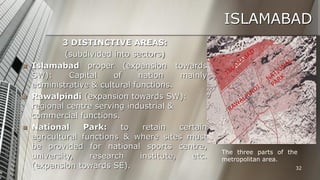
3 DISTINCTIVE AREAS:
(subdivided into sectors)
Islamabad proper (expansion towards
SW):
Capital
of
nation
mainly
administrative & cultural functions.
Rawalpindi (expansion towards SW):
regional centre serving industrial &
commercial functions.
National
Park:
to
retain
certain
agricultural functions & where sites must
be provided for national sports centre,
university,
research
institute,
etc.
(expansion towards SE).

The three parts of the
metropolitan area.
32
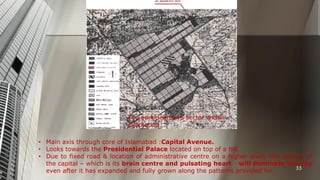
The administrative sector within
Islamabad.
• Main axis through core of Islamabad :Capital Avenue.
• Looks towards the Presidential Palace located on top of a hill.
• Due to fixed road & location of administrative centre on a higher level, this section of
the capital – which is its brain centre and pulsating heart - will dominate the city
33
even after it has expanded and fully grown along the patterns provided for.
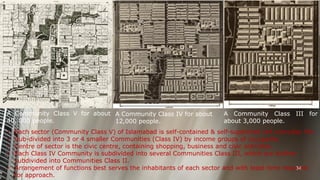
A Community Class V for about A Community Class IV for about
40, 000 people.
12,000 people.

A Community Class III for
about 3,000 people.

Each sector (Community Class V) of Islamabad is self-contained & self-supported wrt everyday life.
Sub-divided into 3 or 4 smaller Communities (Class IV) by income groups of occupants.
Centre of sector is the civic centre, containing shopping, business and civic activities.
Each Class IV Community is subdivided into several Communities Class III, which are further
subdivided into Communities Class II.
34
• Arrangement of functions best serves the inhabitants of each sector and with least time required
for approach.
•
•
•
•
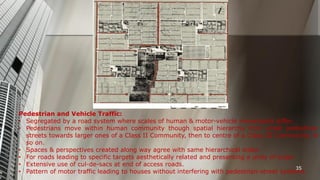
Pedestrian and Vehicle Traffic:
• Segregated by a road system where scales of human & motor-vehicle movements differ.
• Pedestrians move within human community though spatial hierarchy from small pedestrian
streets towards larger ones of a Class II Community, then to centre of a Class III Community, &
so on.
• Spaces & perspectives created along way agree with same hierarchical order.
• For roads leading to specific targets aesthetically related and presenting a unity of scale.
• Extensive use of cul-de-sacs at end of access roads.
35
• Pattern of motor traffic leading to houses without interfering with pedestrian-street systems.
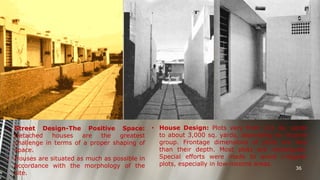
• Street Design-The Positive Space:
Detached
houses
are
the
greatest
challenge in terms of a proper shaping of
space.
• Houses are situated as much as possible in
accordance with the morphology of the
site.

• House Design: Plots vary from 111 sq. yards
to about 3,000 sq. yards, depending on income
group. Frontage dimensions of plots are less
than their depth. Most plots are rectangular.
Special efforts were made to avoid irregular
plots, especially in low-income areas.
36
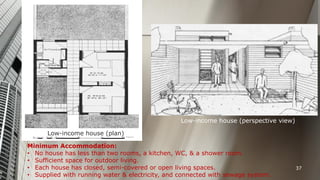
Low-income house (perspective view)

Low-income house (plan)
Minimum Accommodation:
• No house has less than two rooms, a kitchen, WC, & a shower room.
• Sufficient space for outdoor living.
• Each house has closed, semi-covered or open living spaces.
• Supplied with running water & electricity, and connected with sewage system.

37
NEED TO BALANCE ELEMENTS
OF HUMAN SETTLEMENTS
We are dealing by necessity with:
 Nature, which is being spoilt;
 Man, who is continuously changing;
 Society, which is changing because of man’s
new needs;
 Shells, which must be constructed;
 Networks, which are also changing to cope
up with new demands.
38
EVOLUTION OF HUMAN
SETTLEMENTS
Phase 1: Primitive non-organised human
settlements (started with evolution of man)
 Phase 2: Primitive organised settlementsEopolis (period of villages lasted 10,000 years)
 Phase 3: Static urban settlements or citiesPolis (lasted about 5,000 to 6,000 years)
 Phase
4:
Dynamic
urban
settlementsDynapolis (lasted 200 to 400 years)
 Phase 5: Universal City- Ecumenopolis (which
39
is now beginning)

CONCLUSION
Study of human settlements should be
comprehensive and have an interdisciplinary
scope related to five ekistics elements.
 Any study of settlements shall refer to ekistics
units of scale from man to Ecumenopolis, the
fifteen levels in ekistics logarithmic scale.
 Time dimension must be integrated in analysis
and design of human settlements from past to
present to distant future.


40
CONCLUSION


The scientific method shall be used in a
systematic treatment of human settlements,
following the models, concepts, principles,
values & postulations of ekistics.



City must be treated as a dynamic settlement
for which the concept of Dynapolis allows for
growth & change.
41
REFERENCES













Classnotes
Time Saver Standards for Urban Design by Watson, Plattus,
Shibley
Metropolitan Problems by S. Miles
Information & Communication Technologies, Society & Human
Beings: Theory & Framework by Haftor & Mirijamdotter.
Basic ekistic principles_word: pdf
Ekistics_the_science_of_human_settlements:pdf
W.A. Howard, Ekistics
Journal of Planning History by Panayiota Pyla
http://en.wikipedia.org/wiki/Ekistics
http://www.csiss.org/classics/content/36
42

Ekistics taiyaba

  • 1.
    EKISTICS -TAIYABA RASHID F/O ARCHITECTURE& EKISTICS JAMIA MILLIA ISLAMIA 1
  • 2.
    EKISTICS  The term Ekisticswas coined by Greek architect & urban planner Konstantinos Apostolos Doxiadis in 1942.  Applies to the settlements.  Includes regional, city, community planning and dwelling design. science of human 2
  • 3.
    BASIC PRINCIPLES OFEKISTICS Human happiness  Unity of Purpose  Hierarchy of Functions  Four dimensions  Many scales for many masters  3
  • 4.
    FIVE ELEMENTS OFEKISTICS 4
  • 5.
    BASIC PARTS OFCOMPOSITE HUMAN SETTLEMENTS  Homogeneous parts- fields;  Central parts- built-up villages;  Circulatory parts- roads & paths within the fields; and  Special parts- i.e., a monastery contained 5 within the homogeneous part.
  • 6.
    CLASSIFICATION OF HUMAN SETTLEMENTS     Basedon sizes- size of five elements & their combinations Hamlet to Metropolitan cities Small & sparsely spaced (rural settlements or villages specializing in agriculture & other primary activities) Large & closely spaced (urban settlements specializing in secondary & tertiary activities) 6
  • 7.
    CLASSIFICATION OF HUMAN SETTLEMENTS Basedon Location of Settlements- plains, mountains, coastal, etc.  Based on Relationships between Settlements within Space (hierarchical or non-hierarchical)  Based on Physical Forms- form as the expression of content, function, & structure  Based on Five Elements of Human Settlements  7
  • 8.
    CLASSIFICATION OF HUMAN SETTLEMENTS  Basedon Functions- which are important to an understanding of the meaning & role of settlements:  Reveal nature, specialisation, & raison d’etre of settlements Based on activity (economic, social), their performance, or special role (as dormitories, retirement villages, etc.)  8
  • 9.
    CLASSIFICATION OF HUMAN SETTLEMENTS Basedon Time Dimension- age of settlements, their place in continuum (past, present, future), their relative static or dynamic character, the whole process of their growth  Based on degree of society’s conscious involvement in settlements creationnatural & planned settlements  Based on institutions, legislations & administration- which society has created 9 for settlements 
  • 10.
    CLASSIFICATION OF HUMAN SETTLEMENTS By By  By  By  By  Ekistics Units Ekistics Elements Ekistics Functions Evolutionary Phases Factors & Disciplines 10
  • 11.
    CLASSIFICATION OF HUMAN SETTLEMENTS BYEKISTICS UNITS: FOUR BASIC GROUPS Minor shells or elementary units- man (anthropos), room, house;  Micro-settlements- units smaller than, or as small as, the traditional town where people used , do & still do achieve interconnection by walking (housegroup, small neighbourhood);  11
  • 12.
    CLASSIFICATION OF HUMAN SETTLEMENTS BYEKISTICS UNITS: FOUR BASIC GROUPS Meso-settlements- between traditional town & conurbation within which one can commute daily (small polis, polis, small metropolis, small megalopolis, small eperopolis, eperopolis); and  Macro-settlementswhose largest possible expression is the Ecumenopolis.  12
  • 13.
    CLASSIFICATION OF HUMAN SETTLEMENTS BYEKISTICS UNITS Physical & Social Units  Man (as individual)- smallest unit  Space- second unit either personally owned or shared with others  Family Home- third unit Social Unit  Group of Homes 13
  • 14.
    ANTHROPOS-1 EKISTIC UNITS: 15 LEVELS •Also called EKISTICS LOGARITHMIC SCALE (ELS). • Units range from Man to Ecumenopolis which turn into four basic groups. ROOM-2 HOUSE-5 HAMLET-40 VILLAGE-250 NEIGHBOURHOOD-1,500 SMALL POLIS-10,000 POLIS(CITY)-75,000 SMALL METROPOLIS-5,00,000 METROPOLIS-4 MILLION SMALL MEGALOPOLIS-25 MILLION MEGALOPOLIS-150 MILLION SMALL EPEROPOLIS-750 MILLION EPEROPOLIS-7,500 MILLION ECUMENOPOLIS-50,000 MILLION 14
  • 15.
  • 16.
    EKISTICS UNITS Ecumenopolis: Theentire area of Earth taken up by human settlements. Megalopolis: A group of conurbations, consisting of more than 10 million people 16 each.
  • 17.
    EKISTICS UNITS South Florida Conurbation:A group of large cities & their suburbs, consisting of 3 to 10 million people. Also called urban agglomeration. Tokyo: World’s largest metropolis Metropolis: A large city & its suburbs consisting of multiple cities & towns having 1 to 17 3 million people.
  • 18.
    EKISTICS UNITS Large City:A city with large population & many services having less than 1 million but over 3 lakhs people.  City: A city with abundant but not with as many services as in a large city, having over 1 lakh upto 3 lakhs people.  Large Town: Population of 20,000 to 1 lakh.  Town: Population of 1,000 to 20,000.  18
  • 19.
    EKISTICS UNITS Village: Generallydoes not have many services, possibly having only a small corner shop or post office. Population of 100 to 1,000.  Hamlet: A tiny population (<100) & very few (if any) services, & few buildings.  Isolated dwellings: 1 or 2 buildings or families with negligible services, if any.  19
  • 20.
    CLASSIFICATION OF HUMAN SETTLEMENTS BYEKISTICS ELEMENTS  Nature: Represents ecosystems including water cycle, biosystems, climatic zones, etc.  Anthropos: Constantly adapting & changing certain physical & psychological diseases directly associated with urbanisation. These include obesity, respiratory elements & alienation. 20
  • 21.
    CLASSIFICATION OF HUMAN SETTLEMENTS BYEKISTICS ELEMENTS  Society: Realm of society comprises all those aspects of the urban or rural scene that are commonly dealt with by sociologists, economists & administrators: population trends, social customs, income & occupations, & the system of urban government. 21
  • 22.
    CLASSIFICATION OF HUMAN SETTLEMENTS BYEKISTICS ELEMENTS  Shells: The built environment is the traditional domain of architectural & engineering professions.  Networks: Provide glue for all systems of urbanisation. Changes profoundly affect urban scale like advent of the rail-road, or of piped water supplies, or of the telephone which affect the extent, texture & densities 22 of human settlements.
  • 23.
    CLASSIFICATION OF HUMAN SETTLEMENTS BYEVOLUTIONARY PHASES  Macro scale- nomadic, agricultural, urban, urban-industrial;  Micro scale- specific area at a limited period of time. 23
  • 24.
  • 25.
    THE UNIVERSITY OFTHE PUNJAB      Doxiadis was involved in the design of this new campus in Pakistan. Used ekistic principles to create a campus he believed was built for true ” human scale”. Limited the number of roads on campus, banning them from the classroom areas. All the educational buildings are interconnected to permit people to walk from one to the other. Courtyards provide a place for meetings between people. The University of the Punjab, Lahore, Pakistan (1959) 25
  • 26.
    DOXIADIS’ BAGHDAD    Doxiadis Associatesidentified Tigris as reference for establishing a central axis of growth. Ideal limits of the future Iraqi capital set to 3 million—approximately three times larger than 1958 population which suggested Baghdad’s maximum limits, defined with an elongated rectangle orientated along the main NW-SE axis of the river. Rectangular area incorporated some of existing major roads & suggested opening of new roads that would adopt a rectilinear pattern. 26
  • 27.
    DOXIADIS’ BAGHDAD    Residential sectors& subsectors arranged according to rectangular grid system, modified in middle, to accommodate commercial district. Commercial district included old city centre & new commercial centres expected to emerge along main axis of Dynapolis. New commercial centres to abide by rectilinear logic of road system & residential grid. Doxiadis Associates, Baghdad, Iraq, 1958. The Master 27 Plan for
  • 28.
    Plan of CommunitySector in West Baghdad Model of Community Sector in West Baghdad • “Western Baghdad Development Scheme” to house 100,000 people. • Composed of different “community sectors” of seven to ten thousand people. • Each sector provided for administrative, social, educational, health & other community 28 buildings, shopping centers, green areas, coffee houses, & mosques.
  • 29.
    • Sub-hamlets builtin groups of 10 or 15 small attached houses beside a pedestrian way, at end of which was a small gossip square (an idea from Hassan Fathy, the Egyptian architect who joined the Ekistics group in 1957). • Doxiadis asked that term to be replaced with “community squares of first degree”. 29
  • 30.
    House Types inWest Baghdad Upper-Income Housing in West Baghdad Standardized “house types” pushed courtyards to side or back of each unit, thereby losing any of traditional courtyards’ climatic benefits & secluded qualities. 30
  • 31.
    ISLAMABAD   Unity of scalefor cohesion between various elements of town. City isn’t a conglomeration of isolated’& unrelated spaces, but one entity of interrelated spaces. A scale measurement was determined to govern elements composing the city (plots, streets, open spaces, squares, roads, etc.). Unity of Expression: A system of four highways becomes the basic step for the metropolitan area. These axes form a big square, which will define all future transportation systems & all major functions within. The main highways 31
  • 32.
    ISLAMABAD    3 DISTINCTIVE AREAS: (subdividedinto sectors) Islamabad proper (expansion towards SW): Capital of nation mainly administrative & cultural functions. Rawalpindi (expansion towards SW): regional centre serving industrial & commercial functions. National Park: to retain certain agricultural functions & where sites must be provided for national sports centre, university, research institute, etc. (expansion towards SE). The three parts of the metropolitan area. 32
  • 33.
    The administrative sectorwithin Islamabad. • Main axis through core of Islamabad :Capital Avenue. • Looks towards the Presidential Palace located on top of a hill. • Due to fixed road & location of administrative centre on a higher level, this section of the capital – which is its brain centre and pulsating heart - will dominate the city 33 even after it has expanded and fully grown along the patterns provided for.
  • 34.
    A Community ClassV for about A Community Class IV for about 40, 000 people. 12,000 people. A Community Class III for about 3,000 people. Each sector (Community Class V) of Islamabad is self-contained & self-supported wrt everyday life. Sub-divided into 3 or 4 smaller Communities (Class IV) by income groups of occupants. Centre of sector is the civic centre, containing shopping, business and civic activities. Each Class IV Community is subdivided into several Communities Class III, which are further subdivided into Communities Class II. 34 • Arrangement of functions best serves the inhabitants of each sector and with least time required for approach. • • • •
  • 35.
    Pedestrian and VehicleTraffic: • Segregated by a road system where scales of human & motor-vehicle movements differ. • Pedestrians move within human community though spatial hierarchy from small pedestrian streets towards larger ones of a Class II Community, then to centre of a Class III Community, & so on. • Spaces & perspectives created along way agree with same hierarchical order. • For roads leading to specific targets aesthetically related and presenting a unity of scale. • Extensive use of cul-de-sacs at end of access roads. 35 • Pattern of motor traffic leading to houses without interfering with pedestrian-street systems.
  • 36.
    • Street Design-ThePositive Space: Detached houses are the greatest challenge in terms of a proper shaping of space. • Houses are situated as much as possible in accordance with the morphology of the site. • House Design: Plots vary from 111 sq. yards to about 3,000 sq. yards, depending on income group. Frontage dimensions of plots are less than their depth. Most plots are rectangular. Special efforts were made to avoid irregular plots, especially in low-income areas. 36
  • 37.
    Low-income house (perspectiveview) Low-income house (plan) Minimum Accommodation: • No house has less than two rooms, a kitchen, WC, & a shower room. • Sufficient space for outdoor living. • Each house has closed, semi-covered or open living spaces. • Supplied with running water & electricity, and connected with sewage system. 37
  • 38.
    NEED TO BALANCEELEMENTS OF HUMAN SETTLEMENTS We are dealing by necessity with:  Nature, which is being spoilt;  Man, who is continuously changing;  Society, which is changing because of man’s new needs;  Shells, which must be constructed;  Networks, which are also changing to cope up with new demands. 38
  • 39.
    EVOLUTION OF HUMAN SETTLEMENTS Phase1: Primitive non-organised human settlements (started with evolution of man)  Phase 2: Primitive organised settlementsEopolis (period of villages lasted 10,000 years)  Phase 3: Static urban settlements or citiesPolis (lasted about 5,000 to 6,000 years)  Phase 4: Dynamic urban settlementsDynapolis (lasted 200 to 400 years)  Phase 5: Universal City- Ecumenopolis (which 39 is now beginning) 
  • 40.
    CONCLUSION Study of humansettlements should be comprehensive and have an interdisciplinary scope related to five ekistics elements.  Any study of settlements shall refer to ekistics units of scale from man to Ecumenopolis, the fifteen levels in ekistics logarithmic scale.  Time dimension must be integrated in analysis and design of human settlements from past to present to distant future.  40
  • 41.
    CONCLUSION  The scientific methodshall be used in a systematic treatment of human settlements, following the models, concepts, principles, values & postulations of ekistics.  City must be treated as a dynamic settlement for which the concept of Dynapolis allows for growth & change. 41
  • 42.
    REFERENCES           Classnotes Time Saver Standardsfor Urban Design by Watson, Plattus, Shibley Metropolitan Problems by S. Miles Information & Communication Technologies, Society & Human Beings: Theory & Framework by Haftor & Mirijamdotter. Basic ekistic principles_word: pdf Ekistics_the_science_of_human_settlements:pdf W.A. Howard, Ekistics Journal of Planning History by Panayiota Pyla http://en.wikipedia.org/wiki/Ekistics http://www.csiss.org/classics/content/36 42