RADIANT CITY
CONCEPT OF LE
CORBUSIER
SUBMITTED BY:
ANANYA SHARMA 16606
KRITI CHAUHAN 16620
LE CORBUSIER
• Charles-Edouard Jeanneret-gris aka Le Corbusier
was born in the small city of La Chaux-de-Fonds
(October 6, 1887- August 27, 1965)
• Regarded as important architect of the 20th
century.
• He was an architect, designer, urbanist, writer,
and one of the pioneers of what is now called
modern architecture.
• In 1914-15 he developed his first major
theoretical work, the Dom-Ino house: a
reinforced concrete frame which he posited as a
mass production system for free-plan housing.
• Returned to Paris where he began an architecture
• During his career, Le Corbusier developed a set of
architectural principles that dictated his
technique, called “THE FIVE PIONTS OF NEW
ARCHITECTURE” which were most evident in his Villa
Savoye . These were
• PILOTIS- The replacement of supporting walls by a
grid of reinforced concrete columns that bears the
load of structure is the basis of the new aesthetic.
• ROOF GARDEN- The flat roof can be utilized for a
domestic purpose while also providing essential
protection to the concrete roof.
• THE FREE DESIGN OF THE GROUND PLAN- the absence of
supporting walls means that the house is
unrestrained in its internal usage.
• THE FREE DESIGN OF FAÇADE- By separating the
exterior of the building from its structural
function the façade become free
• THE MODULAR:
• Use of golden ratio for the scale of
architecture proportion.
• Use of human measurements.
• Placed system of harmony.
INFLUENCE
• He was most influential in the sphere of urban
planning.
• City of the future- large apartments building
isolated in the park like setting on pilotis.
• He was heavily influenced by problem he saw in
industrial cities at the turn of 19th to 20th
century.
The Evolution of Urban Planning
1. The Garden City Concept by Ebenezer Howard (1903)
• Howard wanted to design an alternative to the
overcrowded and polluted industrial cities of the turn
of the century and his solution centred on creating
smaller “garden cities” in the country
• He captioned the design as “a group of smokeless, Slum
less cities”
2. The Radiant City Concept by Le Corbusier (1924)
• Le Corbusier was trying to find a fix for the same
problem of urban pollution and overcrowding but unlike
Howard he envisioned building not out
• His plan , also know as “Towers in the Park” proposed
exactly that numerous high rise building each
surrounded by green space. Each building was set on
“superblocks”
THE RADIANT CITY
• The Radiant City (Ville Radieuse) is an un realized urban
masterplan, presented in 1924 and published in a book of
same name1933
• Designed to contain effective means of transportation, as
well as an abundance of green space and sunlight.
• Le Corbusier’s city of the future would not only provide
residents with a better lifestyle, but would contribute to
create a better society
• Though radical, strict in order, symmetry and
standardization, Le Corbusier’s proposed principles had an
extensive influence on modern urban planning and led to the
development of new high density housing typologies.
• The Radiant City was to be built on nothing less than the
grounds of demolished vernacular European cities.
• The new city would contain prefabricated and identical
CONCEPT OF RADIANT CITY
CONCEPTUAL SKETCHES
• The radiant city was a linear
city based upon the abstract
shape of the human body with
head, spine, arms and legs.
• The design maintained the idea
of high- rise housing blocks,
free circulation and abundant
green space proposed in his
earlier work.
• The blocks of housing were
laid out in long lines
stepping in and out and were
raised up on pilotis. They had
roof terraces and running
PLANNING
• At the core of Le
Corbusier’s plan stood
the notion of zoning; a
strict division of the
city into segregated
commercial, business,
entertainment an
residential area
• The business district
was located in the
centre and contained
monolithic mega
skyscrapers each
reaching a height of 200
• At the centre of the planned city was a transportation
hub which housed depots for buses and train as well as
highway intersections and at the top an airport
• Location in the centre of the civic district was the
main transportation deck from which a vast underground
system of trains would transport citizens to and from
the surrounding housing districts
• The centre piece of this
plan was a group of sixty
story cruciform skyscrapers
built on steel frames and
encased in curtain wall of
glass. The skyscrapers
housed both offices and the
flats of the most wealthy
inhabitants. These
skyscrapers were set within
large rectangular park
like green space.
• Le Corbusier segregated the pedestrian circulation
paths from the roadways, and glorified the use of the
automobile as a means of transport. As one moved out
from the central skyscrapers, smaller multi story zig
zag blocks set in green space and set far back the
street housed the proletarian workers
HOUSING TOWERS
The housing districts would
contain pre-fabricated
apartment building known as
“unites”
Reaching a height of fifty
meters a single Unite could
accommodate 2,700 inhabitants
and function as a vertical
village: catering and laundry
facilities would be on the
ground floor a kinder garden
and a pool on the roof.
Parks would exist between the
Unites allowing residents
with a maximum of natural
• Inside Les Unites were the vertical streets i.e.
the elevators and the pedestrian interior streets
that connected one building to another
• Automobile traffic was to circulate on piotis
supported roadways five meters above the earth.
• Other transportation
modes like subways and
truck had their own
roadways separate from
automobile
• Corbusier bitterly
reproaches advocated of
the horizontal garden
city for the time
wasted commuting to the
city
• He called it the
• Issues of healthy living, traffic, noise, public space
and transportation which Le Corbusier unlike any
architect before him addressed holistically continue
to be a major concern of city planners today.
• The source of inspiration for designing of the new
“vertical city” by todays architects and planners is
RADIANT CITY, CHANDIGARH
• In 1950invited by Indian Minister Jawaharlal
Nehru to design the city.
• The work started in 1951 until death in 1965.
DESIGN
• Grid Iron Plan
• Hierarchy of movement from highways to
pedestrian walkways.
• Metaphor of a human being.
1. Head – Capital Complex
2. Heart- Commercial Centre.
3. Arms- Academic and leisure facilities.
• Incorporated his principles of light, space and
greenery.
BASIC PLANNING CONCEPTS
Le Corbusier conceived the
master plan of Chandigarh as
analogous to human body, with a
clearly defined.
• HEAD- The Capitol Complex,
Sector 1
• HEART- The City Centre, Sector
17
• LUNGS- The leisure valley,
open space or green sectors
• INTELLECT- The culture and
education
institute
• CIRCULATORY SYSTEM- the
network of roads (the 7Vs)
• VISCERA- The industrial areas
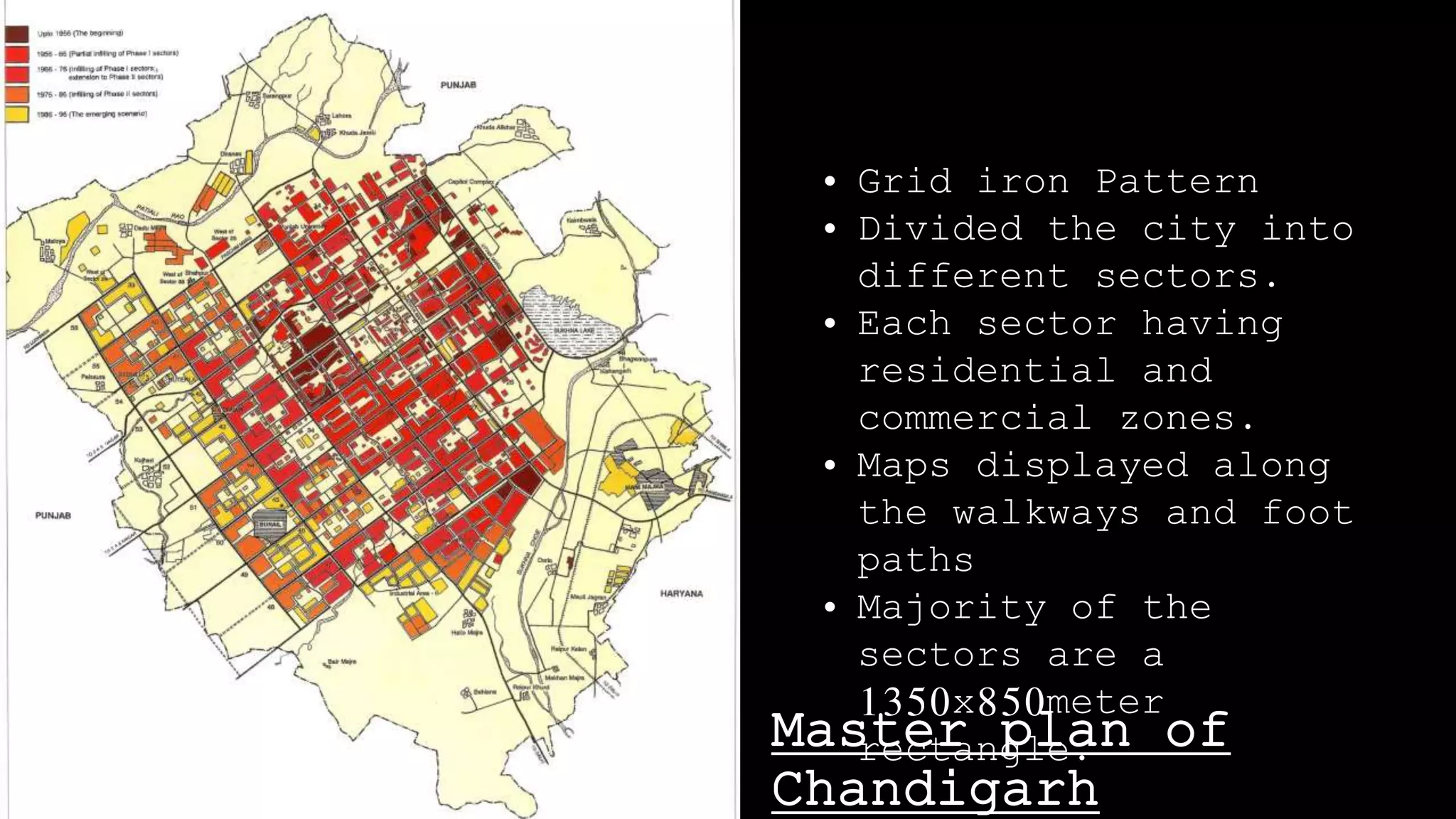
Master plan of
Chandigarh
• Grid iron Pattern
• Divided the city into
different sectors.
• Each sector having
residential and
commercial zones.
• Maps displayed along
the walkways and foot
paths
• Majority of the
sectors are a
1350x850meter
rectangle.
Roads
1. Design and oriented in
such a way that most of
the time during the day,
they are under shadow.
2. Huge parking areas for
the commercial zones.
3. Pedestrian walkways
segregated from the main
road with the help of
wide lawn strip.
4. Huge garden along the
main roads.V1 – Connects Chandigarh to other cities
V2 – Are the major avenues of the city
V3 – Are the corridors stressts for vehicular traffic only
V4-V7 – are the roads whitnin the sectors
POSITIVE HIGHLIGHTS
• Each sector satisfies the
necessities of human needs.
• Separate roads for
pedestrian, bicycle and heavy
vehicles
• Shops on ground floor,
residence on upper floor
• Shop protected from rain and
sun as a covered walkway for
the customers
NEGATIVE HIGHLIGHTS
• Roads being similar to each
other creates confusion.
• Brutal concrete gives a rough
look
• City not planned for lower
THANK

Radiant city concept of le corbusier

  • 1.
    RADIANT CITY CONCEPT OFLE CORBUSIER SUBMITTED BY: ANANYA SHARMA 16606 KRITI CHAUHAN 16620
  • 2.
    LE CORBUSIER • Charles-EdouardJeanneret-gris aka Le Corbusier was born in the small city of La Chaux-de-Fonds (October 6, 1887- August 27, 1965) • Regarded as important architect of the 20th century. • He was an architect, designer, urbanist, writer, and one of the pioneers of what is now called modern architecture. • In 1914-15 he developed his first major theoretical work, the Dom-Ino house: a reinforced concrete frame which he posited as a mass production system for free-plan housing. • Returned to Paris where he began an architecture
  • 3.
    • During hiscareer, Le Corbusier developed a set of architectural principles that dictated his technique, called “THE FIVE PIONTS OF NEW ARCHITECTURE” which were most evident in his Villa Savoye . These were • PILOTIS- The replacement of supporting walls by a grid of reinforced concrete columns that bears the load of structure is the basis of the new aesthetic. • ROOF GARDEN- The flat roof can be utilized for a domestic purpose while also providing essential protection to the concrete roof. • THE FREE DESIGN OF THE GROUND PLAN- the absence of supporting walls means that the house is unrestrained in its internal usage. • THE FREE DESIGN OF FAÇADE- By separating the exterior of the building from its structural function the façade become free
  • 4.
    • THE MODULAR: •Use of golden ratio for the scale of architecture proportion. • Use of human measurements. • Placed system of harmony. INFLUENCE • He was most influential in the sphere of urban planning. • City of the future- large apartments building isolated in the park like setting on pilotis. • He was heavily influenced by problem he saw in industrial cities at the turn of 19th to 20th century.
  • 5.
    The Evolution ofUrban Planning 1. The Garden City Concept by Ebenezer Howard (1903) • Howard wanted to design an alternative to the overcrowded and polluted industrial cities of the turn of the century and his solution centred on creating smaller “garden cities” in the country • He captioned the design as “a group of smokeless, Slum less cities” 2. The Radiant City Concept by Le Corbusier (1924) • Le Corbusier was trying to find a fix for the same problem of urban pollution and overcrowding but unlike Howard he envisioned building not out • His plan , also know as “Towers in the Park” proposed exactly that numerous high rise building each surrounded by green space. Each building was set on “superblocks”
  • 6.
    THE RADIANT CITY •The Radiant City (Ville Radieuse) is an un realized urban masterplan, presented in 1924 and published in a book of same name1933 • Designed to contain effective means of transportation, as well as an abundance of green space and sunlight. • Le Corbusier’s city of the future would not only provide residents with a better lifestyle, but would contribute to create a better society • Though radical, strict in order, symmetry and standardization, Le Corbusier’s proposed principles had an extensive influence on modern urban planning and led to the development of new high density housing typologies. • The Radiant City was to be built on nothing less than the grounds of demolished vernacular European cities. • The new city would contain prefabricated and identical
  • 7.
    CONCEPT OF RADIANTCITY CONCEPTUAL SKETCHES • The radiant city was a linear city based upon the abstract shape of the human body with head, spine, arms and legs. • The design maintained the idea of high- rise housing blocks, free circulation and abundant green space proposed in his earlier work. • The blocks of housing were laid out in long lines stepping in and out and were raised up on pilotis. They had roof terraces and running
  • 8.
    PLANNING • At thecore of Le Corbusier’s plan stood the notion of zoning; a strict division of the city into segregated commercial, business, entertainment an residential area • The business district was located in the centre and contained monolithic mega skyscrapers each reaching a height of 200
  • 9.
    • At thecentre of the planned city was a transportation hub which housed depots for buses and train as well as highway intersections and at the top an airport • Location in the centre of the civic district was the main transportation deck from which a vast underground system of trains would transport citizens to and from the surrounding housing districts
  • 10.
    • The centrepiece of this plan was a group of sixty story cruciform skyscrapers built on steel frames and encased in curtain wall of glass. The skyscrapers housed both offices and the flats of the most wealthy inhabitants. These skyscrapers were set within large rectangular park like green space. • Le Corbusier segregated the pedestrian circulation paths from the roadways, and glorified the use of the automobile as a means of transport. As one moved out from the central skyscrapers, smaller multi story zig zag blocks set in green space and set far back the street housed the proletarian workers
  • 11.
    HOUSING TOWERS The housingdistricts would contain pre-fabricated apartment building known as “unites” Reaching a height of fifty meters a single Unite could accommodate 2,700 inhabitants and function as a vertical village: catering and laundry facilities would be on the ground floor a kinder garden and a pool on the roof. Parks would exist between the Unites allowing residents with a maximum of natural
  • 12.
    • Inside LesUnites were the vertical streets i.e. the elevators and the pedestrian interior streets that connected one building to another • Automobile traffic was to circulate on piotis supported roadways five meters above the earth. • Other transportation modes like subways and truck had their own roadways separate from automobile • Corbusier bitterly reproaches advocated of the horizontal garden city for the time wasted commuting to the city • He called it the
  • 13.
    • Issues ofhealthy living, traffic, noise, public space and transportation which Le Corbusier unlike any architect before him addressed holistically continue to be a major concern of city planners today. • The source of inspiration for designing of the new “vertical city” by todays architects and planners is
  • 14.
    RADIANT CITY, CHANDIGARH •In 1950invited by Indian Minister Jawaharlal Nehru to design the city. • The work started in 1951 until death in 1965. DESIGN • Grid Iron Plan • Hierarchy of movement from highways to pedestrian walkways. • Metaphor of a human being. 1. Head – Capital Complex 2. Heart- Commercial Centre. 3. Arms- Academic and leisure facilities. • Incorporated his principles of light, space and greenery.
  • 15.
    BASIC PLANNING CONCEPTS LeCorbusier conceived the master plan of Chandigarh as analogous to human body, with a clearly defined. • HEAD- The Capitol Complex, Sector 1 • HEART- The City Centre, Sector 17 • LUNGS- The leisure valley, open space or green sectors • INTELLECT- The culture and education institute • CIRCULATORY SYSTEM- the network of roads (the 7Vs) • VISCERA- The industrial areas
  • 17.
    Master plan of Chandigarh •Grid iron Pattern • Divided the city into different sectors. • Each sector having residential and commercial zones. • Maps displayed along the walkways and foot paths • Majority of the sectors are a 1350x850meter rectangle.
  • 18.
    Roads 1. Design andoriented in such a way that most of the time during the day, they are under shadow. 2. Huge parking areas for the commercial zones. 3. Pedestrian walkways segregated from the main road with the help of wide lawn strip. 4. Huge garden along the main roads.V1 – Connects Chandigarh to other cities V2 – Are the major avenues of the city V3 – Are the corridors stressts for vehicular traffic only V4-V7 – are the roads whitnin the sectors
  • 19.
    POSITIVE HIGHLIGHTS • Eachsector satisfies the necessities of human needs. • Separate roads for pedestrian, bicycle and heavy vehicles • Shops on ground floor, residence on upper floor • Shop protected from rain and sun as a covered walkway for the customers NEGATIVE HIGHLIGHTS • Roads being similar to each other creates confusion. • Brutal concrete gives a rough look • City not planned for lower
  • 20.