Mithu Anjali Gayan
M.L.I.S. 3rd semester
Pondicherry University
 Citation is the outcome of a process
where the readers are directed to the
referred to document for further information
on a topic or to direct the reader to the
actual authority behind a particular view
finding or method.
 Robert K. M Metron , Manfred Kochen and
other scholars define citation as intellectual
transactions, formal acknowledgements of
“intellectual debts” to earlier authors.
 Citations symbolize the conceptual
association of scientific ideas as recognized
by publishing research authors.
 According to H. G. Small, “By the references
they cite in their papers, authors make explicit
linkages between their current research and
prior work in the archive of scientific
literature”.
It is the process of indexing the intellectual
transactions by listing both the cited and
citing works.
 if Paper R contains a bibliographic footnote
using and describing Paper C, then R
contains a reference to C, and C has a
citation from R. The number of references a
paper has is measured by the number of
items in its bibliography as endnotes,
footnotes, etc., while the number of citations a
paper has is found by looking it up [in a]
citation index and seeing how many others
papers mention it."
 Frank Shephard of USA is the man behind
the concept of citation Index. He produced
the first citation Index in 1873 named as
Frank Shephard’s Citation Index. This
citation index was of immense importance to
the lawyers to prove their points based on
previous arguments. Eugene Garfield was
second scholar who contributed a lot in the
area of citation Indexing. The first “Science
Citation Index” was brought out in 1961 and
“Genetic Citation Index” in 1963.
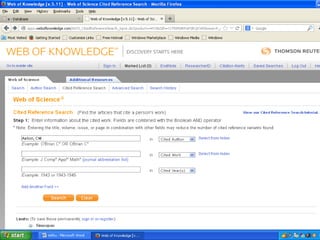
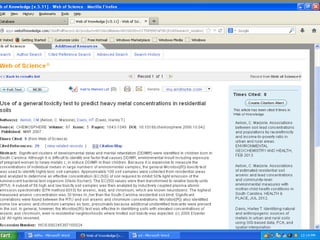
ISI (now part of Thomson Reuters)
publishes the ISI citation indexes in print
and compact disc. They are now generally
accessed through the Web under the
name '' Web of Science'', which is in turn
part of the group of databases in the ''Web
of Knowledge''
 ISI citation indexes include Science
Citation Index, Social Sciences Citation
Index, Arts and Humanities Citation Index.
 Science Citation Index Expanded, which can
be accessed via Web of Science, provides
knowledge seekers with quick, powerful
access to the bibliographic and citation
information they need to find research data,
analyze trends, journals and researchers, and
share their findings.
 Overcome information overload and focus on
essential data from over 8,500 of the world's
leading scientific and technical journals
across 150 disciplines.
 Social Sciences Citation Index which can be
accessed via Web of Science, provides
knowledge seekers with quick, powerful
access to the bibliographic and citation
information they need to find research data,
analyze trends, journals and researchers, and
share their findings.
 Overcome information overload and focus on
essential data from 3,000 of the world's
leading social sciences journals across 50
disciplines.
 Arts & Humanities Citation Index which can
be accessed via Web of Science, provides
knowledge seekers with quick, powerful
access to the bibliographic and citation
information for journal articles in the arts &
humanities they need to find research data,
analyze trends, journals, and researchers,
and share their findings.
 Overcome information overload and focus on
essential data from over 1,700 of the world's
leading arts and humanities journals.
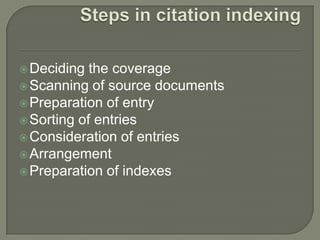
Deciding the coverage
Scanning of source documents
Preparation of entry
Sorting of entries
Consideration of entries
Arrangement
Preparation of indexes
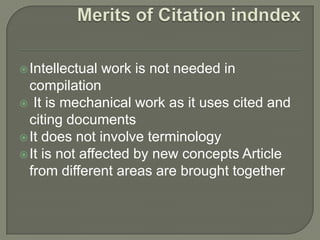
Intellectual work is not needed in
compilation
 It is mechanical work as it uses cited and
citing documents
It does not involve terminology
It is not affected by new concepts Article
from different areas are brought together
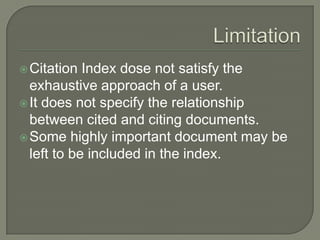
Citation Index dose not satisfy the
exhaustive approach of a user.
It does not specify the relationship
between cited and citing documents.
Some highly important document may be
left to be included in the index.
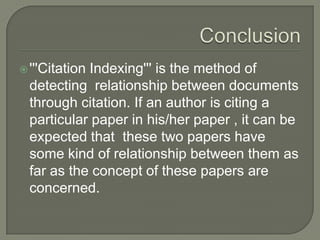
'''Citation Indexing''' is the method of
detecting relationship between documents
through citation. If an author is citing a
particular paper in his/her paper , it can be
expected that these two papers have
some kind of relationship between them as
far as the concept of these papers are
concerned.
Sharma, C. K. and Sharma, A .K. (2008)
Information Process and retrieval. New
Delhi :Atlantic Publishers

Citation indexing

  • 1.
    Mithu Anjali Gayan M.L.I.S.3rd semester Pondicherry University
  • 2.
     Citation isthe outcome of a process where the readers are directed to the referred to document for further information on a topic or to direct the reader to the actual authority behind a particular view finding or method.
  • 3.
     Robert K.M Metron , Manfred Kochen and other scholars define citation as intellectual transactions, formal acknowledgements of “intellectual debts” to earlier authors.  Citations symbolize the conceptual association of scientific ideas as recognized by publishing research authors.  According to H. G. Small, “By the references they cite in their papers, authors make explicit linkages between their current research and prior work in the archive of scientific literature”.
  • 4.
    It is theprocess of indexing the intellectual transactions by listing both the cited and citing works.
  • 5.
     if PaperR contains a bibliographic footnote using and describing Paper C, then R contains a reference to C, and C has a citation from R. The number of references a paper has is measured by the number of items in its bibliography as endnotes, footnotes, etc., while the number of citations a paper has is found by looking it up [in a] citation index and seeing how many others papers mention it."
  • 6.
     Frank Shephardof USA is the man behind the concept of citation Index. He produced the first citation Index in 1873 named as Frank Shephard’s Citation Index. This citation index was of immense importance to the lawyers to prove their points based on previous arguments. Eugene Garfield was second scholar who contributed a lot in the area of citation Indexing. The first “Science Citation Index” was brought out in 1961 and “Genetic Citation Index” in 1963.
  • 7.
    ISI (now partof Thomson Reuters) publishes the ISI citation indexes in print and compact disc. They are now generally accessed through the Web under the name '' Web of Science'', which is in turn part of the group of databases in the ''Web of Knowledge''
  • 8.
     ISI citationindexes include Science Citation Index, Social Sciences Citation Index, Arts and Humanities Citation Index.
  • 12.
     Science CitationIndex Expanded, which can be accessed via Web of Science, provides knowledge seekers with quick, powerful access to the bibliographic and citation information they need to find research data, analyze trends, journals and researchers, and share their findings.  Overcome information overload and focus on essential data from over 8,500 of the world's leading scientific and technical journals across 150 disciplines.
  • 13.
     Social SciencesCitation Index which can be accessed via Web of Science, provides knowledge seekers with quick, powerful access to the bibliographic and citation information they need to find research data, analyze trends, journals and researchers, and share their findings.  Overcome information overload and focus on essential data from 3,000 of the world's leading social sciences journals across 50 disciplines.
  • 14.
     Arts &Humanities Citation Index which can be accessed via Web of Science, provides knowledge seekers with quick, powerful access to the bibliographic and citation information for journal articles in the arts & humanities they need to find research data, analyze trends, journals, and researchers, and share their findings.  Overcome information overload and focus on essential data from over 1,700 of the world's leading arts and humanities journals.
  • 15.
    Deciding the coverage Scanningof source documents Preparation of entry Sorting of entries Consideration of entries Arrangement Preparation of indexes
  • 16.
    Intellectual work isnot needed in compilation  It is mechanical work as it uses cited and citing documents It does not involve terminology It is not affected by new concepts Article from different areas are brought together
  • 17.
    Citation Index dosenot satisfy the exhaustive approach of a user. It does not specify the relationship between cited and citing documents. Some highly important document may be left to be included in the index.
  • 18.
    '''Citation Indexing''' isthe method of detecting relationship between documents through citation. If an author is citing a particular paper in his/her paper , it can be expected that these two papers have some kind of relationship between them as far as the concept of these papers are concerned.
  • 19.
    Sharma, C. K.and Sharma, A .K. (2008) Information Process and retrieval. New Delhi :Atlantic Publishers

Editor's Notes

  • #5 (That is, the citedwork is a paper or book that has been mentioned in the references of other works, while the citingwork is the one that contains the references.)