Qaiser Iqbal
Assistant Manager, Electronic Resources & Serials Librarian
Gad and Birgit Rausing Library
LUMS
qaiser.iqbal@lums.edu.pk
Contents• SCOPUS
• Who Uses Scopus?
• Documents Types Index in Scopus
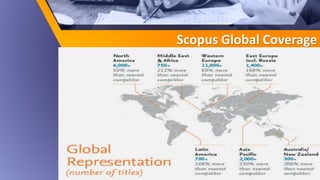
• Subject Coverage & Global Coverage
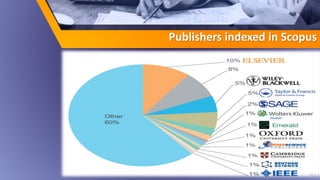
• Publishers Indexed in Scopus
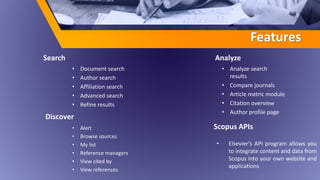
• Features
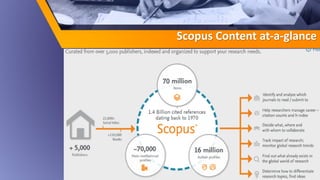
• Contents Index in Scopus
• CSAB (Content Selection Advisory Board)
• ORCID Integration with SCOPUS
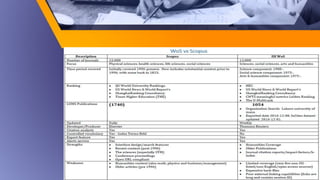
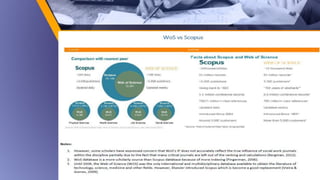
• SCOPUS vs WoS
Looking to
find & evaluate
the right research?
Scopus has you covered
Scopus?
• Scopus is Elsevier’s (Product) abstract and citation database
launched in November 2004
• Scopus is the largest abstract and citation database of peer-
reviewed literature, scientific journals, books and conference
proceedings. Delivering a comprehensive overview of the world's
research output in the fields of science, technology, medicine,
social sciences, arts and humanities, Scopus features smart tools
to track, analyze and visualize research.
Scopus? Researchers’ s Opinions
“Scopus is very customer-friendly… You get more information from all different fields. It
saves a lot of time.”
Chris, Head of R&D, Diagnostic Testing, Scopus user
“Scopus informs every phase of the editorial process. I would not want to do this job
without it, and I intend to continue using it throughout my career.”
William, Professor of Economics, University of Tennessee
Who Uses Scopus?
• Academic Institutions Scopus is designed to serve the
information needs of researchers, educators, students,
administrators and librarians across the entire academic
community.
• Government & Funding Agencies Scopus data can help
guide your agency or institute's overall strategic direction, assess
its status relative to other institutions, identify funding resources,
enable collaboration and measure researcher performance.
• Research & Development Scopus can help you stay abreast
of scientific developments, track key research, identify key
opinion leaders and stay ahead of your competition.
• Developers Elsevier's API program allows you to integrate
content and data from Scopus into your own website and
applications.
Who Uses Scopus?
• Ranking Organizations Scopus provides Ranking Organizations with a reliable and comprehensive source for
research performance data and analytics. Scopus data is used to calculate the influential QS World University
Rankings, Times Higher Education (THE) US World News & World Report's Best Arab Region Universities Rankings,
and the Shanghai Ranking Consultancy etc.
• Reports & Assessments Through the bibliometric expertise of Research Intelligence, and the extensive data
sources available in Scopus, we can help your organization:
 Enhance Research Performance Engage in data-driven strategic planning and benchmark
performance to maximize efficiency and impact of research enterprises
 Support Data Standards Facilitate in data sharing across systems and increase productivity
throughout the research community
 Investigate Grand Challenges Collaborate with institutions to address major societal challenges such
as food and water security, alternative energy and breast cancer
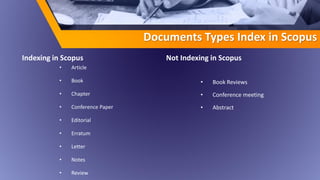
Documents Types Index in Scopus
Indexing in Scopus
• Article
• Book
• Chapter
• Conference Paper
• Editorial
• Erratum
• Letter
• Notes
• Review
Not Indexing in Scopus
• Book Reviews
• Conference meeting
• Abstract
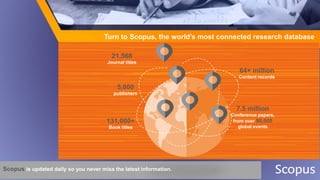
Turn to Scopus, the world’s most connected research database
64+ million
Content records
21,568
Journal titles
5,000
publishers
7.5 million
Conference papers,
from over 90,000
global events
Scopus is updated daily so you never miss the latest information.
131,000+
Book titles
Health
Sciences
31%
Turn to Scopus for broad coverage across all subject areas
Search across 12,900+ Health Science titles; 31% of Scopus publications.
Physical
Sciences
29%
Search across 11,800+ Physical Science titles; 29% of Scopus publications.
Social
Sciences
25%
Search across 10,000+ Social Science titles, including arts & humanities.
Life
Sciences
15%
Search across 6,300+ Life Science titles; 15% of Scopus publications.
Scopus is updated daily so you never miss the latest information.
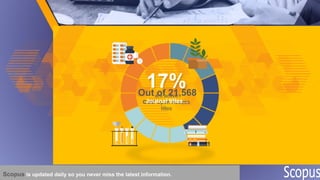
17%are active
Gold Open Access
titles
Out of 21,568
Journal titles…
Scopus is updated daily so you never miss the latest information.
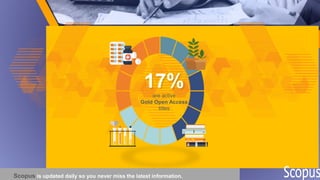
17%are active
Gold Open Access
titles
Scopus Global Coverage
Publishers indexed in Scopus
Features
Discover
• Document search
• Author search
• Affiliation search
• Advanced search
• Refine results
Scopus APIs
• Analyze search
results
• Compare journals
• Article metric module
• Citation overview
• Author profile page
Search
• Alert
• Browse sources
• My list
• Reference managers
• View cited by
• View references
• Elsevier's API program allows you
to integrate content and data from
Scopus into your own website and
applications
Analyze
Contents Index in Scopus
Across all research fields — science, mathematics, engineering, technology, health and
medicine, social sciences, and arts and humanities — Scopus delivers the broadest
overview of global, interdisciplinary scientific information.
 Journals
 Trade journals
 Book series
 Conference material
 Conference material (A non-serial source is a publication with an ISBN)
 Secondary documents
 Patents
Scopus Content at-a-glance
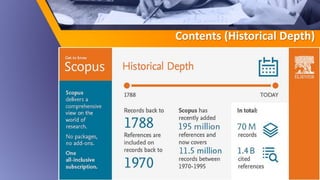
Contents (Historical Depth)
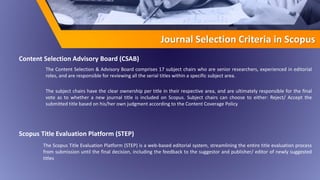
The Content Selection & Advisory Board comprises 17 subject chairs who are senior researchers, experienced in editorial
roles, and are responsible for reviewing all the serial titles within a specific subject area.
The subject chairs have the clear ownership per title in their respective area, and are ultimately responsible for the final
vote as to whether a new journal title is included on Scopus. Subject chairs can choose to either: Reject/ Accept the
submitted title based on his/her own judgment according to the Content Coverage Policy
Journal Selection Criteria in Scopus
Scopus Title Evaluation Platform (STEP)
The Scopus Title Evaluation Platform (STEP) is a web-based editorial system, streamlining the entire title evaluation process
from submission until the final decision, including the feedback to the suggestor and publisher/ editor of newly suggested
titles
Content Selection Advisory Board (CSAB)
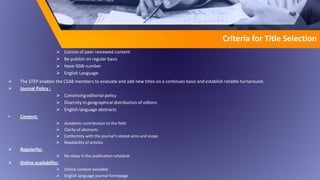
 Consist of peer reviewed content
 Be publish on regular basis
 Have ISSN number
 English Language
 The STEP enables the CSAB members to evaluate and add new titles on a continues basis and establish reliable turnaround.
 Journal Policy ;
 Convincing editorial policy
 Diversity in geographical distribution of editors
 English language abstracts
• Content;
 Academic contribution to the field
 Clarity of abstracts
 Conformity with the journal’s stated aims and scope
 Readability of articles
 Regularity;
 No delay in the publication schedule
 Online availability;
 Online content available
 English language journal homepage
Criteria for Title Selection
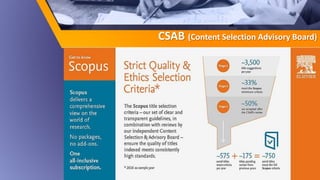
CSAB (Content Selection Advisory Board)
• A Scopus Author ID is automatically assigned to you when you have published a work covered in Scopus. You
may have more than one ID in Scopus if you have published under variant names and affiliations. It is always a
good practice to merge your multiple Scopus IDs and keep all your works listed under one unique ID. This
ensures that your total citation counts and h-index in Scopus are accurate.
• An easy way to do this is to integrate your ORCID with your Scopus Author ID
ORCID (Open Researcher and Contributor ID) Integration with Scopus
Scopus
Scopus
Scopus

Scopus

  • 1.
    Qaiser Iqbal Assistant Manager,Electronic Resources & Serials Librarian Gad and Birgit Rausing Library LUMS qaiser.iqbal@lums.edu.pk
  • 2.
    Contents• SCOPUS • WhoUses Scopus? • Documents Types Index in Scopus • Subject Coverage & Global Coverage • Publishers Indexed in Scopus • Features • Contents Index in Scopus • CSAB (Content Selection Advisory Board) • ORCID Integration with SCOPUS • SCOPUS vs WoS
  • 3.
    Looking to find &evaluate the right research? Scopus has you covered
  • 4.
    Scopus? • Scopus isElsevier’s (Product) abstract and citation database launched in November 2004 • Scopus is the largest abstract and citation database of peer- reviewed literature, scientific journals, books and conference proceedings. Delivering a comprehensive overview of the world's research output in the fields of science, technology, medicine, social sciences, arts and humanities, Scopus features smart tools to track, analyze and visualize research.
  • 5.
    Scopus? Researchers’ sOpinions “Scopus is very customer-friendly… You get more information from all different fields. It saves a lot of time.” Chris, Head of R&D, Diagnostic Testing, Scopus user “Scopus informs every phase of the editorial process. I would not want to do this job without it, and I intend to continue using it throughout my career.” William, Professor of Economics, University of Tennessee
  • 6.
    Who Uses Scopus? •Academic Institutions Scopus is designed to serve the information needs of researchers, educators, students, administrators and librarians across the entire academic community. • Government & Funding Agencies Scopus data can help guide your agency or institute's overall strategic direction, assess its status relative to other institutions, identify funding resources, enable collaboration and measure researcher performance. • Research & Development Scopus can help you stay abreast of scientific developments, track key research, identify key opinion leaders and stay ahead of your competition. • Developers Elsevier's API program allows you to integrate content and data from Scopus into your own website and applications.
  • 7.
    Who Uses Scopus? •Ranking Organizations Scopus provides Ranking Organizations with a reliable and comprehensive source for research performance data and analytics. Scopus data is used to calculate the influential QS World University Rankings, Times Higher Education (THE) US World News & World Report's Best Arab Region Universities Rankings, and the Shanghai Ranking Consultancy etc. • Reports & Assessments Through the bibliometric expertise of Research Intelligence, and the extensive data sources available in Scopus, we can help your organization:  Enhance Research Performance Engage in data-driven strategic planning and benchmark performance to maximize efficiency and impact of research enterprises  Support Data Standards Facilitate in data sharing across systems and increase productivity throughout the research community  Investigate Grand Challenges Collaborate with institutions to address major societal challenges such as food and water security, alternative energy and breast cancer
  • 8.
    Documents Types Indexin Scopus Indexing in Scopus • Article • Book • Chapter • Conference Paper • Editorial • Erratum • Letter • Notes • Review Not Indexing in Scopus • Book Reviews • Conference meeting • Abstract
  • 9.
    Turn to Scopus,the world’s most connected research database 64+ million Content records 21,568 Journal titles 5,000 publishers 7.5 million Conference papers, from over 90,000 global events Scopus is updated daily so you never miss the latest information. 131,000+ Book titles
  • 10.
    Health Sciences 31% Turn to Scopusfor broad coverage across all subject areas Search across 12,900+ Health Science titles; 31% of Scopus publications.
  • 11.
    Physical Sciences 29% Search across 11,800+Physical Science titles; 29% of Scopus publications.
  • 12.
    Social Sciences 25% Search across 10,000+Social Science titles, including arts & humanities.
  • 13.
    Life Sciences 15% Search across 6,300+Life Science titles; 15% of Scopus publications.
  • 14.
    Scopus is updateddaily so you never miss the latest information. 17%are active Gold Open Access titles Out of 21,568 Journal titles…
  • 15.
    Scopus is updateddaily so you never miss the latest information. 17%are active Gold Open Access titles
  • 16.
  • 17.
  • 18.
    Features Discover • Document search •Author search • Affiliation search • Advanced search • Refine results Scopus APIs • Analyze search results • Compare journals • Article metric module • Citation overview • Author profile page Search • Alert • Browse sources • My list • Reference managers • View cited by • View references • Elsevier's API program allows you to integrate content and data from Scopus into your own website and applications Analyze
  • 19.
    Contents Index inScopus Across all research fields — science, mathematics, engineering, technology, health and medicine, social sciences, and arts and humanities — Scopus delivers the broadest overview of global, interdisciplinary scientific information.  Journals  Trade journals  Book series  Conference material  Conference material (A non-serial source is a publication with an ISBN)  Secondary documents  Patents
  • 20.
  • 21.
  • 22.
    The Content Selection& Advisory Board comprises 17 subject chairs who are senior researchers, experienced in editorial roles, and are responsible for reviewing all the serial titles within a specific subject area. The subject chairs have the clear ownership per title in their respective area, and are ultimately responsible for the final vote as to whether a new journal title is included on Scopus. Subject chairs can choose to either: Reject/ Accept the submitted title based on his/her own judgment according to the Content Coverage Policy Journal Selection Criteria in Scopus Scopus Title Evaluation Platform (STEP) The Scopus Title Evaluation Platform (STEP) is a web-based editorial system, streamlining the entire title evaluation process from submission until the final decision, including the feedback to the suggestor and publisher/ editor of newly suggested titles Content Selection Advisory Board (CSAB)
  • 23.
     Consist ofpeer reviewed content  Be publish on regular basis  Have ISSN number  English Language  The STEP enables the CSAB members to evaluate and add new titles on a continues basis and establish reliable turnaround.  Journal Policy ;  Convincing editorial policy  Diversity in geographical distribution of editors  English language abstracts • Content;  Academic contribution to the field  Clarity of abstracts  Conformity with the journal’s stated aims and scope  Readability of articles  Regularity;  No delay in the publication schedule  Online availability;  Online content available  English language journal homepage Criteria for Title Selection
  • 24.
    CSAB (Content SelectionAdvisory Board)
  • 25.
    • A ScopusAuthor ID is automatically assigned to you when you have published a work covered in Scopus. You may have more than one ID in Scopus if you have published under variant names and affiliations. It is always a good practice to merge your multiple Scopus IDs and keep all your works listed under one unique ID. This ensures that your total citation counts and h-index in Scopus are accurate. • An easy way to do this is to integrate your ORCID with your Scopus Author ID ORCID (Open Researcher and Contributor ID) Integration with Scopus