Plagiarism in HEI and how to avoid it
Dr. Utpal Das,
Deputy Librarian
Dibrugarh University,
Dibrugarh, Assam
utpalishaan@gmail.com
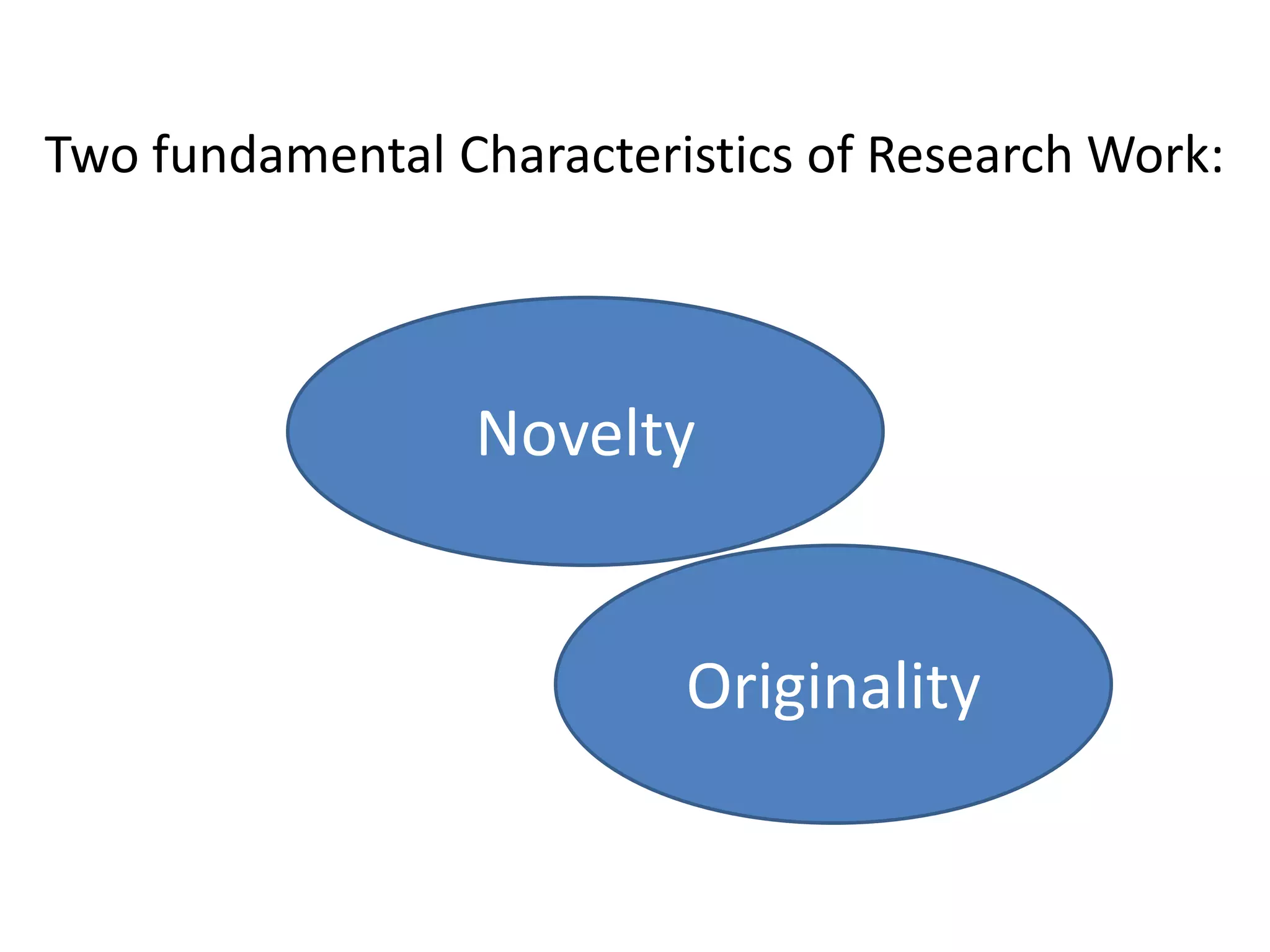
Two fundamental Characteristics of Research Work:
Novelty
Originality
Novelty and originality of a research work is
holistically depended on:
Experimental or observed facts
Analytic/scientific truth
Intellectual honesty
In one phrase:
“Academic Integrity”
Academic Integrity
UGC Regulation 2018 defines:
“Academic Integrity” is the intellectual
honesty in proposing, performing and
reporting any activity, which leads to the
creation of intellectual property.
When we talk about upholding “intellectual
honesty” of any research work, it means, the
research work is completely free from the
following:
Fabrication
Falsification
Plagiarism
PLAGIARISM
PLAGIARISM
09-Aug-16 7utpaldas@dibru.ac.in
Plagiarism: Definition
Gipp, Bela (2014). Citation-based Plagiarism Detection: Detecting Disguised and Cross-language
Plagiarism using Citation Pattern Analysis. Springer Vieweg. ISBN 978-3-658-06393-1. p.10
Bela Gipp (2014) defined plagiarism as the following:
"The use of ideas, concepts, words, or structures
without appropriately acknowledging the source
to benefit in a setting where originality is expected
Contd…
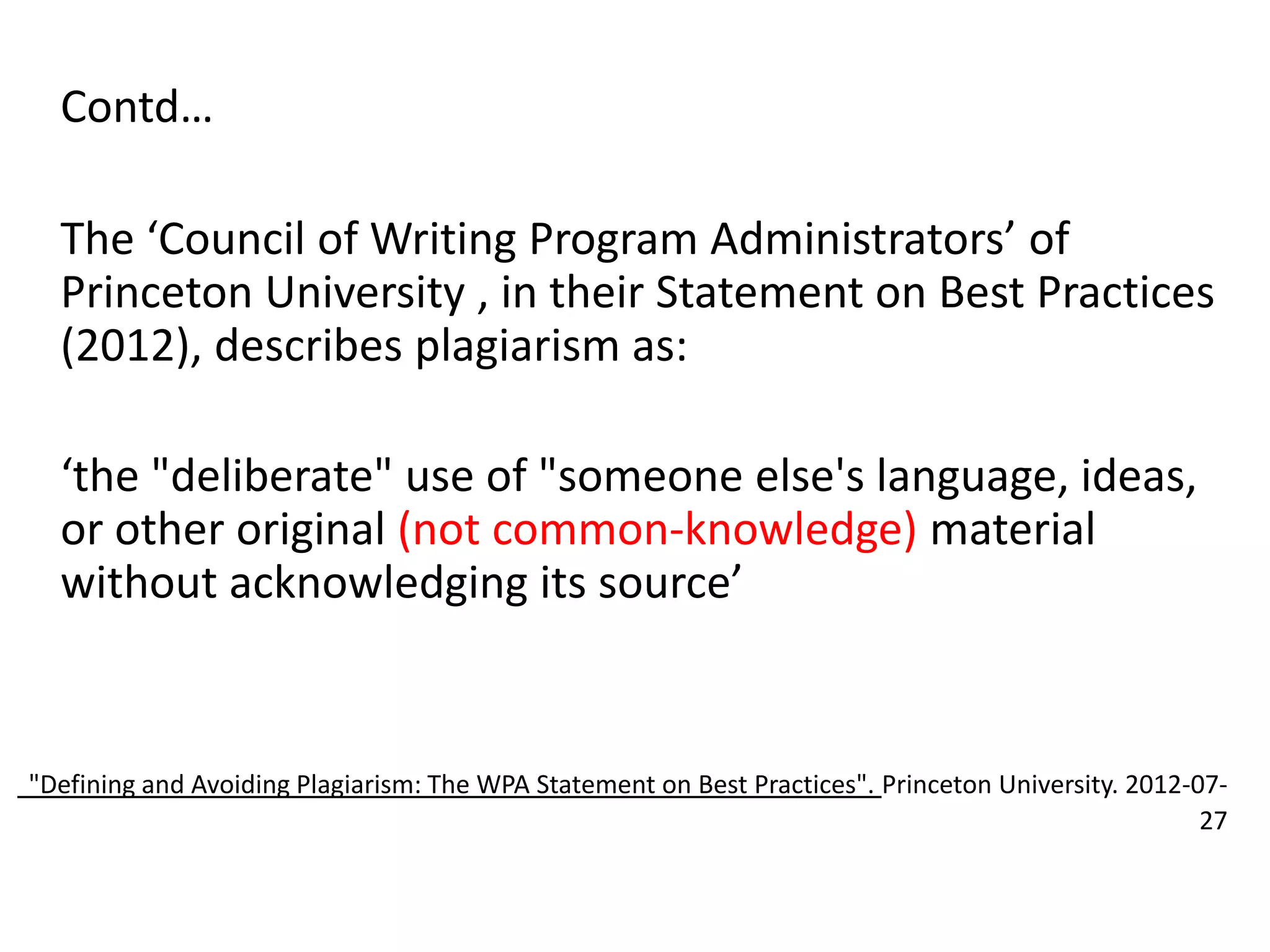
The ‘Council of Writing Program Administrators’ of
Princeton University , in their Statement on Best Practices
(2012), describes plagiarism as:
‘the "deliberate" use of "someone else's language, ideas,
or other original (not common-knowledge) material
without acknowledging its source’
"Defining and Avoiding Plagiarism: The WPA Statement on Best Practices". Princeton University. 2012-07-
27
Contd…
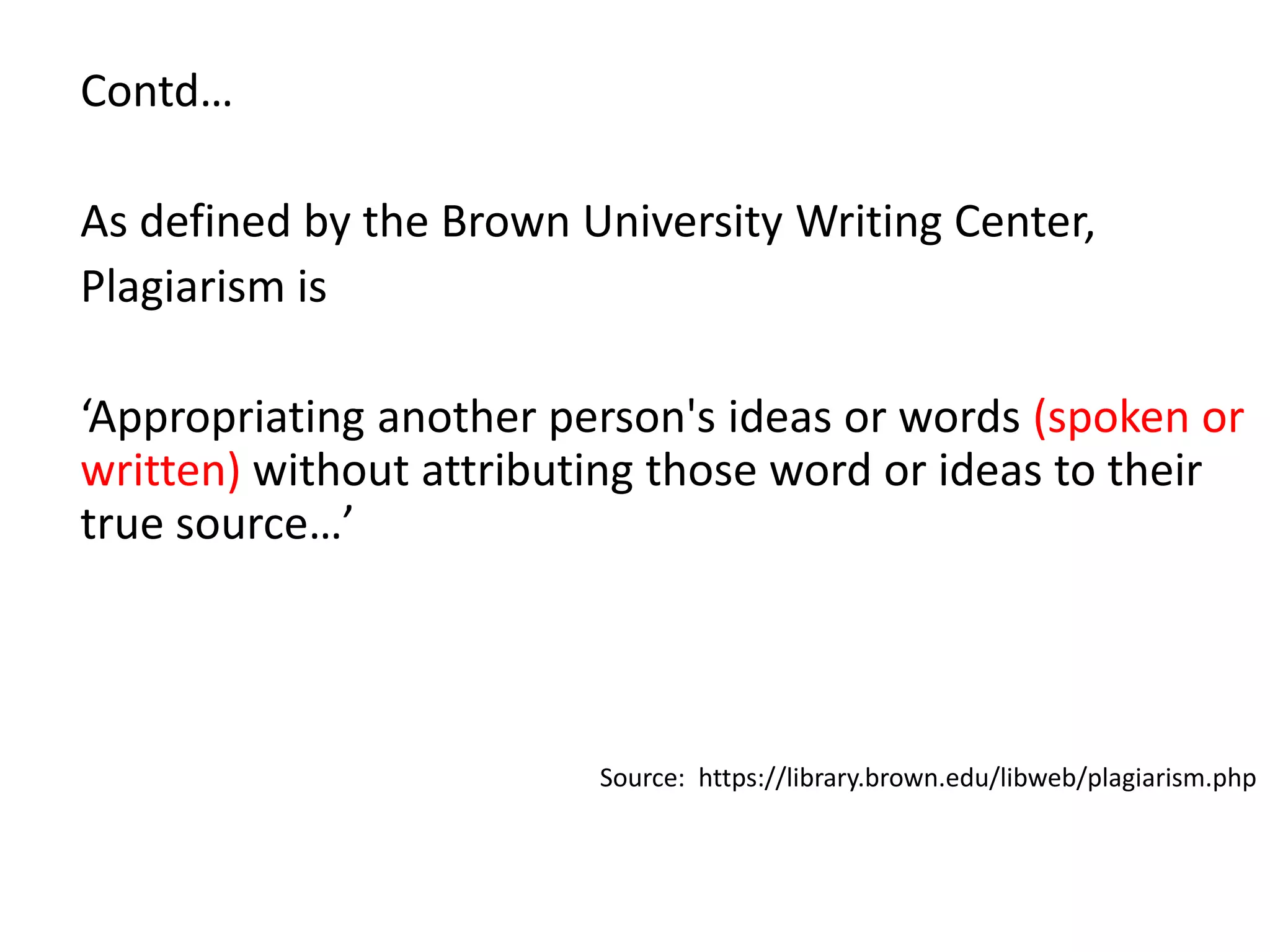
As defined by the Brown University Writing Center,
Plagiarism is
‘Appropriating another person's ideas or words (spoken or
written) without attributing those word or ideas to their
true source…’
Source: https://library.brown.edu/libweb/plagiarism.php
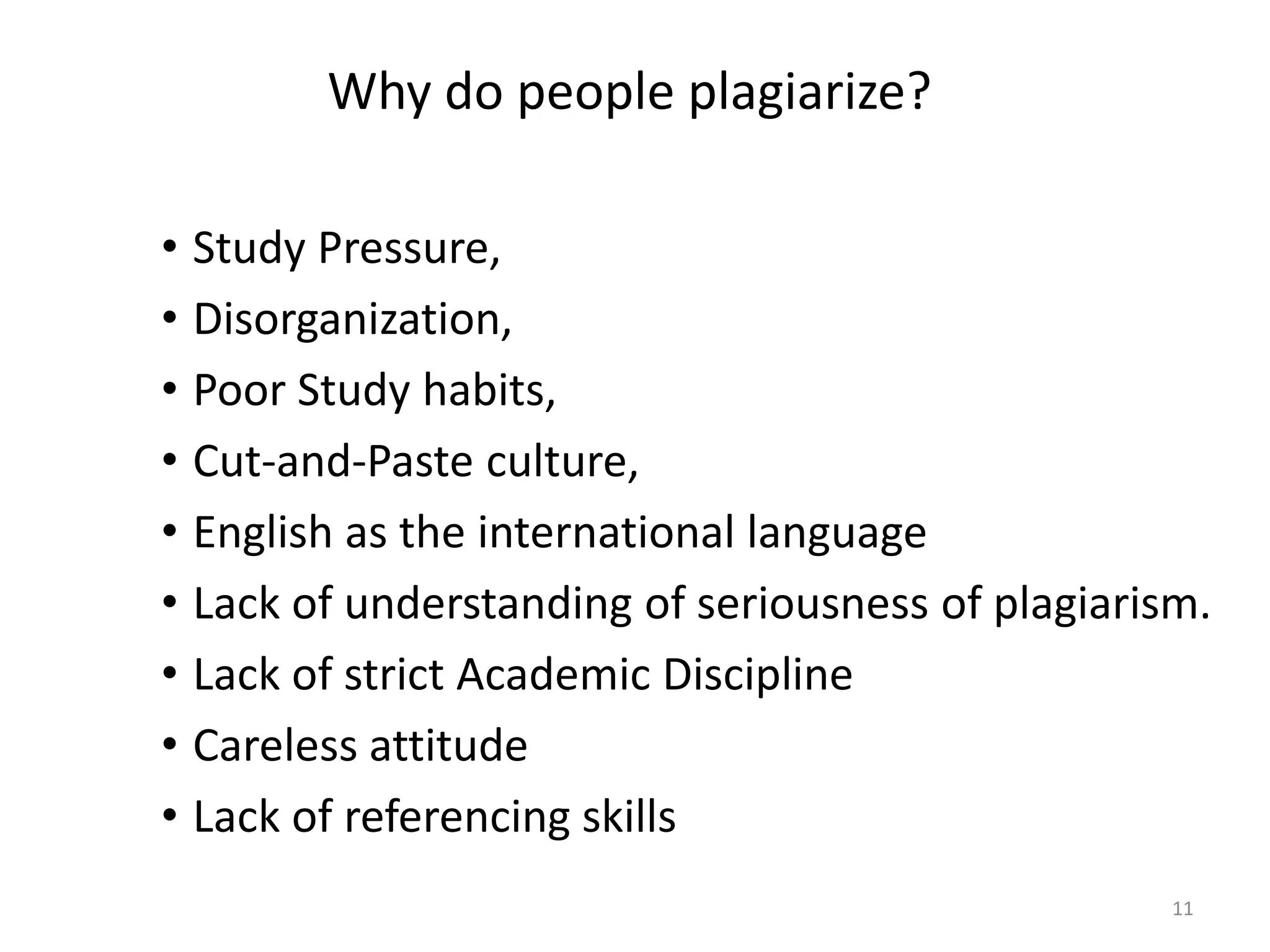
Why do people plagiarize?
• Study Pressure,
• Disorganization,
• Poor Study habits,
• Cut-and-Paste culture,
• English as the international language
• Lack of understanding of seriousness of plagiarism.
• Lack of strict Academic Discipline
• Careless attitude
• Lack of referencing skills
11
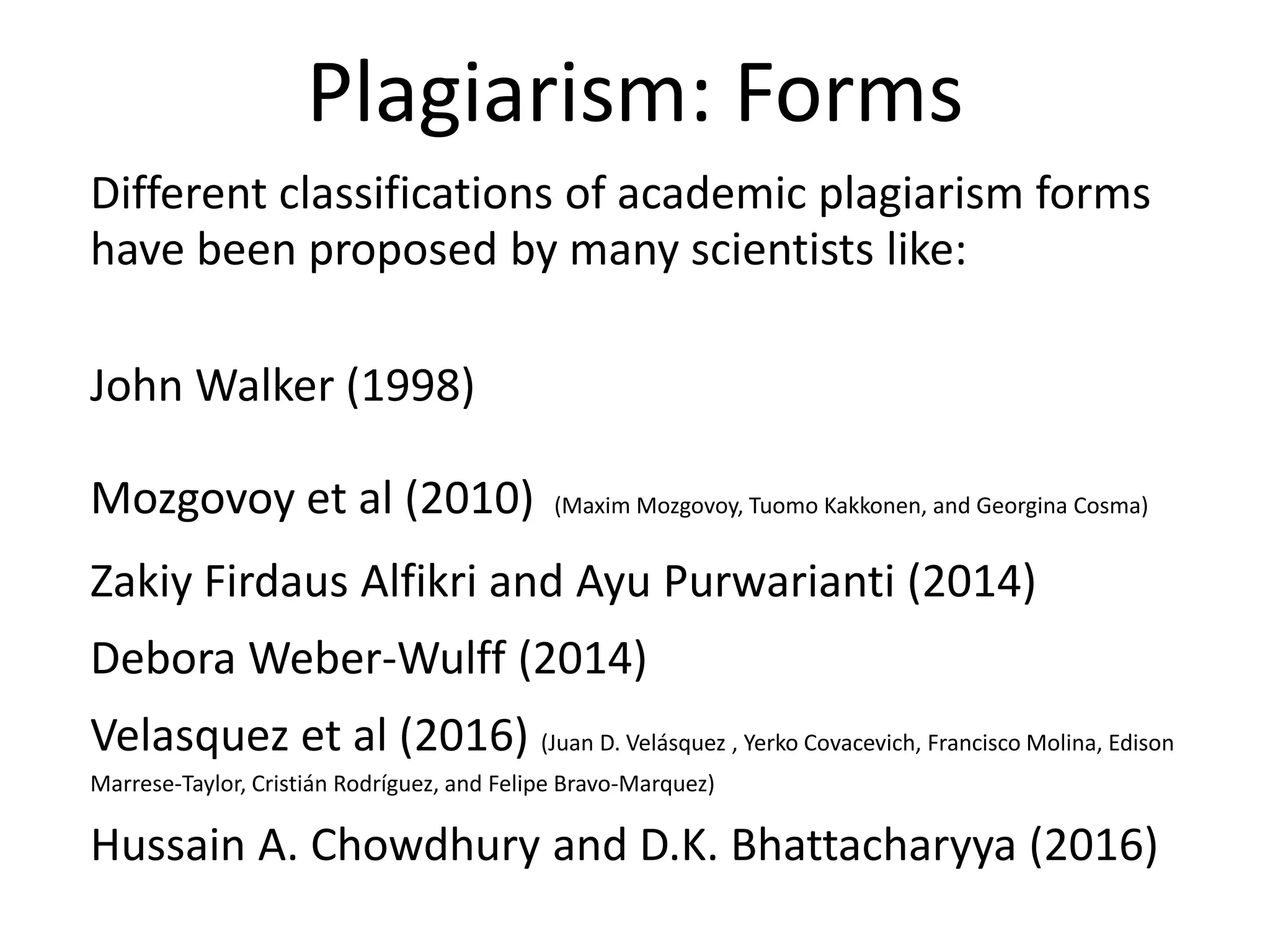
Plagiarism: Forms
Different classifications of academic plagiarism forms
have been proposed by many scientists like:
John Walker (1998)
Mozgovoy et al (2010) (Maxim Mozgovoy, Tuomo Kakkonen, and Georgina Cosma)
Zakiy Firdaus Alfikri and Ayu Purwarianti (2014)
Debora Weber-Wulff (2014)
Velasquez et al (2016) (Juan D. Velásquez , Yerko Covacevich, Francisco Molina, Edison
Marrese-Taylor, Cristián Rodríguez, and Felipe Bravo-Marquez)
Hussain A. Chowdhury and D.K. Bhattacharyya (2016)
contd...
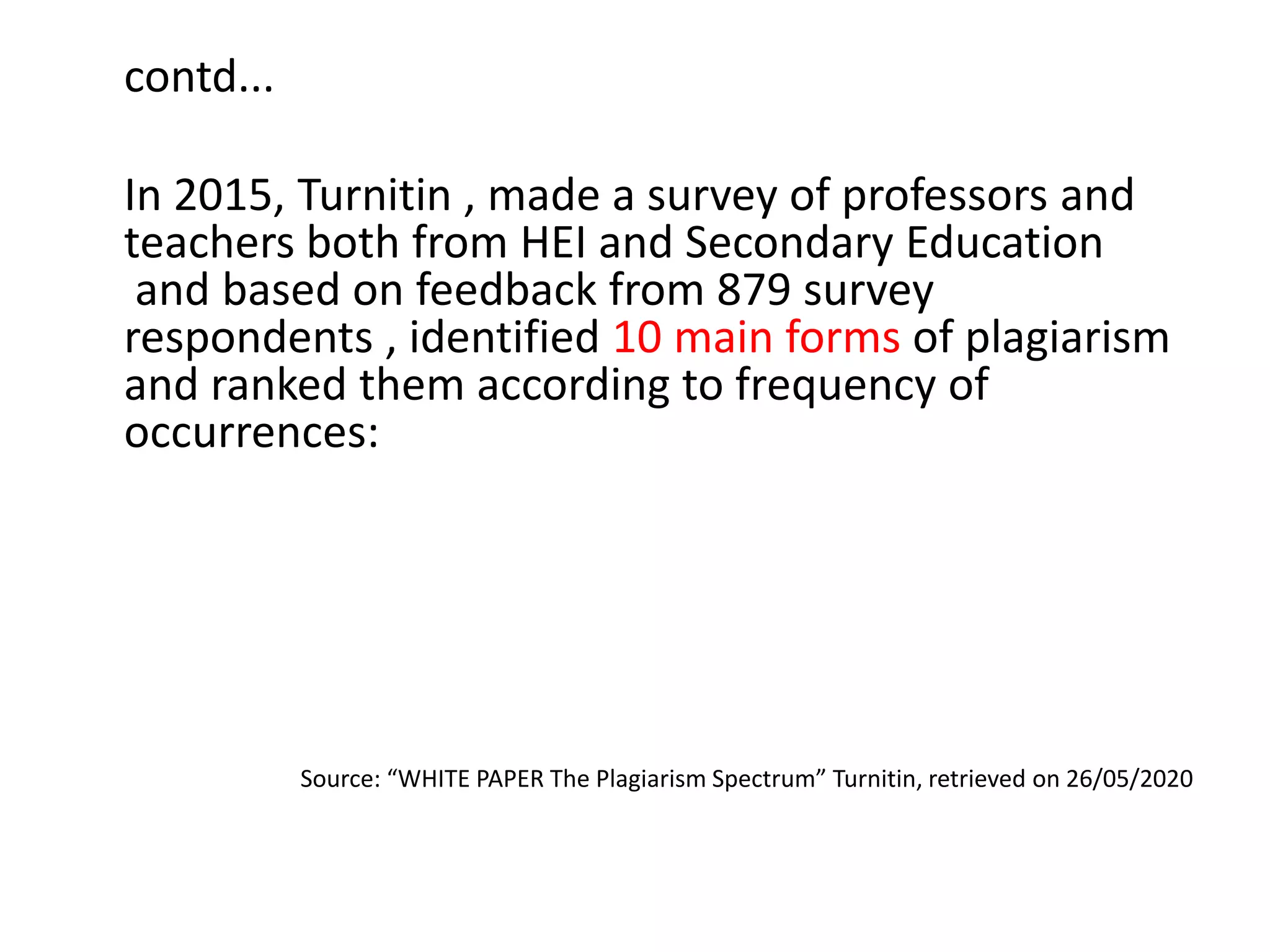
In 2015, Turnitin , made a survey of professors and
teachers both from HEI and Secondary Education
and based on feedback from 879 survey
respondents , identified 10 main forms of plagiarism
and ranked them according to frequency of
occurrences:
Source: “WHITE PAPER The Plagiarism Spectrum” Turnitin, retrieved on 26/05/2020
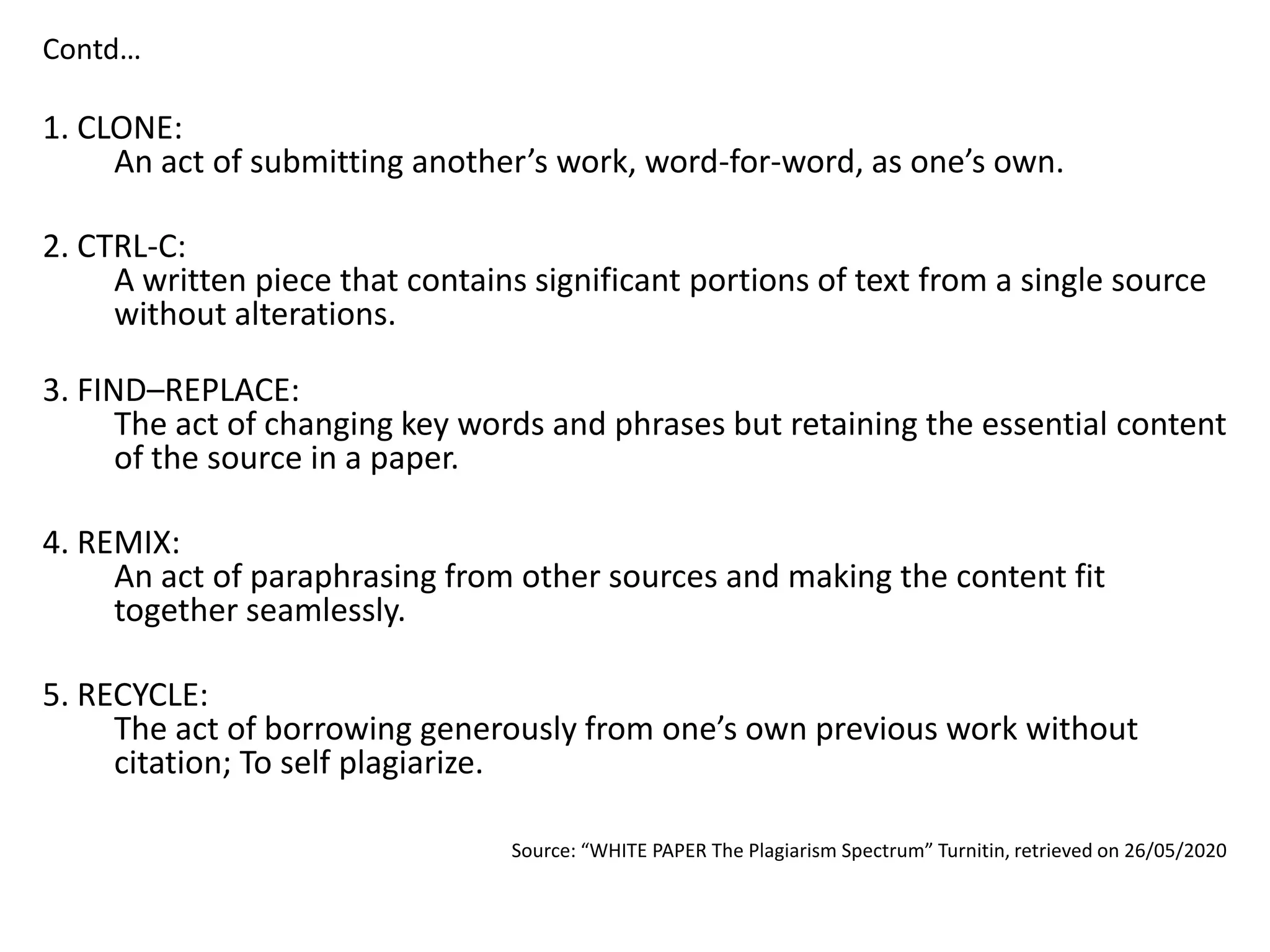
Contd…
1. CLONE:
An act of submitting another’s work, word-for-word, as one’s own.
2. CTRL-C:
A written piece that contains significant portions of text from a single source
without alterations.
3. FIND–REPLACE:
The act of changing key words and phrases but retaining the essential content
of the source in a paper.
4. REMIX:
An act of paraphrasing from other sources and making the content fit
together seamlessly.
5. RECYCLE:
The act of borrowing generously from one’s own previous work without
citation; To self plagiarize.
Source: “WHITE PAPER The Plagiarism Spectrum” Turnitin, retrieved on 26/05/2020
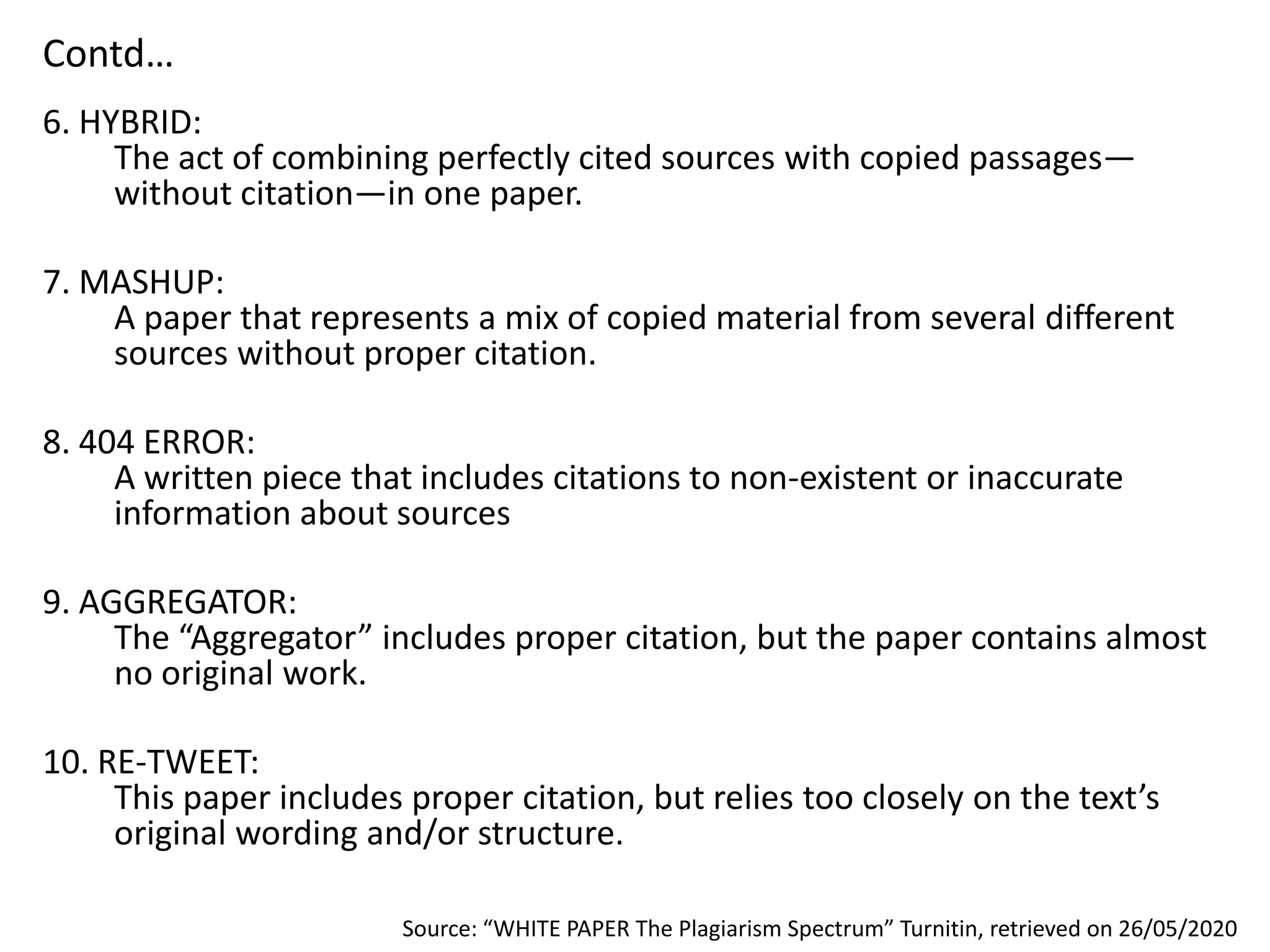
Contd…
6. HYBRID:
The act of combining perfectly cited sources with copied passages—
without citation—in one paper.
7. MASHUP:
A paper that represents a mix of copied material from several different
sources without proper citation.
8. 404 ERROR:
A written piece that includes citations to non-existent or inaccurate
information about sources
9. AGGREGATOR:
The “Aggregator” includes proper citation, but the paper contains almost
no original work.
10. RE-TWEET:
This paper includes proper citation, but relies too closely on the text’s
original wording and/or structure.
Source: “WHITE PAPER The Plagiarism Spectrum” Turnitin, retrieved on 26/05/2020
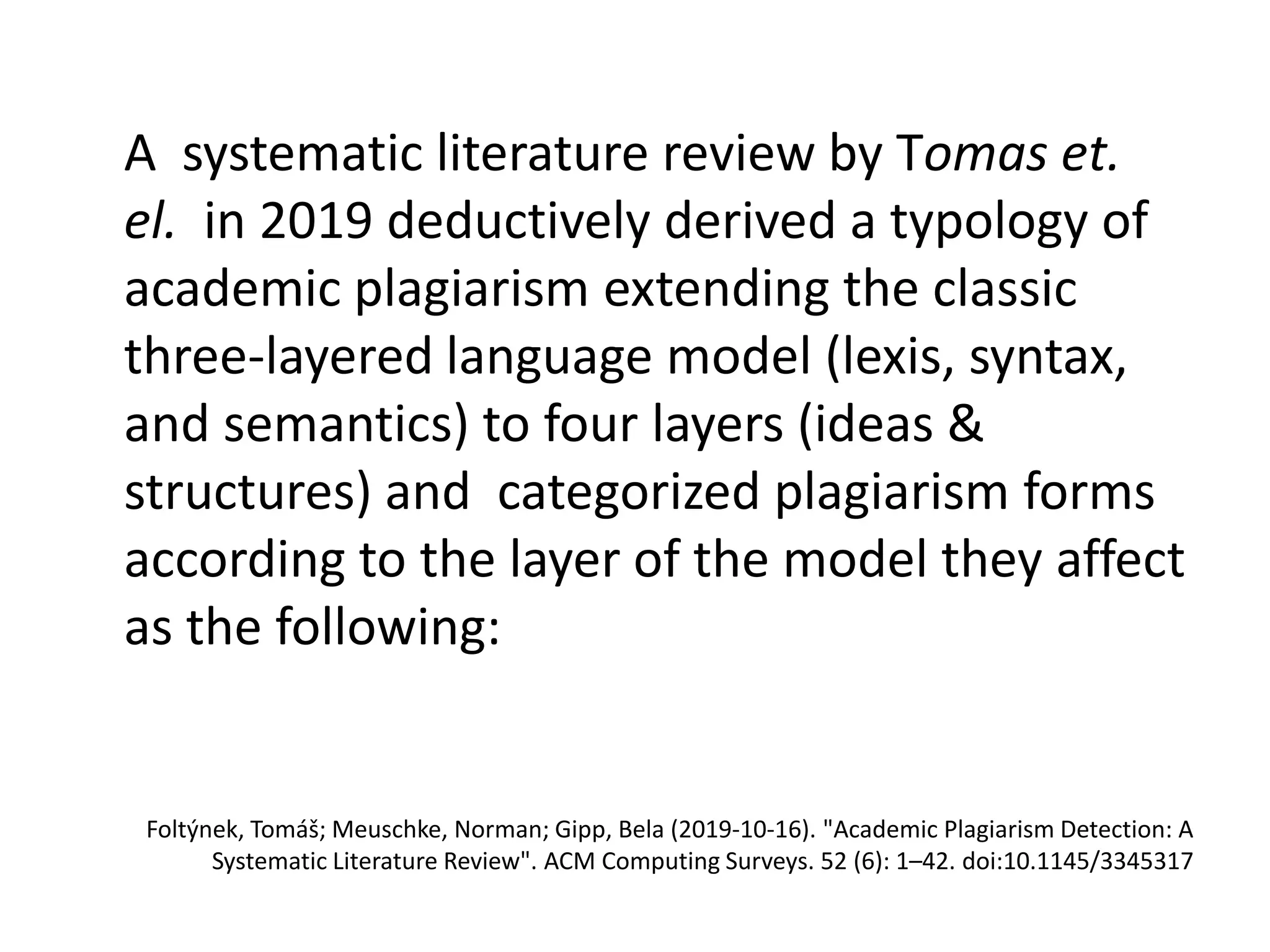
A systematic literature review by Tomas et.
el. in 2019 deductively derived a typology of
academic plagiarism extending the classic
three-layered language model (lexis, syntax,
and semantics) to four layers (ideas &
structures) and categorized plagiarism forms
according to the layer of the model they affect
as the following:
Foltýnek, Tomáš; Meuschke, Norman; Gipp, Bela (2019-10-16). "Academic Plagiarism Detection: A
Systematic Literature Review". ACM Computing Surveys. 52 (6): 1–42. doi:10.1145/3345317
Contd...
1. Characters-preserving plagiarism
• Literal plagiarism (copy and paste i.e. Verbatim copying)
• Possibly with mentioning the source
2. Syntax-preserving plagiarism
• Technical disguise (e.g. using identically looking glyphs from
another alphabet)
• Synonym substitution
3. Semantics-preserving plagiarism
• Translation
• Paraphrase (mosaic, clause quilts, restatement, additional
manner of expression)
Foltýnek, Tomáš; Meuschke, Norman; Gipp, Bela (2019-10-16). "Academic Plagiarism Detection: A Systematic
Literature Review". ACM Computing Surveys. 52 (6): 1–42. doi:10.1145/3345317
Contd…
4. Idea-preserving plagiarism
• Structural plagiarism (Reusing text structure)
• Appropriation of concepts and ideas only
5. Ghostwriting
• Collusion (secret cooperation or deceitful
agreement in order to deceive others)
• Contract cheating ( to pay others to complete
their coursework)
Foltýnek, Tomáš; Meuschke, Norman; Gipp, Bela (2019-10-16). "Academic Plagiarism Detection: A Systematic
Literature Review". ACM Computing Surveys. 52 (6): 1–42. doi:10.1145/3345317
Besides above, the following are also categorised
as plagiarism:
• Failure to acknowledge assistance
• Use of materials written by of professional
agencies
• Repetitive research
• Replication
• Re-publication in translation without permission &
• acknowledgement
• Reverse plagiarism refers to falsely giving authorship
credit over a work to a person who did not author it,
or falsely claiming a source
09-Aug-16 utpaldas@dibru.ac.in 19
The Menace
The problem of academic plagiarism is not new but has been
present for centuries in the literary world.
The Latin word "plagiarius" (literally "kidnapper") was coined in
the 1st century, to denote stealing someone else's work . It was
pioneered by the Roman poet Marcus Valerius Martialis, who
complained that another poet had "kidnapped his verses“
The Latin word plagiārius, meaning "kidnapper“ and plagium,
meaning "kidnapping", is based on the Indo-European root -
plak, "to weave”
The word plagiarism was derived from here and introduced into
English around 1620 indicating its existence in 17 Century AD
Contd...
However, the rapid and continuous
advancement of information technology (IT),
which offers convenient and instant access to
vast amounts of information, has made
plagiarizing easier than ever.
At the same time, IT also facilitated the
detection of academic plagiarism in a faster
and convenient way.
Technology driven society
• The massive ongoing explosion of information
• Impact of Social Media
• Growing impact of technology
• Increasing complexity and volatility due cross
disciplinary research.
• increasingly questioning the value of the research in
universities and also the economy and of graduate
employability
09-Aug-16 utpaldas@dibru.ac.in 22
Contd…
Plagiarism in HEI:
For the first time in the year 2000, the higher educational
institutions in UK started deeper investigation into
problems of plagiarism.
Scientists like, Carroll & Appleton (2001) Bretag (2005) ,
Joyce (2008), East (2009), highlighted holistic approach
towards plagiarism prevention and claimed that it is
impossible to reduce the extent of plagiarism in higher
educational institutions, applying separate or isolated
measures.
How to avoid Academic Plagiarism
Scientists believe that avoiding the menace of
academic plagiarism needs a holistic approach,
may be divided in to three ways:
1. National approach
2. Institutional approach
3. Individual approach
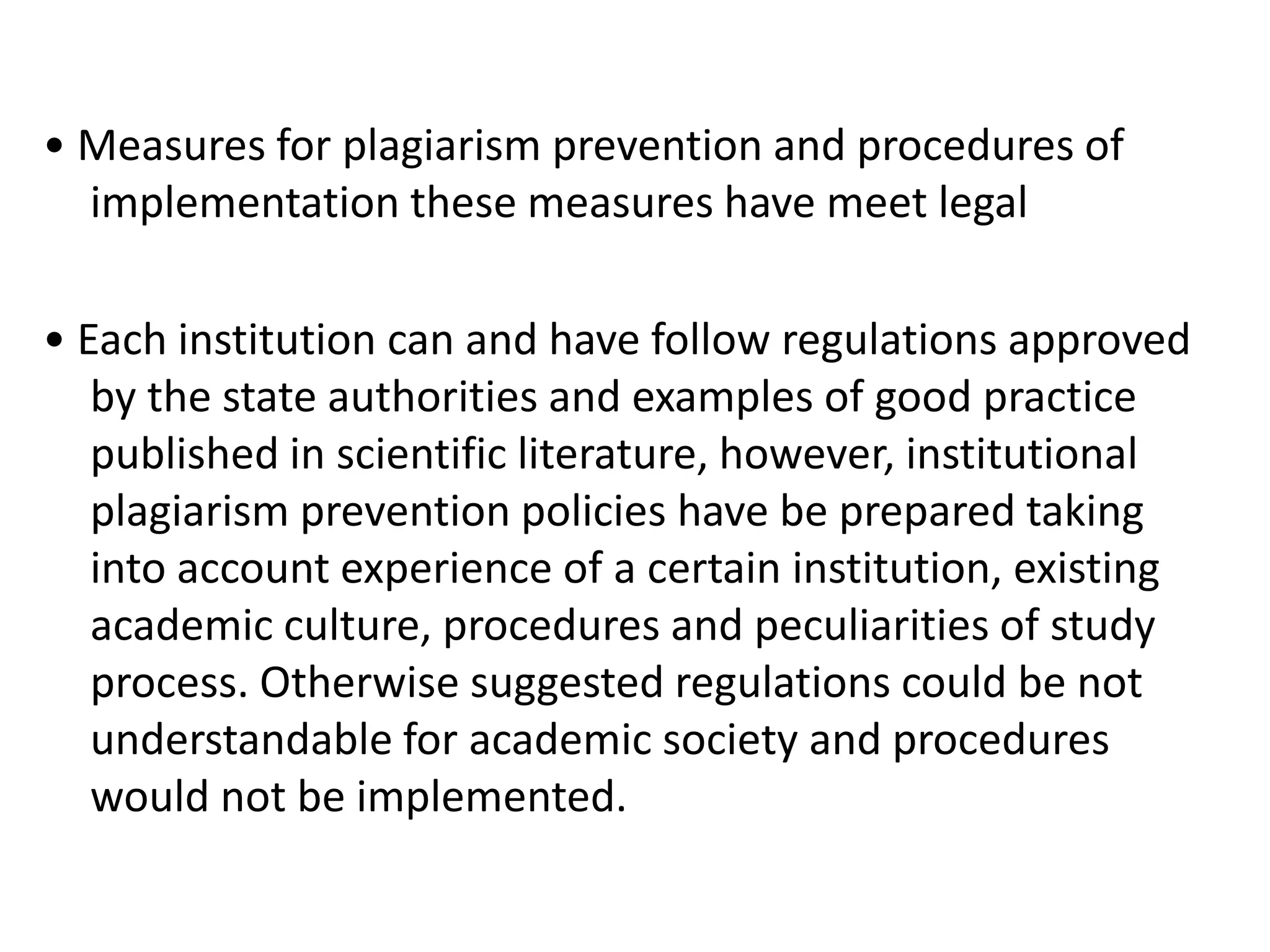
1. National Approach:
Sarlauskiene (2012) summarised results of research policies
that could be suggested following groups of plagiarism
prevention measures at national level:
• It is recommended in all countries and institutions to use
holistic approach for plagiarism prevention;
• Universities and other institutions of higher education are
initiating preparation of plagiarism prevention policy
more often and easier, if are conducted research surveys and
(or) are established responsible offices on national
level;
• Plagiarism prevention policies and measures at universities
have be prepared and implemented systematically,
pursuing management of institutional changes;
• Measures for plagiarism prevention and procedures of
implementation these measures have meet legal
• Each institution can and have follow regulations approved
by the state authorities and examples of good practice
published in scientific literature, however, institutional
plagiarism prevention policies have be prepared taking
into account experience of a certain institution, existing
academic culture, procedures and peculiarities of study
process. Otherwise suggested regulations could be not
understandable for academic society and procedures
would not be implemented.
09-Aug-16 27utpaldas@dibru.ac.in
09-Aug-16 utpaldas@dibru.ac.in 28
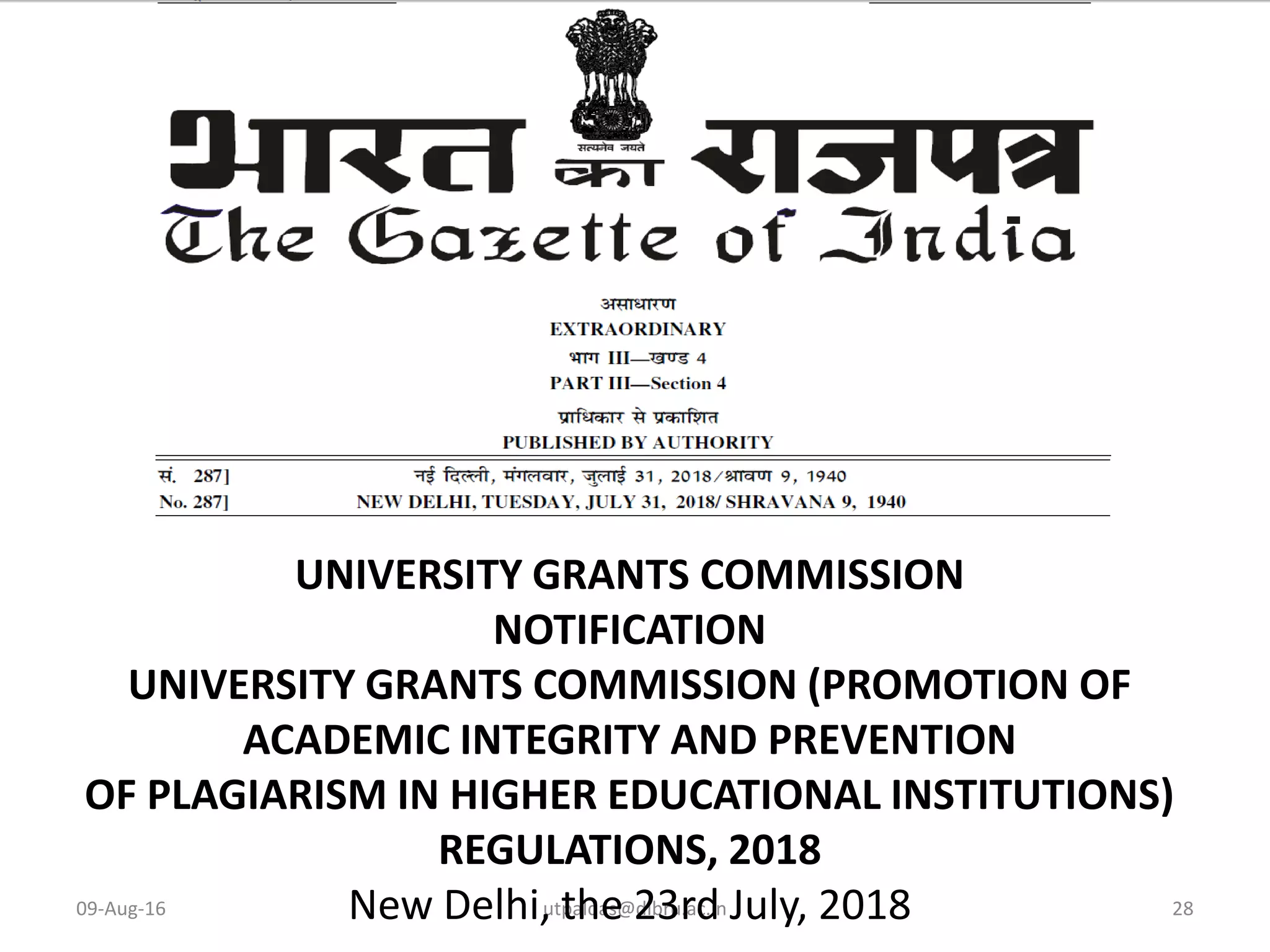
UNIVERSITY GRANTS COMMISSION
NOTIFICATION
UNIVERSITY GRANTS COMMISSION (PROMOTION OF
ACADEMIC INTEGRITY AND PREVENTION
OF PLAGIARISM IN HIGHER EDUCATIONAL INSTITUTIONS)
REGULATIONS, 2018
New Delhi, the 23rd July, 2018
2. Institutional approach:
Gibson et al. (2006) proposed practical measures for
plagiarism prevention in institutions:
• Combat ignorance (faculty members should help
students to select proper sources);
• Sharing responsibility (the procedure should be
provided at the faculty so, that students could present
their works in parts and lecturers could to check them
and to provide remarks);
Contd…
• Prevention of bought works (all lecturers have to
know how many possibilities students have to buy
works and to give students actual topics and ask to
show the sources analysed);
• Changes in academic environment and culture
(requirements have be determined, accepted and
followed, students have be informed about academic
integrity);
• Creation of barriers for plagiarism (for instance,
using measures for plagiarism detection).
3. Individual approach
The case analysis done at Versailles Saint-Quentin-en-
Yvelines University (UVSQ), Paris by Annane & Annane
(2012) reveals six principles to follow be each student to
avoid plagiarism.
A student has to commit that he or she not to:
• Copy books and other parts of the sources, but use only
small parts quoting them and indicating the source;
• Illustrate works with pictures, figures and diagrams
without referencing their original source;
• Present other authors ideas without referencing
their authorship;
• Present texts translated by other authors without
referencing their authorship;
• Use works of other people even in case of having
their permission or agreement on co-authorship if
co authorship is not indicated in the document;
• Appropriate the part or entire work prepared by
another person.
Important terminologies related to Plagiarism:
Author/Writers and the researchers need to understand
the intricacies of the following terminologies before writing
a research output:
1. Attribution
2. Citation
3. Copyright
4. Quote/Quotation Mark
5. Public Domain
6. Fair Use
7. Common Knowledge09-Aug-16 33
utpaldas@dibru.ac.in
1. What is Attribution ?
Attribution is an act of providing acknowledgement to
the source from where some ideas have been borrowed.
For example:
Barrow, in his book "The Manufacture and Testing of
Durable Book Papers,” demonstrated that it was possible
to treat newly manufactured papers with solutions of
magnesium and calcium bicarbonates, thus neutralizing
acidity and prolonging the life of such papers materially.
09-Aug-16 34utpaldas@dibru.ac.in
2. What is Citation?
A “citation” is a piece of detail and complete
information which describes the source(s) from
where certain materials / ideas have been borrowed
or analysed. It must enable the readers to find out
the source(s) again. A citation includes:
• information about the author(s)
• the title of the work
• the name and location of the company
that published the copy of the source
• the date the copy was published
• the page numbers of the material that have
borrowed/analysed
09-Aug-16 35utpaldas@dibru.ac.in
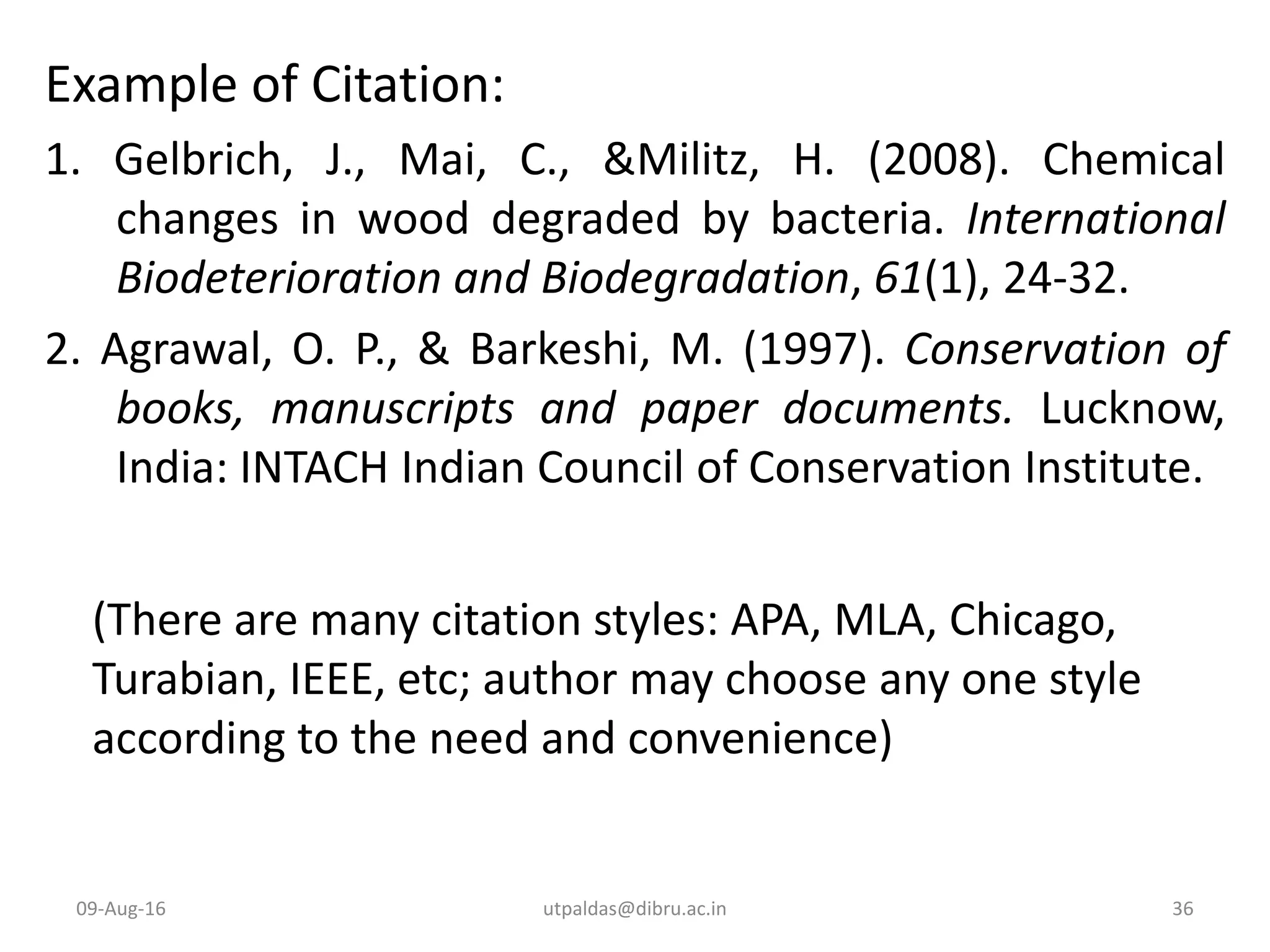
Example of Citation:
1. Gelbrich, J., Mai, C., &Militz, H. (2008). Chemical
changes in wood degraded by bacteria. International
Biodeterioration and Biodegradation, 61(1), 24-32.
2. Agrawal, O. P., & Barkeshi, M. (1997). Conservation of
books, manuscripts and paper documents. Lucknow,
India: INTACH Indian Council of Conservation Institute.
(There are many citation styles: APA, MLA, Chicago,
Turabian, IEEE, etc; author may choose any one style
according to the need and convenience)
09-Aug-16 36utpaldas@dibru.ac.in
When does a writer need to cite?
The following situations always require citation:
• Whenever a writer uses quotes
• Whenever a writer paraphrases
• Whenever a writer uses ideas that someone
else has already expressed
• Whenever a writer makes a specific reference
to the work of another
• Whenever someone else’s work has been
critical in developing writer’s own ideas
09-Aug-16 37utpaldas@dibru.ac.in
3. What is Copyright?
Copyright is a law that protects the intellectual
property created by an individual. It provides the
individual exclusive legal rights over distribution
and reproduction of that property. Intellectual
property of an individual may include music,
images, written words, text, video, and a variety of
other media.
Without written permission of the owner,
reproducing someone else’s ideas or information is
considered illegal as per copyright law.
.
09-Aug-16 38utpaldas@dibru.ac.in
Use of © symbol:
Till 1989, the © symbol was used as trademark
to indicate that the materials are protected by
copyright. But as per Law that established in
1989, however, works are now copyright
protected with or without the inclusion of this
symbol.
09-Aug-16 39utpaldas@dibru.ac.in
Is copyright violation is legal offence?
Improper use of copyrighted material, such as, copying
without permission, alteration of the original text, not
providing acknowledgement or citation, substantial
similarity to the original, etc. are severe violation of
the Copyright Act and considered as legal offence
which may invite prosecution in the court of law.
09-Aug-16 40utpaldas@dibru.ac.in
Can facts be copyrighted?
When “facts” are result of some individual
research then it is considered as intellectual
property of the researcher and thus absolutely
copyrighted
09-Aug-16 41utpaldas@dibru.ac.in
Are all published works copyrighted?
All published works may not be copyrighted. One can
borrow from the following domain without fear of
plagiarism:
• Compilations of readily available information, such as
the phone book, yearbook, atlas, etc.
• Works published by the government, such as
Economic Survey, Census of India, etc.
• Facts that are not the result of original research of an
individual (such as, there are 29 states & 7 union
territories in India, or Hemoglobin contains 4 iron
molecules)
• Works in the “public domain”.
In all the above cases one need to cite properly.09-Aug-16 42utpaldas@dibru.ac.in
4. USING QUOTE- HOW MUCH
A quote is a word, sentence, or sentences that a
writer copies exactly from a source
• You may use 3-4 words without citing a source. if you
use five or more words from a sentence, you should
quote and cite it.
• A quote is enclosed in quotation marks (for quotes
up to 39 words).
• For quotes of 40 or more words, it stands alone
without quotation marks and is indented five (5)
spaces from the left margin.
09-Aug-16 utpaldas@dibru.ac.in 43
SINGLE VS DOUBLE QUOTATION MARKS
• You should use double quotation marks when you quote
material from a source. If you are also quoting passages
from that source that were quoted in the original
source, use single quotation marks to indicate that the
original source contained the quotation.
• http://isites.harvard.edu/icb/icb.do?keyword=k70847&tabgroupid=icb.tabgroup108986
09-Aug-16 utpaldas@dibru.ac.in 44
5. What is Public Domain?
All works that are no longer protected by copyright,
or never under any copyright act, are considered as
“public domain.”
One may freely make use material from these works
without fear of plagiarism, provided he or she
provides proper attributions of it.
09-Aug-16 45utpaldas@dibru.ac.in
How do I know if something is public
domain or not?
In general, anything published more than 75
years ago is now in the public domain.
Works published after 1978 are protected for
the lifetime of the author plus 60 years.
09-Aug-16 46utpaldas@dibru.ac.in
6. What is “fair use”?
Fair use is a doctrine in the law of the United States that
permits limited use of copyrighted material without having to
first acquire permission from the copyright holder.
The “fair use policy” acts as guideline to decide whether the
use of a source is acceptable or contravene copyright laws.
Below some are viewpoints that determine the fairness of any
given usage
The nature of use
The amount used
The effect of used material on the original
09-Aug-16 47utpaldas@dibru.ac.in
The nature of use
If an author has merely copied something from
an original source, it is unlikely to be
considered ‘fair use’. But if the original source
has been transformed through interpretation,
analysis, modification, etc. and presented as
an original output, it is more likely to be
considered as ‘fair use.’
09-Aug-16 48utpaldas@dibru.ac.in
The amount used
If the amount of borrowing from an original
source is less then it is less likely it is to be
considered fair use. The more you borrow, the
more it is likely to be considered as fair use.
09-Aug-16 49utpaldas@dibru.ac.in
The effect of used material on the original
If an author has substantially borrowed from an
original source and created a work that competes
with the original source in the market which may
do the original author economic harm, is likely to
be considered fair use.
It is always better to have difference in objective of
the work or its target audience from that of the
original work to avoid possibilities of ‘fair use’.
09-Aug-16 50utpaldas@dibru.ac.in
7. WHAT IS “COMMON KNOWLEDGE”?
• A well-known fact
• Information that is likely to appear in numerous
sources and to be familiar to large numbers of
people
• This is the only time you do not need to cite
information, provided that you do not copy that
information word-for-word from a source
• If you are not sure if the information you want to use
meets these definitions, cite it
• If at least 10 peer-review papers in your discipline
don’t give a citation for the information, then you
don’t need to
09-Aug-16 utpaldas@dibru.ac.in 51
EXAMPLES OF COMMON KNOWLEDGE
• Martin Luther King, Jr. was assassinated on April 4,
1968
• East Carolina University is located in Greenville, NC
and is part of the UNC system
• Smoking can cause respiratory diseases such as
emphysema and cancer
09-Aug-16 utpaldas@dibru.ac.in 52
What may be Excluded from Plagiarism check?
The following may be excluded at the time of
performing the plagiarism check:
A. Quotes
B. Bibliography
C. Phrases
D. Small matches upto 14 words
E. Mathematical Formula/Scientific Laws
F. Name of Institutions, Departments etc.
G. Small similarity less than 1%
09-Aug-16 53utpaldas@dibru.ac.in
As Per UGC Regulation 2018, the similarity checks for
plagiarism shall exclude the following:
i. All quoted work reproduced with all necessary
permission and/or attribution.
ii. All references, bibliography, table of content, preface
and acknowledgements.
iii. All generic terms, laws, standard symbols and
standards equations.
09-Aug-16 utpaldas@dibru.ac.in 54
The UGC Regulation 2018 also states that
• The research work carried out by the student, faculty,
researcher and staff shall be based on original ideas,
which shall include abstract, summary, hypothesis,
observations, results, conclusions and
recommendations only and shall not have any
similarities.
• It shall exclude a common knowledge or coincidental
terms, up to fourteen (14) consecutive words
09-Aug-16 utpaldas@dibru.ac.in 55
Whether plagiarism invites penalty?
a. Penalties for independent researcher:
Violation of Copyright Act by independent
researcher or author through plagiarism is
considered as legal offence which may attract
prosecution in the court of law leading to several
kinds of penalties depending on the severity of
crime
09-Aug-16 56utpaldas@dibru.ac.in
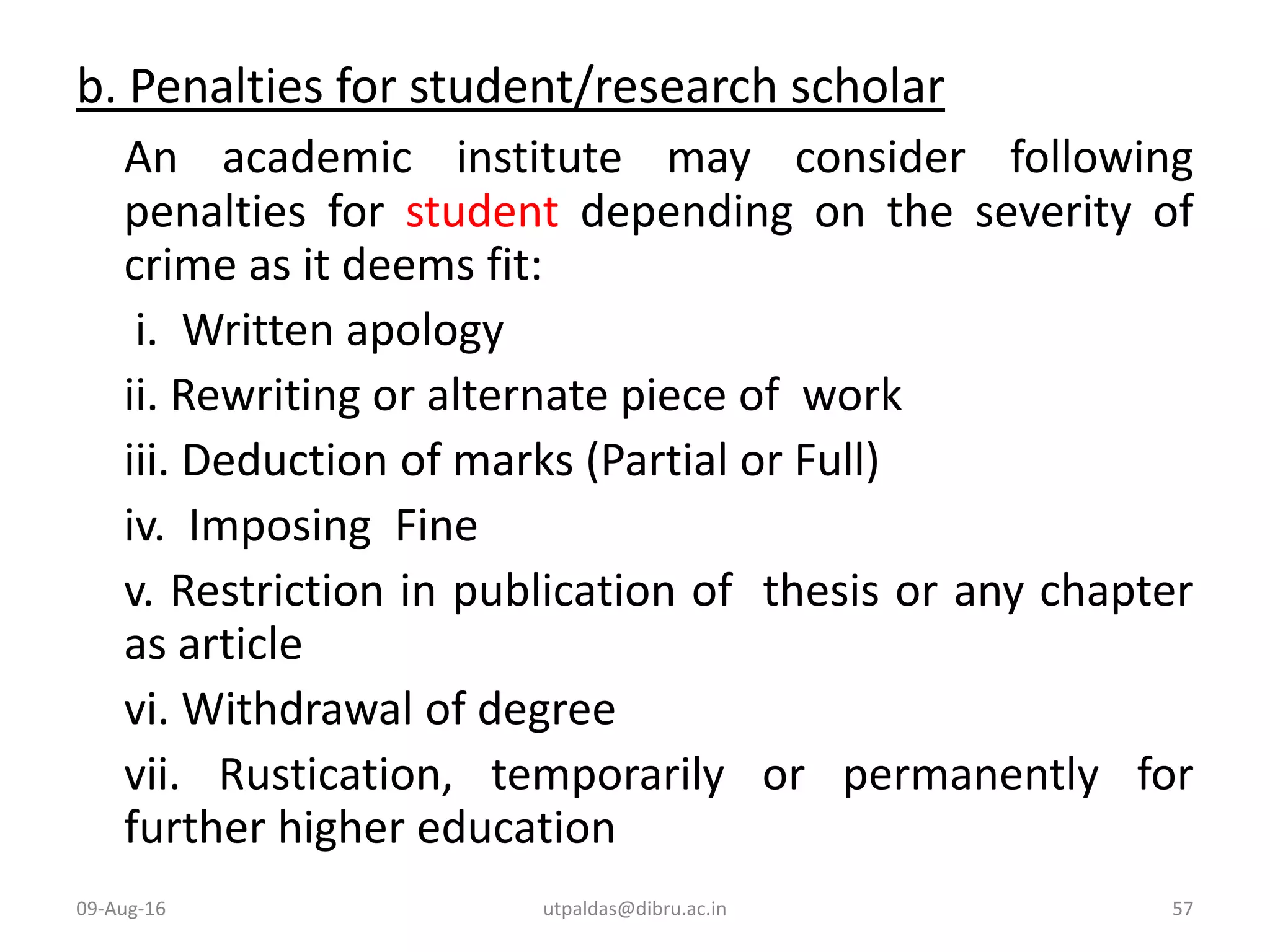
b. Penalties for student/research scholar
An academic institute may consider following
penalties for student depending on the severity of
crime as it deems fit:
i. Written apology
ii. Rewriting or alternate piece of work
iii. Deduction of marks (Partial or Full)
iv. Imposing Fine
v. Restriction in publication of thesis or any chapter
as article
vi. Withdrawal of degree
vii. Rustication, temporarily or permanently for
further higher education
09-Aug-16 57utpaldas@dibru.ac.in
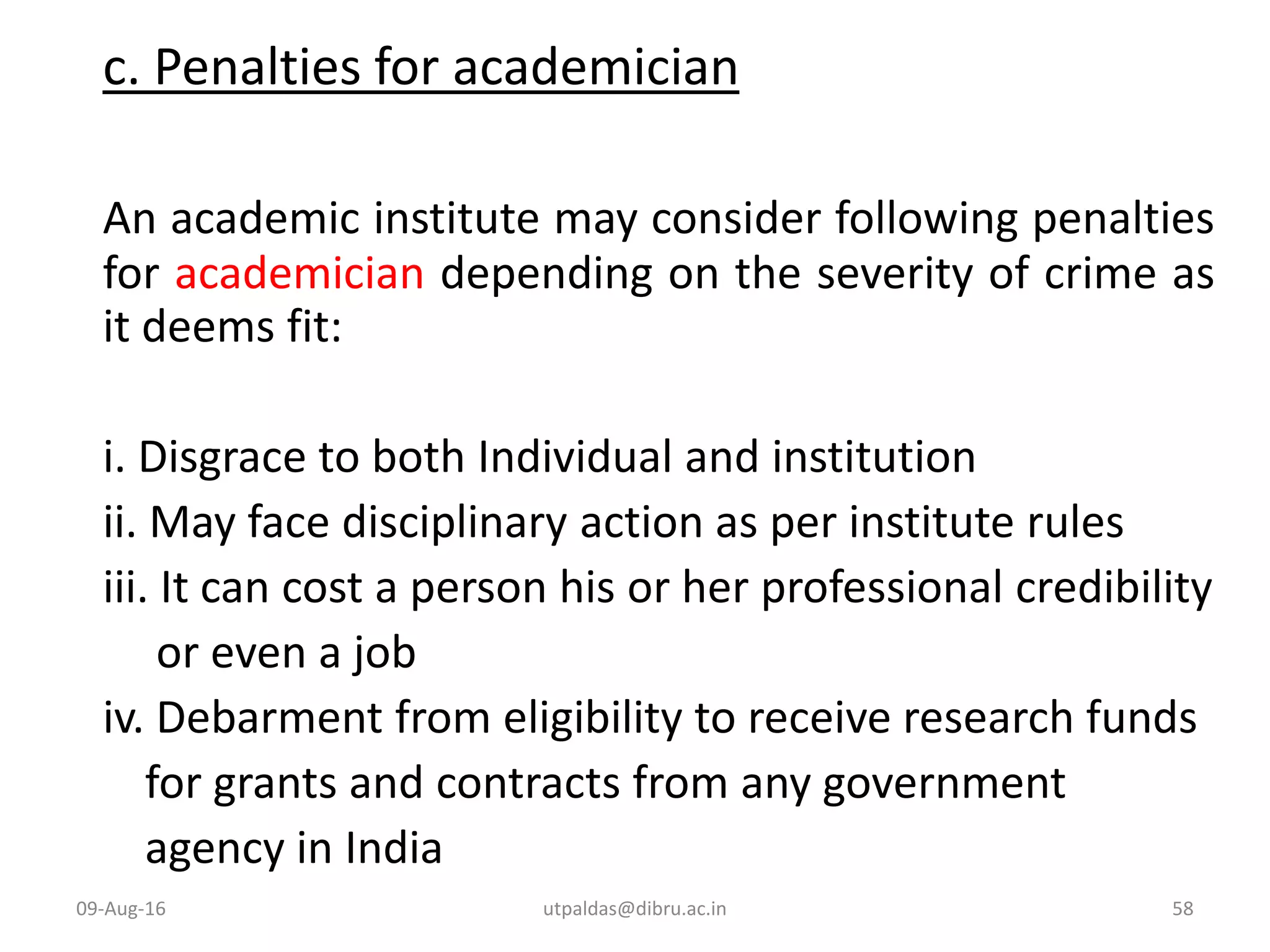
c. Penalties for academician
An academic institute may consider following penalties
for academician depending on the severity of crime as
it deems fit:
i. Disgrace to both Individual and institution
ii. May face disciplinary action as per institute rules
iii. It can cost a person his or her professional credibility
or even a job
iv. Debarment from eligibility to receive research funds
for grants and contracts from any government
agency in India
09-Aug-16 58utpaldas@dibru.ac.in
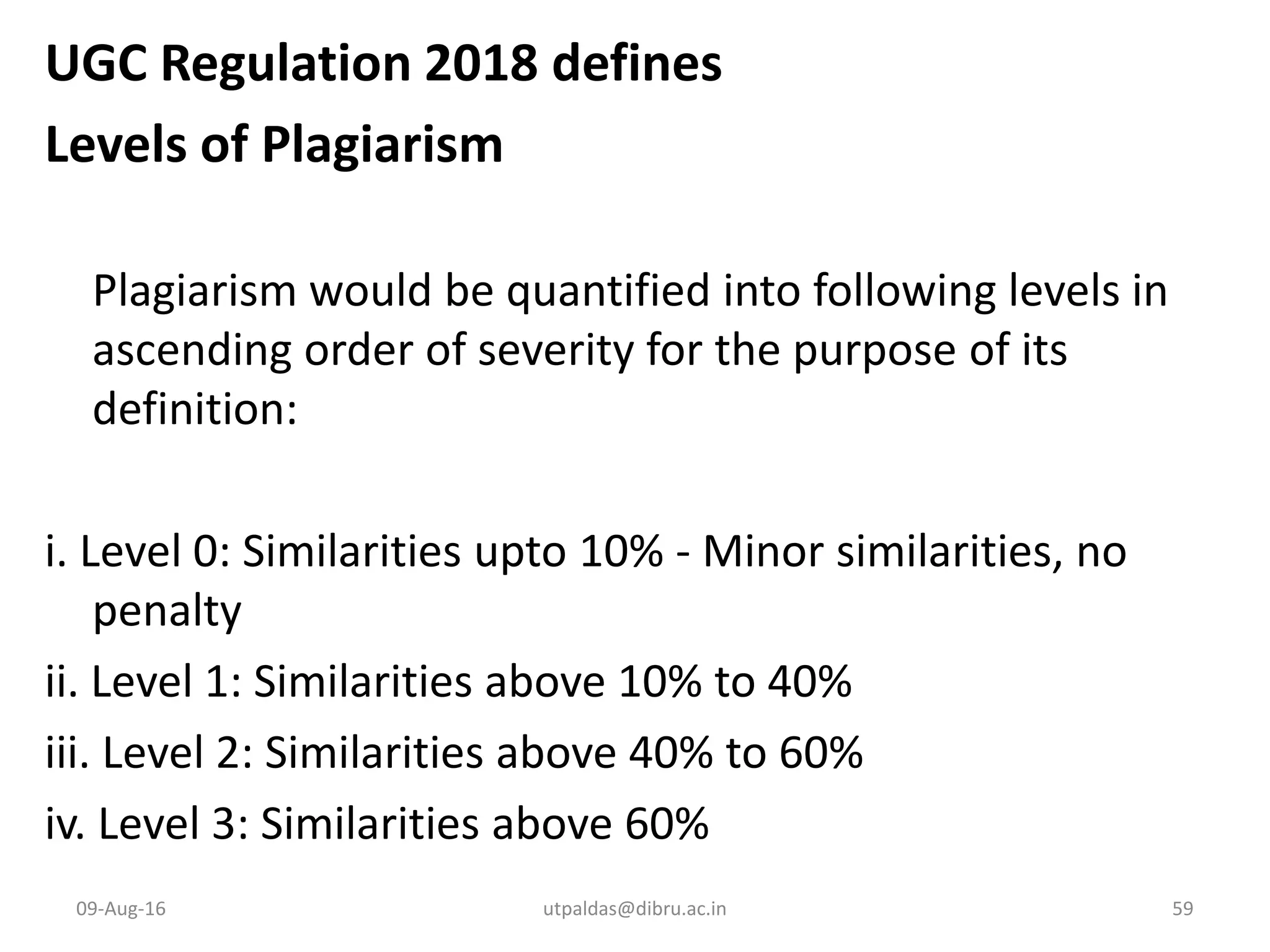
UGC Regulation 2018 defines
Levels of Plagiarism
Plagiarism would be quantified into following levels in
ascending order of severity for the purpose of its
definition:
i. Level 0: Similarities upto 10% - Minor similarities, no
penalty
ii. Level 1: Similarities above 10% to 40%
iii. Level 2: Similarities above 40% to 60%
iv. Level 3: Similarities above 60%
09-Aug-16 utpaldas@dibru.ac.in 59
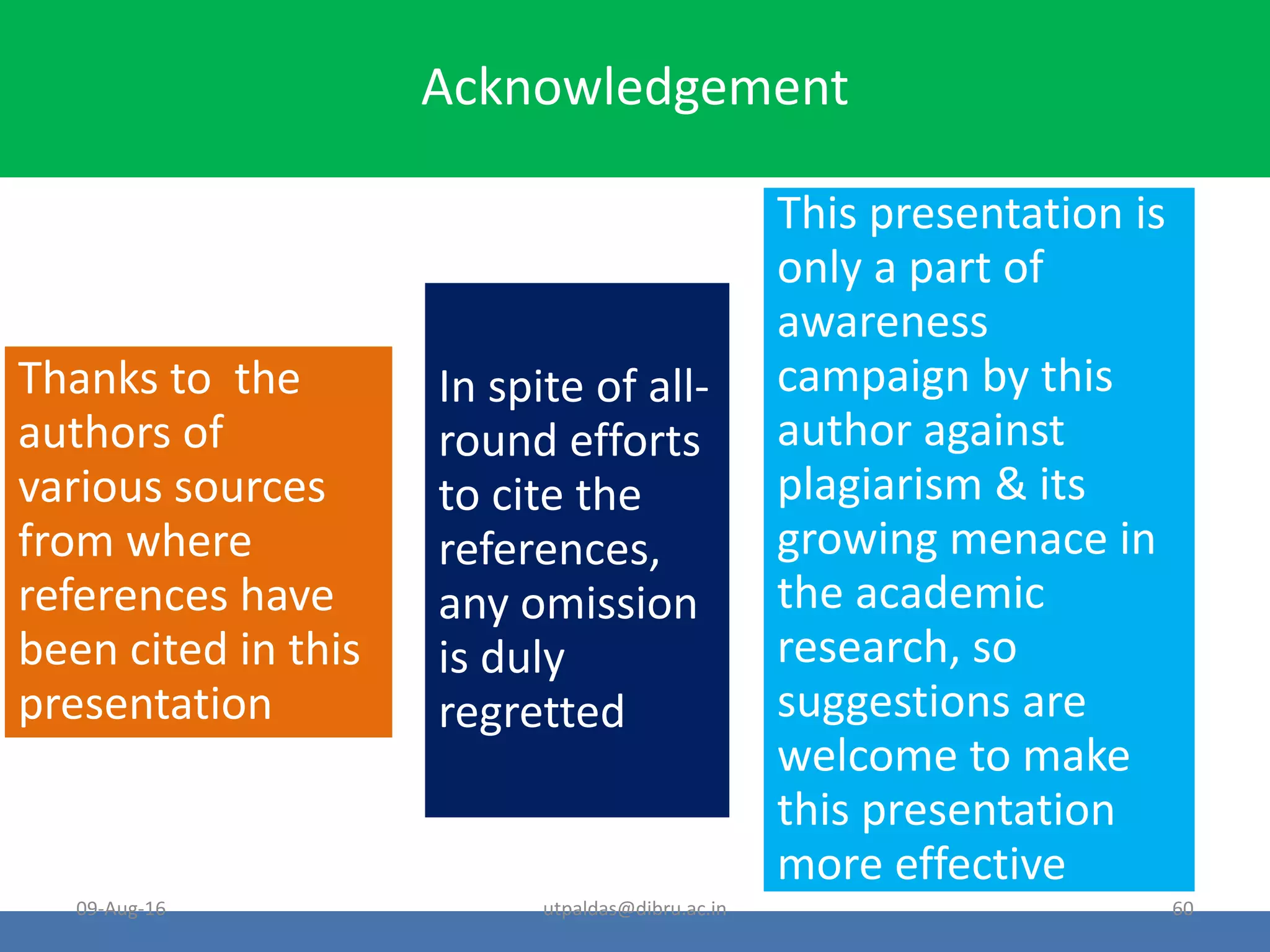
Acknowledgement
Thanks to the
authors of
various sources
from where
references have
been cited in this
presentation
In spite of all-
round efforts
to cite the
references,
any omission
is duly
regretted
This presentation is
only a part of
awareness
campaign by this
author against
plagiarism & its
growing menace in
the academic
research, so
suggestions are
welcome to make
this presentation
more effective
09-Aug-16 60utpaldas@dibru.ac.in
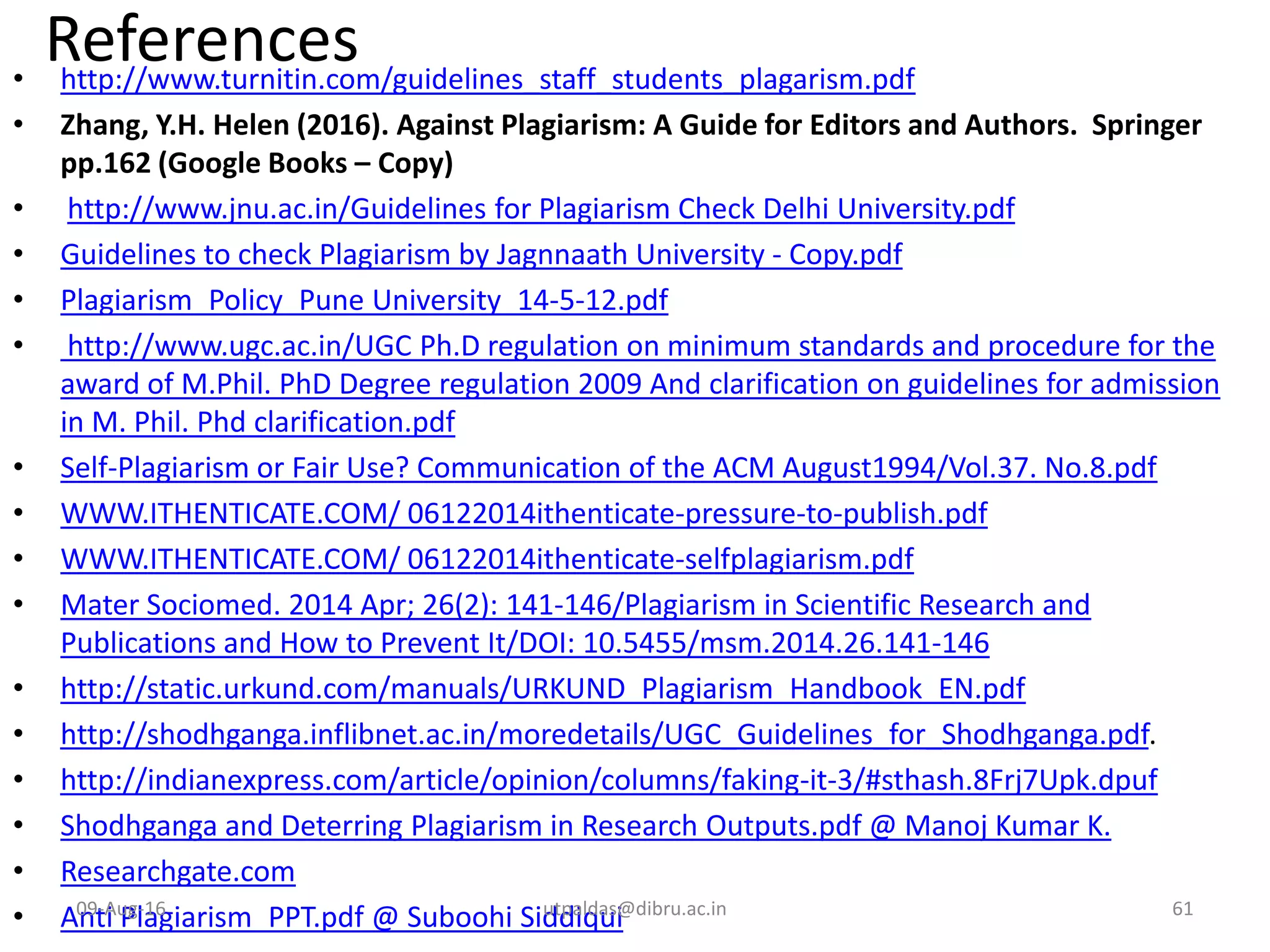
References• http://www.turnitin.com/guidelines_staff_students_plagarism.pdf
• Zhang, Y.H. Helen (2016). Against Plagiarism: A Guide for Editors and Authors. Springer
pp.162 (Google Books – Copy)
• http://www.jnu.ac.in/Guidelines for Plagiarism Check Delhi University.pdf
• Guidelines to check Plagiarism by Jagnnaath University - Copy.pdf
• Plagiarism_Policy_Pune University_14-5-12.pdf
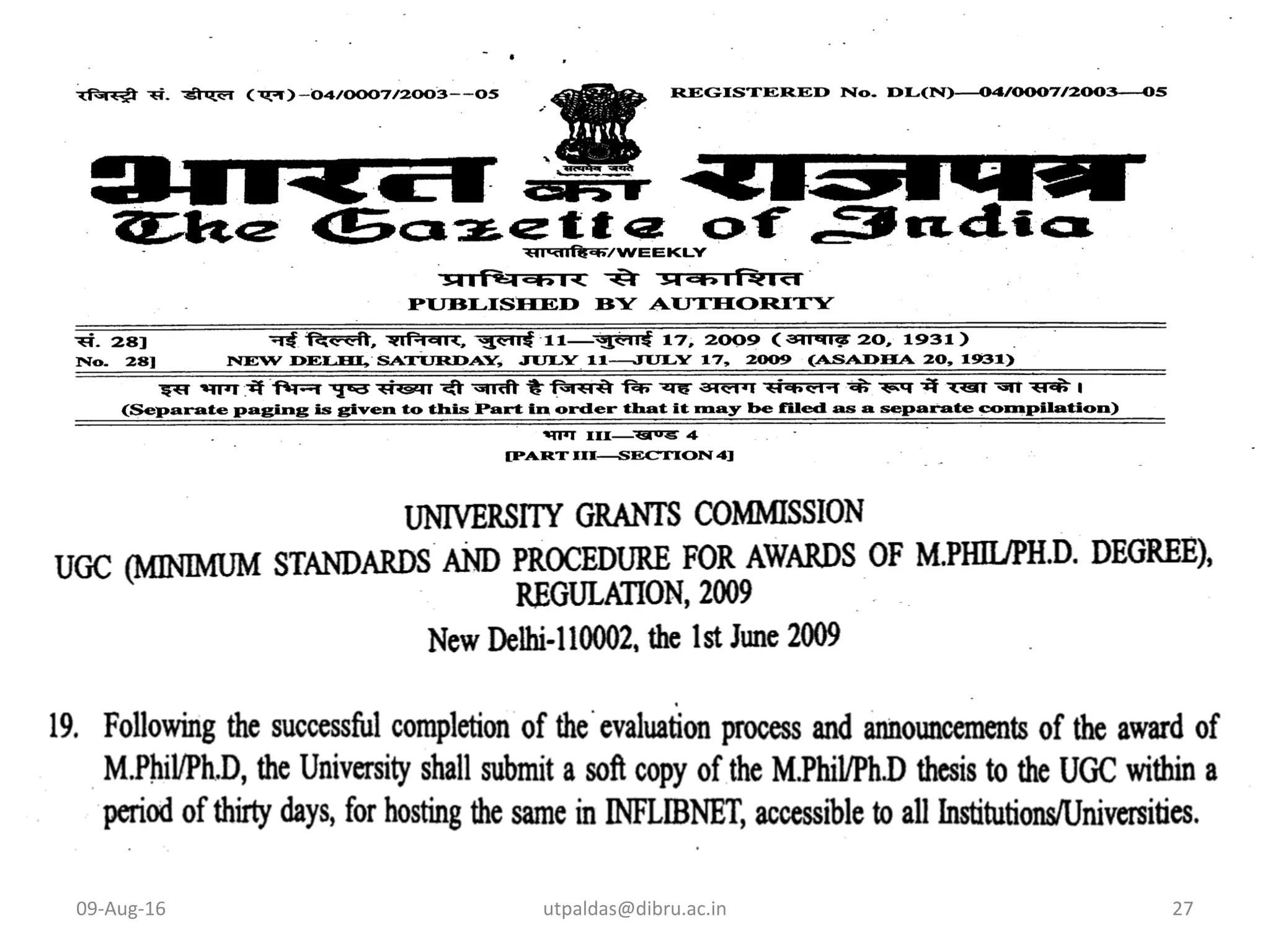
• http://www.ugc.ac.in/UGC Ph.D regulation on minimum standards and procedure for the
award of M.Phil. PhD Degree regulation 2009 And clarification on guidelines for admission
in M. Phil. Phd clarification.pdf
• Self-Plagiarism or Fair Use? Communication of the ACM August1994/Vol.37. No.8.pdf
• WWW.ITHENTICATE.COM/ 06122014ithenticate-pressure-to-publish.pdf
• WWW.ITHENTICATE.COM/ 06122014ithenticate-selfplagiarism.pdf
• Mater Sociomed. 2014 Apr; 26(2): 141-146/Plagiarism in Scientific Research and
Publications and How to Prevent It/DOI: 10.5455/msm.2014.26.141-146
• http://static.urkund.com/manuals/URKUND_Plagiarism_Handbook_EN.pdf
• http://shodhganga.inflibnet.ac.in/moredetails/UGC_Guidelines_for_Shodhganga.pdf.
• http://indianexpress.com/article/opinion/columns/faking-it-3/#sthash.8Frj7Upk.dpuf
• Shodhganga and Deterring Plagiarism in Research Outputs.pdf @ Manoj Kumar K.
• Researchgate.com
• Anti Plagiarism_PPT.pdf @ Suboohi Siddiqui09-Aug-16 61utpaldas@dibru.ac.in
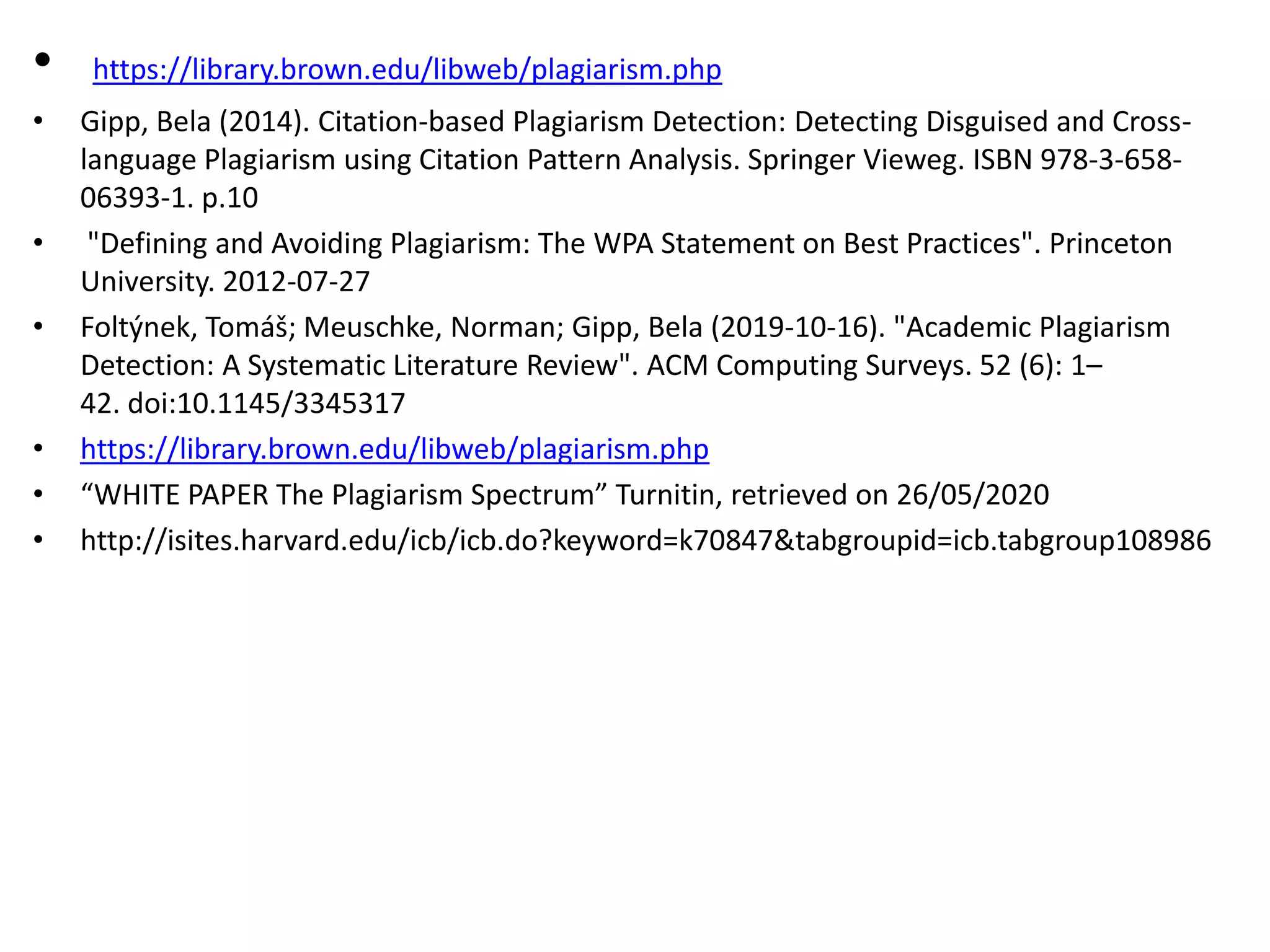
• https://library.brown.edu/libweb/plagiarism.php
• Gipp, Bela (2014). Citation-based Plagiarism Detection: Detecting Disguised and Cross-
language Plagiarism using Citation Pattern Analysis. Springer Vieweg. ISBN 978-3-658-
06393-1. p.10
• "Defining and Avoiding Plagiarism: The WPA Statement on Best Practices". Princeton
University. 2012-07-27
• Foltýnek, Tomáš; Meuschke, Norman; Gipp, Bela (2019-10-16). "Academic Plagiarism
Detection: A Systematic Literature Review". ACM Computing Surveys. 52 (6): 1–
42. doi:10.1145/3345317
• https://library.brown.edu/libweb/plagiarism.php
• “WHITE PAPER The Plagiarism Spectrum” Turnitin, retrieved on 26/05/2020
• http://isites.harvard.edu/icb/icb.do?keyword=k70847&tabgroupid=icb.tabgroup108986
Thanks

Plagiarism in HEI and how to avoid it

  • 1.
    Plagiarism in HEIand how to avoid it Dr. Utpal Das, Deputy Librarian Dibrugarh University, Dibrugarh, Assam utpalishaan@gmail.com
  • 2.
    Two fundamental Characteristicsof Research Work: Novelty Originality
  • 3.
    Novelty and originalityof a research work is holistically depended on: Experimental or observed facts Analytic/scientific truth Intellectual honesty
  • 4.
  • 5.
    Academic Integrity UGC Regulation2018 defines: “Academic Integrity” is the intellectual honesty in proposing, performing and reporting any activity, which leads to the creation of intellectual property.
  • 6.
    When we talkabout upholding “intellectual honesty” of any research work, it means, the research work is completely free from the following: Fabrication Falsification Plagiarism
  • 7.
  • 8.
    Plagiarism: Definition Gipp, Bela(2014). Citation-based Plagiarism Detection: Detecting Disguised and Cross-language Plagiarism using Citation Pattern Analysis. Springer Vieweg. ISBN 978-3-658-06393-1. p.10 Bela Gipp (2014) defined plagiarism as the following: "The use of ideas, concepts, words, or structures without appropriately acknowledging the source to benefit in a setting where originality is expected
  • 9.
    Contd… The ‘Council ofWriting Program Administrators’ of Princeton University , in their Statement on Best Practices (2012), describes plagiarism as: ‘the "deliberate" use of "someone else's language, ideas, or other original (not common-knowledge) material without acknowledging its source’ "Defining and Avoiding Plagiarism: The WPA Statement on Best Practices". Princeton University. 2012-07- 27
  • 10.
    Contd… As defined bythe Brown University Writing Center, Plagiarism is ‘Appropriating another person's ideas or words (spoken or written) without attributing those word or ideas to their true source…’ Source: https://library.brown.edu/libweb/plagiarism.php
  • 11.
    Why do peopleplagiarize? • Study Pressure, • Disorganization, • Poor Study habits, • Cut-and-Paste culture, • English as the international language • Lack of understanding of seriousness of plagiarism. • Lack of strict Academic Discipline • Careless attitude • Lack of referencing skills 11
  • 12.
    Plagiarism: Forms Different classificationsof academic plagiarism forms have been proposed by many scientists like: John Walker (1998) Mozgovoy et al (2010) (Maxim Mozgovoy, Tuomo Kakkonen, and Georgina Cosma) Zakiy Firdaus Alfikri and Ayu Purwarianti (2014) Debora Weber-Wulff (2014) Velasquez et al (2016) (Juan D. Velásquez , Yerko Covacevich, Francisco Molina, Edison Marrese-Taylor, Cristián Rodríguez, and Felipe Bravo-Marquez) Hussain A. Chowdhury and D.K. Bhattacharyya (2016)
  • 13.
    contd... In 2015, Turnitin, made a survey of professors and teachers both from HEI and Secondary Education and based on feedback from 879 survey respondents , identified 10 main forms of plagiarism and ranked them according to frequency of occurrences: Source: “WHITE PAPER The Plagiarism Spectrum” Turnitin, retrieved on 26/05/2020
  • 14.
    Contd… 1. CLONE: An actof submitting another’s work, word-for-word, as one’s own. 2. CTRL-C: A written piece that contains significant portions of text from a single source without alterations. 3. FIND–REPLACE: The act of changing key words and phrases but retaining the essential content of the source in a paper. 4. REMIX: An act of paraphrasing from other sources and making the content fit together seamlessly. 5. RECYCLE: The act of borrowing generously from one’s own previous work without citation; To self plagiarize. Source: “WHITE PAPER The Plagiarism Spectrum” Turnitin, retrieved on 26/05/2020
  • 15.
    Contd… 6. HYBRID: The actof combining perfectly cited sources with copied passages— without citation—in one paper. 7. MASHUP: A paper that represents a mix of copied material from several different sources without proper citation. 8. 404 ERROR: A written piece that includes citations to non-existent or inaccurate information about sources 9. AGGREGATOR: The “Aggregator” includes proper citation, but the paper contains almost no original work. 10. RE-TWEET: This paper includes proper citation, but relies too closely on the text’s original wording and/or structure. Source: “WHITE PAPER The Plagiarism Spectrum” Turnitin, retrieved on 26/05/2020
  • 16.
    A systematic literaturereview by Tomas et. el. in 2019 deductively derived a typology of academic plagiarism extending the classic three-layered language model (lexis, syntax, and semantics) to four layers (ideas & structures) and categorized plagiarism forms according to the layer of the model they affect as the following: Foltýnek, Tomáš; Meuschke, Norman; Gipp, Bela (2019-10-16). "Academic Plagiarism Detection: A Systematic Literature Review". ACM Computing Surveys. 52 (6): 1–42. doi:10.1145/3345317
  • 17.
    Contd... 1. Characters-preserving plagiarism •Literal plagiarism (copy and paste i.e. Verbatim copying) • Possibly with mentioning the source 2. Syntax-preserving plagiarism • Technical disguise (e.g. using identically looking glyphs from another alphabet) • Synonym substitution 3. Semantics-preserving plagiarism • Translation • Paraphrase (mosaic, clause quilts, restatement, additional manner of expression) Foltýnek, Tomáš; Meuschke, Norman; Gipp, Bela (2019-10-16). "Academic Plagiarism Detection: A Systematic Literature Review". ACM Computing Surveys. 52 (6): 1–42. doi:10.1145/3345317
  • 18.
    Contd… 4. Idea-preserving plagiarism •Structural plagiarism (Reusing text structure) • Appropriation of concepts and ideas only 5. Ghostwriting • Collusion (secret cooperation or deceitful agreement in order to deceive others) • Contract cheating ( to pay others to complete their coursework) Foltýnek, Tomáš; Meuschke, Norman; Gipp, Bela (2019-10-16). "Academic Plagiarism Detection: A Systematic Literature Review". ACM Computing Surveys. 52 (6): 1–42. doi:10.1145/3345317
  • 19.
    Besides above, thefollowing are also categorised as plagiarism: • Failure to acknowledge assistance • Use of materials written by of professional agencies • Repetitive research • Replication • Re-publication in translation without permission & • acknowledgement • Reverse plagiarism refers to falsely giving authorship credit over a work to a person who did not author it, or falsely claiming a source 09-Aug-16 utpaldas@dibru.ac.in 19
  • 20.
    The Menace The problemof academic plagiarism is not new but has been present for centuries in the literary world. The Latin word "plagiarius" (literally "kidnapper") was coined in the 1st century, to denote stealing someone else's work . It was pioneered by the Roman poet Marcus Valerius Martialis, who complained that another poet had "kidnapped his verses“ The Latin word plagiārius, meaning "kidnapper“ and plagium, meaning "kidnapping", is based on the Indo-European root - plak, "to weave” The word plagiarism was derived from here and introduced into English around 1620 indicating its existence in 17 Century AD
  • 21.
    Contd... However, the rapidand continuous advancement of information technology (IT), which offers convenient and instant access to vast amounts of information, has made plagiarizing easier than ever. At the same time, IT also facilitated the detection of academic plagiarism in a faster and convenient way.
  • 22.
    Technology driven society •The massive ongoing explosion of information • Impact of Social Media • Growing impact of technology • Increasing complexity and volatility due cross disciplinary research. • increasingly questioning the value of the research in universities and also the economy and of graduate employability 09-Aug-16 utpaldas@dibru.ac.in 22
  • 23.
    Contd… Plagiarism in HEI: Forthe first time in the year 2000, the higher educational institutions in UK started deeper investigation into problems of plagiarism. Scientists like, Carroll & Appleton (2001) Bretag (2005) , Joyce (2008), East (2009), highlighted holistic approach towards plagiarism prevention and claimed that it is impossible to reduce the extent of plagiarism in higher educational institutions, applying separate or isolated measures.
  • 24.
    How to avoidAcademic Plagiarism Scientists believe that avoiding the menace of academic plagiarism needs a holistic approach, may be divided in to three ways: 1. National approach 2. Institutional approach 3. Individual approach
  • 25.
    1. National Approach: Sarlauskiene(2012) summarised results of research policies that could be suggested following groups of plagiarism prevention measures at national level: • It is recommended in all countries and institutions to use holistic approach for plagiarism prevention; • Universities and other institutions of higher education are initiating preparation of plagiarism prevention policy more often and easier, if are conducted research surveys and (or) are established responsible offices on national level; • Plagiarism prevention policies and measures at universities have be prepared and implemented systematically, pursuing management of institutional changes;
  • 26.
    • Measures forplagiarism prevention and procedures of implementation these measures have meet legal • Each institution can and have follow regulations approved by the state authorities and examples of good practice published in scientific literature, however, institutional plagiarism prevention policies have be prepared taking into account experience of a certain institution, existing academic culture, procedures and peculiarities of study process. Otherwise suggested regulations could be not understandable for academic society and procedures would not be implemented.
  • 27.
  • 28.
    09-Aug-16 utpaldas@dibru.ac.in 28 UNIVERSITYGRANTS COMMISSION NOTIFICATION UNIVERSITY GRANTS COMMISSION (PROMOTION OF ACADEMIC INTEGRITY AND PREVENTION OF PLAGIARISM IN HIGHER EDUCATIONAL INSTITUTIONS) REGULATIONS, 2018 New Delhi, the 23rd July, 2018
  • 29.
    2. Institutional approach: Gibsonet al. (2006) proposed practical measures for plagiarism prevention in institutions: • Combat ignorance (faculty members should help students to select proper sources); • Sharing responsibility (the procedure should be provided at the faculty so, that students could present their works in parts and lecturers could to check them and to provide remarks);
  • 30.
    Contd… • Prevention ofbought works (all lecturers have to know how many possibilities students have to buy works and to give students actual topics and ask to show the sources analysed); • Changes in academic environment and culture (requirements have be determined, accepted and followed, students have be informed about academic integrity); • Creation of barriers for plagiarism (for instance, using measures for plagiarism detection).
  • 31.
    3. Individual approach Thecase analysis done at Versailles Saint-Quentin-en- Yvelines University (UVSQ), Paris by Annane & Annane (2012) reveals six principles to follow be each student to avoid plagiarism. A student has to commit that he or she not to: • Copy books and other parts of the sources, but use only small parts quoting them and indicating the source; • Illustrate works with pictures, figures and diagrams without referencing their original source;
  • 32.
    • Present otherauthors ideas without referencing their authorship; • Present texts translated by other authors without referencing their authorship; • Use works of other people even in case of having their permission or agreement on co-authorship if co authorship is not indicated in the document; • Appropriate the part or entire work prepared by another person.
  • 33.
    Important terminologies relatedto Plagiarism: Author/Writers and the researchers need to understand the intricacies of the following terminologies before writing a research output: 1. Attribution 2. Citation 3. Copyright 4. Quote/Quotation Mark 5. Public Domain 6. Fair Use 7. Common Knowledge09-Aug-16 33 utpaldas@dibru.ac.in
  • 34.
    1. What isAttribution ? Attribution is an act of providing acknowledgement to the source from where some ideas have been borrowed. For example: Barrow, in his book "The Manufacture and Testing of Durable Book Papers,” demonstrated that it was possible to treat newly manufactured papers with solutions of magnesium and calcium bicarbonates, thus neutralizing acidity and prolonging the life of such papers materially. 09-Aug-16 34utpaldas@dibru.ac.in
  • 35.
    2. What isCitation? A “citation” is a piece of detail and complete information which describes the source(s) from where certain materials / ideas have been borrowed or analysed. It must enable the readers to find out the source(s) again. A citation includes: • information about the author(s) • the title of the work • the name and location of the company that published the copy of the source • the date the copy was published • the page numbers of the material that have borrowed/analysed 09-Aug-16 35utpaldas@dibru.ac.in
  • 36.
    Example of Citation: 1.Gelbrich, J., Mai, C., &Militz, H. (2008). Chemical changes in wood degraded by bacteria. International Biodeterioration and Biodegradation, 61(1), 24-32. 2. Agrawal, O. P., & Barkeshi, M. (1997). Conservation of books, manuscripts and paper documents. Lucknow, India: INTACH Indian Council of Conservation Institute. (There are many citation styles: APA, MLA, Chicago, Turabian, IEEE, etc; author may choose any one style according to the need and convenience) 09-Aug-16 36utpaldas@dibru.ac.in
  • 37.
    When does awriter need to cite? The following situations always require citation: • Whenever a writer uses quotes • Whenever a writer paraphrases • Whenever a writer uses ideas that someone else has already expressed • Whenever a writer makes a specific reference to the work of another • Whenever someone else’s work has been critical in developing writer’s own ideas 09-Aug-16 37utpaldas@dibru.ac.in
  • 38.
    3. What isCopyright? Copyright is a law that protects the intellectual property created by an individual. It provides the individual exclusive legal rights over distribution and reproduction of that property. Intellectual property of an individual may include music, images, written words, text, video, and a variety of other media. Without written permission of the owner, reproducing someone else’s ideas or information is considered illegal as per copyright law. . 09-Aug-16 38utpaldas@dibru.ac.in
  • 39.
    Use of ©symbol: Till 1989, the © symbol was used as trademark to indicate that the materials are protected by copyright. But as per Law that established in 1989, however, works are now copyright protected with or without the inclusion of this symbol. 09-Aug-16 39utpaldas@dibru.ac.in
  • 40.
    Is copyright violationis legal offence? Improper use of copyrighted material, such as, copying without permission, alteration of the original text, not providing acknowledgement or citation, substantial similarity to the original, etc. are severe violation of the Copyright Act and considered as legal offence which may invite prosecution in the court of law. 09-Aug-16 40utpaldas@dibru.ac.in
  • 41.
    Can facts becopyrighted? When “facts” are result of some individual research then it is considered as intellectual property of the researcher and thus absolutely copyrighted 09-Aug-16 41utpaldas@dibru.ac.in
  • 42.
    Are all publishedworks copyrighted? All published works may not be copyrighted. One can borrow from the following domain without fear of plagiarism: • Compilations of readily available information, such as the phone book, yearbook, atlas, etc. • Works published by the government, such as Economic Survey, Census of India, etc. • Facts that are not the result of original research of an individual (such as, there are 29 states & 7 union territories in India, or Hemoglobin contains 4 iron molecules) • Works in the “public domain”. In all the above cases one need to cite properly.09-Aug-16 42utpaldas@dibru.ac.in
  • 43.
    4. USING QUOTE-HOW MUCH A quote is a word, sentence, or sentences that a writer copies exactly from a source • You may use 3-4 words without citing a source. if you use five or more words from a sentence, you should quote and cite it. • A quote is enclosed in quotation marks (for quotes up to 39 words). • For quotes of 40 or more words, it stands alone without quotation marks and is indented five (5) spaces from the left margin. 09-Aug-16 utpaldas@dibru.ac.in 43
  • 44.
    SINGLE VS DOUBLEQUOTATION MARKS • You should use double quotation marks when you quote material from a source. If you are also quoting passages from that source that were quoted in the original source, use single quotation marks to indicate that the original source contained the quotation. • http://isites.harvard.edu/icb/icb.do?keyword=k70847&tabgroupid=icb.tabgroup108986 09-Aug-16 utpaldas@dibru.ac.in 44
  • 45.
    5. What isPublic Domain? All works that are no longer protected by copyright, or never under any copyright act, are considered as “public domain.” One may freely make use material from these works without fear of plagiarism, provided he or she provides proper attributions of it. 09-Aug-16 45utpaldas@dibru.ac.in
  • 46.
    How do Iknow if something is public domain or not? In general, anything published more than 75 years ago is now in the public domain. Works published after 1978 are protected for the lifetime of the author plus 60 years. 09-Aug-16 46utpaldas@dibru.ac.in
  • 47.
    6. What is“fair use”? Fair use is a doctrine in the law of the United States that permits limited use of copyrighted material without having to first acquire permission from the copyright holder. The “fair use policy” acts as guideline to decide whether the use of a source is acceptable or contravene copyright laws. Below some are viewpoints that determine the fairness of any given usage The nature of use The amount used The effect of used material on the original 09-Aug-16 47utpaldas@dibru.ac.in
  • 48.
    The nature ofuse If an author has merely copied something from an original source, it is unlikely to be considered ‘fair use’. But if the original source has been transformed through interpretation, analysis, modification, etc. and presented as an original output, it is more likely to be considered as ‘fair use.’ 09-Aug-16 48utpaldas@dibru.ac.in
  • 49.
    The amount used Ifthe amount of borrowing from an original source is less then it is less likely it is to be considered fair use. The more you borrow, the more it is likely to be considered as fair use. 09-Aug-16 49utpaldas@dibru.ac.in
  • 50.
    The effect ofused material on the original If an author has substantially borrowed from an original source and created a work that competes with the original source in the market which may do the original author economic harm, is likely to be considered fair use. It is always better to have difference in objective of the work or its target audience from that of the original work to avoid possibilities of ‘fair use’. 09-Aug-16 50utpaldas@dibru.ac.in
  • 51.
    7. WHAT IS“COMMON KNOWLEDGE”? • A well-known fact • Information that is likely to appear in numerous sources and to be familiar to large numbers of people • This is the only time you do not need to cite information, provided that you do not copy that information word-for-word from a source • If you are not sure if the information you want to use meets these definitions, cite it • If at least 10 peer-review papers in your discipline don’t give a citation for the information, then you don’t need to 09-Aug-16 utpaldas@dibru.ac.in 51
  • 52.
    EXAMPLES OF COMMONKNOWLEDGE • Martin Luther King, Jr. was assassinated on April 4, 1968 • East Carolina University is located in Greenville, NC and is part of the UNC system • Smoking can cause respiratory diseases such as emphysema and cancer 09-Aug-16 utpaldas@dibru.ac.in 52
  • 53.
    What may beExcluded from Plagiarism check? The following may be excluded at the time of performing the plagiarism check: A. Quotes B. Bibliography C. Phrases D. Small matches upto 14 words E. Mathematical Formula/Scientific Laws F. Name of Institutions, Departments etc. G. Small similarity less than 1% 09-Aug-16 53utpaldas@dibru.ac.in
  • 54.
    As Per UGCRegulation 2018, the similarity checks for plagiarism shall exclude the following: i. All quoted work reproduced with all necessary permission and/or attribution. ii. All references, bibliography, table of content, preface and acknowledgements. iii. All generic terms, laws, standard symbols and standards equations. 09-Aug-16 utpaldas@dibru.ac.in 54
  • 55.
    The UGC Regulation2018 also states that • The research work carried out by the student, faculty, researcher and staff shall be based on original ideas, which shall include abstract, summary, hypothesis, observations, results, conclusions and recommendations only and shall not have any similarities. • It shall exclude a common knowledge or coincidental terms, up to fourteen (14) consecutive words 09-Aug-16 utpaldas@dibru.ac.in 55
  • 56.
    Whether plagiarism invitespenalty? a. Penalties for independent researcher: Violation of Copyright Act by independent researcher or author through plagiarism is considered as legal offence which may attract prosecution in the court of law leading to several kinds of penalties depending on the severity of crime 09-Aug-16 56utpaldas@dibru.ac.in
  • 57.
    b. Penalties forstudent/research scholar An academic institute may consider following penalties for student depending on the severity of crime as it deems fit: i. Written apology ii. Rewriting or alternate piece of work iii. Deduction of marks (Partial or Full) iv. Imposing Fine v. Restriction in publication of thesis or any chapter as article vi. Withdrawal of degree vii. Rustication, temporarily or permanently for further higher education 09-Aug-16 57utpaldas@dibru.ac.in
  • 58.
    c. Penalties foracademician An academic institute may consider following penalties for academician depending on the severity of crime as it deems fit: i. Disgrace to both Individual and institution ii. May face disciplinary action as per institute rules iii. It can cost a person his or her professional credibility or even a job iv. Debarment from eligibility to receive research funds for grants and contracts from any government agency in India 09-Aug-16 58utpaldas@dibru.ac.in
  • 59.
    UGC Regulation 2018defines Levels of Plagiarism Plagiarism would be quantified into following levels in ascending order of severity for the purpose of its definition: i. Level 0: Similarities upto 10% - Minor similarities, no penalty ii. Level 1: Similarities above 10% to 40% iii. Level 2: Similarities above 40% to 60% iv. Level 3: Similarities above 60% 09-Aug-16 utpaldas@dibru.ac.in 59
  • 60.
    Acknowledgement Thanks to the authorsof various sources from where references have been cited in this presentation In spite of all- round efforts to cite the references, any omission is duly regretted This presentation is only a part of awareness campaign by this author against plagiarism & its growing menace in the academic research, so suggestions are welcome to make this presentation more effective 09-Aug-16 60utpaldas@dibru.ac.in
  • 61.
    References• http://www.turnitin.com/guidelines_staff_students_plagarism.pdf • Zhang,Y.H. Helen (2016). Against Plagiarism: A Guide for Editors and Authors. Springer pp.162 (Google Books – Copy) • http://www.jnu.ac.in/Guidelines for Plagiarism Check Delhi University.pdf • Guidelines to check Plagiarism by Jagnnaath University - Copy.pdf • Plagiarism_Policy_Pune University_14-5-12.pdf • http://www.ugc.ac.in/UGC Ph.D regulation on minimum standards and procedure for the award of M.Phil. PhD Degree regulation 2009 And clarification on guidelines for admission in M. Phil. Phd clarification.pdf • Self-Plagiarism or Fair Use? Communication of the ACM August1994/Vol.37. No.8.pdf • WWW.ITHENTICATE.COM/ 06122014ithenticate-pressure-to-publish.pdf • WWW.ITHENTICATE.COM/ 06122014ithenticate-selfplagiarism.pdf • Mater Sociomed. 2014 Apr; 26(2): 141-146/Plagiarism in Scientific Research and Publications and How to Prevent It/DOI: 10.5455/msm.2014.26.141-146 • http://static.urkund.com/manuals/URKUND_Plagiarism_Handbook_EN.pdf • http://shodhganga.inflibnet.ac.in/moredetails/UGC_Guidelines_for_Shodhganga.pdf. • http://indianexpress.com/article/opinion/columns/faking-it-3/#sthash.8Frj7Upk.dpuf • Shodhganga and Deterring Plagiarism in Research Outputs.pdf @ Manoj Kumar K. • Researchgate.com • Anti Plagiarism_PPT.pdf @ Suboohi Siddiqui09-Aug-16 61utpaldas@dibru.ac.in
  • 62.
    • https://library.brown.edu/libweb/plagiarism.php • Gipp,Bela (2014). Citation-based Plagiarism Detection: Detecting Disguised and Cross- language Plagiarism using Citation Pattern Analysis. Springer Vieweg. ISBN 978-3-658- 06393-1. p.10 • "Defining and Avoiding Plagiarism: The WPA Statement on Best Practices". Princeton University. 2012-07-27 • Foltýnek, Tomáš; Meuschke, Norman; Gipp, Bela (2019-10-16). "Academic Plagiarism Detection: A Systematic Literature Review". ACM Computing Surveys. 52 (6): 1– 42. doi:10.1145/3345317 • https://library.brown.edu/libweb/plagiarism.php • “WHITE PAPER The Plagiarism Spectrum” Turnitin, retrieved on 26/05/2020 • http://isites.harvard.edu/icb/icb.do?keyword=k70847&tabgroupid=icb.tabgroup108986
  • 63.