Information seeking and Information use
behaviour in libraries
Utpal Das,
Dy. Librarian,
Dibrugarh University,
Dibrugarh, Assam
utpalishaan@gmail.com
Information seeking and information use behaviour
changes with the change of time and disruptive
technology at any given stage of human civilization
when accepted popularly by the common man
Disruptive Technology
brings out
Disruptive Behaviour
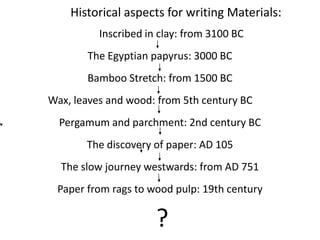
Historical aspects for writing Materials:
Inscribed in clay: from 3100 BC
The Egyptian papyrus: 3000 BC
Bamboo Stretch: from 1500 BC
Wax, leaves and wood: from 5th century BC
Pergamum and parchment: 2nd century BC
The discovery of paper: AD 105
The slow journey westwards: from AD 751
Paper from rags to wood pulp: 19th century
?
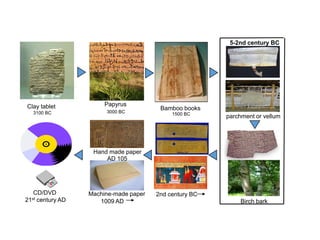
Clay tablet Papyrus
Birch bark
Machine-made paper
Hand made paper
CD/DVD
21st century AD
3100 BC
parchment or vellum
3000 BC 1500 BC
Bamboo books
5-2nd century BC
2nd century BC
AD 105
1009 AD
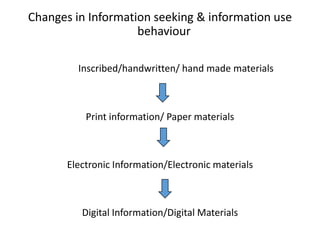
Changes in Information seeking & information use
behaviour
Inscribed/handwritten/ hand made materials
Print information/ Paper materials
Electronic Information/Electronic materials
Digital Information/Digital Materials
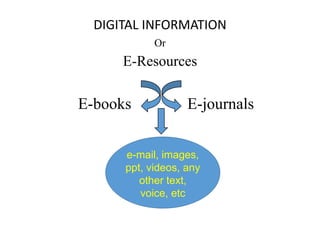
DIGITAL INFORMATION
Or
E-Resources
E-books E-journals
e-mail, images,
ppt, videos, any
other text,
voice, etc
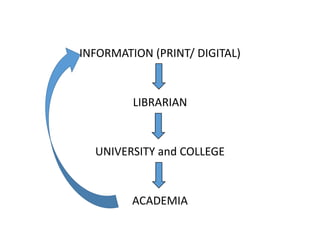
INFORMATION (PRINT/ DIGITAL)
LIBRARIAN
UNIVERSITY and COLLEGE
ACADEMIA
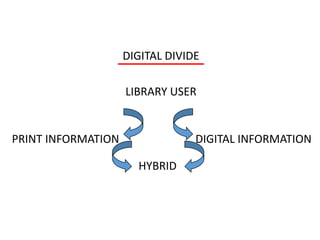
DIGITAL DIVIDE
LIBRARY USER
PRINT INFORMATION DIGITAL INFORMATION
HYBRID
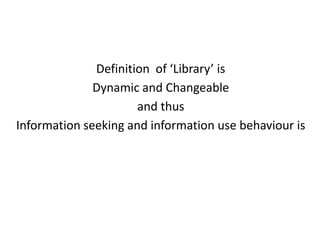
Definition of ‘Library’ is
Dynamic and Changeable
and thus
Information seeking and information use behaviour is
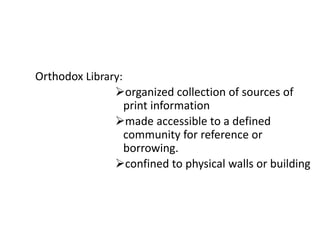
Orthodox Library:
organized collection of sources of
print information
made accessible to a defined
community for reference or
borrowing.
confined to physical walls or building
Modern Library:
organized information in many formats & from
many sources (Print/Electronic/online/offline)
unrestricted access all format of information
extending services beyond the physical walls
of a building
providing material accessible by electronic
means
providing the assistance of librarians in
navigating and analysing very large amounts of
information with a variety of digital tools.
A modern library's collection includes:
print books (textbooks or reference ), journals,
magazines, newspapers, maps, reports, thesis,
dissertations, etc.
e-books, e-journals, databases, indexing and
abstracting tools in online format or offline format
If Online:
Publisher’s websites, data portals
of R&Ds or NGOs, Consortium,
Aggregator's server or cloud, etc
If Offline:
microforms, films, CDs, cassettes,
videotapes, DVDs, discs, audio-books,
hard-disc drive (external or internal),
pen-drive , etc
For all the above developments library provides
access facilities like:
i. public facilities for access to their electronic
resources and the internet using Kiosks, OPAC/web
OPAC, simple nodes, ILM software, database tools,
etc.
Ii. a platform to access to information in many
formats using electronic gazettes like: computer,
scanner, projectors, Audio & Video devices, etc
With all the favourable developments in the
knowledge domain in the present day circumstances
obviously ask for multiple changes in information
seeking and information use behaviour of library
users
Digital Transformation
is a
Paradigm Shift
In
Information seeking and information use behaviour
Sunday, August 16, 2020 utpal_puhor@sify.com 17
Reasons for Paradigm Shift:
1. Extensive use of ICT in knowledge sector
i. Computers ii. Information management software
2. Exponential growth & popularity of WWW and
digital media
Reasons for exponential growth & popularity of WWW and
digital media:
1. Comfort
2. Comprehensiveness
3. Convenience of data accessibility
4. Relevance
Characteristics of Digital media :
Nature
Speed
Delivery, and
Dissemination
Its resultant impact on existing library management
system is enormous
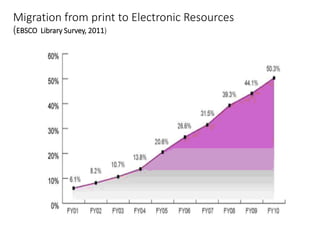
Migration from print to Electronic Resources
(EBSCO Library Survey, 2011)
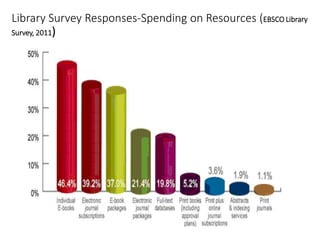
Library Survey Responses-Spending on Resources (EBSCO Library
Survey, 2011)
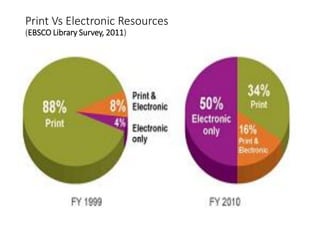
Print Vs Electronic Resources
(EBSCO Library Survey, 2011)
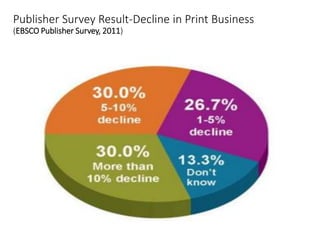
Publisher Survey Result-Decline in Print Business
(EBSCO Publisher Survey, 2011)
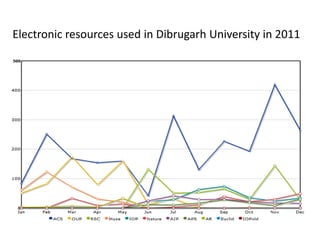
Electronic resources used in Dibrugarh University in 2011
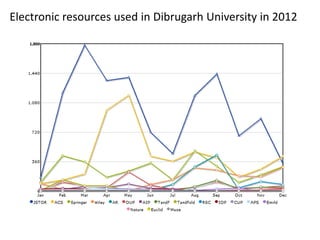
Electronic resources used in Dibrugarh University in 2012
Concluding Remark:
Whatever be the mode of information seeking behaviour,
two aspects are to be remembered by the students:
1. Access to information,
2. Application of the same
Thank you

Information seeking and information use behaviour in libraries

  • 1.
    Information seeking andInformation use behaviour in libraries Utpal Das, Dy. Librarian, Dibrugarh University, Dibrugarh, Assam utpalishaan@gmail.com
  • 2.
    Information seeking andinformation use behaviour changes with the change of time and disruptive technology at any given stage of human civilization when accepted popularly by the common man
  • 3.
  • 4.
    Historical aspects forwriting Materials: Inscribed in clay: from 3100 BC The Egyptian papyrus: 3000 BC Bamboo Stretch: from 1500 BC Wax, leaves and wood: from 5th century BC Pergamum and parchment: 2nd century BC The discovery of paper: AD 105 The slow journey westwards: from AD 751 Paper from rags to wood pulp: 19th century ?
  • 5.
    Clay tablet Papyrus Birchbark Machine-made paper Hand made paper CD/DVD 21st century AD 3100 BC parchment or vellum 3000 BC 1500 BC Bamboo books 5-2nd century BC 2nd century BC AD 105 1009 AD
  • 6.
    Changes in Informationseeking & information use behaviour Inscribed/handwritten/ hand made materials Print information/ Paper materials Electronic Information/Electronic materials Digital Information/Digital Materials
  • 7.
    DIGITAL INFORMATION Or E-Resources E-books E-journals e-mail,images, ppt, videos, any other text, voice, etc
  • 8.
  • 9.
    DIGITAL DIVIDE LIBRARY USER PRINTINFORMATION DIGITAL INFORMATION HYBRID
  • 10.
    Definition of ‘Library’is Dynamic and Changeable and thus Information seeking and information use behaviour is
  • 11.
    Orthodox Library: organized collectionof sources of print information made accessible to a defined community for reference or borrowing. confined to physical walls or building
  • 12.
    Modern Library: organized informationin many formats & from many sources (Print/Electronic/online/offline) unrestricted access all format of information extending services beyond the physical walls of a building providing material accessible by electronic means providing the assistance of librarians in navigating and analysing very large amounts of information with a variety of digital tools.
  • 13.
    A modern library'scollection includes: print books (textbooks or reference ), journals, magazines, newspapers, maps, reports, thesis, dissertations, etc. e-books, e-journals, databases, indexing and abstracting tools in online format or offline format
  • 14.
    If Online: Publisher’s websites,data portals of R&Ds or NGOs, Consortium, Aggregator's server or cloud, etc If Offline: microforms, films, CDs, cassettes, videotapes, DVDs, discs, audio-books, hard-disc drive (external or internal), pen-drive , etc
  • 15.
    For all theabove developments library provides access facilities like: i. public facilities for access to their electronic resources and the internet using Kiosks, OPAC/web OPAC, simple nodes, ILM software, database tools, etc. Ii. a platform to access to information in many formats using electronic gazettes like: computer, scanner, projectors, Audio & Video devices, etc
  • 16.
    With all thefavourable developments in the knowledge domain in the present day circumstances obviously ask for multiple changes in information seeking and information use behaviour of library users
  • 17.
    Digital Transformation is a ParadigmShift In Information seeking and information use behaviour Sunday, August 16, 2020 utpal_puhor@sify.com 17
  • 18.
    Reasons for ParadigmShift: 1. Extensive use of ICT in knowledge sector i. Computers ii. Information management software 2. Exponential growth & popularity of WWW and digital media
  • 19.
    Reasons for exponentialgrowth & popularity of WWW and digital media: 1. Comfort 2. Comprehensiveness 3. Convenience of data accessibility 4. Relevance
  • 20.
    Characteristics of Digitalmedia : Nature Speed Delivery, and Dissemination Its resultant impact on existing library management system is enormous
  • 21.
    Migration from printto Electronic Resources (EBSCO Library Survey, 2011)
  • 22.
    Library Survey Responses-Spendingon Resources (EBSCO Library Survey, 2011)
  • 23.
    Print Vs ElectronicResources (EBSCO Library Survey, 2011)
  • 24.
    Publisher Survey Result-Declinein Print Business (EBSCO Publisher Survey, 2011)
  • 25.
    Electronic resources usedin Dibrugarh University in 2011
  • 26.
    Electronic resources usedin Dibrugarh University in 2012
  • 27.
    Concluding Remark: Whatever bethe mode of information seeking behaviour, two aspects are to be remembered by the students: 1. Access to information, 2. Application of the same
  • 28.