Open Access Publications
Dr. RAMESH B. KURI
Assistant Professor
Department of Library & Information Science
School of Applied Sciences
Rani Channamma University, Belagavi
Email: rameshkuri.rcu@gmail.com
OUTLINE
 What is open access & Open Access Publishing
 Why Open Access Publishing
 Types of Open Access Publishing?
 Benefits of Open Access Publishing (General & Specific)
 The path to open access – recent developments in scholarly publishing
 Creating commons Licensing
 Predatory Journals/Machanism to trace predatory journals
 Open access journals
 Sharpa/RoMeO
What is Open Access?
 OA is a system provide access to knowledge
resources
 Un restricted (copyright) unlimited online
access for academic article
 It eliminates price an approval restrictions
and assures the best possible access
 Open access is a free, unalterable, global
accessible publications (Berlin declaration)
 Its articles components are online delivery
further disseminations and effective
archiving.
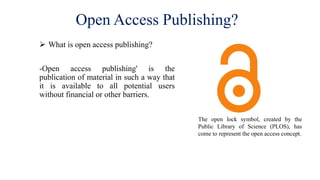
The open lock symbol, created by the
Public Library of Science (PLOS), has
come to represent the open access concept.
Why do we need open access?
 Research is traditionally disseminated via journal articles and conference papers
 Scholarly research is not freely accessible under the traditional model of subscription
based journals
 Access is inequitable and based on ability to pay
 Research is not being disseminated as widely as it could be
Three initiatives which made to establish the concept of open access. They were
collaborated supported and that led it to open access movement in the scholarly literature.
1. Budapest-2002
2. Bethesda Statement on OAP
3. Berlin Declaration on OA to knowledge
Open Access Publishing?
 What is open access publishing?
-Open access publishing' is the
publication of material in such a way that
it is available to all potential users
without financial or other barriers.
The open lock symbol, created by the
Public Library of Science (PLOS), has
come to represent the open access concept.
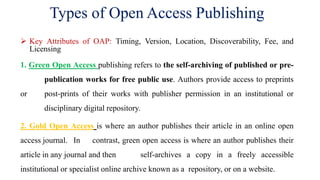
Types of Open Access Publishing
 Key Attributes of OAP: Timing, Version, Location, Discoverability, Fee, and
Licensing
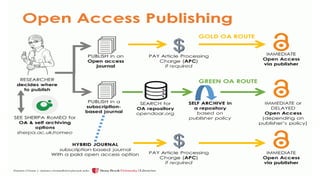
1. Green Open Access publishing refers to the self-archiving of published or pre-
publication works for free public use. Authors provide access to preprints
or post-prints of their works with publisher permission in an institutional or
disciplinary digital repository.
2. Gold Open Access is where an author publishes their article in an online open
access journal. In contrast, green open access is where an author publishes their
article in any journal and then self-archives a copy in a freely accessible
institutional or specialist online archive known as a repository, or on a website.
What is Open Access
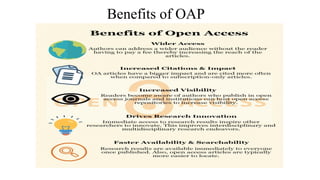
Benefits of OAP
What is Open Access
Benefits of Open Access
 Authors
 Readers
 Students
 Libraries
 Universities
 Funding agencies
 Government
 Citizens
 Even publishers!
Benefits for authors
 Open access provides authors with a worldwide
audience
 Open access increases the visibility and impact of their
work
 Open access widens opportunities for funding and
international collaboration
Benefits for students and lecturers
 Open access gives students access to the
research literature regardless of which
institution they are based at
 Lecturers can more easily make available their
own work for students to use
Benefits for Libraries
 In the long term Open Access may help
alleviate the problem of increasing journal
subscription costs.
 Open access helps libraries provide what
their readers need.
 Open access helps libraries to work
closely with authors and other parts of the
university to make the research output
more visible.
Benefits for universities
 Increases the visibility and impact of the
research being carried out an institution
 Institutional repositories provide a show-
case for a University’s research
 Open access is a major tool in attracting new
students and staff to a university
 Open access helps universities to share their
knowledge and expertise
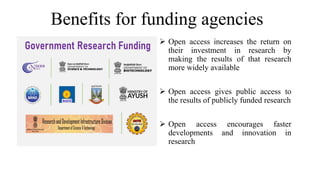
Benefits for funding agencies
 Open access increases the return on
their investment in research by
making the results of that research
more widely available
 Open access gives public access to
the results of publicly funded research
 Open access encourages faster
developments and innovation in
research
Benefits for government
 Open access offers government
similar benefits to those
experienced by funding agencies
 In addition, open access promotes
open democratic government by
making information as freely
available as possible
The current state of open access
 Over 3,700 open access journals listed by the Directory of Open
Access Journals
 Over 1280 repositories listed by the Directory of Open Access
Repositories
 New mandates and policies being announced regularly
 Publishers engaging with open access in a variety of ways
 Projects looking at usage of OA material
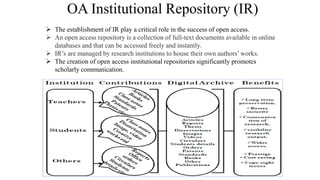
OA Institutional Repository (IR)
 The establishment of IR play a critical role in the success of open access.
 An open access repository is a collection of full-text documents available in online
databases and that can be accessed freely and instantly.
 IR’s are managed by research institutions to house their own authors’ works.
 The creation of open access institutional repositories significantly promotes
scholarly communication.
Pre-print-post print and Publishers version
Preprints: Works before they've undergone peer review
Post-prints: Sometimes called the Author's Accepted Manuscript
(AAM), these are works that have undergone peer review but haven't yet
been formally formatted
Publisher's version: Official versions of works that have been formatted
and posted on publisher websites
Creative Commons
What is Creative Commons License?
A creative commons license is a license issued by the copyright owner to
allow anyone in the world to use his or her copyright work in any
manner consistent with that license.
Creative Commons licenses are essentially standard form license
agreements which can be attached to a work to enable its use under
certain circumstances without the need to contact the author or negotiate
terms of use.
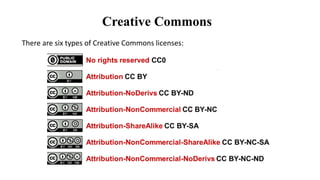
Creative Commons
There are six types of Creative Commons licenses:
Open Access Publishing Initiatives
http://roar.eprints.org/
https://doaj.org/
https://shodhganga.inflibnet.ac.in/
What is Predatory Journal?
 The journal is not indexed by competent scientific databases.
 The journal website does not contain information about the editorial
board.
 There are non-academic advertisements on the webpage.
 The website of the journal does not contain information on the address
and contact details of the editorial board.
 The scientific work of the editor-in-chief, the editorial board, and the
columnists cannot be credibly monitored.
 There is no transparent description of the publishing process.
 The scientific work of the editor-in-chief, the editorial team members
con not be traced in scientific database.
How to find Predatory Journals?
 Do they charge fee for publishing?
 Do they not peer reviewed?
 Do they restrict academic freedom?
 Do they ensure that the copyrights of the author are maintained ?
 Are they typically of low quality?
Software tools for identify predatory journal
 Center for publication ethics (CPE) was established in Savitribai Pule Pune
University, Pune(SPPU)
 It keeps watch on journals without quality.
 UGC keeps watch on publishing the list of quality journals from time to time
 UGC has given the list of entitled UGC-CARE for publishing research
papers.
 It has two parts
 Group-I includes all the indian journals mainly from social sciences,
humanities, culture, and indian knwoldege systems, languages and arts.
 Group-II includes journals across the disciplines listed with Web of Science.
It has citation Index source publication in social sicence, and arts and
humanities.
Sharpa/RoMeO
 It is an online resource that aggregates publishers to check copyright and self
archiving policies.
 Sharpa/Romeo is service run by SHERPA to show the copyright and open access
self-archiving policies of academic journals.
 Sharpa is an acronym for Systematic Human Error Reduction and Prediction
Approach
 Romeo is an acronym for Rights Metadata for open archiving
 Every registered publisher/journal is carefully reviewed and analyzed by the
specialist team who provide summaries of self-archiving permissions and conditions
of rights given to authors on a journal-by-journal.
 The database used a color coding scheme to classify polishers according to self-
archiving policy.
 This allows authors whether the journal allows preprint or post print achieving in
their copyright transfer agreement.
 It currently holds records for over 25000 journals.
 The policy information provided through this service primarily
aims to serve the academic research community.
 Since the service launched over 15 years ago, publisher policies
and the open access sector have changed a lot.
 Open access policy can be complex and varies according to
geographical location, the institution, and the various routes to
open access — all of which affects how and where you can
publish your research.
Search instance:- https://v2.sherpa.ac.uk/romeo/search.html
Journal finder and Journal suggestion tools
 JANE: Journal/Author name estimator
 https://www.ncbi.nlm.nih.gov/pmc/aritcles/PMC6300233
 Elsevier Journal Finder
 https://journalfinder.elsevier.com/
 Springer journal suggested
 https://journalsuggester.springer.com/
Sources Referred
1. https://canterbury.libguides.com/c.php?g=894027&p=6640992
2. https://www.youtube.com/watch?v=8rGJnUhHkAk&t=614s
3. https://www.youtube.com/watch?v=-JykscFFuQA
4. https://www.sciencedirect.com/topics/computer-science/open-access-
repository#:~:text=Open%20Access%20Repositories,works%20(Pinfield%2C%202005).
5. Kuri Ramesh., Maranna O. (2018) Institutional Repositories and its Consequences for
Government College. National Conference “Role of Libraries in Changing Information &
Communication Technology (ICT) Scenario” 9th Feb 2018 Waranagar Kolhapur Maharastra
pp. 51-59/
6. Kuri R. (2014). Foot marks of LIS journals in DOAJ: An analytical study. Asian Journal of
Multidisciplinary Studies, Vol-5 (2),
Thank You

Open Access Publications PPT.pdf

  • 1.
    Open Access Publications Dr.RAMESH B. KURI Assistant Professor Department of Library & Information Science School of Applied Sciences Rani Channamma University, Belagavi Email: rameshkuri.rcu@gmail.com
  • 2.
    OUTLINE  What isopen access & Open Access Publishing  Why Open Access Publishing  Types of Open Access Publishing?  Benefits of Open Access Publishing (General & Specific)  The path to open access – recent developments in scholarly publishing  Creating commons Licensing  Predatory Journals/Machanism to trace predatory journals  Open access journals  Sharpa/RoMeO
  • 3.
    What is OpenAccess?  OA is a system provide access to knowledge resources  Un restricted (copyright) unlimited online access for academic article  It eliminates price an approval restrictions and assures the best possible access  Open access is a free, unalterable, global accessible publications (Berlin declaration)  Its articles components are online delivery further disseminations and effective archiving. The open lock symbol, created by the Public Library of Science (PLOS), has come to represent the open access concept.
  • 4.
    Why do weneed open access?  Research is traditionally disseminated via journal articles and conference papers  Scholarly research is not freely accessible under the traditional model of subscription based journals  Access is inequitable and based on ability to pay  Research is not being disseminated as widely as it could be Three initiatives which made to establish the concept of open access. They were collaborated supported and that led it to open access movement in the scholarly literature. 1. Budapest-2002 2. Bethesda Statement on OAP 3. Berlin Declaration on OA to knowledge
  • 5.
    Open Access Publishing? What is open access publishing? -Open access publishing' is the publication of material in such a way that it is available to all potential users without financial or other barriers. The open lock symbol, created by the Public Library of Science (PLOS), has come to represent the open access concept.
  • 6.
    Types of OpenAccess Publishing  Key Attributes of OAP: Timing, Version, Location, Discoverability, Fee, and Licensing 1. Green Open Access publishing refers to the self-archiving of published or pre- publication works for free public use. Authors provide access to preprints or post-prints of their works with publisher permission in an institutional or disciplinary digital repository. 2. Gold Open Access is where an author publishes their article in an online open access journal. In contrast, green open access is where an author publishes their article in any journal and then self-archives a copy in a freely accessible institutional or specialist online archive known as a repository, or on a website.
  • 7.
  • 8.
    Benefits of OAP Whatis Open Access
  • 9.
    Benefits of OpenAccess  Authors  Readers  Students  Libraries  Universities  Funding agencies  Government  Citizens  Even publishers!
  • 10.
    Benefits for authors Open access provides authors with a worldwide audience  Open access increases the visibility and impact of their work  Open access widens opportunities for funding and international collaboration
  • 11.
    Benefits for studentsand lecturers  Open access gives students access to the research literature regardless of which institution they are based at  Lecturers can more easily make available their own work for students to use
  • 12.
    Benefits for Libraries In the long term Open Access may help alleviate the problem of increasing journal subscription costs.  Open access helps libraries provide what their readers need.  Open access helps libraries to work closely with authors and other parts of the university to make the research output more visible.
  • 13.
    Benefits for universities Increases the visibility and impact of the research being carried out an institution  Institutional repositories provide a show- case for a University’s research  Open access is a major tool in attracting new students and staff to a university  Open access helps universities to share their knowledge and expertise
  • 14.
    Benefits for fundingagencies  Open access increases the return on their investment in research by making the results of that research more widely available  Open access gives public access to the results of publicly funded research  Open access encourages faster developments and innovation in research
  • 15.
    Benefits for government Open access offers government similar benefits to those experienced by funding agencies  In addition, open access promotes open democratic government by making information as freely available as possible
  • 16.
    The current stateof open access  Over 3,700 open access journals listed by the Directory of Open Access Journals  Over 1280 repositories listed by the Directory of Open Access Repositories  New mandates and policies being announced regularly  Publishers engaging with open access in a variety of ways  Projects looking at usage of OA material
  • 17.
    OA Institutional Repository(IR)  The establishment of IR play a critical role in the success of open access.  An open access repository is a collection of full-text documents available in online databases and that can be accessed freely and instantly.  IR’s are managed by research institutions to house their own authors’ works.  The creation of open access institutional repositories significantly promotes scholarly communication.
  • 18.
    Pre-print-post print andPublishers version Preprints: Works before they've undergone peer review Post-prints: Sometimes called the Author's Accepted Manuscript (AAM), these are works that have undergone peer review but haven't yet been formally formatted Publisher's version: Official versions of works that have been formatted and posted on publisher websites
  • 19.
    Creative Commons What isCreative Commons License? A creative commons license is a license issued by the copyright owner to allow anyone in the world to use his or her copyright work in any manner consistent with that license. Creative Commons licenses are essentially standard form license agreements which can be attached to a work to enable its use under certain circumstances without the need to contact the author or negotiate terms of use.
  • 20.
    Creative Commons There aresix types of Creative Commons licenses:
  • 21.
    Open Access PublishingInitiatives http://roar.eprints.org/ https://doaj.org/ https://shodhganga.inflibnet.ac.in/
  • 22.
    What is PredatoryJournal?  The journal is not indexed by competent scientific databases.  The journal website does not contain information about the editorial board.  There are non-academic advertisements on the webpage.  The website of the journal does not contain information on the address and contact details of the editorial board.  The scientific work of the editor-in-chief, the editorial board, and the columnists cannot be credibly monitored.  There is no transparent description of the publishing process.  The scientific work of the editor-in-chief, the editorial team members con not be traced in scientific database.
  • 23.
    How to findPredatory Journals?  Do they charge fee for publishing?  Do they not peer reviewed?  Do they restrict academic freedom?  Do they ensure that the copyrights of the author are maintained ?  Are they typically of low quality?
  • 24.
    Software tools foridentify predatory journal  Center for publication ethics (CPE) was established in Savitribai Pule Pune University, Pune(SPPU)  It keeps watch on journals without quality.  UGC keeps watch on publishing the list of quality journals from time to time  UGC has given the list of entitled UGC-CARE for publishing research papers.  It has two parts  Group-I includes all the indian journals mainly from social sciences, humanities, culture, and indian knwoldege systems, languages and arts.  Group-II includes journals across the disciplines listed with Web of Science. It has citation Index source publication in social sicence, and arts and humanities.
  • 25.
    Sharpa/RoMeO  It isan online resource that aggregates publishers to check copyright and self archiving policies.  Sharpa/Romeo is service run by SHERPA to show the copyright and open access self-archiving policies of academic journals.  Sharpa is an acronym for Systematic Human Error Reduction and Prediction Approach  Romeo is an acronym for Rights Metadata for open archiving  Every registered publisher/journal is carefully reviewed and analyzed by the specialist team who provide summaries of self-archiving permissions and conditions of rights given to authors on a journal-by-journal.  The database used a color coding scheme to classify polishers according to self- archiving policy.  This allows authors whether the journal allows preprint or post print achieving in their copyright transfer agreement.  It currently holds records for over 25000 journals.
  • 26.
     The policyinformation provided through this service primarily aims to serve the academic research community.  Since the service launched over 15 years ago, publisher policies and the open access sector have changed a lot.  Open access policy can be complex and varies according to geographical location, the institution, and the various routes to open access — all of which affects how and where you can publish your research. Search instance:- https://v2.sherpa.ac.uk/romeo/search.html
  • 27.
    Journal finder andJournal suggestion tools  JANE: Journal/Author name estimator  https://www.ncbi.nlm.nih.gov/pmc/aritcles/PMC6300233  Elsevier Journal Finder  https://journalfinder.elsevier.com/  Springer journal suggested  https://journalsuggester.springer.com/
  • 28.
    Sources Referred 1. https://canterbury.libguides.com/c.php?g=894027&p=6640992 2.https://www.youtube.com/watch?v=8rGJnUhHkAk&t=614s 3. https://www.youtube.com/watch?v=-JykscFFuQA 4. https://www.sciencedirect.com/topics/computer-science/open-access- repository#:~:text=Open%20Access%20Repositories,works%20(Pinfield%2C%202005). 5. Kuri Ramesh., Maranna O. (2018) Institutional Repositories and its Consequences for Government College. National Conference “Role of Libraries in Changing Information & Communication Technology (ICT) Scenario” 9th Feb 2018 Waranagar Kolhapur Maharastra pp. 51-59/ 6. Kuri R. (2014). Foot marks of LIS journals in DOAJ: An analytical study. Asian Journal of Multidisciplinary Studies, Vol-5 (2),
  • 29.