Concise Guide To Databases A Practical Introduction Lake Petercrowther
Concise Guide To Databases A Practical Introduction Lake Petercrowther
Concise Guide To Databases A Practical Introduction Lake Petercrowther
Concise Guide To Databases A Practical Introduction Lake Petercrowther
Concise Guide To Databases A Practical Introduction Lake Petercrowther
1.
Concise Guide ToDatabases A Practical
Introduction Lake Petercrowther download
https://ebookbell.com/product/concise-guide-to-databases-a-
practical-introduction-lake-petercrowther-21986176
Explore and download more ebooks at ebookbell.com
2.
Here are somerecommended products that we believe you will be
interested in. You can click the link to download.
Concise Guide To Databases A Practical Introduction 2nd Edition
Konstantinos Domdouzis
https://ebookbell.com/product/concise-guide-to-databases-a-practical-
introduction-2nd-edition-konstantinos-domdouzis-28915600
Concise Guide To Databases Peter Lake Paul Crowther
https://ebookbell.com/product/concise-guide-to-databases-peter-lake-
paul-crowther-59047540
Concise Guide To Software Engineering From Fundamentals To Application
Methods 2nd Edition 2nd Gerard Oregan
https://ebookbell.com/product/concise-guide-to-software-engineering-
from-fundamentals-to-application-methods-2nd-edition-2nd-gerard-
oregan-46257756
Concise Guide To Electrochemical Methods And Voltammetry A
Problembased Test Prep For Students Xian Wen Ng
https://ebookbell.com/product/concise-guide-to-electrochemical-
methods-and-voltammetry-a-problembased-test-prep-for-students-xian-
wen-ng-48163926
3.
Concise Guide ToQuantum Machine Learning 1st Edition Davide
Pastorello
https://ebookbell.com/product/concise-guide-to-quantum-machine-
learning-1st-edition-davide-pastorello-48746596
Concise Guide To Numerical Algorithmics The Foundations And Spirit Of
Scientific Computing John Lawrence Nazareth
https://ebookbell.com/product/concise-guide-to-numerical-algorithmics-
the-foundations-and-spirit-of-scientific-computing-john-lawrence-
nazareth-48813762
Concise Guide To Software Verification From Model Checking To
Annotation Checking Marieke Huisman
https://ebookbell.com/product/concise-guide-to-software-verification-
from-model-checking-to-annotation-checking-marieke-huisman-50974570
Concise Guide To The Moths Of Great Britain And Ireland Second Edition
2nd Edition Martin Townsend
https://ebookbell.com/product/concise-guide-to-the-moths-of-great-
britain-and-ireland-second-edition-2nd-edition-martin-
townsend-57887180
Concise Guide To Brief Dynamic And Interpersonal Therapy 2nd Edition
Concise Guides 2 Sub Hanna Levenson
https://ebookbell.com/product/concise-guide-to-brief-dynamic-and-
interpersonal-therapy-2nd-edition-concise-guides-2-sub-hanna-
levenson-2018366
Undergraduate Topics inComputer Science (UTiCS) delivers high-quality instructional content for un-
dergraduates studying in all areas of computing and information science. From core foundational and
theoretical material to final-year topics and applications, UTiCS books take a fresh, concise, and mod-
ern approach and are ideal for self-study or for a one- or two-semester course. The texts are all authored
by established experts in their fields, reviewed by an international advisory board, and contain numer-
ous examples and problems. Many include fully worked solutions.
For further volumes:
www.springer.com/series/7592
8.
Peter Lake rPaul Crowther
Concise Guide
to Databases
A Practical Introduction
Foreword by Professor Richard Hill
Foreword
From tablets ofstone through to libraries of parchments; from paper-based files to
the electronic era, there is not one aspect of modern business that has avoided the
need to collect, collate, organize and report upon data. The proliferation of databases
and database technologies within modern times, has now been further secured by the
use of the Internet to enable database integration on a massive scale.
In amongst the innovation, the basic concepts remain. The need to organize—
a topic that Codd reminded us could be best done by relational models—is now
being challenged, as processor power and storage space become cheap and utility-
like with the advent of Cloud Computing infrastructure. But a glance at the past does
much to inform future thinking, and this book serves to prepare the foundations of
a mature approach to using database technologies in the 21st Century.
In many cases, both established and emerging database technologies are readily
available and free to use. As such they may appear free to implement, which fuels
rapid adoption of technology that may not have been proven sufficiently, without the
formal governance that other business norms might impose. This creates an exciting,
risky, domain where commercial models can make or lose money depending upon
how they embrace and realize the potential of the technology. Conversely, there is
also an opportunity to solve problems when things go awry—and the accelerated
innovation that we now witness, presents more opportunities and pitfalls, if we do
not possess the requisite understanding of how databases should serve our needs.
Proficiency in the field of databases is a combination of technical understanding,
conceptual knowledge and business acumen. All of these traits are underpinned by
education, and the need for professionals to continually update their knowledge.
Since professionals not only face the challenge of when to introduce a technology,
but also when not to adopt, it is important to understand the impact of failure as well
as success. This book takes readers through the essential basics, before charting a
path towards technical skill acquisition in the real-life context of business.
Professor Richard Hill
Head of Subject, Computing and Mathematics
University of Derby, Derby, UK
June 2013
vii
12.
viii Foreword
About RichardHill:
Richard Hill, PhD, is Professor of Intelligent Systems and Head of Department in the School of
Computing and Mathematics, at the University of Derby, UK. Professor Hill has published widely
in the areas of multi agent systems, computational intelligence, intelligent cloud computing and
emerging technologies for distributed systems, and has organised a number of international confer-
ences. Latterly, Professor Hill has edited and co-authored several book collections and textbooks,
including ‘Guide to Cloud Computing: Principles and Practice’, published by Springer UK.
13.
Preface
Overview and Goals
Databasesare not new and there are many text books available which cover various
database types, especially relational. What is changing, however, is that Relational
Database Management Systems (RDBMS) are no longer the only database solution.
In an era where Big Data is the current buzzword and Data Scientists are tomorrow’s
big earners, it is important to take a wider view of database technology.
Key objectives for this book include:
• Present an understanding of the key technologies involved in Database Systems
in general and place those technologies in an historic context
• Explore the potential use of a variety of database types in a business environ-
ment
• Point out areas for further research in a fast moving domain
• Equip readers with an understanding of the important aspects of a database
professional’s job
• Provide some hands-on experience to further assist in the understanding of the
technologies involved
Organisation and Features
This book is organised into three parts:
• Part I introduces database concepts and places them in both a historic and busi-
ness context;
• Part II provides insights into some of the major database types around today
and also provides some hands-on tutorials in the areas concerned;
• Part III is devoted to issues and challenges which face Database Professionals.
Target Audiences
This book has been written specifically to support the following audiences:
Advanced undergraduate students and postgraduate students should find the
combination of theoretical and practical examples database usage of interest. We
imagine this text would be of particular relevance for modern Computer Science,
ix
14.
x Preface
Software Engineering,and Information Technology courses. However, any course
that makes reference to databases, and in particular to the latest developments in
computing will find this text book of use. As such, University Instructors may adopt
the book as a core text.
Especially in Part II, this book adopts a learning-by-doing approach, with the
extensive worked examples explaining how to use the variety of databases available
to address today’s business needs. Practising Database Professionals, and Applica-
tion Developers will also be able to use this book to review the current state of the
database domain.
Suggested Uses
A Concise Guide to Databases can be used as a solid introduction to the concept of
databases. The book is suitable as both a comprehensive introduction to databases,
as well as a reference text as the reader develops their skills and abilities through
practical application of the ideas. For University Instructors, we suggest the follow-
ing programme of study for a twelve-week semester format:
• Weeks 1–3: Part I
• Weeks 4–8: Part II
• Weeks 9–12: Part III
• Week 12: Assessment
Review Questions
Each chapter concludes with a set of review questions that make specific reference
to the content presented in the chapter, plus an additional set of further questions
that will require further research. The review questions are designed in such a way
that the reader will be able to tackle them based on the chapter contents. They are
followed by discussion questions, that often require research, extended reading of
other material or discussion and collaboration. These can be used as classroom dis-
cussion topics by tutors or used as the basis of summative assignments.
Hands-on Exercises
The technology chapters include extended hands-on exercises. Readers will then
progressively engage in more complex activities, building skills and knowledge
along the way. Such an approach ensures that a solid foundation is built before more
advanced topics are undertaken. Some of the material here is Open Source, whilst
some examples are Oracle specific, but even these latter can be applied to other SQL
databases.
15.
Preface xi
Chapter Summary
Abrief summary of each of the twelve chapters is as follows:
Chapter 1: Data is the lifeblood of all business systems and we place the use of
data in its historical context and review some of the key concepts in handling data.
Chapter 2: Provides an examination of the way that data has been handled
throughout history, using databases of a variety of types.
Chapter 3: Considers how we actually store data. Turning information into a
series of 1s and 0s is at the heart of every current database system and so an under-
standing of issues like physical storage and distribution are important concepts to
understand.
Chapter 4: The de facto standard database solution is, without doubt, the rela-
tional database. In this chapter we look at how RDBMS works and provide worked
examples.
Chapter 5: The NoSQL movement is still relatively new. Databases which store
data without schemas and which do not necessarily provide transactional security
may seem like a bad idea to experienced relational database practitioners, but these
tools do certainly have their place in today’s data rich society. We review the area
in general and then look at specific examples of a Column-based and a Document-
based database, with hands-on tutorials for each.
Chapter 6: Look at many leading database vendors’ web sites and you will see
that we are in the Big Data era. We explore what this actually means and, using a
tutorial, review one of the key concepts in this era—that of MapReduce.
Chapter 7: Object databases were once thought of as the next important design
for databases. When used by developers using Object programming they can seem
very appealing still. There are half-way house solutions also available—Oracle, for
example, has an Object-Relational option. We explore this area with more tutorial
material.
Chapter 8: Reading data from disk is far slower than reading from RAM. Com-
puting technologies now exist that can allow databases to run entirely in memory,
making for very rapid data processing. These databases may well become the norm
as RAM becomes cheaper and hard disk technology becomes less able to improve
in performance.
Chapter 9: Once you have designed your database, especially when supporting
a web- or cloud-based solution, you need to be sure that it can grow if the business
that the application supports is successful. Scalability is about ensuring that you can
cope with many concurrent users, or huge amounts of data, or both.
Chapter 10: Once your system is built, you need to be able to have it available for
use permanently (or as close to permanently as can be achieved within the financial
resources at your disposal). We review key concepts such as back-up, recovery, and
disaster recovery.
Chapter 11: For a DBA the dreaded phone call is “my report is running very
slowly”. For a start, what is mean by slowly? What is the user used to? Then there
is the problem of how you establish where the problem is—is it hardware related?
Or Network related? At the Server or Client end? The solution may be indexes, or
16.
xii Preface
partitions: wereview a variety of performance related techniques. We include some
tutorial material which explores some performance management tools.
Chapter 12: Data is one of an organisation’s most important assets. It needs to
be protected from people wanting to either take it, or bring the system down. We
look at physical and software-related weaknesses and review approaches to making
our databases secure.
Peter Lake
Paul Crowther
Sheffield, UK
4 1 Data,an Organisational Asset
This is an example of how an organisation uses data in an on-line transaction in a
real time way. It is the current stage of an evolutionary process of storing, processing
and exploiting data which began with the first record keeping.
1.2 In the Beginning
Religious orders and governments were the first large organisations to gather and
actively exploit data to raise revenue. Recorded data has been known to exist since
at least 2800 BC in ancient Egypt. These included records of the earliest known
forms of taxation. Records were held on limestone flakes and papyrus. The Rosetta
Stone, famous for holding the key to translating hieroglyphics (the same information
was written in three languages on the stone, one of which could be understood and
was used to translate the other two) was created to show a temples exemption from
taxes.
1.3 The Rise of Organisations
Before considering electronic data and its use in modern commercial organisations
we need to consider how non-government organisations developed and how their
data needs grew more and more sophisticated. In any government or business organ-
isation, there are always records. At its most basic you need to know who owes you
money and who you owe money to. More sophisticated records would include the
value of infrastructure such as buildings and machinery as well as its depreciation—
loss of value—due to wear and tear plus the costs of maintenance. Where the organ-
isation consists of more than a single trader records of employees need to be kept.
In Britain pre-dissolution monasteries maintained excellent records and accounts
of the estates they controlled (something that was also of value to Henry VIII and
which Thomas Cromwell exploited from 1534 as part of the Dissolution). Lands
and money were donated to the monasteries with many of them becoming large
landowners. Income from these estates made many of them extremely wealthy.
This growth in wealth along with numbers of lay brothers who filled ancillary roles
and provided labour created a complexity that could only be managed by keeping
records. The monk in charge of these records and the finances of the monastery was
the bursar who oversaw the maintenance of detailed records of both income and ex-
penditure of the estate. In many cases this was structured within specific categories,
for example capital expenditure (on buildings). In today’s terminology the bursar
would be called the database administrator.
1.4 The Challenges of Multi-site Operation
The monasteries in sixteenth century England were independent organisations
loosely federated by their allegiance to the Roman Catholic Church based in Rome.
As mentioned, they often owned vast estates with many farms or granges which
27.
1.5 Internationalisation 5
couldbe considerable distances (for the day) from the monastery. These granges
needed to keep local records, but also needed to submit accounts to the monastery.
This could be regarded as a form of distributed data where there was a need for
day to day local account keeping along with a centralised master account system.
A problem was maintaining data integrity. Once accounts from the granges had been
submitted to the monastery counting house, records could be updated but there was
always a time delay. At the time this was not regarded as important because at the
time there was no competitive advantage in very rapid processing of records.
1.5 Internationalisation
Despite the previous example most early organisational data was held centrally be-
cause the reach of the organisation tended to be geographically small. This changed
with exploration and colonisation. There needed to be data kept in multiple loca-
tions. With European colonisation of other parts of the world, trading companies
had to start keeping data locally as well as at head office. Some of these companies
were huge, for example the East India Company came into being in 1600 and by
the eighteenth century effectively controlled large parts of India and had its own
army and navy. Its base was London, but it had multiple trading centres in India and
China. The London base was called East India House and it housed the company
records. These and the people needed to maintain them kept growing with the result
that the building was continually being expanded. The demand for more space and
the poor condition of the original building lead was the justification for a new build-
ing. This was completed in 1729. Even this was not enough and as the company
continued to grow adjoining properties were acquired.
What the company developed was effectively a distributed database. Day to day
operations in the colony were handled locally with records being transported back to
head office where the ever expanding central records were updated and processed.
Since long distance data transmission was by ship and there was a risk of the ship
not making it home, there was always going to be a problem with data currency and
integrity. This could be solved by a certain level of data redundancy. For example
rather than relying on one ship for your records, you replicated everything and sent
it by two or more ships. You also distributed valuable cargo between your ships. If
one sank, all the records, including about what was on the missing ship survived.
This was an example of backup and security. It was also a form of insurance.
The East India Company was wound up in 1858 primarily due to public and
government concern about its activities. It had been blamed in part for triggering
American war of Independence (the tea in the Boston tea Party was company stock)
and laying the foundations for the First Opium War where Indian opium was used
to trade for tea. However the British government took over many of the operations
of the Company in the building became the India Office.
The East India Company has been used to illustrate the development of a organi-
sation with international reach, but it was by no means an isolated example. Around
the time the company was wound up technological advances including the develop-
ment of the telegraph and faster and more reliable transport improved the efficiency
28.
6 1 Data,an Organisational Asset
of national and international organisations. With more data which was increasingly
more current better planning and control could be implemented. The following sec-
tions look at the new technologies and their impact on data and the organisation.
1.6 Industrialisation
Between the late eighteenth and early nineteenth there was a change from small
scale hand manufacturing to large scale mass manufacturing. This is usually referred
to as the industrial revolution although there were several phases covering not just
manufacturing but also the supporting infrastructure. In this period, manufacturing
progressively moved from a cottage industry to a factory based enterprise. This
required detailed records to effectively manage a large scale operation.
Materials required for the industrial process were much larger than previously re-
quired in cottage industries. Although the term was not really used until the 1950’s
in business this was supply chain logistics. Consumables had to be bought and trans-
ported. It is costly to have stock in a warehouse; therefore you want to have as little
raw material on hand as possible but no so little as to affect production. Likewise
finished goods need to be shipped as soon as possible. Labour needed to be hired
and managed. All of this required record keeping to plan and manage operations,
in other words data. It also lead to a transport revolution, first with canals and then
with railways to move primarily goods and later in the case of the railways, people.
Both of these had their own data requirements.
The sophistication of the industrialisation process kept increasing through the
nineteenth and twentieth century. The introduction of the assembly line further in-
creased efficiency but it was dependent on the line being supplied. This is a supply
process known as logistics (although the term was not used for business until the
mid-1950’s) and requires: “having the right item in the right quantity at the right
time at the right place for the right price in the right condition...” (Mallik 2010).
This required processing of data to make sure the right decisions on where and when
to buy materials was made. Even today, a break in supply of components can shut
down an entire operation. In Australia, BorgWarner supplied gearboxes to most of
the country’s vehicle manufacturers. Only two days’ supply of these components
were held at the assembly factories, so a strike at BorgWarner effectively shut down
the rest of automotive manufacturing centre.
1.7 Mass Transport
Another impact of the industrial revolution was on transport. Up until the nineteenth
century transport had been either by horse or ship. Neither was particularly fast and
most people rarely travelled far outside their local community. Mass movement of
goods inland tended to be by boat but was restricted to navigable rivers. Although
canals for navigation were not new, it was the Bridgewater Canal opened in 1761 for
the transport of coal that proved the efficiency of this form of transport. The success
29.
1.8 Communication 7
ofBridgewater Canal lead to many more being developed and resulted in dramatic
falls in the transport costs of bulky materials. The dominance of canals was relatively
short. The rapid development of the Railway network from 1840, initially for freight
but also for passengers meant that meant material goods and people could be moved
great distances quickly and cheaply. The railway system was however dependent on
data for its successful (and safe) operation. Trains had to be scheduled which meant
timetables had to be developed. There were several forms of these. One was for
passengers who wanted to know when a train was leaving. There was also a roster
for engines, carriages and their crews—basically another timetable but one which
had to be updated more often because of availability. To make sure you had a place
on the train (particularly if you were a first class passenger) meant seat reservations
had to be implemented. This is a description of just a small part of the records and
data processing needed for running railways in the Victorian era.
Things didn’t really change until the advent of mass air travel. Consider an air-
line booking systems. Today you can book a seat with an airline specifying the date
and time of your flights and even your seat on the plane by accessing a website. Be-
fore networked computers the system was paper based. At head office there would
be a record of each flight scheduled for a specific period in the future. Based on
experience, travel agents would be assigned a number of seats on each plane which
they could sell over the counter. If they ran out of seats or they had not been al-
located seats on a particular flight they would have to phone the flight centre to
request a seat. If there were some in reserve, once again they could book it directly,
otherwise, the customer had to be logged and told they would be contacted once
a check of available seats had been made. The booking centre would then have to
call around other agents who had been assigned seats and see if any were still left.
Depending on the outcome, the customer would be contacted. This was a cumber-
some system and with the growth in air travel it became increasingly sophisticated.
Introduction of computerised booking meant the number of staff needed to run it
declined dramatically.
There was also another effect of the computerisation of data. Once you had
booked on a plane, you had a record of who the customer was and where they were
going which was easily retrievable. If they were a frequent traveller you could start
building a profile of where they tended to go and how often. That meant you could
be sent targeted marketing material. Initially this was by post, but now is most likely
to be via e-mail.
1.8 Communication
Before the advent of technology to transmit information electrically (and it was
electrical rather than electronic) transmission of data was by hand. Faster technolo-
gies, such as the semaphore system and other line of sight communication systems
did exist. In Tasmania (then Van Diemen’s Land) a semaphore system built in 1811
could be used to report an escape from the penal settlement at Port Arthur within
seven minutes. Port Arthur is approximately 100 kilometres (60 miles) from Hobart
30.
8 1 Data,an Organisational Asset
Fig. 1.1 1865 map showing proposed submarine and land telegraphs around the world. (Bill
Burns: Altlantic-Cable.com Website)
by road meaning such a message could take a day or more to get through by hand.
The big disadvantage of the system was it was only useable in daylight in clear
conditions. The semaphore system in Tasmania was discontinued in 1880 with the
installation of a telegraph system (Fig. 1.1).
The electric telegraph which was developed in the early nineteenth century meant
data could be transmitted much more quickly and reliably using a standardised
code—Morse code. This was a series of dots and dashes which represented numbers
and letters. More commonly used letters had shorter codes then longer ones, for ex-
ample T was a single dash while J was a dot and three dashes. Accuracy could still
be a problem however. A solution to this was to send important information twice
and then investigate any discrepancies. Another solution was to introduce a check
number where the final digit was a function of the preceding digits. This meant
a calculation had to be done at both the sending and receiving end slowing down
transmission. This issue was solved in computers using a similar process—the main
difference being it was automated and quicker.
Although the electric telegraph was superseded by telephone and radio technol-
ogy, Morse code continues to be used because it is less sensitive to poor signal
conditions. Aeronautical systems such as VHF omnidirectional radio range (VOR)
constantly send identification signals in the code.
31.
1.9 Stocks andShares 9
An important invention using telegraph technology was invented in 1870. The
ticker tape machine was a device that allowed information about stocks and shares
to be transmitted via the telegraph system. Unlike the telegraph Morse code tapper
key, the sending device had a keyboard (which originally looked like a piano key-
board) to send plain language text. At the receiving end the information was printed
in readable text on a thin strip of paper. Speeds were typically one character per
second so abbreviations for company names were used. This was the first example
of dedicated electrical commercial information transmission and it survived into the
1960’s.
The next two communication technologies which had a major impact on data
transmission were the telephone and the radio (although the latter still relied more on
the Morse code than voice). Major systems were built around the use of telephones
as already illustrated by the airline booking system example. Direct recording of the
majority of data sent this way was rare however. It was almost always transcribed
by an operator which always resulted in a certain level of transcription errors.
Direct data transmission between remote users, computers and other computers
started in the late 1950’s and was originally devised because of cold war concerns.
However, as early as 1964 SABRE (Semi-automated Business Research Environ-
ment) was used by the airline industry to keep bookings correct in real time and was
accessible to travel agents around the world. The amount of transcription and hence
errors was also reduced by this system as the user was entering data directly into the
system and automated checks could be applied.
1.9 Stocks and Shares
Up to this point the discussion has been about organisations that either produce
things or supply the infrastructure to enable production along with the supporting
role of records and data processing. However one of the biggest users and produc-
ers of data has always been financial sector. This sector makes money by buying
and selling holdings in other companies, in other words shares, lending and storing
money for individuals and organisations (banks) and indemnifying individuals and
organisations against loss (insurance).
Stock Exchange The London Stock Exchange was set up in 1801 although trade
in stocks and shares had been going on for a much longer time. For example John
Castaing, operating out of a coffee house in London’s Exchange Alley published the
prices of a few commodities (including salt and coal) several times a week in 1698.
The new exchange was different in that it was regulated and only licensed traders
dealing in listed stocks could operate. The new exchange kept records of trades and
the price they could be traded at. This could be used along with information on
supply and demand to make decisions on whether to buy or sell stock—what we
now call market intelligence.
32.
10 1 Data,an Organisational Asset
Banking Modern banking had its origins in the city states of Renaissance Italy
such as Venice, Genoa and Florence. In the United Kingdom lack of trust in the
government (for example the appropriation of £200,000 of private money in 1640
by Charles I) led merchants to deposit gold and silver with the Worshipful Company
of Goldsmiths. Originally the goldsmiths were an artisan company but over time
incorporated silversmiths and jewellers.
Goldsmiths discovered they now had an asset (money) they could lend at an
interest. This turned out to be quite profitable. The next logical step was to actively
solicit deposits on which they paid interest, but which could be loaned out at a
higher interest. A side effect of this was deposit receipts started being used in lieu
of payment by coin. This in turn meant Goldsmiths didn’t have to have to lend real
money—a deposit receipt would be treated in the same way. You could therefore
lend more than you actually had. This system is still in place today but is regulated.
The basis of banking is records and data. Originally these were kept at your
physical bank branch and arrangements had to be made if you wished to make a
transaction (particularly a withdrawal) at another branch. Banks opened their doors
quite late and closed quite early in comparison to other institutions because of the
need to keep complex accounts including applying interest calculations. The speed
of manual data processing was limiting the availability of the banking system to
users.
Insurance This was a way of spreading risks against loss, especially of ships and
cargo. The concept is not a new one with Chinese merchants distributing cargo
between several ships so that the loss of one would not mean total loss. Modern
insurance had roots in the Great Fire of London of 1666 in that in 1680 an office
opened to insure brick and timber framed buildings against loss by fire. The concept
was you paid a premium (which was invested) based on the risk of your house. It
assumed lots of people would do that so if a house burned down, the cost of the loss
would be covered out of the pool of money received in insurance premiums. A side
effect was insurance companies setting up their own fire brigades to fight fires in
buildings insured by them.
Once again this required a lot of record keeping including who was insured, what
their premiums were and what the risk of them making a claim was. Like today some
areas and some individuals were more risky than others. Another aspect was keeping
control of how the premiums were invested. Insurance companies had to store large
amounts of money, and just like the banks, were able to invest it to make more
money. Insurance companies therefore became important players in both the stock
exchange and banking. It is also no surprise that the first commercial organisation
to buy a computer was an insurance company.
1.10 Corporate Takeovers
Companies are often the target of takeover bids, or attempt takeovers of other com-
panies. The part that usually reaches the headlines is the amount the company is
bought or sold for and only rarely the issues of assimilating the takeover target. One
33.
1.11 The Challengesof Multi National Operations 11
reason company will become a takeover target is because their shares are seen as
undervalued. However a company may become a target because the buyer wants to
either expand their range of goods and services, gain access to more customers, en-
ter into a new regional market or a combination of all three. After a takeover issues
with corporate data rarely make the headlines but there are almost always issues
with assimilating an organisations systems.
The data stored by one company will have one or more of the following incom-
patibilities:
• different vendor supplied system(s)
• different data formats
• different database design
• duplication of key data (for example customer numbers)
and that is only part of the of a potential list. Given these issues, a number of options
are available:
• run more than one system (Channel 4 took this approach).
• load the data from one system into another. This may require programming to
automate the system, but data verification will be necessary.
1.11 The Challenges of Multi National Operations
Many of the world’s big companies are multinational, or transnational. This is a step
on from the idea of internationalisation previously mentioned. It is possible that the
location of the company head office is dictated by tax issues and very little actual
data processing takes place there. Amazon is one example of this.
“Amazon.co.uk is thought to have classified itself as a service provider to its Luxembourg
business, Amazon EU Sarl, in order to reduce its tax bill. Its UK business employed 4,200
people at the end of 2012, compared with 380 in Luxembourg.”
(BBC News http://www.bbc.co.uk/news/business-22549434 accessed 18/06/2013.)
Further the product being bought may have been manufactured in Taiwan, pur-
chased by a customer in Australia using the Amazon UK website referencing data
stored on a server in the United States. The single purchase may therefore involve
multiple subsidiary companies operating under a multitude of different national leg-
islation.
What appears on the surface to be a single organisation is, therefore, often a fed-
eration of companies with a complex ownership and management structure. Data in
the Amazon example has to be distributed both geographically and organisationally.
You buy a book from Amazon UK which is where the transaction is recorded. The
local warehouse were the product is located may run its own segment of the corpo-
rate database to locate stock and generate packing lists. Actually payment is then
routed through Luxembourg company which would also have a local database seg-
ment of the corporate database. The data therefore becomes distributed amongst a
number of businesses. Distributed database systems and transaction processing will
be discussed in more detail in the next chapter.
34.
12 1 Data,an Organisational Asset
1.12 The Data Asset
As already mentioned corporate account data was initially held in paper ledgers
and journals. This was often supplemented by indexed files—small cards arranged
in some order containing information. For example, each customer would have an
index card recording their name and address and possibly other comments.
Index cards appeared in the eighteenth century. The first recorded use of them
was by the botanist Carl Linnaeus who needed a system to record species he was
studying. He wanted something that was easy to insert new data into and easy to
retrieve existing data. The zenith of the card system was its use in libraries. Here
there were a number of card indexes which indexed the physical book collection.
Usually there were indexes for author, title and subject. Details of the book along
with its physical shelf location were recorded. From the late nineteenth century shelf
locations were organised by the Dewey decimal classification which was founded
on subject.
Variations of card indexes, for example recipe cards are still in use today al-
though electronic databases applications are making inroads and library catalogues
are almost all now electronic.
Index cards were usually only organised in one way. Personal data would nor-
mally be sorted on surname for example. This was not a problem when only one
record was wanted and the data happened to be sorted in a way compatible with
the search. Once you wanted to search on more than field, then you had a problem.
This was partially overcome by the use of edge-notched cards. These consisted of
a border with small holes punched in it, then a body where information could be
written. The cards could be classified by clipping the holes so they extended to the
edge of the card. By using one or more needles inserted through the holes, cards
could be lifted out—those that remained were the search results. This system meant
the cards need not be in any fixed order although they all had to be oriented the same
way. The orientation was achieved by bevelling one corner, a system also used on
Hollerith punch cards). Any card not in the correct order would then be immediately
obvious. This system had one major drawback—it only worked on relatively small
numbers of cards and it was impossible to do instant data analysis.
These examples were all for manual data storage and retrieval. It worked but it
was slow and unsuitable for handling large amounts of data that had to be processed
on a regular basis. Census data was a particular problem and in 1890 Herman Hol-
lerith came up with a proposal for storing census data on punched cards which could
be read by a machine.
The idea of using punched cards was not new in 1890. They had first appeared in
the early eighteenth century for controlling textile looms—the pattern to be woven
was stored on the card which automatically ‘programmed’ the machine. The most
often quoted examples are the punched cards of the Jacquard loom of 1801.
The Hollerith card was at the centre of a technology that created, sorted and tab-
ulated data. Hollerith created the Tabulating Machine Company which joined with
three other companies to become the Computing Tabulating Recording Company
in 1901. This company was eventually renamed International Business Machines
35.
1.13 Electronic Storage13
(IBM) in 1924 and went on to become a dominant player in the mainframe and
early personal computer industry.
The original Hollerith card had 12 rows and 24 columns but in 1928 the number
of columns was increased to 80. Initially these were only used for numeric data,
with the bottom ten holes representing the digits 0 through to 9. The top two rows
were used for indicating positive and negative. Alphabetic data was stored by using
a combination of holes, so a hole in row 1 and row 4 represented the letter ‘A’
(Fig. 1.2).
The 80 column card became an industry standard and also influenced other early
computing technology. For example early monitors tended to have 80 column dis-
plays and the coding forms for the COBOL programming language was also organ-
ised in 80 columns because early programs were also entered via punched cards.
This paper technology had a number of significant issues:
• It was bulky.
• Individual cards could not be updated—they had to be re-punched which slowed
down turnaround. There are stories of operators sticking chats back into the
holes.
• Order (particularly of program code stored on cards) was important—the au-
thors boss once came off his motorbike while carrying two boxes of punch cards
on the back. It was quicker to reproduce the cards than to try sorting them.
• It was sensitive to environmental conditions. High humidity caused the cards to
swell and jam the processing machines.
• Care had to be taken to avoid rodent attacks.
• They were a fire hazard.
Card processing reached its peak with the popular IBM 360 series of computers.
During the 1970’s card technology became less and less common and had all but
disappeared by the 1980’s replaced by tape and disk technology.
1.13 Electronic Storage
Punched card technology had an initial advantage over electronic technology—it
was very cheap. However tape and disk technology were available at the same time.
These technologies became progressively cheaper, faster and able to store more and
more data in a compact form.
Magnetic tape was used on the first commercial computer, UNIVAC 1, however
it was IBM’s tape technology that became the industry standard during the 1950’s.
Initially this was a half inch wide seven track tape which gave way to nine track
tape with the introduction of the IBM 360 series of computers. Depending on the
recording density between 5 MB and 140 MB data could be stored on a single tape.
Data is written to the tape in blocks which contain a number of records. Between
each block was an inter-block gap. This was needed because the memory buffer on
the tape drive had a limited size and once full had to be transferred to the central
processing unit. The tape had to be stopped while this was happening, then acceler-
ated back to read speed for the next block. This resulted in the characteristic jerky
movement of early tape drives.
36.
14 1 Data,an Organisational Asset
Fig.
1.2
80
column
punch
card.
Note:
in
this
example
the
meaning
of
holes
is
printed
above
each
column,
so
this
array
of
holes
represents
115,25.1,1/
(original
image
by
Harke
available
at
http://commons.wikimedia.org/wiki/File:Punch_card_80_columns_(2).jpg
accessed
07/08/2013)
37.
1.14 Big Data15
Magnetic tape stores data sequentially, so in that regard it is very similar to cards.
It is also a relatively cheap technology which makes it very convenient for making
backups of systems. It does however have a number of problems.
1. The tape and the recording heads are in contact with each other which means
over time both wear with increasing read/write errors as they get older. It also
means tape heads have to be cleaned on a regular basis.
2. Although less bulky than cards, they are still bulky and prone to damage.
3. Sequential access limits the applications it can be used for.
The final type of magnetic technology is disk based. This was also introduced
in the 1950’s by IBM and is a random access device. When first introduced they
were the most expensive storage device and had relatively low capacities beginning
at 3.7 Mb. However, right from the beginning storage capacities went up while price
came down. Data could now be accessed directly on the disk—a big advantage over
tape technology where to find an individual record you had to read, on average half
the records on a tape, something you would never do. Storage on disk meant the data
had to be organised and this lead to the development of theoretical, then practical
frameworks which became databases. The evolution of database technology will be
discussed in the next chapter.
Although disk technology was the last new technology, it too is being superseded
for new data storage and retrieval applications by main memory. As mentioned in
the previous paragraph, the cost of disk storage has come down, but so has the cost
of computer memory. Early core memory—so called because it was made up of
magnetic rings or cores was very expensive and bulky. The introduction of semi-
conductor memory resulted in massive reductions in size and price and increase in
speed. Initially a major problem semiconductor memory was that it was volatile—if
the power went off you lost all the data stored in memory. Today that is no longer
an issue. Chapter 3 will talk in detail about physical aspects of data retrieval.
It is now feasible to store a database in a computer’s memory—in-memory
databases which will be discussed in Chap. 8. This gives the advantages of very fast
processing not limited by the input/output speed restrictions of disk drives. Disk
backup is still required for backup and recovery operations.
1.14 Big Data
Whenever you use a loyalty card, for example a Nectar card in Britain or a Wal-Mart
card in the USA to gain points which can be used to purchase goods and services
you also ‘give’ the card owner a lot of information about your buying habits. What
you bought, where you bought it, when you bought it and how you bought it are all
captured at the point of sale. Because you will have given them other information
such as your age, address and gender, this can also be cross-referenced and other
information generated, for example, how far from home your purchase was made
and was it likely to have been made on your way to or from work. Now think of
how many people go through all Tesco supermarkets a day using their loyalty cards
and you get an idea of how much data is generated. The new term for this is big
38.
16 1 Data,an Organisational Asset
data—recognition of the fact that it is difficult to process using traditional database
management tools. IBM say
“Big data is more than simply a matter of size; it is an opportunity to find insights in new and
emerging types of data and content, to make your business more agile, and to answer ques-
tions that were previously considered beyond your reach. Until now, there was no practical
way to harvest this opportunity.”
(http://www-01.ibm.com/software/data/bigdata/ accessed 22/06/2013).
The concept is not new however and grew out of the field of data warehousing.
A data warehouse is a repository for organisational data uploaded from its opera-
tional system. Point of sale transactions as described in the Tesco example above are
linked to other systems such as inventory to generate restocking orders but copies of
all transactions are place in the data warehouse. The warehouse is not a database be-
cause its organisation is different and data is added, retrieved and analysed, but not
modified. It is therefore a write once, read many system which continually grows.
Processing data like this can yield unexpected patterns. For example it was discov-
ered that male shoppers under 30 had a tendency to buy nappies (or diapers) and
beer in single shopping run. It turned out fathers were being sent to stock up on nap-
pies and took the opportunity to buy beer at the same time. The supermarket chain
involved used this information to reconfigure isles so nappies and beer were close
together increasing the chance of male customers’ impulse buying beer.
Big data technologies are also of interest to government, particularly intelligence
agencies. The National Security Agency (NSA) has built what is arguably the largest
data storage facility in the world, the Utah Data Centre. We explore Big Data in more
detail in Chap. 6.
1.15 Assets in the Cloud
In 2006 Amazon announced the release of Amazon Elastic Compute Cloud (EC2).
This was one of the first commercial Cloud applications where, rather than storing
data on your own server, you stored it somewhere else. That ‘somewhere else’ was
something you didn’t need to worry about (although many organisations did), you
just bought space and time from the cloud provider who provided the resource you
wanted on a server who’s physical location could be anywhere in the world. The ad-
vantage of cloud computing was that you didn’t have to worry about capacity or even
backup and recovery. There are numerous examples of cloud computing being used
for operational systems. For example G-Cloud (http://gcloud.civilservice.gov.uk/) is
a system used by the United Kingdom civil service to make services widely avail-
able and to distribute a range of material through its CloudStore.
With Cloud computing an organisation no longer has to store its data asset itself,
it can be left with a trusted provider in much the same way an organisation deposits
money (an asset) with a bank. It does raise issues of security and privacy, some of
which are addressed in the next section and in Chap. 12.
39.
1.16 Data, DataEverywhere 17
1.16 Data, Data Everywhere
An issue which has emerged in the last few years is the question: Is technology and
more specifically databases destroying privacy? This claim has gained momentum
with revelations about the use the data at the Utah Data Centre will be put to. Claims
of assaults on privacy are not new. In 1890 in the United States of America William
Brandeis and Samuel Warren writing in the Harvard Law Review claimed there
was an unprecedented assault on privacy. The media they were referring to was the
tabloid press and cheap photography. Up until that point the issue of privacy had
not been a major issue—publicity was the exception rather than the norm. Privacy
could be ensured by physical walls and the distance from neighbours. That is not to
say spying did not occur.
The introduction of a national postal service brought the first real concerns about
data privacy. Once you posted a letter it was almost impossible to ensure no one tam-
pered with it, even if it was sealed. That ultimately resulted in laws outlawing tam-
pering and establishing a legal right to privacy in correspondence. The thing about
this kind of written data was that although it could be copied, that was time consum-
ing. Also letters (and telegraphs) that were not intercepted could be destroyed after
they were read which also ensured their confidentiality.
Today we exist in a world where everything that can be recorded is recorded and
correcting or deleting all copies of data is difficult if not impossible. Aaron Bady
writing in the MIT Technology Review in 2011 states:
“We shouldn’t worry about particular technologies of broadcasting or snooping—for in-
stance the way Facebook trumpets our personal information or deep packet inspection al-
lows government to trawl through oceans of internet data. The most important change is not
the particular technology but, rather, the increase in the number of pathways through which
information flows”
(Bady 2011, ‘World Without Walls’, MIT Technology Review, Vol. 114(6) p. 68).
Bady says that the baseline of our information environment has become a ten-
dency towards total availability and recall—indefinitely storing and circulating ev-
erything. We often add to the circulation ourselves by agreeing to allow the sharing
of our details. This is often in the ‘fine print’ of the terms and conditions of loy-
alty card application forms or when you set up an account with an on-line retailer.
All this means that collecting standardizing, processing and selling vast pools of
data has become big business—data as a true, tradable international organisational
asset. It is not just legitimately acquired data that is being sold. Cases of files of
personal information that could be used for a variety of fraudulent activities being
traded have been reported. In an example from the BBC in 2009 it was reported:
‘Staff at mobile phone company T-Mobile passed on millions of records from thou-
sands of customers to third party brokers, the firm has confirmed.’ (17/11/2009,
http://news.bbc.co.uk/1/hi/8364421.stm accessed 22/06/2013). In actual fact this
case was illegal rather fraudulent with the information being used for direct mar-
keting. The case resulted in prosecutions.
It should be noted, that data is not just an asset for private organisations, Gov-
ernment intelligence agencies increasingly see data as an intelligence asset. Using
data mining techniques, automated systems can monitor data, tracking and analysing
40.
18 1 Data,an Organisational Asset
anomalies. It is another question as to who decides what an anomaly is. In the United
States a lot of the impetus for this type of analysis was the 9/11 2001 terrorist attacks
where the investigating commission blamed a ‘failure to connect the dots’ as part of
the failure to predict the attacks.
Governments can gain access not only to their citizen’s data, but often to the data
of citizens in other countries, particularly given the growing popularity of cloud stor-
age where the physical servers may be located anywhere, but come under the laws
of the country where they are located. This has caused international tensions. In
June 2013 The European commission’s vice-president, Viviane Reding said “Direct
access of US law enforcement to the data of EU citizens on servers of US compa-
nies should be excluded unless in clearly defined, exceptional and judicially review-
able situations” (http://www.guardian.co.uk/world/2013/jun/11/europe-us-privacy
last accessed 22/06/2013). This was in response to revelations from a whistle-blower
in the American National Security Agency (NSA) that the organisation was conduct-
ing widespread surveillance of United States citizens and possibly citizens of other
countries using data stored on servers in America.
1.17 Summary
In this chapter we have concentrated on data and its value to organisations. Evidence
of commercial data has been found in ancient organisations, but much of this chapter
has been devoted to the rise of the modern organisation. In parallel to the increasing
sophistication of organisations and their need for data we looked at the technologies
which helped facilitate its storage and transport noting the rapid changes which
started in the nineteenth century and which are still continuing.
We concluded with looking at the vast amount of data which both governments
and commercial organisations are amassing and how they are using it. We also
looked at the increasing public concerns about privacy.
In the following chapters we will look first at how electronic data is stored and
processed. This will show the evolution of database management systems. After that
various aspects of database technology will be looked at in more depth.
1.18 Exercises
1.18.1 Review Questions
The answers to these questions can be found in the text of this chapter.
1. When were the first financial records kept and in what format
2. What is a ticker tape machine and what was its importance in data communi-
cations?
3. Why were punched cards a popular technology and why did their use decline?
4. List the data issues that can occur when one company takes over another
5. Why is privacy more a concern now than 200 years ago?
41.
References 19
1.18.2 GroupWork Research Activities
These activities require you to research beyond the contents of the book and can be
tackled individually or as a discussion group.
Activity 1 Make a list of the loyalty cards you have. Go the web site associated
with each of them (they almost certainly will have a web site) and for each find:
• terms and conditions.
• are they allowed to share your data with other organisations?
• have you (can you) opted out of that sharing?
• do they state what they are going to do with any data stored on you?
• what are their privacy policies?
Activity 2 There have been a number of articles about ‘going off grid’ where you
do not leave a digital footprint of your activities or movement. John Platt in his
2012 article ‘Going off the grid: Why more people are choosing to live life un-
plugged’ (available at http://www.mnn.com/lifestyle/responsible-living/stories/
going-off-the-grid-why-more-people-are-choosing-to-live-life-un last accessed
2/7/2013) says there are lots of grids: car grid, supermarket grid and the bank
grid are among those mentioned.
• How difficult is it to go completely off grid?
• Is it desirable to go completely off grid?
• How many grids could you opt out of?—make a list with advantages and
disadvantages for each you choose to opt out of
References
Bady A (2011) World without walls. MIT Technol Rev 114(6):66–71
Mallik S (2010) In: Bidgoil H (ed) The handbook of technology management: supply chain man-
agement, marketing and advertising, and global management, vol 2. Wiley, Hoboken, p 104
Further Reading
Anderson KB, Erik D, Salinger MA (2008) Identity theft. J Econ Perspect 22(2):171–192
Bocij P, Greasley A, Hickie S (2008) Business information systems: technology, development and
management, 4th edn. Prentice Hall, Harrow. Chap. 3
Brandeis W, Samuel Warren S (1890) The right to privacy. Harvard Law Rev 4(5). Available at
http://groups.csail.mit.edu/mac/classes/6.805/articles/privacy/Privacy_brand_warr2.html, last
accessed 12/06/2013
Lawson P (1993) The East India Company: a history. Longman, London
London Stock Exchange (2013) Our history. http://www.londonstockexchange.com/about-the-
exchange/company-overview/our-history/our-history.htm, last accessed 22/06/2013
McKinsey and Company (2011) Big data: the next frontier for innovation, competition, and produc-
tivity. http://www.mckinsey.com/insights/business_technology/big_data_the_next_frontier_
for_innovation, last accessed 22/06/2013
National Archives (2013) Dissolution of the monasteries 1536–1540. http://www.nationalarchives.
gov.uk/records/research-guides/dissolution-of-the-monasteries.htm, last accessed 22/06/2013.
This site gives links to monastic records of the time
22 2 AHistory of Databases
Fig. 2.1 UNIVAC 1 (original
at http://www.
computer-history.info/Page4.
dir/pages/Univac.dir/, last
accessed 07/08/2013)
purchase one of the machines. This was a significant step forward giving Metropoli-
tan Life a first mover advantage over other insurance companies. The UNIVAC was
followed by IBM’s 701 in 1953 and 650 in 1954. At the time it was envisaged by
IBM that only 50 machines would be built and installed. By the end of production of
the IBM 650 in 1962 nearly 2,000 had been installed. Data could now be processed
much faster and with fewer errors compared with manual systems and a greater
range of reports which were more up to date could be produced. One unfortunate
side effect was regarding things as ‘must be right, it came from the computer’ and
conversely ‘I can’t do anything about it, it is on the computer’. Fortunately both
attitudes are no longer as prevalent.
2.3 Sequential Systems
Initial computer systems processing data were based on the pre-existing manual
systems. These were sequential systems, where individual files were composed of
records organised in some predetermined order. Although not a database because
there was no one integrated data source, electronic file processing was the first step
towards an electronic data based information system. Processing required you to
start at the first record and continue to the end. This was quite good for producing
payroll and monthly accounts, but much less useful when trying to recall an indi-
vidual record. As a result it was not uncommon to have the latest printout of the file
which could be manually searched if required kept on hand until a new version was
produced. Printing was relatively slow by today’s standards, so usually only one
copy was produced although multi part paper using interleaved carbon paper was
used sometimes when multiple copies could be justified. Sequential file processing
also meant there had to be cut offs—times when no new updates could be accepted
before the programs were run.
44.
2.4 Random Access23
Fig. 2.2 A tape based system
Although disk storage was available it was expensive so early systems tended
to be based on 80 column punched cards, punched paper tape or magnetic tape
storage, which meant input, update and output had to be done in very specific
ways. IBM used card input which was copied onto magnetic tape. This data had
to be sorted. Once that was done it could be merged with and used to update ex-
isting data (Fig. 2.2). This was usually held on the ‘old’ master tape, the tape con-
taining the processed master records from the previous run of the system (when
it was designated the ‘new’ master). Once updated a new master tape was pro-
duced which would become the old master in the next run. Processing had to be
scheduled. In our example, the first run would be sorting, the second process-
ing. Since only one program could be loaded and run at a time with these sys-
tems demand for computer time grew rapidly. As well as data processing time
was needed to develop, compile and test new computer programmes. Ultimately
many computer systems were being scheduled for up to 24 hours a day, 7 days a
week.
There were also very strict rules on tape storage so if a master tape were corrupted
it could be recreated by using archived old masters and the transaction tapes. If there
were any issues with one of the transactions, it would not be processed, but would
be copied to an exception file on another tape. This would be later examined to find
out what had gone wrong. Normally the problem would rectified by adding a new
transaction to be processed at the next run of the program.
2.4 Random Access
IBM introduced hard disk drives which allowed direct access to data in 1956, but
these were relatively low capacity and expensive compared to tape system. By 1961
the systems had become cheaper and it was possible to add extra drives to your
system. The advantage of a disk drive was you could go directly to a record in the file
which meant you could do real time transaction processing. That is now the basis of
45.
24 2 AHistory of Databases
processing for nearly all commercial computer systems. At the same time operating
systems were developed to allow multiple users and multiple programs to active at
the same time removing some of the restrictions imposed by tight scheduling needed
on single process machines.
2.5 Origins of Modern Databases
It was inevitable that data would be organised in some way to make storage and re-
trieval more efficient. However, while they were developing these systems there was
also a move by the manufacturers to lock customers into their proprietary products.
Many failed forcing early adopters of the ‘wrong’ systems to migrate to other widely
adopted systems, usually at great expense. For example Honeywell developed a lan-
guage called FACT (Fully Automated Compiler Technique) which was designed for
implementing corporate systems with associated file structures. The last major user
was the Australian Department of Defence in the 1960’s and 70’s. They took several
years and a large budget to convert to UNIVAC’s DMS 1100 system which will be
described below.
UNIVAC and IBM competed to develop the first database where records were
linked in a way that was not sequential. UNIVAC had decided to adopt the COBOL
(Common Business Oriented Language) programming language and therefore also
adopted the CODASYL (COnference on DAta SYstems Languages) conventions for
developing their database. CODASYL was a consortium formed in 1959 to develop
a common programming language which became the basis for COBOL. Interest-
ingly despite Honeywell being a member of the CODASYL group, they tried to
put forward their FACT language as tried and functioning alternative to the untried
COBOL. As shown this strategy was not successful. In 1967 CODASYL renamed
itself the Database Task Group (DBTG) and developed a series of extensions to
COBOL to handle databases. Honeywell, Univac and Digital Equipment Corpora-
tion (DEC) were among those who adopted this standard for their database imple-
mentations.
IBM on the other hand had developed its own programming language PL/1 (Pro-
gramming Language 1) and a database implementation known as IMS (Information
Management System) for the extremely popular IBM Series 360 computer family.
The UNIVAC system was a network database and the IBM a strictly hierarchical
one. Both were navigational systems were you accessed the system at one point
then navigated down a hierarchy before conducting a sequential search to find the
record you wanted. Both systems relied on pointers.
The following sections will look at transaction processing which underlies many
database systems, then different database technologies will be briefly examined in
roughly the order they appeared. Many of these will be dealt with in more detail in
later chapters.
46.
2.6 Transaction Processingand ACID 25
2.6 Transaction Processing and ACID
Many database applications deal with transaction processing, therefore we need to
look at what a transaction is. Basically a transaction is one or more operations that
make up a single task. Operations fall into one of four categories; Create, Read,
Update or Delete (so called CRUDing). As an example you decide to make a with-
drawal at a cash machine. There are several transactions involved here, first you need
to be authenticated by the system. We will concentrate on the actual withdrawal. The
system checks you have enough money in your account (Read); it then reduces the
amount in your account by the amount requested (Update) and issues the money
and a receipt. It also logs the operation recording your details, the time, location and
amount of the withdrawal (Create). Several things can happen that cause the trans-
action to abort. You may not have enough money in the account or the machine may
not have the right denomination of notes to satisfy your request. In these cases the
operations are undone or rolled back so your account (in other words the database)
is returned to the state it was in before you started.
ACID stands for atomicity, consistency, isolation and durability and is funda-
mental to database transaction processing. Earlier in this chapter we saw how trans-
actions were processed in sequential file systems, but with multiuser systems which
rely on a single database, transaction processing becomes a critical part of process-
ing. Elements of this discussion will be expanded on in the chapters on availability
and security.
Atomicity refers to transactions being applied in an ‘all or nothing’ manner. This
means if any part of a transaction fails, the entire transaction is deemed to have
failed and the database is returned to the state it was in before the transaction started.
This returning to the original state is known as rollback. On the other hand, if the
transaction completes successfully the database is permanently updated—a process
known as commit.
Consistency means data written to a database must be valid according to defined
rules. In a relational database this includes constraints which determine the valid-
ity of data entered. For example, if an attempt was made to create an invoice and
a unassigned customer id was used the transaction would fail (you can’t have an
invoice which does not have an associated customer). This would also trigger the
atomicity feature rolling back the transaction.
Isolation ensures that transactions being executed in parallel would result in a fi-
nal state identical to that which would be arrived at if the transactions were executed
serially. This is important for on line systems. For example, consider two users si-
multaneously attempting to buy the last seat on an airline flight. Both would initially
see that a seat was available, but only one can buy it. The first to commit to buying
by pressing the purchase button and having the purchase approved would cause the
other users transaction to stop and any entered data (like name and address) to be
rolled back.
47.
26 2 AHistory of Databases
Durability is the property by which once a transaction has been committed, it
will stay committed. From the previous example, if our buyer of the last seat on the
aeroplane has finished their transaction, received a success message but the system
crashes for whatever reason before the final update is applied, the user would rea-
sonably think their purchase was a success. Details of the transaction would have to
be stored in a non-volatile area to allow them to be processed when the system was
restored.
2.7 Two-Phase Commit
Two-phase commit is a way of dealing with transactions where the database is held
on more than one server. This is called a distributed database and these will be
discussed in more detail below. However a discussion on the transaction process-
ing implications belongs here. In a distributed database processing a transaction has
implications in terms of the A (atomicity) and C (consistency) of ACID since the
database management system must coordinate the committing or rolling back of
transactions as a self-contained unit on all database components no matter where
they are physically located. The two phases are the request phase and the commit
phase. In the request phase a coordinating process sends a query to commit message
to all other processes. The expected response is ‘YES’ otherwise the transaction
aborts. In the commit phase the coordinator sends a message to the other processes
which attempt to complete the commit (make changes permanent). If any one pro-
cess fails, all processes will execute a rollback.
Oracle, although calling it a two-phase commit has defined three phases: prepare,
commit and forget which we will look at in more detail. In the prepare phase all
nodes referenced in a distributed transaction are told to prepare to commit by the
initiating node which becomes the global coordinator.
Each node then records information in the redo logs so it can commit or rollback.
It also places a distributed lock on tables to be modified so no reads can take place.
The node reports back to the global coordinator that it is prepared to commit, is
read-only or abort. Read-only means no data on the node can be modified by the
request so no preparation is necessary and will not participate in the commit phase.
If the response is abort it means the node cannot successfully prepare. That node
then does a rollback of its local part of the transaction. Once one node has issued
a abort, the action propagates among the rest of the nodes which also rollback the
transaction guaranteeing the A and C of ACID.
If all nodes involved in the transaction respond with prepared, the process moves
into the commit phase. The step in this phase is for the global coordinator node to
commit. If that is successful the global coordinator instructs all the other nodes to
commit the transaction. Each node then does a commit and updates the local redo
log before sending a message that they have committed. In the case of a failure to
commit, a message is sent and all sites rollback.
The forget phase is a clean-up stage. Once all participating nodes notify the
global coordinator they have committed, a message is sent to erase status infor-
mation about the transaction.
48.
2.8 Hierarchical Databases27
Fig. 2.3 Hierarchical database
SQLServer has a similar two phase commit strategy, but includes the third (for-
get) phase at the end of the second phase.
2.8 Hierarchical Databases
Although hierarchical databases are no longer common, it is worth spending some
time on a discussion of them because IMS, a hierarchical database system is still one
of IBM’s highest revenue products and is still being actively developed. It is however
a mainframe software product and may owe some of its longevity to organisations
being locked in to the product from the early days of mainstream computing. The
host language for IMS is usually IBM’s PL/1 but COBOL is also common.
Like a networked databases, the structure of a hierarchical database relies on
pointers. A major difference is that it must be navigated from the top of the tree
(Fig. 2.3).
2.9 Network Databases
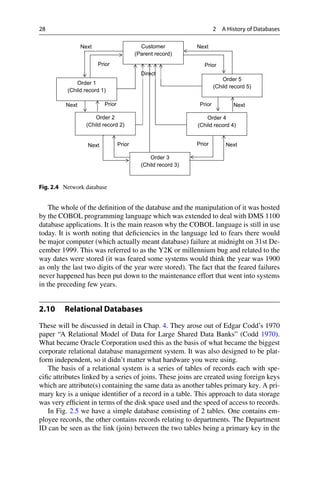
In a network database such as UNIVAC’s DMS 1100, you have one record which
is the parent record. In the example in Fig. 2.4 this is a customer record. This is
defined with a number of attributes (for example Customer ID, Name, Address).
Linked to this are a number of child records, in this case orders which would also
have a number of attributes. It is up to the database design to decide how they are
linked. The default was often to ‘next’ pointers where the parent pointed to the
first child, the first child had a pointer to the second child and so on. The final
child would have a pointer back to the parent. If faster access was required, ‘prior’
pointers could be defined allowing navigation in a forward and backward direction.
Finally if even more flexibility was required ‘direct’ pointers could be defined which
pointed directly from a child record back to the parent. The trade-off was between
speed of access and speed of updates, particularly when inserting new child records
and deleting records. In these cases pointers had to be updated.
49.
28 2 AHistory of Databases
Fig. 2.4 Network database
The whole of the definition of the database and the manipulation of it was hosted
by the COBOL programming language which was extended to deal with DMS 1100
database applications. It is the main reason why the COBOL language is still in use
today. It is worth noting that deficiencies in the language led to fears there would
be major computer (which actually meant database) failure at midnight on 31st De-
cember 1999. This was referred to as the Y2K or millennium bug and related to the
way dates were stored (it was feared some systems would think the year was 1900
as only the last two digits of the year were stored). The fact that the feared failures
never happened has been put down to the maintenance effort that went into systems
in the preceding few years.
2.10 Relational Databases
These will be discussed in detail in Chap. 4. They arose out of Edgar Codd’s 1970
paper “A Relational Model of Data for Large Shared Data Banks” (Codd 1970).
What became Oracle Corporation used this as the basis of what became the biggest
corporate relational database management system. It was also designed to be plat-
form independent, so it didn’t matter what hardware you were using.
The basis of a relational system is a series of tables of records each with spe-
cific attributes linked by a series of joins. These joins are created using foreign keys
which are attribute(s) containing the same data as another tables primary key. A pri-
mary key is a unique identifier of a record in a table. This approach to data storage
was very efficient in terms of the disk space used and the speed of access to records.
In Fig. 2.5 we have a simple database consisting of 2 tables. One contains em-
ployee records, the other contains records relating to departments. The Department
ID can be seen as the link (join) between the two tables being a primary key in the
50.
2.10 Relational Databases29
Fig. 2.5 Relational database consisting of two tables or relations
Department table and a foreign key in the Employee table. There is also a one to
many relationship illustrated which means for every record in the Department table
there are many records in the Employee table. The converse is also true in that for
every record in the Employee table there is one and only one record in the Depart-
ment table.
The data in a relational database is manipulated by the structured query language
(SQL). This was formalised by ANSI (American National Standards Institute) in
1986. The have been seven revisions of SQL86, the most recent revision being
SQL2011 or ISO/IEC 9075:2011 (International Organization for Standardization
/International Electrotechnical Commission). SQL has a direct relationship to rela-
tional algebra. This describes tables (in relational algebra terms—relations), records
(tuples) and the relationship between them. For example:
P1 = •type_property=‘House’(Property_for_Rent)
would be interpreted as find all the records in the property for rent table where the
type of rental property is a house and would be written in SQL as:
SELECT ∗ FROM property_for_rent WHERE type_property = ‘House’;
Oracle and Microsoft SQL server are examples of relational database systems. Mi-
crosoft Access has many of the features of a relational database system including
the ability to manipulate data using SQL, but is not strictly regarded as a relational
database management system.
51.
30 2 AHistory of Databases
2.11 Object Oriented Databases
Most programming today is done in an object oriented language such as Java or
C++. These introduce a rich environment where data and the procedures and func-
tions need to manipulate it are stored together. Often a relational database is seen
by object oriented programmers as a single persistent object on which a number of
operations can be performed. However there are more and more reasons why this is
becoming a narrow view.
One of the first issues confronting databases is the rise of non-character (alphanu-
meric) data. Increasingly images, sound files, maps and video need to be stored, ma-
nipulated and retrieved. Even traditional data is being looked at in other ways than
by traditional table joins. Object oriented structures such as hierarchies, aggregation
and pointers are being introduced. This has led to a number of innovations, but also
to fragmentation of standards.
From the mid 1980’s a number of object oriented database management sys-
tems (OODBMS) were developed but never gained traction in the wider business
environment. They did become popular in niche markets such as the geographic
and engineering sectors where there was a need for graphical data to be stored and
manipulated. One of the big issues with object oriented databases is, as mentioned
creating a standard. This was attempted by the Object Data Management Group
(ODMG) which published five revisions to its standard. This group was wound up
in 2001. The function of ODMG has, been taken over by the Object Management
Group (OMG). Although there is talk of development of a 4th generation standard
for object databases, this has not yet happened
An issue with developing object oriented systems was that a lot of expertise and
systems had been developed around relational databases and SQL had become, for
better or worse, the universal query language. The second approach to object ori-
entation therefore was to extend relational databases to incorporate object oriented
features. These are known as object relational databases. They are manipulated by
SQL commands which have been extended to deal with object structures.
Chapter 7 will look in detail at both Object and Object Relational Databases.
2.12 Data Warehouse
A problem with an operational database is that individual records within it are con-
tinually being updated, therefore it is difficult to do an analysis based on historical
data unless you actively store it. The concept behind a data warehouse is that it can
store data generated by different systems in the organisation, not just transactions
form the database. This data can then be analysed and the results of the analysis
used to make decisions and inform the strategic direction of an organisation. Data
warehouses have already been mentioned in Chap. 1 where they were discussed in
their role of an organisational asset. Here we look briefly at some of their technical
details.
52.
2.12 Data Warehouse31
Fig. 2.6 Star schema
A data warehouse is a central repository of data in an organisation storing his-
torical data and being constantly added to by current transactions. The data can be
analysed to produce trend reports. It can also be analysed using data mining tech-
niques for generating strategic information. Unlike data in a relational database, data
in a data warehouse is organised in a de-normalised format. There are three main
formats:
• Star schema: tables are either fact tables which record data about specific events
such as a sales transaction and dimension tables which information relating to
the attributes in the fact table (Fig. 2.6)
• Snowflake schemas are also based around a fact table which has dimension
tables linked to it. However these dimension tables may also have further tables
linked to them giving the appearance of a snowflake (Fig. 2.7)
• Starflake schema which is a snowflake schema where only some of the dimen-
sion tables have been de-normalised
Data mining is a process of extracting information from a data warehouse and
transforming it into an understandable structure. The term data analytics is starting
to be used in preference to data mining. There are a number of steps in the process:
• Data cleansing were erroneous and duplicate data is removed. It is not uncom-
mon in raw data to have duplicate data where there is only a minor difference,
for example two customer records may be identical, but one contains a suburb
name as part of the address and one does not. One needs removing.
• Initial Analysis where the quality and distribution of the data is determined.
This is done to determine if there is any bias or other problems in the data
distribution
• Main analysis where statistical models are applied to answer some question,
usually asked management.
53.
32 2 AHistory of Databases
Fig. 2.7 Snowflake schema
Data mining is just one method in a group collectively known as Business Intelli-
gence that transform data into useful business information. Others included business
process management and business analytics. A further use for data in a data ware-
house is to generate a decision system based on patterns in the data. This process is
known as machine learning. There are two main branches: neural networks which
use data to train a computer program simulating neural connections in the brain for
pattern recognition and rule based systems where a decision tree is generated.
2.13 The Gartner Hype Cycle
Gartner began publishing its annual hype cycle report for emerging technologies in
2007. Technologies such as Big Data and Cloud Computing both feature so we will
have a brief look at the hype cycle before continuing. The hype cycle is based on
media ‘hype’ about new technologies and classifies them as being in one of five
zones.
• The Technology Trigger which occurs when a technological innovation or
product generates significant press interest
• The Peak of Inflated Expectations where often unrealistic expectations are
raised
• The Trough of Disillusionment where, because of failing to meet expectations
there is a loss of interest
54.
2.14 Big Data33
• The Slope of Enlightenment where organisations which have persisted with
the technology despite setbacks begin to see benefits and practical applications
• The Plateau of Productivity where the benefits of the technology have been
demonstrated and it becomes widely accepted
In practice it is not really a cycle but a continuum. Gartner has produced many
different hype cycles covering many different topics from advertising through to
wireless network infrastructure (see Gartner Inc. 2013).
One of the exercises at the end of this chapter involves examining hype cycles.
By completing this you will see what they look like and how technologies move
across the cycle on a year by year basis.
2.14 Big Data
As mentioned in Chap. 1, the amount of data available that an organisation can
collect and analyse has been growing rapidly. The first reference to big data on
Gartner’s Hype Cycle of emerging technologies was in 2011 when it was referred
to as ‘Big Data and Extreme Information Processing and Management’. As a term
it grew out of data warehousing recognising the growth of storage needed to handle
massive datasets some organisations were generating.
The definition of “Big data” is often left intentionally vague, for example
McKinsey’s 2011 report defines it as referring ‘...to datasets whose size is be-
yond the ability of typical database software tools to capture, store, manage, and
analyze.’ (Manyika et al. 2011, p. 1). This is because different organisations have
different abilities to store and capture data. Context and application are therefore
important. Big Data will be explored in depth in Chap. 6.
2.15 Data in the Cloud
The 2012 Gartner Hype Cycle also identifies database platform as a service (as part
of cloud computing) and like in-memory databases it has been identified as over-
hyped. However like in-memory databases it is also thought to be within five years
of maturity.
Cloud computing is distributed computing where the application and data a user
may be working with is located somewhere on the internet. Amazon Elastic Com-
pute Cloud (Amazon EC2) was one of the first commercial cloud vendors supplying
resizable computing and data capacity in the cloud. The Amazon cloud is actually a
large number of servers located around the world although three of the biggest data
centres are located in the United States, each with thousands of servers in multiple
buildings. An estimate in 2012 suggested Amazon had over 500,000 servers in to-
tal. As a user you can buy both processing and data storage when you need it. Many
other vendors including British Telecom (BT) are now offering cloud services.
The impact on database systems is you no longer have to worry about local stor-
age issues because you can purchase a data platform as a service in the cloud. It also
means whatever an organisations definition of big data is, there is a cost effective
the three divisionsrowed slowly down, preserving their proper
intervals, and keeping time to the music that led the fleet.
"Arrived between the Fanny and the Market wharf, a signal was
made from one of the boats ahead, and the whole lay upon their
oars, while the music played 'God Save the King,' and three cheers
given from the vessels were returned from the multitude on shore.
By this time the flood tide became too rapid for the galleys to
advance; they were therefore quitted, and the company disposed of
in different barges. This alteration broke in upon the order of
procession, but was necessary to give sufficient time for displaying
the entertainments that were prepared on shore.
"The landing place was at the Old Fort, a little to the southward of
the town, fronting the building prepared for the reception of the
company, about four hundred yards from the water by a gentle
ascent. As soon as the general's barge was seen to push from the
shore a salute of seventeen guns was fired from the Roebuck, and,
after some interval, by the same number from the Vigilant. The
company, as they disembarked, arranged themselves into a line of
procession, and advanced through an avenue formed by two files of
grenadiers, and a line of light-horse supporting each file. This
avenue led to a square lawn of two hundred and fifty yards on each
side, lined with troops, and properly prepared for the exhibition of a
tilt and tournament, according to the customs and ordinances of
ancient chivalry. We proceeded through the center of the square.
"The music, consisting of all the bands of the army, moved in front.
The managers, with favors of white and blue ribbon in their breasts,
followed next in order. The general, admiral, and the rest of the
company, succeeded promiscuously.
"In front appeared the building, bounding the view through a vista
formed by two triumphal arches erected at proper intervals in a line
with the landing-place. Two pavilions, with rows of benches rising
one above the other, and serving as the wings of the first triumphal
arch, received the ladies, while the gentlemen arranged themselves
57.
in convenient orderon each side. On the front seat of each pavilion
were placed seven of the principal young ladies of the country,
dressed in Turkish habits and wearing in their turbans the favors
with which they meant to reward the several knights who were to
contend in their honor. These arrangements were scarce made when
the sound of trumpets were heard in the distance, and a band of
knights, dressed in ancient habits of white and red silk, and mounted
on gray horses richly caparisoned in trappings of the same colors,
entered the lists, attended by their esquires on foot, in suitable
apparel."
Major Andre continues his letter with a long and detailed account of
the tournament which followed, and thus concludes:
"The company were regaled with tea, lemonade, and other cooling
liquors when they entered the house. On the same floor with the
ballroom were four drawing-rooms with sideboards of refreshment.
Dancing continued until ten o'clock, when the windows were thrown
open, and the display of fireworks began. At twelve o'clock supper
was announced, and large folding-doors, hitherto artfully concealed,
being suddenly thrown open, discovered a magnificent saloon with
three alcoves on each side which served as sideboards. Fifty-six
large pier glasses, ornamented with green silk artificial flowers and
ribbons; one hundred branches with three lights in each, trimmed in
the same manner as the mirrors; eighteen lusters, each with twenty-
four lights, suspended from the ceiling, and ornamented as the
branches; three hundred wax tapers disposed along the supper-
table; four hundred and thirty covers, twelve hundred dishes,
twenty-four black slaves in oriental dresses, with silver collars and
bracelets, ranged in two lines, and bending to the ground as the
general and admiral approached the saloon. Then came the drinking
of healths and the toasts, and after supper the dancing was
continued until four o'clock."
It was while the citizens as well as the soldiery were gathered on the
riverside, watching the imposing spectacle, that Jacob and Enoch,
instead of following the example of those around them and crowding
58.
as near tothe water's edge as possible, were standing on a slight
elevation some distance from the Penny-Pot House landing, when
they were accosted by a rough-looking fellow, who, to judge from
his dress, was a farm laborer.
"I allow you two lads have allers lived here in Philadelphia, eh?" he
began, as if more for the purpose of making an acquaintance than to
gain information.
"You surely can't take us for Britishers?" Jacob said laughingly.
"That is not your misfortune," the man replied. "You can be as loyal
to the king in the colonies as if you had been born in London."
"And if we had been born there we might consider it our duty to be
loyal to him; but inasmuch as we are Philadelphia boys the case is
different," Jacob replied boldly, despite Enoch's warning glance.
"It is safer to keep the matter a secret if you count on being
disloyal," the man said with a grin.
"That is impossible in our case, for two who have been in prison five
weeks would be distrusted if they suddenly conceived a love for the
king."
"So General Howe believes you are dangerous characters, eh? It
seems as if he was afraid of the boys quite a considerable, for I have
heard tell how he had old Chris Ludwick's son locked up."
"So he did, and I happen to be that son."
"You?" the man exclaimed with a pretense of surprise. "And who is
this with you?"
"It is Enoch Ball. But hark you, friend, I don't understand that you
have got any right to ask questions, and perhaps I have given you
all the information necessary."
Jacob spoke sharply, for there came into his mind the thought that
this stranger was displaying altogether too much interest in what did
59.
not concern himpersonally.
"I don't allow you have," the man replied, glancing furtively around,
as if to make certain there were no eavesdroppers near. "If you are
Chris Ludwick's son, you was jailed by the Britishers for helping one
Seth Graydon, said to be a spy, escape from prison."
The man spoke in such a meaning tone there was no longer any
doubt but that his questions meant something more than idle
curiosity, and both Jacob and Enoch turned upon him suddenly.
"What do you know about Seth Graydon?" the latter asked sharply.
"You will learn fully as much if you don't make such a noise," the
stranger replied in a low tone. "I can't say that I know anything
particular about Seth, except that he wanted me, in case I happened
to run across Jacob Ludwick and Enoch Ball, to give them his best
compliments."
"Where is he?" Jacob asked eagerly.
"I allow you can make a pretty good guess, so there's no need of my
going into particulars, especially round here, where the chances are
it might lead a fellow into trouble."
"Where did you come from?"
"It is best not to ask too many questions, Jacob Ludwick. The least
that is said in this 'ere city is the soonest mended. If it should
happen, though, that you knew anything which might be important
for your friends to know, now is the time to repeat it, and I'll take
care it reaches the proper quarter."
"Then you are—"
"I work on a farm up the Schuylkill with a Quaker by the name of
Parker, and am down here to see the brave doings of the king's
officers."
60.
"Do you knowwhere we can join any portion of the American
army?"
"For what purpose?"
"We count on enlisting as soon as we are able to leave the city; but
the Britishers have kept a close watch on us since we were let out of
jail, and thus far it has been impossible to get away."
"Take my advice, and stay where you are a spell longer. It won't be
many days before there'll be a change around here, and after that
perhaps you won't be so closely watched. If you should happen to
hear anything that would benefit your friends, and want to sent
them word, you might find me somewhere near about the Blue
Anchor, almost any forenoon, when I have disposed of my produce."
There was no necessity for the man to make further explanations;
the boys understood that in his assumed character of a farm laborer
he was acting the spy, and by bringing in produce to sell would have
no trouble in entering or leaving the city.
It was just such an acquaintance as Jacob had been particularly
anxious to make; but he was disappointed and perplexed because
the proposition that he and Enoch enlist was not received with favor.
"It isn't likely we could learn very much that would interest you,"
Master Ludwick said after a brief pause, "for since our arrest we
have but little chance of hearing any British secrets."
"You are not hindered from roaming around the town as you wish?"
"Oh, no; we are prevented, however, from going very far into the
country, and have been stopped several times by the patrol."
"Then spend your time observing the movements of the troops, and
take particular notice if any activity prevails among the soldiers to-
morrow night. You can be of more service here during the next two
weeks than you could in the ranks."
61.
"But you arein town every day, and can see quite as much as we."
"I only remain here long enough to sell my wares and to drink a pint
of beer at the Blue Anchor. It would seem strange if a farmer was
overfond of watching the soldiers. There are several in town who,
during such time as we are haggling over the price of vegetables,
manage to let me know what they have seen, and when it was made
known that we wanted to increase the number of our friends here,
Seth Graydon told General Dickinson you would be willing to do all in
your power."
"Seth was right. We are more than willing; but hardly know how to
set about it."
"There's but little more to do than loiter around the city listening to
the general gossip, and observing the movements of the troops. You
boys certainly are bright enough to know by general appearances if
any great force is making preparations to leave, and even though
you have been under arrest for aiding a boy whom the Britishers
called a spy, I don't think you would be interfered with if you
exercised proper caution. It is especially necessary that our friends
are all on the alert during the next forty-eight hours, and I shall
come into town very early to-morrow morning, and again in the
afternoon, so that you will have two chances to report anything you
may have learned."
"Is there reason to believe the British will make a move within that
time?"
"They certainly will, if, as is probable, the Tories between here and
Valley Forge bring in information of what is being done."
"Is General Washington to make an attack?" Jacob asked eagerly.
"Hardly that; but some of his forces will move toward this city very
shortly, and it becomes highly important he should have early
information of what the enemy may do when they learn of it. We
have talked here as long as is safe, for, although people seem intent
62.
upon the braveshow General Howe's officers are making, there may
be some whose business it is to pay attention to their neighbors."
The stranger lounged away as if following with his eyes the
spectacle upon the water, and when he was gone Jacob said in an
exultant tone:
"It seems that we can be of some service to the cause even if we do
not enlist."
"Yes, and Seth did us a good turn when he said we were ready to
perform our share in the work."
"Yet since we met this stranger, Enoch, we have agreed to become
spies—there is no other name for it—and if we should now be put
under arrest by the Britishers, there would be good cause for dealing
out to us that punishment which Seth escaped."
63.
CHAPTER VII.
ON THEALERT.
Although fully aware of the fact that by following the suggestions of
the stranger they were jeopardizing their lives, Jacob and Enoch felt
very proud because of the confidence in them thus apparently
displayed by the leaders of the cause.
They had no idea as to the identity of the man with whom they had
talked, but it seemed positive he was one in whom the Continental
officers trusted implicitly, otherwise he would not have been selected
for so dangerous and responsible a position as that of gathering
information in the very heart of the British camp.
It was evident, at least to the boys, that he had sufficient authority
to thus attach them to the American army, and both were well
content to delay signing their names on the enlistment rolls, because
of the fact that they were occupying much more responsible and
dangerous posts by remaining in the city.
It was not probable the enemy would be contemplating any
important movement while the festivities were in progress, yet Jacob
and Enoch walked to and fro through the streets of the now almost
deserted city, believing their new duties demanded such diligence;
but seeing nothing more formidable than an unusually surly patrol
who were out of temper because forced to be on duty while their
comrades were participating in the merry-making.
Not until nearly midnight did they return to Enoch's home, and by
daylight next morning both were on the alert once more.
64.
During the forenoonthey saw in the market-place, haggling over the
price of a cabbage as if his only thought was to sell his wares to the
best advantage, their acquaintance of the previous day.
Jacob would have entered into conversation with the man but for
the fact that Enoch restrained him by saying:
"It is not well to be seen talking with him when it is unnecessary,
lest we rouse the suspicions of the Britishers. We have nothing to
report, and he will so understand it when we pass by without
speaking."
"But he may have something to say to us."
"If he has we shall soon know it; but unless he makes a sign we had
better keep on our way."
The seeming farmer paid no attention to the boys; that he saw them
was evident, but he did not so much as raise his eyes after one
quick glance, and Jacob understood that Enoch was wiser than he in
such matters.
During this day it was as if the enemy was resting from the fatigue
of merry-making; but few officers were to be seen on the streets
until late in the afternoon, and at the different barracks there was
even less than the ordinary amount of noise.
It was five o'clock when the boys turned from High into Second
Street believing their day's work nearly done.
The sidewalk in front of the City Tavern was thronged with officers
and civilians, and Jacob whispered:
"I wonder what is going on there? Some of the crowd appear to be
excited."
"Suppose we pass the place singly, for by so doing we shall have a
better chance to linger. You go ahead, and I'll follow when you are
65.
halfway through thecrowd," Enoch suggested, and Jacob acted
upon the idea at once.
Before he was well among the throng he heard that which caused
him the liveliest surprise.
"So Lafayette's tattered retinue have abandoned their mud-holes,
have they?" a gentleman who had just come up said to a group of
officers, and one of the latter replied:
"There appears to be no doubt about it. A Quaker on whom the
Frenchman quartered himself has sent word that he is at Barren Hill,
with twenty-five hundred picked men and five cannon."
"What does it mean? Can it be possible Washington believes for a
single instant that his rag-tag and bob-tail can stand against General
Howe's forces?"
"It is difficult to say just what the rebel commander believes," one of
the officers replied with a laugh. "There are times when he behaves
as if he thought he could annihilate us, and then suddenly he turns
tail as if afraid of his life."
"But if he contemplates any audacious movement, why does he send
Lafayette?" the citizen continued. "He is hardly more than a boy, and
surely Washington must have more experienced officers."
"He has no abler soldier than Lafayette, boy though he is. He has
had the advantage of a thorough military education, and will make
better play for us than many of the elder men."
"Do you apprehend any difficulty in disposing of him if he continues
his march? I should say he might be advancing on Germantown, if
he makes his first halt at Barren Hill."
The officers were greatly pleased at this question, and the
spokesman continued, as soon as his mirth had subsided sufficiently
to admit of his speaking:
66.
"We shall makeshort work of him if we are allowed to take the field;
but I question if General Howe will pay any attention to the
movement until it has developed further."
Jacob was forced to pass this particular group lest the fact that he
was listening to the conversation should become known; but before
getting out of the throng he heard all the particulars that could be
given relative to the advance of the "rebels."
Some of the gossipers believed Washington intended to make an
attack on Philadelphia; others had the idea that he was preparing to
retreat, fearing lest Sir Henry Clinton, after taking command of the
army, would press him too warmly, and that this movement of
Lafayette's but cloaked the design. Not a few thought that the rebels
had decided upon a vigorous campaign, of which this unaccountable
advance was proof, and before many moments such belief was
shared by the majority.
Once Jacob had passed beyond the excited throng he waited with
the utmost impatience for Enoch to join him, and when, after what
seemed an exceedingly long time, his comrade came up looking
surprised and alarmed, Master Ludwick motioned for him to follow
toward the bank of the river.
Not until the boys stood where there was no possibility the
conversation could be overheard did Jacob speak, and then it was to
say:
"Now we understand why the man who talked with us was so
anxious to learn what might be done by the Britishers. He knew
General Lafayette was about to move, and expected troops would be
sent out from here at once."
"If that is done we shall be of but little service, for the soldiers will
march as fast as we can."
"That remains to be seen. The time has come when we can do work
that will be of importance, and we must not lose the opportunity."
67.
"Then we hadbest get around by the barracks; we can be of no
service while we stand here talking idly."
"It is not idle talk, as you shall see. The thought has come to me
that if the enemy makes any move to-night it is our duty to take the
news to General Washington, or General Lafayette, before the
Britishers can get very far on the road."
"I don't understand how it is to be done."
"Are you willing to run a big risk?"
"I am ready to do anything in aid of the cause."
"Then listen. I know where Wharton, the Tory, has two horses
stabled, and it will not be hard work to get them out after the groom
has gone away for the night. If anything is done by the Britishers
which our friends should know, we can take them, follow the
Schuylkill up till we come to the bridge, and be at General
Lafayette's camp before daylight."
"But that would be stealing!" Enoch cried.
"I don't think so, under the circumstances. It will be only an honest
act, for we do it to save the lives of our friends."
"That would prevent our coming back to Philadelphia while the
Britishers are here, and the stranger said we might be of more
service in this city than we could in the army."
"So we shall if we carry such important news, and it is better for us
to leave here on an errand like that than remain idle when the cause
may suffer."
"I will do whatever you say is right, Jacob, but do not want to serve
our country by becoming a thief."
"That you will not become, I tell you!" Jacob cried impatiently.
"It shall be as you say."
68.
"Very well. NowI will go in one direction and you in another. We'll
meet on High Street near Fourth. If nothing has been seen we must
continue to walk around until certain the Britishers do not intend to
leave the city."
Having thus mapped out his plan Jacob started up Walnut Street at
his best pace, and Enoch went in the opposite direction, feeling
rather doubtful of such honesty as displayed itself by the theft of
two horses.
Not until eight o'clock in the evening did either of the boys see
anything to denote that the enemy's troops would be moved that
night, and then it was as if all the preparations had been made in an
instant.
It was Enoch who was standing in front of General Grant's quarters
when that gentleman came out attended by two of his staff, and the
boy heard him say petulantly:
"We are forced to go on a wild-goose chase, while the more
fortunate fellows are enjoying themselves at the play. I expected to
see at least two acts of Douglas, and had invited some ladies to
accompany me."
"Are we likely to go far?" one of his companions asked.
"To Barren Hill; and on arriving there we shall find our French bird
has flown, although General Howe is so certain of capturing him that
he has invited a large party to take supper with the proposed captive
to-morrow night, while Admiral Howe has given orders to have a
frigate made ready for sailing with Lafayette on board. It would
create a sensation if we should send the marquis to England as a
prisoner!"
"Indeed it would, and I only hope he will give us half a chance to
catch him. How large a force shall we have?"
"Five thousand in my column and two thousand under Grey."
69.
"That will beplenty to do the work, and it isn't impossible we may
succeed in surprising him. Our preparations have been made very
quietly."
"Only those engaged in the service have any idea of what it is
proposed to do, and all of us have been sworn to secrecy. I shall—"
The speakers moved on, and Enoch could not distinguish the
remainder of the conversation; but he had heard enough to change
his mind as to the honesty of stealing horses, and now thought only
of the possibility that they might not succeed in such purpose.
Hastening to the rendezvous at full speed, he found Jacob awaiting
him and displaying every evidence of agitation and impatience.
"I thought you would never come," he whispered eagerly. "We have
no time to lose, for I have seen more than a thousand soldiers in the
ranks ready for a march."
"And I have heard exactly how many are to go; but we must hurry
to the Tory's stable, for there is no time to lose!" and Enoch urged
his comrade forward, telling him while they walked so swiftly as to
be almost running that which he had learned.
"No two boys ever had such an opportunity as we've got now!"
Jacob said triumphantly. "If we can be the first to carry the news to
General Lafayette, it will be a work that even General Washington
would thank us for! We shall find no difficulty in enlisting in any
regiment we choose, and who knows but we'll be made officers?"
"I don't understand how that could be, when we are not even
soldiers; a man must have had experience before he can command
others."
"Couldn't we soon gain that?"
"We'd better give all our attention to getting the horses. If we
succeed in finding General Lafayette I shall have reward enough,
and a commission as colonel wouldn't make me any happier."
70.
"I'd rather bean officer than a private," Jacob replied decidedly,
"and we're now in a fair way to wear swords."
The pace at which they were traveling was not well suited for a
prolonged conversation, and the boys were panting so heavily that it
was absolutely necessary to remain silent until they were in the
vicinity of the Tory's stable.
The building was situated a hundred yards or more from the
dwelling, and no one could be seen in the vicinity.
Jacob forced his companion to halt where a clump of bushes hid
them from view of any one who might pass that way, until they had
regained their breath, and then said hurriedly:
"I know the man who takes care of the horses. He boards at the
third house from here, and doesn't often come back in the evening
after his day's work is done. The stable door opens toward
Wharton's house, and our greatest danger will be in getting the
animals out. I'll go ahead; if you fail to hear anything for five
minutes, follow me."
"Go on; don't waste any more time, for if the soldiers set out ahead
of us we shall find it difficult to pass them."
Master Ludwick made his way toward the building as if stealing
horses was a work with which he was thoroughly conversant, and
when the specified time had elapsed Enoch followed.
The fact that a play was being performed at the theater, and also
that nearly all the male population of the city were congregated in
the business portion of the town discussing this unexpected move on
Lafayette's part, was of material aid to the boys in their undertaking.
Not a light could be seen in the Tory's home, and it was situated so
far out of the city there was little fear pedestrians would pass at that
hour in the evening.
71.
When Enoch enteredthe barn he understood by the subdued noise
that Master Ludwick was bridling a horse, and he whispered:
"Are there two here?"
"Yes; I've got a bridle on one, and if you'll hold him I'll take out the
other. We can't stop to find saddles."
"There's no need of anything of that kind, but I think we should
have something in the shape of whips, in case we're pursued."
"We can find a stick once we are clear of the city. Have you got hold
of the bridle?"
"Yes; I'll take care of this fellow. Get the other quickly, for if any one
should come now we'd be in a bad plight. I had rather be in prison
as a spy than a horse thief."
That Jacob was familiar with the interior of the stable was proved by
the celerity of his movements.
Although Enoch was in that frame of mind when the seconds drag
like minutes, it seemed to him as if he had but just taken charge of
the first animal before his comrade had the other in the floor.
There was hardly time for one to have counted twenty when Master
Ludwick opened the stable door cautiously as he whispered:
"Mount, Enoch, and ride at a walk until we are so far away that the
hoof-beats won't be heard in case any of the family should chance to
be at home. Remember, we must keep together as long as possible;
but if it happens that we are separated, each must do his best at
finding General Lafayette's camp!"
"Don't stop to give orders now, but come on!" Enoch replied
nervously as he mounted, and in another moment the young patriots
were riding slowly up the street.
Neither dared to speak, and the noise of the animals' feet on the
hard road sounded so loud in their ears that it seemed as if any one
72.
half a mileaway must hear it.
Both the boys understood, however, that considerably more noise
would be made if they allowed their horses to trot, and, dangerous
though the position was, they reined their steeds down to a walk
until fully a quarter of a mile had been traversed, when Jacob said
grimly:
"It's time to let them out now, and if we are caught it won't be
because we haven't been cautious enough!"
The horses, impatient at having been restrained, darted forward
swiftly when the reins were loosened, and Enoch cried in delight:
"They are in the proper trim for rapid traveling, and we should be
able to keep ahead of foot soldiers, for, of course, we are in advance
of them."
"I don't believe the Britishers have started yet, and it's almost
certain there is no enemy between us and the American force. We've
just the same as won our swords already!"
"Never mind the swords if we—"
Enoch ceased speaking very suddenly as a voice, coming apparently
from the thicket that bordered the road, cried sternly:
"Halt! Halt or I fire!"
Instead of making any reply Jacob struck his horse with both heels,
darting ahead of Enoch for the time being, and in another instant
the command rang out:
"Fire! Then see that they do not escape!"
"They're mounted men!" Enoch cried in fear as he bent over the
neck of the horse, involuntarily glancing back just as a broad sheet
of flame lighted up the trees a short distance in the rear, and he
heard the whistling of bullets over his head almost at the same
instant that the reports of the weapons rang out.
73.
"Are you hurt,Jake?" he cried anxiously.
"Not so much as a scratch; but this isn't the time to talk. Those
fellows have horses, and it's a question how long these can hold out.
Wharton never was known to keep very good stock, so father says."
Enoch was not exactly in that frame of mind where he could best
speculate upon the faults or merits of the Tory's horses; but he was
thoroughly aware that he and his comrade would soon have a very
good idea of the abilities of these two animals as compared with
those in the rear.
Glancing back hurriedly the boy saw a group of horsemen in sharp
pursuit, and he decided there could not be less than half a dozen, all
of whom were in uniform.
The thought came into his mind that this party had been posted on
the road to prevent any one from carrying information to the enemy,
and now, when it was too late, he remembered that he and Jacob
had twice before been turned back by a patrol at this very point.
"We should have remembered it," he said to himself. "It would not
have been much out of our way if we had ridden across the field,
and then we shouldn't be pressing our horses at their best speed
when the journey has but just begun."
It was too late now to indulge in regrets. The pursuers were making
every effort to end the chase quickly, and there was good reason to
believe the weapons would again be used, when a chance shot
might end the chase by crippling one of the animals even if it failed
to hit a human target.
Enoch was not urging the steed he rode to its best pace, but
contented himself with holding the advantage he had over the
enemy; while Jacob had used his heels as spurs to such effect that
his horse was far in advance.
During half an hour the race was continued, and then the animals
showed signs of fatigue. Now it was necessary for Enoch to urge his
74.
on, while Jacob's,less fresh because of the first great burst of
speed, was slowly falling to the rear.
"I won't run away from you," Enoch said encouragingly. "Their
horses must be as tired as ours; but if they've got better wind, I'll be
by your side when we're overtaken."
"No, no, you mustn't do that!" Jacob cried sharply. "If only one can
get through the work will be done, and I deserve to be overhauled
because I sent this beast ahead at such a furious rate when we first
started. Do your best to give them the slip, and pay no attention to
me; but when you see Seth again tell him I tried to do as much for
the cause as he did."
"I shall stay by you," Enoch said decidedly as he reined in his horse.
"They are getting no nearer, and—Look out!"
The warning cry had hardly been uttered when the reports of
muskets or pistols rang out once more; but this time the whistling of
the bullets could not be heard.
"They have lost ground!" Enoch cried joyfully. "Don't punish your
horse so much, but slacken the pace a bit till he gets his wind. We'll
best them yet."
Again and again the weapons were discharged, but the boys no
longer bent their heads, for they were out of range, and the race
was well-nigh won.
Five minutes later the pursuers were lost to view in the distance,
and Jacob cried in a tone of relief:
"We've outridden them at last; but if they had held on five minutes
longer, it would have been all over, so far as I'm concerned, for I
don't believe this beast could have held a trot half a mile more."
"Let him walk awhile, and we'll keep a good lookout in case they
should make another try for us. Do you know the roads
hereabouts?"
75.
"Yes; all ofthem. If it was daylight you could see my home from the
next hill. There is no short cut hereabouts that they can take to get
ahead of us, and we're certain to go through all right!"
76.
CHAPTER VIII.
BARREN HILL.
Theboys now had good reason to believe that the most difficult
portion of their work was accomplished.
It was not probable they would meet any of the enemy while riding
in this direction, and all that now remained was to find General
Lafayette's command.
This last both the boys fancied might be easily done, for Jacob was
familiar with the roads in that section of the country, and should be
able to lead the way to the camping-place.
The horses would be recovering from the effects of their long race if
allowed to continue on at a walk, and such gentle exercise, heated
as they were, was better than to bring them to a halt.
"I reckon we've earned our swords," Jacob said, after he was
satisfied the enemy had abandoned the pursuit and there was no
longer any danger to be apprehended. "It's mighty lucky for us we
met that spy on the day of the carnival!"
"I think we'd better finish the work before crowing very loud," Enoch
replied with a laugh. "As to whether we are given swords or not
troubles me very little, for I had rather be a private than an officer."
"That's because you don't know how much easier it is to command
than be commanded."
"But how is it when a fellow doesn't know how to command?"
77.
"He can soonlearn."
"Well, it doesn't seem to me there is any good reason why we
should discuss the matter, for the swords haven't been offered us,
and perhaps never will be."
"If we don't receive them it'll be because our services are not
appreciated. Hark! Do you hear anything?" and Jacob reined his
steed to a standstill as he listened intently.
Far up the road, in the direction where the boys supposed the
advance of the Continental army was encamped, could be heard the
hoof-beats of horses, sounding nearer and nearer each instant.
"They are coming this way!" Master Ludwick said at length. "Do you
suppose it is possible our friends have any idea of making an attack
on General Howe's forces?"
"They must do that, or be prepared to resist one. Now if ever is the
time when our news will be of value."
The boys rode forward confident the approaching travelers were
friends, and a few moments later two mounted men could be seen
dimly in the gloom, approaching at a quick, but not hurried, pace.
"Hello, friends!" Jacob shouted, guiding his horse to the middle of
the road as if to bar the passage.
The newcomers halted suddenly, and one of them asked in a low
tone, speaking to his companion:
"Who have we here? Surely it cannot be that any of the enemy are
so far from the city."
"We are friends if you are members of the Continental army," Jacob
cried.
"And that is what we are; but why do you take the middle of the
road as if to dispute our right to pass?"
78.
"I am theson of Christopher Ludwick, and this fellow with me is
Enoch Ball. We have ridden at risk of our lives, having been chased
and fired at by a squad of Britishers, to give General Lafayette news
of the enemy's movements."
Jacob spoke in an important tone, much as though the sword he
dreamed of was already hanging by his side, and had even now
assumed a swagger such as he thought essential in an officer of the
army.
"We have just come from the general's headquarters, bound for New
Jersey; but if your information is of importance it may be to our
advantage to turn back. Are the enemy informed of General
Lafayette's movements?"
"General Howe knows all about it; the Quaker at whose house the
marquis quartered himself sent in the full particulars. From all we
could learn, two forces, one of five thousand and the other of two
thousand men, have been sent against you."
"Have been sent?" one of the officers repeated. "Do you mean they
have already started?"
"I saw more than a thousand in the ranks ready for marching before
we came away, and they must have left town about the same time
we did."
"But how are you so certain as to the exact number?"
"Enoch heard General Grant talking with one of his staff, and the
Britisher said General Howe was so sure of capturing the marquis
that he had invited his friends to meet the prisoner at supper to-
morrow night."
The two men spoke together in whispers a few seconds, and then he
who had acted the part of spokesman asked:
"Are you the boys who were imprisoned on the charge of having
aided young Graydon to escape?"
79.
"We are."
"Then thereseems to be no question as to the truth of your
statement—"
"The truth of it?" Jacob interrupted. "Why, we saw the soldiers ready
for the march."
"Will you come with us to General Lafayette?"
"Of course we will! It was to find him that we set out."
The two officers wheeled their steeds, and began to retrace their
steps at a rapid pace, the boys following close behind.
After a few moments one of them, half-turning in his saddle, asked
how the young messengers had procured horses, and Jacob readily
told him the story of despoiling the Tory.
"You boys have begun well in the service of the cause, and if you
continue with the same zeal, should be able to give a good account
of yourselves before the struggle is ended."
"That is what we hope to do," Enoch replied, and Jacob whispered
to his comrade:
"He didn't say anything about our being given commissions for this
night's work."
"And it isn't likely any one else will," Enoch replied with a laugh. "It
should be enough for us that we have rendered an important
service, and it seems selfish to be talking of a reward even before
the work has been done."
"We'll see what General Lafayette thinks about it," and Jacob spoke
in a tone of irritation, after which he relapsed into silence, not
venturing to speak again until the little party had arrived at an
encampment completely surrounding a small farmhouse, before
which the officers drew rein.
80.
Sentries were pacingto and fro in front of the building, and the boys
understood that they were at General Lafayette's quarters, the
owner of which was the person who had sent information to the
British commander.
Not until after considerable parley were they admitted to a room
strewn with military accouterments, in the center of which stood a
table bearing the remnants of a meal.
Here they were forced to wait several moments, after which a
young, not particularly prepossessing-looking man entered, only
partially dressed.
The two officers saluted him with evident respect, while Jacob and
Enoch showed signs of dissatisfaction.
It did not seem possible to them that this boyish-appearing officer
could be the famous Frenchman of whom they had heard so much,
and both were sadly disappointed, because, as they believed, an
interview with the commander himself was to be denied them.
"This is General Lafayette," one of the officers said to Jacob, "and
you can tell him your story."
"This the general?" Master Ludwick cried in amazement.
"You expected to see an old man?" Lafayette asked with a smile.
"Well, I didn't think you was—I mean, it didn't seem—I thought you
might—"
"Never mind what you thought, my friend. If you have important
information to give it will be well if I hear that at once, and your
opinion regarding myself can be told at a more convenient season."
Jacob was so thoroughly confused as not to be able to tell a
connected story, and it became necessary for Enoch to act as
spokesman, a post he filled with great satisfaction to all, except,
perhaps, his comrade, who was angry with himself because he had
81.
foolishly allowed hissurprise to so far overcome him as to tie his
tongue.
"So I am to take supper with General and Lord Howe and their
friends, am I?" Lafayette said as if to himself when Enoch's story
was ended. "With seven thousand men against us the situation may
be desperate, but I do not think I shall go to Philadelphia this night."
Then he gave hurried commands to his officers, and when the two
left the room he turned to the young messengers with a smile which
changed the entire expression of his face, and caused Enoch to
believe he had never seen a more kindly gentleman.
"You have done nobly to bring this news, which is most important
not only to me personally, but to the cause we all serve. As to the
theft of the horses, you need give yourselves no uneasiness. I will
send word to Mr. Wharton at the earliest convenient moment, stating
that I impressed them into the service of the United States, and
forward him an order for the payment of the animals. It will be
better you should remain with this command awhile, since it may be
dangerous for you to go in either direction alone. Procure from the
quartermaster food for yourselves and the beasts, and take such rest
as is possible until we make a move."
Enoch understood that the bow with which they were favored was
an intimation that the interview had come to an end, and at once
went toward the door; but Jacob remained facing the general as if
his business was not yet concluded.
"Have you anything more to tell me?" Lafayette asked.
"I thought perhaps you counted on saying something else," Master
Ludwick stammered.
"I think we have finished our business. Perhaps at some future time
we may have a better opportunity for conversation."
After this Jacob could do no less than follow his companion, and
when they were outside the building he said, in a tone of
82.
dissatisfaction:
"It don't seemto me that we got much thanks for what we've done."
"What could you want more? We know that perhaps we have been
the means of saving this whole command from capture."
"That's exactly what we have done, and yet he didn't say a word
about giving us a sword, or even a corporal's commission."
"You expected too much. If General Lafayette is willing to give his
services to a people who were strangers to him, he has a right to
believe that a couple of boys like us are willing to serve our country
without reward."
Jacob was about to make what might have been an angry reply,
when he was suddenly seized from behind in what was no unfriendly
embrace, as a familiar voice cried:
"I counted on seeing you fellows as soon as you were let out of jail;
but didn't think you'd steal up on us in the night. Have you been
trying to get an interview with General Lafayette at this hour?"
It was Seth who spoke, and several minutes elapsed before the
three boys had so far concluded their greetings as to be able to
carry on a coherent conversation.
Then, in obedience to his friends' urging, Seth explained how he had
succeeded in reaching the American lines on the night they parted
with him on the outskirts of Philadelphia.
It was not such a story as would cause much excitement, owing to
the lack of adventure. From the moment he left them until he was at
Valley Forge he saw nothing of the enemy. The food provided by
Mrs. Ball was ample for all his wants, and the journey which he had
believed would be bristling with danger was hardly more than a
pleasing excursion.
83.
He had beenreceived with a hearty welcome by the Americans,
who, through their spies in Philadelphia, had heard of his dangerous
situation, and was allowed to enlist in whatever branch of the
service he desired. He enrolled himself in the New Jersey militia,
commanded by General Dickinson, because among them were
several acquaintances, and had done a soldier's duty from that day.
Jacob expressed considerable surprise that he had not been
rewarded in some way because of all he had suffered, and Seth's
reply occasioned Master Ludwick no slight amount of astonishment.
"That would have been strange indeed, to reward me for simply
trying to do something in aid of the cause."
"But you gave information which must have been valuable to the
Americans."
"It was, so I have since been told, and surely such knowledge is
sufficient reward."
"I ain't so certain about that," Master Ludwick replied doubtfully.
"Now I had an idea that Enoch and I would be made officers at the
very least, because of bringing news which may prevent General
Lafayette from being made prisoner; but if you haven't got so much
as a uniform for all you've been through with, perhaps we shan't
fare any better."
Seth laughed long and loud at the idea that Jacob had expected to
be made an officer in the Continental army before he had even so
much as handled a musket, and said, when his mirth had subsided
sufficiently to admit of his speaking:
"After you are in the ranks you'll learn that such rewards as you
expected could not well be given, unless the army was to be used as
an ornament, instead of for fighting. I suppose of course you will
enlist?"
"It looks as if that was all we could do," Enoch replied. "It wouldn't
be safe for us to go back to the city, for some one of the squad that
84.
pursued us mightremember our faces. Yes, the time has come when
we should become soldiers, and it seems to be more than ever our
duty since we are within the American lines by accident."
"And you will enlist in the regiment to which I belong?"
"It seems as if we should be with the Pennsylvania troops."
"I don't understand that it can make any particular difference, for
you will do your duty in one place as well as another."
"Of course we want to be with you," Jacob added thoughtfully, "and
if you really believe there's no chance of our being made officers, I
suppose we can't do better than join your company."
"Then you may as well sign the rolls at once, for I question if
General Lafayette will recommend you for promotion until you know
what a private's duty is. Did you see one of our friends in
Philadelphia, whom I sent to you?"
"Do you mean a man who was dressed as a farm-hand, and came
into the market to sell vegetables?"
"Yes."
"We met him on the day the Britishers had their celebration, or
whatever it may be called. Who is he?"
"A member of the company to which I belong; a true patriot, and
one who is willing to risk his life over and over again if by so doing
he can aid the cause. His name is Robert Greene, and when I heard
that he wanted to be directed to several people in the city who
might be able to give him information, I told him about you. The fact
that the Britishers kept you in jail so long was sufficient evidence
you were to be depended upon."
Then Seth insisted that his comrades tell him the story of their
troubles after he escaped, but before his curiosity could be fully
satisfied the entire camp was aroused.
85.
It was nearlytime for the sun to rise, and General Lafayette had
begun making preparations to escape from the trap into which he
had voluntarily walked.
Three messengers from different points had come into camp to give
notice of the British advance, and the commander knew by this time
that Grant's troops were halted at the forks of the roads leading, one
to Barren Hill, and the other to Matson's Ford. It was also learned
that a considerable number of men had been sent to Chestnut Hill,
while Grey with his force of two thousand was at the ford, less than
three miles in front of Lafayette's right flank.
Thus it was that the Americans were almost completely surrounded,
the only avenue of escape left open being by way of Matson's Ford,
the approach to which was very near where Grant had halted his five
thousand men.
The older soldiers whom the boys heard discussing the situation
were of the opinion that General Lafayette was in a trap from which
he could not escape, and, in fact, the majority of the Americans
believed they must soon be made prisoners of war, which would be a
small disaster as compared to the blow given the American arms
before the summer campaign was fairly opened.
"It begins to look as if we had jumped out of the frying-pan into the
fire," Jacob said as he stood with his comrades listening to the
comments of those around him. "We're likely to go back to
Philadelphia sooner than we counted on, and Mr. Wharton will be
after us as horse thieves."
"Come with me," Seth suggested. "I do not believe General
Lafayette is in as bad a fix as some try to make out; but if he is, it
will be better for you to be captured with muskets in your hands,
rather than as fellows who came here solely to bring information of
the enemy's movements."
"How can we do that while we have the horses? I don't propose to
give them up unless we're forced to, and that is what would happen
86.
if we followedyou."
There was no longer time for Seth to discuss the matter with his
friends. The drums were beating the call for the men to "fall in," and
he was forced to take his proper station in the line.
While Jacob hesitated, and Enoch was doing his best to persuade
him that it would be wisest to leave the horses to their fate, the
booming of heavy guns close at hand startled the boys, and Master
Ludwick was looking anxiously around for some convenient way of
escape, believing the British close upon them, when one of the
officers they had stopped on the road came up.
"You look frightened," he said laughingly.
"That's just what I am," Jacob replied grimly. "I don't want to be
taken back to the city as a horse thief, and it now seems as if that
was what is about to be done."
"There is no cause for fear yet awhile. Those cannon are being
served by our men, and I allow they will deceive the Britishers, even
though no great execution follows."
"But it sounds like a regular battle."
"I admit that, my boy; but unless I am mistaken we shan't see
anything in the way of an engagement this morning."
"Do you think General Lafayette will—"
"Have patience and you shall see what is to be done. The troops will
soon begin to move toward Matson's Ford, and you two had better
make your way in that direction at once."
"But some of the soldiers said the Britishers were very near there."
"So they are; but I fancy we can prevent them from knowing what is
being done until our troops are in a place of safety, for, as a matter
of course, there can be no question of pitting twenty-five hundred
87.
men against morethan seven thousand. Take my advice, and get to
the ford as soon as possible."
Enoch insisted that their wisest course was to act upon the officer's
suggestion, and although Jacob appeared to think he should receive
personal orders from General Lafayette regarding himself, he finally
did as his comrade desired, and, mounted on Mr. Wharton's horses,
they followed the main body of the troops.
Not until after the movement had been successfully executed, and
all the men and baggage withdrawn to a place of safety, did the
boys understand how it was done. Then the maneuver was
explained to them by a soldier whose acquaintance they made
during that day.
"Lafayette proved himself adequate to the occasion. In a moment,
as it were, his dangers were revealed, and the one possible means
of extrication resorted to. Dispositions were made in the churchyard
as though to receive Grey; his artillery, by a well-directed fire,
encouraged the idea that he purposed to engage. His real aim was,
of course, flight, and by the ford; but to attain it he must pass within
a short distance of Grant, who was nearer to it than himself. He
feigned movements as though for an attack, and by an occasional
display of the heads of columns he for a time persuaded the
Englishman that an action was imminent. Meantime the troops, as
fast as they could come up, were hurrying across the ford, until at
last the artillery and a body of Oneida savages only remained on this
side of the stream. These were also now brought over, and on the
high ground beyond our men were secure. Grant at last came up,
and ordered the advance to move on, but too late. They saw but a
party of our troops dotting the surface of the water like the floats of
a seine. The prey had escaped. Grant was hopelessly in the rear;
and when Grey's column closed in there was nothing between the
British lines. The only skirmishing even that seems to have occurred
was between a body of light-horse and the Oneidas. Neither had
ever encountered a like foe; and when the cavalry unexpectedly
rode among the savages, the whooping and scampering of the one,
88.
Welcome to ourwebsite – the perfect destination for book lovers and
knowledge seekers. We believe that every book holds a new world,
offering opportunities for learning, discovery, and personal growth.
That’s why we are dedicated to bringing you a diverse collection of
books, ranging from classic literature and specialized publications to
self-development guides and children's books.
More than just a book-buying platform, we strive to be a bridge
connecting you with timeless cultural and intellectual values. With an
elegant, user-friendly interface and a smart search system, you can
quickly find the books that best suit your interests. Additionally,
our special promotions and home delivery services help you save time
and fully enjoy the joy of reading.
Join us on a journey of knowledge exploration, passion nurturing, and
personal growth every day!
ebookbell.com