Downloaded 13 times
![nature reviews | neurology volume 6 | JanuarY 2010 | 29
Parkinson Centre
Nijmegen (ParC),
Department of
Neurology, Radboud
University Nijmegen
Medical Centre,
P. O. Box 9101,
6500 HB Nijmegen,
The Netherlands
(W. F. Abdo,
B. P. C. van de
Warrenburg,
B. r. Bloem). Institute
for Ageing and Health,
Newcastle University,
Campus for Ageing and
Vitality, Newcastle upon
Tyne NE4 5PL, UK
(D. J. Burn). UCL
Institute of Neurology,
Queen Square, London
WC1N 3BG, UK
(n. P. Quinn).
Correspondence to:
B. R. Bloem
b.bloem@
neuro.umcn.nl
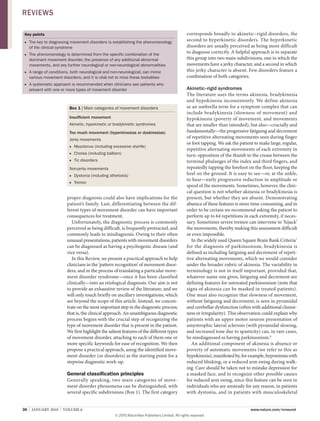
The clinical approach to movement disorders
Wilson F.Abdo, Bart P. C. van de Warrenburg, David J. Burn, Niall P. Quinn and Bastiaan R. Bloem
Abstract | Movement disorders are commonly encountered in the clinic. In this Review, aimed at trainees
and general neurologists, we provide a practical step-by-step approach to help clinicians in their ‘pattern
recognition’ of movement disorders, as part of a process that ultimately leads to the diagnosis. The key to
success is establishing the phenomenology of the clinical syndrome, which is determined from the specific
combination of the dominant movement disorder, other abnormal movements in patients presenting with a
mixed movement disorder, and a set of associated neurological and non-neurological abnormalities. Definition
of the clinical syndrome in this manner should, in turn, result in a differential diagnosis. Sometimes, simple
pattern recognition will suffice and lead directly to the diagnosis, but often ancillary investigations, guided by
the dominant movement disorder, are required. We illustrate this diagnostic process for the most common
types of movement disorder, namely, akinetic–rigid syndromes and the various types of hyperkinetic disorders
(myoclonus, chorea, tics, dystonia and tremor).
Abdo, W. F. et al. Nat. Rev. Neurol. 6, 29–37 (2010); doi:10.1038/nrneurol.2009.196
Introduction
movement disorders, such as Parkinson disease (PD),
tremor, tics and dystonia, are common conditions. the
overall prevalence of PD, for example, is 1% in people
aged 65–85 years, increasing to 4.3% above the age of
85 years.1
the prevalence of essential tremor—the most
common form of tremor—is 4% in people aged over
40 years, increasing to 14% in people over 65 years of
age.2,3
the prevalence of tics in school-age children and
adolescents can be as high as 21%.4
the clinical presentation of movement disorders is
complex, often variable, and sometimes even bizarre.
establishing the correct diagnosis can, therefore, be dif-
ficult, even in the hands of experienced movement dis-
order specialists. However, accurate recognition based on
clinical acumen is important for several reasons.
First, correct classification of the type of movement
disorder forms the basis for the subsequent diagnostic
process. For most disorders, no specific biological
marker is available that can unambiguously diagnose the
underlying disease. many diagnostic tests are available,5,6
but these are often expensive and time-consuming, and
sometimes invasive. moreover, the diagnostic value of
these tests (over and above clinical judgment) is often
limited, especially in early stages of the disease. Hiding
clinical uncertainty behind a broad battery of ancillary
studies (the ‘scattergun’ approach) is generally unreward-
ing because of the large range of potential diagnoses.
the investigational work-up can be greatly simplified
once the type of movement disorder has been defined
properly, because the approach to each type of move-
ment disorder then becomes more focused. the work-up
for dystonia, for example, is very different from that for
chorea. second, adequate classification—as a means to
establish the correct diagnosis—often has prognostic
implications. For example, essential tremor is sometimes
mistaken for early PD, but the prognosis is clearly dif-
ferent. Furthermore, since several movement disorders
are genetically determined (for example, Huntington
disease [HD]), accurate classification leading to the
Competing interests
The authors, the Journal Editor H. Wood and the CME questions
author D. Lie declare no competing interests.
Continuing Medical Education online
This activity has been planned and implemented in accordance
with the Essential Areas and policies of the Accreditation Council
for Continuing Medical Education through the joint sponsorship of
MedscapeCME and Nature Publishing Group.
MedscapeCME is accredited by the Accreditation Council for
Continuing Medical Education (ACCME) to provide continuing
medical education for physicians.
MedscapeCME designates this educational activity for a maximum
of 1.0 AMA PrA Category 1 CreditsTM
. Physicians should only claim
credit commensurate with the extent of their participation in the
activity. All other clinicians completing this activity will be issued
a certificate of participation. To participate in this journal CME
activity: (1) review the learning objectives and author disclosures;
(2) study the education content; (3) take the post-test and/or
complete the evaluation at http://www.medscapecme.com/journal/
nrneurol; and (4) view/print certificate.
learning objectives
Upon completion of this activity, participants should be able to:
1 Describe the prevalence of different movement disorders.
2 Identify the main categories and subtypes of movement
disorders.
3 Describe reasons for misclassification of some
movement disorders.
4 Describe the etiology and subtypes of myoclonus.
5 List 4 key questions for a systematic approach to differential
diagnosis of movement disorders.
REVIEWS
© 20 Macmillan Publishers Limited. All rights reserved10](https://image.slidesharecdn.com/bloemlecture1abdonatureneurolreviews2010recognitionmovdisord-170402140231/85/MOVEMENT-DISORDER-1-320.jpg)
![nature reviews | neurology volume 6 | JanuarY 2010 | 31
problems such as frozen shoulder (although the latter
not uncommonly precedes the diagnosis of PD).
increased muscle tone across a joint due to rigidity or
spasticity can be differentiated while examining the full
range of motion of a joint at varying speeds. in rigidity, the
resistance is more or less stable, and equal between flexion
and extension movements, during the whole trajectory.
in spasticity, the tone is preferentially increased in arm
flexors and leg extensors, and sudden decreases of muscle
resistance (the ‘clasp-knife phenomenon’) can be felt.
Jerky hyperkinetic syndromes
the jerky hyperkinetic syndromes include myoclonus
(together with excessive startle), chorea and tics. Jerky
movements might be seen in isolation or in combination
with non-jerky movements.
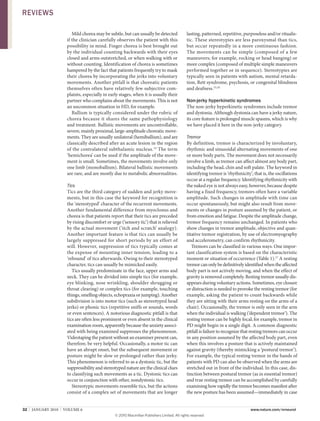
Myoclonus
myoclonic movements are sudden, brief, shock-like
involuntary movements, which are usually positive
(caused by muscle contraction), but can sometimes
be negative (due to brief loss or inhibition of muscu-
lar tonus, as in asterixis—for example, when caused
by hepatic enkephalopathy [‘liver flap’]—or in uremic
enkephalopathy). negative myoclonus can also be seen
while walking, producing a typical veering gait pattern,
or the sudden postural lapses (‘bouncy gait’) seen in post-
anoxic myoclonus. myoclonic muscle contractions are
mostly accompanied by some movement of the affected
body segment, in contrast to, for example, fascicula-
tions or myokymia, where the twitches remain within
the affected body segment. myoclonus is best likened
to the effect seen after stimulating the nerve supplying
the muscle with a single electric shock (or with a train
of shocks, because the myoclonic jerks can occur repeti-
tively within the same muscle). therefore, the keywords
in identifying myoclonus are ‘shock-like movements’.
when myoclonus occurs in series, the timing of the
jerks can be either rhythmic or irregular. sometimes
rhythmic myoclonus can be mistaken for tremor (exam-
ples include spinal segmental myoclonus, and hereditary
cortical myoclonus, which has also been erroneously
labeled ‘cortical tremor’). if myoclonus is repetitive but
more arrhythmic (as in ‘polyminimyoclonus’, which con-
sists of fine myoclonic individual finger jerks seen in the
outstretched hands in, for example, patients with mul-
tiple system atrophy), the movements can be mistaken
for irregular tremor. However, isolated tremor lacks
the defining abrupt and shock-like character of myo-
clonus. the condition that was originally called palatal
myoclonus is now termed palatal tremor because of its
rhythmic nature and lack of abrupt jerky movements.
myoclonus can be described and classified in several
ways. the distribution of myoclonus can be focal, multi-
focal, segmental or generalized. etiologically, myoclonus
can be subdivided into physiological myoclonus (for
example, hypnic jerks), essential myoclonus (idiopathic
or hereditary), epileptic myoclonus, or symptomatic
myoclonus in cases where the myoclonus is secondary
to an underlying disorder. Physiologically, myoclonus is
subdivided into cortical, subcortical, spinal and periph-
eral types.9
in addition, careful assessment of the specific
moments of occurrence for myoclonus is important.
myoclonus can occur spontaneously (at rest), but is also
often present—and usually worsened—during movement
(action myoclonus), or can be provoked by external tactile
or acoustic stimuli (reflex myoclonus). Cortical myo-
clonus is usually action sensitive or stimulus sensitive,
mostly occurring in response to distal touch or stretch,
and occasionally to visual stimuli. Brainstem myoclonus,
by contrast, is more commonly provoked by auditory
stimuli, or by tactile stimuli around the face or snout. it
is important, therefore, to look for stimulus sensitivity
when assessing suspected myoclonus. Cortical myoclonus
tends to be focal, whereas subcortical myoclonus is more
often generalized. the various types of myoclonus have
differing neurophysiological characteristics.10
Propriospinal myoclonus; that is, myoclonus gener-
ated within the spinal cord with subsequent upward and
downward spread, is a clinically difficult category, as
these movements are perceived as being too slow and
insufficiently jerky in character to be classed as myo-
clonus.11
often, polymyographic recordings are needed
to prove the myoclonic nature of these axial movements.
spinal pathology can be demonstrated in some cases, but
this is a rare occurrence. a notable proportion of cases
of propriospinal myoclonus are psychogenic, but the
semiology and physiology can mimic organic cases, so
determining the pathogenesis is difficult.
startle reactions, which are part of the spectrum of
myoclonus, are also provoked by external stimuli—most
often by auditory triggers, but also by surprise, alarm
or acute pain. the startle reaction is characterized by a
bilaterally synchronous shock-like set of movements.12
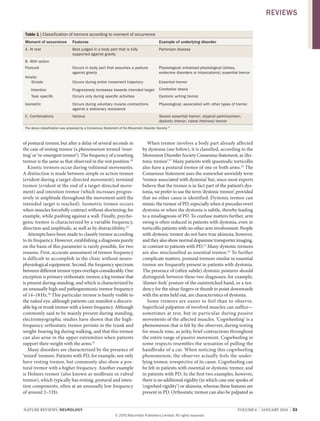
Chorea
Chorea may not be immediately appreciated as being
a jerky movement disorder, perhaps because the word
chorea (Greek for ‘dance’) suggests a certain grace rather
than abrupt, jerky movements. if one carefully observes
a patient with chorea, however, it immediately becomes
evident that the ‘choreography’ includes a constellation
of randomly flowing movements, which are, indivi-
dually, jerky in nature. thus, chorea can be defined as
involuntary movements that are abrupt, unpredictable
and nonrhythmic, resulting from a continuous random
flow of muscle contractions. a key difference from
myoclonus is that the pattern of movements randomly
changes from one body part to another, conveying the
impression of ‘fidgeting’ to the observer. so, if we were to
attach a key description to chorea, it would be ‘randomly
flowing jerks’. other typical signs of chorea are motor
impersistence, as seen in the fluctuating strength of the
grip (so-called ‘milkmaid’s grip’), or hung-up reflexes
(sustained contractions and choreatic movements of
the leg after the knee-jerk reflex).13
some patients with
chorea—in HD, for example—can exhibit additional
brief (<100 msec) muscle jerks that are myoclonic,
and/or longer (>50msec) co-contracting muscle spasms
that are dystonic.
revIeWs
© 20 Macmillan Publishers Limited. All rights reserved10](https://image.slidesharecdn.com/bloemlecture1abdonatureneurolreviews2010recognitionmovdisord-170402140231/85/MOVEMENT-DISORDER-3-320.jpg)

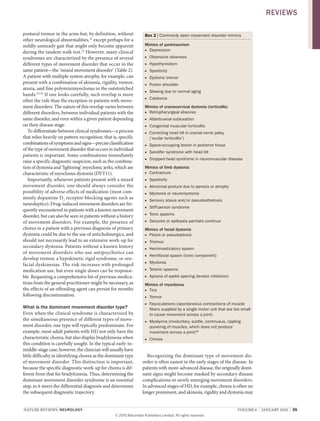

This document provides an introduction to a review article about the clinical approach to diagnosing movement disorders. It discusses the prevalence of common movement disorders like Parkinson's disease and essential tremor. The key to diagnosis is accurately classifying the type of movement disorder present based on the clinical presentation. This involves defining the dominant abnormal movement as well as any associated neurological or non-neurological features. Once classified, the movement disorder can guide further diagnostic testing and help establish a differential diagnosis. The review will cover approaches to diagnosing akinetic-rigid syndromes and hyperkinetic disorders like tics, chorea, dystonia and tremor.


