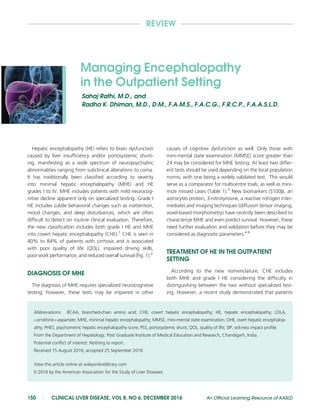
REVIEW
Managing Encephalopathy
in the Outpatient Setting
Sahaj Rathi, M.D., and
Radha K. Dhiman, M.D., D.M., F.A.M.S., F.A.C.G., F.R.C.P., F.A.A.S.L.D.
Hepatic encephalopathy (HE) refers to brain dysfunction
caused by liver insufficiency and/or portosystemic shunt-
ing, manifesting as a wide spectrum of neuropsychiatric
abnormalities ranging from subclinical alterations to coma.
It has traditionally been classified according to severity
into minimal hepatic encephalopathy (MHE) and HE
grades I to IV. MHE includes patients with mild neurocog-
nitive decline apparent only on specialized testing. Grade I
HE includes subtle behavioral changes such as inattention,
mood changes, and sleep disturbances, which are often
difficult to detect on routine clinical evaluation. Therefore,
the new classification includes both grade I HE and MHE
into covert hepatic encephalopathy (CHE).1
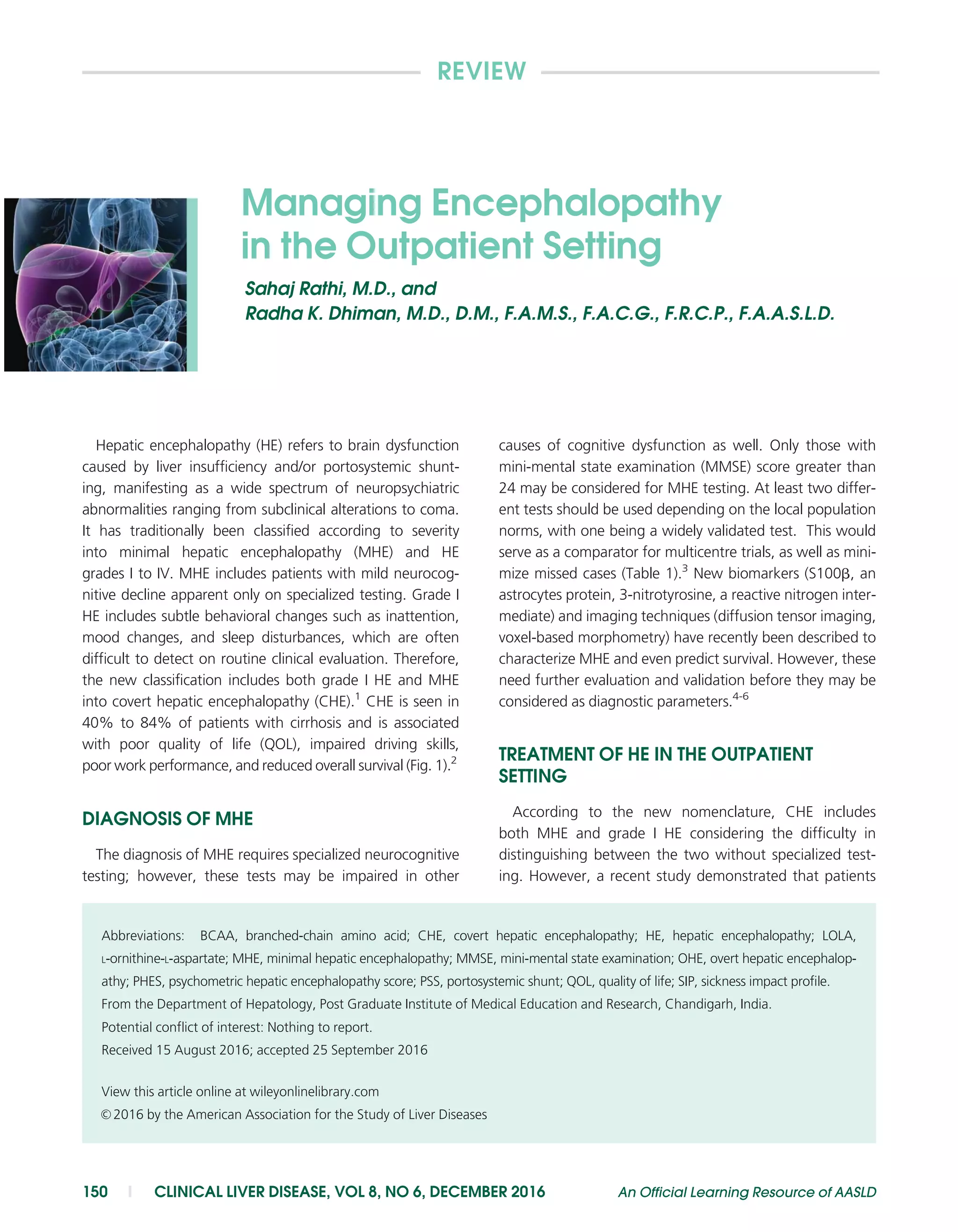
CHE is seen in
40% to 84% of patients with cirrhosis and is associated
with poor quality of life (QOL), impaired driving skills,
poor work performance, and reduced overall survival (Fig. 1).2
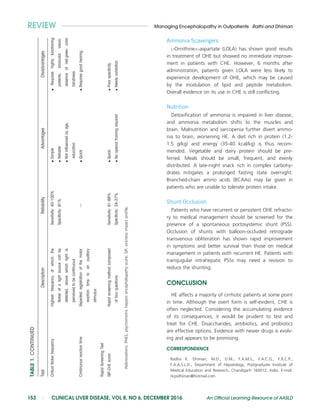
DIAGNOSIS OF MHE
The diagnosis of MHE requires specialized neurocognitive
testing; however, these tests may be impaired in other
causes of cognitive dysfunction as well. Only those with
mini-mental state examination (MMSE) score greater than
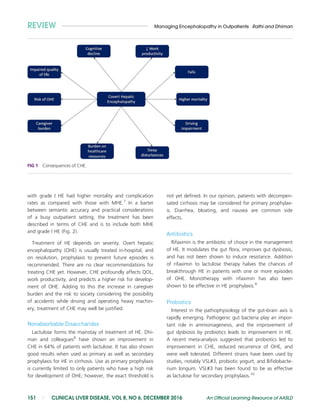
24 may be considered for MHE testing. At least two differ-
ent tests should be used depending on the local population
norms, with one being a widely validated test. This would
serve as a comparator for multicentre trials, as well as mini-
mize missed cases (Table 1).3
New biomarkers (S100b, an
astrocytes protein, 3-nitrotyrosine, a reactive nitrogen inter-
mediate) and imaging techniques (diffusion tensor imaging,
voxel-based morphometry) have recently been described to
characterize MHE and even predict survival. However, these
need further evaluation and validation before they may be
considered as diagnostic parameters.4-6
TREATMENT OF HE IN THE OUTPATIENT
SETTING
According to the new nomenclature, CHE includes
both MHE and grade I HE considering the difficulty in
distinguishing between the two without specialized test-
ing. However, a recent study demonstrated that patients
Abbreviations: BCAA, branched-chain amino acid; CHE, covert hepatic encephalopathy; HE, hepatic encephalopathy; LOLA,
L-ornithine-L-aspartate; MHE, minimal hepatic encephalopathy; MMSE, mini-mental state examination; OHE, overt hepatic encephalop-
athy; PHES, psychometric hepatic encephalopathy score; PSS, portosystemic shunt; QOL, quality of life; SIP, sickness impact profile.
From the Department of Hepatology, Post Graduate Institute of Medical Education and Research, Chandigarh, India.
Potential conflict of interest: Nothing to report.
Received 15 August 2016; accepted 25 September 2016
View this article online at wileyonlinelibrary.com
VC 2016 by the American Association for the Study of Liver Diseases
150 | CLINICAL LIVER DISEASE, VOL 8, NO 6, DECEMBER 2016 An Official Learning Resource of AASLD
with grade I HE had higher mortality and complication
rates as compared with those with MHE.7
In a barter
between semantic accuracy and practical considerations
of a busy outpatient setting, the treatment has been
described in terms of CHE and is to include both MHE
and grade I HE (Fig. 2).
Treatment of HE depends on severity. Overt hepatic
encephalopathy (OHE) is usually treated in-hospital, and
on resolution, prophylaxis to prevent future episodes is
recommended. There are no clear recommendations for
treating CHE yet. However, CHE profoundly affects QOL,
work productivity, and predicts a higher risk for develop-
ment of OHE. Adding to this the increase in caregiver
burden and the risk to society considering the possibility
of accidents while driving and operating heavy machin-
ery, treatment of CHE may well be justified.
Nonabsorbable Disaccharides
Lactulose forms the mainstay of treatment of HE. Dhi-
man and colleagues8
have shown an improvement in
CHE in 64% of patients with lactulose. It has also shown
good results when used as primary as well as secondary
prophylaxis for HE in cirrhosis. Use as primary prophylaxis
is currently limited to only patients who have a high risk
for development of OHE; however, the exact threshold is
not yet defined. In our opinion, patients with decompen-
sated cirrhosis may be considered for primary prophylax-
is. Diarrhea, bloating, and nausea are common side
effects.
Antibiotics
Rifaximin is the antibiotic of choice in the management
of HE. It modulates the gut flora, improves gut dysbiosis,
and has not been shown to induce resistance. Addition
of rifaximin to lactulose therapy halves the chances of
breakthrough HE in patients with one or more episodes
of OHE. Monotherapy with rifaximin has also been
shown to be effective in HE prophylaxis.9
Probiotics
Interest in the pathophysiology of the gut–brain axis is
rapidly emerging. Pathogenic gut bacteria play an impor-
tant role in ammoniagenesis, and the improvement of
gut dysbiosis by probiotics leads to improvement in HE.
A recent meta-analysis suggested that probiotics led to
improvement in CHE, reduced recurrence of OHE, and
were well tolerated. Different strains have been used by
studies, notably VSL#3, probiotic yogurt, and Bifidobacte-
rium longum. VSL#3 has been found to be as effective
as lactulose for secondary prophylaxis.10
FIG 1 Consequences of CHE.
REVIEW Managing Encephalopathy in Outpatients Rathi and Dhiman
151 | CLINICAL LIVER DISEASE, VOL 8, NO 6, DECEMBER 2016 An Official Learning Resource of AASLD
TABLE1.TESTSFORDIAGNOSISOFMHE
TestDescriptionReliabilityAdvantagesDisadvantages
Paper-Pencil
PHES5paperandpenciltests:
numberconnectiontestsAand
B,digitsymbol,linetracingand
serialdottingtests
Adjustedforage,education
Sensitivity:96%
Specificity:100%
ExtensivelyvalidatedTime-consuming
Requirespsychologist
Learningeffect
Requiresgoodneuromuscular
control
RepeatableBatteryforthe
Assessmentof
NeuropsychologicalStatus
Paperorpencilbatterytesting
twodomains,corticaland
subcortical
---HasUSreferencedataCopyrighted
Requirespsychologist
Languageandmemorynot
muchimpairedinCHE
Computerized
InhibitorycontroltestPresentationoflettersat500-ms
intervals
Patientsinstructedtorespondonly
whenXandYarealternating
Sensitivity:87%
Specificity:77%
Validated
Doesnotrequire
apsychologist
Requireshighlyfunctioning
patients
Requiresapracticesession
CognitiveDrugResearchPsychometricbatterypresentedon
computerwithpatients
respondingviaatwo-button
YES/NOresponsebox
Highdegreeof
correlationwithPHES
Noneedforpriorcomputer
knowledge
Requireshighlyfunctioning
patients
StroopEncephalAppIdentificationofthecolorof
symbolsortextpresented,while
thewordnamesadifferentcolor
Sensitivity:70%
Specificity:90%
Easytoadminister
Quick
Reliable
Freelyavailable
Cannotbeperformedin
color-blind
ScantestComputerizeddigitrecognizingtask
measuringthereactiontimes
anderrors
Mortality
hazardratio:
2.4(95%confidence
interval:1.1-5.3)
Reliable,predictsmortalityNeedpracticesessions,
knowledgeofcomputer
Neurophysiological
Electroencephalogram6
evokedpotentials
Candetectchangesincerebral
activityacrossthespectrumof
HE
Sensitivity:43-100%Independentofpatient
cooperation
Nolearningeffect
Requiresinterpretationbya
neurologist
Expensiveandlabor-intensive
REVIEW Managing Encephalopathy in Outpatients Rathi and Dhiman
152 | CLINICAL LIVER DISEASE, VOL 8, NO 6, DECEMBER 2016 An Official Learning Resource of AASLD
Ammonia Scavengers
L-Ornithine-L-aspartate (LOLA) has shown good results
in treatment of OHE but showed no immediate improve-
ment in patients with CHE. However, 6 months after
administration, patients given LOLA were less likely to
experience development of OHE, which may be caused
by the modulation of lipid and peptide metabolism.
Overall evidence on its use in CHE is still conflicting.
Nutrition
Detoxification of ammonia is impaired in liver disease,
and ammonia metabolism shifts to the muscles and
brain. Malnutrition and sarcopenia further divert ammo-
nia to brain, worsening HE. A diet rich in protein (1.2-
1.5 g/kg) and energy (35-40 kcal/kg) is thus recom-
mended. Vegetable and dairy protein should be pre-
ferred. Meals should be small, frequent, and evenly
distributed. A late-night snack rich in complex carbohy-
drates mitigates a prolonged fasting state overnight.
Branched-chain amino acids (BCAAs) may be given in
patients who are unable to tolerate protein intake.
Shunt Occlusion
Patients who have recurrent or persistent OHE refracto-
ry to medical management should be screened for the
presence of a spontaneous portosystemic shunt (PSS).
Occlusion of shunts with balloon-occluded retrograde
transvenous obliteration has shown rapid improvement
in symptoms and better survival than those on medical
management in patients with recurrent HE. Patients with
transjugular intrahepatic PSSs may need a revision to
reduce the shunting.
CONCLUSION
HE affects a majority of cirrhotic patients at some point
in time. Although the overt form is self-evident, CHE is
often neglected. Considering the accumulating evidence
of its consequences, it would be prudent to test and
treat for CHE. Disaccharides, antibiotics, and probiotics
are effective options. Evidence with newer drugs is evolv-
ing and appears to be promising.
CORRESPONDENCE
Radha K. Dhiman, M.D., D.M., F.A.M.S., F.A.C.G., F.R.C.P.,
F.A.A.S.L.D., Department of Hepatology, Postgraduate Institute of
Medical Education and Research, Chandigarh 160012, India. E-mail:
rkpsdhiman@hotmail.com
TABLE1.CONTINUED
TestDescriptionReliabilityAdvantagesDisadvantages
CriticalflickerfrequencyHighestfrequencyatwhichthe
flickerofalightsourcecanbe
detected,abovewhichlightis
perceivedtobecontinuous
Sensitivity:40-100%
Specificity:91%
Simple
Reliable
Notinfluencedbyage,
education
Requireshighlyfunctioning
patients,binocularvision,
absenceofred-greencolor
blindness
ContinuousreactiontimeRepeatedregistrationofthemotor
reactiontimetoanauditory
stimulus
---QuickRequiresgoodhearing
RapidScreeningTest
SIP-CHEscoreRapidscreeningmethodcomposed
offourquestions
Sensitivity:81-88%
Specificity:24-37%
Quick
Nospecialtrainingrequired
Poorspecificity
Needsvalidation
Abbreviations:PHES,psychometrichepaticencephalopathyscore;SIP,sicknessimpactprofile.
REVIEW Managing Encephalopathy in Outpatients Rathi and Dhiman
153 | CLINICAL LIVER DISEASE, VOL 8, NO 6, DECEMBER 2016 An Official Learning Resource of AASLD
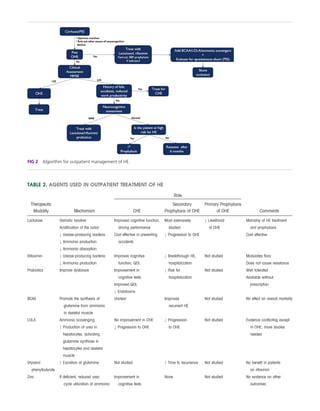
TABLE 2. AGENTS USED IN OUTPATIENT TREATMENT OF HE
Therapeutic
Modality Mechanism
Role
CommentsCHE
Secondary
Prophylaxis of OHE
Primary Prophylaxis
of OHE
Lactulose Osmotic laxative
Acidification of the colon
# Urease-producing bacteria
# Ammonia production
# Ammonia absorption
Improved cognitive function,
driving performance
Cost effective in preventing
accidents
Most extensively
studied.
# Progression to OHE
# Likelihood
of OHE
Mainstay of HE treatment
and prophylaxis
Cost effective
Rifaximin # Urease-producing bacteria
# Ammonia production
Improves cognitive
function, QOL
# Breakthrough HE,
hospitalization
Not studied Modulates flora
Does not cause resistance
Probiotics Improve dysbiosis Improvement in
cognitive tests
Improved QOL
# Endotoxins
# Risk for
hospitalization
Not studied Well tolerated
Available without
prescription
BCAA Promote the synthesis of
glutamine from ammonia
in skeletal muscle
Unclear Improves
recurrent HE
Not studied No effect on overall mortality
LOLA Ammonia scavenging
 Production of urea in
hepatocytes, activating
glutamine synthase in
hepatocytes and skeletal
muscle
No improvement in CHE
# Progression to OHE
# Progression
to OHE
Not studied Evidence conflicting except
in OHE, more studies
needed
Glycerol
phenylbutyrate
 Excretion of glutamine Not studied  Time to recurrence Not studied No benefit in patients
on rifaximin
Zinc If deficient, reduced urea
cycle utilization of ammonia
Improvement in
cognitive tests
None Not studied No evidence on other
outcomes
FIG 2 Algorithm for outpatient management of HE.
REFERENCES
1) Vilstrup H, Amodio P, Bajaj J, Cordoba J, Ferenci P, Mullen KD, et al.
Hepatic encephalopathy in chronic liver disease: 2014 practice
guideline by the American Association for the Study of Liver Diseases
and the European Association for the Study of the Liver. Hepatology
2014;60:715-735.
2) Patidar KR, Thacker LR, Wade JB. Covert hepatic encephalopathy is
independently associated with poor survival and increased risk of
hospitalization. Am J Gastroenterol 2014;109:1757-1763.
3) Romero-Gomez M, Cordoba J, Jove R, del Olmo JA, Ramırez M, Rey
R, et al. Value of the critical flicker frequency in patients with mini-
mal hepatic encephalopathy. Hepatology 2007;45:879-885.
4) Duarte-Rojo A, Ruiz-Margain A, Macias-Rodriguez RU, Cubero FJ,
Estradas-Trujillo J, Mu~noz-Fuentes RM, Torre A. Clinical scenarios for
the use of S100b as a marker of hepatic encephalopathy. World J
Gastroenterol 2016; 22:4397-4402.
5) Chen HJ, Chen R, Yang M, Teng GJ, Herskovits EH. Identification of
minimal hepatic encephalopathy in patients with cirrhosis based on
white matter imaging and Bayesian data mining. AJNR Am J Neuro-
radiol 2015;36:481-487.
6) Attia MS, Al-Radadi NS. Nano optical sensor binuclear Pt-2-
pyrazinecarboxylic acid -bipyridine for enhancement of the efficiency
of 3-nitrotyrosine biomarker for early diagnosis of liver cirrhosis with
minimal hepatic encephalopathy. Biosens Bioelectron 2016;86:406-
412.
7) Thomsen KL, Macnaughtan J, Tritto G, Mookerjee RP, Jalan R. Clini-
cal and pathophysiological characteristics of cirrhotic patients with
grade 1 and minimal hepatic encephalopathy. PLoS ONE 2016;11:
e0146076.
8) Prasad S, Dhiman RK, Duseja A, Chawla YK, Sharma A, Agrawal R.
Lactulose improves cognitive functions and health-related quality of
life in cirrhotic patients with minimal hepatic encephalopathy. Hepa-
tology 2007;45:549-559.
9) Sidhu SS, Goyal O, Mishra BP, Sood A, Chhina RS, Soni RK. Rifaximin
improves psychometric performance and health-related quality of
life in patients with minimal hepatic encephalopathy (the RIME Trial).
Am J Gastroenterol 2011;106:307-316.
10) Dhiman RK, Rana B, Agrawal S, Garg A, Chopra M, Thumburu KK,
et al. Probiotic VSL#3 reduces liver disease severity and hospitaliza-
tion in patients with cirrhosis: a randomized, controlled trial. Gastro-
enterology 2014;147:1327-1337.
REVIEW Managing Encephalopathy in Outpatients Rathi and Dhiman
155 | CLINICAL LIVER DISEASE, VOL 8, NO 6, DECEMBER 2016 An Official Learning Resource of AASLD

Managing hep enceph in out ptn settings

  • 1.
    REVIEW Managing Encephalopathy in theOutpatient Setting Sahaj Rathi, M.D., and Radha K. Dhiman, M.D., D.M., F.A.M.S., F.A.C.G., F.R.C.P., F.A.A.S.L.D. Hepatic encephalopathy (HE) refers to brain dysfunction caused by liver insufficiency and/or portosystemic shunt- ing, manifesting as a wide spectrum of neuropsychiatric abnormalities ranging from subclinical alterations to coma. It has traditionally been classified according to severity into minimal hepatic encephalopathy (MHE) and HE grades I to IV. MHE includes patients with mild neurocog- nitive decline apparent only on specialized testing. Grade I HE includes subtle behavioral changes such as inattention, mood changes, and sleep disturbances, which are often difficult to detect on routine clinical evaluation. Therefore, the new classification includes both grade I HE and MHE into covert hepatic encephalopathy (CHE).1 CHE is seen in 40% to 84% of patients with cirrhosis and is associated with poor quality of life (QOL), impaired driving skills, poor work performance, and reduced overall survival (Fig. 1).2 DIAGNOSIS OF MHE The diagnosis of MHE requires specialized neurocognitive testing; however, these tests may be impaired in other causes of cognitive dysfunction as well. Only those with mini-mental state examination (MMSE) score greater than 24 may be considered for MHE testing. At least two differ- ent tests should be used depending on the local population norms, with one being a widely validated test. This would serve as a comparator for multicentre trials, as well as mini- mize missed cases (Table 1).3 New biomarkers (S100b, an astrocytes protein, 3-nitrotyrosine, a reactive nitrogen inter- mediate) and imaging techniques (diffusion tensor imaging, voxel-based morphometry) have recently been described to characterize MHE and even predict survival. However, these need further evaluation and validation before they may be considered as diagnostic parameters.4-6 TREATMENT OF HE IN THE OUTPATIENT SETTING According to the new nomenclature, CHE includes both MHE and grade I HE considering the difficulty in distinguishing between the two without specialized test- ing. However, a recent study demonstrated that patients Abbreviations: BCAA, branched-chain amino acid; CHE, covert hepatic encephalopathy; HE, hepatic encephalopathy; LOLA, L-ornithine-L-aspartate; MHE, minimal hepatic encephalopathy; MMSE, mini-mental state examination; OHE, overt hepatic encephalop- athy; PHES, psychometric hepatic encephalopathy score; PSS, portosystemic shunt; QOL, quality of life; SIP, sickness impact profile. From the Department of Hepatology, Post Graduate Institute of Medical Education and Research, Chandigarh, India. Potential conflict of interest: Nothing to report. Received 15 August 2016; accepted 25 September 2016 View this article online at wileyonlinelibrary.com VC 2016 by the American Association for the Study of Liver Diseases 150 | CLINICAL LIVER DISEASE, VOL 8, NO 6, DECEMBER 2016 An Official Learning Resource of AASLD
  • 2.
    with grade IHE had higher mortality and complication rates as compared with those with MHE.7 In a barter between semantic accuracy and practical considerations of a busy outpatient setting, the treatment has been described in terms of CHE and is to include both MHE and grade I HE (Fig. 2). Treatment of HE depends on severity. Overt hepatic encephalopathy (OHE) is usually treated in-hospital, and on resolution, prophylaxis to prevent future episodes is recommended. There are no clear recommendations for treating CHE yet. However, CHE profoundly affects QOL, work productivity, and predicts a higher risk for develop- ment of OHE. Adding to this the increase in caregiver burden and the risk to society considering the possibility of accidents while driving and operating heavy machin- ery, treatment of CHE may well be justified. Nonabsorbable Disaccharides Lactulose forms the mainstay of treatment of HE. Dhi- man and colleagues8 have shown an improvement in CHE in 64% of patients with lactulose. It has also shown good results when used as primary as well as secondary prophylaxis for HE in cirrhosis. Use as primary prophylaxis is currently limited to only patients who have a high risk for development of OHE; however, the exact threshold is not yet defined. In our opinion, patients with decompen- sated cirrhosis may be considered for primary prophylax- is. Diarrhea, bloating, and nausea are common side effects. Antibiotics Rifaximin is the antibiotic of choice in the management of HE. It modulates the gut flora, improves gut dysbiosis, and has not been shown to induce resistance. Addition of rifaximin to lactulose therapy halves the chances of breakthrough HE in patients with one or more episodes of OHE. Monotherapy with rifaximin has also been shown to be effective in HE prophylaxis.9 Probiotics Interest in the pathophysiology of the gut–brain axis is rapidly emerging. Pathogenic gut bacteria play an impor- tant role in ammoniagenesis, and the improvement of gut dysbiosis by probiotics leads to improvement in HE. A recent meta-analysis suggested that probiotics led to improvement in CHE, reduced recurrence of OHE, and were well tolerated. Different strains have been used by studies, notably VSL#3, probiotic yogurt, and Bifidobacte- rium longum. VSL#3 has been found to be as effective as lactulose for secondary prophylaxis.10 FIG 1 Consequences of CHE. REVIEW Managing Encephalopathy in Outpatients Rathi and Dhiman 151 | CLINICAL LIVER DISEASE, VOL 8, NO 6, DECEMBER 2016 An Official Learning Resource of AASLD
  • 3.
    TABLE1.TESTSFORDIAGNOSISOFMHE TestDescriptionReliabilityAdvantagesDisadvantages Paper-Pencil PHES5paperandpenciltests: numberconnectiontestsAand B,digitsymbol,linetracingand serialdottingtests Adjustedforage,education Sensitivity:96% Specificity:100% ExtensivelyvalidatedTime-consuming Requirespsychologist Learningeffect Requiresgoodneuromuscular control RepeatableBatteryforthe Assessmentof NeuropsychologicalStatus Paperorpencilbatterytesting twodomains,corticaland subcortical ---HasUSreferencedataCopyrighted Requirespsychologist Languageandmemorynot muchimpairedinCHE Computerized InhibitorycontroltestPresentationoflettersat500-ms intervals Patientsinstructedtorespondonly whenXandYarealternating Sensitivity:87% Specificity:77% Validated Doesnotrequire apsychologist Requireshighlyfunctioning patients Requiresapracticesession CognitiveDrugResearchPsychometricbatterypresentedon computerwithpatients respondingviaatwo-button YES/NOresponsebox Highdegreeof correlationwithPHES Noneedforpriorcomputer knowledge Requireshighlyfunctioning patients StroopEncephalAppIdentificationofthecolorof symbolsortextpresented,while thewordnamesadifferentcolor Sensitivity:70% Specificity:90% Easytoadminister Quick Reliable Freelyavailable Cannotbeperformedin color-blind ScantestComputerizeddigitrecognizingtask measuringthereactiontimes anderrors Mortality hazardratio: 2.4(95%confidence interval:1.1-5.3) Reliable,predictsmortalityNeedpracticesessions, knowledgeofcomputer Neurophysiological Electroencephalogram6 evokedpotentials Candetectchangesincerebral activityacrossthespectrumof HE Sensitivity:43-100%Independentofpatient cooperation Nolearningeffect Requiresinterpretationbya neurologist Expensiveandlabor-intensive REVIEW Managing Encephalopathyin Outpatients Rathi and Dhiman 152 | CLINICAL LIVER DISEASE, VOL 8, NO 6, DECEMBER 2016 An Official Learning Resource of AASLD
  • 4.
    Ammonia Scavengers L-Ornithine-L-aspartate (LOLA)has shown good results in treatment of OHE but showed no immediate improve- ment in patients with CHE. However, 6 months after administration, patients given LOLA were less likely to experience development of OHE, which may be caused by the modulation of lipid and peptide metabolism. Overall evidence on its use in CHE is still conflicting. Nutrition Detoxification of ammonia is impaired in liver disease, and ammonia metabolism shifts to the muscles and brain. Malnutrition and sarcopenia further divert ammo- nia to brain, worsening HE. A diet rich in protein (1.2- 1.5 g/kg) and energy (35-40 kcal/kg) is thus recom- mended. Vegetable and dairy protein should be pre- ferred. Meals should be small, frequent, and evenly distributed. A late-night snack rich in complex carbohy- drates mitigates a prolonged fasting state overnight. Branched-chain amino acids (BCAAs) may be given in patients who are unable to tolerate protein intake. Shunt Occlusion Patients who have recurrent or persistent OHE refracto- ry to medical management should be screened for the presence of a spontaneous portosystemic shunt (PSS). Occlusion of shunts with balloon-occluded retrograde transvenous obliteration has shown rapid improvement in symptoms and better survival than those on medical management in patients with recurrent HE. Patients with transjugular intrahepatic PSSs may need a revision to reduce the shunting. CONCLUSION HE affects a majority of cirrhotic patients at some point in time. Although the overt form is self-evident, CHE is often neglected. Considering the accumulating evidence of its consequences, it would be prudent to test and treat for CHE. Disaccharides, antibiotics, and probiotics are effective options. Evidence with newer drugs is evolv- ing and appears to be promising. CORRESPONDENCE Radha K. Dhiman, M.D., D.M., F.A.M.S., F.A.C.G., F.R.C.P., F.A.A.S.L.D., Department of Hepatology, Postgraduate Institute of Medical Education and Research, Chandigarh 160012, India. E-mail: rkpsdhiman@hotmail.com TABLE1.CONTINUED TestDescriptionReliabilityAdvantagesDisadvantages CriticalflickerfrequencyHighestfrequencyatwhichthe flickerofalightsourcecanbe detected,abovewhichlightis perceivedtobecontinuous Sensitivity:40-100% Specificity:91% Simple Reliable Notinfluencedbyage, education Requireshighlyfunctioning patients,binocularvision, absenceofred-greencolor blindness ContinuousreactiontimeRepeatedregistrationofthemotor reactiontimetoanauditory stimulus ---QuickRequiresgoodhearing RapidScreeningTest SIP-CHEscoreRapidscreeningmethodcomposed offourquestions Sensitivity:81-88% Specificity:24-37% Quick Nospecialtrainingrequired Poorspecificity Needsvalidation Abbreviations:PHES,psychometrichepaticencephalopathyscore;SIP,sicknessimpactprofile. REVIEW Managing Encephalopathy in Outpatients Rathi and Dhiman 153 | CLINICAL LIVER DISEASE, VOL 8, NO 6, DECEMBER 2016 An Official Learning Resource of AASLD
  • 5.
    TABLE 2. AGENTSUSED IN OUTPATIENT TREATMENT OF HE Therapeutic Modality Mechanism Role CommentsCHE Secondary Prophylaxis of OHE Primary Prophylaxis of OHE Lactulose Osmotic laxative Acidification of the colon # Urease-producing bacteria # Ammonia production # Ammonia absorption Improved cognitive function, driving performance Cost effective in preventing accidents Most extensively studied. # Progression to OHE # Likelihood of OHE Mainstay of HE treatment and prophylaxis Cost effective Rifaximin # Urease-producing bacteria # Ammonia production Improves cognitive function, QOL # Breakthrough HE, hospitalization Not studied Modulates flora Does not cause resistance Probiotics Improve dysbiosis Improvement in cognitive tests Improved QOL # Endotoxins # Risk for hospitalization Not studied Well tolerated Available without prescription BCAA Promote the synthesis of glutamine from ammonia in skeletal muscle Unclear Improves recurrent HE Not studied No effect on overall mortality LOLA Ammonia scavenging Production of urea in hepatocytes, activating glutamine synthase in hepatocytes and skeletal muscle No improvement in CHE # Progression to OHE # Progression to OHE Not studied Evidence conflicting except in OHE, more studies needed Glycerol phenylbutyrate Excretion of glutamine Not studied Time to recurrence Not studied No benefit in patients on rifaximin Zinc If deficient, reduced urea cycle utilization of ammonia Improvement in cognitive tests None Not studied No evidence on other outcomes FIG 2 Algorithm for outpatient management of HE.
  • 6.
    REFERENCES 1) Vilstrup H,Amodio P, Bajaj J, Cordoba J, Ferenci P, Mullen KD, et al. Hepatic encephalopathy in chronic liver disease: 2014 practice guideline by the American Association for the Study of Liver Diseases and the European Association for the Study of the Liver. Hepatology 2014;60:715-735. 2) Patidar KR, Thacker LR, Wade JB. Covert hepatic encephalopathy is independently associated with poor survival and increased risk of hospitalization. Am J Gastroenterol 2014;109:1757-1763. 3) Romero-Gomez M, Cordoba J, Jove R, del Olmo JA, Ramırez M, Rey R, et al. Value of the critical flicker frequency in patients with mini- mal hepatic encephalopathy. Hepatology 2007;45:879-885. 4) Duarte-Rojo A, Ruiz-Margain A, Macias-Rodriguez RU, Cubero FJ, Estradas-Trujillo J, Mu~noz-Fuentes RM, Torre A. Clinical scenarios for the use of S100b as a marker of hepatic encephalopathy. World J Gastroenterol 2016; 22:4397-4402. 5) Chen HJ, Chen R, Yang M, Teng GJ, Herskovits EH. Identification of minimal hepatic encephalopathy in patients with cirrhosis based on white matter imaging and Bayesian data mining. AJNR Am J Neuro- radiol 2015;36:481-487. 6) Attia MS, Al-Radadi NS. Nano optical sensor binuclear Pt-2- pyrazinecarboxylic acid -bipyridine for enhancement of the efficiency of 3-nitrotyrosine biomarker for early diagnosis of liver cirrhosis with minimal hepatic encephalopathy. Biosens Bioelectron 2016;86:406- 412. 7) Thomsen KL, Macnaughtan J, Tritto G, Mookerjee RP, Jalan R. Clini- cal and pathophysiological characteristics of cirrhotic patients with grade 1 and minimal hepatic encephalopathy. PLoS ONE 2016;11: e0146076. 8) Prasad S, Dhiman RK, Duseja A, Chawla YK, Sharma A, Agrawal R. Lactulose improves cognitive functions and health-related quality of life in cirrhotic patients with minimal hepatic encephalopathy. Hepa- tology 2007;45:549-559. 9) Sidhu SS, Goyal O, Mishra BP, Sood A, Chhina RS, Soni RK. Rifaximin improves psychometric performance and health-related quality of life in patients with minimal hepatic encephalopathy (the RIME Trial). Am J Gastroenterol 2011;106:307-316. 10) Dhiman RK, Rana B, Agrawal S, Garg A, Chopra M, Thumburu KK, et al. Probiotic VSL#3 reduces liver disease severity and hospitaliza- tion in patients with cirrhosis: a randomized, controlled trial. Gastro- enterology 2014;147:1327-1337. REVIEW Managing Encephalopathy in Outpatients Rathi and Dhiman 155 | CLINICAL LIVER DISEASE, VOL 8, NO 6, DECEMBER 2016 An Official Learning Resource of AASLD