OSTEOPOROSIS
Presented by
Dr Rahul Roy
Dr Ram Mohan
Maj Guarav Datta
Moderator: Col J Muthukrishnan, SM
Professor, (Medicine & Endocrinologist)
OUTLINE
๏ƒ˜Definition
๏ƒ˜Epidemiology
๏ƒ˜Pathophysiology
๏ƒ˜Causes
๏ƒ˜Clinical features
๏ƒ˜Diagnosis
๏ƒ˜Treatment
OSTEOPOROSIS
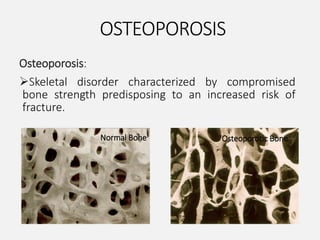
Osteoporosis:
๏ƒ˜Skeletal disorder characterized by compromised
bone strength predisposing to an increased risk of
fracture.
Normal Bone Osteoporotic Bone
OSTEOPOROSIS
WHO definition:
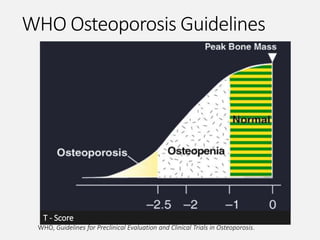
๏ƒ˜Bone density that falls 2.5 standard deviations (SD)
below the mean for young healthy adults of the same
sex
๏ƒ˜Also referred to as a T-score of โ€“2.5
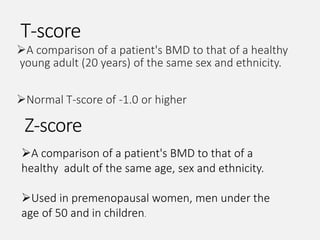
T-score
๏ƒ˜A comparison of a patient's BMD to that of a healthy
young adult (20 years) of the same sex and ethnicity.
๏ƒ˜Normal T-score of -1.0 or higher
Z-score
๏ƒ˜A comparison of a patient's BMD to that of a
healthy adult of the same age, sex and ethnicity.
๏ƒ˜Used in premenopausal women, men under the
age of 50 and in children.
WHO, Guidelines for Preclinical Evaluation and Clinical Trials in Osteoporosis.
T - Score
WHO Osteoporosis Guidelines
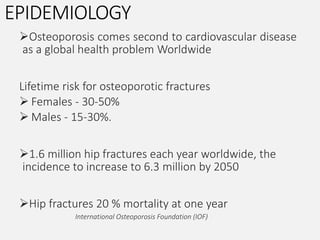
EPIDEMIOLOGY
๏ƒ˜Osteoporosis comes second to cardiovascular disease
as a global health problem Worldwide
Lifetime risk for osteoporotic fractures
๏ƒ˜ Females - 30-50%
๏ƒ˜ Males - 15-30%.
๏ƒ˜1.6 million hip fractures each year worldwide, the
incidence to increase to 6.3 million by 2050
๏ƒ˜Hip fractures 20 % mortality at one year
International Osteoporosis Foundation (IOF)
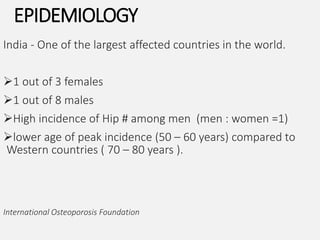
EPIDEMIOLOGY
India - One of the largest affected countries in the world.
๏ƒ˜1 out of 3 females
๏ƒ˜1 out of 8 males
๏ƒ˜High incidence of Hip # among men (men : women =1)
๏ƒ˜lower age of peak incidence (50 โ€“ 60 years) compared to
Western countries ( 70 โ€“ 80 years ).
International Osteoporosis Foundation
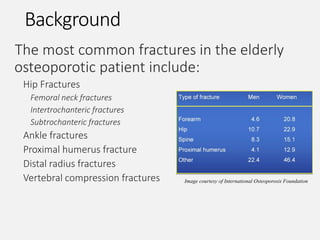
Background
The most common fractures in the elderly
osteoporotic patient include:
Hip Fractures
Femoral neck fractures
Intertrochanteric fractures
Subtrochanteric fractures
Ankle fractures
Proximal humerus fracture
Distal radius fractures
Vertebral compression fractures Image courtesy of International Osteoporosis Foundation
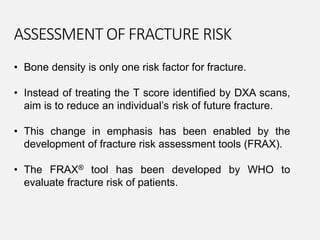
โ€ข Bone density is only one risk factor for fracture.
โ€ข Instead of treating the T score identified by DXA scans,
aim is to reduce an individualโ€™s risk of future fracture.
โ€ข This change in emphasis has been enabled by the
development of fracture risk assessment tools (FRAX).
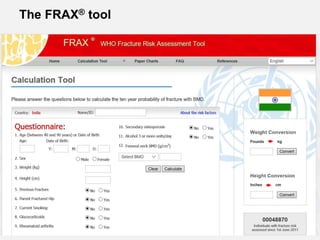
โ€ข The FRAXยฎ tool has been developed by WHO to
evaluate fracture risk of patients.
ASSESSMENT OF FRACTURE RISK
The FRAXยฎ tool
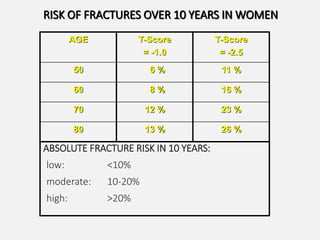
AGE T-Score
= -1.0
T-Score
= -2.5
50 6 % 11 %
60 8 % 16 %
70 12 % 23 %
80 13 % 26 %
RISK OF FRACTURES OVER 10 YEARS IN WOMEN
ABSOLUTE FRACTURE RISK IN 10 YEARS:
low: <10%
moderate: 10-20%
high: >20%
Peak bone mass
๏ƒ˜Skeletal mass increases from approximately 70 to 95 g at birth to 2400 to
3300 g in young individual
๏ƒ˜25% of PBM is acquired during the 2-year period across the adolescent
growth spurt
๏ƒ˜Factors affecting PBM
Hereditary factors
Ethnicity
Nutritional
Physical activity
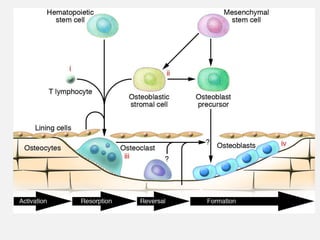
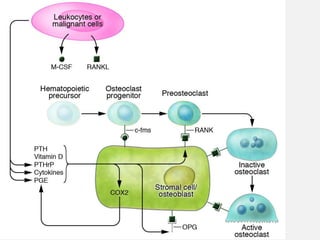
Pathophysiology
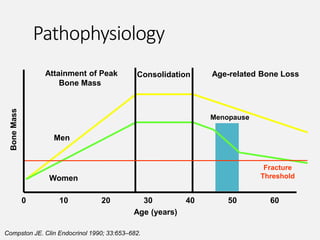
There are three major pathogenetic reasons for low bone mass.
1. Failure to achieve optimal peak bone mass.
2. Increased bone resorption in osteoporotic patients.
3. Inadequate bone formation.
BoneMass
Age (years)
Attainment of Peak
Bone Mass
Consolidation Age-related Bone Loss
Men
Women
Menopause
0 10 20 30 40 50 60
Fracture
Threshold
Compston JE. Clin Endocrinol 1990; 33:653โ€“682.
Pathophysiology
Pathophysiology
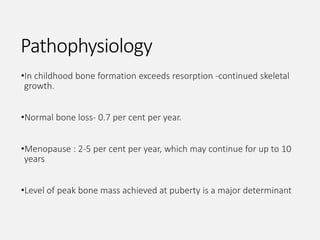
โ€ขIn childhood bone formation exceeds resorption -continued skeletal
growth.
โ€ขNormal bone loss- 0.7 per cent per year.
โ€ขMenopause : 2-5 per cent per year, which may continue for up to 10
years
โ€ขLevel of peak bone mass achieved at puberty is a major determinant
OSTEOPOROSIS - TYPES
โ€ขPrimary (senile) osteoporosis
โ€ขPost menopausal osteoporosis
โ€ขSecondary osteoporosis
SECONDARY CAUSES OF OSTEOPOROSIS
๏ƒ˜Endocrine diseases
๏‚ง Hypogonadism
๏‚ง Hypothyroidism
๏‚ง Hypoparathyroidism
๏‚ง Cushingโ€™s syndrome
๏ƒ˜Inflammatory diseases
๏‚ง Inflammatory bowel diseases
๏‚ง Rheumatoid Arthritis
๏‚ง Ankylosing spondylitis
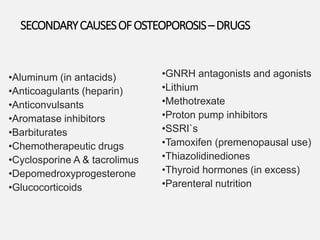
SECONDARYCAUSESOFOSTEOPOROSISโ€“DRUGS
โ€ขAluminum (in antacids)
โ€ขAnticoagulants (heparin)
โ€ขAnticonvulsants
โ€ขAromatase inhibitors
โ€ขBarbiturates
โ€ขChemotherapeutic drugs
โ€ขCyclosporine A & tacrolimus
โ€ขDepomedroxyprogesterone
โ€ขGlucocorticoids
โ€ขGNRH antagonists and agonists
โ€ขLithium
โ€ขMethotrexate
โ€ขProton pump inhibitors
โ€ขSSRI`s
โ€ขTamoxifen (premenopausal use)
โ€ขThiazolidinediones
โ€ขThyroid hormones (in excess)
โ€ขParenteral nutrition
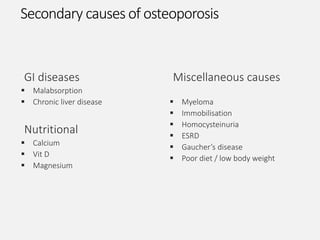
Secondary causes of osteoporosis
GI diseases
๏‚ง Malabsorption
๏‚ง Chronic liver disease
Nutritional
๏‚ง Calcium
๏‚ง Vit D
๏‚ง Magnesium
Miscellaneous causes
๏‚ง Myeloma
๏‚ง Immobilisation
๏‚ง Homocysteinuria
๏‚ง ESRD
๏‚ง Gaucherโ€™s disease
๏‚ง Poor diet / low body weight
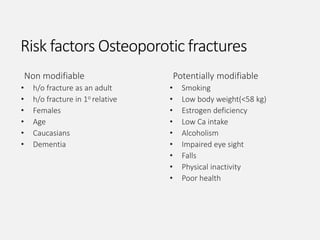
Risk factors Osteoporotic fractures
Non modifiable
โ€ข h/o fracture as an adult
โ€ข h/o fracture in 1o relative
โ€ข Females
โ€ข Age
โ€ข Caucasians
โ€ข Dementia
Potentially modifiable
โ€ข Smoking
โ€ข Low body weight(<58 kg)
โ€ข Estrogen deficiency
โ€ข Low Ca intake
โ€ข Alcoholism
โ€ข Impaired eye sight
โ€ข Falls
โ€ข Physical inactivity
โ€ข Poor health
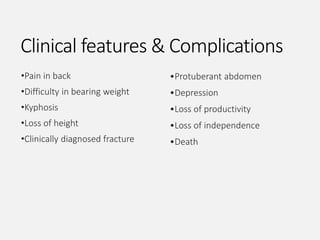
Clinical features & Complications
โ€ขPain in back
โ€ขDifficulty in bearing weight
โ€ขKyphosis
โ€ขLoss of height
โ€ขClinically diagnosed fracture
โ€ขProtuberant abdomen
โ€ขDepression
โ€ขLoss of productivity
โ€ขLoss of independence
โ€ขDeath
CLINICAL DIAGNOSIS AND TREATMENT
Diagnosis
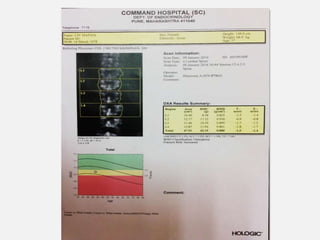
๏ƒ˜Radiographic measurement of bone density
๏ƒ˜Lab biomarkers
๏ƒ˜Bone biopsy with pathological assessment
Bone density
๏ƒ˜Single photon absorptiometry
๏ƒ˜Dual photon absorptiometry
๏ƒ˜Dual X ray absorptiometry
๏ƒ˜Qauntitative CT
๏ƒ˜Quantitative USG
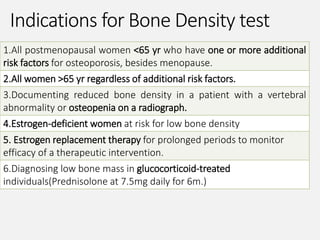
Indications for Bone Density test
1.All postmenopausal women <65 yr who have one or more additional
risk factors for osteoporosis, besides menopause.
2.All women >65 yr regardless of additional risk factors.
3.Documenting reduced bone density in a patient with a vertebral
abnormality or osteopenia on a radiograph.
4.Estrogen-deficient women at risk for low bone density
5. Estrogen replacement therapy for prolonged periods to monitor
efficacy of a therapeutic intervention.
6.Diagnosing low bone mass in glucocorticoid-treated
individuals(Prednisolone at 7.5mg daily for 6m.)
Markers of bone formation
๏ƒ˜ Osteocalcin (OC)
๏ƒ˜ Bone specific alkaline phosphatase (bone ALP)
๏ƒ˜ Procollagen type 1 N-terminal propeptide (P1NP)
๏ƒ˜ Procollagen type 1 C-terminal propeptide (P1CP)
Bone resorption markers
๏ƒ˜ Pyridinoline (PYR)
๏ƒ˜ Deoxy pyridinoline (DPD)
๏ƒ˜ N-telopeptides of type 1 collagen (NTX)
๏ƒ˜ C-telopeptides of type 1 collagen (CTX)
๏ƒ˜ Pyridinolines are measured in urine
๏ƒ˜ Telopeptides can be measured in both serum and urine
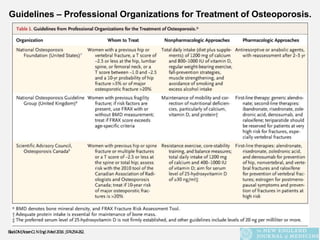
WHOM TO TREAT
๏ƒ˜Women with a previous hip or vertebral fracture, fragility
fracture
๏ƒ˜T score of โˆ’2.5 or less at the hip, lumbar spine, or femoral neck,
๏ƒ˜T score between โˆ’1.0 and โˆ’2.5 and a 10-yr probability of hip
fracture >3% or of major osteoporotic fracture >20%
๏ƒ˜In presence of risk factors,
๏ƒ˜If FRAX score exceeds age-specific criteria
National Osteoporosis Guideline Group
BlackDM,RosenCJ.NEnglJMed2016 ;374:254-262.
Guidelines โ€“ Professional Organizations for Treatment of Osteoporosis.
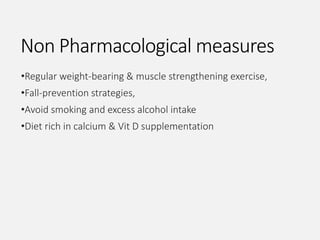
Non Pharmacological measures
โ€ขRegular weight-bearing & muscle strengthening exercise,
โ€ขFall-prevention strategies,
โ€ขAvoid smoking and excess alcohol intake
โ€ขDiet rich in calcium & Vit D supplementation
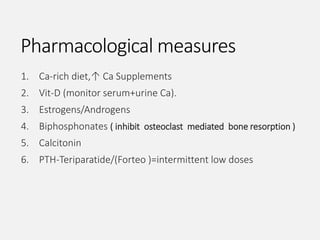
Pharmacological measures
1. Ca-rich diet,โ†‘ Ca Supplements
2. Vit-D (monitor serum+urine Ca).
3. Estrogens/Androgens
4. Biphosphonates ( inhibit osteoclast mediated bone resorption )
5. Calcitonin
6. PTH-Teriparatide/(Forteo )=intermittent low doses
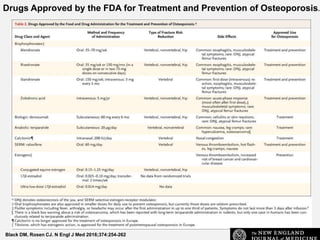
Drugs Approved by the FDA for Treatment and Prevention of Osteoporosis.
Black DM, Rosen CJ. N Engl J Med 2016;374:254-262
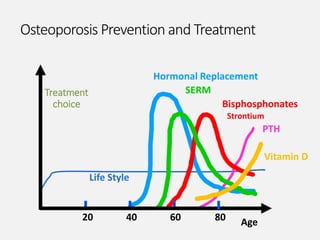
Osteoporosis Prevention and Treatment
Age
Hormonal Replacement
Bisphosphonates
Strontium
SERM
20 40 60 80
Vitamin D
PTH
Life Style
Treatment
choice
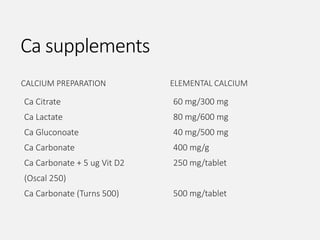
Ca supplements
CALCIUM PREPARATION
Ca Citrate
Ca Lactate
Ca Gluconoate
Ca Carbonate
Ca Carbonate + 5 ug Vit D2
(Oscal 250)
Ca Carbonate (Turns 500)
ELEMENTAL CALCIUM
60 mg/300 mg
80 mg/600 mg
40 mg/500 mg
400 mg/g
250 mg/tablet
500 mg/tablet
Calcium and Vitamin D
โ€ขInadequate calcium intake in adults older than 70 years of age is
associated with increased bone loss and increased risk of fracture
โ€ขObservational studies suggest that bone loss and fracture risk increase
when calcium intake is below 700 to 800 mg per day.
โ€ขCombining Vitamin D and calcium supplementation has been
shown to increase bone mineral density and reduce the risk of
fracture.
Age Calcium/day (mg)
0-6 months 210
6 months-1 yr 270
1-3 500
4-8 800
9-18 1300
19-50 1000
51-70 1200
Vitamin-D requirement
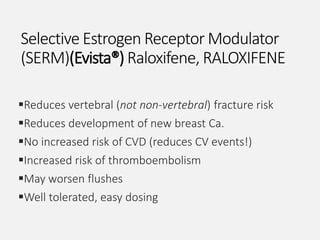
Selective Estrogen Receptor Modulator
(SERM)(Evistaยฎ) Raloxifene, RALOXIFENE
๏‚งReduces vertebral (not non-vertebral) fracture risk
๏‚งReduces development of new breast Ca.
๏‚งNo increased risk of CVD (reduces CV events!)
๏‚งIncreased risk of thromboembolism
๏‚งMay worsen flushes
๏‚งWell tolerated, easy dosing
BISPHOSPHONATES
โ€ขEtidronate, risedronate (Actonelยฎ), alendronate(Fosamaxยฎ),
ibandronate (Bonivaยฎ), zoledronate
โ€ขInterfere with action of osteoclasts &decrease bone resorption,
โ€ขAlendronate and risedronate firstline option in postmenopausal
osteoporosis
โ€ขIV Biphosphonates โ€“ Zolendrenate , Ibandronate
โ€ขStrict dosing instructions
โ€ขContraindicated in patients with GFR<35 ml/min, , vitamin D
depletion, osteomalacia or Hypocalcemia
Clinical use of strontium ranelate
(Protelos)
In women with postmenopausal osteoporosis:
๏ƒ˜ Alternative to bisphosphonates, particularly in the elderly
if potential for upper gastrointestinal complications
๏ƒ˜ Intolerance or inadequate response with other osteoporosis
therapies
๏ƒ˜ Beware of rash (DRESS) and VTE (RR 1.4)
(Miacalcinยฎ) Calcitonin
๏‚งFor pagetโ€™s disease, hypercalcemia, osteoporosis in women > 5
years post menopause
๏‚งNasal Spray-200 IU/L
๏‚งMechanism-small increments in bone mass and small
reduction in new vertebral fractures
๏‚งNot useful in non vertebral fractures
๏‚งMay have an analgesic effect on bone pain
PTH- 1-34h Teriparatide
โ€ขPTH- although causes bone loss in chronic elevated condition ,
has an anabolic effect on bone.
โ€ขMaintainence of trabecular bone mass
โ€ข20 ug PTH sc daily- 65% โ†“ in vertebral fractures and 45%โ†“ in
nonvertebral fractures
โ€ขSingle daily dose for maximum of 2 years
โ€ขFor treatment naรฏve patients- montherapy f/b bisphosphonate
โ€ขS/E- muscle pain, headache, dizziness and nausea
DENOSUMAB
๏‚งMonoclonal Ab to RANKL which drives osteoclasts
๏‚งSubcut every 6/12! 60mg
๏‚งDramatic and quick effect
๏‚งFracture reduction similar to Zoledronate
๏‚งCost similar to risedronate (in 2010)
๏‚งNICE appraised
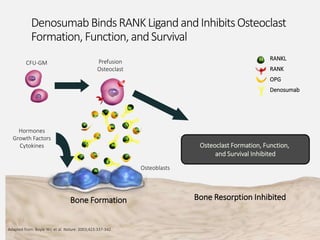
DenosumabBindsRANKLigandandInhibitsOsteoclast
Formation,Function,andSurvival
RANKL
RANK
OPG
Denosumab
Bone Formation Bone Resorption Inhibited
Osteoclast Formation, Function,
and Survival Inhibited
CFU-GM Prefusion
Osteoclast
Osteoblasts
Hormones
Growth Factors
Cytokines
Adapted from: Boyle WJ, et al. Nature. 2003;423:337-342.
RECENT ADVANCES - DRUGS
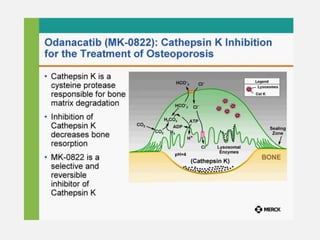
โ€ข Odanacatibโ€” cathepsin K inhibitors .
โ€ข In phase 1 studies, odanacatib at an oral dose of 50 - 100 mg once a week
reduced serum levels of the bone resorption marker C-terminal
telopeptide of type I collagen (CTX) by 62%.
โ€ข Daily administration of odanacatib (10 mg) reduced serum CTX by 81%.64
โ€ข After 24 months, odanacatib (50 g)increased BMD of the lumbar spine and
total hip by 5.7% and 4.1% compared to placebo,
โ€ข Adverse reactions :scleroderma-like cutaneous lesions were not observed.
โ€ข Currently, a phase 3 study is being conducted with over 16,000
postmenopausal women to assess the antifracture efficacy of odanacatib.
Odanacatib
๏‚งSaracatinib : Src kinase inhibitor
๏‚งDose-dependent decrease in serum C-terminal telopeptide of
type I collagen levels and urinary N-terminal telopeptide of
type I collagen.
๏‚งBone formation markers were similar to placebo.
๏‚งAdverse reactions: papular rash and loose stools
SARACATINIB (AZD0530)
โ€ข Calcilytic agents (MK-5442)โ€”Calcilytics represent a new
class of bone-forming agents.
โ€ข Act as antagonists of the CaSR and mimic hypocalcaemia,
thus evoking a short pulse of PTH secretion.
โ€ข Calcilytics are administered orally and obviate the need for
injections as opposed to PTH therapy.
โ€ข Narrow therapeutic index.
โ€ข These compounds led to sustained PTH secretion and findings
that were reminiscent of primary hyperparathyroidism, a
catabolic bone disease.
Anabolic therapies
โ€ข Wnt-dependent nuclear accumulation of ฮฒ-catenin is a
major trigger of osteoblastic differentiation and bone
formation.
โ€ข The endogenous inhibitors of Wnt signalling, sclerostin and
Dkk-1 present potential therapeutic targets to enhance
osteoblastic bone formation and are under clinical
investigation.
โ€ข Sclerostin antibody
โ€ข Dickkopf-1 antibody (BHQ-880)
Inhibitors of Wnt antagonists

Osteoporosis

  • 1.
    OSTEOPOROSIS Presented by Dr RahulRoy Dr Ram Mohan Maj Guarav Datta Moderator: Col J Muthukrishnan, SM Professor, (Medicine & Endocrinologist)
  • 2.
  • 3.
    OSTEOPOROSIS Osteoporosis: ๏ƒ˜Skeletal disorder characterizedby compromised bone strength predisposing to an increased risk of fracture. Normal Bone Osteoporotic Bone
  • 4.
    OSTEOPOROSIS WHO definition: ๏ƒ˜Bone densitythat falls 2.5 standard deviations (SD) below the mean for young healthy adults of the same sex ๏ƒ˜Also referred to as a T-score of โ€“2.5
  • 5.
    T-score ๏ƒ˜A comparison ofa patient's BMD to that of a healthy young adult (20 years) of the same sex and ethnicity. ๏ƒ˜Normal T-score of -1.0 or higher Z-score ๏ƒ˜A comparison of a patient's BMD to that of a healthy adult of the same age, sex and ethnicity. ๏ƒ˜Used in premenopausal women, men under the age of 50 and in children.
  • 6.
    WHO, Guidelines forPreclinical Evaluation and Clinical Trials in Osteoporosis. T - Score WHO Osteoporosis Guidelines
  • 7.
    EPIDEMIOLOGY ๏ƒ˜Osteoporosis comes secondto cardiovascular disease as a global health problem Worldwide Lifetime risk for osteoporotic fractures ๏ƒ˜ Females - 30-50% ๏ƒ˜ Males - 15-30%. ๏ƒ˜1.6 million hip fractures each year worldwide, the incidence to increase to 6.3 million by 2050 ๏ƒ˜Hip fractures 20 % mortality at one year International Osteoporosis Foundation (IOF)
  • 8.
    EPIDEMIOLOGY India - Oneof the largest affected countries in the world. ๏ƒ˜1 out of 3 females ๏ƒ˜1 out of 8 males ๏ƒ˜High incidence of Hip # among men (men : women =1) ๏ƒ˜lower age of peak incidence (50 โ€“ 60 years) compared to Western countries ( 70 โ€“ 80 years ). International Osteoporosis Foundation
  • 9.
    Background The most commonfractures in the elderly osteoporotic patient include: Hip Fractures Femoral neck fractures Intertrochanteric fractures Subtrochanteric fractures Ankle fractures Proximal humerus fracture Distal radius fractures Vertebral compression fractures Image courtesy of International Osteoporosis Foundation
  • 10.
    โ€ข Bone densityis only one risk factor for fracture. โ€ข Instead of treating the T score identified by DXA scans, aim is to reduce an individualโ€™s risk of future fracture. โ€ข This change in emphasis has been enabled by the development of fracture risk assessment tools (FRAX). โ€ข The FRAXยฎ tool has been developed by WHO to evaluate fracture risk of patients. ASSESSMENT OF FRACTURE RISK
  • 11.
  • 12.
    AGE T-Score = -1.0 T-Score =-2.5 50 6 % 11 % 60 8 % 16 % 70 12 % 23 % 80 13 % 26 % RISK OF FRACTURES OVER 10 YEARS IN WOMEN ABSOLUTE FRACTURE RISK IN 10 YEARS: low: <10% moderate: 10-20% high: >20%
  • 13.
    Peak bone mass ๏ƒ˜Skeletalmass increases from approximately 70 to 95 g at birth to 2400 to 3300 g in young individual ๏ƒ˜25% of PBM is acquired during the 2-year period across the adolescent growth spurt ๏ƒ˜Factors affecting PBM Hereditary factors Ethnicity Nutritional Physical activity
  • 16.
    Pathophysiology There are threemajor pathogenetic reasons for low bone mass. 1. Failure to achieve optimal peak bone mass. 2. Increased bone resorption in osteoporotic patients. 3. Inadequate bone formation.
  • 17.
    BoneMass Age (years) Attainment ofPeak Bone Mass Consolidation Age-related Bone Loss Men Women Menopause 0 10 20 30 40 50 60 Fracture Threshold Compston JE. Clin Endocrinol 1990; 33:653โ€“682. Pathophysiology
  • 18.
    Pathophysiology โ€ขIn childhood boneformation exceeds resorption -continued skeletal growth. โ€ขNormal bone loss- 0.7 per cent per year. โ€ขMenopause : 2-5 per cent per year, which may continue for up to 10 years โ€ขLevel of peak bone mass achieved at puberty is a major determinant
  • 19.
    OSTEOPOROSIS - TYPES โ€ขPrimary(senile) osteoporosis โ€ขPost menopausal osteoporosis โ€ขSecondary osteoporosis
  • 20.
    SECONDARY CAUSES OFOSTEOPOROSIS ๏ƒ˜Endocrine diseases ๏‚ง Hypogonadism ๏‚ง Hypothyroidism ๏‚ง Hypoparathyroidism ๏‚ง Cushingโ€™s syndrome ๏ƒ˜Inflammatory diseases ๏‚ง Inflammatory bowel diseases ๏‚ง Rheumatoid Arthritis ๏‚ง Ankylosing spondylitis
  • 21.
    SECONDARYCAUSESOFOSTEOPOROSISโ€“DRUGS โ€ขAluminum (in antacids) โ€ขAnticoagulants(heparin) โ€ขAnticonvulsants โ€ขAromatase inhibitors โ€ขBarbiturates โ€ขChemotherapeutic drugs โ€ขCyclosporine A & tacrolimus โ€ขDepomedroxyprogesterone โ€ขGlucocorticoids โ€ขGNRH antagonists and agonists โ€ขLithium โ€ขMethotrexate โ€ขProton pump inhibitors โ€ขSSRI`s โ€ขTamoxifen (premenopausal use) โ€ขThiazolidinediones โ€ขThyroid hormones (in excess) โ€ขParenteral nutrition
  • 22.
    Secondary causes ofosteoporosis GI diseases ๏‚ง Malabsorption ๏‚ง Chronic liver disease Nutritional ๏‚ง Calcium ๏‚ง Vit D ๏‚ง Magnesium Miscellaneous causes ๏‚ง Myeloma ๏‚ง Immobilisation ๏‚ง Homocysteinuria ๏‚ง ESRD ๏‚ง Gaucherโ€™s disease ๏‚ง Poor diet / low body weight
  • 23.
    Risk factors Osteoporoticfractures Non modifiable โ€ข h/o fracture as an adult โ€ข h/o fracture in 1o relative โ€ข Females โ€ข Age โ€ข Caucasians โ€ข Dementia Potentially modifiable โ€ข Smoking โ€ข Low body weight(<58 kg) โ€ข Estrogen deficiency โ€ข Low Ca intake โ€ข Alcoholism โ€ข Impaired eye sight โ€ข Falls โ€ข Physical inactivity โ€ข Poor health
  • 24.
    Clinical features &Complications โ€ขPain in back โ€ขDifficulty in bearing weight โ€ขKyphosis โ€ขLoss of height โ€ขClinically diagnosed fracture โ€ขProtuberant abdomen โ€ขDepression โ€ขLoss of productivity โ€ขLoss of independence โ€ขDeath
  • 25.
  • 26.
    Diagnosis ๏ƒ˜Radiographic measurement ofbone density ๏ƒ˜Lab biomarkers ๏ƒ˜Bone biopsy with pathological assessment
  • 27.
    Bone density ๏ƒ˜Single photonabsorptiometry ๏ƒ˜Dual photon absorptiometry ๏ƒ˜Dual X ray absorptiometry ๏ƒ˜Qauntitative CT ๏ƒ˜Quantitative USG
  • 28.
    Indications for BoneDensity test 1.All postmenopausal women <65 yr who have one or more additional risk factors for osteoporosis, besides menopause. 2.All women >65 yr regardless of additional risk factors. 3.Documenting reduced bone density in a patient with a vertebral abnormality or osteopenia on a radiograph. 4.Estrogen-deficient women at risk for low bone density 5. Estrogen replacement therapy for prolonged periods to monitor efficacy of a therapeutic intervention. 6.Diagnosing low bone mass in glucocorticoid-treated individuals(Prednisolone at 7.5mg daily for 6m.)
  • 30.
    Markers of boneformation ๏ƒ˜ Osteocalcin (OC) ๏ƒ˜ Bone specific alkaline phosphatase (bone ALP) ๏ƒ˜ Procollagen type 1 N-terminal propeptide (P1NP) ๏ƒ˜ Procollagen type 1 C-terminal propeptide (P1CP)
  • 31.
    Bone resorption markers ๏ƒ˜Pyridinoline (PYR) ๏ƒ˜ Deoxy pyridinoline (DPD) ๏ƒ˜ N-telopeptides of type 1 collagen (NTX) ๏ƒ˜ C-telopeptides of type 1 collagen (CTX) ๏ƒ˜ Pyridinolines are measured in urine ๏ƒ˜ Telopeptides can be measured in both serum and urine
  • 32.
    WHOM TO TREAT ๏ƒ˜Womenwith a previous hip or vertebral fracture, fragility fracture ๏ƒ˜T score of โˆ’2.5 or less at the hip, lumbar spine, or femoral neck, ๏ƒ˜T score between โˆ’1.0 and โˆ’2.5 and a 10-yr probability of hip fracture >3% or of major osteoporotic fracture >20% ๏ƒ˜In presence of risk factors, ๏ƒ˜If FRAX score exceeds age-specific criteria National Osteoporosis Guideline Group
  • 33.
    BlackDM,RosenCJ.NEnglJMed2016 ;374:254-262. Guidelines โ€“Professional Organizations for Treatment of Osteoporosis.
  • 34.
    Non Pharmacological measures โ€ขRegularweight-bearing & muscle strengthening exercise, โ€ขFall-prevention strategies, โ€ขAvoid smoking and excess alcohol intake โ€ขDiet rich in calcium & Vit D supplementation
  • 35.
    Pharmacological measures 1. Ca-richdiet,โ†‘ Ca Supplements 2. Vit-D (monitor serum+urine Ca). 3. Estrogens/Androgens 4. Biphosphonates ( inhibit osteoclast mediated bone resorption ) 5. Calcitonin 6. PTH-Teriparatide/(Forteo )=intermittent low doses
  • 36.
    Drugs Approved bythe FDA for Treatment and Prevention of Osteoporosis. Black DM, Rosen CJ. N Engl J Med 2016;374:254-262
  • 37.
    Osteoporosis Prevention andTreatment Age Hormonal Replacement Bisphosphonates Strontium SERM 20 40 60 80 Vitamin D PTH Life Style Treatment choice
  • 38.
    Ca supplements CALCIUM PREPARATION CaCitrate Ca Lactate Ca Gluconoate Ca Carbonate Ca Carbonate + 5 ug Vit D2 (Oscal 250) Ca Carbonate (Turns 500) ELEMENTAL CALCIUM 60 mg/300 mg 80 mg/600 mg 40 mg/500 mg 400 mg/g 250 mg/tablet 500 mg/tablet
  • 39.
    Calcium and VitaminD โ€ขInadequate calcium intake in adults older than 70 years of age is associated with increased bone loss and increased risk of fracture โ€ขObservational studies suggest that bone loss and fracture risk increase when calcium intake is below 700 to 800 mg per day. โ€ขCombining Vitamin D and calcium supplementation has been shown to increase bone mineral density and reduce the risk of fracture. Age Calcium/day (mg) 0-6 months 210 6 months-1 yr 270 1-3 500 4-8 800 9-18 1300 19-50 1000 51-70 1200 Vitamin-D requirement
  • 40.
    Selective Estrogen ReceptorModulator (SERM)(Evistaยฎ) Raloxifene, RALOXIFENE ๏‚งReduces vertebral (not non-vertebral) fracture risk ๏‚งReduces development of new breast Ca. ๏‚งNo increased risk of CVD (reduces CV events!) ๏‚งIncreased risk of thromboembolism ๏‚งMay worsen flushes ๏‚งWell tolerated, easy dosing
  • 41.
    BISPHOSPHONATES โ€ขEtidronate, risedronate (Actonelยฎ),alendronate(Fosamaxยฎ), ibandronate (Bonivaยฎ), zoledronate โ€ขInterfere with action of osteoclasts &decrease bone resorption, โ€ขAlendronate and risedronate firstline option in postmenopausal osteoporosis โ€ขIV Biphosphonates โ€“ Zolendrenate , Ibandronate โ€ขStrict dosing instructions โ€ขContraindicated in patients with GFR<35 ml/min, , vitamin D depletion, osteomalacia or Hypocalcemia
  • 42.
    Clinical use ofstrontium ranelate (Protelos) In women with postmenopausal osteoporosis: ๏ƒ˜ Alternative to bisphosphonates, particularly in the elderly if potential for upper gastrointestinal complications ๏ƒ˜ Intolerance or inadequate response with other osteoporosis therapies ๏ƒ˜ Beware of rash (DRESS) and VTE (RR 1.4)
  • 43.
    (Miacalcinยฎ) Calcitonin ๏‚งFor pagetโ€™sdisease, hypercalcemia, osteoporosis in women > 5 years post menopause ๏‚งNasal Spray-200 IU/L ๏‚งMechanism-small increments in bone mass and small reduction in new vertebral fractures ๏‚งNot useful in non vertebral fractures ๏‚งMay have an analgesic effect on bone pain
  • 44.
    PTH- 1-34h Teriparatide โ€ขPTH-although causes bone loss in chronic elevated condition , has an anabolic effect on bone. โ€ขMaintainence of trabecular bone mass โ€ข20 ug PTH sc daily- 65% โ†“ in vertebral fractures and 45%โ†“ in nonvertebral fractures โ€ขSingle daily dose for maximum of 2 years โ€ขFor treatment naรฏve patients- montherapy f/b bisphosphonate โ€ขS/E- muscle pain, headache, dizziness and nausea
  • 45.
    DENOSUMAB ๏‚งMonoclonal Ab toRANKL which drives osteoclasts ๏‚งSubcut every 6/12! 60mg ๏‚งDramatic and quick effect ๏‚งFracture reduction similar to Zoledronate ๏‚งCost similar to risedronate (in 2010) ๏‚งNICE appraised
  • 46.
    DenosumabBindsRANKLigandandInhibitsOsteoclast Formation,Function,andSurvival RANKL RANK OPG Denosumab Bone Formation BoneResorption Inhibited Osteoclast Formation, Function, and Survival Inhibited CFU-GM Prefusion Osteoclast Osteoblasts Hormones Growth Factors Cytokines Adapted from: Boyle WJ, et al. Nature. 2003;423:337-342.
  • 47.
  • 48.
    โ€ข Odanacatibโ€” cathepsinK inhibitors . โ€ข In phase 1 studies, odanacatib at an oral dose of 50 - 100 mg once a week reduced serum levels of the bone resorption marker C-terminal telopeptide of type I collagen (CTX) by 62%. โ€ข Daily administration of odanacatib (10 mg) reduced serum CTX by 81%.64 โ€ข After 24 months, odanacatib (50 g)increased BMD of the lumbar spine and total hip by 5.7% and 4.1% compared to placebo, โ€ข Adverse reactions :scleroderma-like cutaneous lesions were not observed. โ€ข Currently, a phase 3 study is being conducted with over 16,000 postmenopausal women to assess the antifracture efficacy of odanacatib. Odanacatib
  • 50.
    ๏‚งSaracatinib : Srckinase inhibitor ๏‚งDose-dependent decrease in serum C-terminal telopeptide of type I collagen levels and urinary N-terminal telopeptide of type I collagen. ๏‚งBone formation markers were similar to placebo. ๏‚งAdverse reactions: papular rash and loose stools SARACATINIB (AZD0530)
  • 51.
    โ€ข Calcilytic agents(MK-5442)โ€”Calcilytics represent a new class of bone-forming agents. โ€ข Act as antagonists of the CaSR and mimic hypocalcaemia, thus evoking a short pulse of PTH secretion. โ€ข Calcilytics are administered orally and obviate the need for injections as opposed to PTH therapy. โ€ข Narrow therapeutic index. โ€ข These compounds led to sustained PTH secretion and findings that were reminiscent of primary hyperparathyroidism, a catabolic bone disease. Anabolic therapies
  • 52.
    โ€ข Wnt-dependent nuclearaccumulation of ฮฒ-catenin is a major trigger of osteoblastic differentiation and bone formation. โ€ข The endogenous inhibitors of Wnt signalling, sclerostin and Dkk-1 present potential therapeutic targets to enhance osteoblastic bone formation and are under clinical investigation. โ€ข Sclerostin antibody โ€ข Dickkopf-1 antibody (BHQ-880) Inhibitors of Wnt antagonists