CHRONIC KIDNEY DISEASE INFO & TEMPLATE
OVERVIEW
CPG = an irreversiblelossof renal functionforatleastthree months.
Oxford= kidneydamage >= 3 monthsbasedon findingof abnormal structure
or GFR <60 mL/min/1.73m2
for>= 3months withorwithoutevidenceof kidneydamage.
UM express= 1. Azotemia– accum of nitrogenousproduct(chieflyurea) inblood –raisedU & C
2. Uremia – manifestationof organdysfunctiona/w azotemia
3. CRF – permanentGFRreduction/ GFR sufficienttoproduce detectablealterations
inwell-being&organ fx
4. ESRF –final stage of CKD whenptcan’t survive w/otransplant@longtermdialysis
   
[NKF-KDOQIClassification]
basedon three factors:
1. GFR (level of kidneyfunction)
2. pathological changes(kidneydamage)
3. presence of the abnormalityforatleast
three months.
- MildCKD. Asymptomatic.
- Moderate CKD.Usually
asymptomatic.
- Anemiainsome ptat 3B.
- Most are non-progressive or
progressveryslowly.
- Severe CKD.Firstsymptom
usuallyatGFR <20.
- ElectrolytesproblemsasGFRfalls
- Kidneyfailure.Significant
symptoms& complications.
- Dialysisinitiationvariesbut
usuallyatGFR <10
The kidneydamage isdefinedaseither:
a. Persistentmicroalbuminuria
b. Persistentproteinuria
c. Persistenthaematuria
d. Radiological evidence of structural
abnormalitiesof the kidneys
e.Biopsyprovenglomerulonephritis
Asymptomatic.Only
biochemical abn.
Loss of excretory,
metabolic & endocrine fx
of kidney.Leadstosx & sx
(referred as uremia)
ESRD/ESRF = when death
is likely w/o RRT
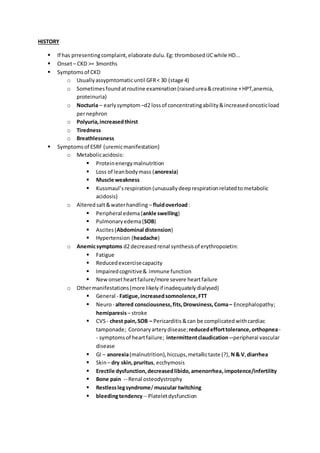
HISTORY
 If has prresentingcomplaint,elaborate dulu.Eg: thrombosedIJCwhile HD...
 Onset– CKD >= 3months
 Symptomsof CKD
o Usuallyassypmtomaticuntil GFR< 30 (stage 4)
o Sometimesfoundatroutine examination(raisedurea&creatinine +HPT,anemia,
proteinuria)
o Nocturia – earlysymptom–d2 lossof concentratingability&increasedoncoticload
pernephron
o Polyuria,increasedthirst
o Tiredness
o Breathlessness
 Symptomsof ESRF (uremicmanifestation)
o Metabolicacidosis:
 Proteinenergymalnutrition
 Loss of leanbodymass (anorexia)
 Muscle weakness
 Kussmaul’srespiration(unusuallydeeprespirationrelatedtometabolic
acidosis)
o Alteredsalt&waterhandling – fluidoverload:
 Peripheral edema(ankle swelling)
 Pulmonaryedema(SOB)
 Ascites(Abdominal distension)
 Hypertension (headache)
o Anemicsymptoms d2 decreasedrenal synthesisof erythropoietin:
 Fatigue
 Reducedexcercisecapacity
 Impairedcognitive& immune function
 Newonsetheartfailure/more severe heartfailure
o Othermanifestations(more likelyif inadequatelydialysed)
 General - Fatigue,increasedsomnolence,FTT
 Neuro- altered consciousness,fits,Drowsiness,Coma– Encephalopathy;
hemiparesis– stroke
 CVS- chest pain,SOB – Pericarditis &can be complicatedwithcardiac
tamponade; Coronaryarterydisease;reducedefforttolerance,orthopnea-
- symptomsof heartfailure; intermittentclaudication --peripheral vascular
disease
 GI – anorexia(malnutrition), hiccups,metallictaste (?), N& V,diarrhea
 Skin– dry skin,pruritus, ecchymosis
 Erectile dysfunction,decreasedlibido,amenorrhea,impotence/infertility
 Bone pain -- Renal osteodystrophy
 Restlesslegsyndrome/muscular twitching
 bleedingtendency-- Plateletdysfunction
 Identifycauses/riskfactorsforCKD
o CommoninMalaysia: long standingDM,HPT
o h/oautoimmune disorders (IgA nephropathymostcommon), systemicinfections,
drugs,neoplasia------[Glomerulardiseases]
o h/orepetitive urinarytractinfection,stones,drugtoxicity,autoimmune,
nephrocalcinosis ----- [Tubulointerstial disease]
o h/olarge vessel disease,hypertension,microangiopathy,vasculitis ----[ Vascular
diseases]
o h/oStones (lointogroinpain,dysuria,etc) oranatomical problemsof the urinary
tract --- [Urinarytract obstruction]
o Symptomsof SLE (malarrash, arthritisetc) & vasculitis ----- [systemicinflammatory
disease]
o Previousepisode of acute renal failure
o Historyof transplantedkidney –can have chronicrejection,drugtoxicity,transplant
glomerulopathy
o HereditaryKidneyDiseases, egPCKD
 inchronic cases,alsoask about:
o Course & progression
 Progressionof symptoms
 Progressionof markers.Egproteinuria,creatinineetc(espeducatedpt)
 Additionof medication, fluidrestrictions..
o Detailsaboutdialyisis
 HD/CAPD,frequency,done at..,compliance
 Int jugularcatheter/femoral catheter/AV Fistula/peritoneal dialysiscatheter
 Complicationsof hemodialysis:
 Hypotension,cardiacarrythmias,hemorrhage,airembolism, dialyser
hypersensitivity,pulmonaryedema,systemicsepsis
 Complicationsof peritoneal dialysis:
 CAPDperitonitis,catheterexitsite infection,sclerosingperitonitis
o Anyotherinterventionsdone:
 Renal transplant,lagi..?
 Functional impairment/status
o Change inqualityof life (espif starteddialysis)
o Psychosocial aspect
 PMH
o Comorbids,eg:
 DM - Glucose control,....
 HPT - Strict bloodpressure control (understandtargetBPinCKD)...
 Illnessleadingtochronicuse of NSAIDs& analgesics
o All followups&medications:
 Currentlistof medications prescribed.Eg: ace-I,ARB,etc
 OTC drugs – worsenCKD
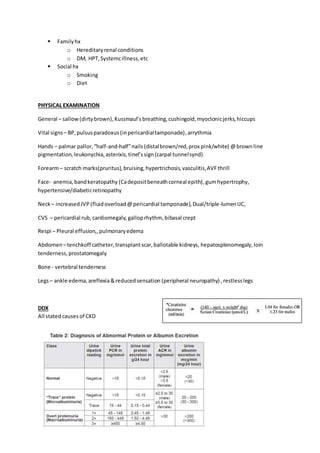
 Familyhx
o Hereditaryrenal conditions
o DM, HPT,Systemcillness,etc
 Social hx
o Smoking
o Diet
PHYSICAL EXAMINATION
General – sallow(dirtybrown),Kussmaul’sbreathing,cushingoid,myoclonicjerks,hiccups
Vital signs– BP,pulsusparadoxus(inpericardialtamponade),arrythmia
Hands – palmar pallor,“half-and-half”nails(distalbrown/red,prox pink/white) @brownline
pigmentation,leukonychia,asterixis,tinel’ssign(carpal tunnelsynd)
Forearm– scratch marks(pruritus),bruising,hypertrichosis,vasculitis,AVFthrill
Face- anemia,bandkeratopathy (Cadepositbeneathcorneal epith),gumhypertrophy,
hypertensive/diabeticretinopathy
Neck– increasedJVP (fluidoverload@pericardial tamponade),Dual/triple-lumenIJC,
CVS – pericardial rub, cardiomegaly, galloprhythm, bibasal crept
Respi – Pleural effusion,,pulmonaryedema
Abdomen –tenchkoff catheter,transplantscar,ballotable kidneys, hepatosplenomegaly,loin
tenderness,prostatomegaly
Bone - vertebral tenderness
Legs– ankle edema,areflexia&reducedsensation (peripheral neuropathy) ,restlesslegs
DDX
All statedcauses of CKD
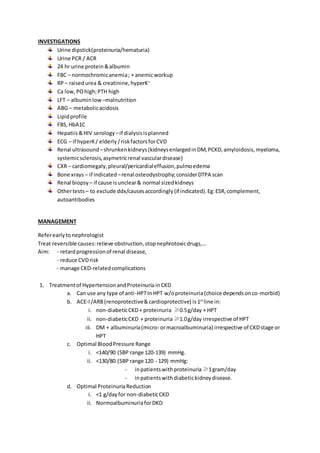
INVESTIGATIONS
Urine dipstick(proteinuria/hematuria)
Urine PCR / ACR
24 hr urine protein&albumin
FBC – normochromicanemia; + anemicworkup
RP – raisedurea & creatinine,hyperK+
Ca low,POhigh;PTH high
LFT – albuminlow –malnutrition
ABG – metabolicacidosis
Lipidprofile
FBS, HbA1C
Hepatiis&HIV serology –if dialysisisplanned
ECG – if hyperK/ elderly/riskfactorsforCVD
Renal ultrasound –shrunkenkidneys(kidneysenlargedinDM,PCKD,amyloidosis,myeloma,
systemicsclerosis,asymetricrenal vasculardisease)
CXR – cardiomegaly,pleural/pericardialeffusion,pulmoedema
Bone xrays – if indicated –renal osteodystrophy;considerDTPA scan
Renal biopsy – if cause isunclear& normal sizedkidneys
Othertests – to exclude ddx/causesaccordingly(if indicated).Eg:ESR,complement,
autoantibodies
MANAGEMENT
Referearlytonephrologist
Treat reversible causes:relieve obstruction,stopnephrotoxicdrugs,…
Aim: - retardprogressionof renal disease,
- reduce CVDrisk
- manage CKD-relatedcomplications
1. Treatmentof HypertensionandProteinuria inCKD
a. Can use any type of anti-HPTInHPT w/oproteinuria(choice dependsonco-morbid)
b. ACE-I/ARB(renoprotective&cardioprotective) is1st
line in:
i. non-diabeticCKD+ proteinuria ≥0.5g/day + HPT
ii. non-diabeticCKD + proteinuria≥1.0g/day irrespective of HPT
iii. DM + albuminuria(micro- ormacroalbuminuria) irrespective of CKDstage or
HPT
c. Optimal BloodPressure Range
i. <140/90 (SBP range 120-139) mmHg.
ii. <130/80 (SBP range 120 - 129) mmHg:
- inpatientswithproteinuria ≥1gram/day
- inpatientswithdiabetickidneydisease.
d. Optimal ProteinuriaReduction
i. <1 g/dayfor non-diabeticCKD
ii. NormoalbuminuriaforDKD
2. Monitoringof Renal Function
a. RP at 2 wksafterstart/adjustACE-I/ARB
b. reduce or discontinue ACEi/ARBif:
i. sustained rise increatinine levelsabove 30% frombaseline
ii. or eGFR reduces>25% from baseline
iii. or serumpotassiumis>5.6 mmol/l duringthe firsttwomonthsafter
commencementof ACEi/ARB
**after excludingotherprecipitatingfactorsandrefertoa nephrologist/physician.
3. Optimal GlycaemicControl
a. Target HbA1c ≤7% inDM but thisshould be individualisedaccordingtoco-
morbidities.
4. Preventionof CoronaryArteryDisease
a. Statinfor 1o
& 2o
prevention (startterusawal2)
b. Aspirinfor2o
prevention(avoidcombinationclopidogrel +aspirininCKDunless..)
5. DietaryIntervention
a. Referdietitian
b. Low proteindiet(0.6- 0.8 g/kg/day) withadequateenergyintake (30– 35
kcal/kg/day) forCKDStage 3 – 5
c. Sodiumrestriction(notmore than 1 level teaspoonof salt addedtofood/day)
6. Lifestyle Modification !!!
a. exercise,reduceexcessweightandavoidsmoking
7. Special Precautions
a. Reviewall prescribedmedicationregularlytoensure dose is appropriate
b. AvoidNSAIDsincludingCOX-2Inhibitors(such asmefenamicacid, diclofenac,
ibuprofen,naproxen,indomethacin,ketoprofen,salicylic acid[highdose],
meloxicam, celecoxibandetoricoxib)
c. Avoidradio-contrastagentsif possible(use alternativesmethod@contrasts)
d. AvoidFleet(oral NaPO) incolono forCKDstage 4-5 (use macrogol)
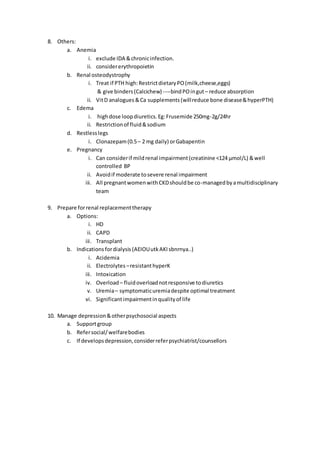
8. Others:
a. Anemia
i. exclude IDA &chronicinfection.
ii. considererythropoietin
b. Renal osteodystrophy
i. Treat if PTH high:RestrictdietaryPO(milk,cheese,eggs)
& give binders(Calcichew) ----bindPOingut– reduce absorption
ii. VitD analogues &Ca supplements(willreduce bone disease&hyperPTH)
c. Edema
i. highdose loopdiuretics.Eg:Frusemide 250mg-2g/24hr
ii. Restrictionof fluid&sodium
d. Restlesslegs
i. Clonazepam(0.5– 2 mg daily) orGabapentin
e. Pregnancy
i. Can considerif mildrenal impairment(creatinine <124 μmol/L) &well
controlled BP
ii. Avoidif moderate tosevere renal impairment
iii. All pregnantwomenwithCKDshouldbe co-managedbyamultidisciplinary
team
9. Prepare forrenal replacementtherapy
a. Options:
i. HD
ii. CAPD
iii. Transplant
b. Indications fordialysis (AEIOUutkAKIsbnrnya..)
i. Acidemia
ii. Electrolytes –resistanthyperK
iii. Intoxication
iv. Overload– fluidoverloadnotresponsive todiuretics
v. Uremia– symptomaticuremiadespite optimal treatment
vi. Significantimpairmentinqualityof life
10. Manage depression&otherpsychosocial aspects
a. Supportgroup
b. Refersocial/welfarebodies
c. If developsdepression,considerreferpsychiatrist/counsellors

CHRONIC KIDNEY DISEASE INFO AND TEMPLATE

  • 1.
    CHRONIC KIDNEY DISEASEINFO & TEMPLATE OVERVIEW CPG = an irreversiblelossof renal functionforatleastthree months. Oxford= kidneydamage >= 3 monthsbasedon findingof abnormal structure or GFR <60 mL/min/1.73m2 for>= 3months withorwithoutevidenceof kidneydamage. UM express= 1. Azotemia– accum of nitrogenousproduct(chieflyurea) inblood –raisedU & C 2. Uremia – manifestationof organdysfunctiona/w azotemia 3. CRF – permanentGFRreduction/ GFR sufficienttoproduce detectablealterations inwell-being&organ fx 4. ESRF –final stage of CKD whenptcan’t survive w/otransplant@longtermdialysis     [NKF-KDOQIClassification] basedon three factors: 1. GFR (level of kidneyfunction) 2. pathological changes(kidneydamage) 3. presence of the abnormalityforatleast three months. - MildCKD. Asymptomatic. - Moderate CKD.Usually asymptomatic. - Anemiainsome ptat 3B. - Most are non-progressive or progressveryslowly. - Severe CKD.Firstsymptom usuallyatGFR <20. - ElectrolytesproblemsasGFRfalls - Kidneyfailure.Significant symptoms& complications. - Dialysisinitiationvariesbut usuallyatGFR <10 The kidneydamage isdefinedaseither: a. Persistentmicroalbuminuria b. Persistentproteinuria c. Persistenthaematuria d. Radiological evidence of structural abnormalitiesof the kidneys e.Biopsyprovenglomerulonephritis Asymptomatic.Only biochemical abn. Loss of excretory, metabolic & endocrine fx of kidney.Leadstosx & sx (referred as uremia) ESRD/ESRF = when death is likely w/o RRT
  • 2.
    HISTORY  If hasprresentingcomplaint,elaborate dulu.Eg: thrombosedIJCwhile HD...  Onset– CKD >= 3months  Symptomsof CKD o Usuallyassypmtomaticuntil GFR< 30 (stage 4) o Sometimesfoundatroutine examination(raisedurea&creatinine +HPT,anemia, proteinuria) o Nocturia – earlysymptom–d2 lossof concentratingability&increasedoncoticload pernephron o Polyuria,increasedthirst o Tiredness o Breathlessness  Symptomsof ESRF (uremicmanifestation) o Metabolicacidosis:  Proteinenergymalnutrition  Loss of leanbodymass (anorexia)  Muscle weakness  Kussmaul’srespiration(unusuallydeeprespirationrelatedtometabolic acidosis) o Alteredsalt&waterhandling – fluidoverload:  Peripheral edema(ankle swelling)  Pulmonaryedema(SOB)  Ascites(Abdominal distension)  Hypertension (headache) o Anemicsymptoms d2 decreasedrenal synthesisof erythropoietin:  Fatigue  Reducedexcercisecapacity  Impairedcognitive& immune function  Newonsetheartfailure/more severe heartfailure o Othermanifestations(more likelyif inadequatelydialysed)  General - Fatigue,increasedsomnolence,FTT  Neuro- altered consciousness,fits,Drowsiness,Coma– Encephalopathy; hemiparesis– stroke  CVS- chest pain,SOB – Pericarditis &can be complicatedwithcardiac tamponade; Coronaryarterydisease;reducedefforttolerance,orthopnea- - symptomsof heartfailure; intermittentclaudication --peripheral vascular disease  GI – anorexia(malnutrition), hiccups,metallictaste (?), N& V,diarrhea  Skin– dry skin,pruritus, ecchymosis  Erectile dysfunction,decreasedlibido,amenorrhea,impotence/infertility  Bone pain -- Renal osteodystrophy  Restlesslegsyndrome/muscular twitching  bleedingtendency-- Plateletdysfunction
  • 3.
     Identifycauses/riskfactorsforCKD o CommoninMalaysia:long standingDM,HPT o h/oautoimmune disorders (IgA nephropathymostcommon), systemicinfections, drugs,neoplasia------[Glomerulardiseases] o h/orepetitive urinarytractinfection,stones,drugtoxicity,autoimmune, nephrocalcinosis ----- [Tubulointerstial disease] o h/olarge vessel disease,hypertension,microangiopathy,vasculitis ----[ Vascular diseases] o h/oStones (lointogroinpain,dysuria,etc) oranatomical problemsof the urinary tract --- [Urinarytract obstruction] o Symptomsof SLE (malarrash, arthritisetc) & vasculitis ----- [systemicinflammatory disease] o Previousepisode of acute renal failure o Historyof transplantedkidney –can have chronicrejection,drugtoxicity,transplant glomerulopathy o HereditaryKidneyDiseases, egPCKD  inchronic cases,alsoask about: o Course & progression  Progressionof symptoms  Progressionof markers.Egproteinuria,creatinineetc(espeducatedpt)  Additionof medication, fluidrestrictions.. o Detailsaboutdialyisis  HD/CAPD,frequency,done at..,compliance  Int jugularcatheter/femoral catheter/AV Fistula/peritoneal dialysiscatheter  Complicationsof hemodialysis:  Hypotension,cardiacarrythmias,hemorrhage,airembolism, dialyser hypersensitivity,pulmonaryedema,systemicsepsis  Complicationsof peritoneal dialysis:  CAPDperitonitis,catheterexitsite infection,sclerosingperitonitis o Anyotherinterventionsdone:  Renal transplant,lagi..?  Functional impairment/status o Change inqualityof life (espif starteddialysis) o Psychosocial aspect  PMH o Comorbids,eg:  DM - Glucose control,....  HPT - Strict bloodpressure control (understandtargetBPinCKD)...  Illnessleadingtochronicuse of NSAIDs& analgesics o All followups&medications:  Currentlistof medications prescribed.Eg: ace-I,ARB,etc  OTC drugs – worsenCKD
  • 4.
     Familyhx o Hereditaryrenalconditions o DM, HPT,Systemcillness,etc  Social hx o Smoking o Diet PHYSICAL EXAMINATION General – sallow(dirtybrown),Kussmaul’sbreathing,cushingoid,myoclonicjerks,hiccups Vital signs– BP,pulsusparadoxus(inpericardialtamponade),arrythmia Hands – palmar pallor,“half-and-half”nails(distalbrown/red,prox pink/white) @brownline pigmentation,leukonychia,asterixis,tinel’ssign(carpal tunnelsynd) Forearm– scratch marks(pruritus),bruising,hypertrichosis,vasculitis,AVFthrill Face- anemia,bandkeratopathy (Cadepositbeneathcorneal epith),gumhypertrophy, hypertensive/diabeticretinopathy Neck– increasedJVP (fluidoverload@pericardial tamponade),Dual/triple-lumenIJC, CVS – pericardial rub, cardiomegaly, galloprhythm, bibasal crept Respi – Pleural effusion,,pulmonaryedema Abdomen –tenchkoff catheter,transplantscar,ballotable kidneys, hepatosplenomegaly,loin tenderness,prostatomegaly Bone - vertebral tenderness Legs– ankle edema,areflexia&reducedsensation (peripheral neuropathy) ,restlesslegs DDX All statedcauses of CKD
  • 5.
    INVESTIGATIONS Urine dipstick(proteinuria/hematuria) Urine PCR/ ACR 24 hr urine protein&albumin FBC – normochromicanemia; + anemicworkup RP – raisedurea & creatinine,hyperK+ Ca low,POhigh;PTH high LFT – albuminlow –malnutrition ABG – metabolicacidosis Lipidprofile FBS, HbA1C Hepatiis&HIV serology –if dialysisisplanned ECG – if hyperK/ elderly/riskfactorsforCVD Renal ultrasound –shrunkenkidneys(kidneysenlargedinDM,PCKD,amyloidosis,myeloma, systemicsclerosis,asymetricrenal vasculardisease) CXR – cardiomegaly,pleural/pericardialeffusion,pulmoedema Bone xrays – if indicated –renal osteodystrophy;considerDTPA scan Renal biopsy – if cause isunclear& normal sizedkidneys Othertests – to exclude ddx/causesaccordingly(if indicated).Eg:ESR,complement, autoantibodies MANAGEMENT Referearlytonephrologist Treat reversible causes:relieve obstruction,stopnephrotoxicdrugs,… Aim: - retardprogressionof renal disease, - reduce CVDrisk - manage CKD-relatedcomplications 1. Treatmentof HypertensionandProteinuria inCKD a. Can use any type of anti-HPTInHPT w/oproteinuria(choice dependsonco-morbid) b. ACE-I/ARB(renoprotective&cardioprotective) is1st line in: i. non-diabeticCKD+ proteinuria ≥0.5g/day + HPT ii. non-diabeticCKD + proteinuria≥1.0g/day irrespective of HPT iii. DM + albuminuria(micro- ormacroalbuminuria) irrespective of CKDstage or HPT c. Optimal BloodPressure Range i. <140/90 (SBP range 120-139) mmHg. ii. <130/80 (SBP range 120 - 129) mmHg: - inpatientswithproteinuria ≥1gram/day - inpatientswithdiabetickidneydisease. d. Optimal ProteinuriaReduction i. <1 g/dayfor non-diabeticCKD ii. NormoalbuminuriaforDKD
  • 6.
    2. Monitoringof RenalFunction a. RP at 2 wksafterstart/adjustACE-I/ARB b. reduce or discontinue ACEi/ARBif: i. sustained rise increatinine levelsabove 30% frombaseline ii. or eGFR reduces>25% from baseline iii. or serumpotassiumis>5.6 mmol/l duringthe firsttwomonthsafter commencementof ACEi/ARB **after excludingotherprecipitatingfactorsandrefertoa nephrologist/physician. 3. Optimal GlycaemicControl a. Target HbA1c ≤7% inDM but thisshould be individualisedaccordingtoco- morbidities. 4. Preventionof CoronaryArteryDisease a. Statinfor 1o & 2o prevention (startterusawal2) b. Aspirinfor2o prevention(avoidcombinationclopidogrel +aspirininCKDunless..) 5. DietaryIntervention a. Referdietitian b. Low proteindiet(0.6- 0.8 g/kg/day) withadequateenergyintake (30– 35 kcal/kg/day) forCKDStage 3 – 5 c. Sodiumrestriction(notmore than 1 level teaspoonof salt addedtofood/day) 6. Lifestyle Modification !!! a. exercise,reduceexcessweightandavoidsmoking 7. Special Precautions a. Reviewall prescribedmedicationregularlytoensure dose is appropriate b. AvoidNSAIDsincludingCOX-2Inhibitors(such asmefenamicacid, diclofenac, ibuprofen,naproxen,indomethacin,ketoprofen,salicylic acid[highdose], meloxicam, celecoxibandetoricoxib) c. Avoidradio-contrastagentsif possible(use alternativesmethod@contrasts) d. AvoidFleet(oral NaPO) incolono forCKDstage 4-5 (use macrogol)
  • 7.
    8. Others: a. Anemia i.exclude IDA &chronicinfection. ii. considererythropoietin b. Renal osteodystrophy i. Treat if PTH high:RestrictdietaryPO(milk,cheese,eggs) & give binders(Calcichew) ----bindPOingut– reduce absorption ii. VitD analogues &Ca supplements(willreduce bone disease&hyperPTH) c. Edema i. highdose loopdiuretics.Eg:Frusemide 250mg-2g/24hr ii. Restrictionof fluid&sodium d. Restlesslegs i. Clonazepam(0.5– 2 mg daily) orGabapentin e. Pregnancy i. Can considerif mildrenal impairment(creatinine <124 μmol/L) &well controlled BP ii. Avoidif moderate tosevere renal impairment iii. All pregnantwomenwithCKDshouldbe co-managedbyamultidisciplinary team 9. Prepare forrenal replacementtherapy a. Options: i. HD ii. CAPD iii. Transplant b. Indications fordialysis (AEIOUutkAKIsbnrnya..) i. Acidemia ii. Electrolytes –resistanthyperK iii. Intoxication iv. Overload– fluidoverloadnotresponsive todiuretics v. Uremia– symptomaticuremiadespite optimal treatment vi. Significantimpairmentinqualityof life 10. Manage depression&otherpsychosocial aspects a. Supportgroup b. Refersocial/welfarebodies c. If developsdepression,considerreferpsychiatrist/counsellors