Acute appendicitis
A Case Study
Page 1
Homework Help
https://www.homeworkping.com/
Research Paper help
https://www.homeworkping.com/
Online Tutoring
https://www.homeworkping.com/
click here for freelancing tutoring sites
INTRODUCTION
According to studies, approximately 1 in every 400 or 0.25% or 680,000 people in USA
have appendicitis. It occurs more frequently in men than in women, with a male-to-female ratio
of 1.7:1. Appendicitis can affect any age but is more common before 40 years of age,
particularly in young people between 8 and 14 years.
Appendicitis is the inflammation of vermiform appendix. When the opening of the
appendix blocked the mucosa, the pressure increases and blood flow to stops. The causative
agents include foreign bodies, trauma, intestinal worms, lymphadenitis, and, most commonly,
calcified fecal deposits known as appendicoliths or fecaliths. Once this obstruction occurs, the
appendix subsequently becomes filled with mucus and swells, increasing pressures within the
lumen and the walls of the appendix, resulting in thrombosis and occlusion of the small vessels,
and stasis of lymphatic flow. The appendix becomes ischemic and necrotic. As bacteria begin to
leak out through the dying walls, pus forms within and around the appendix (suppuration). The
end result of this cascade is appendiceal rupture (a 'burst appendix') causing peritonitis, which
may lead to septicemia and eventually death.
Risk factors that would predispose a person to this pathology include age from 10-20
years old, gender of male, low fiber diet with rich in refined carbohydrates, hereditary history
and other infections.
Pain first, vomiting next and fever last has been described as the classic presentation of
acute appendicitis. Other symptoms that suggest appendicitis are rebound tenderness,
rovsing’s sign, psoas sign, obturator sign, dunphy’s sign, kocher’s sign, Bartomier-Michelson's
sign, Aure-Rozanova's sign, and Blumberg sign.
Acute appendicitis
A Case Study
Page 2
When the doctor diagnoses appendicitis on the patient, they rely on the results of
laboratories such as complete blood count which shows an increase in the number of white
blood cells, abdominal x-ray, ultrasound or CT scan, and urinalysis to rule-out pregnancy in
appendicitis. Actually, there is no definitive test for appendicitis; these laboratories are just
suggestive for this disease. Usually the signs and symptoms that it presents are similar to the
signs and symptoms of ectopic pregnancy in women, the reason why ruling out for pregnancy in
potential female clients are important before diagnosing this disease.
Medical interventions include the correction or prevention fluid and electrolyte
imbalance, dehydration, and sepsis, antibiotics until surgery is performed. Appendectomy is
performed as soon as possible to decrease the risk for perforation which may be performed
with general or spinal anesthesia.
Nursing goals include relieving pain, preventing fluid volume deficit, reducing anxiety,
eliminating infection due to potential or actual disruption of GI tract, maintaining skin integrity
and attaining optimal nutrition. The nurse prepares the patient for surgery, which includes IV
infusion to replace fluid loss and promote adequate renal function and antibiotic therapy to
prevent infection. After surgery, nurse places the patient in a high-fowler’s position to reduce
the tension on the incision and abdominal organs, helping to reduce pain. An opioid, usually
morphine sulfate is prescribed by the doctor to relieve pain.
Discharge teaching for the patient and family is imperative. The nurse instructs the
patient to make an appointment to have the surgeon remove the sutures between fifth and
seventh days after surgery. Incision care and guidelines are discussed; normal activity can
usually be resumed within 2 to 4 weeks. If there is a possibility of peritonitis, a drain is left in
place at the area of incision. Moreover, discussion for the prevention of appendicitis such as
increase fluid intake, and high fiber diet should also be discussed to avoid a repeat of the
incidence to the other family members.
OBJECTIVES
GENERAL: To formulate a case study under Dorothea Orem’s “Self Care Deficit Nursing
Theory” about acute appendicitis employing the theoretical foundation we acquire at school
while developing our own strategy as part of skill-building, taking note of the right approach
and manner towards the patient and his/her relatives of this pathology. To render efficient
and effective nursing interventions towards the achievement of holistic development of the
patient as well as the student nurses.
SPECIFIC:
 To synthesize a framework of knowledge depending on clinical experience, to be able to
delineate the theoretical and clinical wisdom about the disease.
Acute appendicitis
A Case Study
Page 3
 To be able to organize priorities depending on the actual problem while having in mind
the potential and risk problems for prevention.
 To formulate the appropriate attitude in patients with acute appendicitis with the 6C’s
of nursing.
 To inform the patient as well as the relatives on the prevention of the disease to prevent
reoccurrence to other family members with evidence-based and proven health-
teachings.
 To document a particular incident of acute appendicitis and enlighten the community
and prevent future morbidity.
 To evaluate the present trend in caring for patients with acute appendicitis through
experience and conclude possible addendums to the practices recognized in the books.
NURSING HEALTH HISTORY
Demographic Profile
This is a case of R.Z., 10 year-old female, born on May 12, 2001, a Roman Catholic
residing at Marilao, Bulacan. R.Z. is at her 3rd grade of elementary; her father who is a tricycle
driver is the source of their medical expenses. Admitted for the first time at Bulacan Medical
Center, Female Surgery Ward on January 10, 2012 with an admitting diagnosis of Acute
Appendicitis and endorsed for appendectomy.
Chief Complaint
“Aray! ansakit ng tiyan ko.”, as verbalized by the patient.
History of Present Health Concern
4 days prior to admission patient had fever with noted loss of appetite. In response, TSB
was rendered but does not take OTC drugs for fever. 3 days prior to admission, patient
experienced right lower quadrant abdominal pain associated with nausea, still with fever and
loss of appetite.
Acute appendicitis
A Case Study
Page 4
Few hours prior to admission, R.Z. experienced severe abdominal pain with 1 episode of
greenish vomitus; thus brought to Local Health Center, then to Bulacan Medical Center
Emergency Department and admitted with a stat AP status.
Past Health History
Patient had no history of previous hospitalizations. With no known allergies and history
of previous illness. R.A. had BCG, 3 Hepa B, 3 OPV and 1 measles vaccine.
Family Health History
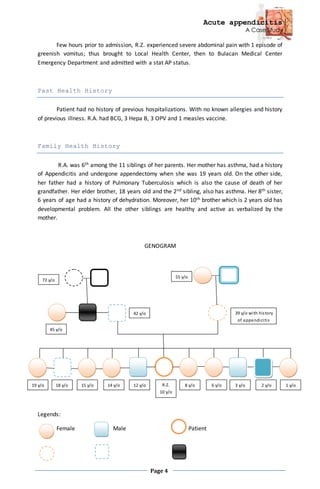
R.A. was 6th among the 11 siblings of her parents. Her mother has asthma, had a history
of Appendicitis and undergone appendectomy when she was 19 years old. On the other side,
her father had a history of Pulmonary Tuberculosis which is also the cause of death of her
grandfather. Her elder brother, 18 years old and the 2nd sibling, also has asthma. Her 8th sister,
6 years of age had a history of dehydration. Moreover, her 10th brother which is 2 years old has
developmental problem. All the other siblings are healthy and active as verbalized by the
mother.
GENOGRAM
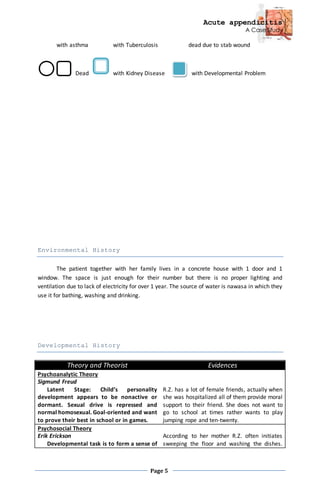
Legends:
Female Male Patient
19 y/o 15 y/o18 y/o 14 y/o 12 y/o
72 y/o
55 y/o
39 y/o with history
of appendicitis
42 y/o
45 y/o
R.Z.
10 y/o
8 y/o 6 y/o 3 y/o 2 y/o 1 y/o
Acute appendicitis
A Case Study
Page 5
with asthma with Tuberculosis dead due to stab wound
Dead with Kidney Disease with Developmental Problem
Environmental History
The patient together with her family lives in a concrete house with 1 door and 1
window. The space is just enough for their number but there is no proper lighting and
ventilation due to lack of electricity for over 1 year. The source of water is nawasa in which they
use it for bathing, washing and drinking.
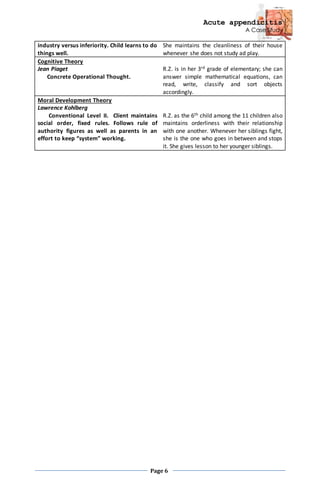
Developmental History
Theory and Theorist Evidences
Psychoanalytic Theory
Sigmund Freud
Latent Stage: Child’s personality
development appears to be nonactive or
dormant. Sexual drive is repressed and
normal homosexual. Goal-oriented and want
to prove their best in school or in games.
R.Z. has a lot of female friends, actually when
she was hospitalized all of them provide moral
support to their friend. She does not want to
go to school at times rather wants to play
jumping rope and ten-twenty.
Psychosocial Theory
Erik Erickson
Developmental task is to form a sense of
According to her mother R.Z. often initiates
sweeping the floor and washing the dishes.
Acute appendicitis
A Case Study
Page 6
industry versus inferiority. Child learns to do
things well.
She maintains the cleanliness of their house
whenever she does not study ad play.
Cognitive Theory
Jean Piaget
Concrete Operational Thought.
R.Z. is in her 3rd grade of elementary; she can
answer simple mathematical equations, can
read, write, classify and sort objects
accordingly.
Moral Development Theory
Lawrence Kohlberg
Conventional Level II. Client maintains
social order, fixed rules. Follows rule of
authority figures as well as parents in an
effort to keep “system” working.
R.Z. as the 6th child among the 11 children also
maintains orderliness with their relationship
with one another. Whenever her siblings fight,
she is the one who goes in between and stops
it. She gives lesson to her younger siblings.
Acute appendicitis
A Case Study
Page 7
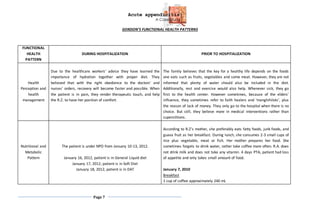
GORDON’S FUNCTIONAL HEALTH PATTERNS
FUNCTIONAL
HEALTH
PATTERN
DURING HOSPITALIZATION PRIOR TO HOSPITALIZATION
Health
Perception and
health
management
Due to the healthcare workers’ advice they have learned the
importance of hydration together with proper diet. They
believed that with the right obedience to the doctors’ and
nurses’ orders, recovery will become faster and possible. When
the patient is in pain, they render therapeutic touch, and help
the R.Z. to have her position of comfort.
The family believes that the key for a healthy life depends on the foods
one eats such as fruits, vegetables and some meat. However, they are not
informed that plenty of water should also be included in the diet.
Additionally, rest and exercise would also help. Whenever sick, they go
first to the health center. However sometimes, because of the elders’
influence, they sometimes refer to faith healers and ‘manghihilots’, plus
the reason of lack of money. They only go to the hospital when there is no
choice. But still, they believe more in medical interventions rather than
superstitions.
Nutritional and
Metabolic
Pattern
The patient is under NPO from January 10-13, 2012.
January 16, 2012, patient is in General Liquid diet
January 17, 2012, patient is in Soft Diet
January 18, 2012, patient is in DAT
According to R.Z’s mother, she preferably eats fatty foods, junk foods, and
guava fruit as her breakfast. During lunch, she consumes 2-3 small cups of
rice plus vegetable, meat or fish. Her mother prepares her food. She
sometimes forgets to drink water, rather take coffee more often. R.A. does
not drink milk and does not take any vitamin. 4 days PTA, patient had loss
of appetite and only takes small amount of food.
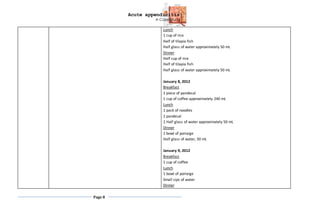
January 7, 2010
Breakfast
1 cup of coffee approximately 240 mL
Acute appendicitis
A Case Study
Page 8
Lunch
1 cup of rice
Half of tilapia fish
Half glass of water approximately 50 mL
Dinner
Half cup of rice
Half of tilapia fish
Half glass of water approximately 50 mL
January 8, 2012
Breakfast
1 piece of pandesal
1 cup of coffee approximately 240 mL
Lunch
1 pack of noodles
1 pandesal
1 Half glass of water approximately 50 mL
Dinner
1 bowl of porraige
Half glass of water, 50 mL
January 9, 2012
Breakfast
1 cup of coffee
Lunch
1 bowl of porraige
Small sips of water
Dinner
Acute appendicitis
A Case Study
Page 9
Half bowl of porraige
Small sips of water
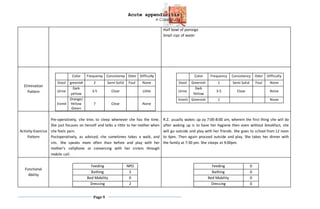
Elimination
Pattern
Color Frequency Consistency Odor Difficulty
Stool greenish 2 Semi Solid Foul None
Urine
Dark
yellow
3-5 Clear Little
Vomit
Orange/
Yellow
Green
7 Clear None
Color Frequency Consistency Odor Difficulty
Stool Greenish 1 Semi Solid Foul None
Urine
Dark
Yellow
3-5 Clear None
Vomit Greenish 1 None
Activity-Exercise
Pattern
Pre-operatively, she tries to sleep whenever she has the time.
She just focuses on herself and talks a little to her mother when
she feels pain.
Postoperatively, as advised, she sometimes takes a walk, and
sits. She speaks more often than before and play with her
mother’s cellphone or conversing with her sisters through
mobile call.
R.Z. usually wakes up ay 7:00-8:00 am, wherein the first thing she will do
after waking up is to have her hygiene then even without breakfast, she
will go outside and play with her friends. She goes to school from 12 noon
to 6pm. Then again proceed outside and play. She takes her dinner with
the family at 7:30 pm. She sleeps at 9:00pm.
Functional
Ability
Feeding NPO
Bathing 2
Bed Mobility 0
Dressing 2
Feeding 0
Bathing 0
Bed Mobility 0
Dressing 0
Acute appendicitis
A Case Study
Page
10
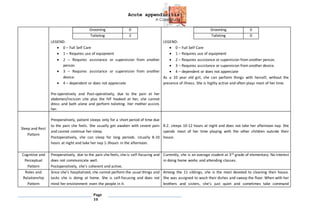
Grooming 0
Toileting 2
LEGEND:
 0 – Full Self Care
 1 – Requires use of equipment
 2 – Requires assistance or supervision from another
person.
 3 – Requires assistance or supervision from another
device.
 4 – dependent or does not appreciate
Pre-operatively and Post-operatively, due to the pain at her
abdomen/incision site plus the IVF hooked at her, she cannot
dress and bath alone and perform toileting. Her mother assists
her.
Grooming 0
Toileting 0
LEGEND:
 0 – Full Self Care
 1 – Requires use of equipment
 2 – Requires assistance or supervision from another person.
 3 – Requires assistance or supervision from another device.
 4 – dependent or does not appreciate
As a 10 year old girl, she can perform things with herself, without the
presence of illness. She is highly active and often plays most of her time.
Sleep and Rest
Pattern
Preoperatively, patient sleeps only for a short period of time due
to the pain she feels. She usually get awaken with severe pain
and cannot continue her sleep.
Postoperatively, she can sleep for long periods. Usually 8-10
hours at night and take her nap 1-3hours in the afternoon.
R.Z. sleeps 10-12 hours at night and does not take her afternoon nap. She
spends most of her time playing with the other children outside their
house.
Cognitive and
Perceptual
Pattern
Preoperatively, due to the pain she feels, she is self-focusing and
does not communicate well.
Postoperatively, she’s coherent and active.
Currently, she is an average student at 3rd grade of elementary. No interest
in doing home works and attending classes.
Roles and
Relationship
Pattern
Since she’s hospitalized, she cannot perform the usual things and
tasks she is doing at home. She is self-focusing and does not
mind her environment even the people in it.
Among the 11 siblings, she is the most devoted to cleaning their house.
She was assigned to wash their dishes and sweep the floor. When with her
brothers and sisters, she’s just quiet and sometimes take command
Acute appendicitis
A Case Study
Page
11
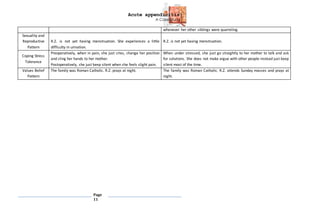
whenever her other siblings were quarreling.
Sexuality and
Reproductive
Pattern
R.Z. is not yet having menstruation. She experiences a little
difficulty in urination.
R.Z. is not yet having menstruation.
Coping Stress
Tolerance
Preoperatively, when in pain, she just cries, change her position
and cling her hands to her mother.
Postoperatively, she just keep silent when she feels slight pain.
When under stressed, she just go straightly to her mother to talk and ask
for solutions. She does not make argue with other people instead just keep
silent most of the time.
Values Belief
Pattern
The family was Roman Catholic. R.Z. prays at night. The family was Roman Catholic. R.Z. attends Sunday masses and prays at
night.
Acute appendicitis
A Case Study
Page
12
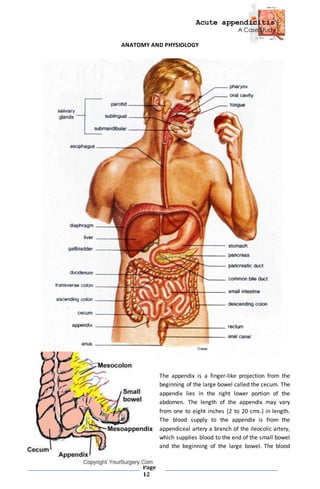
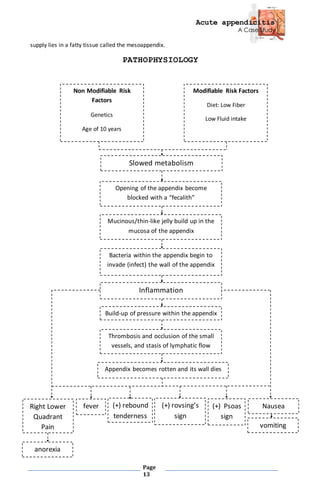
ANATOMY AND PHYSIOLOGY
The appendix is a finger-like projection from the
beginning of the large bowel called the cecum. The
appendix lies in the right lower portion of the
abdomen. The length of the appendix may vary
from one to eight inches (2 to 20 cms.) in length.
The blood supply to the appendix is from the
appendiceal artery a branch of the ileocolic artery,
which supplies blood to the end of the small bowel
and the beginning of the large bowel. The blood
Acute appendicitis
A Case Study
Page
13
supply lies in a fatty tissue called the mesoappendix.
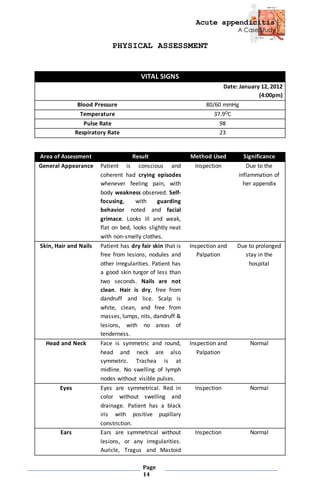
PATHOPHYSIOLOGY
Non Modifiable Risk
Factors
Genetics
Age of 10 years
Modifiable Risk Factors
Diet: Low Fiber
Low Fluid intake
Slowed metabolism
Opening of the appendix become
blocked with a “fecalith”
Mucinous/thin-like jelly build up in the
mucosa of the appendix
Right Lower
Quadrant
Pain vomiting
Nauseafever
anorexia
(+) rebound
tenderness
(+) Psoas
sign
(+) rovsing’s
sign
Build-up of pressure within the appendix
Thrombosis and occlusion of the small
vessels, and stasis of lymphatic flow
Inflammation
Appendix becomes rotten and its wall dies
Bacteria within the appendix begin to
invade (infect) the wall of the appendix
Acute appendicitis
A Case Study
Page
14
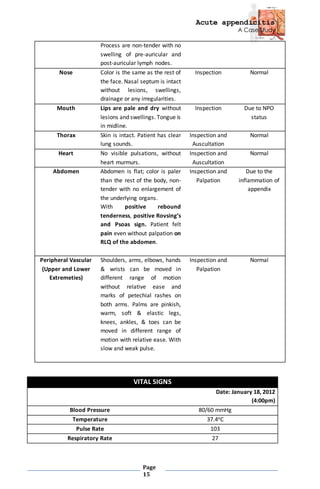
PHYSICAL ASSESSMENT
VITAL SIGNS
Date: January 12, 2012
(4:00pm)
Blood Pressure 80/60 mmHg
Temperature 37.9OC
Pulse Rate 98
Respiratory Rate 23
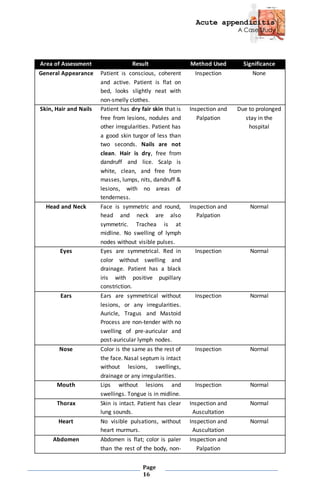
Area of Assessment Result Method Used Significance
General Appearance Patient is conscious and
coherent had crying episodes
whenever feeling pain, with
body weakness observed. Self-
focusing, with guarding
behavior noted and facial
grimace. Looks ill and weak,
flat on bed, looks slightly neat
with non-smelly clothes.
Inspection Due to the
inflammation of
her appendix
Skin, Hair and Nails Patient has dry fair skin that is
free from lesions, nodules and
other irregularities. Patient has
a good skin turgor of less than
two seconds. Nails are not
clean. Hair is dry, free from
dandruff and lice. Scalp is
white, clean, and free from
masses, lumps, nits, dandruff &
lesions, with no areas of
tenderness.
Inspection and
Palpation
Due to prolonged
stay in the
hospital
Head and Neck Face is symmetric and round,
head and neck are also
symmetric. Trachea is at
midline. No swelling of lymph
nodes without visible pulses.
Inspection and
Palpation
Normal
Eyes Eyes are symmetrical. Red in
color without swelling and
drainage. Patient has a black
iris with positive pupillary
constriction.
Inspection Normal
Ears Ears are symmetrical without
lesions, or any irregularities.
Auricle, Tragus and Mastoid
Inspection Normal
Acute appendicitis
A Case Study
Page
15
Process are non-tender with no
swelling of pre-auricular and
post-auricular lymph nodes.
Nose Color is the same as the rest of
the face. Nasal septum is intact
without lesions, swellings,
drainage or any irregularities.
Inspection Normal
Mouth Lips are pale and dry without
lesions and swellings. Tongue is
in midline.
Inspection Due to NPO
status
Thorax Skin is intact. Patient has clear
lung sounds.
Inspection and
Auscultation
Normal
Heart No visible pulsations, without
heart murmurs.
Inspection and
Auscultation
Normal
Abdomen Abdomen is flat; color is paler
than the rest of the body, non-
tender with no enlargement of
the underlying organs.
With positive rebound
tenderness, positive Rovsing’s
and Psoas sign. Patient felt
pain even without palpation on
RLQ of the abdomen.
Inspection and
Palpation
Due to the
inflammation of
appendix
Peripheral Vascular
(Upper and Lower
Extremeties)
Shoulders, arms, elbows, hands
& wrists can be moved in
different range of motion
without relative ease and
marks of petechial rashes on
both arms. Palms are pinkish,
warm, soft & elastic legs,
knees, ankles, & toes can be
moved in different range of
motion with relative ease. With
slow and weak pulse.
Inspection and
Palpation
Normal
VITAL SIGNS
Date: January 18, 2012
(4:00pm)
Blood Pressure 80/60 mmHg
Temperature 37.4oC
Pulse Rate 103
Respiratory Rate 27
Acute appendicitis
A Case Study
Page
16
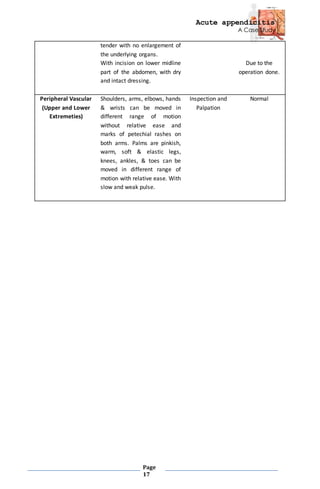
Area of Assessment Result Method Used Significance
General Appearance Patient is conscious, coherent
and active. Patient is flat on
bed, looks slightly neat with
non-smelly clothes.
Inspection None
Skin, Hair and Nails Patient has dry fair skin that is
free from lesions, nodules and
other irregularities. Patient has
a good skin turgor of less than
two seconds. Nails are not
clean. Hair is dry, free from
dandruff and lice. Scalp is
white, clean, and free from
masses, lumps, nits, dandruff &
lesions, with no areas of
tenderness.
Inspection and
Palpation
Due to prolonged
stay in the
hospital
Head and Neck Face is symmetric and round,
head and neck are also
symmetric. Trachea is at
midline. No swelling of lymph
nodes without visible pulses.
Inspection and
Palpation
Normal
Eyes Eyes are symmetrical. Red in
color without swelling and
drainage. Patient has a black
iris with positive pupillary
constriction.
Inspection Normal
Ears Ears are symmetrical without
lesions, or any irregularities.
Auricle, Tragus and Mastoid
Process are non-tender with no
swelling of pre-auricular and
post-auricular lymph nodes.
Inspection Normal
Nose Color is the same as the rest of
the face. Nasal septum is intact
without lesions, swellings,
drainage or any irregularities.
Inspection Normal
Mouth Lips without lesions and
swellings. Tongue is in midline.
Inspection Normal
Thorax Skin is intact. Patient has clear
lung sounds.
Inspection and
Auscultation
Normal
Heart No visible pulsations, without
heart murmurs.
Inspection and
Auscultation
Normal
Abdomen Abdomen is flat; color is paler
than the rest of the body, non-
Inspection and
Palpation
Acute appendicitis
A Case Study
Page
17
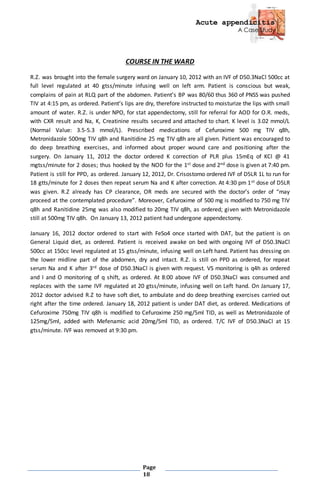
tender with no enlargement of
the underlying organs.
With incision on lower midline
part of the abdomen, with dry
and intact dressing.
Due to the
operation done.
Peripheral Vascular
(Upper and Lower
Extremeties)
Shoulders, arms, elbows, hands
& wrists can be moved in
different range of motion
without relative ease and
marks of petechial rashes on
both arms. Palms are pinkish,
warm, soft & elastic legs,
knees, ankles, & toes can be
moved in different range of
motion with relative ease. With
slow and weak pulse.
Inspection and
Palpation
Normal
Acute appendicitis
A Case Study
Page
18
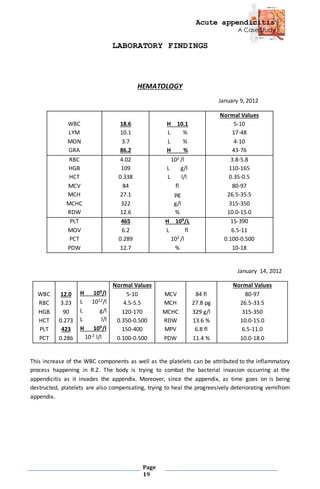
COURSE IN THE WARD
R.Z. was brought into the female surgery ward on January 10, 2012 with an IVF of D50.3NaCl 500cc at
full level regulated at 40 gtss/minute infusing well on left arm. Patient is conscious but weak,
complains of pain at RLQ part of the abdomen. Patient’s BP was 80/60 thus 360 of PNSS was pushed
TIV at 4:15 pm, as ordered. Patient’s lips are dry, therefore instructed to moisturize the lips with small
amount of water. R.Z. is under NPO, for stat appendectomy, still for referral for AOD for O.R. meds,
with CXR result and Na, K, Creatinine results secured and attached to chart. K level is 3.02 mmol/L
(Normal Value: 3.5-5.3 mmol/L). Prescribed medications of Cefuroxime 500 mg TIV q8h,
Metronidazole 500mg TIV q8h and Ranitidine 25 mg TIV q8h are all given. Patient was encouraged to
do deep breathing exercises, and informed about proper wound care and positioning after the
surgery. On January 11, 2012 the doctor ordered K correction of PLR plus 15mEq of KCl @ 41
mgtss/minute for 2 doses; thus hooked by the NOD for the 1st dose and 2nd dose is given at 7:40 pm.
Patient is still for PPD, as ordered. January 12, 2012, Dr. Crisostomo ordered IVF of D5LR 1L to run for
18 gtts/minute for 2 doses then repeat serum Na and K after correction. At 4:30 pm 1st dose of D5LR
was given. R.Z already has CP clearance, OR meds are secured with the doctor’s order of “may
proceed at the contemplated procedure”. Moreover, Cefuroxime of 500 mg is modified to 750 mg TIV
q8h and Ranitidine 25mg was also modified to 20mg TIV q8h, as ordered; given with Metronidazole
still at 500mg TIV q8h. On January 13, 2012 patient had undergone appendectomy.
January 16, 2012 doctor ordered to start with FeSo4 once started with DAT, but the patient is on
General Liquid diet, as ordered. Patient is received awake on bed with ongoing IVF of D50.3NaCl
500cc at 150cc level regulated at 15 gtss/minute, infusing well on Left hand. Patient has dressing on
the lower midline part of the abdomen, dry and intact. R.Z. is still on PPD as ordered, for repeat
serum Na and K after 3rd dose of D50.3NaCl is given with request. VS monitoring is q4h as ordered
and I and O monitoring of q shift, as ordered. At 8:00 above IVF of D50.3NaCl was consumed and
replaces with the same IVF regulated at 20 gtss/minute, infusing well on Left hand. On January 17,
2012 doctor advised R.Z to have soft diet, to ambulate and do deep breathing exercises carried out
right after the time ordered. January 18, 2012 patient is under DAT diet, as ordered. Medications of
Cefuroxime 750mg TIV q8h is modified to Cefuroxime 250 mg/5ml TID, as well as Metronidazole of
125mg/5ml, added with Mefenamic acid 20mg/5ml TID, as ordered. T/C IVF of D50.3NaCl at 15
gtss/minute. IVF was removed at 9:30 pm.
Acute appendicitis
A Case Study
Page
19
LABORATORY FINDINGS
HEMATOLOGY
January 9, 2012
WBC
LYM
MON
GRA
18.6
10.1
3.7
86.2
H 10.1
L %
L %
H %
Normal Values
5-10
17-48
4-10
43-76
RBC
HGB
HCT
MCV
MCH
MCHC
RDW
4.02
109
0.338
84
27.1
322
12.6
102 /l
L g/l
L l/l
fl
pg
g/l
%
3.8-5.8
110-165
0.35-0.5
80-97
26.5-35.5
315-350
10.0-15.0
PLT
MOV
PCT
PDW
465
6.2
0.289
12.7
H 109/L
L fl
102 /l
%
15-390
6.5-11
0.100-0.500
10-18
January 14, 2012
WBC
RBC
HGB
HCT
PLT
PCT
12.0
3.23
90
0.273
423
0.286
H 109/l
L 1012/l
L g/l
L l/l
H 109/l
10-2 l/l
Normal Values
5-10
4.5-5.5
120-170
0.350-0.500
150-400
0.100-0.500
MCV
MCH
MCHC
RDW
MPV
PDW
84 fl
27.8 pg
329 g/l
13.6 %
6.8 fl
11.4 %
Normal Values
80-97
26.5-33.5
315-350
10.0-15.0
6.5-11.0
10.0-18.0
This increase of the WBC components as well as the platelets can be attributed to the inflammatory
process happening in R.Z. The body is trying to combat the bacterial invasion occurring at the
appendicitis as it invades the appendix. Moreover, since the appendix, as time goes on is being
destructed, platelets are also compensating, trying to heal the progreesively deteriorating vernifrom
appendix.
Acute appendicitis
A Case Study
Page
20
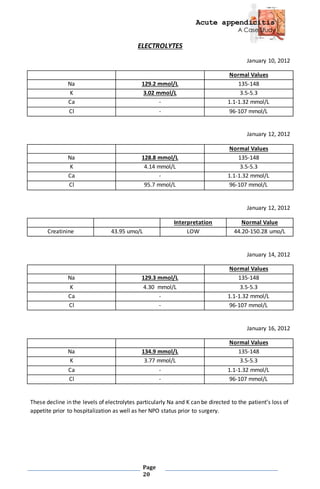
ELECTROLYTES
January 10, 2012
Normal Values
Na 129.2 mmol/L 135-148
K 3.02 mmol/L 3.5-5.3
Ca - 1.1-1.32 mmol/L
Cl - 96-107 mmol/L
January 12, 2012
Normal Values
Na 128.8 mmol/L 135-148
K 4.14 mmol/L 3.5-5.3
Ca - 1.1-1.32 mmol/L
Cl 95.7 mmol/L 96-107 mmol/L
January 12, 2012
Interpretation Normal Value
Creatinine 43.95 umo/L LOW 44.20-150.28 umo/L
January 14, 2012
Normal Values
Na 129.3 mmol/L 135-148
K 4.30 mmol/L 3.5-5.3
Ca - 1.1-1.32 mmol/L
Cl - 96-107 mmol/L
January 16, 2012
Normal Values
Na 134.9 mmol/L 135-148
K 3.77 mmol/L 3.5-5.3
Ca - 1.1-1.32 mmol/L
Cl - 96-107 mmol/L
These decline in the levels of electrolytes particularly Na and K can be directed to the patient’s loss of
appetite prior to hospitalization as well as her NPO status prior to surgery.
Acute appendicitis
A Case Study
Page
21
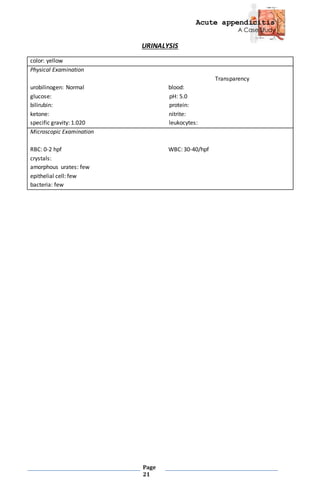
URINALYSIS
color: yellow
Physical Examination
Transparency
urobilinogen: Normal blood:
glucose: pH: 5.0
bilirubin: protein:
ketone: nitrite:
specific gravity: 1.020 leukocytes:
Microscopic Examination
RBC: 0-2 hpf WBC: 30-40/hpf
crystals:
amorphous urates: few
epithelial cell: few
bacteria: few
Acute appendicitis
A Case Study
Page
22
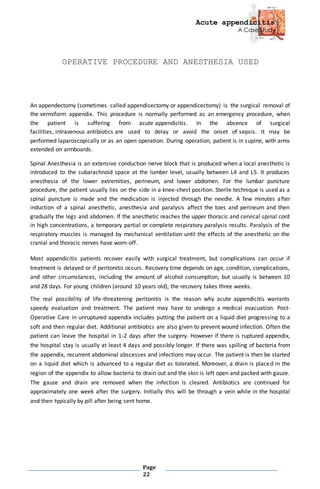
OPERATIVE PROCEDURE AND ANESTHESIA USED
An appendectomy (sometimes called appendisectomy or appendicectomy) is the surgical removal of
the vermiform appendix. This procedure is normally performed as an emergency procedure, when
the patient is suffering from acute appendicitis. In the absence of surgical
facilities, intravenous antibiotics are used to delay or avoid the onset of sepsis. It may be
performed laparoscopically or as an open operation. During operation, patient is in supine, with arms
extended on armboards.
Spinal Anesthesia is an extensive conduction nerve block that is produced when a local anesthetic is
introduced to the subarachnoid space at the lumber level, usually between L4 and L5. It produces
anesthesia of the lower extremities, perineum, and lower abdomen. For the lumbar puncture
procedure, the patient usually lies on the side in a knee-chest position. Sterile technique is used as a
spinal puncture is made and the medication is injected through the needle. A few minutes after
induction of a spinal anesthetic, anesthesia and paralysis affect the toes and perineum and then
gradually the legs and abdomen. If the anesthetic reaches the upper thoracic and cervical spinal cord
in high concentrations, a temporary partial or complete respiratory paralysis results. Paralysis of the
respiratory muscles is managed by mechanical ventilation until the effects of the anesthetic on the
cranial and thoracic nerves have worn-off.
Most appendicitis patients recover easily with surgical treatment, but complications can occur if
treatment is delayed or if peritonitis occurs. Recovery time depends on age, condition, complications,
and other circumstances, including the amount of alcohol consumption, but usually is between 10
and 28 days. For young children (around 10 years old), the recovery takes three weeks.
The real possibility of life-threatening peritonitis is the reason why acute appendicitis warrants
speedy evaluation and treatment. The patient may have to undergo a medical evacuation. Post-
Operative Care in unruptured appendix includes putting the patient on a liquid diet progressing to a
soft and then regular diet. Additional antibiotics are also given to prevent wound infection. Often the
patient can leave the hospital in 1-2 days after the surgery. However if there is ruptured appendix,
the hospital stay is usually at least 4 days and possibly longer. If there was spilling of bacteria from
the appendix, recurrent abdominal abscesses and infections may occur. The patient is then be started
on a liquid diet which is advanced to a regular diet as tolerated. Moreover, a drain is placed in the
region of the appendix to allow bacteria to drain out and the skin is left open and packed with gauze.
The gauze and drain are removed when the infection is cleared. Antibiotics are continued for
approximately one week after the surgery. Initially this will be through a vein while in the hospital
and then typically by pill after being sent home.
Acute appendicitis
A Case Study
Page
23
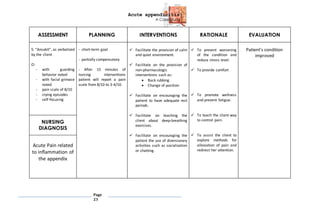
ASSESSMENT PLANNING INTERVENTIONS RATIONALE EVALUATION
S: “Ansakit”, as verbalized
by the client
O:
- with guarding
behavior noted
- with facial grimace
noted
- pain scale of 8/10
- crying episodes
- self-focusing
- short-term goal
- partially compensatory
- After 15 minutes of
nursing interventions
patient will report a pain
scale from 8/10 to 3-4/10.
 Facilitate the provision of calm
and quiet environment.
 Facilitate on the provision of
non-pharmacologic
interventions such as:
 Back rubbing
 Change of position
 Facilitate on encouraging the
patient to have adequate rest
periods.
 Facilitate on teaching the
client about deep-breathing
exercises.
 Facilitate on encouraging the
patient the use of diversionary
activities such as socialization
or chatting.
 To prevent worsening
of the condition and
reduce stress level.
 To provide comfort
 To promote wellness
and prevent fatigue.
 To teach the client way
to control pain.
 To assist the client to
explore methods for
alleviation of pain and
redirect her attention.
Patient’s condition
improved
NURSING
DIAGNOSIS
Acute Pain related
to inflammation of
the appendix
Acute appendicitis
A Case Study
Page
24
ASSESSMENT PLANNING INTERVENTIONS RATIONALE EVALUATION
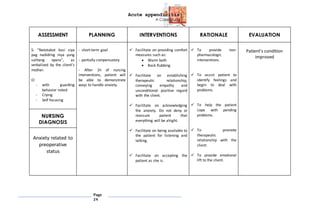
S: “Natatakot kasi siya
pag nadidinig niya yung
salitang opera”, as
verbalized by the client’s
mother.
O:
- with guarding
behavior noted
- Crying
- Self focusing
- short-term goal
- partially compensatory
- After 1h of nursing
interventions, patient will
be able to demonstrate
ways to handle anxiety.
 Facilitate on providing comfort
measures such as:
 Warm bath
 Back Rubbing
 Facilitate on establishing
therapeutic relationship,
conveying empathy and
unconditional positive regard
with the client.
 Facilitate on acknowledging
the anxiety. Do not deny or
reassure patient that
everything will be alright.
 Facilitate on being available to
the patient for listening and
talking.
 Facilitate on accepting the
patient as she is.
 To provide non-
pharmacologic
interventions.
 To assist patient to
identify feelings and
begin to deal with
problems.
 To help the patient
cope with pending
problems.
 To promote
therapeutic
relationship with the
client.
 To provide emotional
lift to the client.
Patient’s condition
improved
NURSING
DIAGNOSIS
Anxiety related to
preoperative
status
Acute appendicitis
A Case Study
Page
25
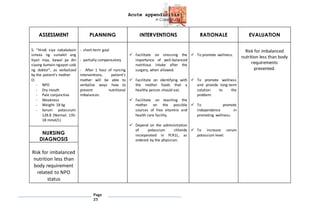
ASSESSMENT PLANNING INTERVENTIONS RATIONALE EVALUATION
S: “Hindi siya nakakakain
simula ng sumakit ang
tiyan niya, bawal pa din
siyang kumain ngayon sabi
ng doktor”, as verbalized
by the patient’s mother
O:
- NPO
- Dry mouth
- Pale conjunctiva
- Weakness
- Weight: 18 kg
- Serum potassium:
128.8 (Normal: 135-
18 mmol/L)
- short-term goal
- partially compensatory
- After 1 hour of nursing
interventions, patient’s
mother will be able to
verbalize ways how to
prevent nutritional
imbalances.
 Facilitate on stressing the
importance of well-balanced
nutritious intake after the
surgery, when allowed.
 Facilitate on identifying with
the mother foods that a
healthy person should eat.
 Facilitate on teaching the
mother on the possible
sources of free vitamins and
health care facility.
 Depend on the administration
of potassium chloride
incorporated in PLR1L, as
ordered by the physician.
 To promote wellness.
 To promote wellness
and provide long-term
solution to the
problem.
 To promote
independence in
promoting wellness.
 To increase serum
potassium level.
Risk for imbalanced
nutrition less than body
requirements
prevented.
NURSING
DIAGNOSIS
Risk for imbalanced
nutrition less than
body requirement
related to NPO
status
Acute appendicitis
A Case Study
Page
26
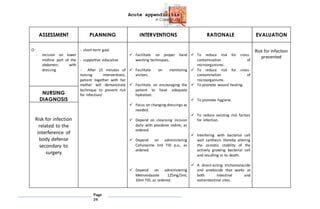
ASSESSMENT PLANNING INTERVENTIONS RATIONALE EVALUATION
O:
- Incision on lower
midline part of the
abdomen; with
dressing
- short-term goal
- supportive educative
- After 15 minutes of
nursing interventions,
patient together with her
mother will demonstrate
technique to prevent risk
for infection/
 Facilitate on proper hand
washing techniques.
 Facilitate on monitoring
visitors.
 Facilitate on encouraging the
patient to have adequate
hydration.
 Focus on changing dressings as
needed.
 Depend on cleansing incision
daily with povidone iodine, as
ordered.
 Depend on administering
Cefuroxime 5ml TID p.o., as
ordered.
 Depend on administering
Metronidazole 125mg/5ml,
10ml TID, as ordered.
 To reduce risk for cross-
contamination of
microorganisms.
 To reduce risk for cross-
contamination of
microorganisms.
 To promote wound healing.
 To promote hygiene.
 To reduce existing risk factors
for infection.
 Interfering with bacterial cell
wall synthesis thereby altering
the osmotic stability of the
actively growing bacterial cell
and resulting in its death.
 A direct-acting trichomonacide
and amebicide that works at
both intestinal and
extraintestinal sites.
Risk for infection
prevented
NURSING
DIAGNOSIS
Risk for infection
related to the
interference of
body defense
secondary to
surgery
Acute appendicitis
A Case Study
Page
27
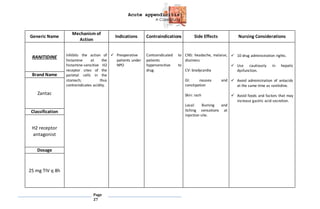
Generic Name
Mechanism of
Action
Indications Contraindications Side Effects Nursing Considerations
RANITIDINE Inhibits the action of
histamine at the
histamine-sensitive H2
receptor sites of the
parietal cells in the
stomach; thus
contraindicates acidity.
 Preoperative
patients under
NPO
Contraindicated to
patients
hypersensitive to
drug.
CNS: headache, malaise,
dizziness
CV: bradycardia
GI: nausea and
constipation
Skin: rash
Local: Burning and
itching sensations at
injection site.
 10 drug administration rights.
 Use cautiously in hepatic
dysfunction.
 Avoid administration of antacids
at the same time as ranitidine.
 Avoid foods and factors that may
increase gastric acid secretion.
Brand Name
Zantac
Classification
H2 receptor
antagonist
Dosage
25 mg TIV q 8h
Acute appendicitis
A Case Study
Page
28
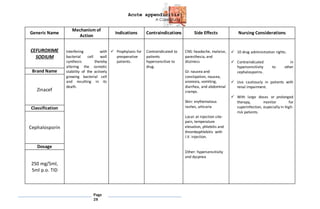
Generic Name
Mechanism of
Action
Indications Contraindications Side Effects Nursing Considerations
CEFUROXIME
SODIUM
Interfering with
bacterial cell wall
synthesis thereby
altering the osmotic
stability of the actively
growing bacterial cell
and resulting in its
death.
 Prophylaxis for
preoperative
patients.
Contraindicated to
patients
hypersensitive to
drug.
CNS: headache, malaise,
paresthesia, and
dizziness
GI: nausea and
constipation, nausea,
anorexia, vomiting,
diarrhea, and abdominal
cramps.
Skin: erythematous
rashes, urticaria
Local: at injection site-
pain, temperature
elevation, phlebitis and
thrombophlebitis with
I.V. injection.
Other: hypersensitivity
and dyspnea
 10 drug administration rights.
 Contraindicated in
hypersensitivity to other
cephalosporins.
 Use cautiously in patients with
renal impairment.
 With large doses or prolonged
therapy, monitor for
superinfection, especially in high-
risk patients.
Brand Name
Zinacef
Classification
Cephalosporin
Dosage
250 mg/5ml,
5ml p.o. TID
Acute appendicitis
A Case Study
Page
29
Generic Name
Mechanism of
Action
Indications Contraindications Side Effects Nursing Considerations
METRONIDAZOLE A direct-acting
trichomonacide and
amebicide that works
at both intestinal and
extraintestinal sites.
 Prevention of
postoperative
infection in
contaminated
or potentially
contaminated
colorectal
surgery.
Contraindicated to
patients
hypersensitive to
drug.
CNS: vertigo, headache,
confusion, irritability,
depression, restlessness,
weakness, fatigue,
drowsiness, insomnia.
GI: cramping, nausea,
vomiting, anorexia,
diarrhea, dry mouth
Skin: pruritus, flushing
GU: darkened urine
Local: thrombophlebitis
after I.V. infusion
 10 drug administration rights.
 The I.V. form should be
administered by slow infusion
only. Don’t give I.V. push.
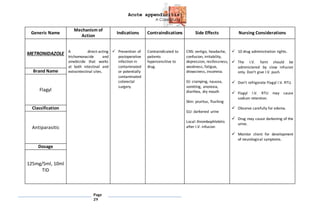
 Don’t refrigerate Flagyl I.V. RTU.
 Flagyl I.V. RTU may cause
sodium retention.
 Observe carefully for edema.
 Drug may cause darkening of the
urine.
 Monitor client for development
of neurological symptoms.
Brand Name
Flagyl
Classification
Antiparasitic
Dosage
125mg/5ml, 10ml
TID
Acute appendicitis
A Case Study
Page
30
Generic Name
Mechanism of
Action
Indications Contraindications Side Effects Nursing Considerations
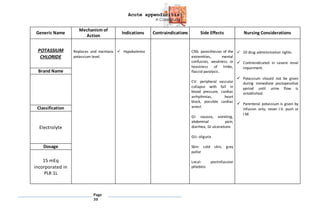
POTASSIUM
CHLORIDE
Replaces and maintans
potassium level.
 Hypokalemia CNS: paresthesias of the
extremities, mental
confusion, weakness or
heaviness of limbs,
flaccid paralysis.
CV: peripheral vascular
collapse with fall in
blood pressure, cardiac
arrhythmias, heart
block, possible cardiac
arrest
GI: nausea, vomiting,
abdominal pain,
diarrhea, GI ulcerations
GU: oliguria
Skin: cold skin, gray
pallor
Local: postinfusuion
phlebitis
 10 drug administration rights.
 Contraindicated in severe renal
impairment.
 Potassium should not be given
during immediate postoperative
period until urine flow is
established.
 Parenteral potassium is given by
infusion only; never I.V. push or
I.M.
Brand Name
Classification
Electrolyte
Dosage
15 mEq
incorporated in
PLR 1L
Acute appendicitis
A Case Study
Page
31
Generic Name
Mechanism of
Action
Indications Contraindications Side Effects Nursing Considerations
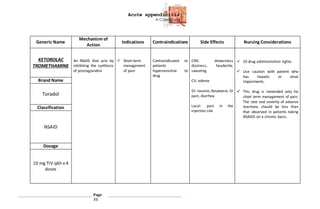
KETOROLAC
TROMETHAMINE
An NSAID that acts by
inhibiting the synthesis
of prostaglandins
 Short-term
management
of pain
Contraindicated to
patients
hypersensitive to
drug
CNS: drowsiness
dizziness, headache,
sweating
CV: edema
GI: nausea, dyspepsia, GI
pain, diarrhea
Local: pain in the
injection site
 10 drug administration rights.
 Use caution with patient who
has hepatic or renal
impairments.
 This drug is inetended only for
short term management of pain.
The rate and severity of adverse
reactions should be less than
that observed in patients taking
NSAIDS on a chronic basis.
Brand Name
Toradol
Classification
NSAID
Dosage
10 mg TIV q6h x 4
doses
Acute appendicitis
A Case Study
Page
32
HEALTH TEACHINGS
M
 Instruct the mother to comply with the medication regime.
 Provide clear,simple,andunderstandable explanationoneachmedication’sname,
indication, patient-appropriate dose, side, and adverse effects.
 Reinforce to mother/caregiver that administering medications without doctor’s
prescriptionwould result to serious complications; explain that when the patient
manifests adverse effects or requires medication, it is best to seek professional
help immediately.
E
 Reiterate the importance of acleanenvironmentwherefood and drinking water is
handled/prepared or stored.
 Instruct mother to always keep the toilet facilities clean/sanitary.
 Instruct the mother to maintain clean environment to prevent post-opeartive
infection and complication.
T  Explain to mother the importance of hydration maintenance.
 Provide clear, simple and understandable factual information to the family
members regarding the disease process and the importance of operation.
H  Emphasize the importance of proper hygiene such as bathing, meticulous hand
washing and oral hygiene in the prevention of the complications other diseases.
 Reinforce the need for sanitary food handling and water handling processes.
 Instructed to have oral hygiene.
O  Emphasized the need for regular check up and wellness checkups.
 Instructmotheron how to recognize and when and where to report unusual signs
and symptoms that could signal complication.
D
 Emphasize the need for a well balanced diet and initially a high calorie, high
protein, high carbohydrate diet to hasten recovery from the disease effects.
 Reiterate the importance of HIGHFIBER DIET to preventrecurrence of appendicitis
to other members of the family.
 Reinforce the needandimportance of regularmultivitamins to prevent recurrence
of the disease.
 Instructthe mothertoincrease the patient’sfluidintake withcleanfluidsto hasten
recovery from the effects of the disease.
S  Assure that the patient will already have her breakfast together with the whole
family as much as possible.
 Instruct the mother to encourage her children to take a 5-15 minute rest after
eating.
Acute appendicitis
A Case Study
Page
33
EVALUATION
At the end the case study, the student was able to employ Dorothea Orem’s Self Care Deficit Nursing
Theory through rendering efficient, accurate, and effective nursing interventions that is based on the
theories acquired. Framework of skills and priorities towards handling patient with acute appendicitis
were also established. Holistic development was promoted through applying the 6C’s of Nursing.
Moreover, evidence-based and proven health teachings are rendered amplifying the nursing care and
promote R.Z’s well being. A case study was formulated and will be documented for the purpose of
informing its readers and enlightening them with the current clinical experiences. Although the
student nurse was not able to update the present trend in caring with the patients of this pathology,
the student nurse come up with a deeper understanding and will continue to study for possible
contributions and updates in the future.
Homework Help
Acute appendicitis
A Case Study
Page
34
https://www.homeworkping.com/
Math homework help
https://www.homeworkping.com/
Research Paper help
https://www.homeworkping.com/
Algebra Help
https://www.homeworkping.com/
Calculus Help
https://www.homeworkping.com/
Accounting help
https://www.homeworkping.com/
Paper Help
https://www.homeworkping.com/
Writing Help
https://www.homeworkping.com/
Online Tutor
https://www.homeworkping.com/
Online Tutoring
https://www.homeworkping.com/
Homework Help
https://www.homeworkping.com/
Math homework help
https://www.homeworkping.com/
Research Paper help
https://www.homeworkping.com/
Acute appendicitis
A Case Study
Page
35
Algebra Help
https://www.homeworkping.com/
Calculus Help
https://www.homeworkping.com/
Accounting help
https://www.homeworkping.com/
Paper Help
https://www.homeworkping.com/
Writing Help
https://www.homeworkping.com/
Online Tutor
https://www.homeworkping.com/
Online Tutoring
https://www.homeworkping.com/

82094993 case-study

  • 1.
    Acute appendicitis A CaseStudy Page 1 Homework Help https://www.homeworkping.com/ Research Paper help https://www.homeworkping.com/ Online Tutoring https://www.homeworkping.com/ click here for freelancing tutoring sites INTRODUCTION According to studies, approximately 1 in every 400 or 0.25% or 680,000 people in USA have appendicitis. It occurs more frequently in men than in women, with a male-to-female ratio of 1.7:1. Appendicitis can affect any age but is more common before 40 years of age, particularly in young people between 8 and 14 years. Appendicitis is the inflammation of vermiform appendix. When the opening of the appendix blocked the mucosa, the pressure increases and blood flow to stops. The causative agents include foreign bodies, trauma, intestinal worms, lymphadenitis, and, most commonly, calcified fecal deposits known as appendicoliths or fecaliths. Once this obstruction occurs, the appendix subsequently becomes filled with mucus and swells, increasing pressures within the lumen and the walls of the appendix, resulting in thrombosis and occlusion of the small vessels, and stasis of lymphatic flow. The appendix becomes ischemic and necrotic. As bacteria begin to leak out through the dying walls, pus forms within and around the appendix (suppuration). The end result of this cascade is appendiceal rupture (a 'burst appendix') causing peritonitis, which may lead to septicemia and eventually death. Risk factors that would predispose a person to this pathology include age from 10-20 years old, gender of male, low fiber diet with rich in refined carbohydrates, hereditary history and other infections. Pain first, vomiting next and fever last has been described as the classic presentation of acute appendicitis. Other symptoms that suggest appendicitis are rebound tenderness, rovsing’s sign, psoas sign, obturator sign, dunphy’s sign, kocher’s sign, Bartomier-Michelson's sign, Aure-Rozanova's sign, and Blumberg sign.
  • 2.
    Acute appendicitis A CaseStudy Page 2 When the doctor diagnoses appendicitis on the patient, they rely on the results of laboratories such as complete blood count which shows an increase in the number of white blood cells, abdominal x-ray, ultrasound or CT scan, and urinalysis to rule-out pregnancy in appendicitis. Actually, there is no definitive test for appendicitis; these laboratories are just suggestive for this disease. Usually the signs and symptoms that it presents are similar to the signs and symptoms of ectopic pregnancy in women, the reason why ruling out for pregnancy in potential female clients are important before diagnosing this disease. Medical interventions include the correction or prevention fluid and electrolyte imbalance, dehydration, and sepsis, antibiotics until surgery is performed. Appendectomy is performed as soon as possible to decrease the risk for perforation which may be performed with general or spinal anesthesia. Nursing goals include relieving pain, preventing fluid volume deficit, reducing anxiety, eliminating infection due to potential or actual disruption of GI tract, maintaining skin integrity and attaining optimal nutrition. The nurse prepares the patient for surgery, which includes IV infusion to replace fluid loss and promote adequate renal function and antibiotic therapy to prevent infection. After surgery, nurse places the patient in a high-fowler’s position to reduce the tension on the incision and abdominal organs, helping to reduce pain. An opioid, usually morphine sulfate is prescribed by the doctor to relieve pain. Discharge teaching for the patient and family is imperative. The nurse instructs the patient to make an appointment to have the surgeon remove the sutures between fifth and seventh days after surgery. Incision care and guidelines are discussed; normal activity can usually be resumed within 2 to 4 weeks. If there is a possibility of peritonitis, a drain is left in place at the area of incision. Moreover, discussion for the prevention of appendicitis such as increase fluid intake, and high fiber diet should also be discussed to avoid a repeat of the incidence to the other family members. OBJECTIVES GENERAL: To formulate a case study under Dorothea Orem’s “Self Care Deficit Nursing Theory” about acute appendicitis employing the theoretical foundation we acquire at school while developing our own strategy as part of skill-building, taking note of the right approach and manner towards the patient and his/her relatives of this pathology. To render efficient and effective nursing interventions towards the achievement of holistic development of the patient as well as the student nurses. SPECIFIC:  To synthesize a framework of knowledge depending on clinical experience, to be able to delineate the theoretical and clinical wisdom about the disease.
  • 3.
    Acute appendicitis A CaseStudy Page 3  To be able to organize priorities depending on the actual problem while having in mind the potential and risk problems for prevention.  To formulate the appropriate attitude in patients with acute appendicitis with the 6C’s of nursing.  To inform the patient as well as the relatives on the prevention of the disease to prevent reoccurrence to other family members with evidence-based and proven health- teachings.  To document a particular incident of acute appendicitis and enlighten the community and prevent future morbidity.  To evaluate the present trend in caring for patients with acute appendicitis through experience and conclude possible addendums to the practices recognized in the books. NURSING HEALTH HISTORY Demographic Profile This is a case of R.Z., 10 year-old female, born on May 12, 2001, a Roman Catholic residing at Marilao, Bulacan. R.Z. is at her 3rd grade of elementary; her father who is a tricycle driver is the source of their medical expenses. Admitted for the first time at Bulacan Medical Center, Female Surgery Ward on January 10, 2012 with an admitting diagnosis of Acute Appendicitis and endorsed for appendectomy. Chief Complaint “Aray! ansakit ng tiyan ko.”, as verbalized by the patient. History of Present Health Concern 4 days prior to admission patient had fever with noted loss of appetite. In response, TSB was rendered but does not take OTC drugs for fever. 3 days prior to admission, patient experienced right lower quadrant abdominal pain associated with nausea, still with fever and loss of appetite.
  • 4.
    Acute appendicitis A CaseStudy Page 4 Few hours prior to admission, R.Z. experienced severe abdominal pain with 1 episode of greenish vomitus; thus brought to Local Health Center, then to Bulacan Medical Center Emergency Department and admitted with a stat AP status. Past Health History Patient had no history of previous hospitalizations. With no known allergies and history of previous illness. R.A. had BCG, 3 Hepa B, 3 OPV and 1 measles vaccine. Family Health History R.A. was 6th among the 11 siblings of her parents. Her mother has asthma, had a history of Appendicitis and undergone appendectomy when she was 19 years old. On the other side, her father had a history of Pulmonary Tuberculosis which is also the cause of death of her grandfather. Her elder brother, 18 years old and the 2nd sibling, also has asthma. Her 8th sister, 6 years of age had a history of dehydration. Moreover, her 10th brother which is 2 years old has developmental problem. All the other siblings are healthy and active as verbalized by the mother. GENOGRAM Legends: Female Male Patient 19 y/o 15 y/o18 y/o 14 y/o 12 y/o 72 y/o 55 y/o 39 y/o with history of appendicitis 42 y/o 45 y/o R.Z. 10 y/o 8 y/o 6 y/o 3 y/o 2 y/o 1 y/o
  • 5.
    Acute appendicitis A CaseStudy Page 5 with asthma with Tuberculosis dead due to stab wound Dead with Kidney Disease with Developmental Problem Environmental History The patient together with her family lives in a concrete house with 1 door and 1 window. The space is just enough for their number but there is no proper lighting and ventilation due to lack of electricity for over 1 year. The source of water is nawasa in which they use it for bathing, washing and drinking. Developmental History Theory and Theorist Evidences Psychoanalytic Theory Sigmund Freud Latent Stage: Child’s personality development appears to be nonactive or dormant. Sexual drive is repressed and normal homosexual. Goal-oriented and want to prove their best in school or in games. R.Z. has a lot of female friends, actually when she was hospitalized all of them provide moral support to their friend. She does not want to go to school at times rather wants to play jumping rope and ten-twenty. Psychosocial Theory Erik Erickson Developmental task is to form a sense of According to her mother R.Z. often initiates sweeping the floor and washing the dishes.
  • 6.
    Acute appendicitis A CaseStudy Page 6 industry versus inferiority. Child learns to do things well. She maintains the cleanliness of their house whenever she does not study ad play. Cognitive Theory Jean Piaget Concrete Operational Thought. R.Z. is in her 3rd grade of elementary; she can answer simple mathematical equations, can read, write, classify and sort objects accordingly. Moral Development Theory Lawrence Kohlberg Conventional Level II. Client maintains social order, fixed rules. Follows rule of authority figures as well as parents in an effort to keep “system” working. R.Z. as the 6th child among the 11 children also maintains orderliness with their relationship with one another. Whenever her siblings fight, she is the one who goes in between and stops it. She gives lesson to her younger siblings.
  • 7.
    Acute appendicitis A CaseStudy Page 7 GORDON’S FUNCTIONAL HEALTH PATTERNS FUNCTIONAL HEALTH PATTERN DURING HOSPITALIZATION PRIOR TO HOSPITALIZATION Health Perception and health management Due to the healthcare workers’ advice they have learned the importance of hydration together with proper diet. They believed that with the right obedience to the doctors’ and nurses’ orders, recovery will become faster and possible. When the patient is in pain, they render therapeutic touch, and help the R.Z. to have her position of comfort. The family believes that the key for a healthy life depends on the foods one eats such as fruits, vegetables and some meat. However, they are not informed that plenty of water should also be included in the diet. Additionally, rest and exercise would also help. Whenever sick, they go first to the health center. However sometimes, because of the elders’ influence, they sometimes refer to faith healers and ‘manghihilots’, plus the reason of lack of money. They only go to the hospital when there is no choice. But still, they believe more in medical interventions rather than superstitions. Nutritional and Metabolic Pattern The patient is under NPO from January 10-13, 2012. January 16, 2012, patient is in General Liquid diet January 17, 2012, patient is in Soft Diet January 18, 2012, patient is in DAT According to R.Z’s mother, she preferably eats fatty foods, junk foods, and guava fruit as her breakfast. During lunch, she consumes 2-3 small cups of rice plus vegetable, meat or fish. Her mother prepares her food. She sometimes forgets to drink water, rather take coffee more often. R.A. does not drink milk and does not take any vitamin. 4 days PTA, patient had loss of appetite and only takes small amount of food. January 7, 2010 Breakfast 1 cup of coffee approximately 240 mL
  • 8.
    Acute appendicitis A CaseStudy Page 8 Lunch 1 cup of rice Half of tilapia fish Half glass of water approximately 50 mL Dinner Half cup of rice Half of tilapia fish Half glass of water approximately 50 mL January 8, 2012 Breakfast 1 piece of pandesal 1 cup of coffee approximately 240 mL Lunch 1 pack of noodles 1 pandesal 1 Half glass of water approximately 50 mL Dinner 1 bowl of porraige Half glass of water, 50 mL January 9, 2012 Breakfast 1 cup of coffee Lunch 1 bowl of porraige Small sips of water Dinner
  • 9.
    Acute appendicitis A CaseStudy Page 9 Half bowl of porraige Small sips of water Elimination Pattern Color Frequency Consistency Odor Difficulty Stool greenish 2 Semi Solid Foul None Urine Dark yellow 3-5 Clear Little Vomit Orange/ Yellow Green 7 Clear None Color Frequency Consistency Odor Difficulty Stool Greenish 1 Semi Solid Foul None Urine Dark Yellow 3-5 Clear None Vomit Greenish 1 None Activity-Exercise Pattern Pre-operatively, she tries to sleep whenever she has the time. She just focuses on herself and talks a little to her mother when she feels pain. Postoperatively, as advised, she sometimes takes a walk, and sits. She speaks more often than before and play with her mother’s cellphone or conversing with her sisters through mobile call. R.Z. usually wakes up ay 7:00-8:00 am, wherein the first thing she will do after waking up is to have her hygiene then even without breakfast, she will go outside and play with her friends. She goes to school from 12 noon to 6pm. Then again proceed outside and play. She takes her dinner with the family at 7:30 pm. She sleeps at 9:00pm. Functional Ability Feeding NPO Bathing 2 Bed Mobility 0 Dressing 2 Feeding 0 Bathing 0 Bed Mobility 0 Dressing 0
  • 10.
    Acute appendicitis A CaseStudy Page 10 Grooming 0 Toileting 2 LEGEND:  0 – Full Self Care  1 – Requires use of equipment  2 – Requires assistance or supervision from another person.  3 – Requires assistance or supervision from another device.  4 – dependent or does not appreciate Pre-operatively and Post-operatively, due to the pain at her abdomen/incision site plus the IVF hooked at her, she cannot dress and bath alone and perform toileting. Her mother assists her. Grooming 0 Toileting 0 LEGEND:  0 – Full Self Care  1 – Requires use of equipment  2 – Requires assistance or supervision from another person.  3 – Requires assistance or supervision from another device.  4 – dependent or does not appreciate As a 10 year old girl, she can perform things with herself, without the presence of illness. She is highly active and often plays most of her time. Sleep and Rest Pattern Preoperatively, patient sleeps only for a short period of time due to the pain she feels. She usually get awaken with severe pain and cannot continue her sleep. Postoperatively, she can sleep for long periods. Usually 8-10 hours at night and take her nap 1-3hours in the afternoon. R.Z. sleeps 10-12 hours at night and does not take her afternoon nap. She spends most of her time playing with the other children outside their house. Cognitive and Perceptual Pattern Preoperatively, due to the pain she feels, she is self-focusing and does not communicate well. Postoperatively, she’s coherent and active. Currently, she is an average student at 3rd grade of elementary. No interest in doing home works and attending classes. Roles and Relationship Pattern Since she’s hospitalized, she cannot perform the usual things and tasks she is doing at home. She is self-focusing and does not mind her environment even the people in it. Among the 11 siblings, she is the most devoted to cleaning their house. She was assigned to wash their dishes and sweep the floor. When with her brothers and sisters, she’s just quiet and sometimes take command
  • 11.
    Acute appendicitis A CaseStudy Page 11 whenever her other siblings were quarreling. Sexuality and Reproductive Pattern R.Z. is not yet having menstruation. She experiences a little difficulty in urination. R.Z. is not yet having menstruation. Coping Stress Tolerance Preoperatively, when in pain, she just cries, change her position and cling her hands to her mother. Postoperatively, she just keep silent when she feels slight pain. When under stressed, she just go straightly to her mother to talk and ask for solutions. She does not make argue with other people instead just keep silent most of the time. Values Belief Pattern The family was Roman Catholic. R.Z. prays at night. The family was Roman Catholic. R.Z. attends Sunday masses and prays at night.
  • 12.
    Acute appendicitis A CaseStudy Page 12 ANATOMY AND PHYSIOLOGY The appendix is a finger-like projection from the beginning of the large bowel called the cecum. The appendix lies in the right lower portion of the abdomen. The length of the appendix may vary from one to eight inches (2 to 20 cms.) in length. The blood supply to the appendix is from the appendiceal artery a branch of the ileocolic artery, which supplies blood to the end of the small bowel and the beginning of the large bowel. The blood
  • 13.
    Acute appendicitis A CaseStudy Page 13 supply lies in a fatty tissue called the mesoappendix. PATHOPHYSIOLOGY Non Modifiable Risk Factors Genetics Age of 10 years Modifiable Risk Factors Diet: Low Fiber Low Fluid intake Slowed metabolism Opening of the appendix become blocked with a “fecalith” Mucinous/thin-like jelly build up in the mucosa of the appendix Right Lower Quadrant Pain vomiting Nauseafever anorexia (+) rebound tenderness (+) Psoas sign (+) rovsing’s sign Build-up of pressure within the appendix Thrombosis and occlusion of the small vessels, and stasis of lymphatic flow Inflammation Appendix becomes rotten and its wall dies Bacteria within the appendix begin to invade (infect) the wall of the appendix
  • 14.
    Acute appendicitis A CaseStudy Page 14 PHYSICAL ASSESSMENT VITAL SIGNS Date: January 12, 2012 (4:00pm) Blood Pressure 80/60 mmHg Temperature 37.9OC Pulse Rate 98 Respiratory Rate 23 Area of Assessment Result Method Used Significance General Appearance Patient is conscious and coherent had crying episodes whenever feeling pain, with body weakness observed. Self- focusing, with guarding behavior noted and facial grimace. Looks ill and weak, flat on bed, looks slightly neat with non-smelly clothes. Inspection Due to the inflammation of her appendix Skin, Hair and Nails Patient has dry fair skin that is free from lesions, nodules and other irregularities. Patient has a good skin turgor of less than two seconds. Nails are not clean. Hair is dry, free from dandruff and lice. Scalp is white, clean, and free from masses, lumps, nits, dandruff & lesions, with no areas of tenderness. Inspection and Palpation Due to prolonged stay in the hospital Head and Neck Face is symmetric and round, head and neck are also symmetric. Trachea is at midline. No swelling of lymph nodes without visible pulses. Inspection and Palpation Normal Eyes Eyes are symmetrical. Red in color without swelling and drainage. Patient has a black iris with positive pupillary constriction. Inspection Normal Ears Ears are symmetrical without lesions, or any irregularities. Auricle, Tragus and Mastoid Inspection Normal
  • 15.
    Acute appendicitis A CaseStudy Page 15 Process are non-tender with no swelling of pre-auricular and post-auricular lymph nodes. Nose Color is the same as the rest of the face. Nasal septum is intact without lesions, swellings, drainage or any irregularities. Inspection Normal Mouth Lips are pale and dry without lesions and swellings. Tongue is in midline. Inspection Due to NPO status Thorax Skin is intact. Patient has clear lung sounds. Inspection and Auscultation Normal Heart No visible pulsations, without heart murmurs. Inspection and Auscultation Normal Abdomen Abdomen is flat; color is paler than the rest of the body, non- tender with no enlargement of the underlying organs. With positive rebound tenderness, positive Rovsing’s and Psoas sign. Patient felt pain even without palpation on RLQ of the abdomen. Inspection and Palpation Due to the inflammation of appendix Peripheral Vascular (Upper and Lower Extremeties) Shoulders, arms, elbows, hands & wrists can be moved in different range of motion without relative ease and marks of petechial rashes on both arms. Palms are pinkish, warm, soft & elastic legs, knees, ankles, & toes can be moved in different range of motion with relative ease. With slow and weak pulse. Inspection and Palpation Normal VITAL SIGNS Date: January 18, 2012 (4:00pm) Blood Pressure 80/60 mmHg Temperature 37.4oC Pulse Rate 103 Respiratory Rate 27
  • 16.
    Acute appendicitis A CaseStudy Page 16 Area of Assessment Result Method Used Significance General Appearance Patient is conscious, coherent and active. Patient is flat on bed, looks slightly neat with non-smelly clothes. Inspection None Skin, Hair and Nails Patient has dry fair skin that is free from lesions, nodules and other irregularities. Patient has a good skin turgor of less than two seconds. Nails are not clean. Hair is dry, free from dandruff and lice. Scalp is white, clean, and free from masses, lumps, nits, dandruff & lesions, with no areas of tenderness. Inspection and Palpation Due to prolonged stay in the hospital Head and Neck Face is symmetric and round, head and neck are also symmetric. Trachea is at midline. No swelling of lymph nodes without visible pulses. Inspection and Palpation Normal Eyes Eyes are symmetrical. Red in color without swelling and drainage. Patient has a black iris with positive pupillary constriction. Inspection Normal Ears Ears are symmetrical without lesions, or any irregularities. Auricle, Tragus and Mastoid Process are non-tender with no swelling of pre-auricular and post-auricular lymph nodes. Inspection Normal Nose Color is the same as the rest of the face. Nasal septum is intact without lesions, swellings, drainage or any irregularities. Inspection Normal Mouth Lips without lesions and swellings. Tongue is in midline. Inspection Normal Thorax Skin is intact. Patient has clear lung sounds. Inspection and Auscultation Normal Heart No visible pulsations, without heart murmurs. Inspection and Auscultation Normal Abdomen Abdomen is flat; color is paler than the rest of the body, non- Inspection and Palpation
  • 17.
    Acute appendicitis A CaseStudy Page 17 tender with no enlargement of the underlying organs. With incision on lower midline part of the abdomen, with dry and intact dressing. Due to the operation done. Peripheral Vascular (Upper and Lower Extremeties) Shoulders, arms, elbows, hands & wrists can be moved in different range of motion without relative ease and marks of petechial rashes on both arms. Palms are pinkish, warm, soft & elastic legs, knees, ankles, & toes can be moved in different range of motion with relative ease. With slow and weak pulse. Inspection and Palpation Normal
  • 18.
    Acute appendicitis A CaseStudy Page 18 COURSE IN THE WARD R.Z. was brought into the female surgery ward on January 10, 2012 with an IVF of D50.3NaCl 500cc at full level regulated at 40 gtss/minute infusing well on left arm. Patient is conscious but weak, complains of pain at RLQ part of the abdomen. Patient’s BP was 80/60 thus 360 of PNSS was pushed TIV at 4:15 pm, as ordered. Patient’s lips are dry, therefore instructed to moisturize the lips with small amount of water. R.Z. is under NPO, for stat appendectomy, still for referral for AOD for O.R. meds, with CXR result and Na, K, Creatinine results secured and attached to chart. K level is 3.02 mmol/L (Normal Value: 3.5-5.3 mmol/L). Prescribed medications of Cefuroxime 500 mg TIV q8h, Metronidazole 500mg TIV q8h and Ranitidine 25 mg TIV q8h are all given. Patient was encouraged to do deep breathing exercises, and informed about proper wound care and positioning after the surgery. On January 11, 2012 the doctor ordered K correction of PLR plus 15mEq of KCl @ 41 mgtss/minute for 2 doses; thus hooked by the NOD for the 1st dose and 2nd dose is given at 7:40 pm. Patient is still for PPD, as ordered. January 12, 2012, Dr. Crisostomo ordered IVF of D5LR 1L to run for 18 gtts/minute for 2 doses then repeat serum Na and K after correction. At 4:30 pm 1st dose of D5LR was given. R.Z already has CP clearance, OR meds are secured with the doctor’s order of “may proceed at the contemplated procedure”. Moreover, Cefuroxime of 500 mg is modified to 750 mg TIV q8h and Ranitidine 25mg was also modified to 20mg TIV q8h, as ordered; given with Metronidazole still at 500mg TIV q8h. On January 13, 2012 patient had undergone appendectomy. January 16, 2012 doctor ordered to start with FeSo4 once started with DAT, but the patient is on General Liquid diet, as ordered. Patient is received awake on bed with ongoing IVF of D50.3NaCl 500cc at 150cc level regulated at 15 gtss/minute, infusing well on Left hand. Patient has dressing on the lower midline part of the abdomen, dry and intact. R.Z. is still on PPD as ordered, for repeat serum Na and K after 3rd dose of D50.3NaCl is given with request. VS monitoring is q4h as ordered and I and O monitoring of q shift, as ordered. At 8:00 above IVF of D50.3NaCl was consumed and replaces with the same IVF regulated at 20 gtss/minute, infusing well on Left hand. On January 17, 2012 doctor advised R.Z to have soft diet, to ambulate and do deep breathing exercises carried out right after the time ordered. January 18, 2012 patient is under DAT diet, as ordered. Medications of Cefuroxime 750mg TIV q8h is modified to Cefuroxime 250 mg/5ml TID, as well as Metronidazole of 125mg/5ml, added with Mefenamic acid 20mg/5ml TID, as ordered. T/C IVF of D50.3NaCl at 15 gtss/minute. IVF was removed at 9:30 pm.
  • 19.
    Acute appendicitis A CaseStudy Page 19 LABORATORY FINDINGS HEMATOLOGY January 9, 2012 WBC LYM MON GRA 18.6 10.1 3.7 86.2 H 10.1 L % L % H % Normal Values 5-10 17-48 4-10 43-76 RBC HGB HCT MCV MCH MCHC RDW 4.02 109 0.338 84 27.1 322 12.6 102 /l L g/l L l/l fl pg g/l % 3.8-5.8 110-165 0.35-0.5 80-97 26.5-35.5 315-350 10.0-15.0 PLT MOV PCT PDW 465 6.2 0.289 12.7 H 109/L L fl 102 /l % 15-390 6.5-11 0.100-0.500 10-18 January 14, 2012 WBC RBC HGB HCT PLT PCT 12.0 3.23 90 0.273 423 0.286 H 109/l L 1012/l L g/l L l/l H 109/l 10-2 l/l Normal Values 5-10 4.5-5.5 120-170 0.350-0.500 150-400 0.100-0.500 MCV MCH MCHC RDW MPV PDW 84 fl 27.8 pg 329 g/l 13.6 % 6.8 fl 11.4 % Normal Values 80-97 26.5-33.5 315-350 10.0-15.0 6.5-11.0 10.0-18.0 This increase of the WBC components as well as the platelets can be attributed to the inflammatory process happening in R.Z. The body is trying to combat the bacterial invasion occurring at the appendicitis as it invades the appendix. Moreover, since the appendix, as time goes on is being destructed, platelets are also compensating, trying to heal the progreesively deteriorating vernifrom appendix.
  • 20.
    Acute appendicitis A CaseStudy Page 20 ELECTROLYTES January 10, 2012 Normal Values Na 129.2 mmol/L 135-148 K 3.02 mmol/L 3.5-5.3 Ca - 1.1-1.32 mmol/L Cl - 96-107 mmol/L January 12, 2012 Normal Values Na 128.8 mmol/L 135-148 K 4.14 mmol/L 3.5-5.3 Ca - 1.1-1.32 mmol/L Cl 95.7 mmol/L 96-107 mmol/L January 12, 2012 Interpretation Normal Value Creatinine 43.95 umo/L LOW 44.20-150.28 umo/L January 14, 2012 Normal Values Na 129.3 mmol/L 135-148 K 4.30 mmol/L 3.5-5.3 Ca - 1.1-1.32 mmol/L Cl - 96-107 mmol/L January 16, 2012 Normal Values Na 134.9 mmol/L 135-148 K 3.77 mmol/L 3.5-5.3 Ca - 1.1-1.32 mmol/L Cl - 96-107 mmol/L These decline in the levels of electrolytes particularly Na and K can be directed to the patient’s loss of appetite prior to hospitalization as well as her NPO status prior to surgery.
  • 21.
    Acute appendicitis A CaseStudy Page 21 URINALYSIS color: yellow Physical Examination Transparency urobilinogen: Normal blood: glucose: pH: 5.0 bilirubin: protein: ketone: nitrite: specific gravity: 1.020 leukocytes: Microscopic Examination RBC: 0-2 hpf WBC: 30-40/hpf crystals: amorphous urates: few epithelial cell: few bacteria: few
  • 22.
    Acute appendicitis A CaseStudy Page 22 OPERATIVE PROCEDURE AND ANESTHESIA USED An appendectomy (sometimes called appendisectomy or appendicectomy) is the surgical removal of the vermiform appendix. This procedure is normally performed as an emergency procedure, when the patient is suffering from acute appendicitis. In the absence of surgical facilities, intravenous antibiotics are used to delay or avoid the onset of sepsis. It may be performed laparoscopically or as an open operation. During operation, patient is in supine, with arms extended on armboards. Spinal Anesthesia is an extensive conduction nerve block that is produced when a local anesthetic is introduced to the subarachnoid space at the lumber level, usually between L4 and L5. It produces anesthesia of the lower extremities, perineum, and lower abdomen. For the lumbar puncture procedure, the patient usually lies on the side in a knee-chest position. Sterile technique is used as a spinal puncture is made and the medication is injected through the needle. A few minutes after induction of a spinal anesthetic, anesthesia and paralysis affect the toes and perineum and then gradually the legs and abdomen. If the anesthetic reaches the upper thoracic and cervical spinal cord in high concentrations, a temporary partial or complete respiratory paralysis results. Paralysis of the respiratory muscles is managed by mechanical ventilation until the effects of the anesthetic on the cranial and thoracic nerves have worn-off. Most appendicitis patients recover easily with surgical treatment, but complications can occur if treatment is delayed or if peritonitis occurs. Recovery time depends on age, condition, complications, and other circumstances, including the amount of alcohol consumption, but usually is between 10 and 28 days. For young children (around 10 years old), the recovery takes three weeks. The real possibility of life-threatening peritonitis is the reason why acute appendicitis warrants speedy evaluation and treatment. The patient may have to undergo a medical evacuation. Post- Operative Care in unruptured appendix includes putting the patient on a liquid diet progressing to a soft and then regular diet. Additional antibiotics are also given to prevent wound infection. Often the patient can leave the hospital in 1-2 days after the surgery. However if there is ruptured appendix, the hospital stay is usually at least 4 days and possibly longer. If there was spilling of bacteria from the appendix, recurrent abdominal abscesses and infections may occur. The patient is then be started on a liquid diet which is advanced to a regular diet as tolerated. Moreover, a drain is placed in the region of the appendix to allow bacteria to drain out and the skin is left open and packed with gauze. The gauze and drain are removed when the infection is cleared. Antibiotics are continued for approximately one week after the surgery. Initially this will be through a vein while in the hospital and then typically by pill after being sent home.
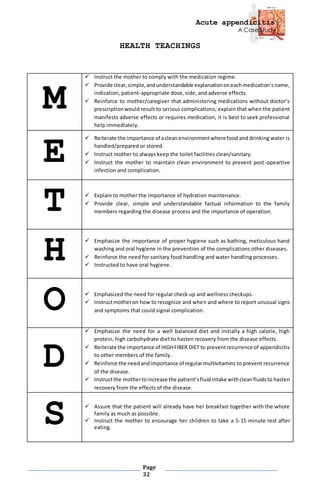
  • 23.
    Acute appendicitis A CaseStudy Page 23 ASSESSMENT PLANNING INTERVENTIONS RATIONALE EVALUATION S: “Ansakit”, as verbalized by the client O: - with guarding behavior noted - with facial grimace noted - pain scale of 8/10 - crying episodes - self-focusing - short-term goal - partially compensatory - After 15 minutes of nursing interventions patient will report a pain scale from 8/10 to 3-4/10.  Facilitate the provision of calm and quiet environment.  Facilitate on the provision of non-pharmacologic interventions such as:  Back rubbing  Change of position  Facilitate on encouraging the patient to have adequate rest periods.  Facilitate on teaching the client about deep-breathing exercises.  Facilitate on encouraging the patient the use of diversionary activities such as socialization or chatting.  To prevent worsening of the condition and reduce stress level.  To provide comfort  To promote wellness and prevent fatigue.  To teach the client way to control pain.  To assist the client to explore methods for alleviation of pain and redirect her attention. Patient’s condition improved NURSING DIAGNOSIS Acute Pain related to inflammation of the appendix
  • 24.
    Acute appendicitis A CaseStudy Page 24 ASSESSMENT PLANNING INTERVENTIONS RATIONALE EVALUATION S: “Natatakot kasi siya pag nadidinig niya yung salitang opera”, as verbalized by the client’s mother. O: - with guarding behavior noted - Crying - Self focusing - short-term goal - partially compensatory - After 1h of nursing interventions, patient will be able to demonstrate ways to handle anxiety.  Facilitate on providing comfort measures such as:  Warm bath  Back Rubbing  Facilitate on establishing therapeutic relationship, conveying empathy and unconditional positive regard with the client.  Facilitate on acknowledging the anxiety. Do not deny or reassure patient that everything will be alright.  Facilitate on being available to the patient for listening and talking.  Facilitate on accepting the patient as she is.  To provide non- pharmacologic interventions.  To assist patient to identify feelings and begin to deal with problems.  To help the patient cope with pending problems.  To promote therapeutic relationship with the client.  To provide emotional lift to the client. Patient’s condition improved NURSING DIAGNOSIS Anxiety related to preoperative status
  • 25.
    Acute appendicitis A CaseStudy Page 25 ASSESSMENT PLANNING INTERVENTIONS RATIONALE EVALUATION S: “Hindi siya nakakakain simula ng sumakit ang tiyan niya, bawal pa din siyang kumain ngayon sabi ng doktor”, as verbalized by the patient’s mother O: - NPO - Dry mouth - Pale conjunctiva - Weakness - Weight: 18 kg - Serum potassium: 128.8 (Normal: 135- 18 mmol/L) - short-term goal - partially compensatory - After 1 hour of nursing interventions, patient’s mother will be able to verbalize ways how to prevent nutritional imbalances.  Facilitate on stressing the importance of well-balanced nutritious intake after the surgery, when allowed.  Facilitate on identifying with the mother foods that a healthy person should eat.  Facilitate on teaching the mother on the possible sources of free vitamins and health care facility.  Depend on the administration of potassium chloride incorporated in PLR1L, as ordered by the physician.  To promote wellness.  To promote wellness and provide long-term solution to the problem.  To promote independence in promoting wellness.  To increase serum potassium level. Risk for imbalanced nutrition less than body requirements prevented. NURSING DIAGNOSIS Risk for imbalanced nutrition less than body requirement related to NPO status
  • 26.
    Acute appendicitis A CaseStudy Page 26 ASSESSMENT PLANNING INTERVENTIONS RATIONALE EVALUATION O: - Incision on lower midline part of the abdomen; with dressing - short-term goal - supportive educative - After 15 minutes of nursing interventions, patient together with her mother will demonstrate technique to prevent risk for infection/  Facilitate on proper hand washing techniques.  Facilitate on monitoring visitors.  Facilitate on encouraging the patient to have adequate hydration.  Focus on changing dressings as needed.  Depend on cleansing incision daily with povidone iodine, as ordered.  Depend on administering Cefuroxime 5ml TID p.o., as ordered.  Depend on administering Metronidazole 125mg/5ml, 10ml TID, as ordered.  To reduce risk for cross- contamination of microorganisms.  To reduce risk for cross- contamination of microorganisms.  To promote wound healing.  To promote hygiene.  To reduce existing risk factors for infection.  Interfering with bacterial cell wall synthesis thereby altering the osmotic stability of the actively growing bacterial cell and resulting in its death.  A direct-acting trichomonacide and amebicide that works at both intestinal and extraintestinal sites. Risk for infection prevented NURSING DIAGNOSIS Risk for infection related to the interference of body defense secondary to surgery
  • 27.
    Acute appendicitis A CaseStudy Page 27 Generic Name Mechanism of Action Indications Contraindications Side Effects Nursing Considerations RANITIDINE Inhibits the action of histamine at the histamine-sensitive H2 receptor sites of the parietal cells in the stomach; thus contraindicates acidity.  Preoperative patients under NPO Contraindicated to patients hypersensitive to drug. CNS: headache, malaise, dizziness CV: bradycardia GI: nausea and constipation Skin: rash Local: Burning and itching sensations at injection site.  10 drug administration rights.  Use cautiously in hepatic dysfunction.  Avoid administration of antacids at the same time as ranitidine.  Avoid foods and factors that may increase gastric acid secretion. Brand Name Zantac Classification H2 receptor antagonist Dosage 25 mg TIV q 8h
  • 28.
    Acute appendicitis A CaseStudy Page 28 Generic Name Mechanism of Action Indications Contraindications Side Effects Nursing Considerations CEFUROXIME SODIUM Interfering with bacterial cell wall synthesis thereby altering the osmotic stability of the actively growing bacterial cell and resulting in its death.  Prophylaxis for preoperative patients. Contraindicated to patients hypersensitive to drug. CNS: headache, malaise, paresthesia, and dizziness GI: nausea and constipation, nausea, anorexia, vomiting, diarrhea, and abdominal cramps. Skin: erythematous rashes, urticaria Local: at injection site- pain, temperature elevation, phlebitis and thrombophlebitis with I.V. injection. Other: hypersensitivity and dyspnea  10 drug administration rights.  Contraindicated in hypersensitivity to other cephalosporins.  Use cautiously in patients with renal impairment.  With large doses or prolonged therapy, monitor for superinfection, especially in high- risk patients. Brand Name Zinacef Classification Cephalosporin Dosage 250 mg/5ml, 5ml p.o. TID
  • 29.
    Acute appendicitis A CaseStudy Page 29 Generic Name Mechanism of Action Indications Contraindications Side Effects Nursing Considerations METRONIDAZOLE A direct-acting trichomonacide and amebicide that works at both intestinal and extraintestinal sites.  Prevention of postoperative infection in contaminated or potentially contaminated colorectal surgery. Contraindicated to patients hypersensitive to drug. CNS: vertigo, headache, confusion, irritability, depression, restlessness, weakness, fatigue, drowsiness, insomnia. GI: cramping, nausea, vomiting, anorexia, diarrhea, dry mouth Skin: pruritus, flushing GU: darkened urine Local: thrombophlebitis after I.V. infusion  10 drug administration rights.  The I.V. form should be administered by slow infusion only. Don’t give I.V. push.  Don’t refrigerate Flagyl I.V. RTU.  Flagyl I.V. RTU may cause sodium retention.  Observe carefully for edema.  Drug may cause darkening of the urine.  Monitor client for development of neurological symptoms. Brand Name Flagyl Classification Antiparasitic Dosage 125mg/5ml, 10ml TID
  • 30.
    Acute appendicitis A CaseStudy Page 30 Generic Name Mechanism of Action Indications Contraindications Side Effects Nursing Considerations POTASSIUM CHLORIDE Replaces and maintans potassium level.  Hypokalemia CNS: paresthesias of the extremities, mental confusion, weakness or heaviness of limbs, flaccid paralysis. CV: peripheral vascular collapse with fall in blood pressure, cardiac arrhythmias, heart block, possible cardiac arrest GI: nausea, vomiting, abdominal pain, diarrhea, GI ulcerations GU: oliguria Skin: cold skin, gray pallor Local: postinfusuion phlebitis  10 drug administration rights.  Contraindicated in severe renal impairment.  Potassium should not be given during immediate postoperative period until urine flow is established.  Parenteral potassium is given by infusion only; never I.V. push or I.M. Brand Name Classification Electrolyte Dosage 15 mEq incorporated in PLR 1L
  • 31.
    Acute appendicitis A CaseStudy Page 31 Generic Name Mechanism of Action Indications Contraindications Side Effects Nursing Considerations KETOROLAC TROMETHAMINE An NSAID that acts by inhibiting the synthesis of prostaglandins  Short-term management of pain Contraindicated to patients hypersensitive to drug CNS: drowsiness dizziness, headache, sweating CV: edema GI: nausea, dyspepsia, GI pain, diarrhea Local: pain in the injection site  10 drug administration rights.  Use caution with patient who has hepatic or renal impairments.  This drug is inetended only for short term management of pain. The rate and severity of adverse reactions should be less than that observed in patients taking NSAIDS on a chronic basis. Brand Name Toradol Classification NSAID Dosage 10 mg TIV q6h x 4 doses
  • 32.
    Acute appendicitis A CaseStudy Page 32 HEALTH TEACHINGS M  Instruct the mother to comply with the medication regime.  Provide clear,simple,andunderstandable explanationoneachmedication’sname, indication, patient-appropriate dose, side, and adverse effects.  Reinforce to mother/caregiver that administering medications without doctor’s prescriptionwould result to serious complications; explain that when the patient manifests adverse effects or requires medication, it is best to seek professional help immediately. E  Reiterate the importance of acleanenvironmentwherefood and drinking water is handled/prepared or stored.  Instruct mother to always keep the toilet facilities clean/sanitary.  Instruct the mother to maintain clean environment to prevent post-opeartive infection and complication. T  Explain to mother the importance of hydration maintenance.  Provide clear, simple and understandable factual information to the family members regarding the disease process and the importance of operation. H  Emphasize the importance of proper hygiene such as bathing, meticulous hand washing and oral hygiene in the prevention of the complications other diseases.  Reinforce the need for sanitary food handling and water handling processes.  Instructed to have oral hygiene. O  Emphasized the need for regular check up and wellness checkups.  Instructmotheron how to recognize and when and where to report unusual signs and symptoms that could signal complication. D  Emphasize the need for a well balanced diet and initially a high calorie, high protein, high carbohydrate diet to hasten recovery from the disease effects.  Reiterate the importance of HIGHFIBER DIET to preventrecurrence of appendicitis to other members of the family.  Reinforce the needandimportance of regularmultivitamins to prevent recurrence of the disease.  Instructthe mothertoincrease the patient’sfluidintake withcleanfluidsto hasten recovery from the effects of the disease. S  Assure that the patient will already have her breakfast together with the whole family as much as possible.  Instruct the mother to encourage her children to take a 5-15 minute rest after eating.
  • 33.
    Acute appendicitis A CaseStudy Page 33 EVALUATION At the end the case study, the student was able to employ Dorothea Orem’s Self Care Deficit Nursing Theory through rendering efficient, accurate, and effective nursing interventions that is based on the theories acquired. Framework of skills and priorities towards handling patient with acute appendicitis were also established. Holistic development was promoted through applying the 6C’s of Nursing. Moreover, evidence-based and proven health teachings are rendered amplifying the nursing care and promote R.Z’s well being. A case study was formulated and will be documented for the purpose of informing its readers and enlightening them with the current clinical experiences. Although the student nurse was not able to update the present trend in caring with the patients of this pathology, the student nurse come up with a deeper understanding and will continue to study for possible contributions and updates in the future. Homework Help
  • 34.
    Acute appendicitis A CaseStudy Page 34 https://www.homeworkping.com/ Math homework help https://www.homeworkping.com/ Research Paper help https://www.homeworkping.com/ Algebra Help https://www.homeworkping.com/ Calculus Help https://www.homeworkping.com/ Accounting help https://www.homeworkping.com/ Paper Help https://www.homeworkping.com/ Writing Help https://www.homeworkping.com/ Online Tutor https://www.homeworkping.com/ Online Tutoring https://www.homeworkping.com/ Homework Help https://www.homeworkping.com/ Math homework help https://www.homeworkping.com/ Research Paper help https://www.homeworkping.com/
  • 35.
    Acute appendicitis A CaseStudy Page 35 Algebra Help https://www.homeworkping.com/ Calculus Help https://www.homeworkping.com/ Accounting help https://www.homeworkping.com/ Paper Help https://www.homeworkping.com/ Writing Help https://www.homeworkping.com/ Online Tutor https://www.homeworkping.com/ Online Tutoring https://www.homeworkping.com/