PRECOCIOUS PUBERTY
Definition of precocious puberty 
Precocious puberty is defined 
as the onset of secondary 
sexual characteristics before 
8 yr of age in girls and 9 yr in 
boys.
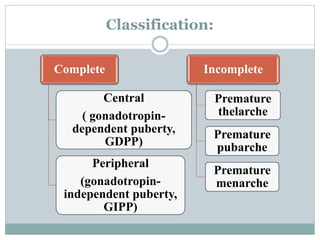
Classification: 
Complete 
Central 
( gonadotropin-dependent 
puberty, 
GDPP) 
Peripheral 
(gonadotropin-independent 
puberty, 
GIPP) 
Incomplete 
Premature 
thelarche 
Premature 
pubarche 
Premature 
menarche
Gonadotropin-dependent precocious 
puberty ( GDPP) 
 also known as true precocious puberty 
 early activation of the entire hypothalamic-pituitary- 
gonadal (HPG) axis 
 is caused by the secretion of high-amplitude pulses of 
gonadotropin-releasing hormone (GnRH) by the 
hypothalamus. 
 Although the onset is early, the pattern and timing of 
pubertal events usually progresses in the normal 
sequence.
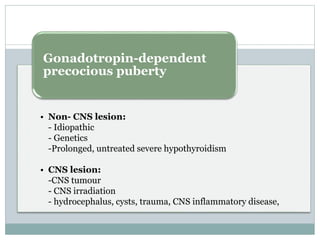
Gonadotropin-dependent 
precocious puberty 
• Non- CNS lesion: 
- Idiopathic 
- Genetics 
-Prolonged, untreated severe hypothyroidism 
• CNS lesion: 
-CNS tumour 
- CNS irradiation 
- hydrocephalus, cysts, trauma, CNS inflammatory disease,
 condition occurs at least 5- to 10-fold more 
frequently in girls than in boys 
 Approximately 90% of sexual precocity in girls is 
idiopathic 
 75% of boys have a structural CNS 
abnormality
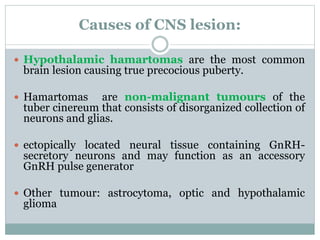
Causes of CNS lesion: 
 Hypothalamic hamartomas are the most common 
brain lesion causing true precocious puberty. 
 Hamartomas are non-malignant tumours of the 
tuber cinereum that consists of disorganized collection of 
neurons and glias. 
 ectopically located neural tissue containing GnRH-secretory 
neurons and may function as an accessory 
GnRH pulse generator 
 Other tumour: astrocytoma, optic and hypothalamic 
glioma
Causes of CNS lesion: (cont.) 
Radiation therapy for leukemia or intracranial 
tumours  irradiation is directed to the 
hypothalamic area or to areas of the brain 
anatomically distant from the hypothalamus  
increases the risk of precocious puberty
Clinical manifestations: 
 Begin at any age, follows the sequence observed in normal 
puberty 
 In girls: 
Breast enlargement comes first 
Pubic hair may appear simultaneously but more often 
laters 
 Menarche is a late event ( irregular cycle and usually 
anovulatory ) 
The pubertal growth spurt occurs early in female puberty
 In boys: 
Testicular enlargement 
( unnoticed) 
Enlargement of penis 
Axillary hair, acne, voice 
deepens 
Erections are common 
spermatogenesis 
observed as early as 5-6 
yr of age
 In both gender: 
Height, weight, and osseous maturation are 
advanced 
Without treatment, 30% early closure of the 
epiphyses > height less than the 5th percentile as 
adults 
Emotional and mood swings are common
 In intracranial lesion ( eg: hamartoma ) : 
Hypothalamic signs: 
diabetes insipidus 
hyperthemia 
unnatural crying or laughing(gelastic seizures) 
cachexia 
 In optic glioma : proptosis 
 In irradiation of brain : signs of growth hormone 
deficiency may present
Gonadotropin-independent precocious 
puberty ( GIPP) 
 Independent of gonadotropin secretion and no 
activation of the HPG axis 
 aka precocious pseudopuberty 
 caused by excess secretion of sex hormones 
(estrogens or androgens) derived either from the 
gonads or adrenal glands or from exogenous 
sources
Causes of GIPP : 
Girls Boys 
Ovarian cysts Leydig cell tumour 
Ovarian tumours Human chorionic gonadotropin 
(hCG) secreting germ cell tumors 
Granulosa theca cell tmour Familial male-limited precocious 
puberty 
Both in boys and girl: 
Exogenous estrogen 
Adrenal pathology ( eg: androgen-secreting 
tumour and CAH) 
Teratoma 
McCune-Albright syndrome
How to approach: 
 Onset of age? 
 Is the cause of precocity central or peripheral? Need to ask the 
pattern of pubertal development in GDPP  normal pubertal 
development but at an earlier age 
 How quickly is the puberty progressing? 
rapid bone maturation suggest either GDPP or GIPP 
 Presence of headaches or seizures ? CNS lesion 
 Previous history of CNS disease or trauma? 
 Are the secondary sexual characteristics virilizing or feminizing? 
 feminizing in Sertoli cell tumor 
 Virilization in CAH 
 Any exposure to exogenous sex steroids?? (medicinal or cosmetic 
sources) 
 Timing of pubertal onset in his or her parents and siblings? family 
history of similar symptoms?
Physical examination: 
 Measurements of height, weight, and calculation of height velocity (cm/yr) 
 Pubertal staging: 
 In girls : 
- Breast staging, pubic hair, 
 In boys: 
- Testicular volume? Penile size? Pubic hair? 
 Abdominal examination: 
 Palpate for mass ( in ovarian cyst and tumour) 
 Neurological examination (neurological deficit?) 
 Eye examination : 
 Fundoscopy :look for papilledema ( in CNS lesion) 
 Visual field 
 Look for signs of virilization in female? Ambigious genitalia? Hirsutism? 
 Dermatological exam to evaluate for cafe-au-lait spots( in McCune-Albright 
syndrome).
Investigations: 
Serum LH 
concentration 
Proceed with GnRH stimulation test 
If basal level of LH 
are low or 
intermediate 
If LH and FSH levels 
not increase with 
GnRH stimulation 
( GIPP) 
If LH and FSH levels 
increase with GnRH 
stimulation 
( GDPP ) 
If basal level of LH 
are markedly elevated 
Confirm GDPP
** Patients with GDPP must proceed with brain imaging to exclude any CNS lesion 
Contrast-enhanced MRI is use to detect any hypothalamic and infundibular lesion
Other investigations: 
 Sex hormone 
 To establish degree of biochemical pubertal enhancement 
 Serum estradiol are low or undetectable in the early phase of sexual 
precocity 
 Serum testosterone levels are detectable or clearly elevated 
 Thyroid function test 
- To be done if there is any clinical evidence of hypothyroidism 
 Radiographic assessment of bone age: 
- If the patient has a normal bone age, he or she is unlikely to have 
GDPP
 Several ix to identify the peripheral cause of 
precocious puberty ( GIPP ): 
- Serum testosterone and estradiol 
- Serum LH and FSH 
- Renal profile (check on dehydration or electrolytes 
imbalance)  in aldosterone deficiency 
- Serum cortisol  to screen for Cushing syndrome 
- Abdominal and pelvic ultrasound  to identify 
presence of ovarian cysts or tumour 
- Ultrasound of testes  possibility of Leydig cell 
tumour
Management of GDPP: 
 The treatment options depend upon the cause of the 
precocious puberty 
 If (GDPP) is caused by an identifiable central nervous 
system (CNS) lesion therapy is directed toward the 
underlying pathology 
 For most patients with GDPP  primary treatment 
option  gonadotropin-releasing hormone 
(GnRH) agonist 
 GnRH agonist administration  slows accelerated 
puberty and improves final height
 The decision of whether to treat GDPP with a GnRH 
agonist depends on: 
- child’s age 
- the rate of pubertal progression 
- height velocity 
- rate of bone age advancement.
Management for GIPP 
 GIPP does not respond to GnRH agonist 
therapy. Instead, treatment is directed at the 
underlying pathology: 
 Children with tumors of the testis, adrenal gland, 
and ovary treated by surgery. 
 Those with hCG-secreting tumors  require some 
combination of surgery, radiation therapy, and 
chemotherapy depending upon the site and histologic 
type.
Management for GIPP (cont.) 
 A large functioning follicular cyst of the ovary  
Cysts develop and regress spontaneously 
conservative management 
 Children whose sexual precocity is caused by 
exposure to exogenous sex steroids  exposure 
identified and removed 
 Children with identifiable defects in adrenal 
steroidogenesis ( CAH )  glucocorticoid therapy
Incomplete precocious puberty 
 Definition: isolated manifestations of precocity 
without development of other signs of puberty. 
Incomplete 
Premature 
thelarche 
Premature 
pubarche 
Premature 
menarche
Premature thelarche 
 Transient condition of isolated breast development 
that most often appears in the first 2 yr of life, often 
persists for 3-5 yr, and is rarely progressive 
 mostly  idiopathic 
 either remit spontaneously or are very slowly 
progressive. 
 no other signs of pubertal development and their 
growth rate is normal. 
 Serum estradiol : usually normal 
 Mx: reassurance and monitoring regularly for any 
other sign of pubertal advancement
Premature pubarche 
 Appearance of sexual hair before the age of 8 yr in girls or 9 
yr in boys without other evidence of maturation 
 Slowly progressive condition that requires no therapy 
 Longitudinal observations suggest that ~50% of affected 
girls are at high risk for 
 Hyperandrogenism 
 Polycystic ovary syndrome 
 Metabolic syndrome
Premature menarche 
 Diagnosis of exclusion 
 Isolated vaginal bleeding in the absence of other 
secondary sexual characteristics 
 Very rare 
 Carefully exclude: 
 Vulvovaginitis 
 Foreign body 
 Sexual abuse
Precocious puberty

Precocious puberty

  • 1.
  • 2.
    Definition of precociouspuberty Precocious puberty is defined as the onset of secondary sexual characteristics before 8 yr of age in girls and 9 yr in boys.
  • 4.
    Classification: Complete Central ( gonadotropin-dependent puberty, GDPP) Peripheral (gonadotropin-independent puberty, GIPP) Incomplete Premature thelarche Premature pubarche Premature menarche
  • 5.
    Gonadotropin-dependent precocious puberty( GDPP)  also known as true precocious puberty  early activation of the entire hypothalamic-pituitary- gonadal (HPG) axis  is caused by the secretion of high-amplitude pulses of gonadotropin-releasing hormone (GnRH) by the hypothalamus.  Although the onset is early, the pattern and timing of pubertal events usually progresses in the normal sequence.
  • 6.
    Gonadotropin-dependent precocious puberty • Non- CNS lesion: - Idiopathic - Genetics -Prolonged, untreated severe hypothyroidism • CNS lesion: -CNS tumour - CNS irradiation - hydrocephalus, cysts, trauma, CNS inflammatory disease,
  • 7.
     condition occursat least 5- to 10-fold more frequently in girls than in boys  Approximately 90% of sexual precocity in girls is idiopathic  75% of boys have a structural CNS abnormality
  • 8.
    Causes of CNSlesion:  Hypothalamic hamartomas are the most common brain lesion causing true precocious puberty.  Hamartomas are non-malignant tumours of the tuber cinereum that consists of disorganized collection of neurons and glias.  ectopically located neural tissue containing GnRH-secretory neurons and may function as an accessory GnRH pulse generator  Other tumour: astrocytoma, optic and hypothalamic glioma
  • 9.
    Causes of CNSlesion: (cont.) Radiation therapy for leukemia or intracranial tumours  irradiation is directed to the hypothalamic area or to areas of the brain anatomically distant from the hypothalamus  increases the risk of precocious puberty
  • 10.
    Clinical manifestations: Begin at any age, follows the sequence observed in normal puberty  In girls: Breast enlargement comes first Pubic hair may appear simultaneously but more often laters  Menarche is a late event ( irregular cycle and usually anovulatory ) The pubertal growth spurt occurs early in female puberty
  • 12.
     In boys: Testicular enlargement ( unnoticed) Enlargement of penis Axillary hair, acne, voice deepens Erections are common spermatogenesis observed as early as 5-6 yr of age
  • 13.
     In bothgender: Height, weight, and osseous maturation are advanced Without treatment, 30% early closure of the epiphyses > height less than the 5th percentile as adults Emotional and mood swings are common
  • 14.
     In intracraniallesion ( eg: hamartoma ) : Hypothalamic signs: diabetes insipidus hyperthemia unnatural crying or laughing(gelastic seizures) cachexia  In optic glioma : proptosis  In irradiation of brain : signs of growth hormone deficiency may present
  • 15.
    Gonadotropin-independent precocious puberty( GIPP)  Independent of gonadotropin secretion and no activation of the HPG axis  aka precocious pseudopuberty  caused by excess secretion of sex hormones (estrogens or androgens) derived either from the gonads or adrenal glands or from exogenous sources
  • 16.
    Causes of GIPP: Girls Boys Ovarian cysts Leydig cell tumour Ovarian tumours Human chorionic gonadotropin (hCG) secreting germ cell tumors Granulosa theca cell tmour Familial male-limited precocious puberty Both in boys and girl: Exogenous estrogen Adrenal pathology ( eg: androgen-secreting tumour and CAH) Teratoma McCune-Albright syndrome
  • 17.
    How to approach:  Onset of age?  Is the cause of precocity central or peripheral? Need to ask the pattern of pubertal development in GDPP  normal pubertal development but at an earlier age  How quickly is the puberty progressing? rapid bone maturation suggest either GDPP or GIPP  Presence of headaches or seizures ? CNS lesion  Previous history of CNS disease or trauma?  Are the secondary sexual characteristics virilizing or feminizing?  feminizing in Sertoli cell tumor  Virilization in CAH  Any exposure to exogenous sex steroids?? (medicinal or cosmetic sources)  Timing of pubertal onset in his or her parents and siblings? family history of similar symptoms?
  • 18.
    Physical examination: Measurements of height, weight, and calculation of height velocity (cm/yr)  Pubertal staging:  In girls : - Breast staging, pubic hair,  In boys: - Testicular volume? Penile size? Pubic hair?  Abdominal examination:  Palpate for mass ( in ovarian cyst and tumour)  Neurological examination (neurological deficit?)  Eye examination :  Fundoscopy :look for papilledema ( in CNS lesion)  Visual field  Look for signs of virilization in female? Ambigious genitalia? Hirsutism?  Dermatological exam to evaluate for cafe-au-lait spots( in McCune-Albright syndrome).
  • 19.
    Investigations: Serum LH concentration Proceed with GnRH stimulation test If basal level of LH are low or intermediate If LH and FSH levels not increase with GnRH stimulation ( GIPP) If LH and FSH levels increase with GnRH stimulation ( GDPP ) If basal level of LH are markedly elevated Confirm GDPP
  • 20.
    ** Patients withGDPP must proceed with brain imaging to exclude any CNS lesion Contrast-enhanced MRI is use to detect any hypothalamic and infundibular lesion
  • 21.
    Other investigations: Sex hormone  To establish degree of biochemical pubertal enhancement  Serum estradiol are low or undetectable in the early phase of sexual precocity  Serum testosterone levels are detectable or clearly elevated  Thyroid function test - To be done if there is any clinical evidence of hypothyroidism  Radiographic assessment of bone age: - If the patient has a normal bone age, he or she is unlikely to have GDPP
  • 22.
     Several ixto identify the peripheral cause of precocious puberty ( GIPP ): - Serum testosterone and estradiol - Serum LH and FSH - Renal profile (check on dehydration or electrolytes imbalance)  in aldosterone deficiency - Serum cortisol  to screen for Cushing syndrome - Abdominal and pelvic ultrasound  to identify presence of ovarian cysts or tumour - Ultrasound of testes  possibility of Leydig cell tumour
  • 23.
    Management of GDPP:  The treatment options depend upon the cause of the precocious puberty  If (GDPP) is caused by an identifiable central nervous system (CNS) lesion therapy is directed toward the underlying pathology  For most patients with GDPP  primary treatment option  gonadotropin-releasing hormone (GnRH) agonist  GnRH agonist administration  slows accelerated puberty and improves final height
  • 24.
     The decisionof whether to treat GDPP with a GnRH agonist depends on: - child’s age - the rate of pubertal progression - height velocity - rate of bone age advancement.
  • 25.
    Management for GIPP  GIPP does not respond to GnRH agonist therapy. Instead, treatment is directed at the underlying pathology:  Children with tumors of the testis, adrenal gland, and ovary treated by surgery.  Those with hCG-secreting tumors  require some combination of surgery, radiation therapy, and chemotherapy depending upon the site and histologic type.
  • 26.
    Management for GIPP(cont.)  A large functioning follicular cyst of the ovary  Cysts develop and regress spontaneously conservative management  Children whose sexual precocity is caused by exposure to exogenous sex steroids  exposure identified and removed  Children with identifiable defects in adrenal steroidogenesis ( CAH )  glucocorticoid therapy
  • 27.
    Incomplete precocious puberty  Definition: isolated manifestations of precocity without development of other signs of puberty. Incomplete Premature thelarche Premature pubarche Premature menarche
  • 28.
    Premature thelarche Transient condition of isolated breast development that most often appears in the first 2 yr of life, often persists for 3-5 yr, and is rarely progressive  mostly  idiopathic  either remit spontaneously or are very slowly progressive.  no other signs of pubertal development and their growth rate is normal.  Serum estradiol : usually normal  Mx: reassurance and monitoring regularly for any other sign of pubertal advancement
  • 29.
    Premature pubarche Appearance of sexual hair before the age of 8 yr in girls or 9 yr in boys without other evidence of maturation  Slowly progressive condition that requires no therapy  Longitudinal observations suggest that ~50% of affected girls are at high risk for  Hyperandrogenism  Polycystic ovary syndrome  Metabolic syndrome
  • 30.
    Premature menarche Diagnosis of exclusion  Isolated vaginal bleeding in the absence of other secondary sexual characteristics  Very rare  Carefully exclude:  Vulvovaginitis  Foreign body  Sexual abuse

Editor's Notes

  • #5 Depending on the primary source of hormonal production, this may be classified as
  • #9 interrupting CNS inhibitory pathways to the hypothalamus usually in very young children
  • #23 Hyperkalemia hyponatremia
  • #24 deslorelin or histrelin
  • #25 As an example, a child presenting with GDPP before the age of six with breast and pubic hair development, advanced bone age, and accelerated height velocity is likely to benefit from GnRH agonist therapy and vice versa * puberty resumes promptly when therapy is discontinued at a “pubertal” chronological age