Renal Disorders PharmacotherapyRenal Disorders Pharmacotherapy
Chapter 3
Chronic Kidney Disease [CKD]
Renal Disorders Pharmacotherapy
By: Tsegaye Melaku
[B.Pharm, MSc, Clinical Pharmacist]
March, 2017March, 2017
tsegayemlk@yahoo.com or tsegaye.melaku@ju.edu.et
+251913765609+251913765609
Chapter 3
Chronic Kidney Disease [CKD]
Lesson Objectives
๏‚ง Upon completion of the chapter, you will be able to:
๏ƒœ List the risk factors for development and progression of chronic
kidney disease (CKD).
๏ƒœ Explain the mechanisms associated with progression of CKD.
๏ƒœ Develop a therapeutic approach to slow progression of CKD,
including lifestyle modifications and pharmacologic therapies.
๏ƒœ Identify complications associated to CKD
๏ƒœ Design an appropriate therapeutic approach for specific
consequences associated with CKD.
๏ƒœ Monitor and evaluate therapeutic outcomes
๏ƒœ List the risk factors for development and progression of chronic
kidney disease (CKD).
๏ƒœ Explain the mechanisms associated with progression of CKD.
๏ƒœ Develop a therapeutic approach to slow progression of CKD,
including lifestyle modifications and pharmacologic therapies.
๏ƒœ Identify complications associated to CKD
๏ƒœ Design an appropriate therapeutic approach for specific
consequences associated with CKD.
๏ƒœ Monitor and evaluate therapeutic outcomes
Case Scenario
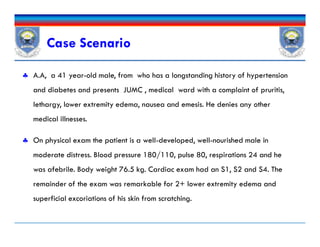
๏‚ง A.A, a 41 year-old male, from who has a longstanding history of hypertension
and diabetes and presents JUMC , medical ward with a complaint of pruritis,
lethargy, lower extremity edema, nausea and emesis. He denies any other
medical illnesses.
๏‚ง On physical exam the patient is a well-developed, well-nourished male in
moderate distress. Blood pressure 180/110, pulse 80, respirations 24 and he
was afebrile. Body weight 76.5 kg. Cardiac exam had an S1, S2 and S4. The
remainder of the exam was remarkable for 2+ lower extremity edema and
superficial excoriations of his skin from scratching.
๏‚ง A.A, a 41 year-old male, from who has a longstanding history of hypertension
and diabetes and presents JUMC , medical ward with a complaint of pruritis,
lethargy, lower extremity edema, nausea and emesis. He denies any other
medical illnesses.
๏‚ง On physical exam the patient is a well-developed, well-nourished male in
moderate distress. Blood pressure 180/110, pulse 80, respirations 24 and he
was afebrile. Body weight 76.5 kg. Cardiac exam had an S1, S2 and S4. The
remainder of the exam was remarkable for 2+ lower extremity edema and
superficial excoriations of his skin from scratching.
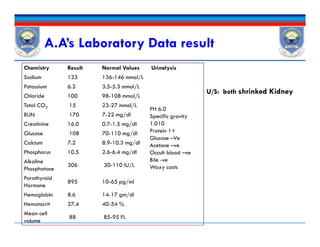
A.Aโ€™s Laboratory Data result
Chemistry Result Normal Values Urinalysis
Sodium 133 136-146 mmol/L
PH 6.0
Specific gravity
1.010
Protein 1+
Glucose โ€“Ve
Acetone โ€“ve
Occult blood โ€“ve
Bile -ve
Waxy casts
Potassium 6.2 3.5-5.3 mmol/L
Chloride 100 98-108 mmol/L
Total CO2 15 23-27 mmol/L
BUN 170 7-22 mg/dl
Creatinine 16.0 0.7-1.5 mg/dl
U/S: both shrinked Kidney
PH 6.0
Specific gravity
1.010
Protein 1+
Glucose โ€“Ve
Acetone โ€“ve
Occult blood โ€“ve
Bile -ve
Waxy casts
Creatinine 16.0 0.7-1.5 mg/dl
Glucose 108 70-110 mg/dl
Calcium 7.2 8.9-10.3 mg/dl
Phosphorus 10.5 2.6-6.4 mg/dl
Alkaline
Phosphatase
306 30-110 IU/L
Parathyroid
Hormone
895 10-65 pg/ml
Hemoglobin 8.6 14-17 gm/dl
Hematocrit 27.4 40-54 %
Mean cell
volume
88 85-95 FL
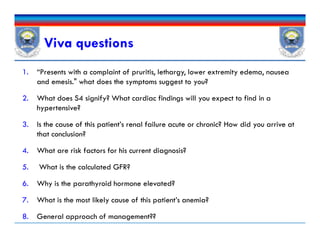
1. โ€œPresents with a complaint of pruritis, lethargy, lower extremity edema, nausea
and emesis." what does the symptoms suggest to you?
2. What does S4 signify? What cardiac findings will you expect to find in a
hypertensive?
3. Is the cause of this patientโ€™s renal failure acute or chronic? How did you arrive at
that conclusion?
4. What are risk factors for his current diagnosis?
5. What is the calculated GFR?
6. Why is the parathyroid hormone elevated?
7. What is the most likely cause of this patientโ€™s anemia?
8. General approach of management??
Viva questions
1. โ€œPresents with a complaint of pruritis, lethargy, lower extremity edema, nausea
and emesis." what does the symptoms suggest to you?
2. What does S4 signify? What cardiac findings will you expect to find in a
hypertensive?
3. Is the cause of this patientโ€™s renal failure acute or chronic? How did you arrive at
that conclusion?
4. What are risk factors for his current diagnosis?
5. What is the calculated GFR?
6. Why is the parathyroid hormone elevated?
7. What is the most likely cause of this patientโ€™s anemia?
8. General approach of management??
Introduction: CKD
๏‚ง CKD Defined
Abnormalities in kidney structure or function, present forโ‰ฅ 3 months
Progressive loss of function over several months to years,
ยป Characterized by gradual replacement of normal kidney
architecture with parenchymal fibrosis.
๏‚ง The KDIGO classification system based on CGA staging
(Cause, GFR, Albuminuria).
๏‚ง CKD Defined
Abnormalities in kidney structure or function, present forโ‰ฅ 3 months
Progressive loss of function over several months to years,
ยป Characterized by gradual replacement of normal kidney
architecture with parenchymal fibrosis.
๏‚ง The KDIGO classification system based on CGA staging
(Cause, GFR, Albuminuria).
KDIGO: Kidney Disease: Improving Global Outcomes
Epidemiology
๏‚ง Globally, 8% to 16% of the general population has CKD
๏‚ง 1.9 million patients are undergoing renal replacement therapy[RRT].
๏‚ง Prevalence of CKD increases with age: ~30% in >70 years old.
๏‚ง Diabetes and hypertension are also important risk factors for CKD.
๏‚ง In patients with type 2 diabetes, prevalence of 27%.
๏‚ง Among T1DM; 17% to 25% of patients developed diabetic chronic
kidney disease (DCKD) after 30 years.
๏‚ง Globally, 8% to 16% of the general population has CKD
๏‚ง 1.9 million patients are undergoing renal replacement therapy[RRT].
๏‚ง Prevalence of CKD increases with age: ~30% in >70 years old.
๏‚ง Diabetes and hypertension are also important risk factors for CKD.
๏‚ง In patients with type 2 diabetes, prevalence of 27%.
๏‚ง Among T1DM; 17% to 25% of patients developed diabetic chronic
kidney disease (DCKD) after 30 years.
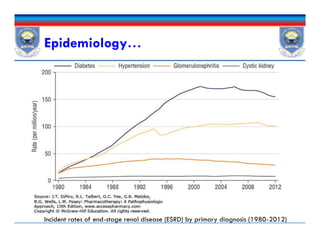
Epidemiologyโ€ฆ
Incident rates of end-stage renal disease (ESRD) by primary diagnosis (1980-2012)
Etiology/Risk Factors
๏‚ง The Kidney Disease Outcomes Quality Initiative (KDOQI):
๏‚ง CKD risk factor categories
Susceptibility factors
Initiation factors
Progression factors
๏‚ง The Kidney Disease Outcomes Quality Initiative (KDOQI):
๏‚ง CKD risk factor categories
Susceptibility factors
Initiation factors
Progression factors
๏‚ง Susceptibility factors:
Advanced age, reduced kidney mass and low birth weight, family
history, low income, systemic inflammation, dyslipidemia.
Most of them are not amenable to pharmacologic or lifestyle
interventions.
Useful for identifying populations at high risk for CKD.
Etiology/Risk Factorsโ€ฆ
๏‚ง Susceptibility factors:
Advanced age, reduced kidney mass and low birth weight, family
history, low income, systemic inflammation, dyslipidemia.
Most of them are not amenable to pharmacologic or lifestyle
interventions.
Useful for identifying populations at high risk for CKD.
๏‚ง Initiation Factors:
Conditions that result in direct kidney damage
Modifiable by pharmacologic therapy
DM, Hypertension, Glomerulonephritis: the most common
leading causes of CKD.
๏‚ง DM: a cause for 45% of new ESRD cases in 2010, followed
by HTN (29%), US
Etiology/Risk Factorsโ€ฆ
๏‚ง Initiation Factors:
Conditions that result in direct kidney damage
Modifiable by pharmacologic therapy
DM, Hypertension, Glomerulonephritis: the most common
leading causes of CKD.
๏‚ง DM: a cause for 45% of new ESRD cases in 2010, followed
by HTN (29%), US
๏‚ง Progression risk factors
Factors associated with further decline in kidney function in patients
who already have kidney damage
Persistence of the underlying initiation factors of CKD (e.g., DM, HTN,
glomerulonephritis)
โ€“ Serve as predictors of progressive CKD
Other factors associated with progression
โ€“ Factors consequent to the underlying kidney disease, e.g, HTN, proteinuria
โ€“ Factors independent of underlying kidney disease, e.g., smoking, obesity
Etiology/Risk Factorsโ€ฆ
๏‚ง Progression risk factors
Factors associated with further decline in kidney function in patients
who already have kidney damage
Persistence of the underlying initiation factors of CKD (e.g., DM, HTN,
glomerulonephritis)
โ€“ Serve as predictors of progressive CKD
Other factors associated with progression
โ€“ Factors consequent to the underlying kidney disease, e.g, HTN, proteinuria
โ€“ Factors independent of underlying kidney disease, e.g., smoking, obesity
Diabetes
๏‚ง Hyperglycemia: an initiation and progression risk factor for CKD
๏‚ง Without treatment,
~80% of patients with DM-2 and microalbuminuria will develop overt
nephropathy
~50% of those with DM-1, nephropathy, and HTN will develop stage 5 CKD within
10 years.
๏‚ง Lifetime risk of developing CKD
Type 1 DM patients: 40%
Type 2 DM patients: 50%
๏‚ง Greater prevalence of type 2 DM compared to type 1
13
๏‚ง Hyperglycemia: an initiation and progression risk factor for CKD
๏‚ง Without treatment,
~80% of patients with DM-2 and microalbuminuria will develop overt
nephropathy
~50% of those with DM-1, nephropathy, and HTN will develop stage 5 CKD within
10 years.
๏‚ง Lifetime risk of developing CKD
Type 1 DM patients: 40%
Type 2 DM patients: 50%
๏‚ง Greater prevalence of type 2 DM compared to type 1
Hypertension
๏‚ง Hypertension: both a cause of CKD and a result of CKD
๏‚ง Early treatment of HTN and achievement of target BP
Slow the rate of progression of CKD
๏‚ง BP goal in CKD is to control at all stages of CKD regardless of the
underlying cause.
๏‚ง Lifetime risk of stage 5 CKD for patients with HTN: 5.6%
Elevated BP increases risk for developing CKD
14
๏‚ง Hypertension: both a cause of CKD and a result of CKD
๏‚ง Early treatment of HTN and achievement of target BP
Slow the rate of progression of CKD
๏‚ง BP goal in CKD is to control at all stages of CKD regardless of the
underlying cause.
๏‚ง Lifetime risk of stage 5 CKD for patients with HTN: 5.6%
Elevated BP increases risk for developing CKD
Glomerulonephritis
๏‚ง Glomerulonephritis โ€ฆ..includes a wide variety of lesions caused by
immunologic, vascular, and other idiopathic diseases.
It is the third leading cause of ESRD
๏‚ง Chronic glomerular diseases progress at variable rates
Loss of GFR 1.4 to 9.5 mL/min/year
15
๏‚ง Glomerulonephritis โ€ฆ..includes a wide variety of lesions caused by
immunologic, vascular, and other idiopathic diseases.
It is the third leading cause of ESRD
๏‚ง Chronic glomerular diseases progress at variable rates
Loss of GFR 1.4 to 9.5 mL/min/year
Proteinuria
๏‚ง In diabetes with CKD, an albumin excretion rate >30 mg/24 hrs
strongly predicted the development of progression of CKD.
๏‚ง Proteinuria alone may promote progressive loss of nephrons through
direct cellular damage
๏‚ง Filtered proteins are toxic to kidney tubule cells
Albumin, transferrin, complement factors, immunoglobulins,
cytokines, angiotensin II
๏‚ง Presence of proteins in renal tubules activates tubular cells
leads to ๏‚ญed production of inflammatory and vasoactive
cytokines such as endothelin (potent VC)
16
๏‚ง In diabetes with CKD, an albumin excretion rate >30 mg/24 hrs
strongly predicted the development of progression of CKD.
๏‚ง Proteinuria alone may promote progressive loss of nephrons through
direct cellular damage
๏‚ง Filtered proteins are toxic to kidney tubule cells
Albumin, transferrin, complement factors, immunoglobulins,
cytokines, angiotensin II
๏‚ง Presence of proteins in renal tubules activates tubular cells
leads to ๏‚ญed production of inflammatory and vasoactive
cytokines such as endothelin (potent VC)
๏‚ง Proteinuria is also associated with the activation of complement
components on the apical membrane of proximal tubules
๏‚ง Intratubular complement activation may be the key mechanism of
damage in the progressive proteinuric nephropathies ๏ƒจ ๏ƒจ
Interstitial scarring
Progressive loss of structural nephron units
Reduction in GFR
Proteinuriaโ€ฆ
17
๏‚ง Proteinuria is also associated with the activation of complement
components on the apical membrane of proximal tubules
๏‚ง Intratubular complement activation may be the key mechanism of
damage in the progressive proteinuric nephropathies ๏ƒจ ๏ƒจ
Interstitial scarring
Progressive loss of structural nephron units
Reduction in GFR
Smoking
๏‚ง Smoking is associated with โ€ฆ.
Acute reduction in GFR
Increase in urinary albumin excretion, HR, and BP, likely
secondary to nicotine exposure
๏‚ง May promote initiation & progression of CKD in DM patients
๏‚ง Smoking has been associated with โ€ฆ.
Diagnosis of CKD in those with HTN
Development of stage 5 CKD
18
๏‚ง Smoking is associated with โ€ฆ.
Acute reduction in GFR
Increase in urinary albumin excretion, HR, and BP, likely
secondary to nicotine exposure
๏‚ง May promote initiation & progression of CKD in DM patients
๏‚ง Smoking has been associated with โ€ฆ.
Diagnosis of CKD in those with HTN
Development of stage 5 CKD
Dyslipidemia
๏‚ง CKD with/without nephrotic syndrome is frequently accompanied by
abnormalities in lipoprotein metabolism.
๏‚ง In patients with CKD and proteinuria >3 g/day, the major lipid
abnormalities are:
Elevation of plasma total and LDL cholesterol
Low HDL cholesterol (<35 mg/dL)
Elevated triglycerides (>200 mg/dL)
๏‚ง Lipid abnormality treatment may slow CKD progression
๏‚ง Treatment of proteinuria resolves the hyperlipidemia in most patients
with nephrotic syndrome.
19
๏‚ง CKD with/without nephrotic syndrome is frequently accompanied by
abnormalities in lipoprotein metabolism.
๏‚ง In patients with CKD and proteinuria >3 g/day, the major lipid
abnormalities are:
Elevation of plasma total and LDL cholesterol
Low HDL cholesterol (<35 mg/dL)
Elevated triglycerides (>200 mg/dL)
๏‚ง Lipid abnormality treatment may slow CKD progression
๏‚ง Treatment of proteinuria resolves the hyperlipidemia in most patients
with nephrotic syndrome.
Obesity***
๏‚ง Studies demonstrate increased risk of stage 5 CKD in overweight
and obese subjects
BMI โ‰ฅ25 kg/m2 associated with 3-fold increase in CKD risk.
Obesity (BMI โ‰ฅ30 kg/m2)associated with 3- to 4 fold increased
in CKD risk
๏‚ง Weight reduction as part of the treatment of progressive kidney
disease is suggested.
20
๏‚ง Studies demonstrate increased risk of stage 5 CKD in overweight
and obese subjects
BMI โ‰ฅ25 kg/m2 associated with 3-fold increase in CKD risk.
Obesity (BMI โ‰ฅ30 kg/m2)associated with 3- to 4 fold increased
in CKD risk
๏‚ง Weight reduction as part of the treatment of progressive kidney
disease is suggested.
๏ƒผ***a major risk factor for essential hypertension, diabetes, and other
comorbid conditions
๏ƒผPuts more strain on the kidneys
Bottom line
๏‚ง Clinical Factors
Diabetes
Hypertension
Obesity
Autoimmune
diseases
Systemic
infections
Urinary tract
infections
Urinary stones
Lower urinary
tract obstruction
Neoplasia
Family history of
CKD
Recovery from
acute kidney
injury
Reduction in
kidney mass
Exposure to
certain drugs
Low birth weight
๏‚ง Sociodemographic Factors
Older age
Exposure to certain chemical and
environmental conditions
Low income/education
Diabetes
Hypertension
Obesity
Autoimmune
diseases
Systemic
infections
Urinary tract
infections
Urinary stones
Lower urinary
tract obstruction
Neoplasia
Family history of
CKD
Recovery from
acute kidney
injury
Reduction in
kidney mass
Exposure to
certain drugs
Low birth weight
Older age
Exposure to certain chemical and
environmental conditions
Low income/education
Pathophysiology
๏‚ง Precise mechanism of kidney damage dependent on the etiology
of the disease.
๏‚ง Heterogeneous causes
Diabetic nephropathy: glomerular mesangial expansion
Hypertensive nephrosclerosis: kidney's arterioles have arteriolar
hyalinosis
Polycystic kidney disease: renal cysts develop
๏‚ง Precise mechanism of kidney damage dependent on the etiology
of the disease.
๏‚ง Heterogeneous causes
Diabetic nephropathy: glomerular mesangial expansion
Hypertensive nephrosclerosis: kidney's arterioles have arteriolar
hyalinosis
Polycystic kidney disease: renal cysts develop
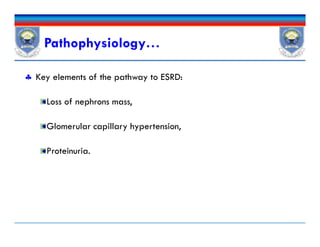
๏‚ง Key elements of the pathway to ESRD:
Loss of nephrons mass,
Glomerular capillary hypertension,
Proteinuria.
Pathophysiologyโ€ฆ
๏‚ง Key elements of the pathway to ESRD:
Loss of nephrons mass,
Glomerular capillary hypertension,
Proteinuria.
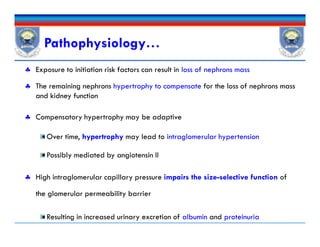
๏‚ง Exposure to initiation risk factors can result in loss of nephrons mass
๏‚ง The remaining nephrons hypertrophy to compensate for the loss of nephrons mass
and kidney function
๏‚ง Compensatory hypertrophy may be adaptive
Over time, hypertrophy may lead to intraglomerular hypertension
Possibly mediated by angiotensin II
๏‚ง High intraglomerular capillary pressure impairs the size-selective function of
the glomerular permeability barrier
Resulting in increased urinary excretion of albumin and proteinuria
Pathophysiologyโ€ฆ
๏‚ง Exposure to initiation risk factors can result in loss of nephrons mass
๏‚ง The remaining nephrons hypertrophy to compensate for the loss of nephrons mass
and kidney function
๏‚ง Compensatory hypertrophy may be adaptive
Over time, hypertrophy may lead to intraglomerular hypertension
Possibly mediated by angiotensin II
๏‚ง High intraglomerular capillary pressure impairs the size-selective function of
the glomerular permeability barrier
Resulting in increased urinary excretion of albumin and proteinuria
Pathophysiologyโ€ฆ
Pathophysiologyโ€ฆ
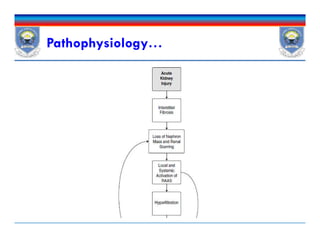
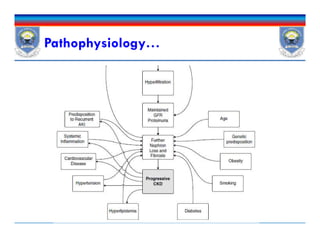
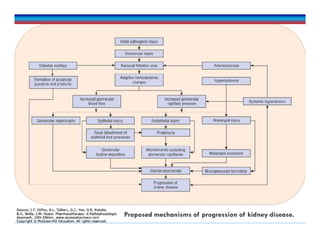
Proposed mechanisms of progression of kidney disease.
GFR Categorya GFR (mL/min2 [mL/s/]) Terms
1 >90 (>0.87) Normal or high
2 60โ€“89 (0.58โ€“0.86) Mildly decreased
3a 45โ€“59 (0.43โ€“0.57) Mildly to moderately
decreased
CKD Stages Based on KDIGO Classification
Mildly to moderately
decreased
3b 30โ€“44 (0.29โ€“0.42) Moderately to severely
decreased
4 15โ€“29 (0.14โ€“0.28) Severely decreased
5 <15 (<0.14) Kidney failure
aTo meet criteria for CKD there must be a significant reduction in GFR (categories 3a-5) or there must
also be evidence of kidney damage (categories 1 and 2) for 3 months or greater.
๏ƒผ CKD can be present with normal/near normal GFR if other markers of kidney disease are
present
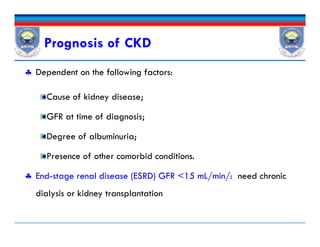
Prognosis of CKD
๏‚ง Dependent on the following factors:
Cause of kidney disease;
GFR at time of diagnosis;
Degree of albuminuria;
Presence of other comorbid conditions.
๏‚ง End-stage renal disease (ESRD) GFR <15 mL/min/: need chronic
dialysis or kidney transplantation
๏‚ง Dependent on the following factors:
Cause of kidney disease;
GFR at time of diagnosis;
Degree of albuminuria;
Presence of other comorbid conditions.
๏‚ง End-stage renal disease (ESRD) GFR <15 mL/min/: need chronic
dialysis or kidney transplantation
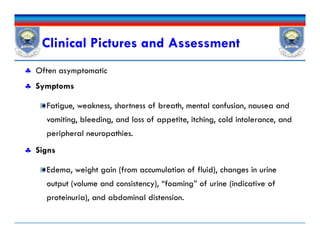
Clinical Pictures and Assessment
๏‚ง Often asymptomatic
๏‚ง Symptoms
Fatigue, weakness, shortness of breath, mental confusion, nausea and
vomiting, bleeding, and loss of appetite, itching, cold intolerance, and
peripheral neuropathies.
๏‚ง Signs
Edema, weight gain (from accumulation of fluid), changes in urine
output (volume and consistency), โ€œfoamingโ€ of urine (indicative of
proteinuria), and abdominal distension.
๏‚ง Often asymptomatic
๏‚ง Symptoms
Fatigue, weakness, shortness of breath, mental confusion, nausea and
vomiting, bleeding, and loss of appetite, itching, cold intolerance, and
peripheral neuropathies.
๏‚ง Signs
Edema, weight gain (from accumulation of fluid), changes in urine
output (volume and consistency), โ€œfoamingโ€ of urine (indicative of
proteinuria), and abdominal distension.
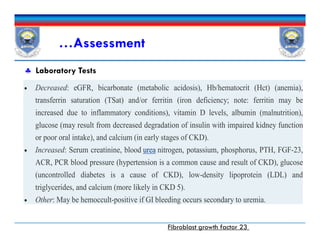
โ€ฆAssessment
๏‚ง Laboratory Tests
๏‚ท Decreased: eGFR, bicarbonate (metabolic acidosis), Hb/hematocrit (Hct) (anemia),
transferrin saturation (TSat) and/or ferritin (iron deficiency; note: ferritin may be
increased due to inflammatory conditions), vitamin D levels, albumin (malnutrition),
glucose (may result from decreased degradation of insulin with impaired kidney function
or poor oral intake), and calcium (in early stages of CKD).
๏‚ท Increased: Serum creatinine, blood urea nitrogen, potassium, phosphorus, PTH, FGF-23,
ACR, PCR blood pressure (hypertension is a common cause and result of CKD), glucose
(uncontrolled diabetes is a cause of CKD), low-density lipoprotein (LDL) and
triglycerides, and calcium (more likely in CKD 5).
๏‚ท Other: May be hemoccult-positive if GI bleeding occurs secondary to uremia.
๏‚ท Decreased: eGFR, bicarbonate (metabolic acidosis), Hb/hematocrit (Hct) (anemia),
transferrin saturation (TSat) and/or ferritin (iron deficiency; note: ferritin may be
increased due to inflammatory conditions), vitamin D levels, albumin (malnutrition),
glucose (may result from decreased degradation of insulin with impaired kidney function
or poor oral intake), and calcium (in early stages of CKD).
๏‚ท Increased: Serum creatinine, blood urea nitrogen, potassium, phosphorus, PTH, FGF-23,
ACR, PCR blood pressure (hypertension is a common cause and result of CKD), glucose
(uncontrolled diabetes is a cause of CKD), low-density lipoprotein (LDL) and
triglycerides, and calcium (more likely in CKD 5).
๏‚ท Other: May be hemoccult-positive if GI bleeding occurs secondary to uremia.
Fibroblast growth factor 23
๏‚ท Urine sediment abnormalities (hematuria, red blood cell and white blood cell casts, renal
tubular epithelial cells)
๏‚ท Pathologic abnormalities indicating glomerular, vascular, tubulointerstitial disease, or
cystic and congenital diseases
๏‚ท Structural abnormalities such as polycystic kidneys, renal masses, renal artery stenosis,
cortical scarring due to infarcts and pyelonephritis, or small kidneys (common in more
severe CKD) detected by imaging studies (eg, ultrasound, computed tomography,
magnetic resonance imaging, angiography)
๏‚ง Other Diagnostic Tests
โ€ฆAssessment
๏‚ท Urine sediment abnormalities (hematuria, red blood cell and white blood cell casts, renal
tubular epithelial cells)
๏‚ท Pathologic abnormalities indicating glomerular, vascular, tubulointerstitial disease, or
cystic and congenital diseases
๏‚ท Structural abnormalities such as polycystic kidneys, renal masses, renal artery stenosis,
cortical scarring due to infarcts and pyelonephritis, or small kidneys (common in more
severe CKD) detected by imaging studies (eg, ultrasound, computed tomography,
magnetic resonance imaging, angiography)
๏ฑ CKD stages 3, 4, 5 require additional workup
๏ƒผ Anemia, CV disease, metabolic bone disease, malnutrition, fluid & electrolyte, disorders
Treatment of CKD
๏‚ง General
Identify the presence and causes of secondary complications
and comorbid conditions.
Interprofessional approach
Dietary education, and social/financial concerns.
Comprehensive medication management (CMM) /Drug-dosing
๏‚ง General
Identify the presence and causes of secondary complications
and comorbid conditions.
Interprofessional approach
Dietary education, and social/financial concerns.
Comprehensive medication management (CMM) /Drug-dosing
Desired Outcome
๏‚ง Delay or prevent progression of the disease
๏‚ง Minimizing the development or severity of associated complications.
๏‚ง Plan for RRT(HD or PD) starting from CKD
๏‚ง Sustain and improve, if possible, the patientโ€™s quality of life [CKD 5]
๏‚ง Prevent adverse outcomes by aggressively managing complications of
CKD.
๏‚ง Delay or prevent progression of the disease
๏‚ง Minimizing the development or severity of associated complications.
๏‚ง Plan for RRT(HD or PD) starting from CKD
๏‚ง Sustain and improve, if possible, the patientโ€™s quality of life [CKD 5]
๏‚ง Prevent adverse outcomes by aggressively managing complications of
CKD.
Non-pharmacologic management
๏‚ง Diet
Protein restriction to 0.8 g/kg/day in eGFR <30 mL/min(i.e,
CKD 4).
Decreasing sodium intake <2 g or 90 mEq (mmol)/day
(corresponding to 5 g NaCl)
๏‚ง Smoking Cessation, Exercise, and Weight Loss
๏‚ง Diet
Protein restriction to 0.8 g/kg/day in eGFR <30 mL/min(i.e,
CKD 4).
Decreasing sodium intake <2 g or 90 mEq (mmol)/day
(corresponding to 5 g NaCl)
๏‚ง Smoking Cessation, Exercise, and Weight Loss
Pharmacologic management
๏‚ง Proteinuria
Initiate ACEIs/ARBs
DCKD: ACEI/ARB 1st line therapy [urine albumin excretion is in
category A2 or greater (ACR between 30-300 mg/g)]
Increase dose until albuminuria is reduced by 30% to 50% or side
effects [e.g. >30% decrease in eGFR or elevation in serum potassium
occur]
ACEI + ARB ??
ACEI/ARB+ Aldosterone antagonist??
๏‚ง Proteinuria
Initiate ACEIs/ARBs
DCKD: ACEI/ARB 1st line therapy [urine albumin excretion is in
category A2 or greater (ACR between 30-300 mg/g)]
Increase dose until albuminuria is reduced by 30% to 50% or side
effects [e.g. >30% decrease in eGFR or elevation in serum potassium
occur]
ACEI + ARB ??
ACEI/ARB+ Aldosterone antagonist??
DCKD: Diabetic CKD
๏‚ง Dihydropyridine CCBs do not appear to have any beneficial effects
beyond those attributable to reducing BP.
๏‚ง Nondihydropyridine agents (diltiazem and verapamil]:yielded beneficial
effects on proteinuria, although not as profoundly as ACEIs.
2nd antiproteinuric drugs [ACEI/ARB is contraindicated/not tolerated]
Suppress of glomerular hypertrophy,
Inhibit of platelet aggregation, and
Decrease in salt accumulation.
Pharmacologic managementโ€ฆ
๏‚ง Dihydropyridine CCBs do not appear to have any beneficial effects
beyond those attributable to reducing BP.
๏‚ง Nondihydropyridine agents (diltiazem and verapamil]:yielded beneficial
effects on proteinuria, although not as profoundly as ACEIs.
2nd antiproteinuric drugs [ACEI/ARB is contraindicated/not tolerated]
Suppress of glomerular hypertrophy,
Inhibit of platelet aggregation, and
Decrease in salt accumulation.
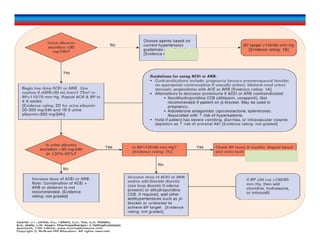
Hypertension
๏‚ง Recommended BP goals based on the degree of albuminuria and
the choice of antihypertensive agent.
๏‚ง KDIGO: โ‰ค140/90 mm Hg for those with category A1 albuminuria.
๏‚ง Category โ‰ฅA2 albuminuria :โ‰ค 130/80 mm Hg
๏‚ง Subjects with proteinuria greater than 300 mg/day did benefit
from the lower blood pressure target.
๏‚ง 1st line: ACEI/ARB,, if not at goal, add diuretic(s)
๏‚ง Recommended BP goals based on the degree of albuminuria and
the choice of antihypertensive agent.
๏‚ง KDIGO: โ‰ค140/90 mm Hg for those with category A1 albuminuria.
๏‚ง Category โ‰ฅA2 albuminuria :โ‰ค 130/80 mm Hg
๏‚ง Subjects with proteinuria greater than 300 mg/day did benefit
from the lower blood pressure target.
๏‚ง 1st line: ACEI/ARB,, if not at goal, add diuretic(s)
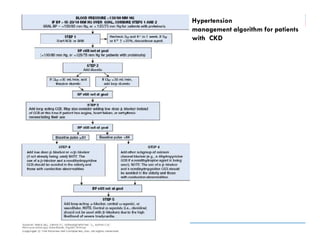
Hypertension
management algorithm for patients
with CKD
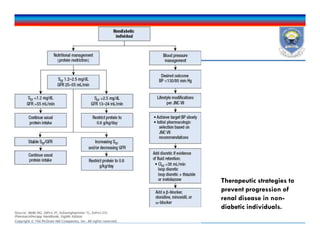
Therapeutic strategies to
prevent progression of
renal disease in non-
diabetic individuals.
Diabetes
๏‚ง Patients with DM should be screened annually for CKD
Start at the time of diagnosis of T2DM
5 years after the diagnosis of T1DM
๏‚ง Reduction of proteinuria and achievement of desired BP & HbA1c [7%]
๏‚ง CKD 3 and 4 are at higher risk of developing hypoglycemia
Reduction in metabolism of insulin by the kidney as GFR declines.
Require reduced doses of oral or injectable hypoglycemic agents
๏‚ง Metformin:
๏‚ง Continued: eGFR โ‰ฅ45 mL/min; Reviewed: eGFR 30 to 44 mL/min,
๏‚ง Discontinued: eGFR <30 mL/min
๏‚ง Patients with DM should be screened annually for CKD
Start at the time of diagnosis of T2DM
5 years after the diagnosis of T1DM
๏‚ง Reduction of proteinuria and achievement of desired BP & HbA1c [7%]
๏‚ง CKD 3 and 4 are at higher risk of developing hypoglycemia
Reduction in metabolism of insulin by the kidney as GFR declines.
Require reduced doses of oral or injectable hypoglycemic agents
๏‚ง Metformin:
๏‚ง Continued: eGFR โ‰ฅ45 mL/min; Reviewed: eGFR 30 to 44 mL/min,
๏‚ง Discontinued: eGFR <30 mL/min
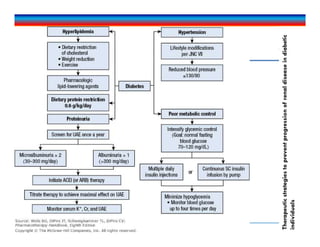
Therapeuticstrategiestopreventprogressionofrenaldiseaseindiabetic
individuals
Therapeuticstrategiestopreventprogressionofrenaldiseaseindiabetic
individuals
Recommendations
Nonpharmacologic
๏ƒผExercise 30 minutes five times per week [1D]
๏ƒผWeight loss if BMI >25 kg/m2 [1D]
๏ƒผSmoking cessation [1D]
๏ƒผAlcohol: Two standard drinks per day for men and one standard drink per day for women[2D]
๏ƒผIf hypertension: Low-sodium diet (<2 g/day, <90 mmol/day) [1C]
Pharmacologic
๏ƒผAdjust medication doses for kidney function [1A]
๏ƒผSeek pharmacist or medical advice before using over-the-counter medicines or nutritional protein
supplements [1B]
๏ƒผHerbal medicines are not recommended [1B]
๏ƒผTemporarily discontinue potentially nephrotoxic/renally excreted drugs if eGFR <60 mL/min/1.73
m2 in patients who are acutely unwell or hypovolemic (eg, metformin, RAAS blockers, diuretics,
NSAIDs/COX II inhibitors, lithium, digoxin) [1C]
Vaccines:
๏‚ท Influenza yearly [1B]
๏‚ท Pneumococcal vaccine if eGFR <30 mL/min/1.73 m2, nephrotic syndrome, diabetes, or receiving
immunosuppression. Single booster dose at year 5 [1B]
๏‚ท Hepatitis B vaccine if eGFR <30 mL/min/1.73 m2 and risk of progression of CKD [1B]
๏ƒผASA suggested for patients at risk for atherosclerotic events unless there is an increased bleeding
risk [2B]
๏ƒผAvoid oral phosphate-containing bowel preparations in people with a GFR <60 mL/min/1.73
m2 (<0.58 mL/s/m2) or in those known to be at risk of phosphate nephropathy [1A]
Pharmacologic
๏ƒผAdjust medication doses for kidney function [1A]
๏ƒผSeek pharmacist or medical advice before using over-the-counter medicines or nutritional protein
supplements [1B]
๏ƒผHerbal medicines are not recommended [1B]
๏ƒผTemporarily discontinue potentially nephrotoxic/renally excreted drugs if eGFR <60 mL/min/1.73
m2 in patients who are acutely unwell or hypovolemic (eg, metformin, RAAS blockers, diuretics,
NSAIDs/COX II inhibitors, lithium, digoxin) [1C]
Vaccines:
๏‚ท Influenza yearly [1B]
๏‚ท Pneumococcal vaccine if eGFR <30 mL/min/1.73 m2, nephrotic syndrome, diabetes, or receiving
immunosuppression. Single booster dose at year 5 [1B]
๏‚ท Hepatitis B vaccine if eGFR <30 mL/min/1.73 m2 and risk of progression of CKD [1B]
๏ƒผASA suggested for patients at risk for atherosclerotic events unless there is an increased bleeding
risk [2B]
๏ƒผAvoid oral phosphate-containing bowel preparations in people with a GFR <60 mL/min/1.73
m2 (<0.58 mL/s/m2) or in those known to be at risk of phosphate nephropathy [1A]
1=recommended; 2= suggested;; A=high quality, B=Moderate, C= Low; D= Very low
Monitor and evaluate
๏‚ง Effectiveness and safety
๏‚ง Monitor for HTN, DM, others related conditions
๏‚ง Clinical signs and symptoms
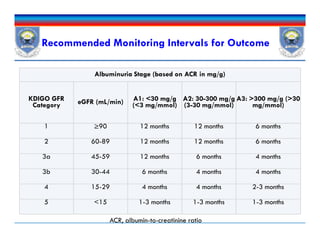
Recommended Monitoring Intervals for Outcome
Albuminuria Stage (based on ACR in mg/g)
KDIGO GFR
Category eGFR (mL/min) A1: <30 mg/g
(<3 mg/mmol)
A2: 30-300 mg/g
(3-30 mg/mmol)
A3: >300 mg/g (>30
mg/mmol)
1 โ‰ฅ90 12 months 12 months 6 months1 โ‰ฅ90 12 months 12 months 6 months
2 60-89 12 months 12 months 6 months
3a 45-59 12 months 6 months 4 months
3b 30-44 6 months 4 months 4 months
4 15-29 4 months 4 months 2-3 months
5 <15 1-3 months 1-3 months 1-3 months
ACR, albumin-to-creatinine ratio
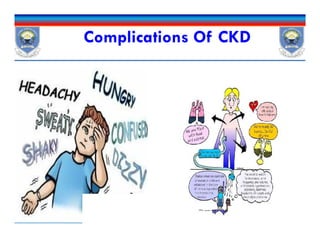
Complications Of CKD
Complications of CKD
๏‚ง Frequent complications of advanced CKD:
Altered sodium and water balance,
Hyperkalemia, metabolic acidosis, anemia,
CKD-related mineral and bone disorder (CKD-MBD),
Cardiovascular disease (CVD).
๏‚ง Frequent complications of advanced CKD:
Altered sodium and water balance,
Hyperkalemia, metabolic acidosis, anemia,
CKD-related mineral and bone disorder (CKD-MBD),
Cardiovascular disease (CVD).
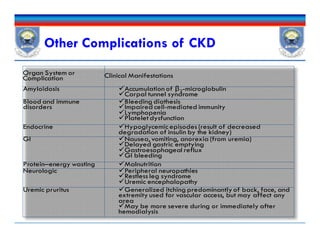
Other Complications of CKD
Organ System or
Complication Clinical Manifestations
Amyloidosis ๏ƒผAccumulation of ฮฒ2-microglobulin
๏ƒผCarpal tunnel syndrome
Blood and immune
disorders
๏ƒผBleeding diathesis
๏ƒผImpaired cell-mediated immunity
๏ƒผLymphopenia
๏ƒผPlatelet dysfunction
Endocrine ๏ƒผHypoglycemic episodes (result of decreased
degradation of insulin by the kidney)
GI ๏ƒผNausea, vomiting, anorexia (from uremia)
๏ƒผDelayed gastric emptying
๏ƒผGastroesophageal reflux
๏ƒผGI bleeding
Proteinโ€“energy wasting ๏ƒผMalnutrition
Neurologic ๏ƒผPeripheral neuropathies
๏ƒผRestless leg syndrome
๏ƒผUremic encephalopathy
Uremic pruritus ๏ƒผGeneralized itching predominantlyof back, face, and
extremity used for vascular access, but may affect any
area
๏ƒผMay be more severe during or immediately after
hemodialysis
Organ System or
Complication Clinical Manifestations
Amyloidosis ๏ƒผAccumulation of ฮฒ2-microglobulin
๏ƒผCarpal tunnel syndrome
Blood and immune
disorders
๏ƒผBleeding diathesis
๏ƒผImpaired cell-mediated immunity
๏ƒผLymphopenia
๏ƒผPlatelet dysfunction
Endocrine ๏ƒผHypoglycemic episodes (result of decreased
degradation of insulin by the kidney)
GI ๏ƒผNausea, vomiting, anorexia (from uremia)
๏ƒผDelayed gastric emptying
๏ƒผGastroesophageal reflux
๏ƒผGI bleeding
Proteinโ€“energy wasting ๏ƒผMalnutrition
Neurologic ๏ƒผPeripheral neuropathies
๏ƒผRestless leg syndrome
๏ƒผUremic encephalopathy
Uremic pruritus ๏ƒผGeneralized itching predominantlyof back, face, and
extremity used for vascular access, but may affect any
area
๏ƒผMay be more severe during or immediately after
hemodialysis
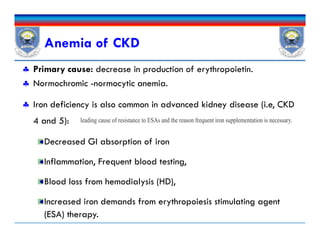
Anemia of CKD
๏‚ง Primary cause: decrease in production of erythropoietin.
๏‚ง Normochromic -normocytic anemia.
๏‚ง Iron deficiency is also common in advanced kidney disease (i.e, CKD
4 and 5):
Decreased GI absorption of iron
Inflammation, Frequent blood testing,
Blood loss from hemodialysis (HD),
Increased iron demands from erythropoiesis stimulating agent
(ESA) therapy.
leading cause of resistance to ESAs and the reason frequent iron supplementation is necessary.
๏‚ง Primary cause: decrease in production of erythropoietin.
๏‚ง Normochromic -normocytic anemia.
๏‚ง Iron deficiency is also common in advanced kidney disease (i.e, CKD
4 and 5):
Decreased GI absorption of iron
Inflammation, Frequent blood testing,
Blood loss from hemodialysis (HD),
Increased iron demands from erythropoiesis stimulating agent
(ESA) therapy.
leading cause of resistance to ESAs and the reason frequent iron supplementation is necessary.
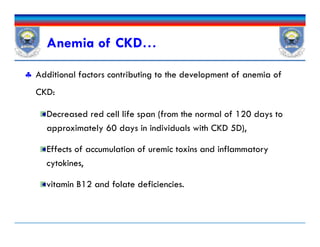
๏‚ง Additional factors contributing to the development of anemia of
CKD:
Decreased red cell life span (from the normal of 120 days to
approximately 60 days in individuals with CKD 5D),
Effects of accumulation of uremic toxins and inflammatory
cytokines,
vitamin B12 and folate deficiencies.
Anemia of CKDโ€ฆ
๏‚ง Additional factors contributing to the development of anemia of
CKD:
Decreased red cell life span (from the normal of 120 days to
approximately 60 days in individuals with CKD 5D),
Effects of accumulation of uremic toxins and inflammatory
cytokines,
vitamin B12 and folate deficiencies.
๏‚ง Sign & sxs of anemia:
Fatigue, shortness of breath, cold intolerance, chest pain, tingling in
the extremities, tachycardia, headaches, and general malaise.
๏‚ง CBC: Hb concentrations [<13 g/dL for male & <12 g/dL for females]
Annually in CKD 3,
biannually in CKD 4-5, and
At least every 3 months in CKD 5 patients.
๏‚ง Iron status; Tsat, serum ferritin
๏‚ง Vitamin B12 or folate, Guaiac test
Anemia of CKDโ€ฆDx
๏‚ง Sign & sxs of anemia:
Fatigue, shortness of breath, cold intolerance, chest pain, tingling in
the extremities, tachycardia, headaches, and general malaise.
๏‚ง CBC: Hb concentrations [<13 g/dL for male & <12 g/dL for females]
Annually in CKD 3,
biannually in CKD 4-5, and
At least every 3 months in CKD 5 patients.
๏‚ง Iron status; Tsat, serum ferritin
๏‚ง Vitamin B12 or folate, Guaiac test
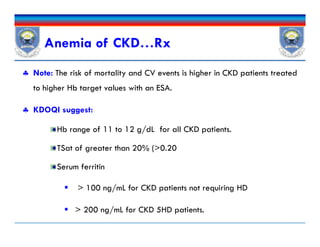
๏‚ง Note: The risk of mortality and CV events is higher in CKD patients treated
to higher Hb target values with an ESA.
๏‚ง KDOQI suggest:
Hb range of 11 to 12 g/dL for all CKD patients.
TSat of greater than 20% (>0.20
Serum ferritin
๏‚ง > 100 ng/mL for CKD patients not requiring HD
๏‚ง > 200 ng/mL for CKD 5HD patients.
Anemia of CKDโ€ฆRx
๏‚ง Note: The risk of mortality and CV events is higher in CKD patients treated
to higher Hb target values with an ESA.
๏‚ง KDOQI suggest:
Hb range of 11 to 12 g/dL for all CKD patients.
TSat of greater than 20% (>0.20
Serum ferritin
๏‚ง > 100 ng/mL for CKD patients not requiring HD
๏‚ง > 200 ng/mL for CKD 5HD patients.
๏‚ง Higher risk of dialysis access thrombosis and uncontrolled blood pressure
in the higher Hb.
Almost twofold increase in the risk of stroke (5%)
High-dose ESA use was associated with greater risk of death.
๏‚ง Non-pharmacologic Therapy
Dietary intake of iron, folate and B12
Anemia of CKDโ€ฆRxโ€ฆ
๏‚ง Higher risk of dialysis access thrombosis and uncontrolled blood pressure
in the higher Hb.
Almost twofold increase in the risk of stroke (5%)
High-dose ESA use was associated with greater risk of death.
๏‚ง Non-pharmacologic Therapy
Dietary intake of iron, folate and B12
Anemia of CKD: Pharmacologic Rx
๏‚ง Iron Supplementation
Provide the elemental iron required for production of Hb.
Warranted in individuals with a TSat < 30% (<0.30) and a ferritin < 500
ng/mL in whom an increase in Hb or a decrease in ESA dose is desired.
Oral preparations: ferrous salts (ferrous sulfate, ferrous fumarate,
and ferrous gluconate), polysaccharide iron complex, and carbonyl
iron.
Differ in terms of the amount of elemental iron: ferrous sulfate
(20%), ferrous gluconate (12%), ferrous fumarate (33%), iron
polysaccharide (100%), and carbonyl iron (100%).
๏‚ง Iron Supplementation
Provide the elemental iron required for production of Hb.
Warranted in individuals with a TSat < 30% (<0.30) and a ferritin < 500
ng/mL in whom an increase in Hb or a decrease in ESA dose is desired.
Oral preparations: ferrous salts (ferrous sulfate, ferrous fumarate,
and ferrous gluconate), polysaccharide iron complex, and carbonyl
iron.
Differ in terms of the amount of elemental iron: ferrous sulfate
(20%), ferrous gluconate (12%), ferrous fumarate (33%), iron
polysaccharide (100%), and carbonyl iron (100%).
๏ƒผ Oral absorption??
๏‚ง IV iron preparations are colloids
To correct absolute iron deficiency, especially if they are receiving
an ESA.
Improves the responsiveness to ESA therapy & lower doses can be
used to maintain the target Hb in HD patients
In patients with CKD 5HD GI absorption of iron is often inadequate
Thus the IV route is preferred for almost all HD patients.
๏‚ง If oral therapy is initiated a 1- to 3-month trial is recommended to assess
response.
Anemia of CKD: Pharmacologic Rxโ€ฆ
๏‚ง IV iron preparations are colloids
To correct absolute iron deficiency, especially if they are receiving
an ESA.
Improves the responsiveness to ESA therapy & lower doses can be
used to maintain the target Hb in HD patients
In patients with CKD 5HD GI absorption of iron is often inadequate
Thus the IV route is preferred for almost all HD patients.
๏‚ง If oral therapy is initiated a 1- to 3-month trial is recommended to assess
response.
Iron dosing
๏‚ง Oral therapy:
200 mg of elemental iron per day
1- to 3-month trial in the non-HD CKD prior to initiating IV therapy.
๏‚ง For the HD population: IV preferred
1-g course of IV iron (in divided doses) recommended.
๏‚ง Typical repletion dosing regimens for IV iron:
100 mg as iron sucrose over 10 dialysis sessions or
125 mg of sodium ferric gluconate over 8 dialysis sessions.
๏‚ง Oral therapy:
200 mg of elemental iron per day
1- to 3-month trial in the non-HD CKD prior to initiating IV therapy.
๏‚ง For the HD population: IV preferred
1-g course of IV iron (in divided doses) recommended.
๏‚ง Typical repletion dosing regimens for IV iron:
100 mg as iron sucrose over 10 dialysis sessions or
125 mg of sodium ferric gluconate over 8 dialysis sessions.
Test dose needed for IV iron (iron dextran)
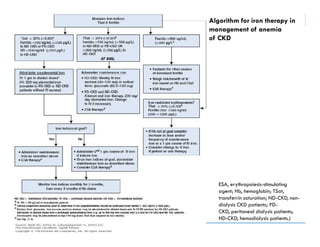
Algorithm for iron therapy in
management of anemia
of CKD
ESA, erythropoiesis-stimulating
agent; Hb, hemoglobin; TSat,
transferrin saturation; ND-CKD, non-
dialysis CKD patients; PD-
CKD, peritoneal dialysis patients;
HD-CKD, hemodialysis patients.)
Iron Adverse Effects
๏‚ง Primarily GI in nature and include constipation, nausea, and
abdominal cramping; more likely as the dose is escalated.
๏‚ง IV iron: hypotension, dizziness, dyspnea, headaches, lower back
pain, arthralgia, syncope, and arthritis, anaphylaxisanaphylaxis 0.60.6% to 0.7%% to 0.7%
So, decrease the dose or rate of infusion
๏‚ง Primarily GI in nature and include constipation, nausea, and
abdominal cramping; more likely as the dose is escalated.
๏‚ง IV iron: hypotension, dizziness, dyspnea, headaches, lower back
pain, arthralgia, syncope, and arthritis, anaphylaxisanaphylaxis 0.60.6% to 0.7%% to 0.7%
Iron Drug Interactions
๏‚ง Iron absorption is decreased by
Other elements (eg, calcium in calcium-containing phosphate
binders),
Medications that increase the pH of the GI tract such as PPIs and
H2As , and antibiotics [doxycycline and tetracycline].
๏‚ง Iron also decreases absorption of other drugs such as antibiotics
(fluoroquinolones, doxycycline)
๏‚ง Iron absorption is decreased by
Other elements (eg, calcium in calcium-containing phosphate
binders),
Medications that increase the pH of the GI tract such as PPIs and
H2As , and antibiotics [doxycycline and tetracycline].
๏‚ง Iron also decreases absorption of other drugs such as antibiotics
(fluoroquinolones, doxycycline)
Erythropoiesis-Stimulating Agent Therapy
๏‚ง Are recombinant erythropoietin with similar amino acid sequence.
Darbepoetin alfa = long t1/2
Epoetin alfa
๏‚ง Administered by either IV or SubQ route.
๏‚ง Donโ€™t make dosing changes too soon
๏‚ง Are recombinant erythropoietin with similar amino acid sequence.
Darbepoetin alfa = long t1/2
Epoetin alfa
๏‚ง Administered by either IV or SubQ route.
๏‚ง Donโ€™t make dosing changes too soon
Hb continues to increase until the life span of the cells stimulated by ESA therapy is reached
(mean 2 months; range 1-4 months in patients with ESRD)
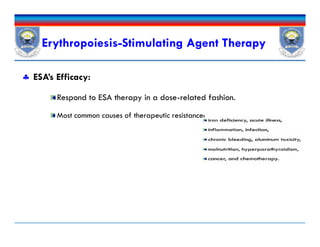
๏‚ง ESAโ€™s Efficacy:
Respond to ESA therapy in a dose-related fashion.
Most common causes of therapeutic resistance:
Erythropoiesis-Stimulating Agent Therapy
๏‚ง ESAโ€™s Efficacy:
Respond to ESA therapy in a dose-related fashion.
Most common causes of therapeutic resistance:
ESA Adverse Effects
๏‚ง Hypertension, Hypertensive encephalopathy.
Donโ€™t be used in those with uncontrolled blood pressure.
๏‚ง Seizures: within 3months of initiation
๏‚ง Thrombosis of the HD vascular access site and other thromboembolic
events esp. in higher hemoglobin [>13 g/dL]
๏‚ง ESAs are not indicated in patients receiving myelosuppressive
chemotherapy when the anticipated outcome is cure.
๏‚ง Hypertension, Hypertensive encephalopathy.
Donโ€™t be used in those with uncontrolled blood pressure.
๏‚ง Seizures: within 3months of initiation
๏‚ง Thrombosis of the HD vascular access site and other thromboembolic
events esp. in higher hemoglobin [>13 g/dL]
๏‚ง ESAs are not indicated in patients receiving myelosuppressive
chemotherapy when the anticipated outcome is cure.
ESA dosing and administration
๏‚ง Hb levels should be monitored at least monthly (weekly may be
preferred) until stable and then monthly thereafter.
๏‚ง Dose adjustments should be made based on Hb response
๏‚ง An acceptable rate of increase in Hb is 1 to 2 g/dL/month.
๏‚ง 25% increase in dose if Hb not increased by 1 g/dL after 4 weeks.
๏‚ง 25% decrease in dose if Hb increased >1 g/dL in a 2-week
๏‚ง Hb levels should be monitored at least monthly (weekly may be
preferred) until stable and then monthly thereafter.
๏‚ง Dose adjustments should be made based on Hb response
๏‚ง An acceptable rate of increase in Hb is 1 to 2 g/dL/month.
๏‚ง 25% increase in dose if Hb not increased by 1 g/dL after 4 weeks.
๏‚ง 25% decrease in dose if Hb increased >1 g/dL in a 2-week
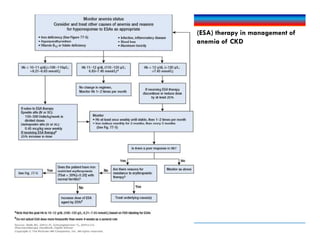
(ESA) therapy in management of
anemia of CKD
KDIGO ESA use recommendation
ND-CKD CKD 5HD and CKD 5PD Pediatric CKD
ESA initiation If Hb <10 g/dL (<100 g/L; <6.21
mmol/L). Consider rate of fall of Hb,
prior response to iron, risk of needing a
transfusion, risk of ESA therapy, and
presence of anemia symptoms before
initiating an ESA. [2C]
Do not initiate if Hb โ‰ฅ10 g/dL (โ‰ฅ100
g/L; โ‰ฅ6.21 mmol/L). [2D]
Use ESAs to avoid drop in Hb to <9
g/dL (<90 g/L; <5.59 mmol/L) by
starting an ESA when Hb is between
9 and 10 g/dL (90 and 100 g/L; 5.59
and 6.21 mmol/L). [2B]
Selection of Hb concentration at which to
initiate ESA therapy should include
consideration of potential benefits (eg,
improvement in QOL, school attendance,
avoidance of blood transfusions) and
potential harms. [2D]
If Hb <10 g/dL (<100 g/L; <6.21
mmol/L). Consider rate of fall of Hb,
prior response to iron, risk of needing a
transfusion, risk of ESA therapy, and
presence of anemia symptoms before
initiating an ESA. [2C]
Do not initiate if Hb โ‰ฅ10 g/dL (โ‰ฅ100
g/L; โ‰ฅ6.21 mmol/L). [2D]
Hb level Do not use ESAs
to intentionally increase Hb above 13
g/dL (130 g/L, 8.07 mmol/L). [1A]
Do not use ESAs to maintain Hb above
11.5 g/dL (115 g/L; 7.14 mmol/L). [2C]
Do not use ESAs
to intentionally increase Hb above 13
g/dL (130 g/L, 8.07 mmol/L). [1A]
Do not use ESAs to maintain Hb
above 11.5 g/dL (115 g/L; 7.14
mmol/L). [2C]
Suggest Hb range of 11-12 g/dL (110-120
g/L, 6.83-7.45 mmol/L). [2D]
Iron initiationb If TSat is โ‰ค30% (โ‰ค0.30) and ferritin is
โ‰ค500 ng/mL (ฮผg/L; โ‰ค1,120 pmol/L).
[2C]
If TSat is โ‰ค30% (โ‰ค0.30) and ferritin is
โ‰ค500 ng/mL (ฮผg/L; โ‰ค1,120 pmol/L).
[2C]
If TSat is โ‰ค20% (โ‰ค0.20) and ferritin is
โ‰ค100 ng/mL (ฮผg/L; โ‰ค225 pmol/L). [1D]
CKD, chronic kidney disease; ESA, erythropoiesis
stimulating agent; Hb, hemoglobin; ND-CKD, non-
dialysis CKD patients; QOL, quality of life; TSat,
transferrin saturation.
๏ƒผ Serum ferritin is an acute-phase reactant-use
clinical judgment when above 500 ng/mL
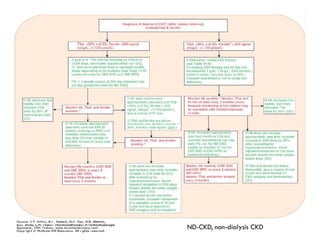
ND-CKD, non-dialysis CKD
Transfusions
๏‚ง Red blood cell transfusions carry many risks
๏‚ง Should only be used in select situations, such as
Acute management of symptomatic anemia,
Following significant acute blood loss
๏‚ง Red blood cell transfusions carry many risks
๏‚ง Should only be used in select situations, such as
Acute management of symptomatic anemia,
Following significant acute blood loss
Evaluation of Therapeutic Outcomes
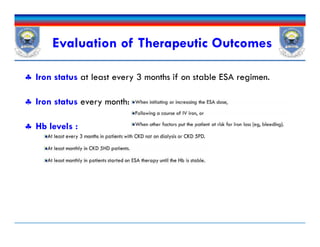
๏‚ง Iron status at least every 3 months if on stable ESA regimen.
๏‚ง Iron status every month:
๏‚ง Hb levels :
๏‚ง Iron status at least every 3 months if on stable ESA regimen.
๏‚ง Iron status every month:
๏‚ง Hb levels :
CKD-Related Mineral and Bone Disorder
๏‚ง Include abnormalities in PTH, Ca, P, Vit. D, fibroblast growth factor-
23 (FGF-23), bone turnover, as well as soft-tissue calcifications.
๏‚ง The pathophysiology of CKD-MBD is complex.
๏‚ง Include abnormalities in PTH, Ca, P, Vit. D, fibroblast growth factor-
23 (FGF-23), bone turnover, as well as soft-tissue calcifications.
๏‚ง The pathophysiology of CKD-MBD is complex.
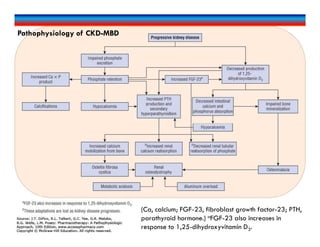
Pathophysiology of CKD-MBD
(Ca, calcium; FGF-23, fibroblast growth factor-23; PTH,
parathyroid hormone.) aFGF-23 also increases in
response to 1,25-dihydroxyvitamin D3.
๏‚ง The abnormalities of CKD-MBD lead to alterations in structural integrity
of bone and other associated consequences.
๏‚ง Continuous high rate of production of PTH by the parathyroid glands
promotes parathyroid hyperplasia.
๏‚ง Bone abnormalities are almost universal in dialysis patients and
observed in the majority of those with CKD 3-5.
Osteitis fibrosa cystica (high bone turnover disease): Most common
Osteomalacia (low bone turnover disease), disease.
CKD-MBD
๏‚ง The abnormalities of CKD-MBD lead to alterations in structural integrity
of bone and other associated consequences.
๏‚ง Continuous high rate of production of PTH by the parathyroid glands
promotes parathyroid hyperplasia.
๏‚ง Bone abnormalities are almost universal in dialysis patients and
observed in the majority of those with CKD 3-5.
Osteitis fibrosa cystica (high bone turnover disease): Most common
Osteomalacia (low bone turnover disease), disease.
๏ƒผCharacterized by areas of peritrabecular fibrosis.
๏ƒผIts result in bone marrow fibrosis and decreased erythropoiesis
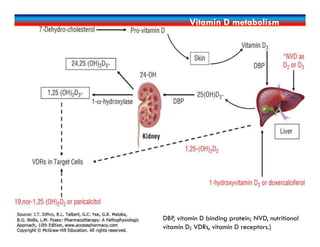
Vitamin D metabolism
DBP, vitamin D binding protein; NVD, nutritional
vitamin D; VDRs, vitamin D receptors.)
Dx of CKD-MBD
๏‚ง Alterations in serum phosphorus, calcium, PTH, and 25(OH)D.
๏‚ง Evaluation of bone architecture
๏‚ง Gold standard: bone biopsy for histologic analysis[very invasive]
๏‚ง Other: based on patient presentation
๏‚ง Alterations in serum phosphorus, calcium, PTH, and 25(OH)D.
๏‚ง Evaluation of bone architecture
๏‚ง Gold standard: bone biopsy for histologic analysis[very invasive]
๏‚ง Other: based on patient presentation
๏‚ง Goal of therapy:
Normalizeโ€ the biochemical parameters
Prevent bone manifestations, CV and extravascular calcifications,
and the associated morbidity and mortality
๏‚ง Management of PTH, phosphorus, and calcium is important.
๏‚ง Combination of dietary intervention, phosphate-binding
medications, vitamin D, and calcimimetic therapy (for ESRD patients).
Rx of CKD-MBD
๏‚ง Goal of therapy:
Normalizeโ€ the biochemical parameters
Prevent bone manifestations, CV and extravascular calcifications,
and the associated morbidity and mortality
๏‚ง Management of PTH, phosphorus, and calcium is important.
๏‚ง Combination of dietary intervention, phosphate-binding
medications, vitamin D, and calcimimetic therapy (for ESRD patients).
CKD-MBDโ€ฆ Non-pharmacologic RX
๏‚ง Dietary phosphorus restriction:
To manage hyperphosphatemia
Should be initiated for most patients with CKD 3-5.
Phosphorus restriction to 800 to 1,000 mg/day
๏‚ง Parathyroidectomy: therapeutic option
Persistently elevated PTH associated with hypercalcemia and/or
hyperphosphatemia [refractory to medical therapy]
๏‚ง Dietary phosphorus restriction:
To manage hyperphosphatemia
Should be initiated for most patients with CKD 3-5.
Phosphorus restriction to 800 to 1,000 mg/day
๏‚ง Parathyroidectomy: therapeutic option
Persistently elevated PTH associated with hypercalcemia and/or
hyperphosphatemia [refractory to medical therapy]
When PTH >800 pg/mL
๏‚ง Phosphate-Binding Agents
Especially for those with ESRD; to limit GI absorption and
thereby control serum phosphorus.
Includes: elemental calcium, iron, and lanthanum-containing
compounds, and the non-elemental agent [sevelamer]
๏‚ง Vitamin D Therapy
๏‚ง Calcimimetics: Cinacalcet acts by increasing the sensitivity of the
calcium-sensing receptor.
CKD-MBDโ€ฆ Pharmacologic RX
๏‚ง Phosphate-Binding Agents
Especially for those with ESRD; to limit GI absorption and
thereby control serum phosphorus.
Includes: elemental calcium, iron, and lanthanum-containing
compounds, and the non-elemental agent [sevelamer]
๏‚ง Vitamin D Therapy
๏‚ง Calcimimetics: Cinacalcet acts by increasing the sensitivity of the
calcium-sensing receptor.
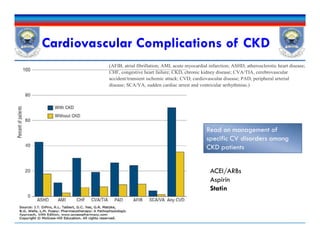
Cardiovascular Complications of CKD
(AFIB, atrial fibrillation; AMI, acute myocardial infarction; ASHD, atherosclerotic heart disease;
CHF, congestive heart failure; CKD, chronic kidney disease; CVA/TIA, cerebrovascular
accident/transient ischemic attack; CVD, cardiovascular disease; PAD, peripheral arterial
disease; SCA/VA, sudden cardiac arrest and ventricular arrhythmias.)
Read on management of
specific CV disorders among
CKD patients
Read on management of
specific CV disorders among
CKD patients
ACEI/ARBs
Aspirin
Statin
Management of Dyslipidemia in CKD
Dyslipidemia Goal Initial Therapy Modification in
Therapya Alternativea
TG โ‰ฅ500
mg/dL
TG<500
mg/dL
TLC TLC + fibrate
or niacin
Fibrate or niacin
LDL 100โ€“129
mg/dL
LDL <100
mg/dL
TLC TLC + low-
dose statin
Bile acid
sequestrant
or niacin
LDL 100โ€“129
mg/dL
LDL <100
mg/dL
TLC + low-
dose statin
Bile acid
sequestrant
or niacin
LDL โ‰ฅ130
mg/dL
LDL <100
mg/dL
TLC + low-
dose statin
TLC +
maximum-
dose statin
Bile acid
sequestrant
or niacin
TG โ‰ฅ200
mg/dL and non-
HDL
โ‰ฅ130mg/dL
Non-HDL <130
mg/dL
TLC + low-
dose statin
TLC +
maximum-
dose statin
Fibrate or niacin
aDosing of selected agents by class: fibrate (gemfibrozil 600 mg twice daily); niacin (1.5โ€“3 g/day of immediate-release
product); statin (simvastatin 10โ€“40 mg/day if GFR<30 mL/min [<0.50 mL/s], 20โ€“80 mg/day if GFR >30 mL/min [>0.50
mL/s]); bile acid sequestrant (cholestyramine 4โ€“16 g/day).
Chronic Kidney Disease (CKD)

Chronic Kidney Disease (CKD)

  • 1.
    Renal Disorders PharmacotherapyRenalDisorders Pharmacotherapy Chapter 3 Chronic Kidney Disease [CKD] Renal Disorders Pharmacotherapy By: Tsegaye Melaku [B.Pharm, MSc, Clinical Pharmacist] March, 2017March, 2017 tsegayemlk@yahoo.com or tsegaye.melaku@ju.edu.et +251913765609+251913765609 Chapter 3 Chronic Kidney Disease [CKD]
  • 2.
    Lesson Objectives ๏‚ง Uponcompletion of the chapter, you will be able to: ๏ƒœ List the risk factors for development and progression of chronic kidney disease (CKD). ๏ƒœ Explain the mechanisms associated with progression of CKD. ๏ƒœ Develop a therapeutic approach to slow progression of CKD, including lifestyle modifications and pharmacologic therapies. ๏ƒœ Identify complications associated to CKD ๏ƒœ Design an appropriate therapeutic approach for specific consequences associated with CKD. ๏ƒœ Monitor and evaluate therapeutic outcomes ๏ƒœ List the risk factors for development and progression of chronic kidney disease (CKD). ๏ƒœ Explain the mechanisms associated with progression of CKD. ๏ƒœ Develop a therapeutic approach to slow progression of CKD, including lifestyle modifications and pharmacologic therapies. ๏ƒœ Identify complications associated to CKD ๏ƒœ Design an appropriate therapeutic approach for specific consequences associated with CKD. ๏ƒœ Monitor and evaluate therapeutic outcomes
  • 3.
    Case Scenario ๏‚ง A.A,a 41 year-old male, from who has a longstanding history of hypertension and diabetes and presents JUMC , medical ward with a complaint of pruritis, lethargy, lower extremity edema, nausea and emesis. He denies any other medical illnesses. ๏‚ง On physical exam the patient is a well-developed, well-nourished male in moderate distress. Blood pressure 180/110, pulse 80, respirations 24 and he was afebrile. Body weight 76.5 kg. Cardiac exam had an S1, S2 and S4. The remainder of the exam was remarkable for 2+ lower extremity edema and superficial excoriations of his skin from scratching. ๏‚ง A.A, a 41 year-old male, from who has a longstanding history of hypertension and diabetes and presents JUMC , medical ward with a complaint of pruritis, lethargy, lower extremity edema, nausea and emesis. He denies any other medical illnesses. ๏‚ง On physical exam the patient is a well-developed, well-nourished male in moderate distress. Blood pressure 180/110, pulse 80, respirations 24 and he was afebrile. Body weight 76.5 kg. Cardiac exam had an S1, S2 and S4. The remainder of the exam was remarkable for 2+ lower extremity edema and superficial excoriations of his skin from scratching.
  • 4.
    A.Aโ€™s Laboratory Dataresult Chemistry Result Normal Values Urinalysis Sodium 133 136-146 mmol/L PH 6.0 Specific gravity 1.010 Protein 1+ Glucose โ€“Ve Acetone โ€“ve Occult blood โ€“ve Bile -ve Waxy casts Potassium 6.2 3.5-5.3 mmol/L Chloride 100 98-108 mmol/L Total CO2 15 23-27 mmol/L BUN 170 7-22 mg/dl Creatinine 16.0 0.7-1.5 mg/dl U/S: both shrinked Kidney PH 6.0 Specific gravity 1.010 Protein 1+ Glucose โ€“Ve Acetone โ€“ve Occult blood โ€“ve Bile -ve Waxy casts Creatinine 16.0 0.7-1.5 mg/dl Glucose 108 70-110 mg/dl Calcium 7.2 8.9-10.3 mg/dl Phosphorus 10.5 2.6-6.4 mg/dl Alkaline Phosphatase 306 30-110 IU/L Parathyroid Hormone 895 10-65 pg/ml Hemoglobin 8.6 14-17 gm/dl Hematocrit 27.4 40-54 % Mean cell volume 88 85-95 FL
  • 5.
    1. โ€œPresents witha complaint of pruritis, lethargy, lower extremity edema, nausea and emesis." what does the symptoms suggest to you? 2. What does S4 signify? What cardiac findings will you expect to find in a hypertensive? 3. Is the cause of this patientโ€™s renal failure acute or chronic? How did you arrive at that conclusion? 4. What are risk factors for his current diagnosis? 5. What is the calculated GFR? 6. Why is the parathyroid hormone elevated? 7. What is the most likely cause of this patientโ€™s anemia? 8. General approach of management?? Viva questions 1. โ€œPresents with a complaint of pruritis, lethargy, lower extremity edema, nausea and emesis." what does the symptoms suggest to you? 2. What does S4 signify? What cardiac findings will you expect to find in a hypertensive? 3. Is the cause of this patientโ€™s renal failure acute or chronic? How did you arrive at that conclusion? 4. What are risk factors for his current diagnosis? 5. What is the calculated GFR? 6. Why is the parathyroid hormone elevated? 7. What is the most likely cause of this patientโ€™s anemia? 8. General approach of management??
  • 6.
    Introduction: CKD ๏‚ง CKDDefined Abnormalities in kidney structure or function, present forโ‰ฅ 3 months Progressive loss of function over several months to years, ยป Characterized by gradual replacement of normal kidney architecture with parenchymal fibrosis. ๏‚ง The KDIGO classification system based on CGA staging (Cause, GFR, Albuminuria). ๏‚ง CKD Defined Abnormalities in kidney structure or function, present forโ‰ฅ 3 months Progressive loss of function over several months to years, ยป Characterized by gradual replacement of normal kidney architecture with parenchymal fibrosis. ๏‚ง The KDIGO classification system based on CGA staging (Cause, GFR, Albuminuria). KDIGO: Kidney Disease: Improving Global Outcomes
  • 7.
    Epidemiology ๏‚ง Globally, 8%to 16% of the general population has CKD ๏‚ง 1.9 million patients are undergoing renal replacement therapy[RRT]. ๏‚ง Prevalence of CKD increases with age: ~30% in >70 years old. ๏‚ง Diabetes and hypertension are also important risk factors for CKD. ๏‚ง In patients with type 2 diabetes, prevalence of 27%. ๏‚ง Among T1DM; 17% to 25% of patients developed diabetic chronic kidney disease (DCKD) after 30 years. ๏‚ง Globally, 8% to 16% of the general population has CKD ๏‚ง 1.9 million patients are undergoing renal replacement therapy[RRT]. ๏‚ง Prevalence of CKD increases with age: ~30% in >70 years old. ๏‚ง Diabetes and hypertension are also important risk factors for CKD. ๏‚ง In patients with type 2 diabetes, prevalence of 27%. ๏‚ง Among T1DM; 17% to 25% of patients developed diabetic chronic kidney disease (DCKD) after 30 years.
  • 8.
    Epidemiologyโ€ฆ Incident rates ofend-stage renal disease (ESRD) by primary diagnosis (1980-2012)
  • 9.
    Etiology/Risk Factors ๏‚ง TheKidney Disease Outcomes Quality Initiative (KDOQI): ๏‚ง CKD risk factor categories Susceptibility factors Initiation factors Progression factors ๏‚ง The Kidney Disease Outcomes Quality Initiative (KDOQI): ๏‚ง CKD risk factor categories Susceptibility factors Initiation factors Progression factors
  • 10.
    ๏‚ง Susceptibility factors: Advancedage, reduced kidney mass and low birth weight, family history, low income, systemic inflammation, dyslipidemia. Most of them are not amenable to pharmacologic or lifestyle interventions. Useful for identifying populations at high risk for CKD. Etiology/Risk Factorsโ€ฆ ๏‚ง Susceptibility factors: Advanced age, reduced kidney mass and low birth weight, family history, low income, systemic inflammation, dyslipidemia. Most of them are not amenable to pharmacologic or lifestyle interventions. Useful for identifying populations at high risk for CKD.
  • 11.
    ๏‚ง Initiation Factors: Conditionsthat result in direct kidney damage Modifiable by pharmacologic therapy DM, Hypertension, Glomerulonephritis: the most common leading causes of CKD. ๏‚ง DM: a cause for 45% of new ESRD cases in 2010, followed by HTN (29%), US Etiology/Risk Factorsโ€ฆ ๏‚ง Initiation Factors: Conditions that result in direct kidney damage Modifiable by pharmacologic therapy DM, Hypertension, Glomerulonephritis: the most common leading causes of CKD. ๏‚ง DM: a cause for 45% of new ESRD cases in 2010, followed by HTN (29%), US
  • 12.
    ๏‚ง Progression riskfactors Factors associated with further decline in kidney function in patients who already have kidney damage Persistence of the underlying initiation factors of CKD (e.g., DM, HTN, glomerulonephritis) โ€“ Serve as predictors of progressive CKD Other factors associated with progression โ€“ Factors consequent to the underlying kidney disease, e.g, HTN, proteinuria โ€“ Factors independent of underlying kidney disease, e.g., smoking, obesity Etiology/Risk Factorsโ€ฆ ๏‚ง Progression risk factors Factors associated with further decline in kidney function in patients who already have kidney damage Persistence of the underlying initiation factors of CKD (e.g., DM, HTN, glomerulonephritis) โ€“ Serve as predictors of progressive CKD Other factors associated with progression โ€“ Factors consequent to the underlying kidney disease, e.g, HTN, proteinuria โ€“ Factors independent of underlying kidney disease, e.g., smoking, obesity
  • 13.
    Diabetes ๏‚ง Hyperglycemia: aninitiation and progression risk factor for CKD ๏‚ง Without treatment, ~80% of patients with DM-2 and microalbuminuria will develop overt nephropathy ~50% of those with DM-1, nephropathy, and HTN will develop stage 5 CKD within 10 years. ๏‚ง Lifetime risk of developing CKD Type 1 DM patients: 40% Type 2 DM patients: 50% ๏‚ง Greater prevalence of type 2 DM compared to type 1 13 ๏‚ง Hyperglycemia: an initiation and progression risk factor for CKD ๏‚ง Without treatment, ~80% of patients with DM-2 and microalbuminuria will develop overt nephropathy ~50% of those with DM-1, nephropathy, and HTN will develop stage 5 CKD within 10 years. ๏‚ง Lifetime risk of developing CKD Type 1 DM patients: 40% Type 2 DM patients: 50% ๏‚ง Greater prevalence of type 2 DM compared to type 1
  • 14.
    Hypertension ๏‚ง Hypertension: botha cause of CKD and a result of CKD ๏‚ง Early treatment of HTN and achievement of target BP Slow the rate of progression of CKD ๏‚ง BP goal in CKD is to control at all stages of CKD regardless of the underlying cause. ๏‚ง Lifetime risk of stage 5 CKD for patients with HTN: 5.6% Elevated BP increases risk for developing CKD 14 ๏‚ง Hypertension: both a cause of CKD and a result of CKD ๏‚ง Early treatment of HTN and achievement of target BP Slow the rate of progression of CKD ๏‚ง BP goal in CKD is to control at all stages of CKD regardless of the underlying cause. ๏‚ง Lifetime risk of stage 5 CKD for patients with HTN: 5.6% Elevated BP increases risk for developing CKD
  • 15.
    Glomerulonephritis ๏‚ง Glomerulonephritis โ€ฆ..includesa wide variety of lesions caused by immunologic, vascular, and other idiopathic diseases. It is the third leading cause of ESRD ๏‚ง Chronic glomerular diseases progress at variable rates Loss of GFR 1.4 to 9.5 mL/min/year 15 ๏‚ง Glomerulonephritis โ€ฆ..includes a wide variety of lesions caused by immunologic, vascular, and other idiopathic diseases. It is the third leading cause of ESRD ๏‚ง Chronic glomerular diseases progress at variable rates Loss of GFR 1.4 to 9.5 mL/min/year
  • 16.
    Proteinuria ๏‚ง In diabeteswith CKD, an albumin excretion rate >30 mg/24 hrs strongly predicted the development of progression of CKD. ๏‚ง Proteinuria alone may promote progressive loss of nephrons through direct cellular damage ๏‚ง Filtered proteins are toxic to kidney tubule cells Albumin, transferrin, complement factors, immunoglobulins, cytokines, angiotensin II ๏‚ง Presence of proteins in renal tubules activates tubular cells leads to ๏‚ญed production of inflammatory and vasoactive cytokines such as endothelin (potent VC) 16 ๏‚ง In diabetes with CKD, an albumin excretion rate >30 mg/24 hrs strongly predicted the development of progression of CKD. ๏‚ง Proteinuria alone may promote progressive loss of nephrons through direct cellular damage ๏‚ง Filtered proteins are toxic to kidney tubule cells Albumin, transferrin, complement factors, immunoglobulins, cytokines, angiotensin II ๏‚ง Presence of proteins in renal tubules activates tubular cells leads to ๏‚ญed production of inflammatory and vasoactive cytokines such as endothelin (potent VC)
  • 17.
    ๏‚ง Proteinuria isalso associated with the activation of complement components on the apical membrane of proximal tubules ๏‚ง Intratubular complement activation may be the key mechanism of damage in the progressive proteinuric nephropathies ๏ƒจ ๏ƒจ Interstitial scarring Progressive loss of structural nephron units Reduction in GFR Proteinuriaโ€ฆ 17 ๏‚ง Proteinuria is also associated with the activation of complement components on the apical membrane of proximal tubules ๏‚ง Intratubular complement activation may be the key mechanism of damage in the progressive proteinuric nephropathies ๏ƒจ ๏ƒจ Interstitial scarring Progressive loss of structural nephron units Reduction in GFR
  • 18.
    Smoking ๏‚ง Smoking isassociated with โ€ฆ. Acute reduction in GFR Increase in urinary albumin excretion, HR, and BP, likely secondary to nicotine exposure ๏‚ง May promote initiation & progression of CKD in DM patients ๏‚ง Smoking has been associated with โ€ฆ. Diagnosis of CKD in those with HTN Development of stage 5 CKD 18 ๏‚ง Smoking is associated with โ€ฆ. Acute reduction in GFR Increase in urinary albumin excretion, HR, and BP, likely secondary to nicotine exposure ๏‚ง May promote initiation & progression of CKD in DM patients ๏‚ง Smoking has been associated with โ€ฆ. Diagnosis of CKD in those with HTN Development of stage 5 CKD
  • 19.
    Dyslipidemia ๏‚ง CKD with/withoutnephrotic syndrome is frequently accompanied by abnormalities in lipoprotein metabolism. ๏‚ง In patients with CKD and proteinuria >3 g/day, the major lipid abnormalities are: Elevation of plasma total and LDL cholesterol Low HDL cholesterol (<35 mg/dL) Elevated triglycerides (>200 mg/dL) ๏‚ง Lipid abnormality treatment may slow CKD progression ๏‚ง Treatment of proteinuria resolves the hyperlipidemia in most patients with nephrotic syndrome. 19 ๏‚ง CKD with/without nephrotic syndrome is frequently accompanied by abnormalities in lipoprotein metabolism. ๏‚ง In patients with CKD and proteinuria >3 g/day, the major lipid abnormalities are: Elevation of plasma total and LDL cholesterol Low HDL cholesterol (<35 mg/dL) Elevated triglycerides (>200 mg/dL) ๏‚ง Lipid abnormality treatment may slow CKD progression ๏‚ง Treatment of proteinuria resolves the hyperlipidemia in most patients with nephrotic syndrome.
  • 20.
    Obesity*** ๏‚ง Studies demonstrateincreased risk of stage 5 CKD in overweight and obese subjects BMI โ‰ฅ25 kg/m2 associated with 3-fold increase in CKD risk. Obesity (BMI โ‰ฅ30 kg/m2)associated with 3- to 4 fold increased in CKD risk ๏‚ง Weight reduction as part of the treatment of progressive kidney disease is suggested. 20 ๏‚ง Studies demonstrate increased risk of stage 5 CKD in overweight and obese subjects BMI โ‰ฅ25 kg/m2 associated with 3-fold increase in CKD risk. Obesity (BMI โ‰ฅ30 kg/m2)associated with 3- to 4 fold increased in CKD risk ๏‚ง Weight reduction as part of the treatment of progressive kidney disease is suggested. ๏ƒผ***a major risk factor for essential hypertension, diabetes, and other comorbid conditions ๏ƒผPuts more strain on the kidneys
  • 21.
    Bottom line ๏‚ง ClinicalFactors Diabetes Hypertension Obesity Autoimmune diseases Systemic infections Urinary tract infections Urinary stones Lower urinary tract obstruction Neoplasia Family history of CKD Recovery from acute kidney injury Reduction in kidney mass Exposure to certain drugs Low birth weight ๏‚ง Sociodemographic Factors Older age Exposure to certain chemical and environmental conditions Low income/education Diabetes Hypertension Obesity Autoimmune diseases Systemic infections Urinary tract infections Urinary stones Lower urinary tract obstruction Neoplasia Family history of CKD Recovery from acute kidney injury Reduction in kidney mass Exposure to certain drugs Low birth weight Older age Exposure to certain chemical and environmental conditions Low income/education
  • 22.
    Pathophysiology ๏‚ง Precise mechanismof kidney damage dependent on the etiology of the disease. ๏‚ง Heterogeneous causes Diabetic nephropathy: glomerular mesangial expansion Hypertensive nephrosclerosis: kidney's arterioles have arteriolar hyalinosis Polycystic kidney disease: renal cysts develop ๏‚ง Precise mechanism of kidney damage dependent on the etiology of the disease. ๏‚ง Heterogeneous causes Diabetic nephropathy: glomerular mesangial expansion Hypertensive nephrosclerosis: kidney's arterioles have arteriolar hyalinosis Polycystic kidney disease: renal cysts develop
  • 23.
    ๏‚ง Key elementsof the pathway to ESRD: Loss of nephrons mass, Glomerular capillary hypertension, Proteinuria. Pathophysiologyโ€ฆ ๏‚ง Key elements of the pathway to ESRD: Loss of nephrons mass, Glomerular capillary hypertension, Proteinuria.
  • 24.
    ๏‚ง Exposure toinitiation risk factors can result in loss of nephrons mass ๏‚ง The remaining nephrons hypertrophy to compensate for the loss of nephrons mass and kidney function ๏‚ง Compensatory hypertrophy may be adaptive Over time, hypertrophy may lead to intraglomerular hypertension Possibly mediated by angiotensin II ๏‚ง High intraglomerular capillary pressure impairs the size-selective function of the glomerular permeability barrier Resulting in increased urinary excretion of albumin and proteinuria Pathophysiologyโ€ฆ ๏‚ง Exposure to initiation risk factors can result in loss of nephrons mass ๏‚ง The remaining nephrons hypertrophy to compensate for the loss of nephrons mass and kidney function ๏‚ง Compensatory hypertrophy may be adaptive Over time, hypertrophy may lead to intraglomerular hypertension Possibly mediated by angiotensin II ๏‚ง High intraglomerular capillary pressure impairs the size-selective function of the glomerular permeability barrier Resulting in increased urinary excretion of albumin and proteinuria
  • 25.
  • 26.
  • 27.
    Proposed mechanisms ofprogression of kidney disease.
  • 28.
    GFR Categorya GFR(mL/min2 [mL/s/]) Terms 1 >90 (>0.87) Normal or high 2 60โ€“89 (0.58โ€“0.86) Mildly decreased 3a 45โ€“59 (0.43โ€“0.57) Mildly to moderately decreased CKD Stages Based on KDIGO Classification Mildly to moderately decreased 3b 30โ€“44 (0.29โ€“0.42) Moderately to severely decreased 4 15โ€“29 (0.14โ€“0.28) Severely decreased 5 <15 (<0.14) Kidney failure aTo meet criteria for CKD there must be a significant reduction in GFR (categories 3a-5) or there must also be evidence of kidney damage (categories 1 and 2) for 3 months or greater. ๏ƒผ CKD can be present with normal/near normal GFR if other markers of kidney disease are present
  • 29.
    Prognosis of CKD ๏‚งDependent on the following factors: Cause of kidney disease; GFR at time of diagnosis; Degree of albuminuria; Presence of other comorbid conditions. ๏‚ง End-stage renal disease (ESRD) GFR <15 mL/min/: need chronic dialysis or kidney transplantation ๏‚ง Dependent on the following factors: Cause of kidney disease; GFR at time of diagnosis; Degree of albuminuria; Presence of other comorbid conditions. ๏‚ง End-stage renal disease (ESRD) GFR <15 mL/min/: need chronic dialysis or kidney transplantation
  • 30.
    Clinical Pictures andAssessment ๏‚ง Often asymptomatic ๏‚ง Symptoms Fatigue, weakness, shortness of breath, mental confusion, nausea and vomiting, bleeding, and loss of appetite, itching, cold intolerance, and peripheral neuropathies. ๏‚ง Signs Edema, weight gain (from accumulation of fluid), changes in urine output (volume and consistency), โ€œfoamingโ€ of urine (indicative of proteinuria), and abdominal distension. ๏‚ง Often asymptomatic ๏‚ง Symptoms Fatigue, weakness, shortness of breath, mental confusion, nausea and vomiting, bleeding, and loss of appetite, itching, cold intolerance, and peripheral neuropathies. ๏‚ง Signs Edema, weight gain (from accumulation of fluid), changes in urine output (volume and consistency), โ€œfoamingโ€ of urine (indicative of proteinuria), and abdominal distension.
  • 31.
    โ€ฆAssessment ๏‚ง Laboratory Tests ๏‚ทDecreased: eGFR, bicarbonate (metabolic acidosis), Hb/hematocrit (Hct) (anemia), transferrin saturation (TSat) and/or ferritin (iron deficiency; note: ferritin may be increased due to inflammatory conditions), vitamin D levels, albumin (malnutrition), glucose (may result from decreased degradation of insulin with impaired kidney function or poor oral intake), and calcium (in early stages of CKD). ๏‚ท Increased: Serum creatinine, blood urea nitrogen, potassium, phosphorus, PTH, FGF-23, ACR, PCR blood pressure (hypertension is a common cause and result of CKD), glucose (uncontrolled diabetes is a cause of CKD), low-density lipoprotein (LDL) and triglycerides, and calcium (more likely in CKD 5). ๏‚ท Other: May be hemoccult-positive if GI bleeding occurs secondary to uremia. ๏‚ท Decreased: eGFR, bicarbonate (metabolic acidosis), Hb/hematocrit (Hct) (anemia), transferrin saturation (TSat) and/or ferritin (iron deficiency; note: ferritin may be increased due to inflammatory conditions), vitamin D levels, albumin (malnutrition), glucose (may result from decreased degradation of insulin with impaired kidney function or poor oral intake), and calcium (in early stages of CKD). ๏‚ท Increased: Serum creatinine, blood urea nitrogen, potassium, phosphorus, PTH, FGF-23, ACR, PCR blood pressure (hypertension is a common cause and result of CKD), glucose (uncontrolled diabetes is a cause of CKD), low-density lipoprotein (LDL) and triglycerides, and calcium (more likely in CKD 5). ๏‚ท Other: May be hemoccult-positive if GI bleeding occurs secondary to uremia. Fibroblast growth factor 23
  • 32.
    ๏‚ท Urine sedimentabnormalities (hematuria, red blood cell and white blood cell casts, renal tubular epithelial cells) ๏‚ท Pathologic abnormalities indicating glomerular, vascular, tubulointerstitial disease, or cystic and congenital diseases ๏‚ท Structural abnormalities such as polycystic kidneys, renal masses, renal artery stenosis, cortical scarring due to infarcts and pyelonephritis, or small kidneys (common in more severe CKD) detected by imaging studies (eg, ultrasound, computed tomography, magnetic resonance imaging, angiography) ๏‚ง Other Diagnostic Tests โ€ฆAssessment ๏‚ท Urine sediment abnormalities (hematuria, red blood cell and white blood cell casts, renal tubular epithelial cells) ๏‚ท Pathologic abnormalities indicating glomerular, vascular, tubulointerstitial disease, or cystic and congenital diseases ๏‚ท Structural abnormalities such as polycystic kidneys, renal masses, renal artery stenosis, cortical scarring due to infarcts and pyelonephritis, or small kidneys (common in more severe CKD) detected by imaging studies (eg, ultrasound, computed tomography, magnetic resonance imaging, angiography) ๏ฑ CKD stages 3, 4, 5 require additional workup ๏ƒผ Anemia, CV disease, metabolic bone disease, malnutrition, fluid & electrolyte, disorders
  • 33.
    Treatment of CKD ๏‚งGeneral Identify the presence and causes of secondary complications and comorbid conditions. Interprofessional approach Dietary education, and social/financial concerns. Comprehensive medication management (CMM) /Drug-dosing ๏‚ง General Identify the presence and causes of secondary complications and comorbid conditions. Interprofessional approach Dietary education, and social/financial concerns. Comprehensive medication management (CMM) /Drug-dosing
  • 34.
    Desired Outcome ๏‚ง Delayor prevent progression of the disease ๏‚ง Minimizing the development or severity of associated complications. ๏‚ง Plan for RRT(HD or PD) starting from CKD ๏‚ง Sustain and improve, if possible, the patientโ€™s quality of life [CKD 5] ๏‚ง Prevent adverse outcomes by aggressively managing complications of CKD. ๏‚ง Delay or prevent progression of the disease ๏‚ง Minimizing the development or severity of associated complications. ๏‚ง Plan for RRT(HD or PD) starting from CKD ๏‚ง Sustain and improve, if possible, the patientโ€™s quality of life [CKD 5] ๏‚ง Prevent adverse outcomes by aggressively managing complications of CKD.
  • 35.
    Non-pharmacologic management ๏‚ง Diet Proteinrestriction to 0.8 g/kg/day in eGFR <30 mL/min(i.e, CKD 4). Decreasing sodium intake <2 g or 90 mEq (mmol)/day (corresponding to 5 g NaCl) ๏‚ง Smoking Cessation, Exercise, and Weight Loss ๏‚ง Diet Protein restriction to 0.8 g/kg/day in eGFR <30 mL/min(i.e, CKD 4). Decreasing sodium intake <2 g or 90 mEq (mmol)/day (corresponding to 5 g NaCl) ๏‚ง Smoking Cessation, Exercise, and Weight Loss
  • 36.
    Pharmacologic management ๏‚ง Proteinuria InitiateACEIs/ARBs DCKD: ACEI/ARB 1st line therapy [urine albumin excretion is in category A2 or greater (ACR between 30-300 mg/g)] Increase dose until albuminuria is reduced by 30% to 50% or side effects [e.g. >30% decrease in eGFR or elevation in serum potassium occur] ACEI + ARB ?? ACEI/ARB+ Aldosterone antagonist?? ๏‚ง Proteinuria Initiate ACEIs/ARBs DCKD: ACEI/ARB 1st line therapy [urine albumin excretion is in category A2 or greater (ACR between 30-300 mg/g)] Increase dose until albuminuria is reduced by 30% to 50% or side effects [e.g. >30% decrease in eGFR or elevation in serum potassium occur] ACEI + ARB ?? ACEI/ARB+ Aldosterone antagonist?? DCKD: Diabetic CKD
  • 37.
    ๏‚ง Dihydropyridine CCBsdo not appear to have any beneficial effects beyond those attributable to reducing BP. ๏‚ง Nondihydropyridine agents (diltiazem and verapamil]:yielded beneficial effects on proteinuria, although not as profoundly as ACEIs. 2nd antiproteinuric drugs [ACEI/ARB is contraindicated/not tolerated] Suppress of glomerular hypertrophy, Inhibit of platelet aggregation, and Decrease in salt accumulation. Pharmacologic managementโ€ฆ ๏‚ง Dihydropyridine CCBs do not appear to have any beneficial effects beyond those attributable to reducing BP. ๏‚ง Nondihydropyridine agents (diltiazem and verapamil]:yielded beneficial effects on proteinuria, although not as profoundly as ACEIs. 2nd antiproteinuric drugs [ACEI/ARB is contraindicated/not tolerated] Suppress of glomerular hypertrophy, Inhibit of platelet aggregation, and Decrease in salt accumulation.
  • 38.
    Hypertension ๏‚ง Recommended BPgoals based on the degree of albuminuria and the choice of antihypertensive agent. ๏‚ง KDIGO: โ‰ค140/90 mm Hg for those with category A1 albuminuria. ๏‚ง Category โ‰ฅA2 albuminuria :โ‰ค 130/80 mm Hg ๏‚ง Subjects with proteinuria greater than 300 mg/day did benefit from the lower blood pressure target. ๏‚ง 1st line: ACEI/ARB,, if not at goal, add diuretic(s) ๏‚ง Recommended BP goals based on the degree of albuminuria and the choice of antihypertensive agent. ๏‚ง KDIGO: โ‰ค140/90 mm Hg for those with category A1 albuminuria. ๏‚ง Category โ‰ฅA2 albuminuria :โ‰ค 130/80 mm Hg ๏‚ง Subjects with proteinuria greater than 300 mg/day did benefit from the lower blood pressure target. ๏‚ง 1st line: ACEI/ARB,, if not at goal, add diuretic(s)
  • 40.
  • 41.
    Therapeutic strategies to preventprogression of renal disease in non- diabetic individuals.
  • 42.
    Diabetes ๏‚ง Patients withDM should be screened annually for CKD Start at the time of diagnosis of T2DM 5 years after the diagnosis of T1DM ๏‚ง Reduction of proteinuria and achievement of desired BP & HbA1c [7%] ๏‚ง CKD 3 and 4 are at higher risk of developing hypoglycemia Reduction in metabolism of insulin by the kidney as GFR declines. Require reduced doses of oral or injectable hypoglycemic agents ๏‚ง Metformin: ๏‚ง Continued: eGFR โ‰ฅ45 mL/min; Reviewed: eGFR 30 to 44 mL/min, ๏‚ง Discontinued: eGFR <30 mL/min ๏‚ง Patients with DM should be screened annually for CKD Start at the time of diagnosis of T2DM 5 years after the diagnosis of T1DM ๏‚ง Reduction of proteinuria and achievement of desired BP & HbA1c [7%] ๏‚ง CKD 3 and 4 are at higher risk of developing hypoglycemia Reduction in metabolism of insulin by the kidney as GFR declines. Require reduced doses of oral or injectable hypoglycemic agents ๏‚ง Metformin: ๏‚ง Continued: eGFR โ‰ฅ45 mL/min; Reviewed: eGFR 30 to 44 mL/min, ๏‚ง Discontinued: eGFR <30 mL/min
  • 43.
  • 44.
    Recommendations Nonpharmacologic ๏ƒผExercise 30 minutesfive times per week [1D] ๏ƒผWeight loss if BMI >25 kg/m2 [1D] ๏ƒผSmoking cessation [1D] ๏ƒผAlcohol: Two standard drinks per day for men and one standard drink per day for women[2D] ๏ƒผIf hypertension: Low-sodium diet (<2 g/day, <90 mmol/day) [1C] Pharmacologic ๏ƒผAdjust medication doses for kidney function [1A] ๏ƒผSeek pharmacist or medical advice before using over-the-counter medicines or nutritional protein supplements [1B] ๏ƒผHerbal medicines are not recommended [1B] ๏ƒผTemporarily discontinue potentially nephrotoxic/renally excreted drugs if eGFR <60 mL/min/1.73 m2 in patients who are acutely unwell or hypovolemic (eg, metformin, RAAS blockers, diuretics, NSAIDs/COX II inhibitors, lithium, digoxin) [1C] Vaccines: ๏‚ท Influenza yearly [1B] ๏‚ท Pneumococcal vaccine if eGFR <30 mL/min/1.73 m2, nephrotic syndrome, diabetes, or receiving immunosuppression. Single booster dose at year 5 [1B] ๏‚ท Hepatitis B vaccine if eGFR <30 mL/min/1.73 m2 and risk of progression of CKD [1B] ๏ƒผASA suggested for patients at risk for atherosclerotic events unless there is an increased bleeding risk [2B] ๏ƒผAvoid oral phosphate-containing bowel preparations in people with a GFR <60 mL/min/1.73 m2 (<0.58 mL/s/m2) or in those known to be at risk of phosphate nephropathy [1A] Pharmacologic ๏ƒผAdjust medication doses for kidney function [1A] ๏ƒผSeek pharmacist or medical advice before using over-the-counter medicines or nutritional protein supplements [1B] ๏ƒผHerbal medicines are not recommended [1B] ๏ƒผTemporarily discontinue potentially nephrotoxic/renally excreted drugs if eGFR <60 mL/min/1.73 m2 in patients who are acutely unwell or hypovolemic (eg, metformin, RAAS blockers, diuretics, NSAIDs/COX II inhibitors, lithium, digoxin) [1C] Vaccines: ๏‚ท Influenza yearly [1B] ๏‚ท Pneumococcal vaccine if eGFR <30 mL/min/1.73 m2, nephrotic syndrome, diabetes, or receiving immunosuppression. Single booster dose at year 5 [1B] ๏‚ท Hepatitis B vaccine if eGFR <30 mL/min/1.73 m2 and risk of progression of CKD [1B] ๏ƒผASA suggested for patients at risk for atherosclerotic events unless there is an increased bleeding risk [2B] ๏ƒผAvoid oral phosphate-containing bowel preparations in people with a GFR <60 mL/min/1.73 m2 (<0.58 mL/s/m2) or in those known to be at risk of phosphate nephropathy [1A] 1=recommended; 2= suggested;; A=high quality, B=Moderate, C= Low; D= Very low
  • 45.
    Monitor and evaluate ๏‚งEffectiveness and safety ๏‚ง Monitor for HTN, DM, others related conditions ๏‚ง Clinical signs and symptoms
  • 46.
    Recommended Monitoring Intervalsfor Outcome Albuminuria Stage (based on ACR in mg/g) KDIGO GFR Category eGFR (mL/min) A1: <30 mg/g (<3 mg/mmol) A2: 30-300 mg/g (3-30 mg/mmol) A3: >300 mg/g (>30 mg/mmol) 1 โ‰ฅ90 12 months 12 months 6 months1 โ‰ฅ90 12 months 12 months 6 months 2 60-89 12 months 12 months 6 months 3a 45-59 12 months 6 months 4 months 3b 30-44 6 months 4 months 4 months 4 15-29 4 months 4 months 2-3 months 5 <15 1-3 months 1-3 months 1-3 months ACR, albumin-to-creatinine ratio
  • 47.
  • 48.
    Complications of CKD ๏‚งFrequent complications of advanced CKD: Altered sodium and water balance, Hyperkalemia, metabolic acidosis, anemia, CKD-related mineral and bone disorder (CKD-MBD), Cardiovascular disease (CVD). ๏‚ง Frequent complications of advanced CKD: Altered sodium and water balance, Hyperkalemia, metabolic acidosis, anemia, CKD-related mineral and bone disorder (CKD-MBD), Cardiovascular disease (CVD).
  • 49.
    Other Complications ofCKD Organ System or Complication Clinical Manifestations Amyloidosis ๏ƒผAccumulation of ฮฒ2-microglobulin ๏ƒผCarpal tunnel syndrome Blood and immune disorders ๏ƒผBleeding diathesis ๏ƒผImpaired cell-mediated immunity ๏ƒผLymphopenia ๏ƒผPlatelet dysfunction Endocrine ๏ƒผHypoglycemic episodes (result of decreased degradation of insulin by the kidney) GI ๏ƒผNausea, vomiting, anorexia (from uremia) ๏ƒผDelayed gastric emptying ๏ƒผGastroesophageal reflux ๏ƒผGI bleeding Proteinโ€“energy wasting ๏ƒผMalnutrition Neurologic ๏ƒผPeripheral neuropathies ๏ƒผRestless leg syndrome ๏ƒผUremic encephalopathy Uremic pruritus ๏ƒผGeneralized itching predominantlyof back, face, and extremity used for vascular access, but may affect any area ๏ƒผMay be more severe during or immediately after hemodialysis Organ System or Complication Clinical Manifestations Amyloidosis ๏ƒผAccumulation of ฮฒ2-microglobulin ๏ƒผCarpal tunnel syndrome Blood and immune disorders ๏ƒผBleeding diathesis ๏ƒผImpaired cell-mediated immunity ๏ƒผLymphopenia ๏ƒผPlatelet dysfunction Endocrine ๏ƒผHypoglycemic episodes (result of decreased degradation of insulin by the kidney) GI ๏ƒผNausea, vomiting, anorexia (from uremia) ๏ƒผDelayed gastric emptying ๏ƒผGastroesophageal reflux ๏ƒผGI bleeding Proteinโ€“energy wasting ๏ƒผMalnutrition Neurologic ๏ƒผPeripheral neuropathies ๏ƒผRestless leg syndrome ๏ƒผUremic encephalopathy Uremic pruritus ๏ƒผGeneralized itching predominantlyof back, face, and extremity used for vascular access, but may affect any area ๏ƒผMay be more severe during or immediately after hemodialysis
  • 50.
    Anemia of CKD ๏‚งPrimary cause: decrease in production of erythropoietin. ๏‚ง Normochromic -normocytic anemia. ๏‚ง Iron deficiency is also common in advanced kidney disease (i.e, CKD 4 and 5): Decreased GI absorption of iron Inflammation, Frequent blood testing, Blood loss from hemodialysis (HD), Increased iron demands from erythropoiesis stimulating agent (ESA) therapy. leading cause of resistance to ESAs and the reason frequent iron supplementation is necessary. ๏‚ง Primary cause: decrease in production of erythropoietin. ๏‚ง Normochromic -normocytic anemia. ๏‚ง Iron deficiency is also common in advanced kidney disease (i.e, CKD 4 and 5): Decreased GI absorption of iron Inflammation, Frequent blood testing, Blood loss from hemodialysis (HD), Increased iron demands from erythropoiesis stimulating agent (ESA) therapy. leading cause of resistance to ESAs and the reason frequent iron supplementation is necessary.
  • 51.
    ๏‚ง Additional factorscontributing to the development of anemia of CKD: Decreased red cell life span (from the normal of 120 days to approximately 60 days in individuals with CKD 5D), Effects of accumulation of uremic toxins and inflammatory cytokines, vitamin B12 and folate deficiencies. Anemia of CKDโ€ฆ ๏‚ง Additional factors contributing to the development of anemia of CKD: Decreased red cell life span (from the normal of 120 days to approximately 60 days in individuals with CKD 5D), Effects of accumulation of uremic toxins and inflammatory cytokines, vitamin B12 and folate deficiencies.
  • 52.
    ๏‚ง Sign &sxs of anemia: Fatigue, shortness of breath, cold intolerance, chest pain, tingling in the extremities, tachycardia, headaches, and general malaise. ๏‚ง CBC: Hb concentrations [<13 g/dL for male & <12 g/dL for females] Annually in CKD 3, biannually in CKD 4-5, and At least every 3 months in CKD 5 patients. ๏‚ง Iron status; Tsat, serum ferritin ๏‚ง Vitamin B12 or folate, Guaiac test Anemia of CKDโ€ฆDx ๏‚ง Sign & sxs of anemia: Fatigue, shortness of breath, cold intolerance, chest pain, tingling in the extremities, tachycardia, headaches, and general malaise. ๏‚ง CBC: Hb concentrations [<13 g/dL for male & <12 g/dL for females] Annually in CKD 3, biannually in CKD 4-5, and At least every 3 months in CKD 5 patients. ๏‚ง Iron status; Tsat, serum ferritin ๏‚ง Vitamin B12 or folate, Guaiac test
  • 53.
    ๏‚ง Note: Therisk of mortality and CV events is higher in CKD patients treated to higher Hb target values with an ESA. ๏‚ง KDOQI suggest: Hb range of 11 to 12 g/dL for all CKD patients. TSat of greater than 20% (>0.20 Serum ferritin ๏‚ง > 100 ng/mL for CKD patients not requiring HD ๏‚ง > 200 ng/mL for CKD 5HD patients. Anemia of CKDโ€ฆRx ๏‚ง Note: The risk of mortality and CV events is higher in CKD patients treated to higher Hb target values with an ESA. ๏‚ง KDOQI suggest: Hb range of 11 to 12 g/dL for all CKD patients. TSat of greater than 20% (>0.20 Serum ferritin ๏‚ง > 100 ng/mL for CKD patients not requiring HD ๏‚ง > 200 ng/mL for CKD 5HD patients.
  • 54.
    ๏‚ง Higher riskof dialysis access thrombosis and uncontrolled blood pressure in the higher Hb. Almost twofold increase in the risk of stroke (5%) High-dose ESA use was associated with greater risk of death. ๏‚ง Non-pharmacologic Therapy Dietary intake of iron, folate and B12 Anemia of CKDโ€ฆRxโ€ฆ ๏‚ง Higher risk of dialysis access thrombosis and uncontrolled blood pressure in the higher Hb. Almost twofold increase in the risk of stroke (5%) High-dose ESA use was associated with greater risk of death. ๏‚ง Non-pharmacologic Therapy Dietary intake of iron, folate and B12
  • 55.
    Anemia of CKD:Pharmacologic Rx ๏‚ง Iron Supplementation Provide the elemental iron required for production of Hb. Warranted in individuals with a TSat < 30% (<0.30) and a ferritin < 500 ng/mL in whom an increase in Hb or a decrease in ESA dose is desired. Oral preparations: ferrous salts (ferrous sulfate, ferrous fumarate, and ferrous gluconate), polysaccharide iron complex, and carbonyl iron. Differ in terms of the amount of elemental iron: ferrous sulfate (20%), ferrous gluconate (12%), ferrous fumarate (33%), iron polysaccharide (100%), and carbonyl iron (100%). ๏‚ง Iron Supplementation Provide the elemental iron required for production of Hb. Warranted in individuals with a TSat < 30% (<0.30) and a ferritin < 500 ng/mL in whom an increase in Hb or a decrease in ESA dose is desired. Oral preparations: ferrous salts (ferrous sulfate, ferrous fumarate, and ferrous gluconate), polysaccharide iron complex, and carbonyl iron. Differ in terms of the amount of elemental iron: ferrous sulfate (20%), ferrous gluconate (12%), ferrous fumarate (33%), iron polysaccharide (100%), and carbonyl iron (100%). ๏ƒผ Oral absorption??
  • 56.
    ๏‚ง IV ironpreparations are colloids To correct absolute iron deficiency, especially if they are receiving an ESA. Improves the responsiveness to ESA therapy & lower doses can be used to maintain the target Hb in HD patients In patients with CKD 5HD GI absorption of iron is often inadequate Thus the IV route is preferred for almost all HD patients. ๏‚ง If oral therapy is initiated a 1- to 3-month trial is recommended to assess response. Anemia of CKD: Pharmacologic Rxโ€ฆ ๏‚ง IV iron preparations are colloids To correct absolute iron deficiency, especially if they are receiving an ESA. Improves the responsiveness to ESA therapy & lower doses can be used to maintain the target Hb in HD patients In patients with CKD 5HD GI absorption of iron is often inadequate Thus the IV route is preferred for almost all HD patients. ๏‚ง If oral therapy is initiated a 1- to 3-month trial is recommended to assess response.
  • 57.
    Iron dosing ๏‚ง Oraltherapy: 200 mg of elemental iron per day 1- to 3-month trial in the non-HD CKD prior to initiating IV therapy. ๏‚ง For the HD population: IV preferred 1-g course of IV iron (in divided doses) recommended. ๏‚ง Typical repletion dosing regimens for IV iron: 100 mg as iron sucrose over 10 dialysis sessions or 125 mg of sodium ferric gluconate over 8 dialysis sessions. ๏‚ง Oral therapy: 200 mg of elemental iron per day 1- to 3-month trial in the non-HD CKD prior to initiating IV therapy. ๏‚ง For the HD population: IV preferred 1-g course of IV iron (in divided doses) recommended. ๏‚ง Typical repletion dosing regimens for IV iron: 100 mg as iron sucrose over 10 dialysis sessions or 125 mg of sodium ferric gluconate over 8 dialysis sessions. Test dose needed for IV iron (iron dextran)
  • 58.
    Algorithm for irontherapy in management of anemia of CKD ESA, erythropoiesis-stimulating agent; Hb, hemoglobin; TSat, transferrin saturation; ND-CKD, non- dialysis CKD patients; PD- CKD, peritoneal dialysis patients; HD-CKD, hemodialysis patients.)
  • 59.
    Iron Adverse Effects ๏‚งPrimarily GI in nature and include constipation, nausea, and abdominal cramping; more likely as the dose is escalated. ๏‚ง IV iron: hypotension, dizziness, dyspnea, headaches, lower back pain, arthralgia, syncope, and arthritis, anaphylaxisanaphylaxis 0.60.6% to 0.7%% to 0.7% So, decrease the dose or rate of infusion ๏‚ง Primarily GI in nature and include constipation, nausea, and abdominal cramping; more likely as the dose is escalated. ๏‚ง IV iron: hypotension, dizziness, dyspnea, headaches, lower back pain, arthralgia, syncope, and arthritis, anaphylaxisanaphylaxis 0.60.6% to 0.7%% to 0.7%
  • 60.
    Iron Drug Interactions ๏‚งIron absorption is decreased by Other elements (eg, calcium in calcium-containing phosphate binders), Medications that increase the pH of the GI tract such as PPIs and H2As , and antibiotics [doxycycline and tetracycline]. ๏‚ง Iron also decreases absorption of other drugs such as antibiotics (fluoroquinolones, doxycycline) ๏‚ง Iron absorption is decreased by Other elements (eg, calcium in calcium-containing phosphate binders), Medications that increase the pH of the GI tract such as PPIs and H2As , and antibiotics [doxycycline and tetracycline]. ๏‚ง Iron also decreases absorption of other drugs such as antibiotics (fluoroquinolones, doxycycline)
  • 61.
    Erythropoiesis-Stimulating Agent Therapy ๏‚งAre recombinant erythropoietin with similar amino acid sequence. Darbepoetin alfa = long t1/2 Epoetin alfa ๏‚ง Administered by either IV or SubQ route. ๏‚ง Donโ€™t make dosing changes too soon ๏‚ง Are recombinant erythropoietin with similar amino acid sequence. Darbepoetin alfa = long t1/2 Epoetin alfa ๏‚ง Administered by either IV or SubQ route. ๏‚ง Donโ€™t make dosing changes too soon Hb continues to increase until the life span of the cells stimulated by ESA therapy is reached (mean 2 months; range 1-4 months in patients with ESRD)
  • 62.
    ๏‚ง ESAโ€™s Efficacy: Respondto ESA therapy in a dose-related fashion. Most common causes of therapeutic resistance: Erythropoiesis-Stimulating Agent Therapy ๏‚ง ESAโ€™s Efficacy: Respond to ESA therapy in a dose-related fashion. Most common causes of therapeutic resistance:
  • 63.
    ESA Adverse Effects ๏‚งHypertension, Hypertensive encephalopathy. Donโ€™t be used in those with uncontrolled blood pressure. ๏‚ง Seizures: within 3months of initiation ๏‚ง Thrombosis of the HD vascular access site and other thromboembolic events esp. in higher hemoglobin [>13 g/dL] ๏‚ง ESAs are not indicated in patients receiving myelosuppressive chemotherapy when the anticipated outcome is cure. ๏‚ง Hypertension, Hypertensive encephalopathy. Donโ€™t be used in those with uncontrolled blood pressure. ๏‚ง Seizures: within 3months of initiation ๏‚ง Thrombosis of the HD vascular access site and other thromboembolic events esp. in higher hemoglobin [>13 g/dL] ๏‚ง ESAs are not indicated in patients receiving myelosuppressive chemotherapy when the anticipated outcome is cure.
  • 64.
    ESA dosing andadministration ๏‚ง Hb levels should be monitored at least monthly (weekly may be preferred) until stable and then monthly thereafter. ๏‚ง Dose adjustments should be made based on Hb response ๏‚ง An acceptable rate of increase in Hb is 1 to 2 g/dL/month. ๏‚ง 25% increase in dose if Hb not increased by 1 g/dL after 4 weeks. ๏‚ง 25% decrease in dose if Hb increased >1 g/dL in a 2-week ๏‚ง Hb levels should be monitored at least monthly (weekly may be preferred) until stable and then monthly thereafter. ๏‚ง Dose adjustments should be made based on Hb response ๏‚ง An acceptable rate of increase in Hb is 1 to 2 g/dL/month. ๏‚ง 25% increase in dose if Hb not increased by 1 g/dL after 4 weeks. ๏‚ง 25% decrease in dose if Hb increased >1 g/dL in a 2-week
  • 65.
    (ESA) therapy inmanagement of anemia of CKD
  • 66.
    KDIGO ESA userecommendation ND-CKD CKD 5HD and CKD 5PD Pediatric CKD ESA initiation If Hb <10 g/dL (<100 g/L; <6.21 mmol/L). Consider rate of fall of Hb, prior response to iron, risk of needing a transfusion, risk of ESA therapy, and presence of anemia symptoms before initiating an ESA. [2C] Do not initiate if Hb โ‰ฅ10 g/dL (โ‰ฅ100 g/L; โ‰ฅ6.21 mmol/L). [2D] Use ESAs to avoid drop in Hb to <9 g/dL (<90 g/L; <5.59 mmol/L) by starting an ESA when Hb is between 9 and 10 g/dL (90 and 100 g/L; 5.59 and 6.21 mmol/L). [2B] Selection of Hb concentration at which to initiate ESA therapy should include consideration of potential benefits (eg, improvement in QOL, school attendance, avoidance of blood transfusions) and potential harms. [2D] If Hb <10 g/dL (<100 g/L; <6.21 mmol/L). Consider rate of fall of Hb, prior response to iron, risk of needing a transfusion, risk of ESA therapy, and presence of anemia symptoms before initiating an ESA. [2C] Do not initiate if Hb โ‰ฅ10 g/dL (โ‰ฅ100 g/L; โ‰ฅ6.21 mmol/L). [2D] Hb level Do not use ESAs to intentionally increase Hb above 13 g/dL (130 g/L, 8.07 mmol/L). [1A] Do not use ESAs to maintain Hb above 11.5 g/dL (115 g/L; 7.14 mmol/L). [2C] Do not use ESAs to intentionally increase Hb above 13 g/dL (130 g/L, 8.07 mmol/L). [1A] Do not use ESAs to maintain Hb above 11.5 g/dL (115 g/L; 7.14 mmol/L). [2C] Suggest Hb range of 11-12 g/dL (110-120 g/L, 6.83-7.45 mmol/L). [2D] Iron initiationb If TSat is โ‰ค30% (โ‰ค0.30) and ferritin is โ‰ค500 ng/mL (ฮผg/L; โ‰ค1,120 pmol/L). [2C] If TSat is โ‰ค30% (โ‰ค0.30) and ferritin is โ‰ค500 ng/mL (ฮผg/L; โ‰ค1,120 pmol/L). [2C] If TSat is โ‰ค20% (โ‰ค0.20) and ferritin is โ‰ค100 ng/mL (ฮผg/L; โ‰ค225 pmol/L). [1D] CKD, chronic kidney disease; ESA, erythropoiesis stimulating agent; Hb, hemoglobin; ND-CKD, non- dialysis CKD patients; QOL, quality of life; TSat, transferrin saturation. ๏ƒผ Serum ferritin is an acute-phase reactant-use clinical judgment when above 500 ng/mL
  • 67.
  • 68.
    Transfusions ๏‚ง Red bloodcell transfusions carry many risks ๏‚ง Should only be used in select situations, such as Acute management of symptomatic anemia, Following significant acute blood loss ๏‚ง Red blood cell transfusions carry many risks ๏‚ง Should only be used in select situations, such as Acute management of symptomatic anemia, Following significant acute blood loss
  • 69.
    Evaluation of TherapeuticOutcomes ๏‚ง Iron status at least every 3 months if on stable ESA regimen. ๏‚ง Iron status every month: ๏‚ง Hb levels : ๏‚ง Iron status at least every 3 months if on stable ESA regimen. ๏‚ง Iron status every month: ๏‚ง Hb levels :
  • 70.
    CKD-Related Mineral andBone Disorder ๏‚ง Include abnormalities in PTH, Ca, P, Vit. D, fibroblast growth factor- 23 (FGF-23), bone turnover, as well as soft-tissue calcifications. ๏‚ง The pathophysiology of CKD-MBD is complex. ๏‚ง Include abnormalities in PTH, Ca, P, Vit. D, fibroblast growth factor- 23 (FGF-23), bone turnover, as well as soft-tissue calcifications. ๏‚ง The pathophysiology of CKD-MBD is complex.
  • 71.
    Pathophysiology of CKD-MBD (Ca,calcium; FGF-23, fibroblast growth factor-23; PTH, parathyroid hormone.) aFGF-23 also increases in response to 1,25-dihydroxyvitamin D3.
  • 72.
    ๏‚ง The abnormalitiesof CKD-MBD lead to alterations in structural integrity of bone and other associated consequences. ๏‚ง Continuous high rate of production of PTH by the parathyroid glands promotes parathyroid hyperplasia. ๏‚ง Bone abnormalities are almost universal in dialysis patients and observed in the majority of those with CKD 3-5. Osteitis fibrosa cystica (high bone turnover disease): Most common Osteomalacia (low bone turnover disease), disease. CKD-MBD ๏‚ง The abnormalities of CKD-MBD lead to alterations in structural integrity of bone and other associated consequences. ๏‚ง Continuous high rate of production of PTH by the parathyroid glands promotes parathyroid hyperplasia. ๏‚ง Bone abnormalities are almost universal in dialysis patients and observed in the majority of those with CKD 3-5. Osteitis fibrosa cystica (high bone turnover disease): Most common Osteomalacia (low bone turnover disease), disease. ๏ƒผCharacterized by areas of peritrabecular fibrosis. ๏ƒผIts result in bone marrow fibrosis and decreased erythropoiesis
  • 73.
    Vitamin D metabolism DBP,vitamin D binding protein; NVD, nutritional vitamin D; VDRs, vitamin D receptors.)
  • 74.
    Dx of CKD-MBD ๏‚งAlterations in serum phosphorus, calcium, PTH, and 25(OH)D. ๏‚ง Evaluation of bone architecture ๏‚ง Gold standard: bone biopsy for histologic analysis[very invasive] ๏‚ง Other: based on patient presentation ๏‚ง Alterations in serum phosphorus, calcium, PTH, and 25(OH)D. ๏‚ง Evaluation of bone architecture ๏‚ง Gold standard: bone biopsy for histologic analysis[very invasive] ๏‚ง Other: based on patient presentation
  • 75.
    ๏‚ง Goal oftherapy: Normalizeโ€ the biochemical parameters Prevent bone manifestations, CV and extravascular calcifications, and the associated morbidity and mortality ๏‚ง Management of PTH, phosphorus, and calcium is important. ๏‚ง Combination of dietary intervention, phosphate-binding medications, vitamin D, and calcimimetic therapy (for ESRD patients). Rx of CKD-MBD ๏‚ง Goal of therapy: Normalizeโ€ the biochemical parameters Prevent bone manifestations, CV and extravascular calcifications, and the associated morbidity and mortality ๏‚ง Management of PTH, phosphorus, and calcium is important. ๏‚ง Combination of dietary intervention, phosphate-binding medications, vitamin D, and calcimimetic therapy (for ESRD patients).
  • 76.
    CKD-MBDโ€ฆ Non-pharmacologic RX ๏‚งDietary phosphorus restriction: To manage hyperphosphatemia Should be initiated for most patients with CKD 3-5. Phosphorus restriction to 800 to 1,000 mg/day ๏‚ง Parathyroidectomy: therapeutic option Persistently elevated PTH associated with hypercalcemia and/or hyperphosphatemia [refractory to medical therapy] ๏‚ง Dietary phosphorus restriction: To manage hyperphosphatemia Should be initiated for most patients with CKD 3-5. Phosphorus restriction to 800 to 1,000 mg/day ๏‚ง Parathyroidectomy: therapeutic option Persistently elevated PTH associated with hypercalcemia and/or hyperphosphatemia [refractory to medical therapy] When PTH >800 pg/mL
  • 77.
    ๏‚ง Phosphate-Binding Agents Especiallyfor those with ESRD; to limit GI absorption and thereby control serum phosphorus. Includes: elemental calcium, iron, and lanthanum-containing compounds, and the non-elemental agent [sevelamer] ๏‚ง Vitamin D Therapy ๏‚ง Calcimimetics: Cinacalcet acts by increasing the sensitivity of the calcium-sensing receptor. CKD-MBDโ€ฆ Pharmacologic RX ๏‚ง Phosphate-Binding Agents Especially for those with ESRD; to limit GI absorption and thereby control serum phosphorus. Includes: elemental calcium, iron, and lanthanum-containing compounds, and the non-elemental agent [sevelamer] ๏‚ง Vitamin D Therapy ๏‚ง Calcimimetics: Cinacalcet acts by increasing the sensitivity of the calcium-sensing receptor.
  • 78.
    Cardiovascular Complications ofCKD (AFIB, atrial fibrillation; AMI, acute myocardial infarction; ASHD, atherosclerotic heart disease; CHF, congestive heart failure; CKD, chronic kidney disease; CVA/TIA, cerebrovascular accident/transient ischemic attack; CVD, cardiovascular disease; PAD, peripheral arterial disease; SCA/VA, sudden cardiac arrest and ventricular arrhythmias.) Read on management of specific CV disorders among CKD patients Read on management of specific CV disorders among CKD patients ACEI/ARBs Aspirin Statin
  • 79.
    Management of Dyslipidemiain CKD Dyslipidemia Goal Initial Therapy Modification in Therapya Alternativea TG โ‰ฅ500 mg/dL TG<500 mg/dL TLC TLC + fibrate or niacin Fibrate or niacin LDL 100โ€“129 mg/dL LDL <100 mg/dL TLC TLC + low- dose statin Bile acid sequestrant or niacin LDL 100โ€“129 mg/dL LDL <100 mg/dL TLC + low- dose statin Bile acid sequestrant or niacin LDL โ‰ฅ130 mg/dL LDL <100 mg/dL TLC + low- dose statin TLC + maximum- dose statin Bile acid sequestrant or niacin TG โ‰ฅ200 mg/dL and non- HDL โ‰ฅ130mg/dL Non-HDL <130 mg/dL TLC + low- dose statin TLC + maximum- dose statin Fibrate or niacin aDosing of selected agents by class: fibrate (gemfibrozil 600 mg twice daily); niacin (1.5โ€“3 g/day of immediate-release product); statin (simvastatin 10โ€“40 mg/day if GFR<30 mL/min [<0.50 mL/s], 20โ€“80 mg/day if GFR >30 mL/min [>0.50 mL/s]); bile acid sequestrant (cholestyramine 4โ€“16 g/day).