objective
Introduction
Definition
Stages of diabetic nephropathy
Signe and symptoms
Nursing management
Summery
Reference










In the end student will be able to:
define nephropathy .1
learn signs and symptoms

.1

Identify the stages of nephropathy

.1

How Can You Prevent Diabetic
nephropathy Disease?

.2
Nephropathy is considered one of the 
hardest
and most dangerous complication of diabetes
After the onset of diabetic nephropathy the
disease progresses over several years
reaching the case of renal failure that require
(dialysis)treatment or anew kidney transplant
The record in recent year growing and rise
in the number of patient with diabetes
especially type 2 and the number of patient
who have kidney damaged.
Where in the world 2 million people
suffering from chronic renal failure .. There
is also in the United States alone, 300
thousand cases.




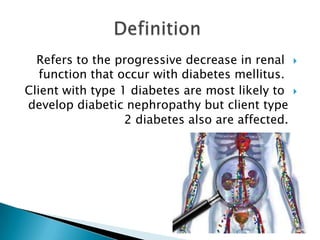
Refers to the progressive decrease in renal
function that occur with diabetes mellitus.
Client with type 1 diabetes are most likely to
develop diabetic nephropathy but client type
2 diabetes also are affected.




Stage 1:hyperfilitration,glomerular 
hypertrophy affect on blood flow through
kidneys is increased, kidneys are enlarged
stage2:microalbuminuria affect on albumin , a
blood protein ,is excreted in small amount
Stage3:Gross albuminuria affect large amount
of albumin is excreted Bb becomes elevated
excretion of nitrogen wastes is impaired
Stage 4: advanced dysfunction affect sever 
impairment of glomerular filtration is
evidenced by excessive proteinuria
, hypertension and rise in blood urea nitrogen
and creatinine level
Stage 5:end stage renal failure affect kidney
function are severely impaired((dialysis or
renal transplantation is necessary))
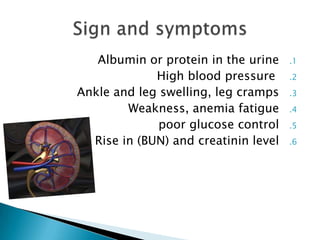
Albumin or protein in the urine
High blood pressure
Ankle and leg swelling, leg cramps
Weakness, anemia fatigue
poor glucose control
Rise in (BUN) and creatinin level

.1
.2
.3
.4
.5

.6
the nurse monitor the client blood glucose
and hemoglobin
The nurse provides additional teaching if the
clients blood glucose level is not controlled
Check the urine with a test strip to detect
evidence of albuminuria
Smoking cessation
Blood pressure controls
Use of ACE inhibitor is essential as
microalbuminuria










Diabetic nephropathy is a disease that
develops slowly and if treated
early, progression can be delayed.
The national heart lung and blood institute
recommended that the client with diabetes
maintain their BP at or below 130/85mmHg




Barbara K.Timby , nancy E smith 
, introductory medical surgical nursing 18
Edition
www.clevelandclinicmeded.com
www.webteb.com

Nephropathy

  • 2.
    objective Introduction Definition Stages of diabeticnephropathy Signe and symptoms Nursing management Summery Reference        
  • 3.
    In the endstudent will be able to: define nephropathy .1 learn signs and symptoms .1 Identify the stages of nephropathy .1 How Can You Prevent Diabetic nephropathy Disease? .2
  • 4.
    Nephropathy is consideredone of the  hardest and most dangerous complication of diabetes After the onset of diabetic nephropathy the disease progresses over several years reaching the case of renal failure that require (dialysis)treatment or anew kidney transplant
  • 5.
    The record inrecent year growing and rise in the number of patient with diabetes especially type 2 and the number of patient who have kidney damaged. Where in the world 2 million people suffering from chronic renal failure .. There is also in the United States alone, 300 thousand cases.  
  • 6.
    Refers to theprogressive decrease in renal function that occur with diabetes mellitus. Client with type 1 diabetes are most likely to develop diabetic nephropathy but client type 2 diabetes also are affected.  
  • 7.
    Stage 1:hyperfilitration,glomerular  hypertrophyaffect on blood flow through kidneys is increased, kidneys are enlarged stage2:microalbuminuria affect on albumin , a blood protein ,is excreted in small amount Stage3:Gross albuminuria affect large amount of albumin is excreted Bb becomes elevated excretion of nitrogen wastes is impaired
  • 8.
    Stage 4: advanceddysfunction affect sever  impairment of glomerular filtration is evidenced by excessive proteinuria , hypertension and rise in blood urea nitrogen and creatinine level Stage 5:end stage renal failure affect kidney function are severely impaired((dialysis or renal transplantation is necessary))
  • 10.
    Albumin or proteinin the urine High blood pressure Ankle and leg swelling, leg cramps Weakness, anemia fatigue poor glucose control Rise in (BUN) and creatinin level .1 .2 .3 .4 .5 .6
  • 11.
    the nurse monitorthe client blood glucose and hemoglobin The nurse provides additional teaching if the clients blood glucose level is not controlled Check the urine with a test strip to detect evidence of albuminuria Smoking cessation Blood pressure controls Use of ACE inhibitor is essential as microalbuminuria      
  • 12.
    Diabetic nephropathy isa disease that develops slowly and if treated early, progression can be delayed. The national heart lung and blood institute recommended that the client with diabetes maintain their BP at or below 130/85mmHg  
  • 13.
    Barbara K.Timby ,nancy E smith  , introductory medical surgical nursing 18 Edition www.clevelandclinicmeded.com www.webteb.com