DIABETIC   NEPHROPATHY Presented By Rashi Tantia
INTRODUCTION and EPIDEMIOLOGY India has increased burden of chronic diseases like Hypertension and Diabetes India has largest number of diabetics in the world with prevalence of 3.8% in rural and 11.8% in urban adults 25-40% of these develop End Stage Renal Disease which is now known as CKD Both type 1 and type 2 diabetes lead to ESRD but majority of patients are those with NIDDM In Diabetic Nephropathy, Glomeruli and Kidneys are normal or increased in size unlike Polycystic kidney disease where their size is reduced
GOALS and OBJECTIVES To discuss the risk of development of Diabetic nephropathy To discuss the screening methods and diagnosis of Diabetic nephropathy To discuss the implications of Microalbuminuria To discuss the management of nephropathy through Diet, Control of Blood Pressure, and Dialysis and Transplantation
RISK FACTORS Genetic Factors :- Person having family history of Diabetic nephropathy is more likely to develop it as well Inadequate Glucose Control :- Improved blood glucose level has found to reduce the risk of nephropathy High blood pressure :- Usually it occurs as a result of kidney disease but is also associated with progression and pathogenesis of nephropathy
Contd. Hyperlipidemia Smoking Long Standing Diabetes: - Patients having long standing diabetes have higher risk of developing nephropathy Pregnancy :- During pregnancy, there is rise in GFR which returns to normal after delivery. But hypertensive women or those with renal disease prior to conception have higher risk of progression of the disease
Natural History of Kidney Disease Diabetic Nephropathy progresses   through  five predictable stages  which are as follows:-
Stage 1 (very early diabetes ) Increased demand upon the kidneys is indicated by an above-normal glomerular filtration rate (GFR).   Hyperglycemia leads to increased kidney filtration (see later)  This is due to osmotic load and to toxic effects of high sugar levels on kidney cells  Increased Glomerular Filtration Rate ( GFR  >90ml/min ) w ith enlarged kidneys
Stage 2 (developing diabetes) Clinically silent phase with continued hyper filtration and hypertrophy  The GFR remains elevated or has returned to normal  ( GFR 60-89ml/min ),   but glomerular damage has progressed to significant microalbuminuria (small but above-normal level of the protein albumin in the urine).  Significant microalbuminuria will progress to end-stage renal disease (ESRD). Therefore, all diabetes patients should be screened for microalbuminuria on a routine basis.
Stage 3 (overt, or dipstick-positive diabetes) Glomerular damage has progressed to clinical albuminuria  with  GFR 30-59ml/min . Basement membrane thickening due to AGEP  The urine is "dipstick positive," containing more than 300 mg of albumin in a 24-hour period. Hypertension (high blood pressure) typically develops during stage 3.
Stage 4 (late-stage diabetes) Glomerular damage continues, with increasing amounts of protein albumin in the urine. The kidneys’ filtering ability has begun to decline steadily, and blood urea nitrogen (BUN) and creatinine (Cr) has begun to increase. The glomerular filtration rate (GFR) decreases further more with  ( GFR 15-29ml/min ).  Almost all patients have hypertension at stage 4.
Stage 5 (end-stage renal disease, ESRD or CKD, chronic kidney disease) GFR has fallen to  <15 ml/min  and renal replacement therapy (i.e., haemodialysis, peritoneal dialysis, kidney transplantation) is needed.
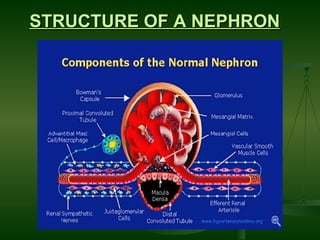
KIDNEY FUNCTION Functional unit is Nephron It filters the blood into the tubules which have very thin walls Normally, materials that body needs flow back and wastes are thrown back across these walls Most important is Glucose which is reabsorbed back completely
STRUCTURE OF A NEPHRON
Normal v/s Declining Function of the Kidney   Removal of nitrogenous waste products Fluid and electrolyte and acid-base balance BP Control Excretion of certain drugs Production of erythropoietin Formation of 1,25-dehydroxy vitamin D Increased serum BUN and creatinine Fluid and sodium retention and increased serum potassium and metabolic acidosis Hypertension Alteration of drug activity Decreased production of Erythropoietin and hence RBC’s and lead to anaemia and HbA1C would always be low. Decreased Calcium absorption
SCREENING METHODS It can be done by 3 methods :- A random spot collection to ACR A 24-hr collection for creatinine A timed (4-hr) collection
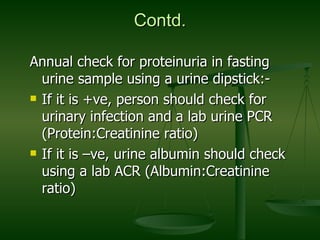
Contd. Annual check for proteinuria in fasting urine sample using a urine dipstick:- If it is +ve, person should check for urinary infection and a lab urine PCR (Protein:Creatinine ratio) If it is –ve, urine albumin should check using a lab ACR (Albumin:Creatinine ratio)
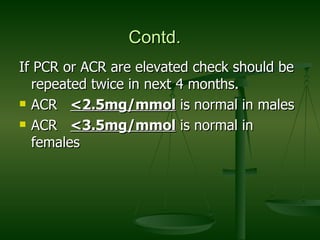
Contd. If PCR or ACR are elevated check should be repeated twice in next 4 months. ACR  <2.5mg/mmol  is normal in males ACR  <3.5mg/mmol  is normal in females
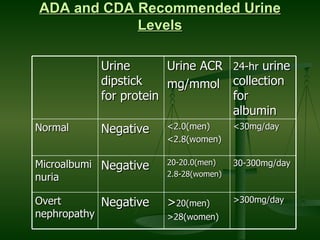
ADA and CDA Recommended Urine Levels Urine dipstick for protein Urine ACR mg/mmol 24-hr  urine collection for albumin Normal Negative <2.0(men) <2.8(women) <30mg/day Microalbuminuria Negative 20-20.0(men) 2.8-28(women) 30-300mg/day Overt nephropathy Negative > 20(men) >28(women) >300mg/day
MANAGEMENT Presence of  Microalbuminuria  indicates that treatment should be started:- Use of ACE Inhibitor is essential as microalbuminuria indicates increased pressure in kidney. BP should be managed to achieve <130/80mmHg. HbA1c should be managed to <6.5%. Reduce protein in diet to 0.8-1.0gm/Kg body weight in early stages and to <0.8gm in later stages of CKD. Lipid management, non-smoking, aspirin therapy is also helpful. When GFR falls <60ml/min/1.73mt.sq. BSA, person should be referred to a Nephrologist.
PREVENTION OR DELAY Achieving blood glucose level in normal range can either delay the start or progression of  Microalbuminuria  to  Macroalbuminuria.  (DCCT&UKPDS) Lowering BP reduces the development of kidney disease. (UKPDS-1998) According to (DCCT-1993), intensively managed group had  40% decrease  in the occurrence of  Microalbuminuria  and  50%  decrease  in the occurrence of  Macroalbuminuria.
SYMPTOMS No symptoms of early kidney disease. If one waited for symptoms to appear, person would have significant disease on diagnosis.  Solution at this stage is either  Dialysis  or  Kidney Transplantation.
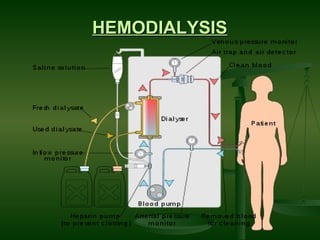
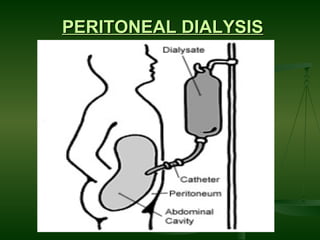
DIALYSIS It is a method where blood is cleaned off wastes artificially when kidneys are not able to do it properly. There are two types of Dialysis:- Hemodialysis Peritoneal Dialysis
HEMODIALYSIS
Contd. As you can see, it uses a machine to take over the function of the kidney. It requires a surgical procedure to create a shunt between arteries and veins known as  AV Fistula .
PERITONEAL DIALYSIS
Contd. As you can see, in this, a solution is run into the abdominal cavity, left for few hours and drained off, taking with it wastes from the blood. People can do this at homes during sleeping hours.
KIDNEY TRANSPLANTATION Also known as Renal Transplant Quite common now a days mostly in young patients Good success rates if kidney is received from a living relative
To Wrap Up :-  Diabetic nephropathy is a disease that develops slowly and if treated early, progression can be delayed. There are no signs and symptoms of early disease so screening is important. Aggressive treatment of Blood glucose, BP, Lipids helps in prevention of renal function and can improve the outcome. In CKD, some people progress to Dialysis and few to Kidney Transplantation.
THANK YOU
BIBLIOGRAPHY 1. Diabetes Education Module, 2006 2. ADA, 2007;CDA,2003 3. IDF,2005;ADA,2007 4. Malhotra, 1999 5. UKPDS,1998 and DCCT,1993  6. http://www.slideworld.org/slideshow.aspx/diabetic nephropathy ppt   7.The Everything Diabetes Book, Ford Martin with Blumer, M.D.

diabetic nephropathy

  • 1.
    DIABETIC NEPHROPATHY Presented By Rashi Tantia
  • 2.
    INTRODUCTION and EPIDEMIOLOGYIndia has increased burden of chronic diseases like Hypertension and Diabetes India has largest number of diabetics in the world with prevalence of 3.8% in rural and 11.8% in urban adults 25-40% of these develop End Stage Renal Disease which is now known as CKD Both type 1 and type 2 diabetes lead to ESRD but majority of patients are those with NIDDM In Diabetic Nephropathy, Glomeruli and Kidneys are normal or increased in size unlike Polycystic kidney disease where their size is reduced
  • 3.
    GOALS and OBJECTIVESTo discuss the risk of development of Diabetic nephropathy To discuss the screening methods and diagnosis of Diabetic nephropathy To discuss the implications of Microalbuminuria To discuss the management of nephropathy through Diet, Control of Blood Pressure, and Dialysis and Transplantation
  • 4.
    RISK FACTORS GeneticFactors :- Person having family history of Diabetic nephropathy is more likely to develop it as well Inadequate Glucose Control :- Improved blood glucose level has found to reduce the risk of nephropathy High blood pressure :- Usually it occurs as a result of kidney disease but is also associated with progression and pathogenesis of nephropathy
  • 5.
    Contd. Hyperlipidemia SmokingLong Standing Diabetes: - Patients having long standing diabetes have higher risk of developing nephropathy Pregnancy :- During pregnancy, there is rise in GFR which returns to normal after delivery. But hypertensive women or those with renal disease prior to conception have higher risk of progression of the disease
  • 6.
    Natural History ofKidney Disease Diabetic Nephropathy progresses through five predictable stages which are as follows:-
  • 7.
    Stage 1 (veryearly diabetes ) Increased demand upon the kidneys is indicated by an above-normal glomerular filtration rate (GFR). Hyperglycemia leads to increased kidney filtration (see later) This is due to osmotic load and to toxic effects of high sugar levels on kidney cells Increased Glomerular Filtration Rate ( GFR >90ml/min ) w ith enlarged kidneys
  • 8.
    Stage 2 (developingdiabetes) Clinically silent phase with continued hyper filtration and hypertrophy The GFR remains elevated or has returned to normal ( GFR 60-89ml/min ), but glomerular damage has progressed to significant microalbuminuria (small but above-normal level of the protein albumin in the urine). Significant microalbuminuria will progress to end-stage renal disease (ESRD). Therefore, all diabetes patients should be screened for microalbuminuria on a routine basis.
  • 9.
    Stage 3 (overt,or dipstick-positive diabetes) Glomerular damage has progressed to clinical albuminuria with GFR 30-59ml/min . Basement membrane thickening due to AGEP The urine is &quot;dipstick positive,&quot; containing more than 300 mg of albumin in a 24-hour period. Hypertension (high blood pressure) typically develops during stage 3.
  • 10.
    Stage 4 (late-stagediabetes) Glomerular damage continues, with increasing amounts of protein albumin in the urine. The kidneys’ filtering ability has begun to decline steadily, and blood urea nitrogen (BUN) and creatinine (Cr) has begun to increase. The glomerular filtration rate (GFR) decreases further more with ( GFR 15-29ml/min ). Almost all patients have hypertension at stage 4.
  • 11.
    Stage 5 (end-stagerenal disease, ESRD or CKD, chronic kidney disease) GFR has fallen to <15 ml/min and renal replacement therapy (i.e., haemodialysis, peritoneal dialysis, kidney transplantation) is needed.
  • 12.
    KIDNEY FUNCTION Functionalunit is Nephron It filters the blood into the tubules which have very thin walls Normally, materials that body needs flow back and wastes are thrown back across these walls Most important is Glucose which is reabsorbed back completely
  • 13.
  • 14.
    Normal v/s DecliningFunction of the Kidney Removal of nitrogenous waste products Fluid and electrolyte and acid-base balance BP Control Excretion of certain drugs Production of erythropoietin Formation of 1,25-dehydroxy vitamin D Increased serum BUN and creatinine Fluid and sodium retention and increased serum potassium and metabolic acidosis Hypertension Alteration of drug activity Decreased production of Erythropoietin and hence RBC’s and lead to anaemia and HbA1C would always be low. Decreased Calcium absorption
  • 15.
    SCREENING METHODS Itcan be done by 3 methods :- A random spot collection to ACR A 24-hr collection for creatinine A timed (4-hr) collection
  • 16.
    Contd. Annual checkfor proteinuria in fasting urine sample using a urine dipstick:- If it is +ve, person should check for urinary infection and a lab urine PCR (Protein:Creatinine ratio) If it is –ve, urine albumin should check using a lab ACR (Albumin:Creatinine ratio)
  • 17.
    Contd. If PCRor ACR are elevated check should be repeated twice in next 4 months. ACR <2.5mg/mmol is normal in males ACR <3.5mg/mmol is normal in females
  • 18.
    ADA and CDARecommended Urine Levels Urine dipstick for protein Urine ACR mg/mmol 24-hr urine collection for albumin Normal Negative <2.0(men) <2.8(women) <30mg/day Microalbuminuria Negative 20-20.0(men) 2.8-28(women) 30-300mg/day Overt nephropathy Negative > 20(men) >28(women) >300mg/day
  • 19.
    MANAGEMENT Presence of Microalbuminuria indicates that treatment should be started:- Use of ACE Inhibitor is essential as microalbuminuria indicates increased pressure in kidney. BP should be managed to achieve <130/80mmHg. HbA1c should be managed to <6.5%. Reduce protein in diet to 0.8-1.0gm/Kg body weight in early stages and to <0.8gm in later stages of CKD. Lipid management, non-smoking, aspirin therapy is also helpful. When GFR falls <60ml/min/1.73mt.sq. BSA, person should be referred to a Nephrologist.
  • 20.
    PREVENTION OR DELAYAchieving blood glucose level in normal range can either delay the start or progression of Microalbuminuria to Macroalbuminuria. (DCCT&UKPDS) Lowering BP reduces the development of kidney disease. (UKPDS-1998) According to (DCCT-1993), intensively managed group had 40% decrease in the occurrence of Microalbuminuria and 50% decrease in the occurrence of Macroalbuminuria.
  • 21.
    SYMPTOMS No symptomsof early kidney disease. If one waited for symptoms to appear, person would have significant disease on diagnosis. Solution at this stage is either Dialysis or Kidney Transplantation.
  • 22.
    DIALYSIS It isa method where blood is cleaned off wastes artificially when kidneys are not able to do it properly. There are two types of Dialysis:- Hemodialysis Peritoneal Dialysis
  • 23.
  • 24.
    Contd. As youcan see, it uses a machine to take over the function of the kidney. It requires a surgical procedure to create a shunt between arteries and veins known as AV Fistula .
  • 25.
  • 26.
    Contd. As youcan see, in this, a solution is run into the abdominal cavity, left for few hours and drained off, taking with it wastes from the blood. People can do this at homes during sleeping hours.
  • 27.
    KIDNEY TRANSPLANTATION Alsoknown as Renal Transplant Quite common now a days mostly in young patients Good success rates if kidney is received from a living relative
  • 28.
    To Wrap Up:- Diabetic nephropathy is a disease that develops slowly and if treated early, progression can be delayed. There are no signs and symptoms of early disease so screening is important. Aggressive treatment of Blood glucose, BP, Lipids helps in prevention of renal function and can improve the outcome. In CKD, some people progress to Dialysis and few to Kidney Transplantation.
  • 29.
  • 30.
    BIBLIOGRAPHY 1. DiabetesEducation Module, 2006 2. ADA, 2007;CDA,2003 3. IDF,2005;ADA,2007 4. Malhotra, 1999 5. UKPDS,1998 and DCCT,1993 6. http://www.slideworld.org/slideshow.aspx/diabetic nephropathy ppt 7.The Everything Diabetes Book, Ford Martin with Blumer, M.D.