Mitosis and Meiosis
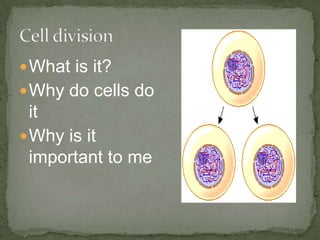
 What is it?

 Why do cells do

it
 Why is it
important to me
 •All Organisms Consist of Cells and Arise from









Preexisting Cells Mitosis is the process by which new
cells are generated.
Meiosis is the process by which gametes are generated
for reproduction.
•The Cell Cycle Represents All Phases in the Life of a
Cell DNA replication (S phase) must precede mitosis, so
that all daughter cells receive the same complement of
chromosomes as the parent cell.
The gap phases separate mitosis from S phase. This is
the time when molecular signals mediate the switch in
cellular activity.
Mitosis involves the separation of copied chromosomes
into separate cells
•Unregulated Cell Division Can Lead to Cancer
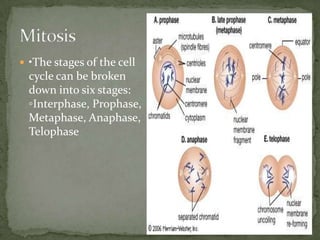
 •The stages of the cell

cycle can be broken
down into six stages:
◦Interphase, Prophase,
Metaphase, Anaphase,
Telophase
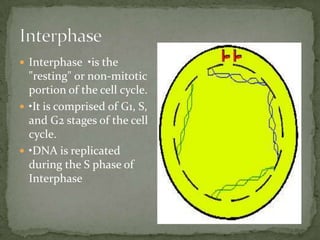
 Interphase •is the

"resting" or non-mitotic
portion of the cell cycle.
 •It is comprised of G1, S,
and G2 stages of the cell
cycle.
 •DNA is replicated
during the S phase of
Interphase
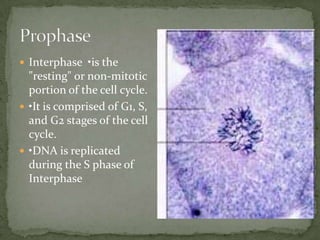
 Interphase •is the

"resting" or non-mitotic
portion of the cell cycle.
 •It is comprised of G1, S,
and G2 stages of the cell
cycle.
 •DNA is replicated
during the S phase of
Interphase
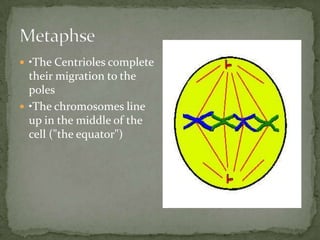
 •The Centrioles complete

their migration to the
poles
 •The chromosomes line
up in the middle of the
cell ("the equator")
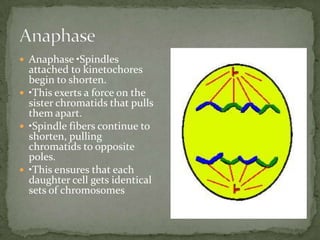
 Anaphase •Spindles

attached to kinetochores
begin to shorten.
 •This exerts a force on the
sister chromatids that pulls
them apart.
 •Spindle fibers continue to
shorten, pulling
chromatids to opposite
poles.
 •This ensures that each
daughter cell gets identical
sets of chromosomes
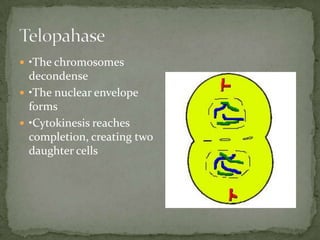
 •The chromosomes

decondense
 •The nuclear envelope
forms
 •Cytokinesis reaches
completion, creating two
daughter cells
 In animal cells, cytokinesis occurs by a process known as








cleavage •First, a cleavage furrow appears cleavage
furrow = shallow groove near the location of the old
metaphase plate
•A contractile ring of actin microfilaments in association
with myosin, a protein Actin and myosin are also
involved in muscle contraction and other movement
functions
•The contraction of a the dividing cell's ring of
microfilaments is like the pulling of drawstrings The cell
is pinched in two
•Cytokinesis in plant cells is different because plant cells
have cell walls.
•There is no cleavage furrow
 •During telophase, vesicles from the Golgi apparatus

move along microtubules to the middle of the cell
(where the cell plate was) and coalesce, producing the
cell plate ◦Cell-wall construction materials are carried
in the vesicles and are continually deposited until a
complete cell wall forms between the two daughter
cells
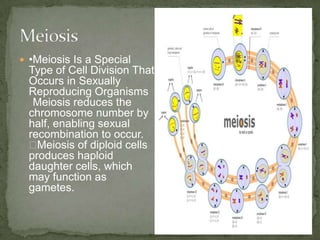
 •Meiosis Is a Special

Type of Cell Division That
Occurs in Sexually
Reproducing Organisms
Meiosis reduces the
chromosome number by
half, enabling sexual
recombination to occur.
◾
Meiosis of diploid cells
produces haploid
daughter cells, which
may function as
gametes.
 ◾
Gametes undergo fertilization, restoring the diploid








number of chromosomes in the zygote
Meiosis and fertilization introduce genetic variation in
three ways: ◾
Crossing over between homologous
chromosomes at prophase I.
◾
Independent assortment of homologous pairs at
metaphase I: ◾
Each homologous pair can orient in either
of two ways at the plane of cell division.
◾
The total number of possible outcomes = 2n (n =
number of haploid chromosomes).
◾
Random chance fertilization between any one female
gamete with any other male gamete.
 •The Role of Sexual Reproduction in Evolution Sexual

reproduction in a population should decline in frequency
relative to asexual reproduction. ◾
Asexual reproduction?
No males are needed, all individuals can produce
offspring.
 ◾
Sexual reproduction? Only females can produce
offspring, therefore fewer are produced.
 Sexual reproduction may exist because it provides

genetic variability that reduces susceptibility of a
population to pathogen attack.
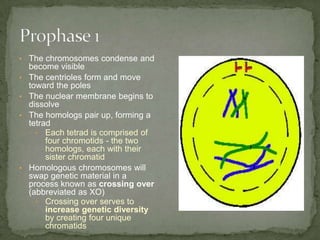
• The chromosomes condense and
•
•
•

•

become visible
The centrioles form and move
toward the poles
The nuclear membrane begins to
dissolve
The homologs pair up, forming a
tetrad
• Each tetrad is comprised of
four chromotids - the two
homologs, each with their
sister chromatid
Homologous chromosomes will
swap genetic material in a
process known as crossing over
(abbreviated as XO)
• Crossing over serves to
increase genetic diversity
by creating four unique
chromatids
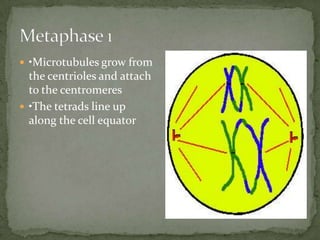
 •Microtubules grow from

the centrioles and attach
to the centromeres
 •The tetrads line up
along the cell equator
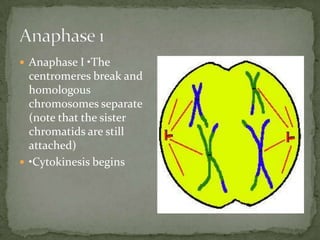
 Anaphase I •The

centromeres break and
homologous
chromosomes separate
(note that the sister
chromatids are still
attached)
 •Cytokinesis begins
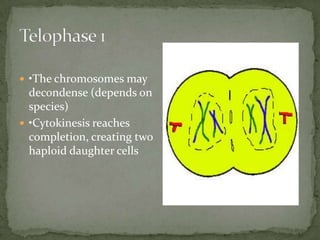
 •The chromosomes may

decondense (depends on
species)
 •Cytokinesis reaches
completion, creating two
haploid daughter cells
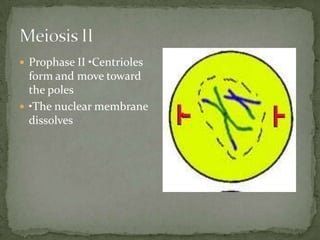
 Prophase II •Centrioles

form and move toward
the poles
 •The nuclear membrane
dissolves
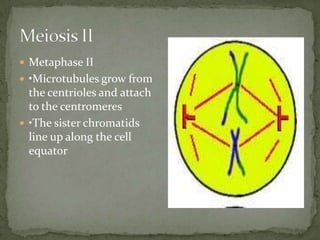
 Metaphase II
 •Microtubules grow from

the centrioles and attach
to the centromeres
 •The sister chromatids
line up along the cell
equator
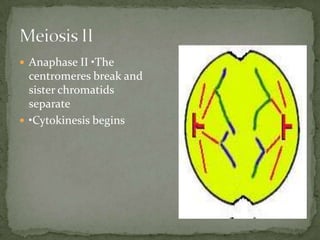
 Anaphase II •The

centromeres break and
sister chromatids
separate
 •Cytokinesis begins
 Telophase II
 •The chromosomes may decondense (depends on

species)
 •Cytokinesis reaches completion, creating four haploid
daughter cells
 Berg, Jeremy M., John L. Tymoczko, and Lubert Stryer.

Biochemistry. 7th ed. New York: W.H. Freeman, 2012.
Print.
 Reece, Campbell, Lisa A. Urry, Michael L. Cain, Steven

A. Wasserman, Peter V. Minosky, and Robert B.
Jackson. Biology. 8th ed. San Francisco: Cummings,
2010. Print.

cell division mitosis and meiosis

  • 1.
  • 2.
     What isit?  Why do cells do it  Why is it important to me
  • 3.
     •All OrganismsConsist of Cells and Arise from      Preexisting Cells Mitosis is the process by which new cells are generated. Meiosis is the process by which gametes are generated for reproduction. •The Cell Cycle Represents All Phases in the Life of a Cell DNA replication (S phase) must precede mitosis, so that all daughter cells receive the same complement of chromosomes as the parent cell. The gap phases separate mitosis from S phase. This is the time when molecular signals mediate the switch in cellular activity. Mitosis involves the separation of copied chromosomes into separate cells •Unregulated Cell Division Can Lead to Cancer
  • 4.
     •The stagesof the cell cycle can be broken down into six stages: ◦Interphase, Prophase, Metaphase, Anaphase, Telophase
  • 5.
     Interphase •isthe "resting" or non-mitotic portion of the cell cycle.  •It is comprised of G1, S, and G2 stages of the cell cycle.  •DNA is replicated during the S phase of Interphase
  • 6.
     Interphase •isthe "resting" or non-mitotic portion of the cell cycle.  •It is comprised of G1, S, and G2 stages of the cell cycle.  •DNA is replicated during the S phase of Interphase
  • 7.
     •The Centriolescomplete their migration to the poles  •The chromosomes line up in the middle of the cell ("the equator")
  • 8.
     Anaphase •Spindles attachedto kinetochores begin to shorten.  •This exerts a force on the sister chromatids that pulls them apart.  •Spindle fibers continue to shorten, pulling chromatids to opposite poles.  •This ensures that each daughter cell gets identical sets of chromosomes
  • 9.
     •The chromosomes decondense •The nuclear envelope forms  •Cytokinesis reaches completion, creating two daughter cells
  • 10.
     In animalcells, cytokinesis occurs by a process known as     cleavage •First, a cleavage furrow appears cleavage furrow = shallow groove near the location of the old metaphase plate •A contractile ring of actin microfilaments in association with myosin, a protein Actin and myosin are also involved in muscle contraction and other movement functions •The contraction of a the dividing cell's ring of microfilaments is like the pulling of drawstrings The cell is pinched in two •Cytokinesis in plant cells is different because plant cells have cell walls. •There is no cleavage furrow
  • 11.
     •During telophase,vesicles from the Golgi apparatus move along microtubules to the middle of the cell (where the cell plate was) and coalesce, producing the cell plate ◦Cell-wall construction materials are carried in the vesicles and are continually deposited until a complete cell wall forms between the two daughter cells
  • 12.
     •Meiosis Isa Special Type of Cell Division That Occurs in Sexually Reproducing Organisms Meiosis reduces the chromosome number by half, enabling sexual recombination to occur. ◾ Meiosis of diploid cells produces haploid daughter cells, which may function as gametes.
  • 13.
     ◾ Gametes undergofertilization, restoring the diploid     number of chromosomes in the zygote Meiosis and fertilization introduce genetic variation in three ways: ◾ Crossing over between homologous chromosomes at prophase I. ◾ Independent assortment of homologous pairs at metaphase I: ◾ Each homologous pair can orient in either of two ways at the plane of cell division. ◾ The total number of possible outcomes = 2n (n = number of haploid chromosomes). ◾ Random chance fertilization between any one female gamete with any other male gamete.
  • 14.
     •The Roleof Sexual Reproduction in Evolution Sexual reproduction in a population should decline in frequency relative to asexual reproduction. ◾ Asexual reproduction? No males are needed, all individuals can produce offspring.  ◾ Sexual reproduction? Only females can produce offspring, therefore fewer are produced.  Sexual reproduction may exist because it provides genetic variability that reduces susceptibility of a population to pathogen attack.
  • 15.
    • The chromosomescondense and • • • • become visible The centrioles form and move toward the poles The nuclear membrane begins to dissolve The homologs pair up, forming a tetrad • Each tetrad is comprised of four chromotids - the two homologs, each with their sister chromatid Homologous chromosomes will swap genetic material in a process known as crossing over (abbreviated as XO) • Crossing over serves to increase genetic diversity by creating four unique chromatids
  • 16.
     •Microtubules growfrom the centrioles and attach to the centromeres  •The tetrads line up along the cell equator
  • 17.
     Anaphase I•The centromeres break and homologous chromosomes separate (note that the sister chromatids are still attached)  •Cytokinesis begins
  • 18.
     •The chromosomesmay decondense (depends on species)  •Cytokinesis reaches completion, creating two haploid daughter cells
  • 19.
     Prophase II•Centrioles form and move toward the poles  •The nuclear membrane dissolves
  • 20.
     Metaphase II •Microtubules grow from the centrioles and attach to the centromeres  •The sister chromatids line up along the cell equator
  • 21.
     Anaphase II•The centromeres break and sister chromatids separate  •Cytokinesis begins
  • 22.
     Telophase II •The chromosomes may decondense (depends on species)  •Cytokinesis reaches completion, creating four haploid daughter cells
  • 23.
     Berg, JeremyM., John L. Tymoczko, and Lubert Stryer. Biochemistry. 7th ed. New York: W.H. Freeman, 2012. Print.  Reece, Campbell, Lisa A. Urry, Michael L. Cain, Steven A. Wasserman, Peter V. Minosky, and Robert B. Jackson. Biology. 8th ed. San Francisco: Cummings, 2010. Print.