Chirality in Therapeutics
Introduction
• Chiral chemistry was discovered by Louis Pasteur (1848)1
• Key role not only in the life of plants and animals but also in
pharmaceutical, agricultural and other chemical industries
• In pharmaceutical industries, 56% of the drugs currently in
use are chiral products and 88% of the last ones are marketed
as racemates
Chirality in therapeutics
Introduction
• All natural compounds are under single enantiomeric form
• Racemic drugs exhibit marked differences in biological
activities
• 2001 Nobel Prize in Chemistry : Dr. William S. Knowles and Pr.
K. Barry Sharpless and Pr. Ryori Nyori , for their development
of asymmetric synthesis of chiral molecules
Chirality in therapeutics
Definitions & Nomenclature
• Chirality (stereoisomerism or
enantiomerism or dissymmetry)1
property of an object which is
non-superimposable with its mirror image
• A chiral molecule is a molecule having at least one
asymmetric carbon
• Enantiomers:2 The two non-superimposable mirror-image
forms of chiral molecules
• Chiral molecules exhibit optical activity, so enantiomers are
also sometimes called optical isomers
1
Chirality in therapeutics
Definitions & Nomenclature
• The two enantiomers of chiral compounds may be classifed as levorotary (l-
isomer) or dextrorotary (d-isomer) depending on whether they rotate plane-
polarized light in a left (-) or right (+) -handed manner, respectively.
• Racemic mixture (racemate) An equimolar mixture (50/50) of the two
enantiomers of a chiral compound , with sign (±) or (d, l)
Chirality in therapeutics
Definitions & Nomenclature
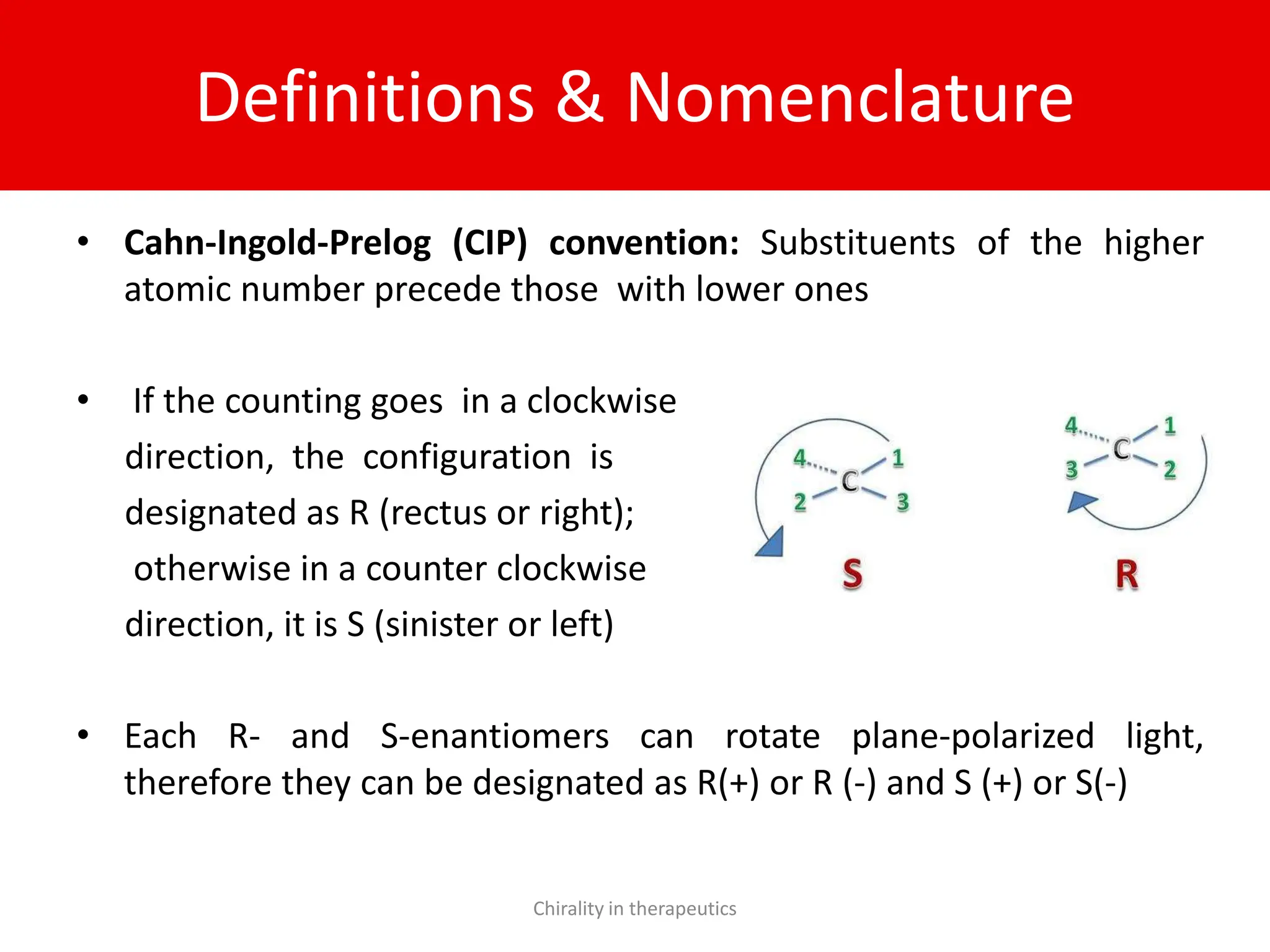
• Cahn-Ingold-Prelog (CIP) convention: Substituents of the higher
atomic number precede those with lower ones
• If the counting goes in a clockwise
direction, the configuration is
designated as R (rectus or right);
otherwise in a counter clockwise
direction, it is S (sinister or left)
• Each R- and S-enantiomers can rotate plane-polarized light,
therefore they can be designated as R(+) or R (-) and S (+) or S(-)
Chirality in therapeutics
Definitions & Nomenclature
• Full description3 : Absolute descriptor + Relative descriptor +
generic name
e.g. S(-) Bupivacaine
• Eutomer refers to bioactive enantiomer or enantiomer having
higher pharmacological activity. Its opposite is called distomer
• Racemic/chiral switches are chiral drugs that have already
been approved as racemates and which have been redeveloped
as single enantiomer.
e.g. escitalopram, esomeprazole
Chirality in therapeutics
Importance of chirality in therapeutics
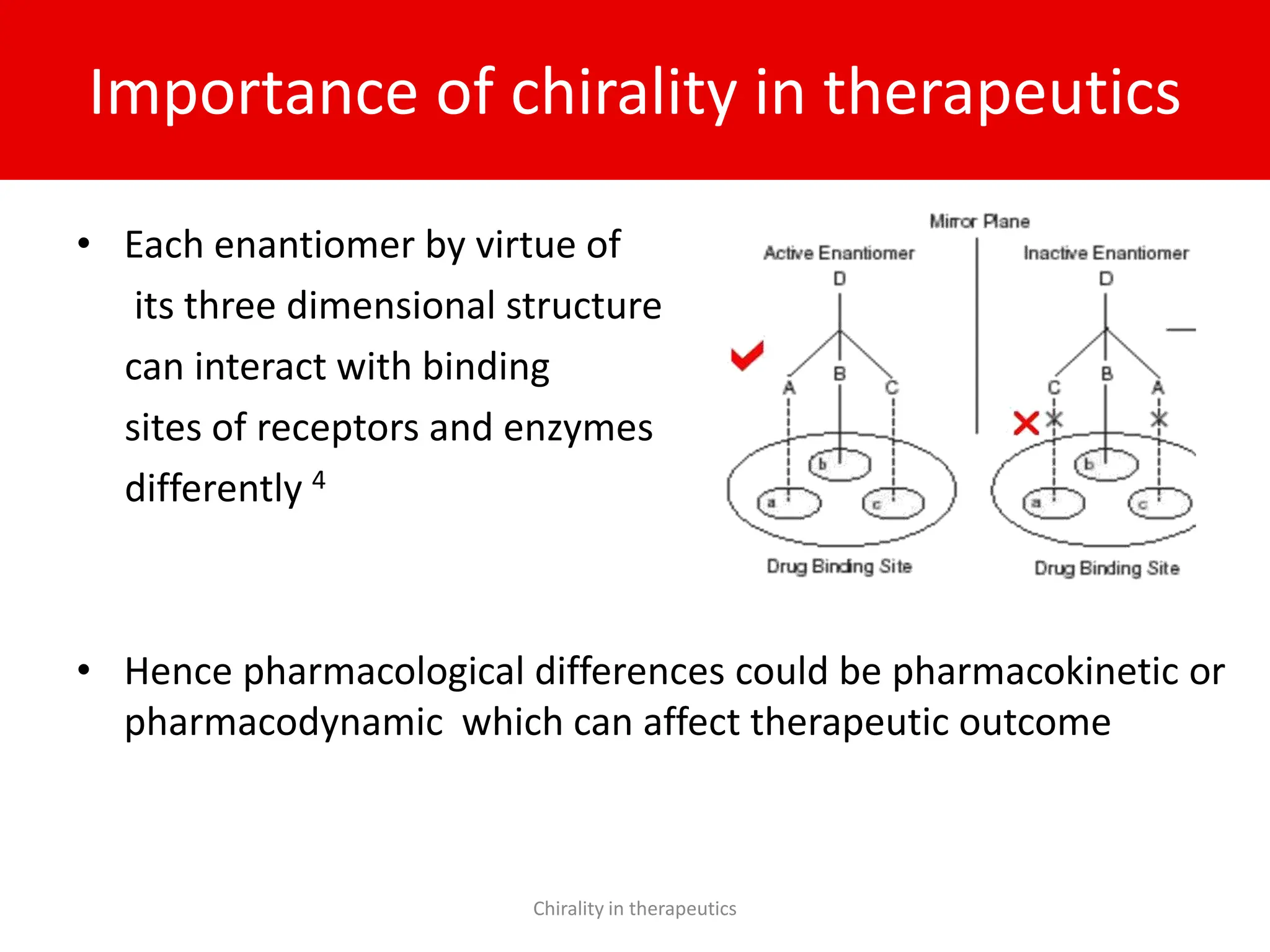
• Each enantiomer by virtue of
its three dimensional structure
can interact with binding
sites of receptors and enzymes
differently 4
• Hence pharmacological differences could be pharmacokinetic or
pharmacodynamic which can affect therapeutic outcome
Chirality in therapeutics
Pharmacokinetic implications5
• Absorption: L-methotrexate & esomeprazole is better
absorbed than D-methotrexate & omeprazole
• Distribution: S-warfarin & levocetirizine have lower volume of
distribution than their opposite enantiomers
• Metabolism: S-Warfarin is more potent and metabolized by
ring oxidation while R-Warfarin is less potent and metabolized
by side chain reduction, half life of S-Warfarin is 32 hours
while it is 54 hours for R-Warfarin
Chirality in therapeutics
Pharmacodynamic implications4
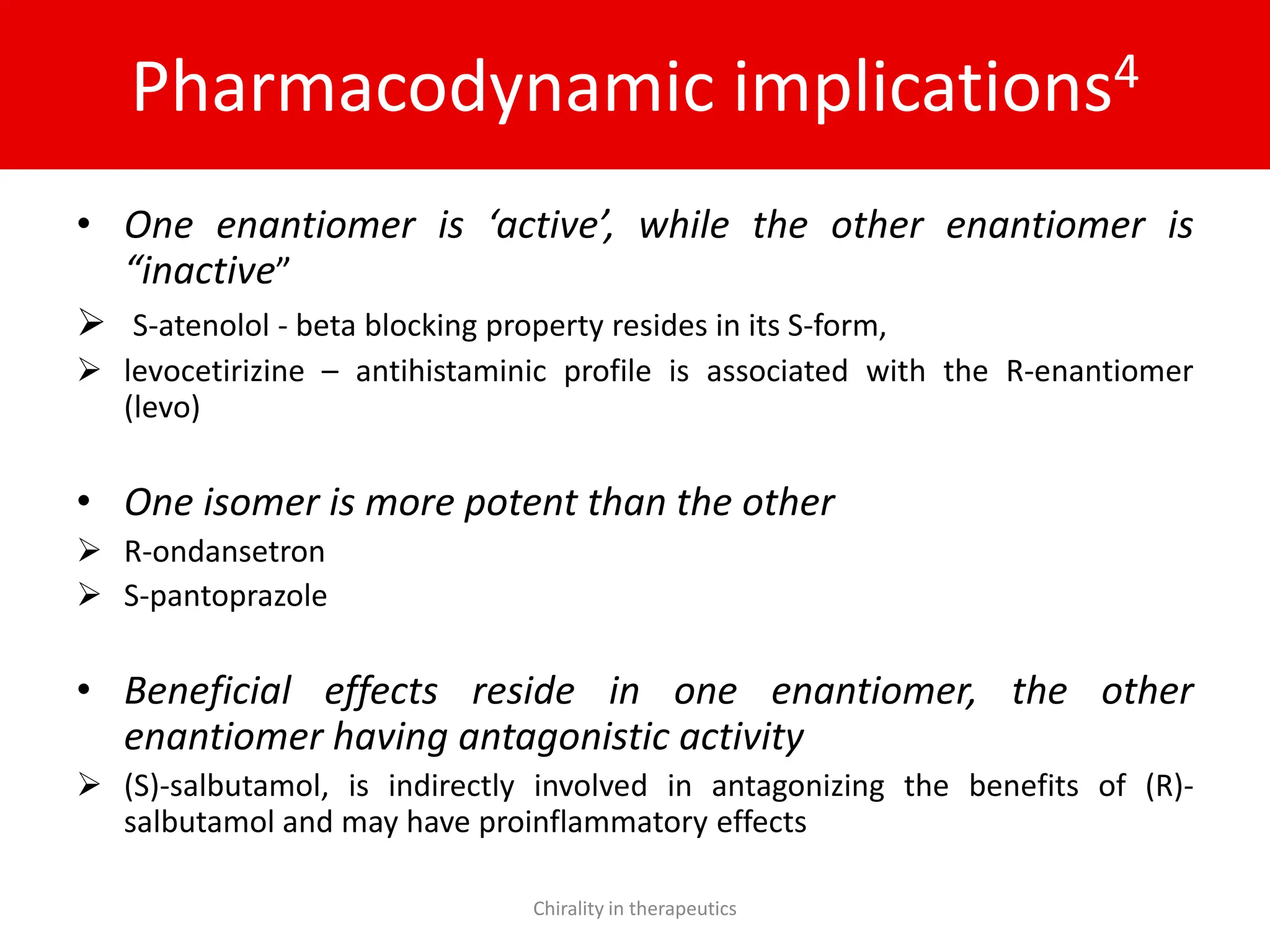
• One enantiomer is ‘active’, while the other enantiomer is
“inactive”
 S-atenolol - beta blocking property resides in its S-form,
 levocetirizine – antihistaminic profile is associated with the R-enantiomer
(levo)
• One isomer is more potent than the other
 R-ondansetron
 S-pantoprazole
• Beneficial effects reside in one enantiomer, the other
enantiomer having antagonistic activity
 (S)-salbutamol, is indirectly involved in antagonizing the benefits of (R)-
salbutamol and may have proinflammatory effects
Chirality in therapeutics
Pharmacodynamic implications
• Enantiomers have entirely different therapeutic possibilities
 R-fluoxetine is useful for depression while S-fluoxetine is envisaged for
migraine treatment
 S-propranolol has beta-blocking and membrane stabilizing property, its
counterpart, R-propranolol, has membrane stabilizing and spermicidal
properties and may be useful in hyperthyroidism
• Beneficial effects in one enantiomer whilst the other
enantiomer has adverse activity
 S-amlodipine is a calcium channel blocker (CCB) while R-amlodipine is
inactive as CCB and is thought to be responsible for pedal edema
observed with racemic amlodipine
Chirality in therapeutics
Advantages of chiral drugs in therapeutics6
 Removal of unwanted pharmacodynamic side effects and
toxic effects
 Reducing metabolic/renal/ hepatic drug load compared to
racemic drug administration
 Easier assessment of physiology, disease, and drug
coadministration effects
 Reduce drug interactions
Chirality in therapeutics
Advantages of chiral drugs in therapeutics
 Prevents enantiomer–enantiomer drug interactions if
present
 Avoids the probability for chiral inversion
 If the enantiomers are sufficiently different in
pharmacological effects, it may be possible to get a
patent on one or both
 Easier assessment of efficacy and toxicity through pk/pd
monitoring of the stereochemically pure active enantiomer
Pk-Pharmacokinetics, Pd- pharmacodynamics
Chirality in therapeutics
Review of some important Unichiral drugs4
Sr.
no.
Unichiral
drug
Advantages over racemate
1 S-amlodipine  longer half-life of S-isomer
consistent pharmacokinetics due to less inter-subject
variability
 half the racemate dose, less metabolic load
 negligible pedal edema
2 S- metoprolol  can be administered at high doses without causing
beta-2 receptor mediated side effects
safer in poor metabolizers of CYP2D6
 avoids many drug-drug interactions
Chirality in therapeutics
Review of some important Unichiral drugs
Sr.
no.
Unichiral drug Advantages over racemate
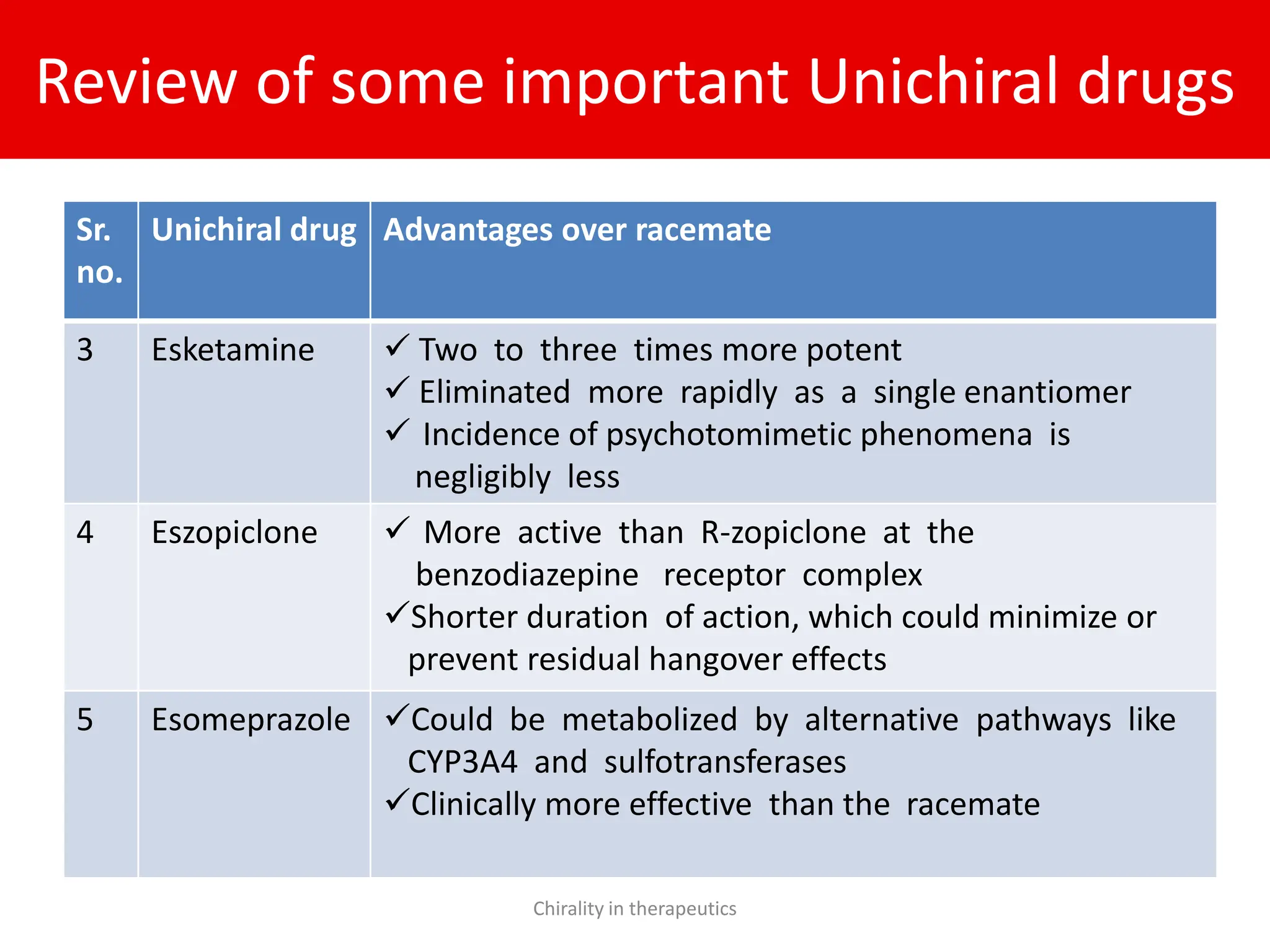
3 Esketamine  Two to three times more potent
 Eliminated more rapidly as a single enantiomer
 Incidence of psychotomimetic phenomena is
negligibly less
4 Eszopiclone  More active than R-zopiclone at the
benzodiazepine receptor complex
Shorter duration of action, which could minimize or
prevent residual hangover effects
5 Esomeprazole Could be metabolized by alternative pathways like
CYP3A4 and sulfotransferases
Clinically more effective than the racemate
Chirality in therapeutics
FDA policy statement on development of chiral drugs3
• More difficult to obtain approval for racemates
• Approval could not be granted for drug containing more than
one isomer unless Pk/Pd properties of each could be
described and justified
• Additional isomers in a compound are no longer considered as
‘silent passengers’ but as potential contaminants (isomeric
ballast)
• Shortened approval process for the enantiomeric versions of
the approved drugs, with the promise of patent protection
Chirality in therapeutics
Conclusion
• Trend in pharmaceutical industry towards development of
chiral drugs either de novo or by chiral switch
• Use of a single isomer must be seriously taken after long
clinical assessments between racemate and single enantiomer
actions
• Important to give more information about chiral drugs
especially racemic form to healthcare professionals in order to
help them for finding an optimal treatment and a right
therapeutic control
Chirality in therapeutics
References
1. Nguyen LA, He H, Pham-Huy C. Chiral Drugs: An Overview. Int J Biomed
Sci. 2006 June; 2(2): 85–100.
2. Smith SW. Chiral Toxicology: It’s the Same Thing...Only Different. Toxicological
sciences. 2009 ; 110(1):4–30
3. Burke D, Henderson DJ. Chirality: a blueprint for the future. British journal of
anaesthesia. 2002; 88(4): 563-76
4. Chhabra N, Aseri ML and Padmanabhan D. A review of drug isomerism and its
significance. International Journal of Applied and Basic Medical Research. 2013
Jan-Jun; 3(1): 16–18.
5. Mohan SJ, Mohan EC, Reddy S, Manda S and Yamsani MR. Chiral interactions
and chiral inversions – new challenges to chiral scientists. International journal of
comprehensive pharmacy. 2011; 3 (01):1-9
Chirality in therapeutics

Chirality in therapeutics with enantiomer

  • 1.
  • 2.
    Introduction • Chiral chemistrywas discovered by Louis Pasteur (1848)1 • Key role not only in the life of plants and animals but also in pharmaceutical, agricultural and other chemical industries • In pharmaceutical industries, 56% of the drugs currently in use are chiral products and 88% of the last ones are marketed as racemates Chirality in therapeutics
  • 3.
    Introduction • All naturalcompounds are under single enantiomeric form • Racemic drugs exhibit marked differences in biological activities • 2001 Nobel Prize in Chemistry : Dr. William S. Knowles and Pr. K. Barry Sharpless and Pr. Ryori Nyori , for their development of asymmetric synthesis of chiral molecules Chirality in therapeutics
  • 4.
    Definitions & Nomenclature •Chirality (stereoisomerism or enantiomerism or dissymmetry)1 property of an object which is non-superimposable with its mirror image • A chiral molecule is a molecule having at least one asymmetric carbon • Enantiomers:2 The two non-superimposable mirror-image forms of chiral molecules • Chiral molecules exhibit optical activity, so enantiomers are also sometimes called optical isomers 1 Chirality in therapeutics
  • 5.
    Definitions & Nomenclature •The two enantiomers of chiral compounds may be classifed as levorotary (l- isomer) or dextrorotary (d-isomer) depending on whether they rotate plane- polarized light in a left (-) or right (+) -handed manner, respectively. • Racemic mixture (racemate) An equimolar mixture (50/50) of the two enantiomers of a chiral compound , with sign (±) or (d, l) Chirality in therapeutics
  • 6.
    Definitions & Nomenclature •Cahn-Ingold-Prelog (CIP) convention: Substituents of the higher atomic number precede those with lower ones • If the counting goes in a clockwise direction, the configuration is designated as R (rectus or right); otherwise in a counter clockwise direction, it is S (sinister or left) • Each R- and S-enantiomers can rotate plane-polarized light, therefore they can be designated as R(+) or R (-) and S (+) or S(-) Chirality in therapeutics
  • 7.
    Definitions & Nomenclature •Full description3 : Absolute descriptor + Relative descriptor + generic name e.g. S(-) Bupivacaine • Eutomer refers to bioactive enantiomer or enantiomer having higher pharmacological activity. Its opposite is called distomer • Racemic/chiral switches are chiral drugs that have already been approved as racemates and which have been redeveloped as single enantiomer. e.g. escitalopram, esomeprazole Chirality in therapeutics
  • 8.
    Importance of chiralityin therapeutics • Each enantiomer by virtue of its three dimensional structure can interact with binding sites of receptors and enzymes differently 4 • Hence pharmacological differences could be pharmacokinetic or pharmacodynamic which can affect therapeutic outcome Chirality in therapeutics
  • 9.
    Pharmacokinetic implications5 • Absorption:L-methotrexate & esomeprazole is better absorbed than D-methotrexate & omeprazole • Distribution: S-warfarin & levocetirizine have lower volume of distribution than their opposite enantiomers • Metabolism: S-Warfarin is more potent and metabolized by ring oxidation while R-Warfarin is less potent and metabolized by side chain reduction, half life of S-Warfarin is 32 hours while it is 54 hours for R-Warfarin Chirality in therapeutics
  • 10.
    Pharmacodynamic implications4 • Oneenantiomer is ‘active’, while the other enantiomer is “inactive”  S-atenolol - beta blocking property resides in its S-form,  levocetirizine – antihistaminic profile is associated with the R-enantiomer (levo) • One isomer is more potent than the other  R-ondansetron  S-pantoprazole • Beneficial effects reside in one enantiomer, the other enantiomer having antagonistic activity  (S)-salbutamol, is indirectly involved in antagonizing the benefits of (R)- salbutamol and may have proinflammatory effects Chirality in therapeutics
  • 11.
    Pharmacodynamic implications • Enantiomershave entirely different therapeutic possibilities  R-fluoxetine is useful for depression while S-fluoxetine is envisaged for migraine treatment  S-propranolol has beta-blocking and membrane stabilizing property, its counterpart, R-propranolol, has membrane stabilizing and spermicidal properties and may be useful in hyperthyroidism • Beneficial effects in one enantiomer whilst the other enantiomer has adverse activity  S-amlodipine is a calcium channel blocker (CCB) while R-amlodipine is inactive as CCB and is thought to be responsible for pedal edema observed with racemic amlodipine Chirality in therapeutics
  • 12.
    Advantages of chiraldrugs in therapeutics6  Removal of unwanted pharmacodynamic side effects and toxic effects  Reducing metabolic/renal/ hepatic drug load compared to racemic drug administration  Easier assessment of physiology, disease, and drug coadministration effects  Reduce drug interactions Chirality in therapeutics
  • 13.
    Advantages of chiraldrugs in therapeutics  Prevents enantiomer–enantiomer drug interactions if present  Avoids the probability for chiral inversion  If the enantiomers are sufficiently different in pharmacological effects, it may be possible to get a patent on one or both  Easier assessment of efficacy and toxicity through pk/pd monitoring of the stereochemically pure active enantiomer Pk-Pharmacokinetics, Pd- pharmacodynamics Chirality in therapeutics
  • 14.
    Review of someimportant Unichiral drugs4 Sr. no. Unichiral drug Advantages over racemate 1 S-amlodipine  longer half-life of S-isomer consistent pharmacokinetics due to less inter-subject variability  half the racemate dose, less metabolic load  negligible pedal edema 2 S- metoprolol  can be administered at high doses without causing beta-2 receptor mediated side effects safer in poor metabolizers of CYP2D6  avoids many drug-drug interactions Chirality in therapeutics
  • 15.
    Review of someimportant Unichiral drugs Sr. no. Unichiral drug Advantages over racemate 3 Esketamine  Two to three times more potent  Eliminated more rapidly as a single enantiomer  Incidence of psychotomimetic phenomena is negligibly less 4 Eszopiclone  More active than R-zopiclone at the benzodiazepine receptor complex Shorter duration of action, which could minimize or prevent residual hangover effects 5 Esomeprazole Could be metabolized by alternative pathways like CYP3A4 and sulfotransferases Clinically more effective than the racemate Chirality in therapeutics
  • 16.
    FDA policy statementon development of chiral drugs3 • More difficult to obtain approval for racemates • Approval could not be granted for drug containing more than one isomer unless Pk/Pd properties of each could be described and justified • Additional isomers in a compound are no longer considered as ‘silent passengers’ but as potential contaminants (isomeric ballast) • Shortened approval process for the enantiomeric versions of the approved drugs, with the promise of patent protection Chirality in therapeutics
  • 17.
    Conclusion • Trend inpharmaceutical industry towards development of chiral drugs either de novo or by chiral switch • Use of a single isomer must be seriously taken after long clinical assessments between racemate and single enantiomer actions • Important to give more information about chiral drugs especially racemic form to healthcare professionals in order to help them for finding an optimal treatment and a right therapeutic control Chirality in therapeutics
  • 18.
  • 19.
    References 1. Nguyen LA,He H, Pham-Huy C. Chiral Drugs: An Overview. Int J Biomed Sci. 2006 June; 2(2): 85–100. 2. Smith SW. Chiral Toxicology: It’s the Same Thing...Only Different. Toxicological sciences. 2009 ; 110(1):4–30 3. Burke D, Henderson DJ. Chirality: a blueprint for the future. British journal of anaesthesia. 2002; 88(4): 563-76 4. Chhabra N, Aseri ML and Padmanabhan D. A review of drug isomerism and its significance. International Journal of Applied and Basic Medical Research. 2013 Jan-Jun; 3(1): 16–18. 5. Mohan SJ, Mohan EC, Reddy S, Manda S and Yamsani MR. Chiral interactions and chiral inversions – new challenges to chiral scientists. International journal of comprehensive pharmacy. 2011; 3 (01):1-9 Chirality in therapeutics

Editor's Notes

  • #3 separated by hand for the first time, the two isomers of sodium ammonium tartrate
  • #4 for example, all natural amino acids are l-isomer (levorotatory) as well as all natural sugars (carbohydrates) are d-isomer (dextrorotatory).
  • #5 Sulfur, phosphorus can sometimes form chiral molecules such as omeprazole, cyclophosphamide respectively.
  • #6 Optical isomers or enantiomers are molecules having the same chemical formula, the same physical and chemical properties, but differing in their optical activity and their spatial arrangement.
  • #17 Isomeric ballast :refer to the one of a stereoisomeric pair, the distomer, which has little or no desired activity at a given receptor and is essentially the dead weight in the racemate. For product development following information should be considered. Appropriate manufacturing and control procedures should be used to assure stereoisomeric composition of a product, Pharmacokinetic evaluations that do not use a chiral assay will be misleading Developing a Single Stereoisomer after the Racemate is studied an abbreviated, appropriate pharmacology/toxicology evaluation could be conducted to allow the existing knowledge of the racemate available to the sponsor to be applied to the pure stereoisomer. Ongoing studies would usually include the longest repeat-dose toxicity study conducted (up to 3 months), and the reproductive toxicity segment II study in the most sensitive species, using the single enantiomer. These studies should include a positive control group consisting of the racemate. If there is no difference between the toxicological profile of the single stereoisomeric product and the racemate, no further studies would be needed. If the single enantiomer is more toxic, the explanation should be sought and the implications for human dosing considered.
  • #18  Success of unichiral products, US FDA regulations, scarcity of blockbuster new entities and potential to offer rational, safer & more effective therapies