STEREOCHEMISTRYANDDRUG ACTION:
Realizationthatstereoselectivityisapre-requisite
forevolution
Presented by :
Soma Ghosh
M.Pharm (1st Year ) Pharmaceutical Chemistry
Roll No- 36520123004
Anand College of Education
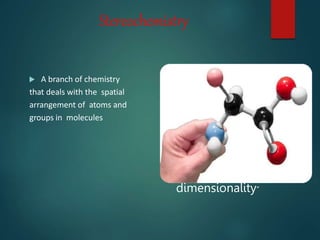
Stereochemistry
 A branch of chemistry
that deals with the spatial
arrangement of atoms and
groups in molecules
 "stereo”- means
“three
dimensionality’’
IMPORTANT DEFINITIONS
• CHIRALITY:
A chiral molecule/ion is non-
superposable on its mirror
image. The presence of an
asymmetric carbon center
is one of several structural
features that induce chirality in
organic and inorganic molecules.
• STEREOISOMERS: Isomers that have same molecular
formula and connectivity but differ in a way that
atoms are oriented in space – i.e; Difference between
isomers lies only in 3D arrangements of atoms.
TYPES OF ISOMERISMS
CHIRALITYOFDRUGS
•Chiral center arises when a carbon atom has
four structurally different groups attach to it.
•When a compound contain one or more
chiral center it is able to rotate plane polarized
light to the right (+) or the left (-)
•E.g; Adrenaline can exist as two Enantiomers
that are mirror images of each others and thus
known as non-superimposable
ADRENALINE
 chemical properties , the only in their properties
is that the Enantiomers rotate plane polarize
light in opposite direction , both Enantiomers
have different biological properties
• The negative Enantiomers exert stronger effect
i.e; Heart rate increases
• Device which is used to determine the direction
in which a molecule rotate plane polarize light is
polarimeter.
• X-ray crystallography of adrenaline Enantiomers
shown that negative form has R configuration
and the positive form has S configuration
• Adrenaline Enantiomers have identical ,physical and
Importance of the chirality in drugs
•This stereoisomerism results in different physical and
chemical properties of the compound. If this compound
happens to be drug then it results in different
pharmacokinetic and pharmacodynamic properties
•The importance of chiral drugs in the drug development
space cannot be understated. In pharmaceutical industries,
56% of the drugs currently in use are chiral molecules and
88% of the last ones are marketed as racemates (or racemic
mixtures), consisting of an equimolar mixture of two
enantiomers.
EXAMPLES OF CHIRAL
DRUGS
• INTRAVENOUS ANAESTHETICS
• LOCAL ANAESTHETICS
• INHALATIONAL AGENTS
• NUEROMUSCULAR BLOCKING AGENTS
• SOME OTHER DRUGS
Intravenous anaesthetics
1.Etomidate
• Administered as a single isomer: R-isomer.
• Site of action: GABAA receptor.
• R-isomer is 15 times more potent than the S-isomer.
• S-isomer lacks hypnotic activity.
LOCALANAESTEHTICS
BUPIVACAINE
Long acting local anaesthetic marketed as 50:50 racemic
mixture.
Reports of death due to
• Bupivacaine induced CNS toxicity and
cardiotoxicity on accidental intravenous injection
and difficult resuscitation following cardiotoxicity.
Safer alternatives
• Levobupivacaine
• Ropivacaine
These are S- enantiomers of bupivacaine.
• Ropivacaine is the first ‘pure’ enantiomer containing
>99% of the S-form.
INHALATIONAL AGENTS
Isoflurane
•Some studies have found S(+)-isoflurane to be 50%
more potent than R(-)- isoflurane while other studies
have found no significant difference.
•Both enantiomers are equally soluble in the lipid bilayers.
•S- isoflurane induced about 50% longer sleep
times than R- isoflurane
•Majority of the inhalational agents
•currently used are chiral except, Sevoflurane
NEUROMUSCULAR BLOCKINGAGENTS
1. Atracurium
• Intermediate duration non-depolarizing
neuromuscular blocker.
• Causes histamine release, transient hypotension,
tachycardia, facial or truncal flushing.
• Continuous infusion in critical patients can lead to
laudanosine accumulation, which is
epileptogenic.
• Its structure contains 4 chiral centres and is a
mixture of 10 optical and geometric isomers.
REFERENCES
• https://www.slideshare.net/AZMINMOGAL/stereoch
emistry-83184901?qid=6fc35486-740a-
45b083bdf812d3804882&v=&b=&from_search=3
• https://www.slideshare.net/arzoodharasandiya/case
-study-of-stereochemistry-and-drug-design-
85443779?qid=6fc35486-740a-45b0-83bd-
f812d3804882&v=&b=&from_search=2
• https://www.slideshare.net/rudramadhab1/chiral-
drug?qid=37d78d5f-a23d-4f72-8268-
08b3b65105f7&v=&b=&from_search=7
Realization that stereo selectivity is a pre-requisite for evolution.pptx

Realization that stereo selectivity is a pre-requisite for evolution.pptx

  • 1.
    STEREOCHEMISTRYANDDRUG ACTION: Realizationthatstereoselectivityisapre-requisite forevolution Presented by: Soma Ghosh M.Pharm (1st Year ) Pharmaceutical Chemistry Roll No- 36520123004 Anand College of Education
  • 2.
    Stereochemistry  A branchof chemistry that deals with the spatial arrangement of atoms and groups in molecules  "stereo”- means “three dimensionality’’
  • 3.
    IMPORTANT DEFINITIONS • CHIRALITY: Achiral molecule/ion is non- superposable on its mirror image. The presence of an asymmetric carbon center is one of several structural features that induce chirality in organic and inorganic molecules.
  • 4.
    • STEREOISOMERS: Isomersthat have same molecular formula and connectivity but differ in a way that atoms are oriented in space – i.e; Difference between isomers lies only in 3D arrangements of atoms.
  • 5.
  • 6.
    CHIRALITYOFDRUGS •Chiral center ariseswhen a carbon atom has four structurally different groups attach to it. •When a compound contain one or more chiral center it is able to rotate plane polarized light to the right (+) or the left (-) •E.g; Adrenaline can exist as two Enantiomers that are mirror images of each others and thus known as non-superimposable
  • 7.
    ADRENALINE  chemical properties, the only in their properties is that the Enantiomers rotate plane polarize light in opposite direction , both Enantiomers have different biological properties • The negative Enantiomers exert stronger effect i.e; Heart rate increases • Device which is used to determine the direction in which a molecule rotate plane polarize light is polarimeter. • X-ray crystallography of adrenaline Enantiomers shown that negative form has R configuration and the positive form has S configuration • Adrenaline Enantiomers have identical ,physical and
  • 8.
    Importance of thechirality in drugs •This stereoisomerism results in different physical and chemical properties of the compound. If this compound happens to be drug then it results in different pharmacokinetic and pharmacodynamic properties •The importance of chiral drugs in the drug development space cannot be understated. In pharmaceutical industries, 56% of the drugs currently in use are chiral molecules and 88% of the last ones are marketed as racemates (or racemic mixtures), consisting of an equimolar mixture of two enantiomers.
  • 9.
    EXAMPLES OF CHIRAL DRUGS •INTRAVENOUS ANAESTHETICS • LOCAL ANAESTHETICS • INHALATIONAL AGENTS • NUEROMUSCULAR BLOCKING AGENTS • SOME OTHER DRUGS
  • 10.
    Intravenous anaesthetics 1.Etomidate • Administeredas a single isomer: R-isomer. • Site of action: GABAA receptor. • R-isomer is 15 times more potent than the S-isomer. • S-isomer lacks hypnotic activity.
  • 11.
    LOCALANAESTEHTICS BUPIVACAINE Long acting localanaesthetic marketed as 50:50 racemic mixture. Reports of death due to • Bupivacaine induced CNS toxicity and cardiotoxicity on accidental intravenous injection and difficult resuscitation following cardiotoxicity. Safer alternatives • Levobupivacaine • Ropivacaine These are S- enantiomers of bupivacaine. • Ropivacaine is the first ‘pure’ enantiomer containing >99% of the S-form.
  • 12.
    INHALATIONAL AGENTS Isoflurane •Some studieshave found S(+)-isoflurane to be 50% more potent than R(-)- isoflurane while other studies have found no significant difference. •Both enantiomers are equally soluble in the lipid bilayers. •S- isoflurane induced about 50% longer sleep times than R- isoflurane •Majority of the inhalational agents •currently used are chiral except, Sevoflurane
  • 13.
    NEUROMUSCULAR BLOCKINGAGENTS 1. Atracurium •Intermediate duration non-depolarizing neuromuscular blocker. • Causes histamine release, transient hypotension, tachycardia, facial or truncal flushing. • Continuous infusion in critical patients can lead to laudanosine accumulation, which is epileptogenic. • Its structure contains 4 chiral centres and is a mixture of 10 optical and geometric isomers.
  • 14.