DEPARTMENT OF PHARMACOLOGY
JNMC,Sawangi
PURPOSE STATEMENT
At the end of this lecture the student will be able to
 Classify Chelating Agents
 Explain Mechanism of Action
 Describe Clinical Profile of Drugs
Sr.
No
Learning Objectives Domain
Leve
l
Criter
ia
Conditi
on
01. Define Chelating agent
Cognitiv
e
M.K - -
02. Classify of Chelating agent
Cognitiv
e
N.T.
K
- -
03. Describe Mechanism of action of drug
Cognitiv
e
M.K - -
04. Describe Treatment of Poison
Cognitiv
e
M.K - -
At the end of this lecture student should be able to
M.K = Must know ; N.T.K = Nice to know ; D.T.K = Desirable to know
Introduction :
 Heavy Metal acts as general protoplasmic poison and impairs the
cell function.
 Have ability to form complexes with important biological radicals
like sulfhydryl hydroxyl, carboxyl, the amino acid, the imidazole.
 Cheating agents :
 Definition – These are the drugs used to prevent heavy metal
poisoning.
 The process by which these organic compounds combine with
the metals to form relatively stable nonionised ring complexes is
called chelation (chele-clow).
 The compound known as chelating agent.

Mechanism of Action :
 Drug + Metallic ions → Non toxic , water
soluble complex -------eliminated by the kidney.
Classification :
Drug
EDTA ----------------
Dimercaprol ---------------
Succimer ---------------
Penicillamine -------------
Trientine -------------
Deferrioxamine -----------
Deferiprone -----------
Used against
 Lead
 Arsenic,copper,mer.
 Lead,arsenic,mercury
 Copper,mercury,lead
 Copper
 Iron
 Iron
EDTA :
 Types- sodium EDTA, calcium EDTA.
 Calcium sodium has high affinity for lead while disodium salts
exihibits a high affinity for calcium.
 Also has affinity for other metals like Pb,Zn,Cd,Cu,radioactive
metals. It can remove from the body by exchanging with calcium
held by it.
Pharmacokinetic ---
 Absorption – poorly by GIT. Given by i.v
 i.m route is painful.
 Excreted within 24 hours,by glomerular filteration,tubular secretion.
Adverse effect :
 Common – thrombophlebitis
 Other– N,V, toxic nephrosis, renal damage.
 Disodium salts may cause hypocalcemic tetany due to excessive
chelation of calcium.
Preparation : inj. Calcium edetate 20% w/v diluted in N.S. or 5%
dextrose before iv administration.
Disodium edetate inj. 20ml amp. Contains 3mg of the drug.
Therapeutic uses :
 Lead poisoning.
 Diagnostic test for lead poisoning.
 Treatment of Porphyria.
 Poisoning with iron Cd, platineum.
Dimercaprol (BAL) :
Synthesizes by Britisher Stocker and Thomson during second
whorld war-II as an antidote to the arsenical war gas as lewisite.
. Oily ,pungent smelling ,viscous liquid.
 M.O.A. – two SH group of dimercaprol bind with toxic metal lead
dimercaprol metal complex .
 This complex is dissociable .Dissociation occurs in vivo, causing the
release of toxic metal in active form → problematic.
 Therefore adjust the dose in such a way that excess amt. of free
drug is always present in the body to bind the free metal released as
a result of dissociation.
Advantage :
1.Protects SH enzymes from inactivation by heavy metals
2. Reactivates the inhibited enzyme.
Pharmacokinetic :
 Route –i.m. peak plasma level -2hr.
 Metabolism-liver ,6-24 hr.
 Excretion – urine.
Dose : 50mg/ml(2ml amp.)
Adverse effect :
 Burning sensation of mouth , eye. Lacremation, sialorrhoea, paresthesia
of the excremities, ms pain.
 Inj. BAL is painful → sterile abscess and drug fever.
Precaution :
Urine should made alkaline during dimercaprol therapy to protect the
kidneys from toxic effects of the released free metals.
Used cautiously in hypertensive individual.
Contraindications :
Hepatic damage.
Iron poisonig.
Cadmium poisoning.
Therapeutic uses :
 Acute poisoning – due to arsenic, gold, antimony, bismuth.
 For accidental contamination by arsenical vesicants to eye.
 As adjuvants to calcium disodium edetate in lead poisoning
Wilsons desease – in pts allergic to penicillamine.
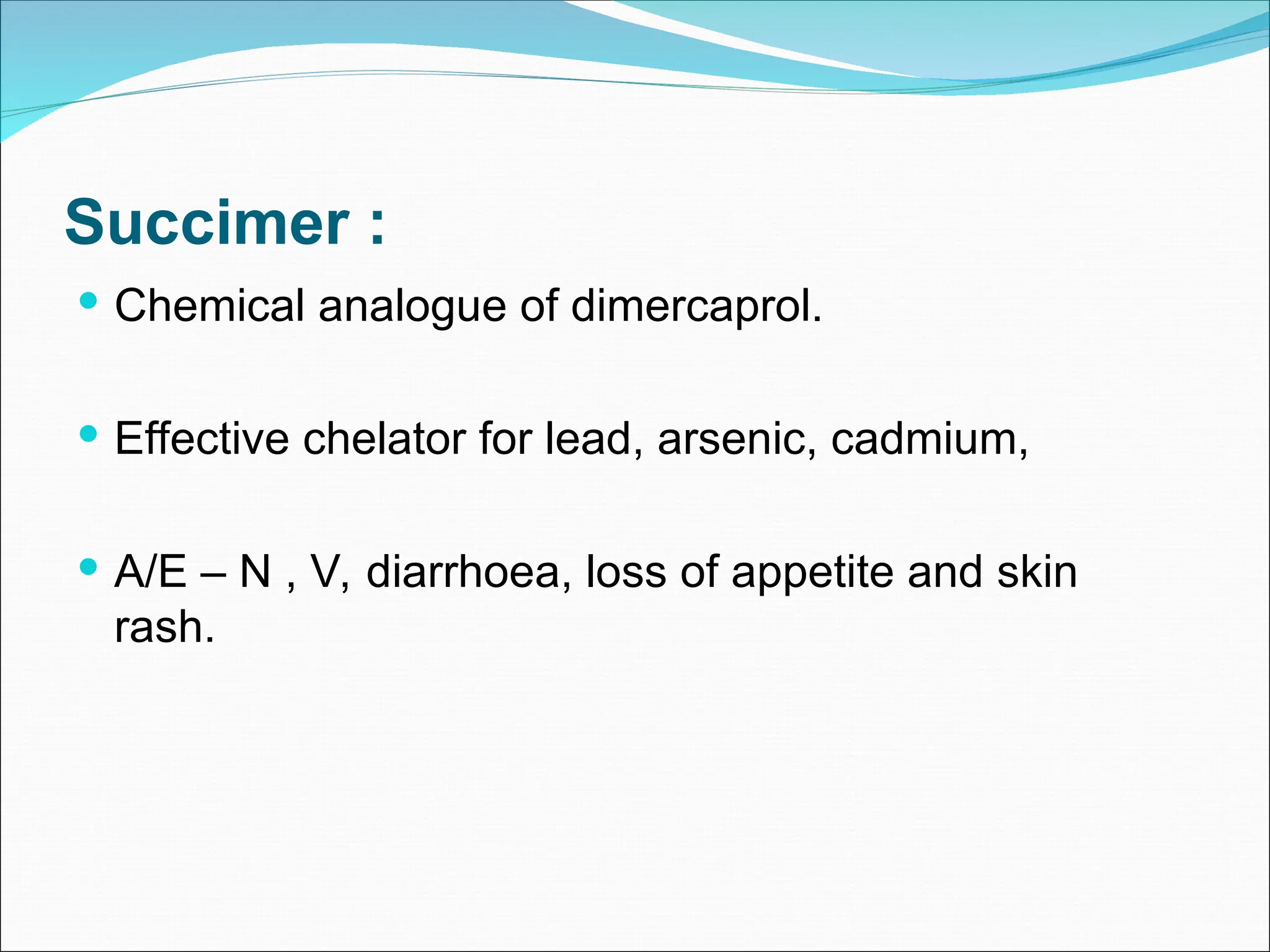
Succimer :
 Chemical analogue of dimercaprol.
 Effective chelator for lead, arsenic, cadmium,
 A/E – N , V, diarrhoea, loss of appetite and skin
rash.
D-Penicillamine :
 Have strong copper chelating property
 d-isomer is used b,coz l-isomer produced optic neuritis and
more toxic.
 Like dimercaprol ,it inhibit enzymes transeaminase and
desulfhydase .
Pharmacokinetic :
well absorbed, excreted in urine.
Adverse Effect :
1.General toxicity – sore throat, lymphadenopathy, neuritis,
loss of taste sensation.
2.Heamatological toxicity – leucopenia, thrombocytopenia,
agranulocytosis, aplastic anaemia .
 Renal toxicity – proteinuria, reversible nephrotic syndrome,
haematuria.
 Autoimmune syndrome – myaesthesia gravis, diabetes,
polymyositis, SLE.
 Iron deficiency in children and young women
 Pyridoxine deficiency.Dose – 250mg
 Therapeutic uses :
 Wilsons disease – 1-2mg(base) daily in divided doses.
 Rheumatoid arthritis – 125mg daily.
 Acute lead and mercury poisoning.
 Cystinosis, cystinuria, haemosiderosis.
 Primary biliary cirrhosis.
 Scleroderma.
Trientine :
 400-800mg t.d.s. daily before meals.
 Effective as penicillamine in reversing the
neurological lesion of wilson disease.
 Advantages: less toxic than penicillamine,
cause less iron deficiency.
Deferiprone :
 New,orally effective iron chelator.
Use :
 Acute iron poisoning
 Iron load condition like cirrhosis of liver.
 Dose – tab. 250mg- 500mg
Adverse effect :
 Anorexia
 Altered taste
 Joint pain
 Agranulocytosis
 Neuropenia
Summary :
 These are the drugs used to prevent heavy
metal poisoning. Have ability to form
complexes with important biological
radicals like sulfhydryl hydroxyl,
carboxyl, the amino acid, the imidazole.
 BIBLIOGRAPHY
 1. Essential Of Medical Pharmacology- K.D.THRIPATHI 6th
Edition.
 2.The Pharmacology Basis Of Therapeutics -GOODMAN & GILMAN”S 11th
Edition.
 3.Pharmacology and Pharmacotherapeutics- R.S.SATOSKAR. 18th
Edition
 4.Basic & clinical Pharmacology-BARTUM G.Katzung 9th
Edition

Thank you

Pharmacotherapy of chelating agents (Heavy metal antagonist)

  • 1.
  • 2.
    PURPOSE STATEMENT At theend of this lecture the student will be able to  Classify Chelating Agents  Explain Mechanism of Action  Describe Clinical Profile of Drugs
  • 3.
    Sr. No Learning Objectives Domain Leve l Criter ia Conditi on 01.Define Chelating agent Cognitiv e M.K - - 02. Classify of Chelating agent Cognitiv e N.T. K - - 03. Describe Mechanism of action of drug Cognitiv e M.K - - 04. Describe Treatment of Poison Cognitiv e M.K - - At the end of this lecture student should be able to M.K = Must know ; N.T.K = Nice to know ; D.T.K = Desirable to know
  • 4.
    Introduction :  HeavyMetal acts as general protoplasmic poison and impairs the cell function.  Have ability to form complexes with important biological radicals like sulfhydryl hydroxyl, carboxyl, the amino acid, the imidazole.  Cheating agents :  Definition – These are the drugs used to prevent heavy metal poisoning.  The process by which these organic compounds combine with the metals to form relatively stable nonionised ring complexes is called chelation (chele-clow).  The compound known as chelating agent. 
  • 5.
    Mechanism of Action:  Drug + Metallic ions → Non toxic , water soluble complex -------eliminated by the kidney.
  • 6.
    Classification : Drug EDTA ---------------- Dimercaprol--------------- Succimer --------------- Penicillamine ------------- Trientine ------------- Deferrioxamine ----------- Deferiprone ----------- Used against  Lead  Arsenic,copper,mer.  Lead,arsenic,mercury  Copper,mercury,lead  Copper  Iron  Iron
  • 7.
    EDTA :  Types-sodium EDTA, calcium EDTA.  Calcium sodium has high affinity for lead while disodium salts exihibits a high affinity for calcium.  Also has affinity for other metals like Pb,Zn,Cd,Cu,radioactive metals. It can remove from the body by exchanging with calcium held by it. Pharmacokinetic ---  Absorption – poorly by GIT. Given by i.v  i.m route is painful.  Excreted within 24 hours,by glomerular filteration,tubular secretion.
  • 8.
    Adverse effect : Common – thrombophlebitis  Other– N,V, toxic nephrosis, renal damage.  Disodium salts may cause hypocalcemic tetany due to excessive chelation of calcium. Preparation : inj. Calcium edetate 20% w/v diluted in N.S. or 5% dextrose before iv administration. Disodium edetate inj. 20ml amp. Contains 3mg of the drug. Therapeutic uses :  Lead poisoning.  Diagnostic test for lead poisoning.  Treatment of Porphyria.  Poisoning with iron Cd, platineum.
  • 9.
    Dimercaprol (BAL) : Synthesizesby Britisher Stocker and Thomson during second whorld war-II as an antidote to the arsenical war gas as lewisite. . Oily ,pungent smelling ,viscous liquid.  M.O.A. – two SH group of dimercaprol bind with toxic metal lead dimercaprol metal complex .  This complex is dissociable .Dissociation occurs in vivo, causing the release of toxic metal in active form → problematic.  Therefore adjust the dose in such a way that excess amt. of free drug is always present in the body to bind the free metal released as a result of dissociation.
  • 10.
    Advantage : 1.Protects SHenzymes from inactivation by heavy metals 2. Reactivates the inhibited enzyme. Pharmacokinetic :  Route –i.m. peak plasma level -2hr.  Metabolism-liver ,6-24 hr.  Excretion – urine. Dose : 50mg/ml(2ml amp.) Adverse effect :  Burning sensation of mouth , eye. Lacremation, sialorrhoea, paresthesia of the excremities, ms pain.  Inj. BAL is painful → sterile abscess and drug fever. Precaution : Urine should made alkaline during dimercaprol therapy to protect the kidneys from toxic effects of the released free metals. Used cautiously in hypertensive individual.
  • 11.
    Contraindications : Hepatic damage. Ironpoisonig. Cadmium poisoning. Therapeutic uses :  Acute poisoning – due to arsenic, gold, antimony, bismuth.  For accidental contamination by arsenical vesicants to eye.  As adjuvants to calcium disodium edetate in lead poisoning Wilsons desease – in pts allergic to penicillamine.
  • 12.
    Succimer :  Chemicalanalogue of dimercaprol.  Effective chelator for lead, arsenic, cadmium,  A/E – N , V, diarrhoea, loss of appetite and skin rash.
  • 13.
    D-Penicillamine :  Havestrong copper chelating property  d-isomer is used b,coz l-isomer produced optic neuritis and more toxic.  Like dimercaprol ,it inhibit enzymes transeaminase and desulfhydase . Pharmacokinetic : well absorbed, excreted in urine. Adverse Effect : 1.General toxicity – sore throat, lymphadenopathy, neuritis, loss of taste sensation. 2.Heamatological toxicity – leucopenia, thrombocytopenia, agranulocytosis, aplastic anaemia .
  • 14.
     Renal toxicity– proteinuria, reversible nephrotic syndrome, haematuria.  Autoimmune syndrome – myaesthesia gravis, diabetes, polymyositis, SLE.  Iron deficiency in children and young women  Pyridoxine deficiency.Dose – 250mg  Therapeutic uses :  Wilsons disease – 1-2mg(base) daily in divided doses.  Rheumatoid arthritis – 125mg daily.  Acute lead and mercury poisoning.  Cystinosis, cystinuria, haemosiderosis.  Primary biliary cirrhosis.  Scleroderma.
  • 15.
    Trientine :  400-800mgt.d.s. daily before meals.  Effective as penicillamine in reversing the neurological lesion of wilson disease.  Advantages: less toxic than penicillamine, cause less iron deficiency.
  • 16.
    Deferiprone :  New,orallyeffective iron chelator. Use :  Acute iron poisoning  Iron load condition like cirrhosis of liver.  Dose – tab. 250mg- 500mg Adverse effect :  Anorexia  Altered taste  Joint pain  Agranulocytosis  Neuropenia
  • 17.
    Summary :  Theseare the drugs used to prevent heavy metal poisoning. Have ability to form complexes with important biological radicals like sulfhydryl hydroxyl, carboxyl, the amino acid, the imidazole.
  • 18.
     BIBLIOGRAPHY  1.Essential Of Medical Pharmacology- K.D.THRIPATHI 6th Edition.  2.The Pharmacology Basis Of Therapeutics -GOODMAN & GILMAN”S 11th Edition.  3.Pharmacology and Pharmacotherapeutics- R.S.SATOSKAR. 18th Edition  4.Basic & clinical Pharmacology-BARTUM G.Katzung 9th Edition
  • 19.