CHIRAL
SEPARATION:
A PHARMA
INDUSTRY
PERSPECTIVE
Presented at the Chiral India 2013 Conference,
Mumbai, November 14-15, 2013

1

Dr. Bhaswat S. Chakraborty
Sr. VP & Chair, R&D Core Committee
Cadila Pharmaceuticals Ltd., Ahmedabad
CONTENTS


Chirality – the Tragic lessons from Thalidomide



Importance of separation of single enantiomers



Chiral stationary phases



Racemic switch & life-cycle management



Development of single enantiomer



Science vs efficacy



Stereoselective assay in Bioequivalence



Regulatory issues



Concluding Remarks
2
THALIDOMIDE








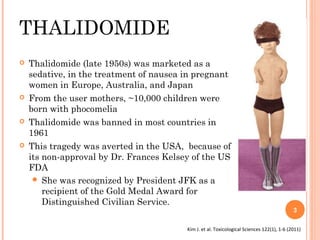
Thalidomide (late 1950s) was marketed as a
sedative, in the treatment of nausea in pregnant
women in Europe, Australia, and Japan
From the user mothers, ~10,000 children were
born with phocomelia
Thalidomide was banned in most countries in
1961
This tragedy was averted in the USA, because of
its non-approval by Dr. Frances Kelsey of the US
FDA
 She was recognized by President JFK as a
recipient of the Gold Medal Award for
Distinguished Civilian Service.

3

Kim J. et al. Toxicological Sciences 122(1), 1-6 (2011)
THALIDOMIDE





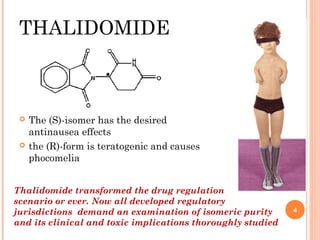
The (S)-isomer has the desired
antinausea effects
the (R)-form is teratogenic and causes
phocomelia

Thalidomide transformed the drug regulation
scenario or ever. Now all developed regulatory
jurisdictions demand an examination of isomeric purity
and its clinical and toxic implications thoroughly studied

4
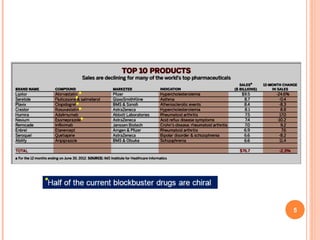
5
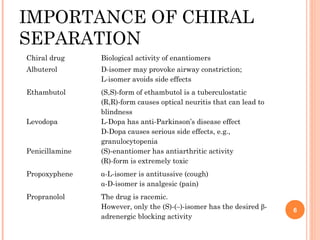
IMPORTANCE OF CHIRAL
SEPARATION
Chiral drug

Biological activity of enantiomers

Albuterol

D-isomer may provoke airway constriction;
L-isomer avoids side effects

Ethambutol

(S,S)-form of ethambutol is a tuberculostatic
(R,R)-form causes optical neuritis that can lead to
blindness
L-Dopa has anti-Parkinson’s disease effect
D-Dopa causes serious side effects, e.g.,
granulocytopenia
(S)-enantiomer has antiarthritic activity
(R)-form is extremely toxic

Levodopa

Penicillamine
Propoxyphene

α-L-isomer is antitussive (cough)
α-D-isomer is analgesic (pain)

Propranolol

The drug is racemic.
However, only the (S)-(–)-isomer has the desired βadrenergic blocking activity

6
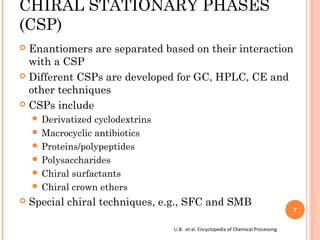
CHIRAL STATIONARY PHASES
(CSP)
Enantiomers are separated based on their interaction
with a CSP
 Different CSPs are developed for GC, HPLC, CE and
other techniques
 CSPs include


 Derivatized

cyclodextrins
 Macrocyclic antibiotics
 Proteins/polypeptides
 Polysaccharides
 Chiral surfactants
 Chiral crown ethers


Special chiral techniques, e.g., SFC and SMB
Li B. et al. Encyclopedia of Chemical Processing

7
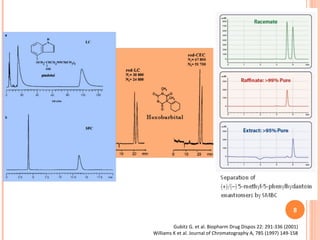
8
Gubitz G. et al. Biopharm Drug Dispos 22: 291-336 (2001)
Williams K et al. Journal of Chromatography A, 785 (1997) 149-158
USEFULNESS OF A SINGLE
ACTIVE ISOMER







Fewer or diminished side effects, which may result from
the unwanted isomeric form
Automatically halved dosage for a patient
Decreased waste due to decrease in manufacturing of
unwanted isomer
New commercial opportunities for ‘‘racemic switching’’




A racemate can be redeveloped as an enantiomerically pure
form, possibly useful for extending patent protection of a
key product

Typically when a specific enantiomeric ratio is
expected to improve the therapeutic profile,
single isomers are developed

9
WHEN DEVELOPMENT OF A
RACEMATE
MAY BE JUSTIFIED
The enantiomers are configurationally unstable
in vitro or undergo racemization in vivo
 The enantiomers have similar pharmacokinetic,
pharmacodynamic and toxicological properties
 It is not technically feasible to separate the
enantiomers in sufficient quantity and/or with
sufficient quality




Decision to develop a racemate or a single
isomer is purely that of the sponsor or
manufacturer

10
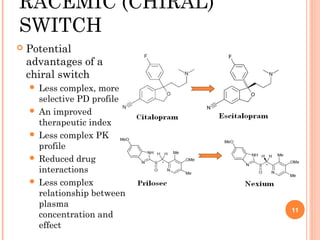
RACEMIC (CHIRAL)
SWITCH


Potential
advantages of a
chiral switch
Less complex, more
selective PD profile
 An improved
therapeutic index
 Less complex PK
profile
 Reduced drug
interactions
 Less complex
relationship between
plasma
concentration and
effect


11
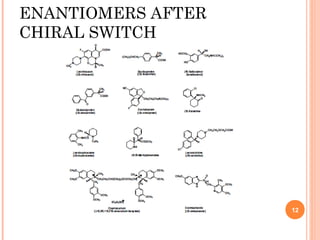
ENANTIOMERS AFTER
CHIRAL SWITCH

12
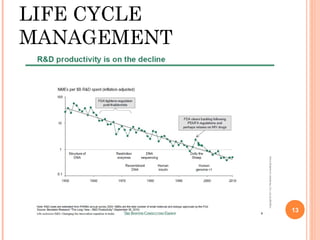
LIFE CYCLE
MANAGEMENT

13
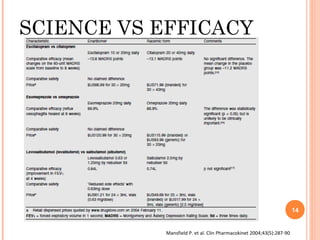
SCIENCE VS EFFICACY

14

Mansfield P. et al. Clin Pharmacokinet 2004;43(5):287-90
PRECLINICAL AND
CLINICAL
CONSIDERATIONS
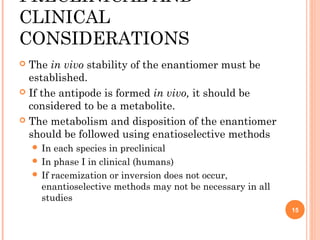
The in vivo stability of the enantiomer must be
established.
 If the antipode is formed in vivo, it should be
considered to be a metabolite.
 The metabolism and disposition of the enantiomer
should be followed using enatioselective methods


 In

each species in preclinical
 In phase I in clinical (humans)
 If racemization or inversion does not occur,
enantioselective methods may not be necessary in all
studies
15
STEREOSELECTIVE ASSAY
IN BIOEQUIVALENCE


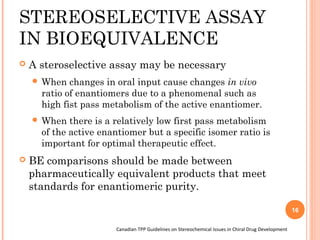
A steroselective assay may be necessary
 When

changes in oral input cause changes in vivo
ratio of enantiomers due to a phenomenal such as
high fist pass metabolism of the active enantiomer.

 When

there is a relatively low first pass metabolism
of the active enantiomer but a specific isomer ratio is
important for optimal therapeutic effect.



BE comparisons should be made between
pharmaceutically equivalent products that meet
standards for enantiomeric purity.
16
Canadian TPP Guidelines on Stereochemical Issues in Chiral Drug Development
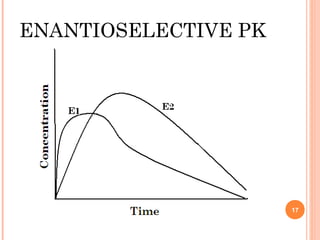
ENANTIOSELECTIVE PK

17
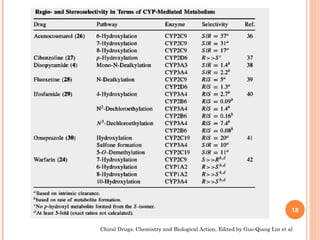
18
Chiral Drugs: Chemistry and Biological Action, Edited by Guo-Qiang Lin et al
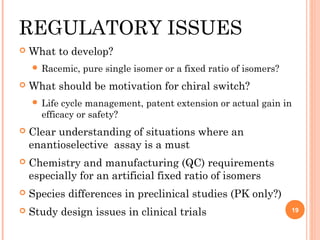
REGULATORY ISSUES


What to develop?
 Racemic,



pure single isomer or a fixed ratio of isomers?

What should be motivation for chiral switch?
 Life

cycle management, patent extension or actual gain in
efficacy or safety?



Clear understanding of situations where an
enantioselective assay is a must



Chemistry and manufacturing (QC) requirements
especially for an artificial fixed ratio of isomers



Species differences in preclinical studies (PK only?)



Study design issues in clinical trials

19
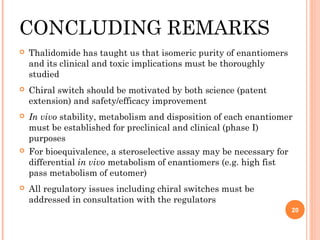
CONCLUDING REMARKS


Thalidomide has taught us that isomeric purity of enantiomers
and its clinical and toxic implications must be thoroughly
studied



Chiral switch should be motivated by both science (patent
extension) and safety/efficacy improvement



In vivo stability, metabolism and disposition of each enantiomer
must be established for preclinical and clinical (phase I)
purposes
For bioequivalence, a steroselective assay may be necessary for
differential in vivo metabolism of enantiomers (e.g. high fist
pass metabolism of eutomer)





All regulatory issues including chiral switches must be
addressed in consultation with the regulators
20
Acknowledgement: Ms. Raji Nair

THANK YOU VERY
MUCH

21

Chiral Separation A pharma Industry Perspective

  • 1.
    CHIRAL SEPARATION: A PHARMA INDUSTRY PERSPECTIVE Presented atthe Chiral India 2013 Conference, Mumbai, November 14-15, 2013 1 Dr. Bhaswat S. Chakraborty Sr. VP & Chair, R&D Core Committee Cadila Pharmaceuticals Ltd., Ahmedabad
  • 2.
    CONTENTS  Chirality – theTragic lessons from Thalidomide  Importance of separation of single enantiomers  Chiral stationary phases  Racemic switch & life-cycle management  Development of single enantiomer  Science vs efficacy  Stereoselective assay in Bioequivalence  Regulatory issues  Concluding Remarks 2
  • 3.
    THALIDOMIDE     Thalidomide (late 1950s)was marketed as a sedative, in the treatment of nausea in pregnant women in Europe, Australia, and Japan From the user mothers, ~10,000 children were born with phocomelia Thalidomide was banned in most countries in 1961 This tragedy was averted in the USA, because of its non-approval by Dr. Frances Kelsey of the US FDA  She was recognized by President JFK as a recipient of the Gold Medal Award for Distinguished Civilian Service. 3 Kim J. et al. Toxicological Sciences 122(1), 1-6 (2011)
  • 4.
    THALIDOMIDE   The (S)-isomer hasthe desired antinausea effects the (R)-form is teratogenic and causes phocomelia Thalidomide transformed the drug regulation scenario or ever. Now all developed regulatory jurisdictions demand an examination of isomeric purity and its clinical and toxic implications thoroughly studied 4
  • 5.
  • 6.
    IMPORTANCE OF CHIRAL SEPARATION Chiraldrug Biological activity of enantiomers Albuterol D-isomer may provoke airway constriction; L-isomer avoids side effects Ethambutol (S,S)-form of ethambutol is a tuberculostatic (R,R)-form causes optical neuritis that can lead to blindness L-Dopa has anti-Parkinson’s disease effect D-Dopa causes serious side effects, e.g., granulocytopenia (S)-enantiomer has antiarthritic activity (R)-form is extremely toxic Levodopa Penicillamine Propoxyphene α-L-isomer is antitussive (cough) α-D-isomer is analgesic (pain) Propranolol The drug is racemic. However, only the (S)-(–)-isomer has the desired βadrenergic blocking activity 6
  • 7.
    CHIRAL STATIONARY PHASES (CSP) Enantiomersare separated based on their interaction with a CSP  Different CSPs are developed for GC, HPLC, CE and other techniques  CSPs include   Derivatized cyclodextrins  Macrocyclic antibiotics  Proteins/polypeptides  Polysaccharides  Chiral surfactants  Chiral crown ethers  Special chiral techniques, e.g., SFC and SMB Li B. et al. Encyclopedia of Chemical Processing 7
  • 8.
    8 Gubitz G. etal. Biopharm Drug Dispos 22: 291-336 (2001) Williams K et al. Journal of Chromatography A, 785 (1997) 149-158
  • 9.
    USEFULNESS OF ASINGLE ACTIVE ISOMER     Fewer or diminished side effects, which may result from the unwanted isomeric form Automatically halved dosage for a patient Decreased waste due to decrease in manufacturing of unwanted isomer New commercial opportunities for ‘‘racemic switching’’   A racemate can be redeveloped as an enantiomerically pure form, possibly useful for extending patent protection of a key product Typically when a specific enantiomeric ratio is expected to improve the therapeutic profile, single isomers are developed 9
  • 10.
    WHEN DEVELOPMENT OFA RACEMATE MAY BE JUSTIFIED The enantiomers are configurationally unstable in vitro or undergo racemization in vivo  The enantiomers have similar pharmacokinetic, pharmacodynamic and toxicological properties  It is not technically feasible to separate the enantiomers in sufficient quantity and/or with sufficient quality   Decision to develop a racemate or a single isomer is purely that of the sponsor or manufacturer 10
  • 11.
    RACEMIC (CHIRAL) SWITCH  Potential advantages ofa chiral switch Less complex, more selective PD profile  An improved therapeutic index  Less complex PK profile  Reduced drug interactions  Less complex relationship between plasma concentration and effect  11
  • 12.
  • 13.
  • 14.
    SCIENCE VS EFFICACY 14 MansfieldP. et al. Clin Pharmacokinet 2004;43(5):287-90
  • 15.
    PRECLINICAL AND CLINICAL CONSIDERATIONS The invivo stability of the enantiomer must be established.  If the antipode is formed in vivo, it should be considered to be a metabolite.  The metabolism and disposition of the enantiomer should be followed using enatioselective methods   In each species in preclinical  In phase I in clinical (humans)  If racemization or inversion does not occur, enantioselective methods may not be necessary in all studies 15
  • 16.
    STEREOSELECTIVE ASSAY IN BIOEQUIVALENCE  Asteroselective assay may be necessary  When changes in oral input cause changes in vivo ratio of enantiomers due to a phenomenal such as high fist pass metabolism of the active enantiomer.  When there is a relatively low first pass metabolism of the active enantiomer but a specific isomer ratio is important for optimal therapeutic effect.  BE comparisons should be made between pharmaceutically equivalent products that meet standards for enantiomeric purity. 16 Canadian TPP Guidelines on Stereochemical Issues in Chiral Drug Development
  • 17.
  • 18.
    18 Chiral Drugs: Chemistryand Biological Action, Edited by Guo-Qiang Lin et al
  • 19.
    REGULATORY ISSUES  What todevelop?  Racemic,  pure single isomer or a fixed ratio of isomers? What should be motivation for chiral switch?  Life cycle management, patent extension or actual gain in efficacy or safety?  Clear understanding of situations where an enantioselective assay is a must  Chemistry and manufacturing (QC) requirements especially for an artificial fixed ratio of isomers  Species differences in preclinical studies (PK only?)  Study design issues in clinical trials 19
  • 20.
    CONCLUDING REMARKS  Thalidomide hastaught us that isomeric purity of enantiomers and its clinical and toxic implications must be thoroughly studied  Chiral switch should be motivated by both science (patent extension) and safety/efficacy improvement  In vivo stability, metabolism and disposition of each enantiomer must be established for preclinical and clinical (phase I) purposes For bioequivalence, a steroselective assay may be necessary for differential in vivo metabolism of enantiomers (e.g. high fist pass metabolism of eutomer)   All regulatory issues including chiral switches must be addressed in consultation with the regulators 20
  • 21.
    Acknowledgement: Ms. RajiNair THANK YOU VERY MUCH 21